
Please note: this Bulletin is being put on the website one month after publication. Alternatively you can receive the Bulletin by email as soon as it is published, by becoming a member of the Lewes History Group, and renewing your membership annually.
- New Street Stories publications: Mill Road and Chapel Hill
- Members’ poll on meeting format (by Neil Merchant)
- A Richard Comber clock
- Quarter Sessions Orders for medical treatment
- Subscription for a Newhaven lifeboat
- Plans for a Lewes War Memorial (by Stephen Luscombe)
- Attempted Murder in Albion Street
- A postcard view of Potters Lane, Southover
- Motor Runs round Lewes
- Western Road
- New Street Stories publications: Mill Road and Chapel Hill
We are delighted to announce the publication of two new books in our ‘Lewes Street Stories’ series. Over the last few years different members have researched several Lewes streets, bringing to light many interesting insights into the past life in the town. Two books have been published – ‘The Sun Street Story’ and ‘The Pells of Lewes’ – both of which have sold out. More has been published via our website: https://leweshistory.org.uk/projects/the-lewes-street-stories-initiative/
Two new titles covering Mill Road and Chapel Hill will be available in September at £7.50 per copy. These are ‘Mill Road South Malling’, by Chris Taylor, and ‘The Chapel Hill Street Story’ written by Mary Benjamin, Meg Griffiths and Shân Rose. Both books provide fascinating insights into many aspects that will surprise even those who know the town well. Both books are also liberally illustrated with photographs that will not have been widely seen before.
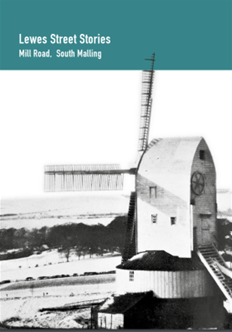 Mill Road leads uphill eastward for a couple of hundred metres from the A26 towards the combined footpath and cycle track to Ringmer and the Sussex Wildlife Trust nature reserve. The road is easily overlooked by passers-by travelling in and out of the town of Lewes. At first sight – and possibly at second and third sight – there is nothing remarkable about the appearance of this residential street.
Take a walk along it however, and there is much to see and many questions for those with curiosity about how things came about to ask. The oldest complete structure in Mill Road is Mill House, built in the early 19th Century. Near Mill House stands the roundhouse which once formed the base of Malling Mill, an imposing windmill that stood for at least 300 years. The mixture of semi-detached and detached houses and bungalows that you see today on the lower part of the road were built in the 1920s and 1930. The houses built towards the top of the road were built in the 1970s and 1990s. The block of flats at the bottom of the road on the right-hand side was constructed in the late 1950s, built on the site of the old Steam Laundry that served Lewes in the early part of the 20th century.
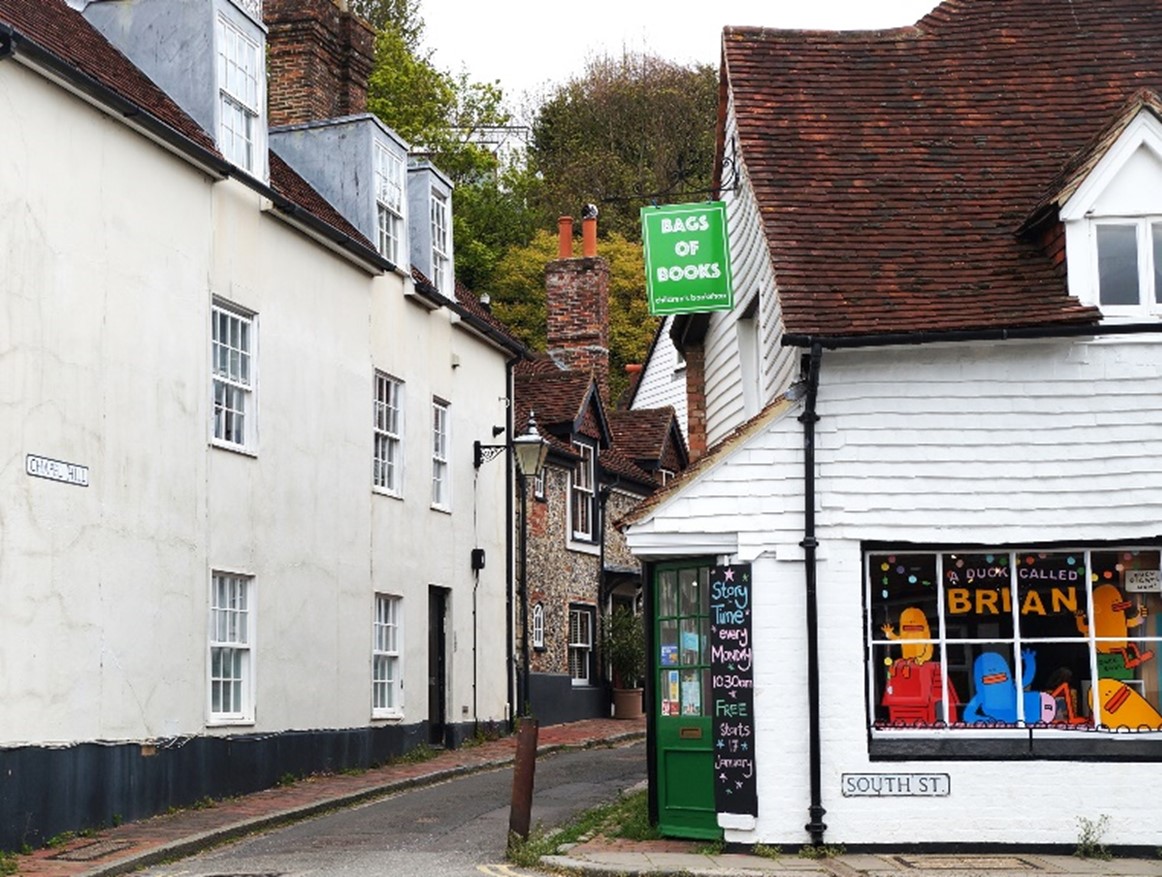
 Chapel Hill leads steeply uphill from Cliffe Corner, passing above the Cuilfail Tunnel, towards Lewes Golf Club and the Downs beyond. The road will be familiar to the walkers, sledgers, joggers and golfers who use it today, as well as to its residents.
Chapel Hill almost certainly follows the line of a track used by early Britons to descend from their hilltop encampments down to the river. The track later became a droveway linking Lewes with Glynde and further east towards Pevensey. The road’s name has undergone many changes. Originally it was known as Cliffe Hill. It later became known as East Street, Cliffe, when Cliffe’s streets were named from the then centre at Cliffe Corner. West Street has become Cliffe High Street, and North Street is now Malling Street, with South Street the only street to retain its name.
So why is it now called Chapel Hill? As you might expect there was for many years a chapel located there.
- Members’ poll on meeting format (by Neil Merchant)
At the time of writing the members poll is still in progress (response deadline 31 July), but the responses to date (with a turnout approaching 50%) are as follows:
- All meetings by Zoom 75
- All meetings physical meetings in a Room 54
- Hybrid – summer Room, winter Zoom 112
The final results will be a great help to your committee in deciding its future course of action.
- A Richard Comber clock
This George III mahogany-framed wall clock with an 8-day movement signed on the dial by the Lewes clockmaker Richard Comber (1742-1824) was auctioned recently by Tooveys of Washington, West Sussex. The hammer price was £1,700.

Sources: http://www.tooveys.com
- Quarter Sessions Orders for medical treatment
The Easter Quarter Sessions held at Lewes in 1688 heard that William Dennis, a poor man, had broken his thigh in St Michael’s parish, and that the surgeon John Walter of St Michael’s had set and cured it. St Michael’s parish were ordered to pay the surgeon thirty shillings for his work.
The same Quarter Sessions also heard that John Lenham and his family, who had come from Tunbridge, Kent, to St Michael’s, had contracted smallpox. They ordered that the family were to remain at present in St Michael’s, “without prejudice”. Removing a family with such an infectious disease to their home parish was just too risky. At the Epiphany Quarter Sessions of 1689/90 Brighton’s parish officers were ordered to reimburse £3 11s 0d to Cliffe parish, the costs incurred by Cliffe when a man legally settled in Brighton had smallpox there.
Source: Quarter Sessions order book, ESRO QO/9
- Subscription for a Newhaven lifeboat
The 13 December 1802 Sussex Advertiser noted that: “Boats particularly calculated for the purpose of saving the lives of shipwrecked seamen (the invention of Mr Henry Greathead of South Shields) having been found by experience of great service, and the saving of very many valuable lives, the Gentlemen of Lloyd’s Coffee House, London, have handsomely contributed £50 towards the building of a boat of this description for the use of the Port of Newhaven.”
Further funding was needed to deliver the project, so gentlemen of the neighbourhood, merchants and others concerned in the trade of Lewes were asked to leave their names and the amounts they intended to subscribe to this laudable undertaking at the Lewes offices of Sir Henry Blackman, or with Messrs Rickman & Godlee in the Cliffe. As usual, as an encouragement, the notice was accompanied by a list of the subscriptions already promised.
Lord Pelham and Lord Sheffield headed the list with subscriptions of 10 guineas each. They were followed by three guineas from Lord Francis Osborne (newly elected as Tory MP for Lewes) and two guineas each from Colonel William Newton of Southover Grange, the racehorse owner Sir Ferdinando Poole of The Friars (both personal friends of the Prince of Wales, the future prince Regent), Thomas Kemp esquire (MP for Lewes until his defeat in 1802, and again from 1806 until his death in 1811), George Shiffner esquire of Hamsey (MP for Lewes from 1812), the wine, coal and timber merchant Sir Henry Blackman, the corn merchants and millers Thomas Rickman & Samuel Woodgate Durrant, and William Roe of His Majesty’s Customs. The merchant firms of Rickman & Godlee and Wille & Co also subscribed two guineas each. Another twenty five members of the local gentry and the Lewes business community donated a guinea each, while the magistrate Henry Thurloe Shadwell of Middleham, Ringmer, contributed £18 11s 4d, the unused funds in his account as treasurer of the local Association against Republicans and Levellers, a body he had created a decade earlier when it was feared that the French Revolution might spread to Sussex.
The Greathead family were involved in the coastal trade bringing coals from the north east round to Sussex, and in 1783 a young Lewes lad was apprenticed by St Michael’s parish to Henry Greathead’s brother to learn the mariner’s trade while John Greathead’s ship the Acorn was lying at Newhaven.
- Plans for a Lewes War Memorial (by Stephen Luscombe)
22 January 1919 entry in Mrs Henry Dudeney’s Diary:
“There has been a town meeting over some memorial to Lewes soldiers who have fallen. One illuminated idiot suggested an obelisk, with an urinal and cloakrooms underneath”.
The Lewes War Memorial was not erected until 1922, without the additional facilities.
- Attempted Murder in Albion Street
On Monday 5 June 1882 Edwin Battersby, chief clerk of the district probate office at 2 Albion Street, Lewes, visited the Station Street shop of gunsmith James Lloyd and asked to see some revolvers. After discussing the available options with the gunsmith’s son, Gerard Lloyd, he settled on a British Bulldog model costing 22s 6d, and asked to take it away on approval, together with 5 cartridges, one for each of the revolver’s chambers. As the Lloyds had known their customer for over 20 years as a man of the utmost respectability, well educated, articulate, comfortably off and a father of nine, this was agreed. It was assumed that Mr Battersby wanted the revolver as a gift for a friend going abroad, as such guns were rarely owned by people intending to stay in England.
Two days later on Wednesday morning Edwin Battersby loaded three of the chambers with cartridges, and went to 4 Albion Street, which housed the consulting rooms of Messrs Rigden and Hall, surgeons, and where Frank Algernon Hall, the junior partner, lived. He followed Mr Hall into his consulting room, and then took the revolver out of his pocket and fired two shots at him. Luckily for Mr Hall, his assailant was not an experienced shot – Mr Lloyd had had to show him how to load the revolver. One bullet just grazed Mr Hall’s head, near his ear, while the second hit the back of his leg. Misunderstanding the action of the gun, Edwin Battersby had fired the middle of the three cartridges first, so after two shots the next two chambers were empty – he still had two of the five cartridges in his pocket. The noise of the gunshots was loud, and a practice employee and two men visiting the Probate Registry were quickly on the scene. Edwin Battersby still had the revolver in his hand. A police sergeant who was nearby affected an easy arrest. Five doctors arrived within a few minutes, and Mr Hall’s bleeding was quickly stopped, though there were concerns about the longer term impact of his leg wound.
Edwin Battersby had been born in London in 1829, so was in his fifties at the time of this event. He had come to Lewes shortly after his 1858 marriage, living first in St James Street, Southover before moving to live at the Probate Registry in Albion Street. His eldest son had been born in Islington, but the other eight children had all been born in Lewes. It was noted that he had not been in good health for some time, that he had been under the care of Messrs Rigden & Hall, and that he had conceived an aversion to Mr Hall. He was taken that same afternoon before three magistrates, the Mayor (Wynne Baxter), the banker George Whitfeld and non-conformist warehouseman Robert Crosskey. There were medical and legal gentlemen present, including Mr Hall’s partner George Rigden, and the facts of the case were quickly established.
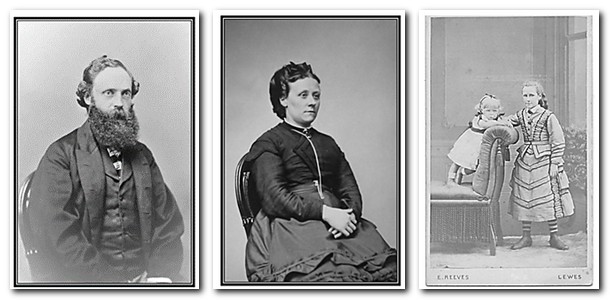
Edwin Battersby, his wife Emma Margaret, and his daughters Jane & Kate. The third photo was taken c.1872
Edwin Battersby was remanded to Lewes gaol, charged with attempted murder, but the case never came to trial. It was quickly concluded that he was of unsound mind, and he was committed to Broadmoor. He was still an inmate at Broadmoor in the 1891 census, and he died there of pneumonia on New Year’s Day 1893. Amongst his fellow inmates was the man who, also in 1882, took a pot shot at Queen Victoria.
The consequences for his wife and family were severe, the most immediate being the loss of their home, which was tied to his job. 2 Albion Street remained the Lewes Probate Office until 1976. The 1891 census finds his wife Emma Battersby, aged 56, as a lodging house keeper in St John’s Terrace, with her household including her son Walter Battersby, a publisher’s clerk. By 1901 they had moved to St Andrew’s Place, and had been joined by an unmarried daughter. By 1911, now in her mid-seventies Emma Battersby was a lodger in Teddington, Middlesex, and she died there in 1913. The victim of the shooting, Frank Algernon Hall (1846-1899) continued to live in Albion Street as a general practitioner, until his death at the age of 52. He never married, and seems to have left few other traces in the town’s records.
Sources: Mark D. Bishop, ‘Ancestral Chains, Battersby Bloodline’ (2017); Maxwell J. Cooper, Journal of Medical Biography vol.29, pp.260-261; Familysearch; reports in the Sussex Express.
- A postcard view of Potters Lane, Southover
This Aqua-Tone series postcard view from Southover High Street looking down Potters Lane probably dates from the inter-war period. It proudly advertises itself as of ‘British Manufacture Throughout’

Potters Lane does not appear either in Leslie Davey’s original 1961 ‘Street Names of Lewes’ or in the 2010 version updated by Kim Clark. However, Judith Brent’s ‘Southover House Histories’ notes a Stephen Potter owning property in Westport Street, Southover, in the mid-17th century, and the same property described as in Potters Lane in 1668.
- Motor Runs round Lewes
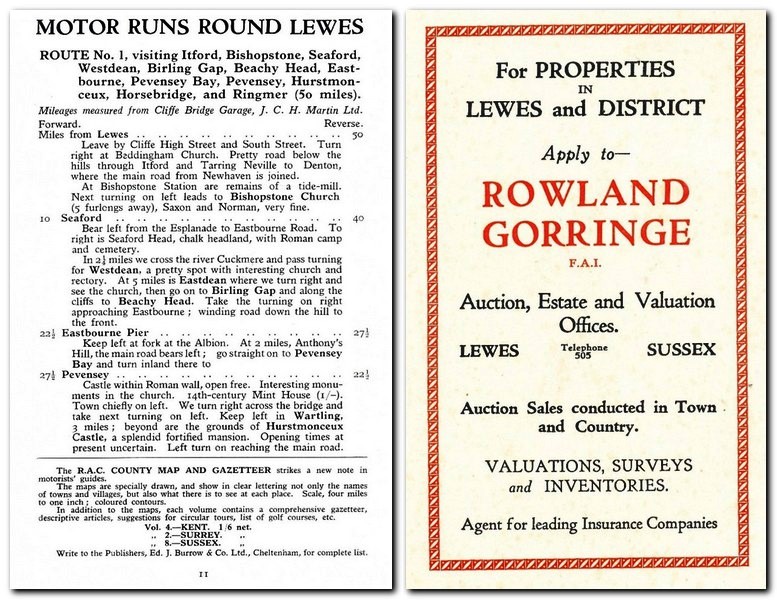
Below are some extracts from a complimentary booklet issued by the Cliffe Bridge garage of J.C.H. Martin to encourage their customers to use their cars to explore the Sussex countryside.


The booklet is undated, but the advertisements indicate it was published around 1930.
Eight different routes were advertised, each 40-70 miles long, and taking in several places of interest. All the routes started and ended at Martin’s Cliffe Bridge Garage, now the Riverside Centre. The centrepiece is a map of Sussex illustrating the different routes. Part of the first route is shown below. The different routes extended east to Hastings, west to Worthing and north as far as Horsham, East Grinstead and Tunbridge Wells.

- Western Road
This image of Western Road, taken from outside the Black Horse Inn, is from a postcard mailed in 1908. The anonymous photographer looks down towards the Pelham Arms, and the spire of St Anne’s church is visible behind the houses to the right. The entrance to St Anne’s Crescent is on the right, and beyond that the wall that surrounded the Waterworks Company’s Victorian reservoir serving the town. The postcard was offered for sale on ebay in June 2022 and sold for £52.50.
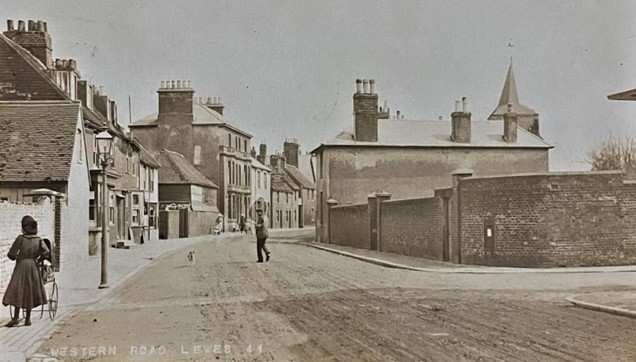
Western Road was one of the areas of Lewes that saw substantial residential and commercial development in the 19th century. A pesthouse, suitably isolated on the edge of the town, was built near here in the 18th century, but there was little other development until one reached the former St Nicholas Hospital, by then converted into cottages, at Spital Road. The model Victorian prison was then built, at great public expense. Cottage development continued all along Western Road, with larger houses and villas opposite the prison and in St Anne’s Crescent to benefit from the outstanding views.
Your committee, inspired by Sue Berry, hopes to initiate a major research project next year to study the Victorian and Edwardian development that transformed much of Lewes. This is a crucial period for the expansion of urban life in England, in which almost every community played its distinctive part. We hope that as many members as possible will participate in this study, into all the different aspects in which the town’s life changed. At our September meeting Sue will set the scene by giving a talk on development in Lewes in the 1830s and 1840s, the last years of the Georgian period in which Lewes played its part as county town, before the arrival of the railway.
John Kay
Contact details for Friends of the Lewes History Group promoting local historical events:
Sussex Archaeological Society
Lewes Priory Trust
Lewes Archaeological Group
Friends of Lewes
Lewes History Group Facebook, Twitter



 Lewes History Group