
Please note: this Bulletin is being put on the website one month after publication. Alternatively you can receive the Bulletin by email as soon as it is published, by becoming a member of the Lewes History Group, and renewing your membership annually.
- Next Meeting: Bob Cairns, ‘Transported to Lewes’
- Guided Walks led by Sue Berry
- New Street Stories publications: Mill Road and Chapel Hill
- Smallpox in Lewes in 1710
- A triple wedding at St Michael’s
- The Corn Inspector at Lewes Market
- The Rendel Williams Postcard Collection
- The 15th Century Bookshop
- The Sussex School of Archaeology and History
- Next Meeting 7.30 p.m. King’s Church Lewes Monday 10 October Bob Cairns Transported to Lewes
Bob Cairns will use the Lewes History Group as a vehicle to share rare images of transport in, around and above Lewes between 1860 and 1960. Until the mid-19th century the only ways into Lewes were via the river or on roads and ancient track-ways which, over millennia, had gently shaped the layout of the town, but were difficult to traverse. However, the coming of the railways and then motor vehicles brought rapid and dramatic changes which have continued through to today. With photographs and postcards from his extensive collection (many of which have not been shared before), Bob will demonstrate these developments in the townscape. There will also be a few old favourites, plus images of airplanes which landed in Lewes and the aerial views they took of the town. Bob comments, “Of course I will encourage the audience to join in and identify where the photographs were taken. Some will be easy to identify, but I know that others will test even the most seasoned local historians.”
Admission to this talk will be free for members, with no advance booking required. The charge for non-members is £4, payable at the door (cash or card).
Following our members poll the five following meetings, from November 2022 to March 2023, will be held by Zoom, with the usual Zoom registration process. ‘Live’ meetings at King’s Church will resume in April 2023.
- Guided Walks led by Sue Berry
We are planning a new series of member-only Lewes guided walks led by Sue Berry, each with a different theme. The theme for the first walk will be Lewes Industrial History. The walk will start in central Lewes at 11 am on Saturday 23 October 2022. Places will be restricted to 12. Details, including how to book, will be provided to members separately.
- New Street Stories publications: Mill Road and Chapel Hill
The two latest books in our Street Stories series, covering Chapel Hill and Mill Road, South Malling, and based on our members’ research were published in September. Copies are available (at £7.50 each, plus postage if applicable) and can be purchased either at our October meeting or via our website: https://leweshistory.org.uk/publications/ . Both are excellent!
- Smallpox in Lewes in 1710
With the disappearance of plague in the late 17th century, smallpox replaced it as the most feared infectious disease of early 18th century England. The London Bills of Mortality showed it as accounting for at least 5% of all deaths in the crowded metropolis throughout the 18th century, rising to over 10% in bad years, such as 1710, 1714 and 1719. At the Michaelmas Quarter Sessions held in Lewes from 4-6 October 1711 the magistrates ordered that the county treasurer was to pay £7 to James Owden of St Michael’s, Lewes, to reimburse him for his charges “in relieving and burying William Tulley in the time of the smallpox”. William Tulley was buried at St Michael’s on 12 November 1710.
Source: Quarter Sessions order book, ESRO QO/14
- A triple wedding at St Michael’s
On 3 April 1809 St Michael’s church was the venue for a triple wedding, featuring three young members of the Davey family.
- Sophia Davey of St Michael’s parish married John Simmons of Uckfield
- Joseph Davey of St Michael’s married Phebe Simmons of Uckfield
- Theodosia Davey of St Michael’s married John Harvey of Cliffe
All three marriages were by licence. The parties, all bachelors and spinsters, were young non-conformists required at this time by Lord Hardwicke’s 1753 Marriage Act to be married by an Anglican clergyman in an Anglican church. Only Jews and Quakers were exempt from this requirement. There were four witnesses named for each marriage, and in each case one was Edward Pugh and another was the St Michael’s parish clerk, Joseph Tinslay. There were also one other male and one female witness for each marriage, with John Harvey serving in this role for Sophia Davey’s marriage. Several of these witnesses have surnames well known at the Old Chapel and, later, Tabernacle.
Theodosia and Joseph Davey, born in 1784 and 1786 respectively, were recorded in chapel registers as the children of Thomas Davey and his wife Mary. It was Thomas Davey, then a young surgeon and apothecary of 1 Malling Street, who in 1775 provided the land on which the Old Cliffe Chapel on Chapel Hill was built. Sophia Davey may well have been an unrecorded sister – she survived until the 1851 census, by which time she was a widow farming at Chiddingly with an Uckfield-born son, and gave her age as 66, suggesting a birth date of about 1785. Joseph Davey was a chemist and druggist at 179 High Street and then at 178 High Street, both in St Michael’s parish, for many years, until he retired to be succeeded by a son.
Edward Pugh had married schoolmistress Mary Symonds Davey at St Michael’s by licence back in 1794, with Thomas Davey as the witness. He too kept a school for some years, but is also recorded as a druggist in partnership with Joseph Davey until their partnership was dissolved by mutual agreement in 1812. He then established an independent business as a druggist in Cliffe, before becoming a linen draper there in 1814 and becoming bankrupt in 1817.
The first two marriages proved long and productive. Sadly John Harvey’s first marriage was short-lived and produced no children: Theodosia Harvey was buried at All Saints in March 1811 aged 26. Two years later John Harvey remarried, to Delia Button, a teenage daughter of John Button who kept a well-known non-conformist academy in the Cliffe, by whom he was to have 13 children.
His relationship with Joseph Davey survived these changes in circumstance – when Joseph Davey, chemist and druggist, purchased the freehold of 178 High Street in 1826 it was John Harvey of Cliffe, spirit merchant, who acted as his trustee.
Sources: Family search website; Colin Brent, ‘Lewes & Cliffe House Histories’; The Keep online catalogue.
- The Corn Inspector at Lewes Market
This hand-coloured lithograph of Mr Leighton, the corn inspector at Lewes market, was created by T. Illman from an original drawing by William Lee. It was offered for auction at Gorringe’s in June 2022 with an estimated price of £70-£100 but not sold. Reoffered at a July sale, it sold for £30.

The accounts of the treasurer for the Eastern part of Sussex for 1796-7 show quarterly sums of about £4 10s 0d paid to John Leighton for making weekly returns of the prices of corn from Lewes since the last Sessions, and for his salary as cryer to the court. The trade section of the 1791 Universal British Directory lists two John Leightons in Lewes – John Leighton senior as a cow-keeper and John Leighton junior as a tailor, who married at St Michael’s in that same year. The Lewes Town Book shows one John Leighton chosen as pound keeper for the Borough in 1810.
- The Rendel Williams Postcard Collection
The first part of the disposal of the exceptional collection of Sussex postcards assembled by Lewes resident Rendel Williams (1941-2021) took place at Tooveys auction house in Washington, West Sussex, on 24 August. There were over 200 lots, each containing between 1 and about 200 postcards, mostly divided by the town, village or topic they featured. Bidding from private collectors and dealers was fierce, with most lots exceeding their upper estimates. Local historians and other collectors of historic postcards were out in force, and the Barcombe, Isfield, Newick and Ringmer lots were all purchased by local collectors. There will be a second auction in November.
 Rendel was an academic geographer at Sussex University, with a professional interest in the development of the Sussex landscape, and in particular its downland. He was also a nature reserve manager for the Sussex Wildlife Trust. His initial interest in historic postcards was in the evidence they provided for the erosion affecting our chalk cliffs and the changing downland vegetation. However, he soon became interested in the postcards themselves and in the lives of the photographers and publishers who created and sold them. His collection grew to over 10,000 Sussex postcards. He created the www.sussexpostcards.info website, which includes the authoritative directory of the hundreds of Sussex postcard photographers and publishers, and a brief history of the development of their postcards. This website has become an important resource for local historians, and frequently used in these Bulletins.
Included in the first sale were 20 lots of Lewes postcards. These included over 800 individual cards, and sold for almost £2,500. By the standards of the auction the Lewes cards went relatively cheaply. Most were purchased by dealers or online buyers, but Bob Cairns, who arranged the sale and lotted the cards, has ensured that at least a few of the rarer examples will remain in the locality. Some featured examples are shown below.
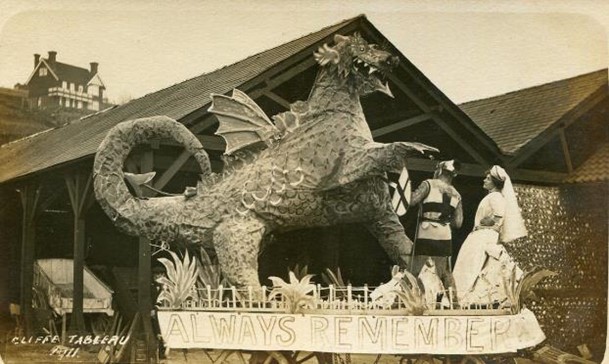
The 1911 Cliffe Bonfire Society tableau

The Recreation Ground near the Pells, during the 1911 floods

The Lewes Fire Brigade outside their North Street fire station, ready to gallop off into action
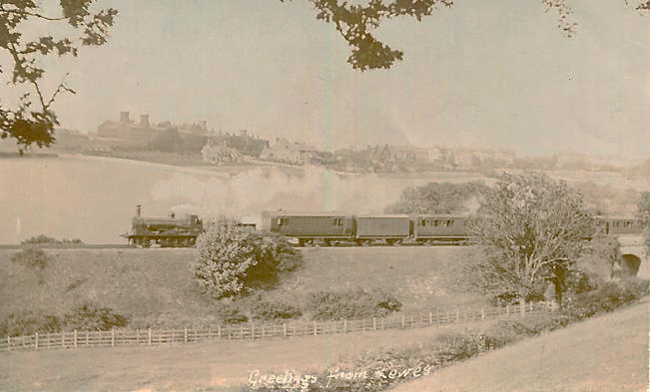
A steam engine heads off to Brighton, with a mixed load of passengers and goods, passing below the Prison and Hope in the Valley.
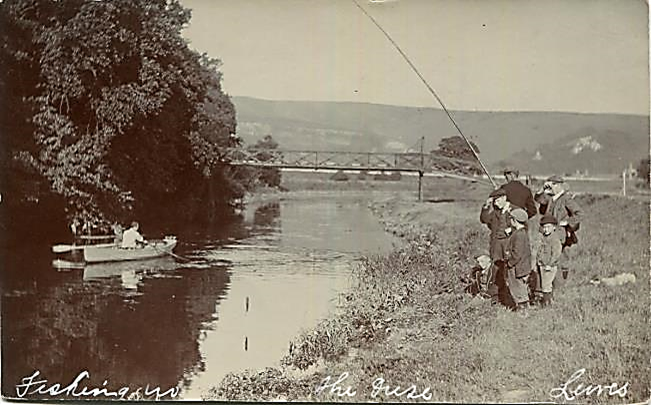
A James Cheetham postcard of recreational uses of the River Ouse on a sunny day

A 1907 procession follows a military band down Station Street towards the Dripping Pan. The caption tells us this was a fundraising event for the Lewes Sanatorium.
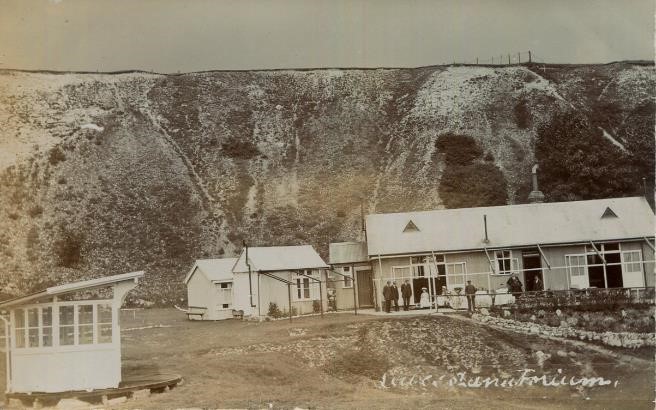
The Lewes Sanatorium, in the chalk pit at Offham
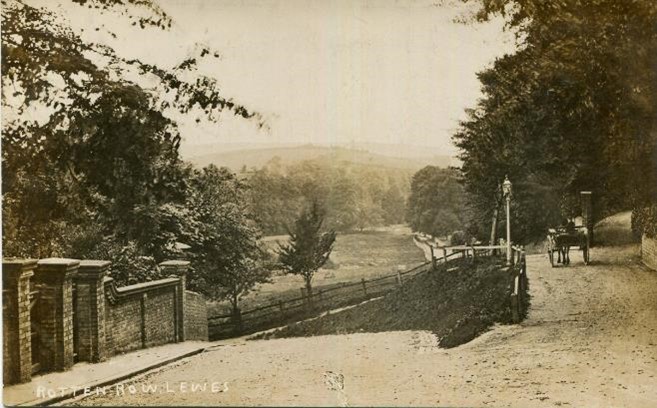
An unusual view of Rotten Row

St Peters Place and its children. The publisher, using mirror writing on his negative, has his letter S the wrong way round
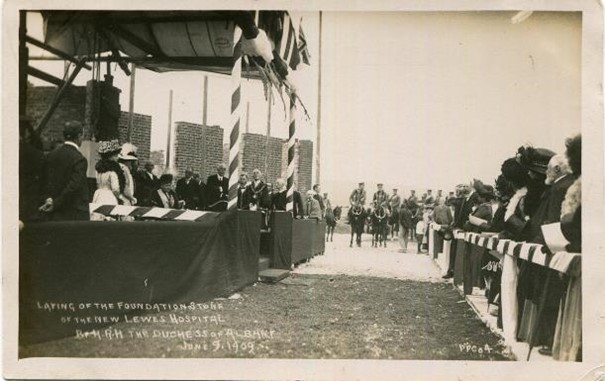
The Duchess of Albany laying the Foundation Stone for the new Victoria Hospital in 1909.
A German princess, she was the widow of Queen Victoria’s youngest son, Prince Leopold, Duke of Albany, who had died of haemophilia. Queen Victoria was concerned that, unusually well-educated for a princess, she might be an ‘intellectual’, but she worked tirelessly for hospital charities.
Her son became Prince of Saxe-Coburg-Gotha, and lost his British Dukedom during the Great War. Her daughter married Prince Alexander of Teck, and so became Queen Mary’s sister-in-law.

The following year the same photographer came back to record the opening of the Victoria Hospital by Princess Henry of Battenberg, better known as Princess Beatrice, Victoria’s youngest daughter.
- The 15th Century Bookshop
The inter-war postcard below by an anonymous publisher features 99/100 High Street, known today the 15th Century Bookshop.
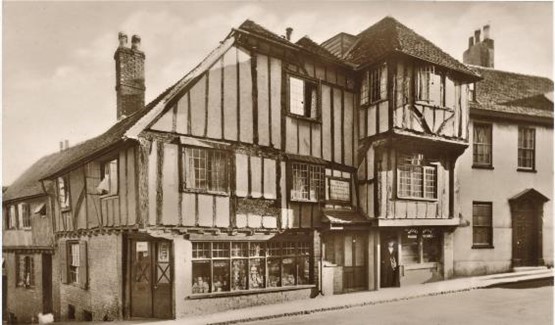
Inter-war local directories show the shop next to Keere Street (99 High Street) as that of P.D. le Seelleur, a confectioner, in 1927 and 1934, while at the same dates 100 High Street accommodated the Lewes & District Window Cleaning Company, run by C. Budge, and a bootmaker’s. The postcard appears to show the building in this period, with the sweetshop advertising a variety of treats, while the shop next door advertises Nugget Polishes. No.101 High Street appears to be a private residence, as it was in all the inter-war directories.
By 1938 C. Budge had acquired both 99 and 100 High Street, and was now trading from both as the 15th Century Library House. Cooper Budge of 99 High Street, Lewes, died on 21 May 1944 aged 79, with probate of his estate granted later that year to Lloyd’s Bank. He had been born in Glasgow in 1867, with Cooper his mother’s maiden name. Is he the man standing in the doorway of 100 High Street in the picture above? By 1951 this establishment had become the 15th Century Bookshop. There were also two residential apartments above the shop, and there was still a boot and shoe repairer using part of the premises of 100 High Street. 101 High Street had become Mrs M.A. Elliot’s antique shop, as well as Captain L.N. Elliott’s residence.
- The Sussex School of Archaeology and History
During lockdown the Sussex School of Archaeology established by David Rudling has decided to broaden its remit, and has changed its name to the Sussex School of Archaeology and History. Their annual Spring Archaeology conference is to be joined by an autumn History conference, both held at King’s Church. The inaugural History conference will be held from 10-5 on Saturday 26 November. For details and booking see: https://www.sussexarchaeology.org/symposium.
John Kay
Contact details for Friends of the Lewes History Group promoting local historical events:
Sussex Archaeological Society
Lewes Priory Trust
Lewes Archaeological Group
Friends of Lewes
Lewes History Group Facebook, Twitter



 Lewes History Group