
Please note: this Bulletin is being put on the website one month after publication. Alternatively you can receive the Bulletin by email as soon as it is published, by becoming a member of the Lewes History Group, and renewing your membership annually.
- Next Meeting: 14 Nov 2022, John Bleach, ‘A Historical Overview of Cliffe’
- Battlefield Trust event: ‘Conflict on the South Coast’
- Emmanuel Bowen’s 1750 Map of Sussex
- Southover’s failed stratagem
- Two 1905 Bonfire postcards
- A Bonfire case in 1786
- Naming the Royal Oak
- Thomas Read Kemp: how to Win Friends and Influence People
- William Cobbett’s view of Lewes
- The Cliffe Tavern on Cliffe High Street
- The Clock at St Thomas, Cliffe (by Peter Varlow)
- The Demolition of Southover Brewery chimney
- Next Meeting 7.30 p.m. Zoom Meeting Monday 14 November John Bleach A Historical Overview of Cliffe
John Bleach gives November’s Lewes History Group talk and suggests answers to some basic historical questions relating to Cliffe, including where it was, when and why it was founded, and who by. He will describe its medieval development as a commercial centre to rival that controlled by the De Warrenne family.
Viewed over the long run this can only be seen as a success. The Cliffe, which includes both Tesco and Aldi, is now the commercial heart of the town, leaving Lewes only with Waitrose. There are still plenty of businesses on the Lewes side of the river, but the centre of commercial gravity has been dragged away from the old High Street atop the hill down the hill towards Cliffe.
This will be the first of our winter meetings to be held by Zoom. Members will be sent a free registration link in advance. Non-members can buy a ticket (£4) at http://www.ticketsource.co.uk/lhg. The emailed ticket will include a Zoom registration link for the talk, to complete in advance.
- Battlefields Trust event: ‘Conflict on the South Coast’
The Battlefields Trust South East and South London Region’s First History Day, entitled ‘Conflict on the South Coast’ will be held in the Meeting Room at Lewes Town Hall on Saturday 26 November 2022. Use the Fisher Street entrance. Registration is from 10.00am and the first talk is 10.30am. The meeting finishes at 4.00pm. Tea, coffee and biscuits are provided, and there will be a lunchtime break. Advance registration is necessary and the cost per participant will be £25.00.
The four key speakers will be:
- Professor Andrew FitzPatrick: The Roman invasions
- Julian Humphrys: The Battle of Hastings
- Dr Sophie Therese Ambler: The Battle of Lewes (including Simon de Montfort’s crucial role)
- Dan Moorhouse: The 14th century French raids, their impact on Lewes and the coastal towns.
Book via Eventbrite: www.eventbrite.co.uk/e/conflict-on-the-south-coast-tickets-415595516377
Please phone John Freeman, 07957 829997, for any further information.
- Emmanuel Bowen’s 1750 Map of Sussex
Offered for sale at Gorringe’s weekly auction on Monday 16 May 2022 was a copy of Emmanuel Bowen’s map of Sussex. It sold for £180. The map is undated, but dedicated (top right) to Algernon, Duke of Somerset. He inherited this title when his father died in 1748, at the age of 86, and died himself in 1750, which gives a pretty precise date. The title (top left) includes two illustrations of 18th century surveyors with their equipment, one of them for some reason unclothed.
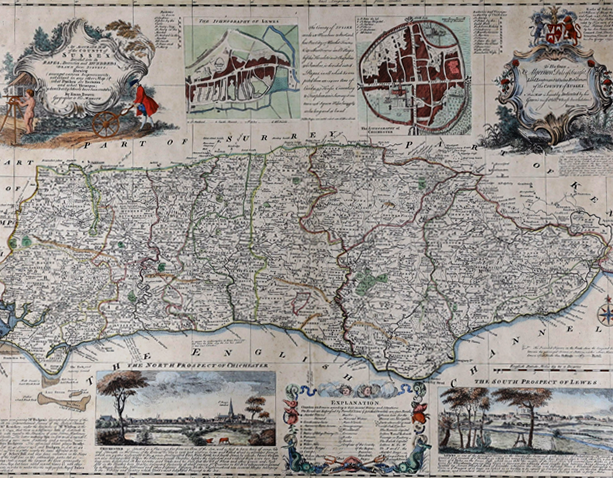
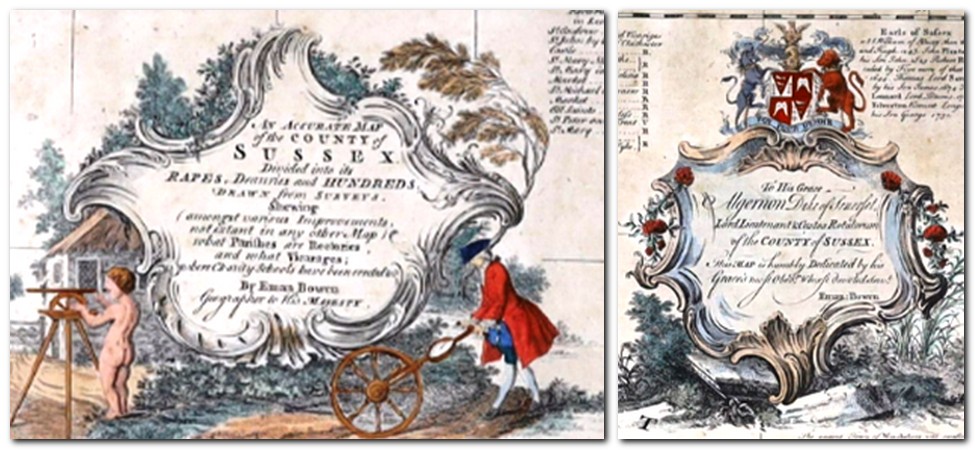
The plan includes at the top street plans of Lewes and Chichester in about 1750, and at the bottom views of both towns. That of Lewes is taken from the south (bottom right hand corner).

To the right of the street plan are listed the seven rectories of Lewes: St Andrew, St John by the Castle, St Mary Mag, St Mary in the Market, St Michael in the Market, All Saints and St Peter & St Mary. Four streets are named: School Hill; Friars (the High Street section between School Hill and the Bridge); Friars Lane (Friars Walk); and St Mary’s Street (Station Street). It also shows the Bowling Green within the Castle precincts.
Under the view of Lewes from the south is the text: “Lewes is one of the principal Towns in the County, for largeness and Number of Inhabitants. It stands upon a rising Ground and consists of 6 Parishes in which are many Gentlemen’s Seats whose Gardens joyn to each other. Tis a Sea Port at a distance of 8 miles on the River Ouse which runs thro the middle of the Town. Here are several iron works in which they make Guns for Merchants service. This Town is famous for a Bloody Battle fought here between King Henry 3rd and the Barons headed by Simon Monford Earl of Leicester, wherein the King was defeated. From a Windmill belonging to and near this Town is a Prospect of so large an extent as is hardly to be equal’d in Europe, for you may see the Sea Westward at 30 Miles distance, and Eastward there’s an uninterrupted view to the Bansted Downs in Surrey, which us 40 Miles.”
- Southover’s failed stratagem
The 1741 Epiphany Quarter Sessions held in Lewes heard an appeal by Horsted Keynes parish against a magistrate’s order that they should pay 1s 6d per week to Newick parish for the maintenance of an illegitimate baby girl. An illegitimate child was the legal responsibility of the parish where it was born, but the practice was that the child would remain with its mother (Mary Longley at the time of the birth, but now married and living in Newick) until it reached the age of seven. The Horsted Keynes parish officers did not dispute that the child had been born in their parish in May 1740, and it was baptised there that month, on the same day as its mother was married there. At the baptism the baby was given her mother’s new surname. However, the grounds for their appeal were that, from the mother’s sworn statement, “the child had been born illegally in Horsted Keynes by the fraud and practice of Southover”. The order was quashed.
At the following Midsummer Quarter Sessions held in Lewes it was Southover’s turn to appeal against a new order made by a magistrate a few days previously that they were to pay two shillings a week to Ditchling parish, where the mother (since widowed and remarried to a Ditchling labourer) had now moved. The magistrate believed that the Southover parish officers had overstepped the mark, by carrying the mother away to Horsted Keynes when her delivery was imminent. The assembled magistrates deferred the decision until the next Sessions, when they decided that Southover should pay half a crown a week for the child’s maintenance. The unusually high maintenance payment ordered presumably reflects their disapproval of Southover’s behaviour.
Source: Quarter Sessions minute & order books, ESRO QM/8 & QO/18
- Two 1905 Bonfire postcards
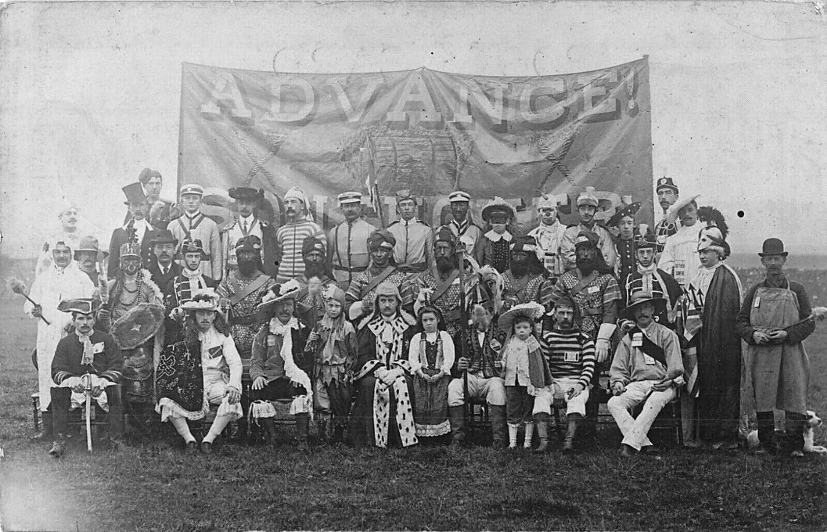
Postcard mailed 12 November 1905 from Lewes by ‘Ted’ to Mr W. Webb, 9 Park Place, St James. “I send you a post card of the Boys” “We are having fine weather down here raining every day”.
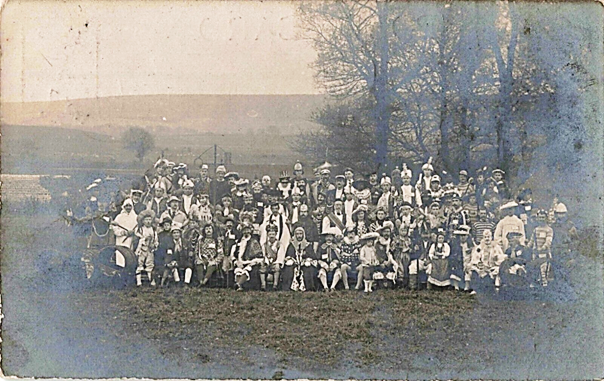
This postcard was sent to the same recipient by ‘FB’ on 7 November 1905, with the note “It is the Bonfire lot. Ted is there somewhere”. Again the judge sits in the middle of the front row. Mick Symes identifies this as the Southover Bonfire Society. The two postcards were the subject of competitive bidding on ebay.
- A Bonfire Case in 1786
This letter to The Times was dated 13 Aug 1786 and published 3 days later.
“A prosecution commenced by some persons not openly avowed against Mr Charles Scrase, son of Mr Henry Scrase of Lewes (who as a tradesman, a neighbour and a gentleman has ever supported an unblemished character) and their apprentice Mr Chitty, for firing squibs etc on the 5th November last, was tried on Wednesday 19th inst. at the assizes at Horsham, when after the examination of many witnesses they were convicted and fined £25 each.
The inhabitants of Lewes are by no means satisfied with the determination, for the whole affair has been pursued in a very arbitrary and malevolent manner, as several young gentlemen were in company, and only those two singled out as victims for resentment. Had not the people of Lewes been very pacifically inclined they would have enquired, through the medium of a Court of Judicature, whether it was legal to read the Riot Act, on the 5th of November, at a spot where it had been kept time out of mind; and to disturb the commonality without previous offence? And how consistent was it with justice to drag people to prison for being mere spectators, and others who were passing by the place on business? It is not however wished to irritate; yet to represent the matter in its true colours, and to recommend to the Bench if they wish to appear respectable, to proceed in a quite different line of conduct, by preferring mild and lenient directions in such sort of cases, previous to the exercise of arbitrary and coercive measures; perverting the civil, by introducing military police, and thereby widening a breach which it is the duty of their office to heal.
What a pity the tradesmen and populace of Lewes should be held as slaves; and that every effort of ingenuity, genius or industry should be cramped by inconsiderate men. If the Justices of Lewes would exert themselves to crush the baneful encroachments of smuggling, in conjunction with the tradesmen who have conspicuously evinced their abhorrence of it, they might be of infinite service in their station. Let them also look to several of those pernicious haunts in their vicinity called gin-shops, nurseries of every species of iniquity, and view the several families who exist, and are brought up in beggary, without any knowledge of their duty to either God or man from their parents resorting to these places. Were men in the beforementioned station to notice, as they ought, these lamentable evils, and use the means of taking those children from their abandoned parents, placing them in some manufacturing line, mercantile service or fishery, and promoting industry by proper encouragements, these steps would at once insure them respect and authority; while on the contrary their persevering in the mere pusillanimous exertions of office will ever render them equally ridiculous and contemptible.”
- Naming the Royal Oak
The Royal Oak at the top of St Mary’s Lane was built in 1791 as a public house initially called the White Horse. In 1819 it was purchased by the wine and spirit merchant Adam Harvey, and he installed as tenant a Mr Penderell, who was a linear descendant of the Richard Penderell who had saved the future King Charles II from capture by Parliamentary forces after the battle of Worcester, on one occasion by hiding him in an oak tree. After the Restoration Charles II signalled his gratitude to Richard Penderell by awarding him and his descendants an permanent annuity of 100 marks per annum, and the right to hunt in any part of the king’s own lands. The new tenant at the White Horse was a lineal descendant of Richard Penderell, who hoped to inherit the annuity in due course, and he changed the name of the establishment to the Royal Oak.
Although Adam Harvey was a wine and spirit merchant in Lewes at the same time as his contemporary John Harvey was engaged in the same business in Cliffe, I have not been able to establish any relationship between the two, and both the Royal Oak and the Harvey & Windus wine and spirit merchants business at 83 High Street became part of the rival Beards Brewery.
Sources: Gideon Mantell’s journal, entry for 15 October 1819 and a footnote to page 201 of Thomas Walker Horsfield’s ‘History and Antiquities of Lewes’, published in 1824.
- Thomas Read Kemp: how to Win Friends and Influence People
In February 1814 the Sussex Advertiser reported that T.R. Kemp esquire distributed amongst such of the inhabitants of Lewes as would accept his bounty one hundred pounds in beef or coals, at the option of the partakers, which afforded a very seasonable relief to the sufferers in the frost. The tickets were for seven pounds of meat, or three bushels and a half of coals. Thomas Read Kemp (1782-1844) was at that time MP for Lewes, and such generous gestures to the electorate were expected. The word ‘inhabitants’ had at that time a somewhat different meaning from today – it meant those householders who paid the poor rates and were thus, in the old borough of Lewes, qualified to vote. The Sussex Advertiser was a Whig newspaper, and Thomas Read Kemp was a Whig MP. This gift was not to the poorest members of the town community, who had no vote.
Thomas Read Kemp was a landowner’s son, educated at Westminster School, Cambridge and the Middle Temple, who is best known as a developer of Kemp Town and other areas of Brighton. He provided the site for the Royal Sussex County Hospital, and donated £1,000 towards its construction. In 1806 he had married a daughter of the merchant banker Sir Francis Baring. He was MP for Lewes from 1811-1816 (in succession to his father Thomas Kemp), MP for Arundel 1823-1826 and then MP for Lewes again from 1826-1837. He resigned his seat in 1816 to found a dissenting sect in Brighton, for whom he built a chapel where he preached for six years, before returning to the established church and re-entering Parliament. In 1837 he left Britain to escape his creditors, and died in Paris.
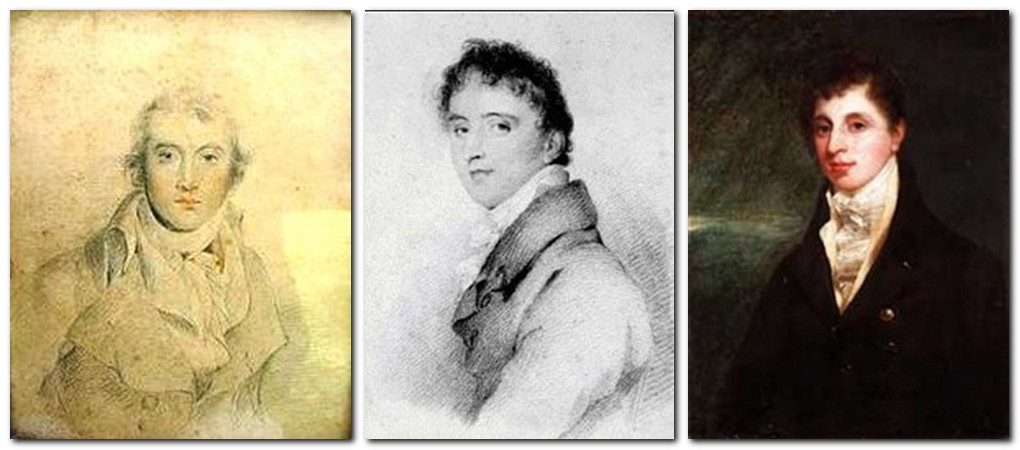
Portraits of Thomas Read Kemp by Sir Thomas Lawrence RA (left); from the Henry Smith collection of Brighton prints (centre); and from kemptownestatehistories.com (right).
Sources: 14 February 1814 Sussex Advertiser; Wikipedia; Dictionary of National Biography; Mark Antony Lower, ‘Worthies of Sussex’; Victoria County History of Sussex; mybrightonandhove.org.uk; kemptownestatehistories.com.
- William Cobbett’s view of Lewes
“Lewes is in a valley of the South Downs. There is a great extent of rich meadows above and below Lewes. The town itself is a model of solidity and neatness. The buildings are all substantial to the very outskirts; the pavements good and complete; the shops nice and clean; the people well-dressed; and, though last not least, the girls remarkably pretty, as indeed they are in most parts of Sussex; round faces, features small, little hands and wrists, plump arms and bright eyes. The Sussex men too are remarkable for their good looks. The inns are good at Lewes, the people civil and not servile, and the charges really (considering the taxes) far below what one could reasonably expect.”
Source: 10 Jan 1822 entry in Cobbett’s Political Register.
- The Cliffe Tavern on Cliffe High Street
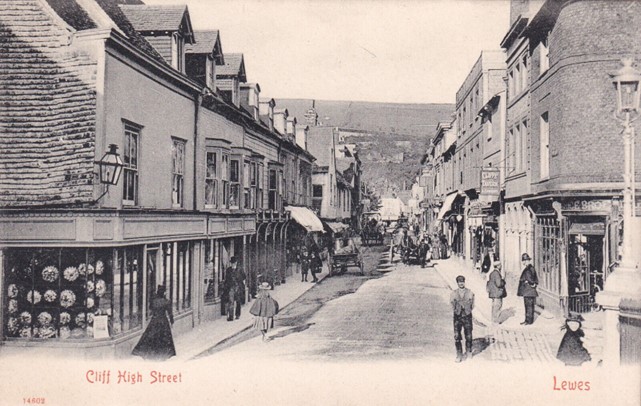
This must be one of the earliest postcards of Cliffe High Street, published by Stengel & Co of 39 Redcross Street, London EC, and printed at their works in Dresden. It has an undivided back, found only in the earliest Edwardian cards. As usual there is a policeman ready to assist passers-by.
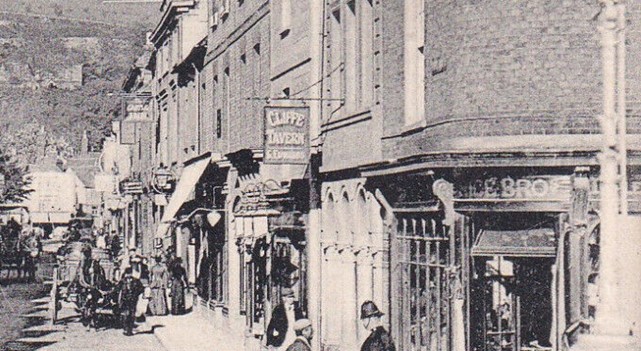
To the right, after the Rice Brothers saddlers shop, was the inn sign of the Cliffe Tavern, proprietor G. Edwards. Bulletin no.95 identifies G. Edwards as the licensee there in 1902.
- The Clock at St Thomas, Cliffe (by Peter Varlow)
St Thomas à Becket Church in Cliffe is appealing to local residents to join a volunteer team to wind its turret clock every day. The clock has been out of action for over a year while funds were raised to make the church tower’s 15th-century spiral staircase safe. Now the clock will be re-started, at midday on Friday 25 November.
The clock dates to 1670 and is reputed to be the second oldest in Sussex, so this is an opportunity for LHG members to literally get a handle on Lewes history. Thomas Woollgar’s ‘Spicilegia’ begun in 1761 reads: “The Clock was made by James Looker a blacksmith of Ditchling for five pounds ten shillings in 1670. He was to keep the same in repair for three years. To find all the materials except the Dial. This was originally in the loft where the clock stands, but being worn out a new dial was added within my memory and placed against the Bell loft.”
The new clock may have replaced one noted by Woollgar as “repaired in 1650-1 by Mr Gorynge of Lewes”. In 1697 the Churchwardens’ accounts state, says Woollgar, “Cleaning and mending the Clock, Paid 10s 6d”. Fifty years later the accounts said that “Ringing the Bell and winding the Clock cost £1 10s.”
The clock works are set in a wrought iron frame with scrolled finials and two side-by-side trains. One train drives the hands, and one operates the hourly strike via the clapper of one of the bells in the belfry a storey above. The frame is mounted on a modern platform in the clock-room, 42 steps up from the base of the tower, behind the attractive gold-and-blue external dial. The cast iron weights for both trains hang from pulleys in the belfry.
In 1886 the East Sussex News told its readers that repairs to the clock in 1886 by William Tanner, watchmaker of the Cliffe, “caused the expenditure of a considerable sum”. In the late 1990s when the ring of four bells was re-installed, after more extensive and expensive repairs, one was connected to the clock so that it would once again chime the hours. In 2016 the entire mechanism was overhauled and the clock-face repainted and gilded by Thwaites & Reed Engineering Ltd of Rottingdean, who will be re-commissioning it on 25 November.
The latest work has included a new handrail for the 42-step spiral stair to the clock room and up to the bell chamber (another 15 steps), new stone flooring at the base of the stair, and new lighting, incorporating emergency lighting. The Church raised nearly £25,000 for this thanks to generous donations by many local people and visitors to the town, as well as by the organisations that have supported the project, including Lewes Town Council, the Friends of Lewes, the Worshipful Company of Clockmakers, the Rugby Group Benevolent Fund and the Ian Askew Charitable Trust.
The daily hand-winding that is required is a five-minute job, and St Thomas is aiming to establish a rota of winders who live nearby and would like to a handle on their town’s history. Interested members can get more information from parochial church council member Peter Varlow, peter@varlow.org.uk. Guided tours of the tower are also planned.
Source: Woollgar, Thomas, ‘Spicilegia sive Collectanea ad Historiam et Antiquitatis Municipii et Viciniae Lewensis’, vol II, p.342. Woollgar (1761-1821), did not complete the title page of the MS in the Sussex Archaeological Society library – its date reads 1790-18.. with space left for the final two digits.
- The Demolition of Southover Brewery chimney
The demolition of Southover Brewery’s chimney in September 1905 was an event attended by at least two professional photographers. The Lewes firm Bliss and the Mezzotint Company of Brighton both sold postcards of the event, taken at almost exactly the same moment but from slightly different vantage points. The Brewery stood opposite the Swan Inn in Southover.
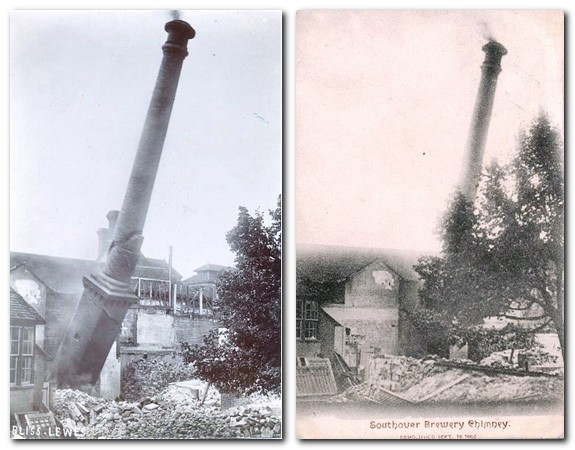
The Southover Brewery run for many years by William Verrall senior (1759-1837), his son William Verrall junior (1798-1890) and then by his son Francis Verrall. In 1897 Francis Verrall sold the brewery and its chain of 35 public houses to the Croydon brewery of Page & Overton for £118,000. £65,000 of the cost was covered by a mortgage secured on the business and provided by Francis Verrall. It was Page & Overton who demolished the Brewery. After the Great War the business passed successively to the Southdown & East Grinstead Brewery, Tamplins and Watneys. Some of the brewery buildings survive, now converted to housing.
Source: Graham Holter, ‘Sussex Breweries’ (2001); my file on the Cock Inn, Ringmer (one of their houses).
John Kay
Contact details for Friends of the Lewes History Group promoting local historical events:
Sussex Archaeological Society
Lewes Priory Trust
Lewes Archaeological Group
Friends of Lewes
Lewes History Group Facebook, Twitter



 Lewes History Group