
Please note: this Bulletin is being put on the website one month after publication. Alternatively you can receive the Bulletin by email as soon as it is published, by becoming a member of the Lewes History Group, and renewing your membership annually.
- Next Meeting: 12 Dec 2022, John Kay, ‘Lewes in Living Memory’
- A.G.M. Agenda
- Annual Reports for the G.M.
- The Juggs Lane Windmills
- John Gibbs and the Bethesda Chapel, St John Street (by Ian Smallwood)
- Albert Goodwin’s view of Lewes Castle
- Lewes Railway Station postcards
- The Golf Links
- Christmas Dinner in the House of Correction
- Fifty Years a Master Baker (by Eunice Olley)
1. Next Meeting, 7.30 p.m. Zoom Meeting, Monday 12 December John Kay Lewes in Living Memory
This will be self-assessed quiz along the same lines as last year’s Christmas Quiz, except that this time we shall be using photographs of the town taken between the 1940s and the 1980s, within the memory of many of our members. It is surprising how much Lewes has changed in that time.
This meeting will be held by Zoom. Members will be sent a free registration link in advance. Non- members can buy a ticket (£4) at www.ticketsource.co.uk/lhg. The emailed ticket will include a Zoom registration link for the talk, to complete in advance.
2. A.G.M. Agenda
Our December meeting will be followed, after a short gap, by our A.G.M. at 8.45 pm.
You will need to log in separately for the A.G.M. You can join directly via the link that will be sent to members in a separate email invitation. The A.G.M. will be held in the regular Zoom format, so we will all be able to see each other. For the A.G.M. Reports please see item 3 below.
Agenda
- Acceptance of Annual Please see below.
- Appointment of The following officers have so far been nominated for 2023:
- Chair: Neil Merchant
- Treasurer: Ron Gordon
- Secretary: Krystyna Weinstein
- Executive committee: Ann Holmes (Chair for EC meetings), John Kay (Bulletin editor), Jane Lee (Communications), Ian McClelland (Chair for evening meetings & ‘Street Stories’ lead), Barbara Merchant (Website manager) & Chris Taylor (Membership).
Any other nominations, seconded and with the candidate’s consent, should be sent to info@leweshistory.org.uk by 5 December.
- Membership The committee recommends that the annual subscription should remain at £10 p.a. per member, and that admission to evening meetings should be free for members. Admissions charges for non-members should remain at £4 per meeting.
- Questions and Comments
3. Annual Reports for the A.G.M.
Chair’s Report (by Neil Merchant)
It has been a successful year for LHG – thank you for your membership and support. We started the year continuing to deliver our monthly talks using Zoom, but in April we took our heart in our hands and switched back to King’s Church with the Battle Of Lewes reenactors. Attendances rose steadily through the spring and summer, but with Covid still present – and the anticipation of a winter resurgence of both it and flu – we asked you how you’d prefer to attend our talks in future. We offered Zoom all year, in the hall all year, or a Zoom in winter/hall in summer mixed option. Based on your clear preference, we’ve adopted the mixed option.
Membership has risen gently but steadily through the year, and now stands at over 560. We have continued to publish our monthly bulletin, put on some guided walks around Lewes, led by Sue Berry, and participated successfully again in the Heritage Open Days weekend in September.
Our website goes from strength to strength, and acts as a valuable resource for visitors from far and wide. We have published two more books in our Street Stories series, covering Mill Rd and Chapel Hill, and these are selling well, and other research projects are under way. You will see from the financial report that we end the year in a healthy state.
Once again my thanks are due to all our EC members for their commitment and contributions:
- Sue Berry for leading our course program, chairing our talks and contributing her profound local history knowledge. Sue had to leave us during the year, for personal reasons, but continues to support us by leading walks and in other ways
- Ron Gordon for managing our finances
- Ann Holmes for chairing our EC meetings
- John Kay for the monthly Bulletins, for our monthly talks program, and for fielding most of the surprising number of enquiries we receive about local history and genealogy
- Jane Lee for her unstinting PR work
- Ian McClelland for managing our Street Stories research program and chairing our talks since Sue’s departure
- Barbara Merchant for tirelessly maintaining both our website and social media presence, and our LHG records
- Chris Taylor for taking on the membership secretary role
- Krystyna Weinstein, our secretary, for taking our committee meeting minutes
Thanks are also due to our various volunteers, including over the HOD weekend, when Bill Kocher and Penny Butten helped resource our presence.
Succession
LHG has now been in existence for some 13 years, and has become a thriving, well-established group in Lewes, with over 560 members, but is still run largely by the same group of volunteers who originally started it. We are looking for new blood to join our committee with a view to helping with, and ultimately taking over, some roles. There is no immediate urgency: rather, we are preparing for the future, to ensure LHG’s continued success.
Specifically, we’re looking for people interested in the following roles in the coming year:
- a treasurer;
- a PR person (someone with a marketing and social media background);
- someone to manage Zoom and Ticketsource;
- someone to help with preparing our monthly talk program; and
- a local historian to guide research projects, answer queries from members, and perhaps give some talks and lead occasional historical walks in the town.
If any of this sounds of interest to you, do get in touch (info@leweshistory.org.uk) so we can explore further. Thank you.
Treasurer’s Report
The full Treasurer’s Report will be included in the January 2023 Bulletin, after the end of our financial year. The provisional report received by the last EC shows that the Group’s finances remain on a very sound footing.
Membership Report (by Chris Taylor)
We now have 560 members, compared with 550 at this time last year: a modest increase. While 95 memberships lapsed for one reason or another during 2022, no fewer than 105 new members have joined. We are delighted to welcome among them our first member based in Norway. We also have 282 “Information only” email contacts, slightly more than last year (276).
Our membership is at its highest ever level indicating, we think, the success of our use of technology at our Zoom meetings; and, we trust, the high quality of the benefits we offer to our members. We have about the same number of members as local history societies in significant towns across the country, most of them much larger than Lewes, for example St Albans (population 80,000).
The great majority of members now pay their annual subscriptions online. This helps considerably to simplify our administration, for which I am particularly grateful.
LHG Website Report (by Barbara Merchant)
In the 12 months to mid-November 2022, website usage showed a small rise from pre-Covid figures, having dipped back down after two years of high usage levels during lockdown and social restriction (2022: 41,311; 2021: 54,220; 2020: 43,410, 2019: 39,446). Posts about Events rose up the list of most popular website pages, in third place after Lewes Street Stories reports, and Bulletins, reflecting a return to normal life.
 Our website News items are copied to Facebook and Twitter, drawing followers to the website. We continued our efforts to increase our Facebook presence to reach a new audience and broaden our visibility.
- Twitter – 1,096 following @LewesHistory (2021: 1,037), +5.7%
- Facebook – 1,850 following LewesHistoryGroup FB page (2021: 1,223), +51.3%
- Website – 290 news item subscribers (2021: 273), +6.2%
Communications Report (by Jane Lee)
Our promotional activities in 2022 have included:
- Keeping the Tourist Information Centre stocked with LHG leaflets as a key means of raising awareness
- Using @leweshistory Facebook/Twitter accounts to promote our own and other local history events
- Talk information disseminated via:
- Sussex Express
- Lewes News
- The Lewesian
- Online what’s on pages: co.uk, VisitLewes.co.uk, ESCC Library (escis.org.uk), WhereCanWeGo.com, TheLewesList
- Third party Instagram accounts: @Visit.Lewes & @LewesNews
- A4 posters in Library, Tourist Information Centre, Bow Windows Bookshop & Nevill noticeboard. Also, the windows of members in all parts of the town and some nearby villages
- LHG website & Bulletin
For 2022 Heritage Open Days in September we again had a room in Lewes House. There we launched the latest Street Stories books on Mill Rd and Chapel Hill and also displayed panels covering other Street Stories’ projects and recent research on Winterbourne Lodge and on John Steinhaeuser, the early 20th century medical officer who reduced TB levels in Lewes.
In addition to promoting the new books at HOD, we had editorial in The Lewesian (June), Lewes News (July) and Sussex Express (9 Sept). The books are on sale from our website and the Tourist Information Centre.
After over 10 years in the role of Publicity Officer, I would like to find, and progressively hand over to, a successor: if you’d be interested in this, feel free to email me via the LHG website.
4. The Juggs Lane Windmills
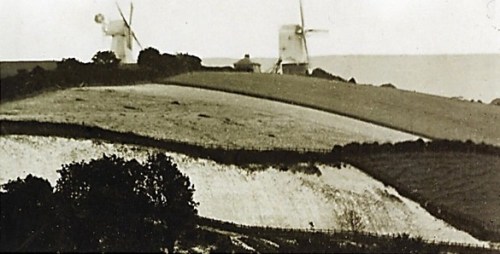
This photograph of the two windmills that stood on either side of Juggs Lane must have been taken before the smock mill on the left collapsed in 1891. Postcard-sized copies were recently offered for sale on ebay. The remains of the brick roundhouse of the post mill on the right remain visible in the garden of Rosery Mill Cottage [see Bulletin no.131].

5. John Gibbs and the Bethesda Chapel, St John Street (by Ian Smallwood)
My ancestor John Gibbs was born in Ditchling in 1769, where his parents were hired to manage a house owned by the Countess of Huntingdon. She occasionally stayed there herself, but it was mainly used to accommodate some of the ministers she had had trained to preach the Gospel when they were between assignments.
Very soon after John Gibbs was born one of these priests brought disaster on the family, by bringing to stay with them a child who had been inoculated with the smallpox in the days when real smallpox virus was used. The live virus was administered in a way designed to give the person inoculated only a mild infection followed by lifelong immunity. A problem with this approach was that if the inoculated person was not carefully isolated they could spread the live virus to others, and this child spread it to John’s family, leading to the deaths of his mother and one of his brothers, and other siblings being blinded. John Gibbs was left to the tender mercies of his father, who also preached at some of the Countess’s chapels, and suffered neglect. Contrasting his treatment by his father with the kindness and moral conduct of the Anglican mistress who he served as a teenager, he abandoned dissent in favour of the established church. He married and came to Lewes, and had four sons and a daughter born between 1797 and 1812.
With 12 guineas inherited from his grandmother he apprenticed himself to a shoemaker and followed that trade for the rest of his life, in combination later with his role as a Minister of the Gospel. He appears in both capacities in Pigot’s directories. He appears as a resident in East Street in John V. Button’s ‘Brighton & Lewes Guide’ of 1805, and lived at 14 East Street for the rest of his life. Initially a tenant, he became the owner and bequeathed it to his widow, who lived there until her own death in 1851.
However, he soon began to doubt the value of the Anglican preaching he heard at churches in and around Lewes. Some academic sermons went over his head, and those he understood focused only on the value of virtue, good works and charity, which he found unhelpful as a poor man who had little enough for his family and nothing to give to others. After a long and painful period of soul- searching, he initially found a happier spiritual home in the new Jireh Chapel established in 1805 by Rev Jenkin Jenkins and William Huntington. While there he had a dramatic experience that he interpreted as a vision of Christ, but when he told Jenkin Jenkins it was dismissed as the work of the devil. John Gibbs then abandoned Jireh, and instead began to preach to others in his own house, with mixed results. In 1811 he and a small band of adherents leased a building on Lancaster Street to serve as a new chapel, inviting the radical Brighton Calvinist preacher Vigor McCulla to preach there. They called this chapel Bethesda, which means house of grace. This building, called the Refuge Chapel, was built for them by Amon and Amon Henry Wilds.
This project also soon came to grief, as McCulla judged that John Gibbs “did not speak consistently with the Spirit’s work”, and banned him from the building. John Gibbs went back to preaching with passionate intensity in his own house, until in 1815 he and his adherents leased an old schoolroom in St John Street from Mrs Gideon Mantell for their new Bethesda Chapel. The room was enlarged in 1824 and rebuilt in 1827. Here, despite being plagued by ill-health, John Gibbs continued to preach until his death in 1838. In 1827 he published a 206-page book, ‘The Life and Experience of and Some Traces of the Lord’s Gracious Dealings Towards the Author John Gibbs, Minister of the Gospel, at the Chapel in Saint John Street, Lewes, Sussex’. Copies, at 3s 6d each, were sold from his house, his chapel and a range of booksellers across Sussex, but only two copies are known to survive today. One is in The Keep, purchased from the estate of the noted Sussex University academic Stephen Medcalf, where it is accompanied by a register of the children ‘named’ in the chapel up to 1842. However, facsimile copies, printed on demand, are now widely available at a modest cost. His book received a long and mocking review titled ‘Nuts for the Saints’ in the 27 May 1830 Brighton Gazette. The review treated other prominent Calvinist preachers such as William Huntington, Jenkin Jenkins and John Vinall with similar ridicule, so he was in good company.
His chapel was one of two Lewes chapels that joined in the national 1831 petition to the House of Lords “for the total abolition of negro slavery” – the other was the Wesleyan Methodist chapel in St Mary’s Lane. Evidently successful (if not quite on the scale of Jireh or Tabernacle) it had a congregation of 250 in 1829. He also preached on occasion in Brighton. He died in East Street of consumption on 1 May 1838, aged 68. His death certificate described him just as a ‘Dissenting Minister’. John Gibbs’ death was noted in national newspapers like The Globe as well as in the local press, and he was buried in a family vault in his chapel. His will left his entire estate to his widow, with his personal estate (excluding his house) valued at under £100. The chapel continued in other hands until 1929. It was demolished to be replaced by a terrace of modern townhouses in 1973. I would love to know what became of the bodies of John Gibbs, his wife and the other members of his family who were buried in the family vault when the chapel was demolished.
Sources: ESRO NI/3; Jeremy Goring, ‘Burn Holy Fire’; Emma Griffin, ‘Liberty’s Dawn: A People’s History of the Industrial Revolution’; British Newspaper Archive; Colin Brent, ‘Lewes House Histories’; House of Lords Journal for 1831; Sussex County Magazine (1930) p.717.
6. Albert Goodwin’s view of Lewes Castle
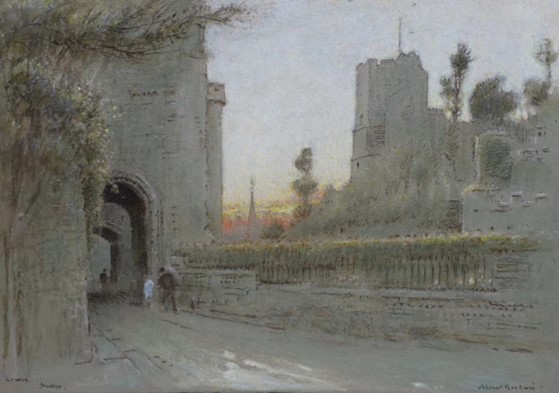
 This ink and pastel painting captioned ‘Lewes Sussex’ and signed by Albert Goodwin (1845-1932) was offered for auction at Gorringe’s autumn fine sale in September 2022, at an estimated price of £600-£800. It sold for £600.
Albert Goodwin, a builder’s son, trained under the Pre- Raphaelites Arthur Hughes and Ford Madox Brown and was championed by Ruskin. He first exhibited at the Royal Academy at the age of 15. His works included, in addition to landscapes, biblical and allegorical subjects. He was a prolific artist, exhibiting and travelling widely.
Image of Albert Goodwin from https://www.chrisbeetles.com/artists/goodwin-albert-rws-1845-1932.html
7. Lewes Railway Station postcards
Two more postcards of Lewes railway station were recently advertised for sale on ebay, with a starting price of £30 each. The first shows a view from above the station looking towards Haywards Heath & London. There appear to be allotments below Southover Road, to the right of the tunnel. The second, dated 1907, shows a train pulling out heading towards Eastbourne and Hastings


8. The Golf Links
This postcard, by an anonymous publisher, was used in the 1920s, but another postcard view with its caption in the same distinctive hand and the same elaborate printed styling on the reverse has ‘Affix Halfpenny Stamp’ in the stamp box, indicating it was published before the cost of mailing a postcard was doubled in 1919.
The photographer took this view from the open downland between the Offham Road and Hill Road, but while the Lewes golf course is there in the distance, ‘The Golf Links’ does not seem the most obvious caption. The Martyrs Memorial is certainly visible but the clubhouse, if there at all, is hard to make out. The Malling chalkpits are a more obvious distant feature. Beyond are Caburn and Firle Beacon, with arable fields advancing far up the downland towards Caburn. There is no traffic visible, but there are several groups of people out and about, some sitting to survey the view, suggesting this was not taken on a working day.

There are houses on the Wallands, but development has not yet advanced up Hill Road, which at this date looks little more than a track across the chalk downland. The positions of the railway line, raised slightly above the surrounding brookland, and the river are evident. St John-sub-Castro rises above the surrounding houses, and I think that the large multi-chimnied building a little distance to its right must be the old House of Correction, by this date a Naval Prison.
Down to the left, where the Landport estate was to appear before the start of World War II, part of the lower downland has been enclosed into smaller units. Many have buildings, some little more than allotment sheds but others more substantial, more like small barns. None of the buildings appear to have chimneys, so they are probably not residential. The first impression is of allotments, but many of the plots seem far larger than any allotments would be today. Is this the reality on the ground of Lewes residents ‘digging for victory during their spare time in the Great War?
This postcard was offered for sale on ebay during September 2022.
9. Christmas Dinner in the House of Correction
The 17 December 1829 Cheltenham Chronicle noted that in the previous week an incorrigible poacher had again been committed to the Lewes House of Correction.
It reported: “He managed his affairs so seasonably that his last eleven Christmas dinners had all been taken in the same prison”.
10. Fifty Years a Master Baker (by Eunice Olley)
From a July 1943 local newspaper report, retained by my Pinyoun family.
“Recently Mr Harry Pinyoun, of Keere Street, Lewes, Sussex, created a proud record – that of completing fifty years as a master baker in one street. Born in Lewes seventy four years ago, he was closely associated with the local trade, and for thirty years has been treasurer of the Lewes and Mid-Sussex Master Baker’s Association.
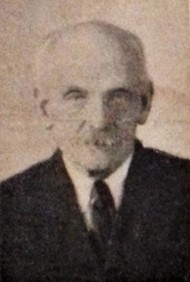 In an interview with a local representative, Mr Pinyoun said:
“Here in Keere Street I have made my home, and perhaps you would hardly credit that I still serve some of my original customers who came to me when I first opened my bakery.
Mine has always been a one-man business, so you may guess that I have not had much time for holiday-making. Even during war time I have not changed my methods of baking, and I think I am one of the few remaining hand-made bakers in the district. I have no machinery of any kind. War, of course, has changed things in the bakery, but even with war-time flour I can still keep the distinctive character of my bread. This was flour is much better than the flour we had to use in the last war. It is more scientifically mixed/ Last war I think they just used to shovel in the ingredients anyhow. I still make my morning rolls, and every morning the early workers in Lewes call for them and take them away to eat in the dinner hour. The school children also take them to school.”
Harry Pinyoun was born in Lewes in December 1869, and he died in 1952, aged 82. The 1871 & 1881 censuses find him with his family in Spring Gardens and Lancaster Street, respectively. By 1891 he was a journeyman baker in Croydon, Surrey, lodging with the master baker he worked for. He married a Surrey girl at Lewes in 1896, not long after he started his own business back in his home town. The 1901 census finds him in Keere Street, now with a young daughter. His household included a middle-aged man and a middle aged widow, both described as assistant bakers, so he was not always a one-man band. By the 1911 census he had three daughters, ranging from a teenager to a baby, and his wife assisted in the business. He finally gave up his business when bread rationing began. His family worshipped at Tabernacle Congregational Church.
John Kay
Contact details for Friends of the Lewes History Group promoting local historical events:
Sussex Archaeological Society
Lewes Priory Trust
Lewes Archaeological Group
Friends of Lewes
Lewes History Group Facebook, Twitter



 Lewes History Group