
Please note: this Bulletin is being put on the website one month after publication. Alternatively you can receive the Bulletin by email as soon as it is published, by becoming a member of the Lewes History Group, and renewing your membership annually.
- Next Meeting: 9 January 2023, Marcus Taylor, ‘Lewes in Storm and Flood’
- LHG Walks Programme for 2023
- A.G.M. Report
- Treasurer’s Report for 2021/2 (by Ron Gordon)
- The Rendel Williams Postcard Collection
- Houses on School Hill in 1783
- All in the family at Barley Banks
- Historic Lewes for Sale: The Old Bank
- Lewes War Memorial centenary
- Common Lodging Houses (by Chris Taylor)
- Next Meeting 7.30 p.m. Zoom Meeting Monday 9 January Marcus Taylor Lewes in Storm and Flood
For our first 2023 talk Marcus Taylor will speak about the flooding of the river Ouse in October 2000 and the so-called Great Storm of 1987. Both had a huge impact on Lewes and its residents; if you were here then, you will have memories of your own. Many people had to leave their homes for months after the relatively brief but deep and sudden surge of water. However, such floods have happened on quite a number of occasions over the past century or so. Using interviews and many previously unseen photographs, the effects of this natural disaster are vividly outlined. Similarly, in the middle of an October night, ‘the hurricane that wasn’t’ caused widespread damage to buildings throughout the town in 1987, uprooting trees, closing roads and affecting businesses. First-hand accounts will remind many of us of the chaos that met our eyes the next morning.
This meeting will be held by Zoom. Members will be sent a free registration link in advance. Non-members can buy a ticket (£4) at http://www.ticketsource.co.uk/lhg. The emailed ticket will include a Zoom registration link for the talk, to complete in advance.
- LHG Walks Programme for 2023
This year we are planning a series of guided walks in and around Lewes, led by Sue Berry. Each walk will be restricted to twelve members, with places booked in advance. They will be planned to last for 75 minutes and there will be a charge, typically £5, refundable if the walk has to be cancelled because of bad weather, etc. Participants will need to be able to walk at reasonable speed, and cope with slopes. As Lewes pavements can be narrow the group will need to keep together, so please don’t bring dogs or large bags. There will be a handout provided for the route of each walk.
The walks currently planned are:
Sunday 12 March, 2.30 pm The Anglican churches of Lewes
Sunday 23 April, 10.30 am The Pelhams of Stanmer, their house and park
Saturday 20 May, 10.00 am How old is that? How to read our High Street buildings
Tuesday 20 June, 7.30 pm The evolution of Southover
Sunday 16 July, 2.30 pm The Industrial History of Lewes
Each walk will be advertised in detail, and booking will be open, from the circulation date of the previous month’s Bulletin – so booking for the March walk will open at the circulation of the February LHG Bulletin.
- A.G.M. Report
- The Annual Reports as published in Bulletin149 were received.
- Appointment of officers. The following officers were appointed for 2023:
- Chair: Neil Merchant
- Treasurer: Ron Gordon
- Secretary: Krystyna Weinstein
- Executive committee: Ann Holmes (Chair for EC meetings), John Kay (Bulletin editor), Jane Lee (Communications), Ian McClelland (Chair for evening meetings & ‘Street Stories’ lead), Barbara Merchant (Website manager) & Chris Taylor (Membership).
- Membership subscription. It was agreed that the annual subscription should remain at £10 p.a. per member, and that admission to evening meetings should be free for members. Admissions charges for non-members should remain at £4 per meeting.
- There was no other business.
- Treasurer’s Report for 2021/2 (by Ron Gordon)
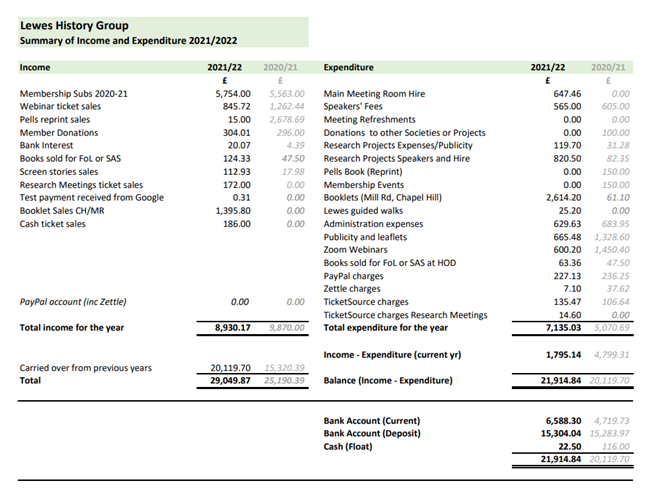
As you can see, our expenditure came closer to matching our income in 2021/2 than it has in some previous years, but our overall financial situation remains strong.
- The Rendel Williams Postcard Collection
The second half of the remarkable collection of Sussex postcards assembled by Lewes resident Rendel Williams was sold by auction at Toovey’s Washington saleroom in November. Once again there were several lots of Lewes postcards, most of which were purchased at high prices by dealers or online bidders. Some examples are shown below.
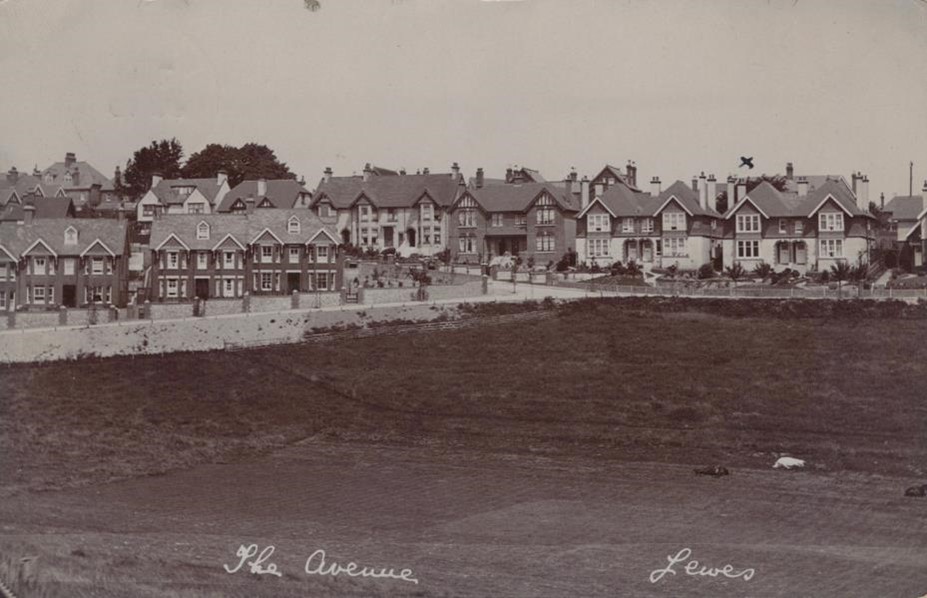
Above, new-looking houses on The Avenue, one marked by the sender. Bradford Road does not feature on many Lewes postcards. Below an Edwardian view of North Street, apparently by James Cheetham, when East Street took two-way traffic.

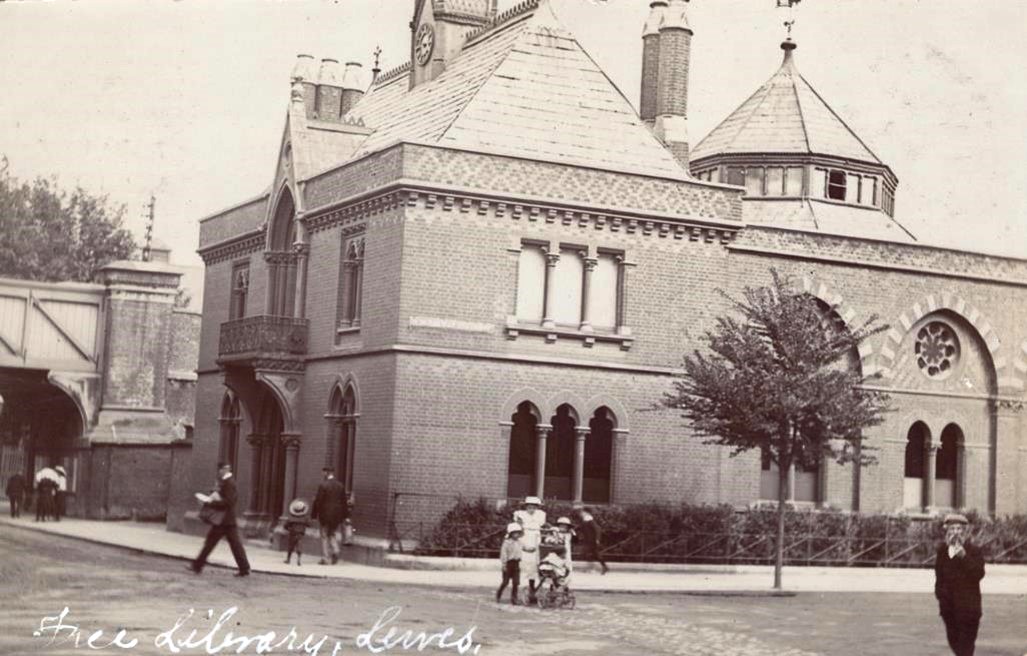
Two more James Cheetham postcards featuring the ‘Free Library’ and the railway bridge over the High Street (above) and the Old Bank in the days before the War Memorial (below).


This early Edwardian view by F. Douglas Miller of Haywards Heath looks towards Lewes over Malling Brooks and the Uckfield railway line from a recently harvested field on the Downs in South Malling. The old House of Correction and St John-sub-Castro can be picked out.
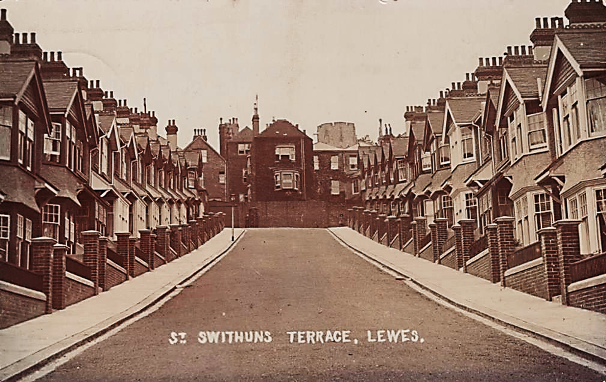
St Swithun’s Terrace is a part of the town that rarely figures in postcards.
- Houses on School Hill in 1783
This view of School Hill House, then owned by Brightling landowner John (‘Mad Jack’) Fuller, and Lewes House, then owned by the barrister Henry Humphrey, was drawn by James Lambert senior in 1783 and included in John Farrant’s ‘Sussex Depicted’, published in 2001 as Sussex Record Society volume 85. School Hill House was built in 1715 by Mad Jack Fuller’s great-grandfather Peter White, a prominent Lewes physician. Lewes House looked very different in 1783, but the present three-storey facade was to be added within the next two decades. Just visible to the left of Lewes House is the All Saints parish poorhouse.

- All in the family at Barley Banks
The St John-sub-Castro parish registers record the baptism on 26 February 1655 of Elizabeth the daughter of Ann Hockney, widow, of Barley Banks, the reputed father John Hockney, her husband’s brother.
There were other baptisms of the children of residents at Barley Banks in 1660, 1661 and 1677. At a 1713 baptism it was noted that the parents “were now living at Barley Banks in St John’s”.
The death of a yeoman farmer of Barley Banks in St John-sub-Castro was noted in 1639. The Historic Environment Record identifies Barley Banks as a small farmstead in St John Without, to the west of Hamsey on the road to Ditchling. While Hamsey or East Chiltington churches would have been nearer, it appears the residents at Barley Banks were expected to come to Lewes to have their children baptised.
- Historic Lewes for Sale: The Old Bank
Offered for sale recently by Lewes Estates were the two prominent town houses at 190 & 191 High Street that together made up the premises of the Lewes Old Bank, The Lewes Old Bank merged into Barclays about 125 years ago, but the buildings became redundant when the branch closed. The asking price for the entire premises was just £1.8 million for two very substantial houses right at the heart of the town, adjacent to the Town Hall.
What was then called the Lewes New Bank opened in the red-brick 190 High Street in 1789. The bank was extended to incorporate new purpose-built premises at 191 High Street between 1837 and 1839. The large banking hall built at the start of Queen Victoria’s reign might be more challenging to adapt to other purposes, given the restrictions imposed by the listed building status.


- Lewes War Memorial centenary
2022 saw the centenary of the Lewes War Memorial, which was unveiled by General Sir Henry Crichton Sclater and dedicated in a ceremony held on 6 September 1922.
The memorial was designed by Vernon March, a sculptor of considerable renown notable for the vigour of his figures, whose premature death makes his war memorials his main legacy. That in Lewes is the finest of his memorials in England. The tight composition and verticality of its design are particularly well suited to its constricted site. He won the commission following a design competition judged by the Slade Professor of Fine Art at Cambridge University.
 General Sclater (1855-1923) had strong local connections. He was born in Brighton and in the 1861 census the 5 year old Henry Crichton Sclater, the 5th of nine children, was living with his family in Lewes. His father inherited the Newick Park estate in 1864, becoming a local magistrate and Deputy Lieutenant for Sussex. Commissioned as an artillery officer at the age of 20, Henry Crichton Sclater had a distinguished military career and was a senior member of Lord Kitchener’s staff during the Second Boer War. During the Great War he served on the Army Council as Adjutant-General, and was from 1916 to 1919 in charge of Southern Command.
The memorial has three bronze angels, two seated at the base (Peace and Liberty) and one at the top (Victory). It was listed as grade II* by English Heritage in 2014. It includes 236 names of the fallen during the First World War and a further 129 names from the Second World War, making a total of 365, one name for every day of the year. Dr Graham Mayhew has conducted extensive research into those recorded upon, and those omitted from, the memorial, an impressive body of work that currently comprises biographies of 389 individuals.

Sources: Lewes Town Council website; Wikipedia; Familysearch website; image from a postcard in the collection of the late Rendel Williams; https://www.westernfrontassociation.com/world-war-i-articles/lewes-war-memorial-by-dr-graham-mayhew.
- Common Lodging Houses (by Chris Taylor)
The poorest in late Victorian Lewes had recourse to very basic free accommodation in the Union workhouse in return for labour of some kind. Those who were homeless and without steady employment, but who had a few pence in their pockets and were thus disqualified from entry to the workhouse, would be customers of the town’s privately-owned common lodging houses (CLHs). There were several of these in Lewes when the town was incorporated as a borough in 1881 and the Council, as the local sanitary authority, assumed responsibility for regulating them.
Despite their reputation nationally for over-crowding and low-standard accommodation, Lewes CLHs appear to have provided generally decent facilities. Throughout the 1880s and 1890s they were frequently visited by the borough’s Inspector of Nuisances, who reported on their condition to the council’s Sanitary Committee. The reports were largely positive. They record regular lime-washing, as required by the 1875 Public Health Act, and a state of general cleanliness with sufficient sleeping and living space for each individual. In 1883, for example, they were described as “in every way well-kept and cleanly, reflecting much credit on their proprietors, when the heterogeneous character of the frequenters is taken into consideration.”
There were four CLHs in Lewes in 1900 – 2 in Southover, one in St John-sub-Castro (in White Hill) and one in St Michael’s (the Britannia Inn, Keere Street) – after which date they came in for more criticism, perhaps linked to the appointment in 1898 of an unusually zealous Medical Officer of Health, John Steinhaeuser. He noted insanitary conditions in one CLH, which resulted in the council serving a statutory notice to improve on its owner. Legal proceedings began when he failed to comply, after which the house was put in good order and converted to a laundry. Another CLH closed in 1903. Of the remaining two, one was described in 1904 as having recently changed hands and in the process of “much needed renovation”.
In December 1903 the Inspector of Nuisances reported that a house in Castle Banks (No. 7) was being used as a CLH without being registered. Proceedings were taken against the proprietor to oblige registration. By 1905 this property, which had previously been part of the St John’s Parish workhouse, was the only remaining officially registered CLH in the town. It accommodated 40 people. Steinhaeuser lamented the old age of the building and the fact that it was much used by vagrants because there was no casual ward at the Union workhouse where they could be accommodated.
The regulation of CLHs provides a good illustration of how the state in the later 19th century began to interest itself in housing conditions as part of the drive to improve the nation’s health. There persisted a strong disinclination to countenance the interference with property rights that intervening directly to improve housing would entail. It took the devastating experience of the First World War for governments to accept that state intervention was required to ensure there was decent housing available that all lower income households could afford.
Source: Lewes Borough Council Sanitary Committee minutes (ESRO DL/D 169/1-4); census returns; Colin Brent, ‘Lewes House Histories’.
Editor’s Note: This is exactly the type of lost information that we hope our planned study of Victorian & Edwardian Lewes will bring to light.
John Kay
Contact details for Friends of the Lewes History Group promoting local historical events:
Sussex Archaeological Society
Lewes Priory Trust
Lewes Archaeological Group
Friends of Lewes
Lewes History Group Facebook, Twitter



 Lewes History Group