
Please note: this Bulletin is being put on the website one month after publication. Alternatively you can receive the Bulletin by email as soon as it is published, by becoming a member of the Lewes History Group, and renewing your membership annually.
- Next Meeting: 13 February 2023, Gary Webster, ‘Changing Chalk’
- LHG Walks: 12 March 2023, Sue Berry, ‘The Anglican Churches of Lewes’
- James Edwards’ Map of Lewes, c.1817
- Mary Ann Lyth, a redoubtable woman
- The Bear Inn Fire from the Rendel Williams Postcard Collection
- Harper & Stedman, Ironmongers & Agricultural Engineers
- Lewes from the West by Rev Charles Edward Pratt
- Vernon March, designer of the Lewes War Memorial
- Common Lodging Houses (by Chris Taylor)
- Historic Lewes for Sale: The Red, White and Blue
- A Bull in a grocer’s Shop
- Next Meeting 7.30 p.m. Zoom Meeting Monday 13 February Gary Webster Changing Chalk
This month’s speaker is National Trust Heritage Officer Gary Webster, who will talk to us about the new archaeology of our chalk landscape, mapped as part of the ‘Downs From Above’ project, and threats to the many surviving ancient monuments there. The chalk downland was first formed over 90 million years ago, and Gary will show how this created a unique landscape that has influenced its later inhabitants, both human and animal. He says, “Many different people have revered this landscape, as we can see from the monuments that remain”. The ‘Downs From Above’ project uses new approaches to mapping that have already revealed several unknown archaeological sites on the downland north of Brighton. Gary will tell us what has been uncovered so far.
Many of these monuments are now under threat, from pressures both new and old. Gary will also be telling us about a new initiative called ‘Monument Mentors’, which seeks to use people power to ensure they are protected. If there is time, Gary will also discuss the current ‘Big Dig’ project near Eastbourne.
This meeting will be held by Zoom. Members will be sent a free registration link in advance. Non-members can buy a ticket (£4) at http://www.ticketsource.co.uk/lhg. The emailed ticket will include a Zoom registration link for the talk, to complete in advance.
- LHG Walk 2.30 p.m. Sunday 12 March 2023, The Anglican Churches of Lewes
The first of this year’s guided walks led by Sue Berry is planned to start at 2.30 p.m. and will visit the town’s Anglican Churches, and compare the impact of changing fashions in worship. Each walk will be restricted to twelve LHG members, and advance booking, open now, is essential. There is a charge for joining these walks, in this case £5, refundable if the walk has to be cancelled because of bad weather, etc.
How to register: tickets will be available from https://www.ticketsource.co.uk/lhg, on a first come, first served basis. Over-subscribed walks can be repeated in the future.
- James Edwards’ Map of Lewes, c.1817
A copy of an Edwards map of Lewes, dated to about 1817, was sold for £110 at Toovey’s auction house, Washington, West Sussex, in August 2022. The Cliffe section is shown below.
The letters M and L are identified in a key as marking respectively the locations of the Independent chapel on Chapel Hill, described as the ‘Bridle way to Glynde’, and its Particular Baptist offshoot on Foundry Lane. Cliffe church is clearly shown. Jireh Chapel, built in 1805, is present but labelled as ‘Irish Meeting’. The position of the Bear Inn is marked as K. Cliffe High Street is labelled as West Street and Malling Street as North Street. Cliffe Bridge is the only bridge across the Ouse.

The built up area at that date is marked by grey stipples, but individual buildings are not in general distinguished. The houses are surrounded by large areas of what look like formal gardens, and to the north what look like orchards. The large area between South Street and the river is perhaps meant to indicate a timberyard.
- Mary Ann Lyth, a redoubtable woman
The Wesleyan policy was to rotate its ministers between the church’s circuits, moving them from town to town after a maximum of three years. For financial reasons those appointed to serve the Lewes Wesleyan church, whose congregation was not a wealthy one, served also as leaders of the Sussex Wesleyan Mission, with most of their salary covered by the national Wesleyan Conference. Most of the men sent to Lewes had decades of experience at other Wesleyan chapels across the country, and a many had personal experience of missionary work in far-flung outposts of the Empire. They were all trained preachers, travelling round the local circuit, exchanging pulpits with their fellows on Sundays and giving inspirational lectures on weekday evenings too.
One such minister sent to Lewes before the old Wesleyan chapel was replaced by the present Station Street building was the Reverend Richard Burdsall Lyth. He was despatched to Lewes by the Wesleyan Conference in August 1865 and served only for a single year before moving on – it was his successor who oversaw the construction of the surviving chapel building on Station Street in 1867. Richard Lyth was a Yorkshireman, born in York in 1810, and qualified as a surgeon in London in 1834 and also as a Wesleyan minister. In 1836, when they were both aged 25, he married Mary Ann Hardy at Bradford. She had been born at Preston, but was also from a prominent York Wesleyan family. That same year they were despatched as the first ever medical missionaries sent out by the Wesleyan Conference, sailing by way of Cape Town, New Zealand and Tasmania to their first station in the Friendly Islands, today known as Tonga. Three years later, in 1839, they were sent on to Fiji, where they remained until 1854.
When the Lyths and another Wesleyan missionary couple arrived in Fiji Christianity was new idea. Tribal warfare was accompanied by pagan worship and polygamy, and cannibalism was endemic. However, the local rulers were pragmatic. The white man’s gunpowder and his medicine were evidently effective, and his trading ships brought all manner of new technology, so perhaps his religion was also worth considering – at least after the completion of the next campaign. The Lyths moved from island to island, leaving new converts in their wake. They learned the language, specialised in training native teachers and ministers, and translated the bible. They were amongst the most successful Wesleyan missionaries. Their copious letters home are well represented in archives in UK, Australian and New Zealand and command substantial sums when they come on the market today. Their work has led to successful 20th century PhD theses, and Methodism remains the predominant form of Christianity in Fiji in the 21st century.
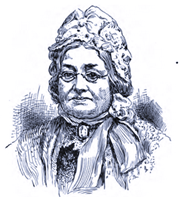 Mary Ann Lyth, initially her husband’s nurse, trained others to fulfil that role and became a teacher and Bible translator. She was indefatigable in his support, and bore him nine children. She taught the women to sew, knit and read the Bible. In their last posting she and the wife of another missionary discovered, while their husbands were away, that the local king was about to sacrifice, cook and eat 14 women prisoners of war in honour of some visitors. They rushed through the crowds to his house, and thrust themselves into his presence (banned to women not of his household) bearing in each hand a whale’s tooth as an offering. They saved the last five of the victims. After leaving Fiji Rev Richard Lyth was governor of Wesley College in Auckland, and they then served five years in Gibraltar. This couple’s experiences were very different to those of most Lewes residents, and Victorian Lewesians flocked to hear their stories.
Sources: Wikipedia entry for Mary Ann Lyth; https://espace.library.uq.edu.au/view/UQ:323188; https://natlib.govt.nz/records/22373819; https://archiveshub.jisc.ac.uk/search/archives/81f3564f-eb3a-3c75-a9fb-93fcc1eceb2b; https://www.ancestry.com/genealogy/records/rev-richard-burdsall-lyth-24-845gv; https://maa.cam.ac.uk/Fiji-missionaries; https://search.sl.nsw.gov.au/primo-explore/fulldisplay/ADLIB110351102/SLNSW; British Newspaper Archive; Familysearch website.
- The Bear Inn fire from the Rendel Williams Postcard Collection
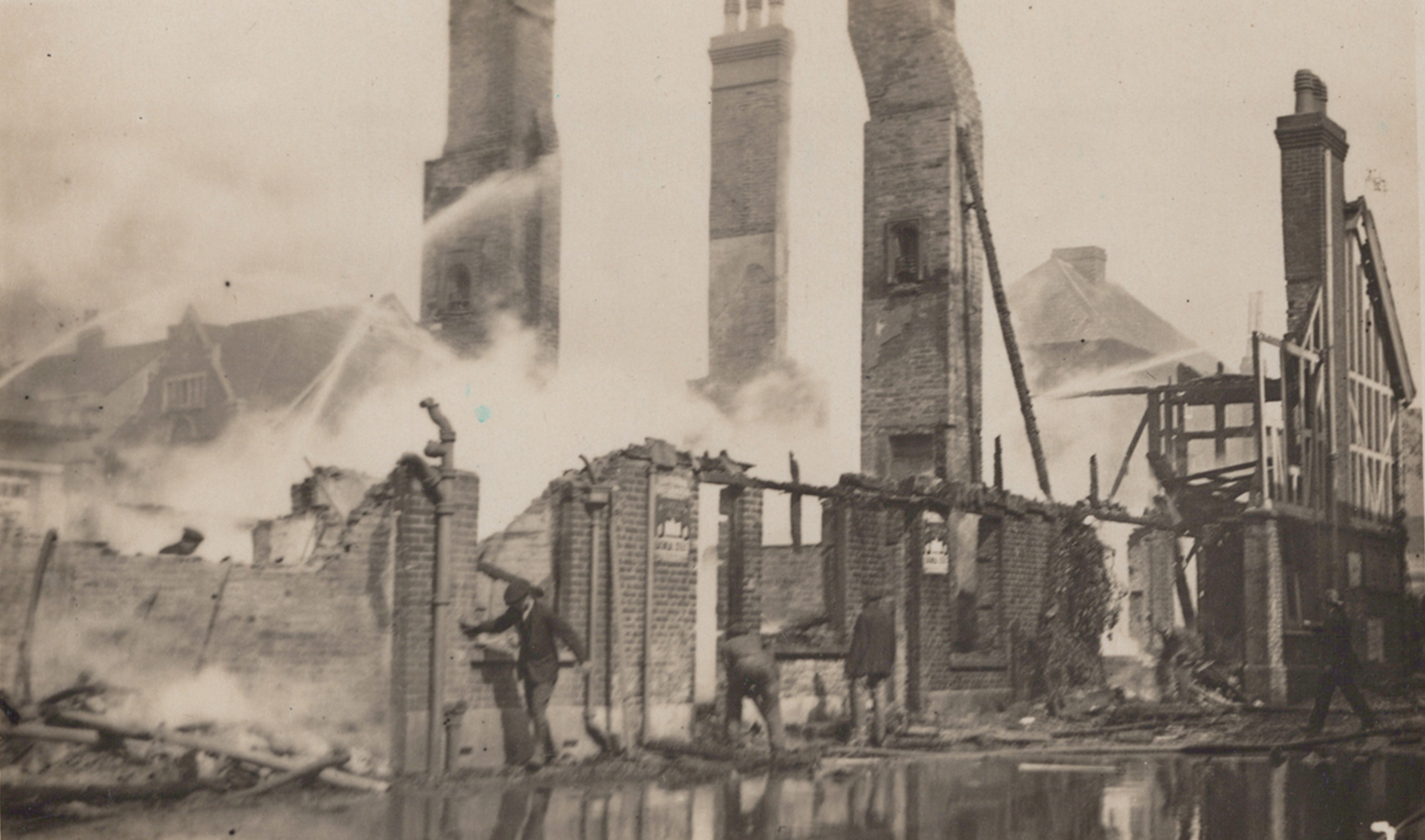
Rendel Williams’ postcard collection included several images of the Bear Inn, and the catastrophic 1919 fire that ended its centuries of history. The first postcard below shows it as is was before the fire, and the following two images are from two of the photographers who recorded the outcome.


The postcard below shows the Lewes Fire Brigade in 1906, posed outside its North Street Fire Station, and illustrates the equipment that it had available to fight such fires.

- Harper & Stedman, Ironmongers & Agricultural Engineers
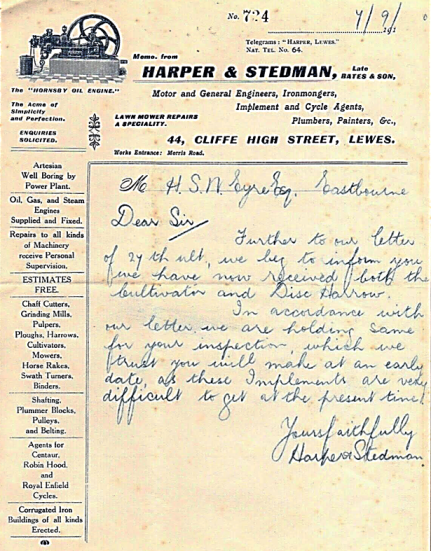
This 1910 letterhead from the Cliffe ironmongers and agricultural engineers Harper & Stedman (later Harper & Eede) illustrates the range of activities such a country town business undertook to serve their farm clients in the surrounding countryside. Market day would be especially busy for such businesses, with the farmers in town, and had money from the sale of crops or livestock to reinvest. This item was offered for sale on ebay.
- Lewes from the West by Rev Charles Edward Pratt
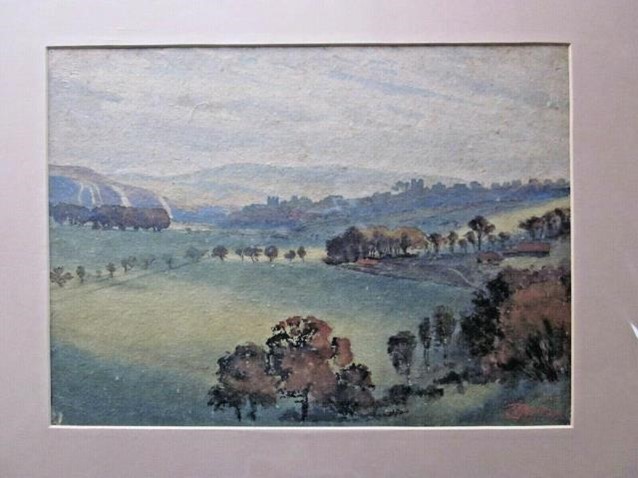
The watercolour below, offered for sale on ebay in June 2021, carries in the bottom right hand corner the signature of C.E. Pratt and the date 1930. Visible above the ridge on which Lewes stands are the towers of St John-sub-Castro church and Lewes Castle. The slope to the right is where Landport was soon to be built. Rev C.E. Pratt was a clergyman artist who exhibited between 1929 and 1934 at the prestigious Walker Gallery and Abbey Gallery in London. He was in his mid-sixties when this work was painted.
Charles Edward Pratt was born in Barnstaple, Devon, in 1864. His father, a wine and spirit merchant, died while he was very young. The 1871 & 1881 censuses find him in a Gloucestershire, household headed by a schoolmaster-uncle that include his widowed mother and grandmother and a younger brother. By 1891 he had moved to Cranbrook, Kent, as a teacher of modern languages and drawing at the town’s Grammar School. Two years later he married Louisa Hardy, daughter of the talented professional artist George Hardy, a member of the Cranbrook Colony. This was an important group of Victorian artists specialising in genre paintings, particularly cottage interiors.
After his marriage Charles Edward Pratt changed career. He studied in Cambridge (where his eldest son was born) and took holy orders. He was briefly curate at Rotherfield, before becoming curate at Eastbourne, where he spent 7 years in charge of St Michael and All Angels, Willingdon Road. In 1906 he was made Rector of Warbleton, but in 1910 returned to Eastbourne, as the first Vicar of the newly independent St Michael and All Angels. He remained there until his death in 1935. A faculty was granted for a brass memorial in his memory in his church, and the Towner Gallery held a retrospective exhibition of his artistic work.
Sources: Familysearch; British Newspaper Archive; Wikipedia entries for George Hardy and the Cranbrook Colony.
- Vernon March, designer of the Lewes War Memorial
Vernon March (1891-1930) was born in Hull, where his father was the foreman in an oil mill, but by the 1901 census the family had moved to Battersea, where his father had become a builder’s clerk. He was the youngest of nine children, and was orphaned in his early teens when both his parents died in 1904. In 1911 all nine children lived together near Farnborough, in Kent.
 Eight of the nine March children followed careers as artists or sculptors, working together at their home ‘Goddendene’, in Locksbottom, near Farnborough. Vernon, who had no formal education in the arts, became the youngest ever exhibitor at the Royal Academy Exhibition in 1907, where his sculpture ‘Psyche’ was sold on the third day. He exhibited another twelve works there over the following 20 years. On major projects he often worked with other family members, especially his elder brother Sydney. He enlisted in the Royal Flying Corps in March 1916 but was discharged a year later as Air Mechanic, 2nd class.
Vernon March about 1925
Regarded as a prodigy, he is best known today for his war memorials, which include the Cenotaph in Cape Town and the National War Memorial in Ottawa, which was still not complete when he died of pneumonia in 1930. His Diamond War Memorial in Derry, Northern Ireland, is, like that in Lewes crowned by the figure of Winged Victory. The bronzes for the memorials were cast at the foundry at the March family home ‘Goddendene’. Lewes is considered to be the finest of his English war memorials.
Sources: Wikipedia; image from findagrave.com
- Common Lodging Houses (by Chris Taylor)
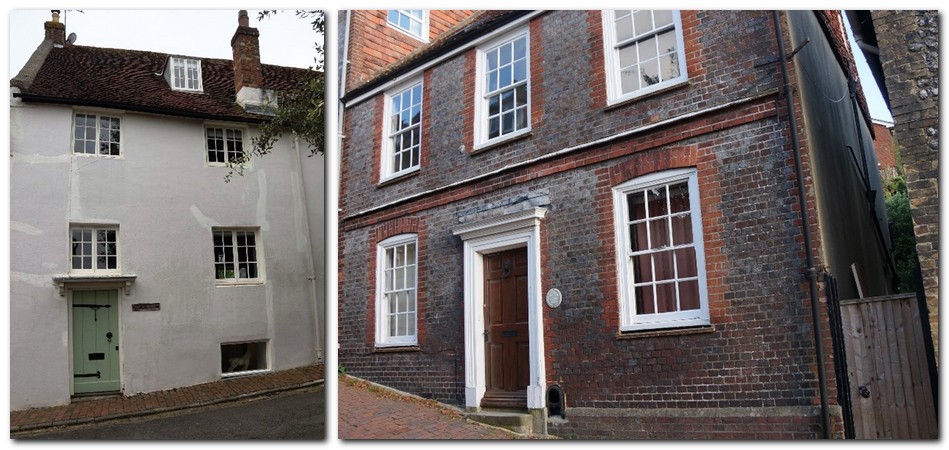
Pictured here are two of the Common Lodging Houses mentioned in LHG Bulletin no.150.
On the left is 7 Mount Cottages, Whitehill. On the right is 10 Keere Street, once the Britannia Inn.
- Historic Lewes for Sale: The Red, White and Blue
Offered for sale recently by Charles Wycherley was the former Red, White and Blue public house at 17-18 Friars Walk. According to the plaque it was open for business between the 1850s and 1956. It was owned by the Rock Brewery of Brighton, and then the Portsmouth & Brighton United Brewery. Given its name, the choice by the latter brewery of green ceramic tiles for its frontage is interesting. Marketed today as a 4-bed town house, the asking price is a little under £1.2 million.

- A Bull in a Grocer’s Shop
The 28 February 1814 Sussex Advertiser reported that as the servants of Mr Morris, butcher, were tackling a bullock for slaughter the animal became enraged, and then broke out from the slaughterhouse. He entered the nearby back door of Mr Madgwick, grocer, and made his way through first Mr Madgwick’s house and then his shop before escaping through the shop-door into Cliffe High Street. He then continued through Cliffe to Southerham, where he joined some other beasts and “his irritation left him”. The bullock was then taken back to the slaughterhouse and killed, without further difficulty, or having done any material mischief.
John Kay
Contact details for Friends of the Lewes History Group promoting local historical events:
Sussex Archaeological Society
Lewes Priory Trust
Lewes Archaeological Group
Friends of Lewes
Lewes History Group Facebook, Twitter



 Lewes History Group