
Please note: this Bulletin is being put on the website one month after publication. Alternatively you can receive the Bulletin by email as soon as it is published, by becoming a member of the Lewes History Group, and renewing your membership annually.
- Next Meeting: 13 March 2023, Christopher Whittick, ‘To the Manor Born’
- LHG Walks: 23 April 2023, Sue Berry, ‘The Pelhams of Stanmer’
- New blood for the LHG Executive Committee (by Neil Merchant)
- 60th anniversary of the closure of Lewes Racecourse (by Barry Foulkes)
- The origins of Harveys’ Brewery
- A Woman Preacher
- Good prices for stock
- An Edwardian view of Malling Street
- Equipping the new Lewes Victoria Hospital
- Penny-wisdom on the Nevill (by Chris Taylor)
- Lewes Crown Court refurbishment, 1992-3
- Remembrance Day in Lewes (by Geoff Bridger)
- Next Meeting 7.30 p.m. Zoom Meeting Monday 13 March Christopher Whittick To the Manor Born. Manorial records for local historians
Archivist and historical researcher Christopher Whittick joined East Sussex Record Office in 1977, and became East Sussex County Archivist until his retirement in 2019. He has been a crucial figure in East Sussex historical research ever since his appointment. He is a Deputy Lieutenant for East Sussex, vice-president of Sussex Archaeological Society, president of the Wealden Iron Research Group, chairman of the Sussex Historic Churches Trust, a Fellow of the Royal Historical Society, and the Society of Antiquaries. He will be talking to us about the role that manors played in Sussex history, a particular issue for Lewes. There was a manor of Lewes, originally held by the de Warennes but later subdivided between their heirs. However, it did not cover every property in Lewes – we have a town in which many different manors had a stake.
This meeting will be the last of our winter Zoom series. Members will be sent a free registration link in advance. Non-members can buy a ticket (£4) at http://www.ticketsource.co.uk/lhg. The emailed ticket will include a Zoom registration link for the talk, to complete in advance.
- LHG Walk 10.30 a.m. Sunday 23 April
Sue Berry: The Pelhams of Stanmer: the development of their house and park
Our second 2023 walk will be at Stanmer Park and will look at the development of the park and the house and buildings within it between 1720 and 1840. The Pelhams were important politically in Lewes and as clients of local businesses. They rebuilt the residential part of the house in the 1720s and overhauled the (now demolished) service wing. They also built the stables (now homes) and the church. From the 1750s they also used their influence to encourage visitors to the developing resort of Brighton. Eventually the family overspent, and from the later 19th century their estates were progressively sold off. Brighton Borough bought the house and park and some farmland.
Each walk will be restricted to twelve LHG members, and advance booking, open now, is essential. There is a charge for joining these walks, in this case £5, refundable if the walk has to be cancelled because of bad weather, etc. Tickets are available from https://www.ticketsource.co.uk/lhg, on a first come, first served basis.
- New blood for the LHG Executive Committee (by Neil Merchant)
At the AGM in December, I mentioned that we need some new blood on the committee. As I said then, LHG is run mostly by the same stalwarts who founded it in 2009, and we are all 14 years older now.
Some committee members have expressed a clear intent to step down this year, and it’s inevitable that others will in time. Specifically we know that Jane Lee, our PR/Communications officer, plans to retire this year, as does Ron Gordon, our treasurer. We need replacements for them soon, to work with them over the remainder of the current year, so if you have an interest please let me know.
John Kay would welcome some assistance in pulling together the speaker programme, so if you have an interest in that, sing out. I’d like to pass on responsibility for managing Zoom and Ticketsource. If you have these skills, or would like to learn them, you’d be very welcome.
Beyond that, if you have a more general interest in helping to steer and run LHG, I’d be more than happy to talk with you and explore possibilities. We are pleased and proud that over the past decade, LHG has become a valued part of Lewes life, and it would be a shame if we couldn’t continue. You can contact me at info@leweshistory.org.uk.
- 60th anniversary of the closure of Lewes Racecourse (by Barry Foulkes)
The 60th anniversary of the closure of Lewes Racecourse will be in 2024. If this interests you, and you would like to be involved the Lewes Racecourse History Group would like to invite you our launch party at the King’s Church building between 17.00 and 21.00 on Saturday 1 April 2023, when we will be discussing what might be included in this event. The café will be open.
If you would like to participate please phone 07546 554640 or email beejaysfencing@aol.com.

- The origins of Harvey’s Brewery
The business that became Harvey’s Brewery was originally a wine and spirit merchants, an aspect that still continues today at 4-6 Cliffe High Street. It is claimed on the Harvey’s Brewery website to have been founded in 1790, with deliveries of wines and spirits recorded from that date onwards, but if so it was not established by John Harvey, the reputed founder, as he was no more than six years old in 1790. The information below suggests that the business actually originated as a brandy merchant’s about a quarter of a century later, diversifying as a wine merchant and brewer within a few years thereafter. Great Britain and France were at war for most of the period between the 1792 Revolution and the 1815 battle at Waterloo, so the legal importation of brandy during that period would have been difficult.
John Harvey’s origins are not entirely clear, but he was an in-comer to Lewes. The 1841 census gives his age as 52, and notes that he was not born in Sussex. In the 1851 census he was in St Marylebone with his second son, an ironmonger, and was described as a brewer aged 66. In the 1861 census, when he had retired and lived in Blandford Square, Middlesex, his age was 76, and at his death in December 1862 he was aged 78. In both 1851 and 1861 his birthplace was given as Downton, Wiltshire. This suggests that he was born sometime between 1784 and 1789, with three of the four records suggesting the earlier end of that range. In 1841 he had a significantly younger wife, a situation in which it is not uncommon for the younger partner to borrow a few years from the older for census purposes, but it is also not uncommon at the end of a life for ascribed ages to deviate from the calendar age. Harvey is a common English surname, and John Harveys are especially numerous. No baptism of a John Harvey born at Downton has been found in the right period, though there are alternative options at Salisbury, not many miles away.
The earliest records I have found of John Harvey in Lewes date from April 1809, and confirm that he was a confidently literate young man. On 3 April 1809 John Harvey of Cliffe married Theodosia Davey at St Michael’s church by licence, and he also acted as a witness for the marriage of Sophia Davey (probably Theodosia’s sister) at the same church on the same day. The licence for the marriage, issued two days previously, described him as John Harvey of Cliffe, tea dealer, a bachelor aged over 21 years, and his bride as Theodosia Davey of St Michael’s, spinster aged over 23. The bondsman for the licence was Theodosia’s brother Joseph Davey, a druggist, who was himself also married at the same church on the same day. Theodosia Davey had been born in Lewes in December 1784, a daughter of Thomas and Mary Davey, so was actually 24. Sadly she died and was buried at All Saints less than two years later. Two years after that, in April 1813, John Harvey married Delia Button at Cliffe church. She was born in August 1794, a daughter of John Button, master of the non-conformist Cliffe Academy, so aged 18 when she married. The licence for this second marriage described John Harvey as a Cliffe widower aged over 21, and Delia as a spinster aged 17, marrying with the consent of her father, who was also the bondsman. John and Delia Harvey then had 13 children, 6 boys and 7 girls (including a pair of twins), born at regular intervals between January 1814 and 1835. In March 1846 his wife Delia died sufficiently suddenly at the age of 51 for an inquest to be required, and she was buried at Cliffe.
As an adult in Lewes John Harvey was a non-conformist: both his wives were from prominent Lewes Baptist families, and his first wife Theodosia was recorded as a member of the Lewes Particular Baptists meeting in Foundry Lane. Her father Thomas Davey, a surgeon, had provided the site for the Countess of Huntingdon’s chapel on Chapel Hill in 1775, but when the minister Joseph Middleton and part of the congregation split in 1784 to found a Particular Baptist chapel on Foundry Lane her parents were prominent amongst his supporters. After Theodosia’s father died, her widowed mother married Joseph Middleton. In 1829 John Harvey was made a trustee of Tabernacle. Non-conformist birth records have a very patchy survival. Baptists, by definition, do not believe in infant christening – the issue at the heart of the 1784 schism at the Chapel Hill chapel. Tabernacle did maintain a register of christenings of its members’ children, but there are no Harveys recorded there. However John & Delia Harvey did ensure that the births of their 13 children were properly registered: they were all recorded (in three batches in 1822, 1831 and 1837) in the national records of non-conformist births maintained by Dr Williams Library in London. Each entry records the exact date of birth, the place of birth as in Cliffe (from 1823 onwards, 6 Cliffe High Street), and the names of two people present at the birth. One of the two was always a Lewes surgeon – first Thomas Hodson and later Richard Turner. The other was a woman – for the first nine their grandmother Eliza Button. The births of his second wife and her siblings had similarly been recorded in the same register.
The first record I have found ascribing an occupation to John Harvey thus refers to him as a tea dealer in 1809. He evidently prospered. The next record, apart from the regular births of his children, is an advertisement in the 2 July 1821 Sussex Advertiser, that John Harvey, in business for 7 years, had purchased the house, shop, stable, warehouse and yard at 6 Cliffe High Street that had long been occupied by Christopher Elliott, a tea dealer, grocer and tallow chandler who had become bankrupt. The birthplaces of the Harvey children are recorded as 6 Cliffe High Street from 1823 onwards, and his family lived there into at least the 1850s. In Pigot’s 1828 directory John Harvey of Cliffe is one of four brandy merchants in Lewes, but he is not one of the three wine merchants, one of the five brewers or amongst the town’s tea dealers, grocers or coal merchants. John Harvey was recorded in Cliffe High Street in 1833 as a wine and spirit merchant who had been in business for 17 years. This would suggest the original foundation of this business took place in about 1814-1816, about the end of the Napoleonic Wars, but for the first few years it was based elsewhere in Cliffe. In the 1841 census John Harvey, resident at 6 Cliffe High Street, was described as a wine merchant, and his eldest son William, still living at home, was a brewer.
Brewing would be a natural extension of a wine and spirit merchant’s business, and John Harvey is said to have brewed initially at Thomas Wood’s brewery in Bear Yard, just across Cliffe High Street. Graham Holter dates this as starting about 1810, but Thomas Wood did not purchase the Bear Brewery from John Rickman until 1817, and the Harvey & Son website dates the start of his brewing at about 1820. John Harvey was evidently a practical brewer, with Harvey & Son records showing him keeping a detailed journal recording the impact of such details as the ambient temperature, water quality and the quality of his raw materials. In 1838 Thomas Wood died, and in the same year John Harvey was able to purchase his own premises across Cliffe High Street, Bridge Wharf, which lay between his business at 6 Cliffe High Street and the river. This property included three houses, wharfs and yards, including coal merchants yards that he immediately incorporated into his business.
Soon after 1838 John Harvey and his eldest son William, whom were now in partnership, constructed his first brewery on his new wharf, but they are not included amongst the six Lewes brewers appearing in Pigot’s 1839 local directory of the town. Harvey & Son, wine and spirit merchants of 6 Cliffe High Street, are one of four such businesses listed in the town in that directory, and Harvey & Son, Bridge Wharf, were also one of a dozen Lewes coal merchants. They are not listed amongst the six Lewes tea dealers. John Harvey was described as a spirit merchant when acting as a trustee for his brother-in-law Joseph Davey in 1826 and when appointed a Tabernacle trustee in 1829; he was a wine and spirit merchant in an 1833 local directory, and in the 1834 newspaper announcement that he had acquired all the stock of wines of the long-established rival business run up to that date by Henry Blackman on School Hill. He was called a wine merchant at the 1843, 1845, 1847, 1848 & 1851 marriages of daughters at Cliffe church, all of which were conducted by his brother in law John Viney Button rather than the usual Cliffe rector. He was described as a spirit merchant in the local newspaper report of his wife Delia’s 1846 death but as a brewer in 1848 when trustee for the creditors of a bankrupt. In 1851 John Harvey’s family still lived at 6 Cliffe High Street, but he was away on census night, and is listed in London, now described as a brewer, in the household of his ironmonger-son, who had established himself in the capital. John Harvey’s eldest son William, now married and with his own family, had moved to 3 Cliffe High Street, down the lane that leads to the present brewery, and was described as a brewer, wine and coal merchant. At 6 Cliffe High Street the eldest resident daughter was called a spirit merchant’s daughter, while her brother Edwin, aged 19, was a brewer’s assistant.
John Harvey & Son were wine and spirit merchants, brewers and coal merchants at 6 Cliffe High Street in the 1851 Post Office local directory. By the 1855 edition the ‘coal merchant’ had been dropped, but the business was still listed as at 6 Cliffe High Street. By 1859 John arvey had retired and Harvey & Son was in the hands of three of his sons, William, Henry and Edwin. The brewery on Bridge Wharf supplied a chain of 17 public houses. Most listed on the Harveys website were in the Eastbourne-Hailsham area, though one was in Crawley. The nearest to Lewes was the Halfway House at Isfield, on the road between Lewes and Uckfield. In the 1861 census John Harvey was living at his house in Blandford Square, St Marylebone, where he lived in comfortable retirement with his youngest daughter, a middle-aged companion called Mary Jenner and three female servants. In Lewes his eldest son William Harvey, 47, wine and spirit merchant and brewer, lived at 3 Cliffe High Street, and was also an important figure in the Sussex Archaeological Society. Henry Harvey, 33, described as an ‘operative brewer’ and in charge of the brewery, lived on School Hill, while Edwin Harvey, 29, also a brewer, had recently moved from South Street to North Street, South Malling. The three brothers were all married with children, and all the households included servants. Edwin Harvey had become an Anglican – his children were baptised at Cliffe church. Shortly after his marriage Edwin and his wife had made a visit to Melbourne, Australia, where his eldest daughter was born in 1857, but he soon returned to Cliffe.
By 1861 John Harvey had long been a widower for the second time, and most of his daughters had married. The eldest married the man who ran the Tipper Brewery in Newhaven, but after her husband’s death in 1858 she had moved to Islington. The second daughter married an Islington banker, the third a Basingstoke grocer, the fourth a London bookseller and the fifth a Brighton wine merchant. There were now more of his family living in London than there were in Lewes. John Harvey died at his house in Blandford Square on 13 December 1862, and his body was brought back to Lewes for burial with his second wife at Cliffe. His three executors were his second son (the London ironmonger), his bookseller son-in-law and his brother-in-law William Button, who ran the Cliffe Academy. It is perhaps notable that none of the three Lewes sons were nominated to this role.
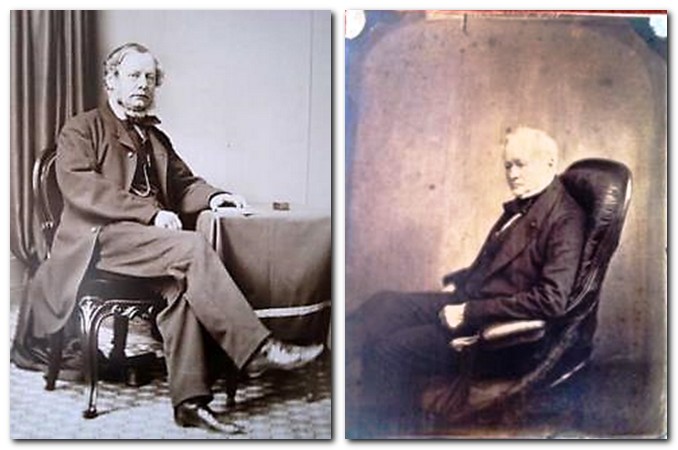
John Harvey (left) in the early 1840s & (right) in June 1857, 5 years before his death
With three brothers, all with families, in charge of the Lewes business the Harvey dynasty appeared set fair. However, the two younger brothers, Henry and Edwin, died suddenly within ten days of each other in April 1866 at the ages of 38 and 34. Edwin’s death was reportedly due to ‘gastric fever’. The eldest brother William Harvey had only a single daughter who survived infancy, and in 1864 she had married John Maxfield Smith, heir to a Lewes draper’s business. Two months after Henry and Edwin’s deaths it was announced that John Maxfield Smith would become a partner in the brewery. When William Harvey himself died in 1869 the surname Harvey disappeared from the business. Henry Titlow Barrett, a young practical brewer from Lowestoft, Suffolk, had been recruited and in 1869 he married Esther Morris, a daughter of a Lewes master butcher Benjamin Morris. John Maxfield Smith and Henry Barrett continued to run Harvey & Sons together into the 20th century, building the main part of the present brewery on Bridge Wharf in 1881. Henry Barrett lived by the Brewery at 3 Cliffe High Street, and John Maxfield Smith in rather more grandeur at School Hill House.
One question that remains unresolved is what brought the Wiltshire-born John Harvey to establish himself in business in Lewes. Did he just accept an opportunity as a teenager or a very young man to establish himself in a new town, or was there perhaps an unidentified family connection? There were two other young businessmen with the same surname who were John Harvey’s contemporaries in the town.
One candidate is Daniel Harvey, first noted in 1800 when it was reported that the long-established Quaker business of Rickman & Godlee, based in and around the Bear Yard, which included a brewery, had declined tea dealing and grocery, and the business was being continued by their former shopmen, Thomas Cooke and Daniel Harvey. Daniel Harvey, a contemporary and neighbour of John Harvey, lived just across Cliffe High Street, and by 1807 had established himself as a hatter. However, he was an Anglican, a long-serving churchwarden of Cliffe and took a leading part in the Cliffe’s civic affairs. Despite both men being recorded as tea dealers in Cliffe less than a decade apart, I have found no record of the two close neighbours working together.
The second candidate is Adam Harvey, first noted in July 1807 as a City of London wine merchant when he married a Lewes girl by licence at St Michael’s church. In 1811 he and his wife established a wine merchant’s business in Lewes, based initially in a smart rented property at Hill House, 118 High Street in St Anne’s parish. In 1816 he purchased 83 High Street when it was put up for sale by the radical politician William Green, and moved the business there. In 1819 he purchased the White Horse Inn at the top of St Mary’s Lane, installing as tenant a Mr Penderell who was lineally descended from the Richard Penderell who rescued the young Charles II after his defeat at the 1651 battle of Worcester, famously hiding him on one occasion in an oak tree, and changing the name of the establishment to the Royal Oak. In 1820 Adam Harvey went into partnership with Arthur Windus of Southover, and the business traded as Harvey & Windus from 83 High Street, in competition with the rival establishment run by John Harvey in Cliffe. In 1832 Adam Harvey sold his interests in both the wine and spirit merchant’s business and the Royal Oak to his partner, and both soon ended up in the ownership of Beards Brewery. Adam Harvey and his wife had four children given Anglican baptisms in Lewes, first at St Anne’s and then at St Michael’s.
There is thus no evidence other than a fairly common surname to link John Harvey to these two contemporaries in the same lines of business in different parts of the town.
Sources: www.harveys.org.uk/harveys-story; Harvey & Son, Bridge Wharf Brewery, Bicentenary volume (1990); Graham Holter, ‘Sussex Breweries’ (2001); Familysearch and FindMyPast websites; The Keep online catalogue; ESRO ACC 5120/173/1; Colin Brent, ‘Cliffe House Histories’; information and photographs from family historian Dany Nicholas.
- A Woman Preacher
In 1829 a Methodist sect known as the Bible Christians briefly occupied the Eastport Lane chapel that had been vacated by the General Baptist congregation when they had merged with Rev Thomas Walker Horsfield’s Unitarians at Westgate Chapel. Unlike any of the other churches or chapels in the town these Ranters (as the Sussex Advertiser called them) allowed women to preach as well as men. When they first arrived in Lewes in 1824 it caused both astonishment and consternation that a young woman preached for nearly an hour and a half at an open air service attended by over 500 people.
The Sussex Advertiser noted that she spoke with a broad northern accent, but admitted that her sermon (or harangue, as they called it) was “couched in good language and for the most part delivered with ease and grammatical accuracy”. The Bible Christians flourished for only a few years, and women preachers were not heard again in Lewes until the arrival of the first Salvation Army mission in 1891.
Source: Jeremy Goring, ‘Burn Holy Fire’, p.96, quoting the 31 May 1924 Sussex Advertiser.
- Good prices for stock
The 26 Sep 1825 Hampshire Telegraph reported that at the Lewes stock market on the previous Tuesday “everything in the shape of oxen, sheep and lambs was principally bought up by the Brighton butchers, at prices about the same as those of the last market”. Nearly 40,000 sheep had been penned at the Sheep Fair on the previous Wednesday, with ewes fetching between 28 and 40 shillings, and lambs between 20 and 27 shillings.
- An Edwardian view of Malling Street
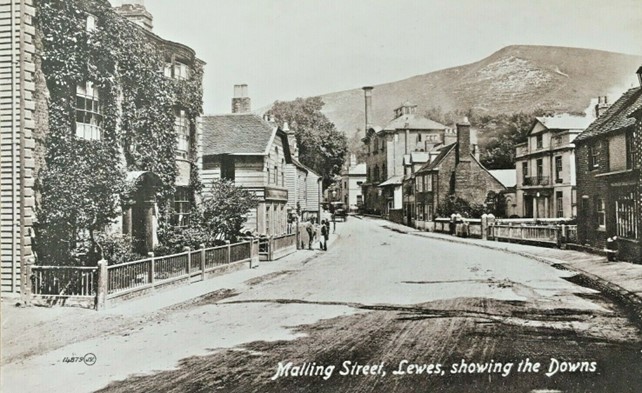
This nice early-Edwardian Valentine’s postcard features in the distance an early motor car, travelling in the middle of the road. There is a large and elegant bow-fronted mathematically-tiled villa-residence in the left foreground, and the rather bizarre upward extension of the shop in the terrace of cottages to the right (seen in some late-Edwardian postcards) has not yet taken place.
- Equipping the new Lewes Victoria Hospital
The 11 February 1910 Sussex Express carried the following news item:
“NEW LEWES HOSPITAL. MUNIFICENT DONATION FROM LADY AUBREY-FLETCHER: The Mayor of Lewes, hon. secretary of the Hospital Building Fund, has this week received from Lady Aubrey-Fletcher a cheque for £250 towards the cost of furnishing the new hospital. Sir Henry and Lady Aubrey-Fletcher had previously given a like amount to the building fund.”
Sir Henry Aubrey-Fletcher (1835-1910), 4th Baronet, lived at Ham Manor, Angmering. He inherited the family baronetcy from his father as a teenager in 1851, and changed his surname from Fletcher to Aubrey-Fletcher on the receipt of a large and unexpected inheritance in 1901 from a distant and reclusive relative he had never met. After Eton he served as a Lieutenant in the Grenadier Guards, and for much of the rest of his life was a senior officer in the Sussex Rifle Volunteers. He was a parish and county councillor, chairman of the East Preston Board of Guardians and Groom-in-waiting to Queen Victoria in 1885-6. He had been the Conservative MP for Horsham 1880-1885, and was then MP for the new Lewes constituency from its creation in 1885 until his death in May 1910, three months after this gift. In his day the Lewes constituency covered a rather different area around Brighton, predominantly to the north and west of the seaside town, and including Worthing. £250 was a generous donation – the price of a decent house. It was estimated that 2,000 people attended his Angmering funeral.
The postcard below shows the declaration of the poll outside County Hall when Sir Henry was re-elected in 1906. The cartoon image of him by Spy was drawn in 1898 for publication in Vanity Fair.

- Penny-wisdom on the Nevill (by Chris Taylor)
In September 1920 work began on Lewes Borough Council’s first housing scheme, soon known as the Nevill Estate. The council had responded promptly and with enthusiasm to the directives of the 1919 Housing and Town Planning Act to prepare post-war building plans. House-building had virtually ceased during the war and by 1918 the country faced an acute shortage. The high costs of scarce materials and labour made it impossible for private developers to supply housing at rents working class families could afford. The experience of war had spread new social attitudes among the public, who increasingly looked to the state to provide a remedy, giving rise to Lloyd George’s famous promise of ‘homes fit for heroes’.
Direction from central government ensured that the first housing schemes generally adhered to the recommendations of the committee led by the civil servant Tudor Walters in 1918. Councils were urged to create communities comprising mostly 3-bedroom family houses at no more than 12 per acre, some with a parlour and all with a scullery, a bath and a generously-sized garden. The costs were to be shared between tenants, local rate payers and the government through subsidies. This ambitious programme is evident in Lewes in the design and construction of the first stages of development on the Nevill – houses in Nevill Crescent, Nevill Road and North Way.
This brief period of idealism ended abruptly in the 1920s as the government responded to post-war economic dislocation and the growing national debt by sharply reducing its spending on social housing. The subsidies for new houses were cut as early as 1921; councils came under pressure to reduce the size and standard of houses and to build them at higher density. The effects of this change in policy – and an object-lesson in false economy – are visible on the Nevill Estate.
In April 1927 the council decided on 20 new brick-built 3-bedroom houses on the east side of North Way, pending approval from the Ministry of Health and Housing. The council awarded the contract to a local builder for £9,717 but the Ministry recommended another firm’s offer to complete the houses more quickly, before a deadline after which the subsidy of £9 per dwelling for 40 years would be reduced by 17%. Instead, the council decided to save even more money by accepting a tender for £8,820 from Universal Housing Company of Rickmansworth to build the houses in a few months and from concrete rather than brick, to a design similar to one a delegation of councillors had recently inspected at Tunbridge Wells. The 20 houses were ready for occupation on 8 October. Ninety-seven applications had been received from prospective tenants: special consideration was given to ex-servicemen, to applicants’ family size and to the sanitary condition of their present accommodation. The rent was set at 9s 6d (47½ p) a week.
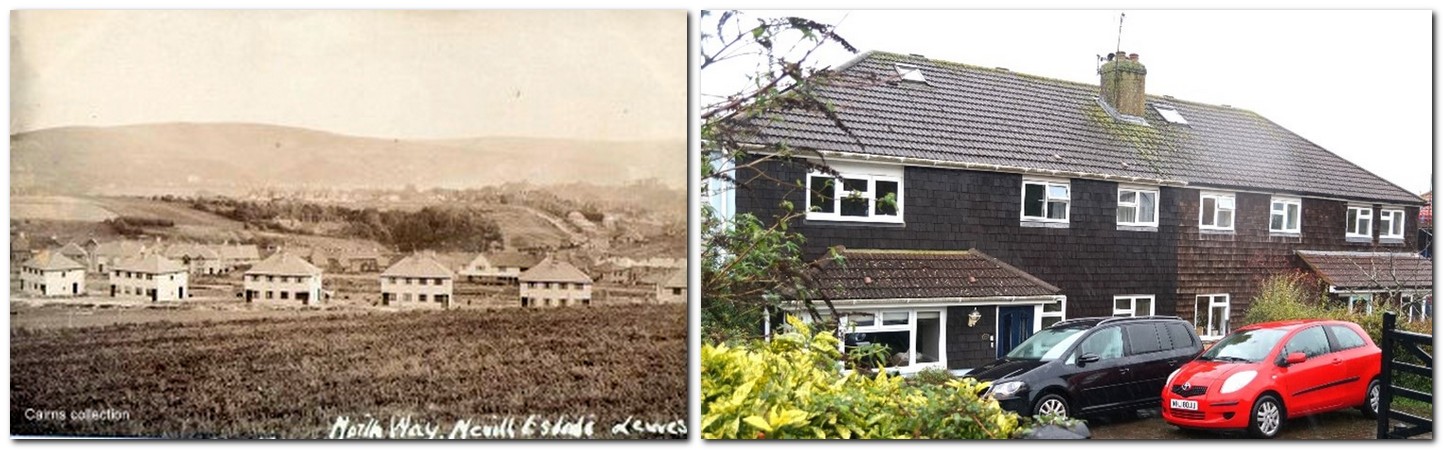
Houses in North Way, soon after construction and, often extended, today
Problems began almost immediately. In September 1928, defects were reported in the asbestos sheets and channels on the exteriors of the new houses. Between December 1929 and September 1930, after more defects had been reported, the asbestos was removed and replaced with weatherproof rendering, porches were added to stop rainwater seeping in under the front doors and defective floorboards were replaced.
Some years later, in November 1944, two of the houses were found to be in ‘a most unsatisfactory condition’ because of water penetration, requiring the application of liquid concrete by pressure spray. In February 1946, after reports of damp walls and dry rot in the floor timbers, an examination was made of all 20 homes. As a result, by 1952 all the houses had been fitted with cedar wood shingles, repairs had been made to the walls, grates, drainage and paved areas, all the floors had been replaced and all 20 houses had been redecorated. In 25 years the council had spent well over £10,000 on keeping these houses habitable, rather more than the cost of building them.
Sources: Lewes Borough Council Housing Committee minutes: ESRO DL/D/175/1; LHG Street Stories initiative: the Nevill Estate
- Lewes Crown Court refurbishment, 1992-3
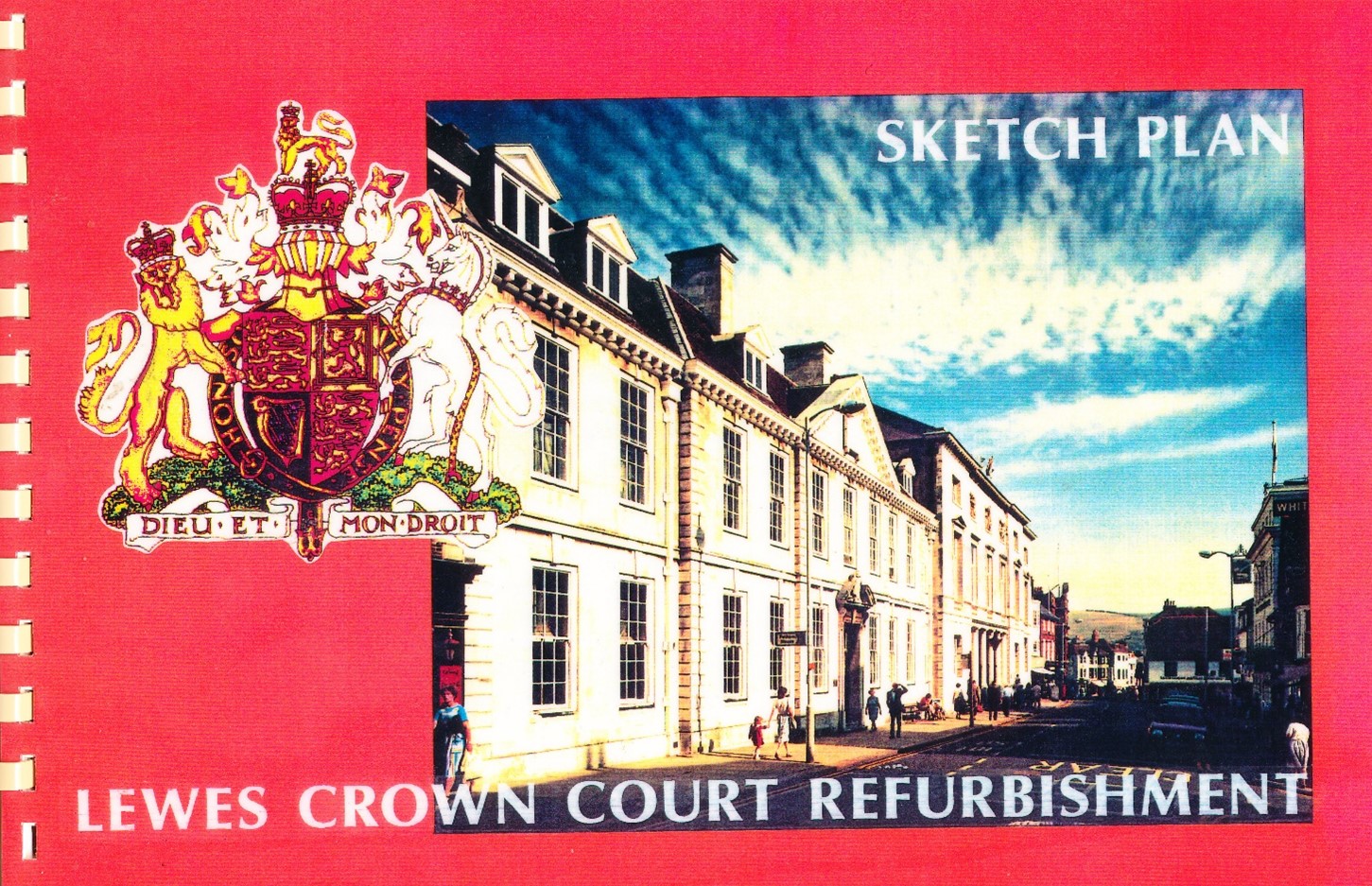
Architect Richard Booth has recently given us a copy of the architects’ sketch plan for the refurbishment of the Lewes Crown Court building to be carried out over a 10 month closure period starting in August 1992, at a planned cost of just under £2 million.
A particular concern was the preservation of the character of the six Victorian toilets in the building, three on the ground floor, one on the first floor and two on the second floor. The District and County conservation officers agreed that one of those on the second floor was of very poor design and condition, and so unworthy of preservation, but the other five would have their fittings restored, which would incur significant expense, and their tiles made good or replaced by tiles with Victorian designs. All ironmongery and door furniture was to be Victorian in style.
- Remembrance Day in Lewes (by Geoff Bridger)
Why does Lewes conduct its Remembrance Sunday events at around 3 p.m. when the King, Government, Armed Forces and pretty wellverybody else in the United Kingdom follows the traditional time of 11 a.m.?
John Kay
Contact details for Friends of the Lewes History Group promoting local historical events:
Sussex Archaeological Society
Lewes Priory Trust
Lewes Archaeological Group
Friends of Lewes
Lewes History Group Facebook, Twitter



 Lewes History Group