
Please note: this Bulletin is being put on the website one month after publication. Alternatively you can receive the Bulletin by email as soon as it is published, by becoming a member of the Lewes History Group, and renewing your membership annually.
- Next Meeting: 15 May 2023, Jane Clark, ‘The Portable Antiquities Scheme’
- L.H.G. Walk: 20 June 2023, Sue Berry, ‘The Evolution of Southover’’
- The 1832 Reform Act and the Borough of Lewes
- Lewes High Street in 1755-6
- Early Trade Unionism suppressed by Lewes Magistrates
- A 1751 Robbery on the Downs
- Edward Reeves at the Old Bailey
- The Lewes Mechanics Institute
- The Martyrs’ Memorial, Cuilfail
- An early Lewes Picture Postcard
- New homes for old at Landport (by Chris Taylor)
- 1955 Traffic in the High Street
- Next Meeting 7.30 p.m. King’s Church, Lewes Monday 15 May Jane Clark Recording our past with the Portable Antiquities Scheme
Jane Clark is Finds Liaison Officer for Sussex, based at Barbican House. Her role is to provide guidance to people, especially metal detectorists, who discover items they think may be of interest in our county. Jane will explain the role of the Portable Antiquities Scheme and the Treasure Act, and show us some of the amazing archaeological objects and treasures found by the public around Lewes. Her talk will feature the contents of the ‘Near Lewes Hoard’, a remarkable collection of nearly 80 artefacts buried in a ceramic vessel during the Middle Bronze Age (about 1300 BC) at an undisclosed hilltop location on the downland near our town. Some were locally produced, but others including amber beads imported from the Baltic. Four gold applique discs are of a type otherwise known only in southern France. The hoard was discovered by a metal detectorist in 2011, over a decade ago, but immediately reported and carefully excavated.
This meeting has been moved to the third Monday of the month to avoid conflict with the Coronation bank holiday. Members are requested to register in advance, so that we can monitor numbers attending. Non-members wishing to attend should register and pay in advance, as usual.
- L.H.G. Walk 7.30 p.m. Tuesday 20 June Sue Berry The Evolution of Southover
This will be an evening walk along Southover High Street and down some of the slide streets. You will be provided with an annotated map of the walk. The traffic during any day in Southover is considerable and noisy partly because of the stone sets, and also because many of the drivers are driving vehicles with cold engines for short distances, which makes the pollution worse. Hence an evening walk.
Each walk will be restricted to twelve LHG members, and advance booking, open now, is essential. There is a charge for joining these walks, in this case £5, refundable if the walk has to be cancelled because of bad weather, etc. Tickets are available from https://www.ticketsource.co.uk/lhg, on a first come, first served basis.
- The 1832 Reform Act and the Borough of Lewes
The map below, drawn by Robert Creighton and engraved by J. & C. Walker, is from ‘Views of the Representative History of England’ published in 1835 by Creighton and Samuel Lewis, who had already published a series of English county maps. The green line shows the boundary of the Borough of Lewes up to the 1832 Reform Act and the red line the boundary of the much larger post-1832 borough, which included residents in Southover and Cliffe, a large part of South Malling parish and a small section of Kingston. Several of the new boundary points were current or former windmills – the two mills either side of Juggs Lane, the Town Mill near where the prison was to be built, South Malling Mill and the site of a former windmill above Cliffe.
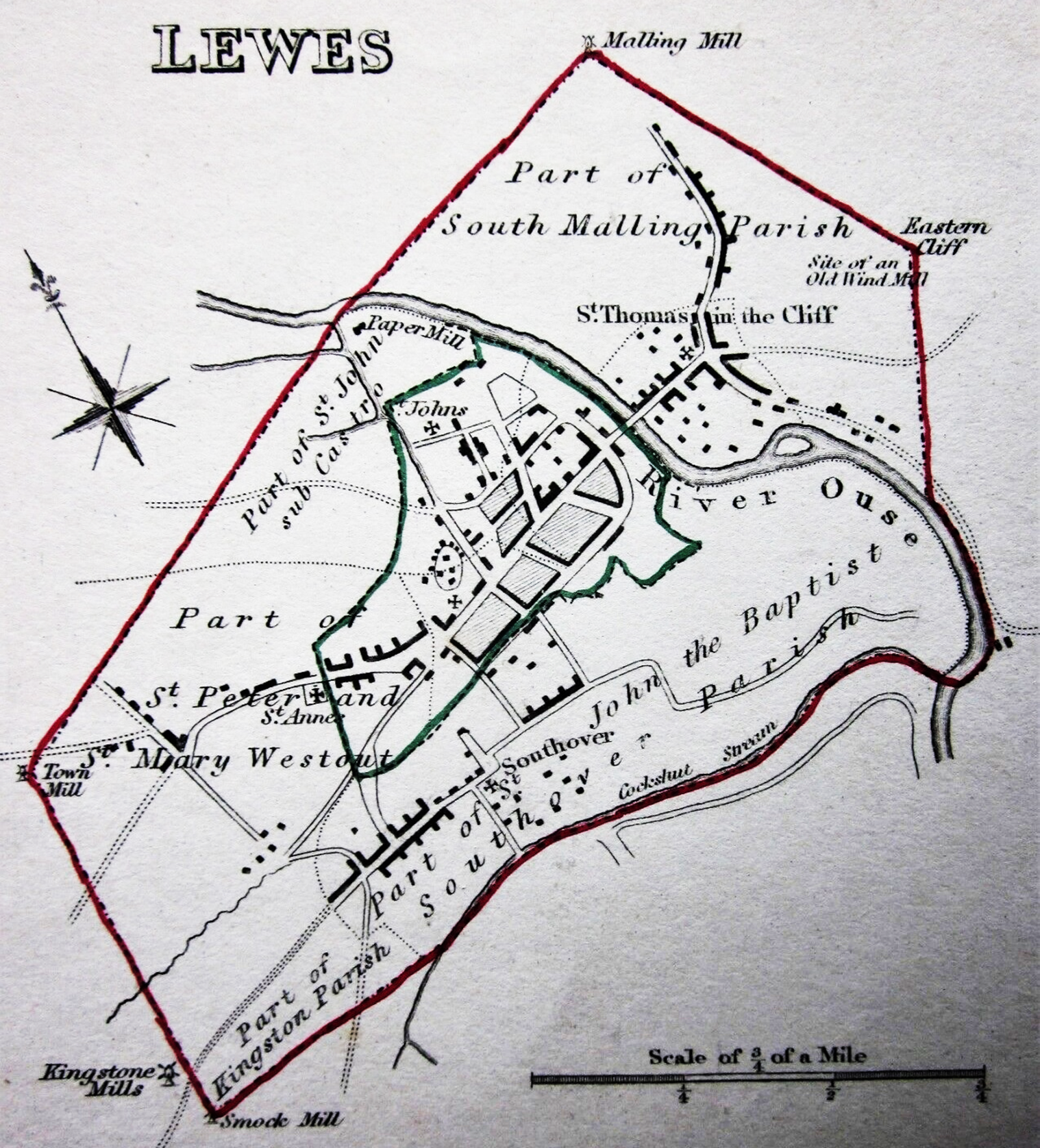
The hotly contested 1832 Reform Act, forced through by Earl Grey’s Whigs, disenfranchised 56 rotten boroughs (including Seaford) and reduced the representation of another 31 old boroughs from two MPs to one. Lewes retained two MPs at this date, though in Queen Victoria’s reign this was reduced to one. New constituencies were created in under-represented areas, mainly in the rapidly growing industrial areas but including for the first time Brighton. The franchise retained a property qualification, but was also broadened and standardised. It was no longer confined to freeholders, but now included tenant farmers and shopkeepers. Instead of every borough creating its own rules to decide who could and could not vote, a new national rule gave the franchise to every male householder of a property valued at £10 p.a. For the first time women were formally excluded from the franchise, with the 1832 Act specifically defining a voter as a male person.
- Lewes High Street in 1755-6
This view of Lewes High Street and the Castle was drawn from the Mount by Cologne-born artist and musician John Baptist Malchair, probably in the year after August 1755, when the army regiment to which he was attached as a musician was based in Lewes. The nearest buildings were those on Stewards Inn Lane, with behind them those on the south side of the High Street. The large gardens running down to the site of the town wall at the base of the hill are a prominent feature of the town.
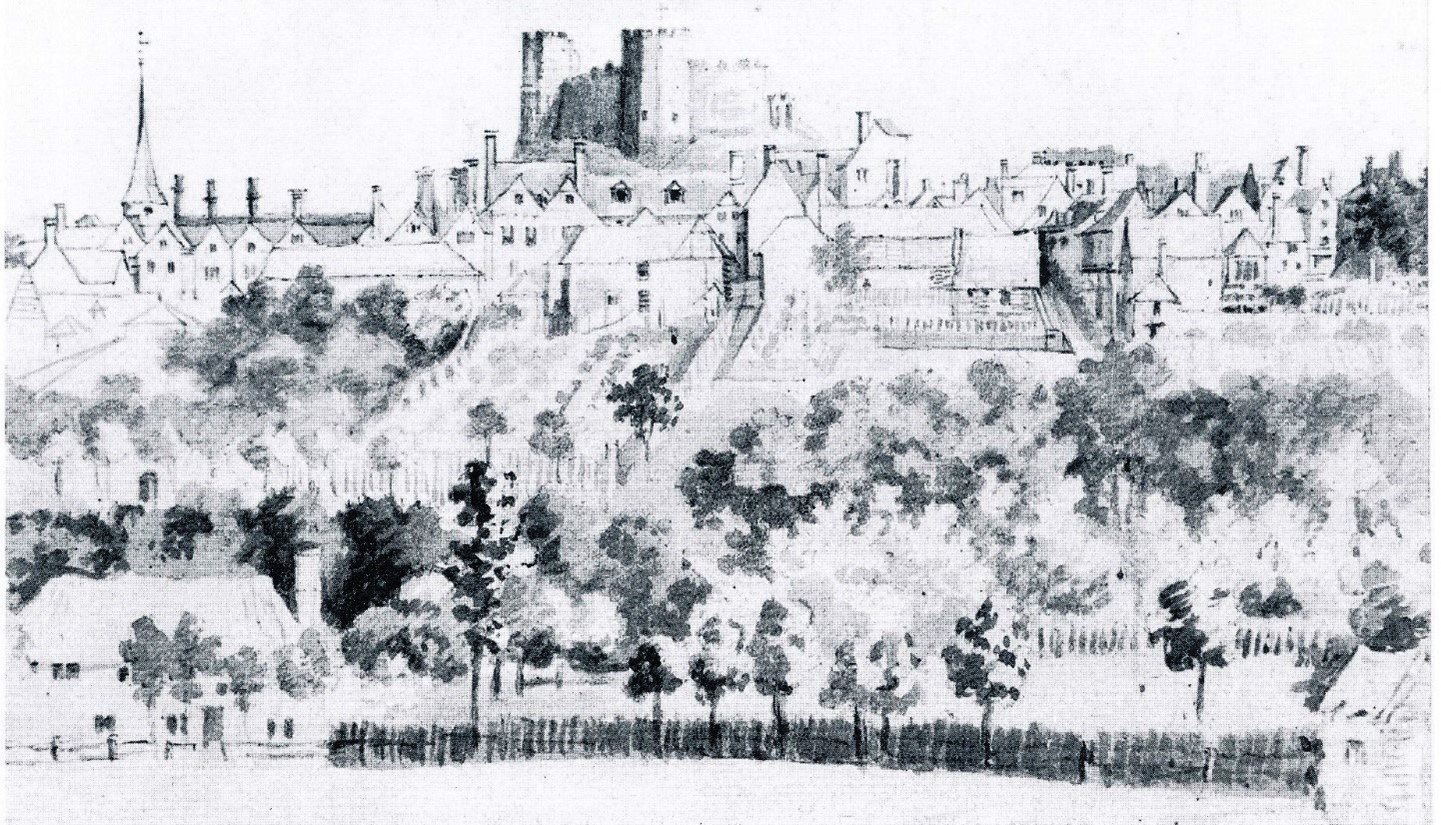
Source: John Farrant, ‘Sussex Depicted’, published in 2001 as Sussex Record Society volume 85.
- Early Trade Unionism suppressed by Lewes Magistrates
At the 1723 Midsummer Quarter Sessions held in the Lewes the magistrates heard that John Sumner, Thomas Woods, Richard Greenfeild, JohnTrelfee, William Russell and John Clarke, all of Cliffe, Richard Wood of South Malling and William Rossom of Lewes had all been convicted by their own confessions of entering into a conspiracy with others not to work but at certain wages as they had agreed amongst themselves. For this crime they were ordered to forfeit £10 each, to be paid within six days. In default the sheriff was to apprehend them and they were to suffer 20 days imprisonment in the common gaol. It is unlikely that any of these workmen will have been able to raise the money to pay the fine, far more than they could expect to have earned in the period.
Source: Quarter Sessions order book, ESRO QO/16
- A 1751 Robbery on the Downs
The 12 October 1751 Ipswich Journal reported:
“On Thursday se’ennight, as the Rev Mr Hincliffe was passing over the South Downs in his way to Lewes, he was attacked by two ruffians on foot, who pulled him off his horse and took out of his pockets a Common Prayer book, a guinea, some silver, a ring off his finger and his hat and wig. They then pulled a cord out of their pockets, tied him by his neck to a stump, and there left him.
This robbery was committed between eight and nine o’clock in the morning and the unfortunate gentleman continued bound until five in the afternoon, when he was released by a poor shepherd, who happily came by and, like a good Samaritan, carried him to his hut, and gave him what refreshment his cottage afforded. He afterwards sought his horse, and after putting him on it, wished him a good journey, desiring him to remember Tom Cordwell the poor shepherd, and his wife Mary and his two bairns Billy and Molly in his prayers. Mr Hincliffe told him he would not only remember them in his prayers, but as soon as he got to Lewes would send them a proper gratuity for their kindness and hospitality, as he did not know but it was (under God) owing to him that his life was preserved.”
This story is also recited by Mark Antony Lower in an article on early Sussex newspaper articles in Sussex Archaeological Collections. However, there is no matching clergyman called Hincliffe or Hinchcliffe in the Clergy of the Church of England database maintained by King’s College, London, nor can I find any trace of the Cordwell family in the Lewes area in this period.
- Edward Reeves at the Old Bailey
On 15 December 1862 Edward Reeves appeared at the Old Bailey before the Common Serjeant to give evidence against Henry Alexander Gough, aged 29, accused of feloniously receiving some knives, forks and watches that had been stolen from Reeves house in Lewes High Street. His address is given as 129 High Street in the court transcript, though local directories list him at 159 High Street at this date.
Reeves’ evidence was that he was a watchmaker, and that on the night of 29 July he had locked up his shop and secured his windows. On the following morning he discovered that his shop and back premises had been broken open and that 70 watches, a quantity of jewellery, two silver forks, three plated forks and two butter knives taken. He identified three watches shown in the court plus the knives and forks as amongst the items stolen from him. The watches were of a common type but they all carried a number and name – no two were alike – and Reeves’ private mark was on the two knives. He kept a detailed list of all his watches, and their marks matched those on his list.
James Jenner, Superintendent of the Lewes Police, gave evidence that he had attended the scene of the burglary on the day it was discovered. He believed it to have been carried out by a hawker of jewellery called Luke Bliss, who could not be found. The defendant kept a Finsbury public house, and another witness, who kept a different Finsbury public house, said that Luke Bliss, who also used the name Watson and was known as ‘Cheap Jack’, had tried to pawn some jewellery to him. Bliss had told him that he had pawned a watch to the defendant for four shillings, and at his suggestion Henry Gough had sold the watch to an acquaintance who wanted one, allowing him to take it away on trial. This was one of Edward Reeves’ watches. When the police searched Henry Gough’s premises they discovered quantities of jewellery, watches and handkerchiefs, but for most he had a satisfactory account. Some belonged to an auctioneer who held auctions at his public house. Others, including those Edward Reeves had identified, he had obtained from pawnbrokers and he admitted that he had bought some articles from Bliss. Bliss was also known to the London police as traveller and hawker in the jewellery trade who ‘haunts that part of London’. Both the London police and the other publican gave the defendant a good character, noting that he was respected and one of the vestrymen for Shoreditch. The defendant was acquitted, with both the court and the jury stating that he left the bar without the slightest stain on his character.
Source: https://www.oldbaileyonline.org/browse.jsp?name=18621215
- The Lewes Mechanics Institute
Lewes Mechanics Institute (MI) was started in 1825, the same year as those in Brighton and Chichester (the first three in Sussex), and less than two years after the pioneer London Mechanics Institute was inaugurated in December 1823. Mr Ricardo of the Brighton Mechanics Institute, which had started 3 months earlier, attended the inaugural meeting at the Star Inn on 2 November 1825, as did Dr William King from Brighton, who gave a course of lectures at Lewes. Present at the first Lewes meeting were Unitarians Rev Thomas Walker Horsfield (who became vice-president) and Henry Browne (who became the Lewes Mechanics Institute secretary). By 1826 it had classes in chemistry, pneumatics, geography, English grammar, writing, drawing, arithmetic and French. In 1846 Dr King, who led the pneumatics class, attended its 21st anniversary celebrations. Henry Browne and his business partner William Crosskey, both Unitarians, were two of the Lewes MI’s staunchest supporters. Henry Browne had a private chemical laboratory and also a private printing press. His scientific knowledge made him a frequent lecturer, especially on chemistry. A librarian and two sub-librarians were appointed to manage the MI’s library.
Unitarians and Quakers were everywhere heavily engaged in the promotion of Mechanics Institutes, and in Lewes both groups had influential non-conformist churches. The Quaker Burwood Godlee, who had founded the Lewes gas works, was another leading figure in managing the Lewes MI, as was the Wesleyan shepherd-turned-schoolteacher John Dudeney. All these non-conformists were, politically, committed Liberals, but the Tory Sussex Express, established in 1837 by John Baxter, also gave strong support. The dominant figures in the organisation were Henry Browne and, later, Charles Aspull Wells, and it was Wells who was responsible for the preservation of its excellent archives.
The organisation was initially based in a house in the Cliffe but in 1827 rented the former theatre building in West Street. In 1840 this building was purchased by raising loans, in the form of £25 shares, from supporters, but in 1867 the shares were redeemed and additional money borrowed to extend the premises. In the 1870s club amenities were added and the name changed to the Lewes Institute. However, by 1880 it was decided to wind up the institute, as considerable debts had accumulated. Ownership passed to the mortgagee, Montague Spencer Blaker, in 1881.
Lewes MI thus survived for over 50 years, whereas Brighton, less well managed, folded after a few years, to be resurrected later. Similar institutes spread rapidly to towns throughout the county. Their role was the technical and scientific education of (mainly) young men to create the skilled workforce that Victorian society needed. However in 1833 the committee decreed that each member could bring a lady to every lecture. In 1834 the Lewes committee were twice challenged by aggrieved male members who objected to their decision to allow women to use the library and attend lectures if they paid the appropriate fee. The committee’s refusal to change their decision reflected the positive attitudes of Quakers and Unitarians to the education of women. However, they did not go so far as to permit their committee room to be hired by those who wished to use it for dancing. As late as 1879 women were not allowed to vote at meetings or become members of the committee. Women were unusual but not unknown as lecturers. In 1847 the Lewes MI invited the London-based Clara Balfour, a committed advocate of the Temperance movement and one of the most accomplished and popular lecturers on the MI circuit, to give two lectures on the moral and intellectual influence of women. It was Rev Samuel Wood, the Unitarian minister at Westgate, who arranged Mrs Balfour’s invitation to speak at Lewes. Women were also regularly involved as performers in the Mechanics Institute musical entertainments.
From the 1830s, contrary to the national trend, the Lewes MI actually increased its focus on scientific subjects. Courses between 1830-1837 included galvanism, hydrostatics, the atmosphere, acoustics, the steam engine and astronomy. Chemistry was the most frequently selected science, with Henry Browne leading a course over the period from October 1834 to January 1836. Other topics included phrenology, music and horology. From 1838 the Lewes membership was introduced to the ways in which science was applied to contemporary trades and everyday life, with short courses on dyeing, warming and ventilating houses, and the influence of machinery on the condition of society. A course of three lectures on the steam engine which included its application to railways (which had not yet reached Lewes), the steam plough and the steam printing press, was attended by over 200 people. At its peak annual membership was between two and three hundred.
There was still plenty of science in the Lewes MI programme for the 1840s, but there were now included talks on the principles of Friendly Societies, popular superstitions and the history of the English language. In 1844 Rev Samuel Wood lectured on school buildings, furniture and tactics. Two years earlier he had proposed the establishment of a Unitarian Normal School, and at his death he left a £2,000 bequest for the education of poor, destitute and orphan children. He also gave his own lectures at Westgate Chapel, with notice of them given to Lewes MI members alongside their own lecture programme.
By the late 1840s Lewes MI was running two music classes each week, terminating in a concert. Reading, conversation, discussion and elocution classes were found at most MIs. Lewes and Brighton were unusual in offering Latin tuition. There was also a chess class. When a teacher could not be found for a drawing class in 1848, the committee resorted to mutual instruction by the class members. Teachers of the more advanced mathematics classes were remunerated at £2 per quarter, while tutors for more basic numeracy and literacy received only half that rate. Lewes MI continued to run more basic classes in such topics as reading, writing, English grammar, algebra and geometry, with some teachers volunteers and others paid.
From 1868 the Mechanics Institute was rivalled by the new Lewes School of Science and Art, established to prepare candidates for national examinations. The Lewes School was accommodated in a new building on Albion Street (later to become the town museum and later its library) that cost £2,000. Its subjects by 1882 included drawing and painting, geometry, construction, designing and modelling. It offered scholarships and awarded prizes on the basis of local examinations held each May. The secretary of the School of Science and Art was Robert Crosskey, another Unitarian.
Source: Jana Hilda Sims, ‘Mechanics Institutes in Sussex and Hampshire: 1825-1875’ (2010) PhD thesis, Institute of Education, University of London [https://core.ac.uk/download/pdf/33678422.pdf]; ESRO AMS 6006.
- The Martyrs’ Memorial, Cuilfail
The Martyrs’ Memorial was built on land owned by Isaac Vinall, solicitor, a leading member of Jireh Chapel (where his father and grandfather had been minsters) and proprietor of the Ragged School. The memorial’s construction was the project of a group called the Protestant Alliance, principally made up of local non-conformist churches. On the Sunday before its official opening special services were held at Jireh, Eastgate Baptist, Tabernacle, Wesleyan and Hamilton Presbyterian churches, and at the parish churches of South Malling and Southover, and representatives of all these churches attended the opening.
The cost was covered by a national subscription to which over 800 people contributed, including many with no special connection to Lewes. The memorial stands almost 36 feet high, and used 210 tons of stone, mostly Aberdeen granite. It was unveiled by the Countess of Portsmouth on 8 May 1901, while mayor George Holman gave a speech of welcome. Isaac Vinall and his staff kept count of those who entered the site. Despite heavy showers their tally was 5,812.
Source: Jeremy Goring, ‘Burn Holy Fire’ (2003) p.136
- An early Lewes Picture Postcard
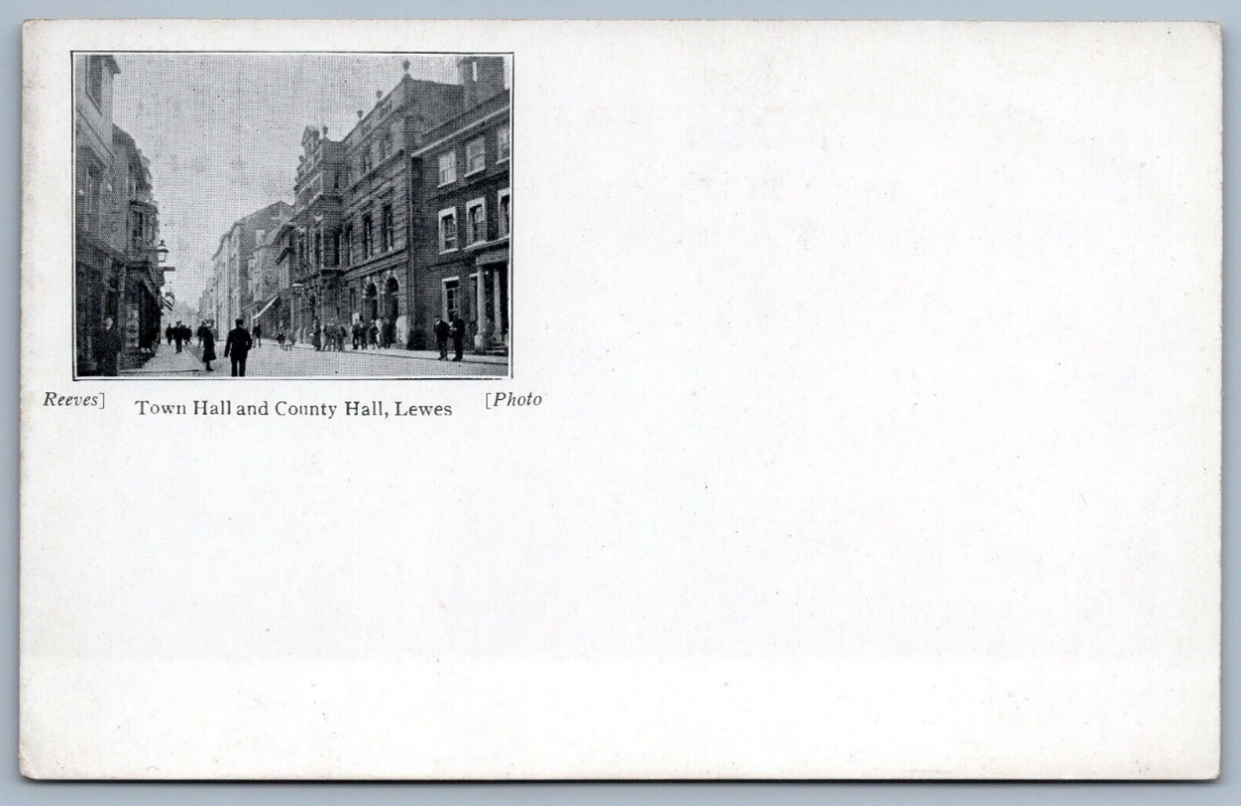
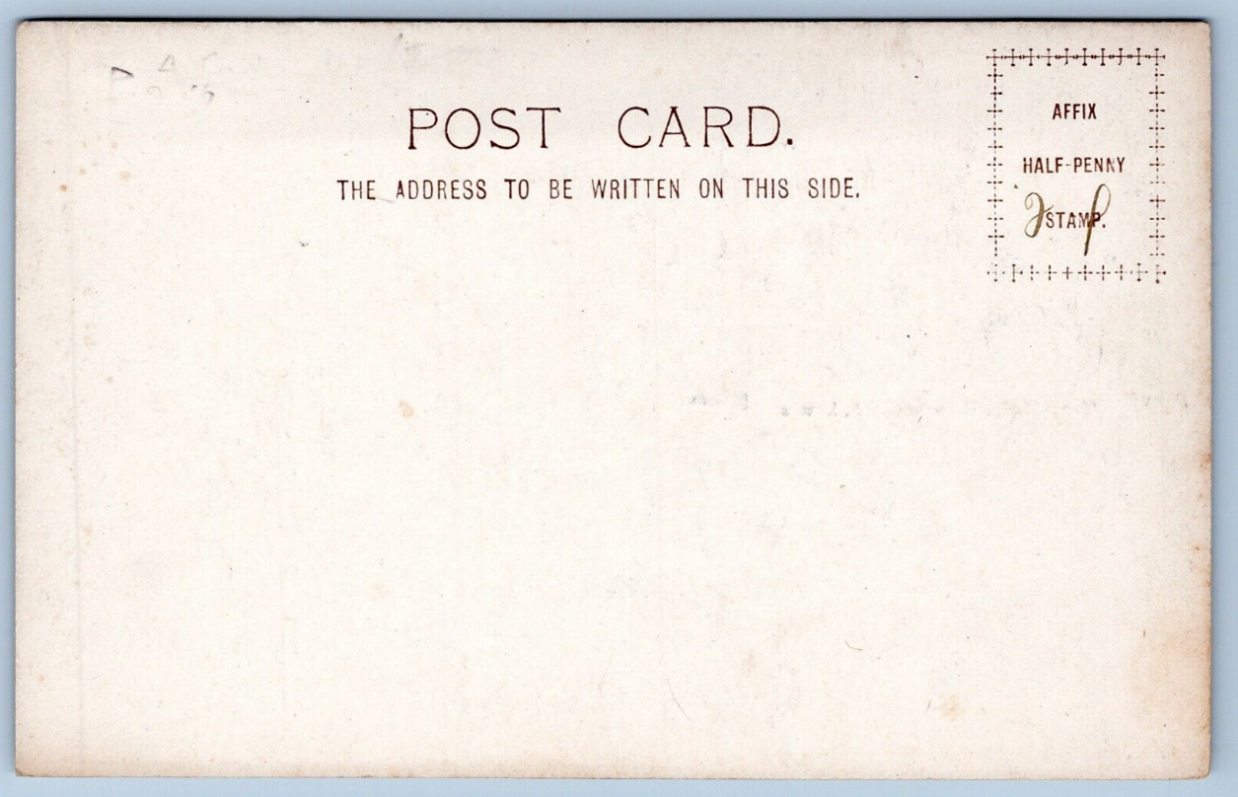
When postcards were first allowed by the Post Office in 1870 one side was devoted to the address and your message was confined to the other. They required just a halfpenny stamp, at a time when the postage for a sealed envelope was a penny, as it had been since 1840. When picture postcards were first introduced at the very end of Queen Victoria’s reign this is what they looked like. The message side included a small picture, in this case by Reeves, and not brilliantly printed. The rest was for your message.
Within a very short time, just a year or two, the pictures got bigger and bigger, and the message space smaller and smaller. In 1902 the Post Office agreed to accept cards with the message on the same side as the address, so the picture could fill the whole of the other side.
- New homes for old at Landport (by Chris Taylor)
In 1933, prompted by the government’s policy to tackle slum housing and its associated evils, Lewes Borough Council identified 35 “Clearance Areas”, in which over the next five years, using when necessary powers of compulsory purchase, insanitary and over-crowded dwellings would be demolished and their inhabitants re-housed. These areas were located in streets across the town, including St John Street, Southover High Street, Western Road and St Pancras Lane. The first demolitions – at South Place and Priory Street – were replaced in situ with blocks of flats [Bulletin no.153], but by 1936, responding to the government’s exhortation to accelerate the programme, the council was on the lookout for land on which to build. The first purchases, at Winterbourne Hollow, were insufficient to meet the demand and, in December 1936, unimpressed by objections from residents in King Henry’s Road and Wallands Crescent, the council bought 39 acres of farmland and allotments between Landport Lane and the Offham Road from the Abergavenny estate for £3,700, plus £190 compensation to the tenant farmer for the loss of his crops.
Landport was the council’s most ambitious housing scheme to date, employing 180 workmen and requiring the hire of an additional council architect and engineer. The contract to build 172 houses (8 with one bedroom, 40 with two, 112 with three and 12 with four) and four shops was awarded to McClelland & Co of London for £61,080. The site was to include three green recreational spaces. George Beard, a partner in the company that owned the Star brewery in Fisher Street, offered to buy half an acre of the site for £365 on which to build a pub (the Tally Ho). The council agreed, but refused his request that it should be the only licensed premises allowed on the estate (he needn’t have worried). A new access road was planned with, where it joins the main road, a suspended roadway requiring a reinforced concrete bastion. This specialised project was entrusted to the London engineering firm of Reed & Mallik. A ceremony in February 1939 marked its opening, at which Councillor Baker, Chairman of the Public Health and Housing Joint Committee, declared that the bastion would “in 150 years time … stand as sound and solid as it is today.” In an ominous sign of the times, he pointed out that 700 people could shelter under it in the event of war.
This first phase of the Landport estate was completed and fully occupied by March 1939. The rents ranged from four shillings (20p) a week to six shillings and ninepence (34p) for a 4-bedroom house. The average workman’s weekly wage at the time was about £1.75p. Virtually all the original residents were families re-located from slum clearance areas. Almost all the men were employed in manual trades: building workers, painters and decorators, lorry drivers, roundsmen, shop workers, gardeners, cement workers, railwaymen, grooms and lads at the racecourse. For them and their families, a new house at Landport must have represented an appreciable improvement over their previous, privately-rented accommodation.
The councillors’ approach at this time could be characterised as one of well-meaning paternalism. In 1938 they erected an obelisk marking the Greenwich meridian with a metal emblem on top, donated by Councillor Every. Each household received a copy of “The New Home”, a handbook of hints on good housekeeping, published by the national Health and Cleanliness Council in 1937. And in May 1939 the council inaugurated an annual garden competition, open to all its tenants, with a silver challenge cup for the best one, donated by Councillor Crisp.
The new homes did not satisfy the great demand. In 1938 the council had a waiting list of between 100 and 130 families and in December they took the decision to build a further 80 houses at Landport. Fifty-one of these were designated to relieve over-crowding, and so would qualify for government subsidies; but the other 29 would be “general requirement” houses, attracting no subsidy and thus paid for from the rates. The weekly rent for these houses was consequently a little higher: between 8s 6d (43p) and 9s 9d (47p). Building, undertaken by Messrs F. W. Beach of Shoreham, got underway in April 1939 and was about half completed when the war intervened. House-building came to a halt; the next decisive initiatives towards enabling the population to inhabit decent homes at rents they could afford had to wait until the immediate post-war years.
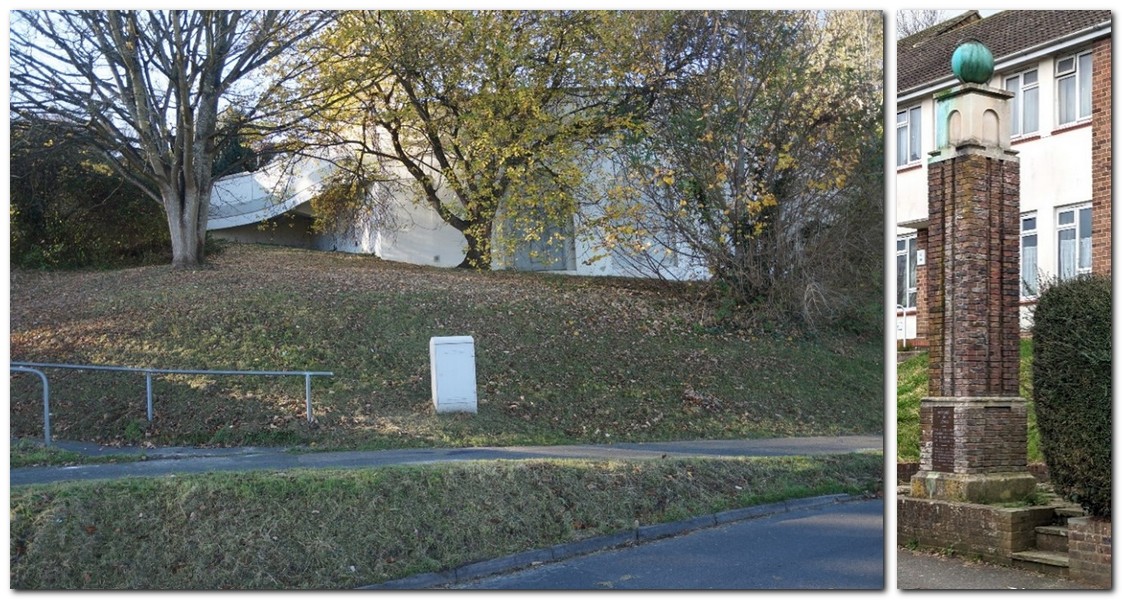
The Landport Bastion and the Meridian Obelisk
Sources: Lewes Borough Council Public Health and Housing Joint Committee minutes ESRO DL/D/174/1; Sussex Express 1938, 1939; Government Register, September 1939; The New Home: a handbook for tenants, The Health and Cleanliness Council, 1937 [https://cdm21047.contentdm.oclc.org/digital/collection/health/id/500]
- 1955 Traffic in the High Street
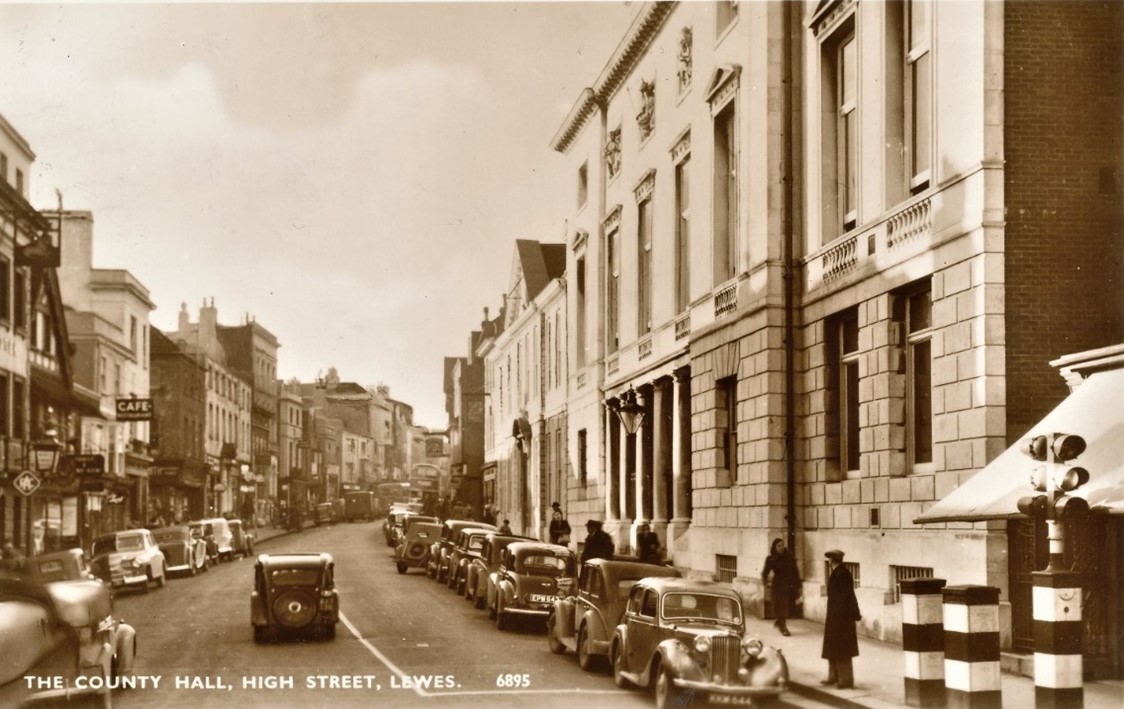
This Shoesmith & Etheridge ‘Norman series’ postcard, postmarked 1955, illustrates the accumulation of traffic in the High Street, even at a time before cars were such an everyday feature of Sussex life.
John Kay
Contact details for Friends of the Lewes History Group promoting local historical events:
Sussex Archaeological Society
Lewes Priory Trust
Lewes Archaeological Group
Friends of Lewes
Lewes History Group Facebook, Twitter



 Lewes History Group