
Please note: this Bulletin is being put on the website one month after publication. Alternatively you can receive the Bulletin by email as soon as it is published, by becoming a member of the Lewes History Group, and renewing your membership annually.
- Next Meeting: 12 June 2023, Philip Taylor, ‘The History of Gorringe’s Auction Galleries’
- L.H.G. Walk: 16 July 2023, Sue Berry, ‘The Industrial History of Lewes’
- B.A.L.H. Award (by Jane Lee)
- John Every, an Enlightened Victorian Employer
- Garden defences
- Pictures of Lewes offered at Gorringe’s in April
- Nuisance at the Bargeman’s Arms
- St Mary in Foro
- Lewes History for Sale: St Michael’s Court, Keere Street
- Somewhere to live: post-war prefabs in Lewes (by Chris Taylor)
- Warehouses lining the River Ouse
- Next Meeting 7.30 p.m. King’s Church, Lewes Monday 12 June Philip Taylor The History of Gorringe’s Auction Galleries
On 12 June, the Lewes History Group welcomes Philip Taylor who will guide us through almost a century of Gorringe’s Auction Galleries’ history, from a local Sussex saleroom to an internationally known business at the forefront of the online auction experience. As with a number of successful provincial auction rooms, Gorringe’s largely owes its origins to one famous sale; theirs being the contents of Lewes House, conducted by Rowland Gorringe in 1929. This sale aroused international interest, resulting in Rowland Gorringe becoming ‘’the man’’ to consult for the sale of Art and Antiques in Sussex.
Philip Taylor, a partner since 1981, will discuss and trace the firm’s journey through almost 100 years, from periodic ‘’on the premises’’ house sales, to the eventual opening of Gorringe’s Galleries, in North Street, Lewes, in 1945. Philip will cover outside sales of the contents of country house, private schools, as well as looking at a host of remarkable individual sale results, including £24,000 for a lock of John Lennon’s hair and the £82,000 for Orwell’s Down and Out in Paris and London. We will hear how sales ledger accounting has progressed to state-of-the-art digital online sales, which now expose every sale to over 3,000,000 potential buyers.
Members are requested to register in advance, so that we can monitor numbers attending. Non-members wishing to attend should register and pay in advance, as usual.
- L.H.G. Walk 2.30 p.m. Sunday 16 July Sue Berry The Industrial History of Lewes
This will be a revised version of last October’s popular walk, but following a new route. The walk will start from Lewes bridge.
Each walk will be restricted to twelve LHG members, and advance booking, open now, is essential. There is a charge for joining these walks, in this case £5, refundable if the walk has to be cancelled because of bad weather, etc. Tickets are available from https://www.ticketsource.co.uk/lhg, on a first come, first served basis.
- B.A.L.H. Award (by Jane Lee)
On 18 May, Lewes History Group’s Dr John Kay, programme secretary and editor of the monthly LHG Bulletin, won the Outstanding Individual Contributor Award for 2023 from the British Association for Local History (BALH). This prestigious honour is given to a local historian who has made a significant voluntary contribution to the subject in their locality and John certainly fulfils the criterion.
With his unstinting enthusiasm and wide local knowledge, past and present, John was especially singled out for his four decades of producing monthly bulletins for first the Ringmer History Group, then the Lewes History Group too; the co-founding of both societies; his responding usefully to other researchers’ enquiries from around the world; as well as his many other voluntary roles in the community.
- John Every, an Enlightened Victorian Employer
John Every, founder of the Phoenix Ironworks, was widely considered a model employer. He was the leading member of the Unitarian congregation at Westgate Chapel, and a Gladstonian Liberal. In 1871 he was one of the first employers in the town to agree to reduce his employees’ working week to 54 hours.
 The theologies of Westgate Chapel and the Calvinist Eastgate Baptists were about as far apart as people who called themselves Christians could get, but on John Every’s death in 1900 the pastor of Eastgate, Rev John Penfold Morris, devoted an entire sermon to a eulogy. He commended his ‘sturdy active life and upright character’ and his support for the Temperance campaign. He may well have been influenced by the fact that John Every, in recognition of the work Eastgate did for the children of the town, conveyed to them the site for their Sunday School building at a nominal price and had made a generous contribution to the cost of the building.
The picture shows Eastgate Chapel, built in 1843, with its original ‘pepperpot’, which had to be removed in 1915. Across the road stood the Eastgate Sunday School, built in 1899 but demolished when Phoenix Causeway was built.
Source: Jeremy Goring, ‘Burn Holy Fire’ (2003) p.140
- Garden defences
The following report appeared in the 8 September 1825 Brighton Gazette:
“On Tuesday morning the garden of Mr Stephen Walls of St Ann’s was entered by some depredators for the purpose of robbing it of its beautiful produce. They scaled the wall from Mrs Newton’s field, but soon came into contact with the string of a spring gun set in the garden, which caused an immediate explosion. They made a precipitate repeat, having effected their purpose. The report was distinctly heard by Mr W. and it is supposed the contents struck one of the thieves. Had these fellows proceeded a little further towards a fine pear tree that was robbed of its fruit last year, they would in all probability have been saluted by a steel trap.”
- Pictures of Lewes offered at Gorringe’s in April
A number of local paintings, etchings and prints were auctioned at Gorringe’s weekly sales in April, many of them sold at very affordable prices. They included the following.
A view from the Coombe by Edward Stanley Inchbold: This watercolour signed by Stanley Inchbold was sold for £80. Edward Stanley Inchbold was born in Greenwich in 1855, son of Thomas Mawson Inchbold, a Yorkshireman who also described himself as a painter in the 1861 census. His paintings are usually signed ‘Stanley Inchbold’.
In 1881 he was a schoolmaster in Barnet but studied art at Sir Hubert von Herkomer’s art school at Bushey, Hertfordshire, from 1892 to 1894. He and his wife travelled extensively in Europe and the Middle East, but later lived in Alfriston and Eastbourne, where in the 1911 census he described himself as a professional artist aged 55, while his wife Ada was an author, a romantic novelist and a travel writer.
He illustrated Arthur Beckett’s book ‘The Spirit of the Downs’, first published in 1909. He died in 1934, aged 78, and was buried in Brighton Borough cemetery. The memorial to Stanley & Ada Inchbold includes a quotation from Revelations 14:13, ‘Their Works do Follow Them”.

Source: Neil Stevenson’s online artblog; Familysearch; billiongraves.com.
Lewes Castle Etching: This 19th century etching of Lewes Castle was estimated at £40-£60, and sold for £50. For three other similar and broadly contemporary views see Bulletin no.142.

Cliffe Bridge and the Bear Inn by Clem Lambert: This attractive watercolour of Cliffe Bridge and the Bear Inn is signed by the Brighton-based artist Clem Lambert. He specialised in landscapes and coastal scenes and has several paintings in the Brighton Museum collection. He was a member of the Brighton Fine Art Committee. It was sold, together with the following item, for £50, well below the estimate.

Clement Lambert was the youngest son of a Brighton jeweller and a professional artist. He exhibited widely at the Royal Academy and elsewhere from the 1880s onwards. Although most sources give his dates as 1855-1925, his birth was actually recorded in Brighton early in 1850. He was a lifelong Brighton resident, living first with his parents and after their deaths with other unmarried siblings. His ages as recorded in the censuses were 1 in 1851, 11 in 1861 (when living with his parents), 29 in 1881, 40 in 1891 (when living with an elder brother who took over the family business), 48 in 1901 and 54 in 1911 (when living with his younger sister Charlotte). When his 1924 death was registered in Brighton early in 1925 his age was given as 70. His sister Charlotte, born in 1852, similarly shaved a few years from her real age for census purposes – she was recorded as 8 in 1861, 25 in 1881, 30 in 1891 and had lost a whole decade by 1901 when she claimed to be 38. By 1911 she admitted to 50. After their eldest brother’s death it was Charlotte rather than Clement who became head of the household.
He was described as a tall stooping figure with a questioning glance in his eyes, and had feared an early death, as he suffered from tuberculosis. A consequence of this was that he never married his lifelong sweetheart, who by his death had accumulated 110 of his paintings. He was buried at Hove Cemetery with his tombstone marked simply ‘Clem’, with no surname. Also buried in the same plot were his sister ‘Lottie’, and a dentist brother and his wife. He did have a family connection with Cliffe – his Norwich-born father and Brighton-born mother were both ‘of this parish’ when they married at Cliffe church on 30 June 1833.
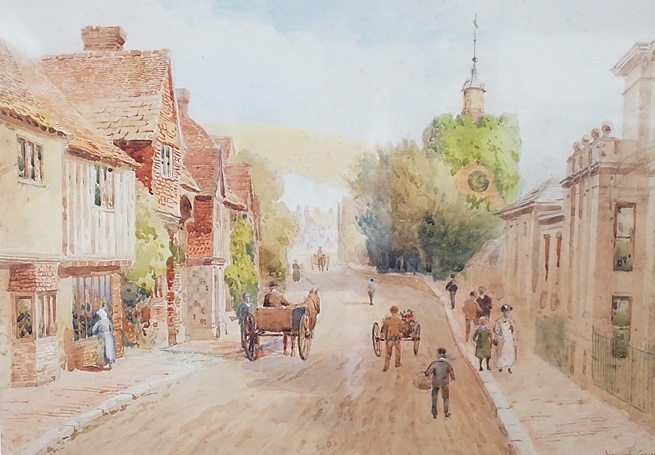
Southover High Street by Howard Gaye: This watercolour of Southover High Street was signed by the architect-artist Howard Gaye (1848-1925). He was a Suffolk man who moved to London in the 1880s. Another of his paintings, a view of the Castle as seen from the Priory and painted in 1895, was sold by Gorringe’s last February. That painting, and a brief account of his life, were included in Bulletin no.141. As he is not known as a regular visitor to Lewes, perhaps this was painted on the same occasion?
- Nuisance at the Bargeman’s Arms
Edmund Evans was brought before the magistrates at the Midsummer Quarter Sessions in 1865 charged with “keeping a certain common, ill-governed and disorderly house, and causing certain persons of evil name to frequent the said house, and there to remain drinking and misbehaving themselves, at St Thomas’s in the Cliffe, Lewes, on 13 April 1865 and at divers other times”. The house was called the Bargeman’s Arms or Aunt Harriet public house. The prosecution was by the parish officers, because the house had been for some time a disgrace, and a nuisance to the neighbourhood. The defending barrister said his client would plead guilty, and it had been agreed with the prosecution that he would be set at liberty on his own recognizances, with the conditions that the nuisance should be suppressed, and the house conducted in future as it should be. The prisoner entered into the required recognizances, and was allowed to leave the court.
Source: 1 July 1865 Sussex Advertiser: L.S. Davey in ‘The Inns of Lewes, past and present’, notes the Bargeman’s Arms at an unidentified location in South Street in the 1850s. David & Lynda Russell, ‘The Pubs of Lewes’ note Harriet Welfare (presumably ‘Aunt Harriet’) at the Bargeman’s Arms from 1862 and then Edward Evans from 1865. There are no later references to the Bargeman’s Arms. The Anchor Beer House, 101 South Street, is recorded from 1865, though as Heather Downie notes on the LHG website, that is in South Malling parish rather than Cliffe.
- St Mary in Foro
This coloured etching of the former church of St Mary in Foro as it appeared in 1770 was reproduced for the February 1825 edition of the Gentleman’s Magazine. It stood at the junction of High Street and Station Street. How much of the medieval fabric survives within the contemporary building on this spot, shown in the Edwardian postcard below?

- Lewes History for Sale: St Michael’s Court, Keere Street
Offered for sale in May by Rowland Gorringe at £750K is 1 St Michael’s Court, Keere Street. Grade II listed (alongside its neighbour), it is described as formerly a row of almshouses. The external walling is of knapped flint. It carries a plaque that briefly outlines its history.


Thomas Mathew was a prosperous late 17th century woollen draper who lived at 83 High Street, which had 10 hearths in the 1662 Hearth Tax. He also owned substantial property in Norlington, Ringmer, distributed on his 1690 death between nephews and nieces. This property was then an alehouse called The Bottle. By his will, written in 1688, he left this Keere Street house, subject to a cousin’s life interest, to St Michael’s parish for the benefit of the poor. He also bequeathed £60 to support dissenting ministers ejected from their livings in 1662, after the Restoration. By the early 18th century The Bottle had become the St Michael’s parish workhouse, and it was enlarged in 1797, when more accommodation was needed. After the 1834 New Poor Law was introduced it became almshouses. The Historic England listing describes it as rebuilt in 1846.
Sources: Colin Brent, ‘Lewes House Histories’; Historic England listing; ESRO PAR 414/24/1/1.
- Somewhere to live: post-war prefabs in Lewes (by Chris Taylor)
The outbreak of the Second World War effectively put a stop to house building. As the war drew to a close, Britain faced a more serious housing shortage than ever before. Many thousands of houses across the country had been lost or badly damaged by bombing (56 in Lewes); and by 1945 it was estimated that 750,000 new homes were required in England and Wales to replace them and continue the pre-war slum clearance schemes. Well before the end of the war the National Government began to plan an ambitious house-building programme. As early as 1943 local councils were instructed to consider their post-war housing requirements and to earmark sites to meet them. In March 1944 they were encouraged to purchase in advance, compulsorily if necessary, the land they would need for the first two post-war years.
In the summer of 1944, acting on the recommendations of a specially-appointed Post-war Housing Sub-committee, Lewes Borough Council responded by opening negotiations to buy an extra 25 acres to build an additional 136 dwellings, arranged in terraces and two-storey flats, on the Landport estate, the development of which had begun in the immediate pre-war years (see Bulletin 154). They also cast an acquisitive eye over the Mill Field on Malling Hill, the site that eventually became The Lynchets estate.
An important part of the government’s housing policy was the rapid construction of prefabs – factory-built, single-storey temporary dwellings – as a stopgap measure until enough men had been demobilised to work on building sites. A total of 156,000 were built nationally, although Churchill originally wanted half a million. In February 1945 Lewes Borough Council applied for 48 prefabs, of which 42 were eventually supplied: 28 in the newly-constructed Crisp Road and Churchill Road on the Landport estate; and 14 at Winterbourne in a new road to be called Winterbourne Lane. Prefabs were owned by the government and expected to last for 10 years. The council was responsible for maintaining the sites on which they stood and paid the government £23 ten shillings per year for each one. The Lewes prefabs were all of the Uni-seco type, manufactured by the London-based Selection Engineering Company, using a timber frame and asbestos cement cladding.
Although designed to be a rapid response to an immediate crisis, the prefabs took quite a long time to arrive in Lewes. Only about half a dozen (at Winterbourne) were ready for occupation by the end of 1945, causing the council and Tufton Beamish MP to complain to the ministry about the delay. It took until October 1946 to install them all, while the demand for housing remained very high. The council received 170 applications from families to occupy the 42 prefabs. A hierarchy was established to decide who would qualify: returning servicemen (including war widows) were at the top of the list, followed by families living in overcrowded or insanitary accommodation, those suffering from a serious medical complaint and those with children under the age of 11. Any ‘tied’ decisions would be settled by taking into account the family’s length of residence and/or employment in the borough. The weekly rent was fixed at 11/6 (57½ p).

A seco prefab, and today’s Winterbourne Lane bungalows
The Lewes prefabs outlived their 10-year projected life span. In June 1955 Lewes Borough decided to retain them for a few more years. In September 1950 the government had made councils responsible for all their associated costs but retained responsibility for their removal. The council planned to have them removed between 1960 and 1965, so that they could be substituted with permanent housing. Accordingly, the prefabs in Crisp Road and Churchill Road were demolished in April and June 1961 respectively. Those in Winterbourne Lane survived a little longer because the ministry queried whether it might be more economical for the council to retain and repair them. After an inspector’s visit the council’s view prevailed. Winterbourne Lane lost its prefabs in March 1962, to be replaced by 24 dwellings for elderly tenants, comprising 13 bungalows and 12 flats in three blocks of four: they are still there.
Sources: Housing and Health Committee minutes, ESRO DL/D/169/9; Historic England, A Brief History of Prefabs https://heritagecalling.com/2022/08/04/a-brief-history-of-prefabs/; Elliston, R.A. Lewes at War 1939-1945 (1995)
- Warehouses lining the River Ouse
This pen and ink watercolour by local artist Ted Pelling-Fulford (1922-2013) titled ‘Lewes from the Bridge’ features the warehouses then lining the west bank of the River Ouse downstream of the bridge. It was sold on ebay in October 2018 and shows a view that many residents will remember, but is now utterly changed.

John Kay
Contact details for Friends of the Lewes History Group promoting local historical events:
Sussex Archaeological Society
Lewes Priory Trust
Lewes Archaeological Group
Friends of Lewes
Lewes History Group Facebook, Twitter



 Lewes History Group