
Please note: this Bulletin is being put on the website one month after publication. Alternatively you can receive the Bulletin by email as soon as it is published, by becoming a member of the Lewes History Group, and renewing your membership annually.
- Next Meeting: 10 July 2023, Chris Grove, ‘The Battle for a Railway to Lewes’
- Chair’s Report (by Neil Merchant)
- An unsatisfactory Apprentice
- Rev Richard Cecil, an Evangelical Preacher
- William Hawley and the Lewes Union Guardians
- The rebuilding of St John-sub-Castro
- Lewes 1945-1955: how to tackle a housing shortage (by Chris Taylor)
- Historic Lewes for Sale: 1 Little East Street
- Hannah Fuller’s Diaries
- Lost Lewes street names
- Next Meeting 7.30 p.m. King’s Church, Lewes Monday 10 July Chris Grove The Battle for a Railway to Lewes
Chris will tell us the remarkable story of the events that led to the eventual approval of the coastal railway through Lewes in mid-19th century. The new railways were making their impact felt across the country, with the connection from Manchester to Liverpool pre-dating that from London to Brighton by a decade, but there were many different ideas about where the new lines should run, and fractious meetings both in Parliament and across East Sussex. We have become used to our railways today, but they could so easily have been very different.
Members are requested to register in advance, so that we can monitor numbers attending. Non-members wishing to attend should register and pay in advance, as usual.
- Chair’s Report (by Neil Merchant)
Your committee held a small reception, funded from reserves, at the end of May. It’s primary purpose was to recognise John Kay’s Outstanding Contributor Award from the British Association for Local History. We used the occasion to also thank those who have contributed to LHG’s success over the past fourteen years, for example inviting our books’ authors, and our longest-standing members, Sue Berry, Bob Cairns and Christopher Whittick, who presented John with his award certificate.
I’m pleased to confirm that we have identified both a new treasurer to succeed Ron Gordon, and a new PR/Comms officer to succeed Jane Lee: they are Phil Green and Jeremy Hedger respectively, and transition is under way for both. A brief biography for Jeremy is below: Phil’s will follow later.
While this recruitment satisfies our immediate and pressing needs, we’d very much like to recruit further new blood, so do step forward if this appeals to you.
Jeremy Hedger has a keen interest in social history. He is now semi-retired; previously he ran a marketing and management consultancy. He is an experienced marketeer: over a 40 year career he has worked for, and with, many organisations in the private, public and voluntary sectors. He is currently based just outside Lewes in Beddingham.
- An unsatisfactory Apprentice
At the Michaelmas 1713 Quarter Sessions in Lewes the magistrates considered the conduct of Timothy Grover, apprentice to Daniel Fabre of Lewes, periwig maker. They described him as an idle disorderly person, and decreed that he should remain in the House of Correction for one month, “have due correction”, and then be discharged, paying his fees. His apprenticeship was to be terminated.
Source: Quarter Sessions order book, ESRO QO/14
- Rev Richard Cecil, an Evangelical Preacher
Rev Richard Cecil (1748-1810) was from a wealthy family. He came to the church after spending some years in a City of London business house, and he embraced evangelical Christianity after an ill-spent youth. His father, an Anglican, was recorded as scarlet-dyer to the East India Company and a descendant of Lord Burghley. His mother was a pious dissenter from the Grosvenor family. As a young man he wrote poetry and played the violin, but his passion was for painting. He then decided to devote his life to Christian ministry. Richard Cecil matriculated at Queens College, Oxford, at the age of 24 in 1773, and graduated in 1777. He was ordained as deacon in 1776, and served two brief curacies in the Midlands, but was made rector of Cliffe and All Saints in 1777, the same year that he graduated and was ordained a priest. Neither Cliffe nor All Saints were well-endowed livings, but Cecil had support from his father, on the condition that he remained within the Anglican church.
When appointed he came to Lewes to serve his new cures in person. His evangelical zeal was not universally welcomed, and he was the target of hostility from the Sussex Advertiser, then the town’s only newspaper: “It is much to be wished that the doctrine then enjoined may in future be adopted by a certain pastor, which will neither bewilder the imagination nor lead the unthinking vulgar into a state of despondency”. Cecil proved, however, a riveting and popular preacher, and he attracted hearers both from the other Anglican congregations in Lewes, and from the newly established Cliffe Chapel. The shepherd-schoolmaster John Dudeney, later a leading Lewes Wesleyan, heard him gladly. William Marten, then attending Cliffe Chapel but later an influential Lewes Quaker, recorded in his journal that “Under his ministry I was made sensible of my sinful nature and undone state, and that without a Saviour I must perish for ever”.
Cecil retained his two livings for over 20 years, but he was not happy in Lewes, and from quite soon after his appointment divided his time between here and London. The dampness of his Lewes house produced a ‘severe rheumatic affliction in his head’. In 1780 he accepted a curacy at St Andrew, Holborn, with responsibility for St John’s Chapel, Bedford Row, a post that he retained until his death. In the following year he married, and also appointed a curate at Cliffe. He travelled regularly between London and Lewes, and on one such occasion was overtaken by nightfall while riding across East Grinstead Common, then a desolate and dangerous place. He was interrupted by a band of four highwaymen, who demanded to know who he was and where he was going. Acting on one of his maxims, that “Nothing needs a lie”, he told them his name and his business. The leader of the four then declared “Sir, I know you and have heard you preach at Lewes; let the gentleman’s horse go; we wish you good night”. Richard Cecil was carrying on his person a considerable sum of money that he had received from Queen Anne’s Bounty for the benefit of one of his Lewes churches.
In 1787 he was appointed as evening lecturer at Christ Church, Spitalfields, where he had a huge congregation, and thereafter he was rarely seen in Lewes. In London he preached four times on a Sunday, starting at 6 a.m., as well as during the week. From 1790 he appointed as his curate at Lewes another evangelical preacher, the Rev Thomas Aquila Dale, who succeeded him as rector of Cliffe in 1797 and All Saints in 1798. After resigning his two Lewes livings Cecil was appointed to two Surrey livings, becoming rector of Bisley and vicar of Chobham in 1800. His father had purchased the advowsons, for his benefit. He lived there for three months each summer, for the benefit of his declining health, but delegated the main duties to curates. He suffered a serious stroke in 1808 and died at Hampstead of apoplexy in 1810, aged 62 regarded as one of the leaders of the Evangelical Revival, seen by many as their preeminent preacher. He was buried at St Andrew, Holborn. His extensive writings, together with an account of his life and character, were published in four volumes in 1811, edited by his assistant at St John’s, Bedford Row. They are still available, via Amazon, and include his memoir of the life of his friend John Newton, slave ship captain turned evangelical Christian, who composed the hymn ‘Amazing Grace’.

The image of Rev Richard Cecil on the left is of him as a younger man, taken from the cover of his collected works; that on the right, from when he was vicar of Chobham, is by Henry Meyer and in the National Gallery collection
Some quotations from Rev Richard Cecil are still relevant today:
- “The first step towards knowledge is to know that we are ignorant.”
- “Example is more forcible than precept. People look at my six days in the week to see what I mean on the seventh.”
- “Every year of my life I grow more convinced that it is wisest and best to fix our attention on the beautiful and good, and dwell as little as possible on the evil and the false.”
- “All extremes are error. The reverse of error is not truth, but error still. Truth lies between extremes.”
- “Wisdom prepares for the worst, but folly leaves the worst for the day when it comes.”
- “An accession of wealth is a dangerous predicament for a man. At first he is stunned if the accession be sudden, and is very humble and very grateful. Then he begins to speak a little louder, people think him more sensible, and soon he thinks himself so.”
- “The bulk of mankind are capable of much more than the Papist allows, but are incapable of that which the Puritan supposes. The middle path is generally the wise path, but there are few wise enough to find it.”
Sources: Clergy of the Church of England database; George Hennessy, ‘Chichester Diocese Clergy Lists’ (1900); Mark Antony Lower, ‘The Worthies of Sussex’, (1865) pp.324-325; Jeremy Goring, ‘Burn Holy Fire’, pp.103-5; Dictionary of National Biography; https://curiosmith.com/pages/richard-cecil; https://catalog.hathitrust.org/Record/008590941; https://www.azquotes.com/author/2647-Richard_Cecil
- William Hawley and the Lewes Union Guardians
In her article ‘Poor Relief in 19th Century Sussex’ in Sussex Past & Present no.152 (2021), Mary Rudling notes that William Hawley, the assistant commissioner whose role was to oversee the new East Sussex Poor Law Unions following the 1834 Poor Law Amendment Act, seems to have been impressed by social status. He was generally positive about the new Uckfield, Newhaven and West Firle Unions, where the Earls of Liverpool and Chichester and Viscount Gage were respectively influential guardians.
William Hawley was less impressed by the Hailsham Union, where the guardians were mostly farmers, and the Lewes Union, where they were mostly tradesmen. He was particularly unimpressed by the Lewes overseers under the Old Poor Law, considering that they had been over-generous in their treatment of the poor, so that the recipients of relief would have money to spend in their shops. Lewes residents were in their turn generally opposed to central government telling them how to run their own town, a key principle of the New Poor Law, and the relationship between the assistant commissioners and the Lewes guardians remained strained for much of the next decade.
A precipitating event for the Poor Law Amendment Act was the Captain Swing riots that spread from Kent across southern England in the autumn of 1830. The villages around Lewes were affected, and in Lewes itself an incendiary set alight, and destroyed, a barn and its contents in Southover on the night of 18 November 1830. The property belonged to Samuel Durrant and was tenanted by James Morris. The townsmen recognised these events as driven by the poverty of the rural labourers though their immediate response, recorded in the Lewes Town Book, was to enrol special constables, establish a nightly Town Watch and offer a reward for the arrest of the culprit. In the longer term they sought to promote political reform, electing pro-Reform members of Parliament unopposed, and frequently petitioning King William IV on this subject, though their success would inevitably lead, over time, to the loss of first one and then both of the MPs elected by the borough. They also sought establish a more professional borough police than the system of beadles and watchmen appointed by the Town Commissioners.
William Hawley met with all the Lewes parishes in the autumn of 1834, after each parish had held its own pre-meeting. After the assembled parishioners were addressed by Hawley, he found nine vestrymen prepared to support the establishment of a Lewes Union, with a great forest of hands, estimated at 140-150, raised in opposition. He had admittedly antagonised his audience by telling them that they had been relieving too many people who didn’t deserve it, and so wasted much public money, but he did not need their approval. The Poor Law Commissioners had the power to form the new Lewes Union without their consent. Assistant Commissioner Hawley is alleged to have expressed the view that by making workhouses “as uninviting as possible.. .and by pursuing a very rigid system of economy.. .poverty is to be treated almost as a crime”.
Sources: Mary Rudling, ‘Poor Relief in 19th Century Sussex’ in Sussex Past & Present no.152 (2021); Lewes Town Book; Carl James Griffin, ‘Popular protest in South East England’, PhD Thesis, University of Bristol (2001).
- The rebuilding of St John-sub-Castro
The relative frequency of early 19th century baptisms in all the town’s churches gives quite exact dates for the rebuilding of this church, as the parish registers note a list of 37 children baptised at All Saints church “during the rebuilding of St Johns”.
The last baptisms in the old church building were a batch of six, all carried out on 28 April 1839. Baptisms between 19 May 1839 and 26 April 1840 were carried out at All Saints, with the first at the new St John-sub-Castro church a batch of four all on 14 June 1840.
- Lewes 1945-1955: how to tackle a housing shortage (by Chris Taylor)
“While we shall be judged for a year or two by the number of houses we build … we shall be judged in ten years’ time by the type of houses we build” (Aneurin Bevan, minister for health and housing 1945-1951). “Too often in the past the most that was hoped for of a council estate was that it should be ‘unobtrusive’. We hope that in future local authorities will set out with the intention of adding positively to the beauties of the town and countryside” (The Dudley Report 1944, adopted in 1949 as the Housing Manual for new house building).
These ambitions set the direction of government policy for the years immediately following the second world war. Housing, in huge numbers and mostly council-built, was to be an essential component in Britain’s post-war recovery. The designation of council housing as homes specifically for working class people was abandoned in favour of serving the needs of a cross-section of the community, including the elderly, whose provision had historically been supplied by charities and the workhouse. The 1947 Town and Country Planning Act required every council, equipped with compulsory purchasing powers and permission to borrow cheaply from the Public Works Loans Board, to prepare a comprehensive development plan. Through a system of licensing, councils were instructed to limit private building to no more than 20% of new houses, and to set maximum sale prices and rents.
Like everywhere else, the demand for council housing in Lewes was high: the waiting list stood at 837 applications in 1947 (mostly people in unsuitable private rental accommodation in the town) and never fell below 400 in the first five post-war years. In response the Borough Council embarked upon the largest-scale programme of house-building in its history. Further land purchases at Landport allowed work to begin on doubling the size of the pre-war estate. And in 1946 the council bought 32 new privately-built houses in Valence Road for £35,000. But more sites were required and, in May 1946, a council sub-committee identified land on either side of the A26 at South Malling for purchase and development. These became the Lynchets and the Church Lane estates and they incorporate in microcosm several of the features of national post-war housing policy.
In July 1947, after a somewhat convoluted negotiation with the East Sussex Laundry Company, whose burnt-out building had stood derelict on the site since 1941, the council bought the entire Mill Field to the south of Mill Road (excluding Mill House) for £3,400. In September the council approved a plan for 22 houses (14 with three bedrooms and 8 with two), gained ministry approval two years later and awarded the contract to Ringmer Building Works for just under £30,000. This slow start was compounded when specialist geologists had to be consulted to overcome difficulties presented by an unusual subsoil structure. Several of the houses required concrete foundations at an additional cost of between £64 and £70 each. Variation in design was achieved by including eight houses with Mansard (aka French Provincial) roofs. The new road was named The Lynchets and the first residents arrived in November 1950. The weekly rents were £1 for a two-bedroom house and £1 2s 0d (£1.10) for three bedrooms. A further six dwellings, including two bungalows for elderly tenants, were completed in January 1956.

Mansard-roofed houses at The Lynchetts
The final cost of The Lynchets – Lewes Council’s first new post-war housing estate – came to £47,810 and eleven shillings.
The council’s next housing venture was on a grander scale, comprising almost 200 new homes on the farmland on either side of Church Lane, bought from Lady Boughey of Malling House (soon to become the Police HQ) and from the trustees of the late Mr. W. James. The south side of the road was developed first in 1950-1951, to designs in accordance with the new Housing Manual. Three and a half acres were sold to the County Council for the new South Malling Primary School, which began to replace the old school at the bottom of Malling Hill (next to the former Working Men’s Club building) in 1954. The new dwellings catered for a wide range of requirements, from single bedroom flats to four-bedroom houses, arranged in terraces, semi-detached pairs and two-storey blocks. The estate’s roads were named in November 1951; Baldred Road became Hereward Way the next year in response to a petition from dismayed residents.
The same range of accommodation featured on the north side of Church Lane. A few were reserved for occupation by police and prison officers’ families, with the addition to the mixture of 13 plots sold, under strict conditions for size and style of building, to private individuals. The original plan included a bowling green, tennis courts, children’s playing areas, a pub and a community centre, although these, as a result of later economies, either never materialised or, in the case of the community centre, appeared only decades later. Similarly, only two of the planned four shops were built. In 1954 the residents were balloted on their preferences for what they should sell. As a result, a general store was established but no butcher could be attracted and a newsagent-tobacconist (now a hairdresser) opened instead.

Police bungalows in Church Lane (left), market sector and private houses at
Church Lane (right)
In the decade after 1945, 1.5 million homes were completed nationally. Although the Conservative government elected in 1951 provided greater encouragement to private development, imposed lower design standards and reversed the emphasis on council building to meet general housing needs, the majority of new homes between 1945 and 1955 were council-built and the proportion of households renting from local authorities rose from 10% to about a quarter.
By the end of 1955 Lewes Borough Council had built 934 houses, accommodating 3,428 people among a population of around 13,000. The minutes of Housing Committee meetings during this period reveal a generation of councillors and officers committed to tackling housing inadequacies, determined to understand individuals’ needs in order to allocate tenancies fairly and proud of the improvements they were helping to make to living conditions. Seventy years later, given the current state of the housing market, many will agree with the social historian John Boughton that “we might be nostalgic for an era when the state – or the wider society through the instrument of the state – assumed responsibility for housing its people decently”.
Sources: Lewes Borough Council Housing Committee minutes, ESRO DL/D/174/1; DL/D/169/11, 12; The Design of Dwellings (Dudley Committee Report), 1944; Municipal Dreams, John Boughton, ‘Municipal Dreams’ (2018); Chris Taylor, ‘Mill Road Street Story’, Lewes History Group (2022).
- Historic Lewes for Sale: 1 Little East Street
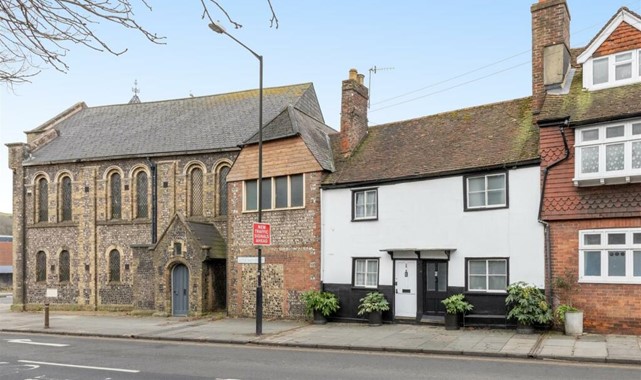
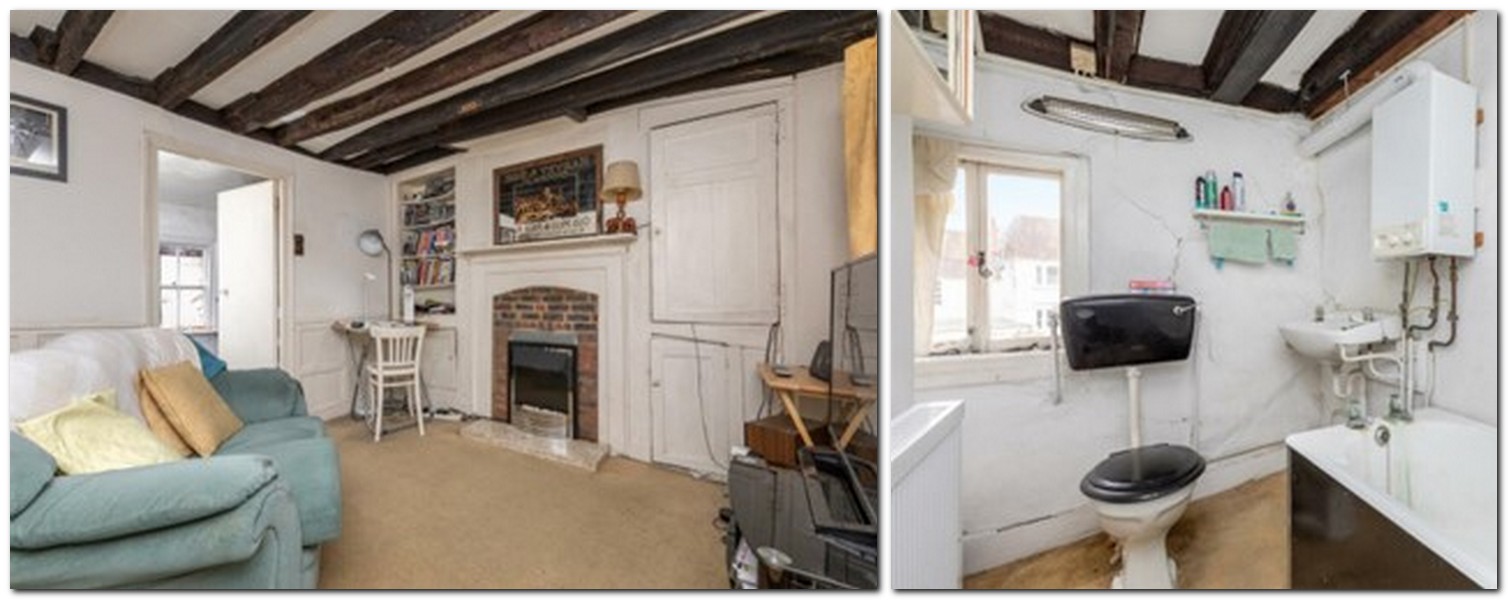
It is not often these days that a grade II listed timber-framed cottage with exposed beams in central Lewes comes on the market for as little as the £350K for which this cottage on Little East Street, adjacent to Eastgate Baptist church, is advertised by Oakleys. It is, however, very small – its advertised 44 sqm includes an attic room accessible by a ‘ladder-staircase’ and a small outbuilding in the yard behind. The agent’s suggestion of scope for further improvement and updating is supported by the pictures, especially those of the kitchen and bathroom, while the local air cannot be guaranteed to be of the highest quality. The Historic England listing suggests an 18th century date. In Colin Brent, ‘Lewes House Histories’ they are first recorded in 1793 when both numbers 1 and 2 were owned by the carpenter-builder George Stanford and let to different tenants. George Stanford was based in All Saints parish, active in the early 19th century expansion of Lewes and chosen one of the constables of the borough in 1808 and 1815. At his death in 1826 his estate was valued as “under £12,000”.
- Hannah Fuller’s Diaries
In March 2023 The Keep was able to purchase two volumes of a manuscript Lewes diary from a Hampshire antiquarian bookseller, with assistance in covering the £350 cost from the Friends of The Keep (FOTKA). The diary is now available to the public, reference ESRO AMS 7419.
There are two volumes of the diary, which together cover the years 1821-1824. The author was Hannah Fuller (1790-1866), a young married woman. She was born in January 1890, her father being Joseph Morris, a Lewes tallow chandler and butcher. She married currier and leather seller Thomas Fuller in 1816, and they established themselves in Cliffe High Street. They had seven children born in the Cliffe between 1820 and 1832, the first four being baptised at Jireh Chapel. The four years covered by the diary include the births of three of her children and the deaths of two of them. She confided her innermost feelings to her diary, including her less than entirely complimentary views about her husband and her servants. The Fuller’s long-established family business collapsed in 1832 and the family moved to Brighton, where Hannah Fuller established a successful academy for young ladies. It was just as well that she could support herself, as her husband’s fortunes in business continued to be erratic and later in life they lived separately.
Source: Thanks to Sue Berry for bringing this to our attention.
- Lost Lewes street names
John Geall recently provided some Lewes street maps from before the slum clearance movement. Parts of two of these are shown below.

Lewes Street map before slum clearance, between Little East Street and the Saw Mill
Residential street names shown to the north of Little East Street and the east of North Street include: Bath Place; Bouverie Street; Green Wall; Norfolk Street; North Place; Queen Street; Waterloo Place; Wellington Street and York Street. Of all these only Green Wall, Waterloo Place and Wellington Street google as residential addresses today.
John Kay
Contact details for Friends of the Lewes History Group promoting local historical events:
Sussex Archaeological Society
Lewes Priory Trust
Lewes Archaeological Group
Friends of Lewes
Lewes History Group Facebook, Twitter



 Lewes History Group