
Please note: this Bulletin is being put on the website one month after publication. Alternatively you can receive the Bulletin by email as soon as it is published, by becoming a member of the Lewes History Group, and renewing your membership annually.
- Next Meeting: 11 September 2023, Mary Burke, ‘The River Ouse & the growth of Lewes’
- News from the Chair (by Neil Merchant)
- A painting of St John-sub-Castro Church (by Philip Taylor)
- Whitemans in Lewes (by Barbara Merchant)
- Looking back on Lewes in 1793 (by Chris Grove)
- Eastwoods Cement Works (by Geoff Isted)
- St Michael’s Almshouses, Keere Street (by David Hutchinson)
- Historic Lewes for Sale: Gables Cottage, 55 Southover High Street
- Lewes council housing: to sell or not to sell? (by Chris Taylor)
- Heritage Open Days, 8-10 September 2023 (by Ian McClelland)
- Next Meeting 7.30 p.m. King’s Church, Lewes Monday 11 September Mary Burke The River Ouse: its importance for the growth of Lewes
The River Ouse was once the eastern boundary of Lewes, and guarding the Ouse from marauding Vikings was presumably the reason King Alfred founded the fortified town at this location. However, the tidal river brought trade as well as hostile invaders, and for centuries ships were the only practicable way of transporting heavy or bulky goods into and out from the town. Both banks of the river became lined with wharves and warehouses to facilitate the town’s trade. Mary Burke will explain the importance of the river to Lewes from its earliest times through the industrial revolution up to the present day.
Members are requested to register in advance, so that we can monitor numbers attending. Non-members wishing to attend should register and pay in advance, as usual.
- News from the Chair (by Neil Merchant)
After several months’ searching, I’m pleased to be able to say that Victoria Moy has agreed to become our Publicity Officer, and has picked up the reins from Jane Lee, who – as I wrote earlier in the year – had decided that she wanted to move on after many years in the role. Victoria, as Jane did, works in the Publicity industry, and has returned to Lewes after spending some of her earlier life here. She will bring a fresh and younger perspective to LHG and its promotion, and we all look forward to working with her. Please join me in welcoming her.
The next role we need to fill is a new one, carving out some of the work that I currently do with Zoom and Ticketsource: it involves setting up our Zoom talks, committee meetings and ticketing. It’s not as complicated as it sounds, if you’re comfortable and familiar with using a PC. Instructions, a gradual handover and support will all be available if needed. These skills are useful and applicable elsewhere, as societies and groups like ours move into the digital age. This need not be a committee role, though we’d prefer it to be. If you’re interested, or know anyone who might be, interested, do let us know.
- A painting of St John-sub-Castro Church (by Philip Taylor)
A label on the reverse of this oil painting states: “Oil Painting, circa 1830, showing a view of Lewes taken from the Pells, with St John’s Church in the middle distance, and the Castle in the background. 8½ inches by 12½ inches. Framed in gilt.”
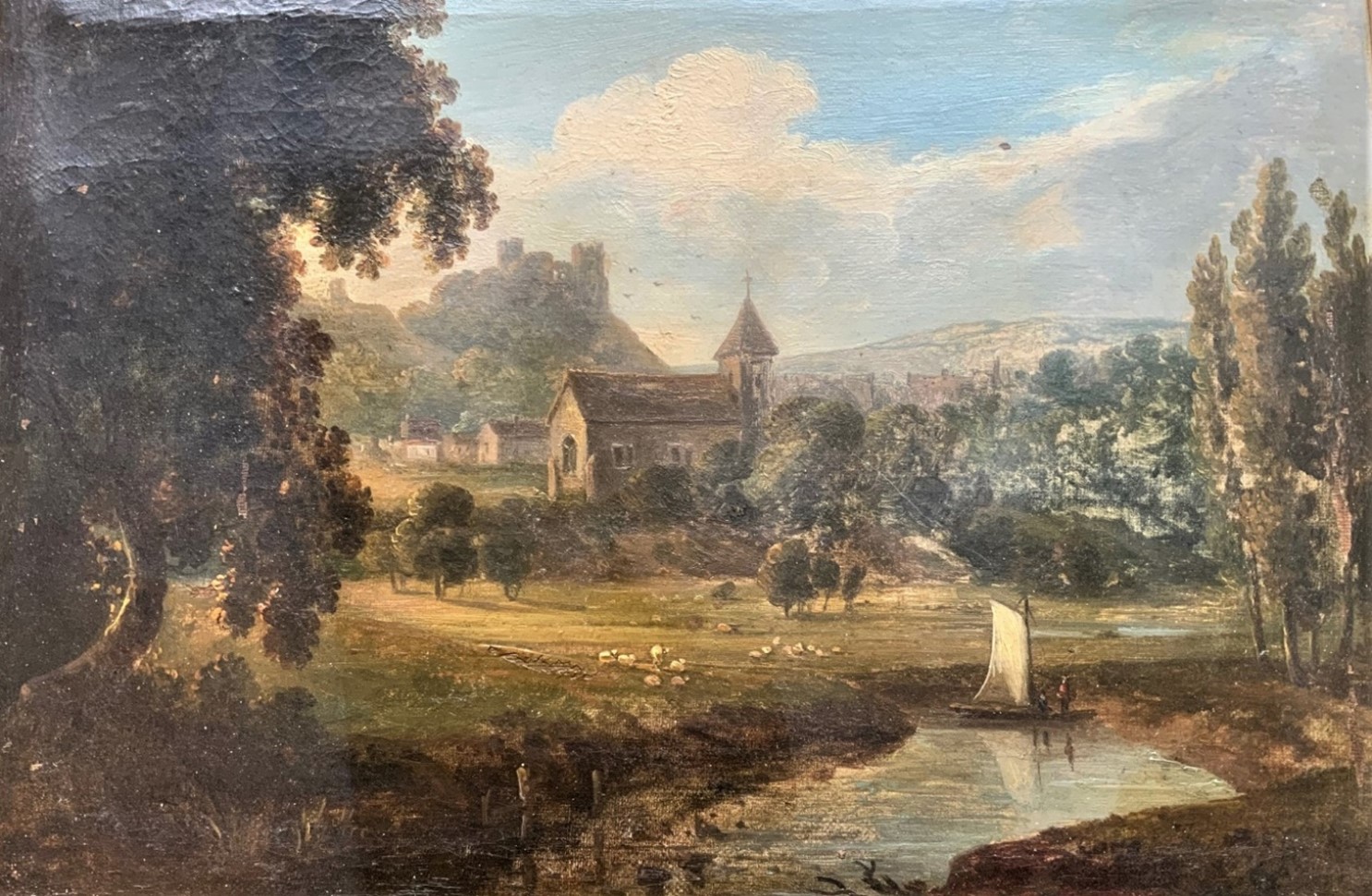
The style of the painting suggests that it was created between 1820-1830, and the old church shown was replaced by the current St John-sub-Castro church in 1839. The current owner purchased the painting for £550 at a Clifford Dann auction in 1997.
There appears to be a structure on top of Brack Mount at this date. Paul Dunvan says, in his 1795 book ‘Ancient and Modern History of Lewes and Brighthelmston’, published by William Lee (pp.352/353) “[The Castle] was watched and guarded by two keeps, or little distinct fortresses, constructed on artificial mounts, on the east and west. From the deep and wide ditches that surrounded those mounts, were continued very high and strong walls of chalk and flint-stone on the north and the south, from one to the other…the mounts constructed with considerable labor [sic] and judgement were next crowned with little fortresses. The building on the eastern mount had for many years been in a ruinous state, and therefore received the name of Brack-mount, or Crumbling-mount, from the Saxon verb braecon, to break or moulder. This name [is] now nearly obsolete’.”
- Whitemans in Lewes (by Barbara Merchant)
David Whiteman, an LHG member in Australia, will be visiting Lewes in October. He is keen to meet up with anyone from the Whiteman family who is living in the Lewes area. David is related to Bernard Whiteman who was awarded the Military Cross for service in WW1, and was later manager of Barclay’s Bank at 64 High Street, Lewes. He also served in the Home Guard in WW II. Please reply in the first instance to the Lewes History Group.
- Looking back on Lewes in 1793 (by Chris Grove)
This view of Lewes past is taken from a description of the borough in the 28 January 1793 edition of the Hampshire Chronicle, appended to that newspapers’ account of the electoral practices in the 18th century borough [see Bulletin no.157]
“Lewes was formerly fortified with a castle and walls, of which there are still some remains. King Athelstan appointed two mint-houses in this town; and in the reign of King Edward the Confessor it had 127 burgesses. It is a borough by prescription, governed by two constables, annually chosen at the court-leet. Here Wm de Warren, Earl of Surrey, and the Lady Gundreda his wife, in the year 1078, founded a priory of Cluniac monks, which was the first and principal house of the order in England: in after-times it had many notable benefactors, namely the succeeding Earls of Surrey and others, several of whom, with their ladies, were interred here. It continued a cell to the abbey of Cluny, in Burgundy, till King Edward III made it independent. At the general dissolution its revenues were valued by Dugdale at £920 4s 6d a year, and at £1091 9s 6d by Speed. It was granted, with all its appendages, to Thomas Lord Cromwell; since which time it has been in the possession of the Dukes of Dorset and Earls of Thanet, and lately belonged to Edward Trayton Esq. It also had a priory of grey friars, a monastery dedicated to St James, for 13 poor bretheren and sisters, and a hospital dedicated to St Nicholas.”
- Eastwoods Cement Works (by Geoff Isted)
Below is an aerial view of Eastwoods Cement Works in 1932. If any LHG members have other photographs of the works or the workers there, or would like more information about this important Lewes business please get in touch [geoffisted@aol.com].

Editor’s note: There look to be another set of well-maintained allotments on the downland just across the railway branch line serving the plant.
- St Michael’s Almshouses, Keere Street (by David Hutchinson)
LHG Bulletin no.155 (June 2023) included an article about 1 St. Michael’s Court in Keere Street, part of a former row of almshouses. It referred to the bequest of Thomas Matthew in the 17th century, and to the rebuilding in1846. The later history is summarised below. Between 1856 and 1936 the Charity of Thomas Mathew (sic) was managed under a scheme established by the County Court with the almshouses in Keere Street to be “used as a residence for six deserving poor widows or poor single women not less than fifty years of age.” 1

Extract from the 1/500 scale Ordnance Survey map of 1873 showing the almshouses
In 1936 a new scheme was established by the Charity Commission, following a request from the Rector and Church Wardens of St. Michael’s church. This provided for six Almspeople who were to be “poor widows or poor single women of good character who (except in special cases to be approved by the Charity Commissioners) have resided in the Parish of St. Michael, Lewes, for not less than two years next preceding the time of their appointment, who are not at the time of their appointment in receipt of Poor-law relief other than medical relief, and who from age, ill-health, accident or infirmity, are, wholly or in part, unable to maintain themselves by their own exertions.” Rent was “not exceeding 3s 0d a week”.2 The rent was set at 2s 6d per week in March 1937.
Estimates for repairs, painting and providing gas and electrical services were approved by the Trustees in 1951, but by 1955 they were becoming concerned about the general condition of the property. In April 1957 Lewes Borough Council was asked whether it could help with the cost of renovation, but it could not do so. In December 1957 the Trustees therefor resolved to seek permission from the Charity Commission to sell the almshouses and use the proceeds for the benefit of old people in Lewes.
In response, the Charity Commission proposed a new scheme which extended the area of benefit to the Borough of Lewes and, subject to a further order, provided for the sale of the Almshouses. The existing Trustees were also to be appointed Trustees of Ann Smith’s Charity and Thomas Blunt’s Charity “for the general benefit of the poor” in the Borough of Lewes.3 Meanwhile, in November 1958, the Trustees were told that the roof of No. 6 cottage was falling in and that Messrs. Wycherley had been instructed to remove the tiles and make safe. Also, that the local authority proposed putting a closing order on the Almshouses under its slum clearance powers.
In March 1960, the Trustees were told that the Charity Commission had approved the sale of the Almshouses, but that this must be by auction. This took place at the White Hart Hotel on 23 June 1960, and raised £2,525 (the equivalent of £75,986 at May 2023 prices using RPI). The buyer told the Sussex Express “he intended to restore the buildings without altering the outside appearance, as far as possible”.4 The buyer was Jim Franks, who later restored the derelict Fitzroy Library as his family home.
The conversion of the six almshouses into two self-contained three-bedroom modern homes was designed by Derek Montefiore, a Kensington-based architect. The most obvious modern feature is the addition of a glazed entrance to porch each of the houses. The magazine Homes & Gardens published a detailed description of one of the houses in the September 1965 issue.
Following the sale of the almshouses, the Charity Commission established a new scheme 5 for the general benefit of the poor in the Borough of Lewes “with a preference for widows and unmarried women”. It allowed for one-off grants to other charitable organizations and to individuals but prevented the Trustee from making recurring grants. Further changes were made in 1986 with the addition of the Charity of the Honorable and Reverend Sydney Godolphin Osborne to the charities of Thomas Matthew, Ann Smith and Thomas Blunt for the “relief of people in need”. The Trustees were given a wide choice in the sort of relief that they could provide “so long as the need is clear”, and that recipients had claimed all the statutory benefits to which they are entitled.
In May 2003 the Trustees met to consider the future of the charity. It was making a loss due to low rates of interest, and it was agreed to seek advice from the Charity Commission on how it could be wound up. In November, the Trustees agreed to seek the Commission’s approval to the using the remaining capital as income, and this was approved February 2004. The final meeting took place on 22 February 2005 when the Trustees considered what should be done with the final £70.66. It was agreed “that a tree should be purchased and planted in the graveyard of St Michael’s [church] and a plaque commemorating the Trust should be added.” A walnut tree was planted but, unfortunately, it did not survive.

The almshouses following their sale in 1960
Sources: [1] Salzman, L F (ed). 1940. The Victoria History of the Counties of England: Sussex – Volume Seven: The Rape of Lewes (1940), p.43; [2] Charity Commission Scheme 814/36 of 21 February 1936; [3] Charity Commission Scheme 760/59 of 3 February 1959; [4] 1 July 1960 Sussex Express; [5] Charity Commission Scheme 2363/61 of 28 July 1961. The records of the Thomas Matthew/Godolphin Osborne Fund are currently in private ownership but they will shortly be deposited in the East Sussex Record Office.
- Historic Lewes for Sale: Gables Cottage, 55 Southover High Street
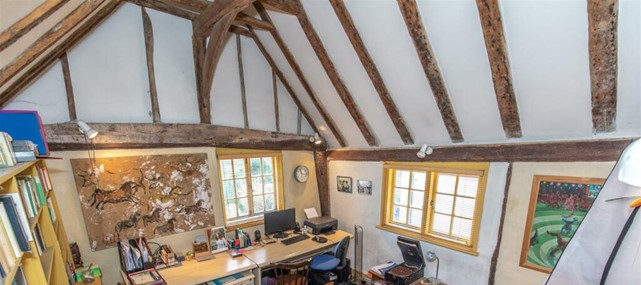
Gables Cottage, a double-fronted, tile hung and Horsham stone roofed, 5-bed house on the north side of Southover High Street was offered for sale in May by Rowland Gorringe at offers in excess of £1.5 million. The terraced house is described as part-medieval and part Jacobean.

Historic England describes the house as 17th century, refronted in the 19th century. Estate agents’ historical descriptions cannot always be relied upon, but in this case photographs of an upper room (below) show what appears to be a crown post roof, typical of the 15th and early-16th centuries. At least some of the larger rafters are laid flat, but not obviously smoke-blackened by an open fire. This part of the house at least was probably in existence before the Priory across the road was demolished. Judith Brent’s ‘Southover house histories’ report that there was a malthouse associated with this property in the 17th & early-18th centuries.
- Lewes council housing: to sell or not to sell? (by Chris Taylor)
The sale of council houses, a flagship policy in the Conservative Party’s 1979 general election manifesto, aimed to extend ‘the security and satisfaction’ of home ownership to many more citizens of what should become a ‘property-owning democracy’. However, for many years before Mrs Thatcher’s Housing Act of 1980 made it virtually compulsory, the wisdom and practicality of selling council houses were matters of debate and controversy.
The sale of council-owned land for private house-building is as old as the first estates: Lewes Borough Council approved the sale of a building plot on the Nevill in October 1921. The sale of land for private development on the Nevill continued throughout 1920s and 1930s, from 1923 supported by government subsidies. Not all applications went through on the nod, however: in April 1925, for example, councillors rejected a proposal for seven private dwellings because they disapproved of the type and density of the planned houses.
The Labour government elected in 1945 strongly favoured council house building over private development in its attempt to tackle the acute post-war housing shortage. The 1946 Housing Act instructed councils to ensure that no more than 20% of new dwellings were privately built. The policy supported ministers’ belief that new council estates should house people from different sections of the community in the same neighbourhoods, not just the working class.
In December 1948 councillors in Lewes debated the financial viability of this ‘buy land and build at all costs’ policy, which had led to expensive land purchases. A majority concluded that the only way to avoid suspending the Mill Field and Church Lane developments would be to start selling council houses to tenants. The ministry was not impressed by this suggestion, but the proponents of council house sales persevered by organising in 1950 a survey of local opinion, which revealed some enthusiasm for the idea among tenants and the general public. The return of a Conservative government enabled the council in October 1952 to adopt the principle of the sale of council houses to existing tenants. Gorringe & Co. were appointed to determine the selling prices. Purchasers had to put down a deposit and were allowed council-guaranteed mortgage loans at standard rates of interest over a maximum 30-year period. Re-sale at a profit was forbidden for five years and a pre-emption clause gave the council the right to buy the property back if the owner wished to sell.
The new policy failed to provoke an avalanche of sales. Only 31 of the 1,000 or so council properties had been sold by September 1957 for a total of £30,205: 24 on the Nevill, five in Valence Road, one in Landport and one in the Lynchets. Selling council houses continued to divide the council. An attempt to reverse the policy in 1959 failed to carry the Housing Committee; and another in 1961 was approved by the committee but did not convince the full council. The chief concern at this time was the potential loss of larger council properties that could meet the needs of families on the waiting list. This proved a compelling argument and, in practice, sales dried up almost entirely for most of the 1960s.
The issue surfaced again in July 1968, when a majority of councillors rejected the Housing Committee’s resolution not to sell until the demand for rented accommodation had been satisfied and the slum clearance programme had advanced further. Accordingly, an invitation was issued to all council tenants (except those in flats and old people’s accommodation) to buy the houses they occupied. Again, the policy produced only a trickle of sales and the council soon dropped it.
Lewes District Council superseded the Borough in 1973 and almost immediately required its senior officers to set out the case for and against the sale of council houses. Their 1974 report presents a classically succinct account of the debate that had occupied councillors periodically for the preceding 30 years:
Demerits
- Selling postpones the time when an adequate supply of rented houses becomes available
- Families on the waiting list have to wait longer
- The sale of older houses and their replacement by new houses tends to increase rents
- Tenants should be assisted to buy private houses, not council houses
- Selling reduces the stock of council houses for letting at moderate rents
- The loss of rent and subsidies may not be compensated by the reduction of maintenance costs
- Piecemeal sales on estates can cause management problems
Merits
- Sales encourage thrift and pride in ownership
- Selling enables many to be owners who cannot afford private purchases
- Sales at near market value minimise loss of revenue
- Sales don’t reduce housing stock: the houses are still there
- Replacement new homes have better amenities
- Older houses are expensive to renovate
The ‘merits’ proved the more persuasive to the new, Conservative-dominated, council. In January 1975 it adopted a scheme for the sale of council houses to long-term tenants at between 10% and 20% below the market price. A further 5% reduction was available to those who had made improvements. Twenty-four houses in Lewes had been sold under this scheme by October 1976.
The 1980 Housing Act dismissed all objections to the sale of council houses. It gave all tenants who had rented for three (later two) or more years the right to buy at a discount of up to 50% of the market price. Well over 100 council houses were sold in Lewes in the first 18 months and sales continued to accelerate. Crucially, whereas councils had retained the proceeds of previous sales, budgets were now severely reduced so that there could be no replacement of council-owned homes. Nationally, the number of new council homes fell from 80,000 in 1978-9 to 400 in 1996-7.
The effects of these measures, for good or ill, have been well-documented. One of them, widely acknowledged, is that sales have intensified the tendency, growing since the mid-1950s, to regard renting from the council as a ‘residual’ form of tenure, providing homes only for those with no alternative form of accommodation. That perception, many believe, is likely to limit recourse to council housing in tackling present and future shortages.
Sources: Lewes Borough Council Housing Committee minutes, ESRO DL/D 174; DL/D 169; Lewes District Council Housing Committee minutes ESRO DL/D 300/1; John Boughton, ‘Municipal Dreams’ (2018); Ian Cole & Robert Furbey, ‘The Eclipse of Council Housing’ (1994).
- Heritage Open Days, 8-10 September 2023 (by Ian McClelland)
LHG will once again be present in Lewes House, School Hill, during the weekend. We will have panels displaying some of the Street Stories work and in particular the work on Chapel Hill, Mill Road and the Pells area. The corresponding books we have published will be available for purchase. We will also have three panels describing the origins of the Lewes Little Theatre, supporting the 2023 HOD theme of creativity. The Theatre came about as a result of initiatives by Rev Kenneth Rawlings, a Lewes resident and notable pacifist during WW II, and John Maynard Keynes, the celebrated economist and frequent visitor to Charleston, amongst others. The origins of the Little Theatre will be the subject of a talk by Paul Myles at our meeting in May 2024.
If you happen to be in Lewes during the weekend please feel free to drop by.
John Kay
Contact details for Friends of the Lewes History Group promoting local historical events:
Sussex Archaeological Society
Lewes Priory Trust
Lewes Archaeological Group
Friends of Lewes
Lewes History Group Facebook, Twitter



 Lewes History Group