
Please note: this Bulletin is being put on the website one month after publication. Alternatively you can receive the Bulletin by email as soon as it is published, by becoming a member of the Lewes History Group, and renewing your membership annually.
1. Next Meeting: 11 March 2024, John Kay, ‘John Whitfeld, Cliffe Merchant’
2. Chair’s news (by Neil Merchant)
3. Gorringe’s new Auction Galleries (by Lucy Wolf)
4. The Lewes Town Act of 1806
5. Cleaning up Lewes
6. Emigration to Australia
7. How the Post Office worked in Lewes in 1899 (by Chris Grove)
8. An early assessment of the impact of the Railway
9. A studio portrait by W.S. Branch of Lewes
10. The Lewes Magistrates Bench in 1911
11. Territorial camps at Lewes in 1910
1. Next Meeting 7.30 p.m. Zoom Meeting Monday 11 March
John Kay The life and times of John Whitfeld, Cliffe Merchant
John Whitfeld appears in Lewes as a young merchant in 1720 and remained a significant member of the town community for the next 35 years. He married the daughter of a Huguenot clock maker working in the town, and he acquired the business premises and wharves that now accommodate Harvey’s Brewery. He dealt in a range of commodities, rescued cargoes from ships wrecked on the coast, and engaged in the Wealden iron industry in its dying days. He played an active role in the town’s politics, and could be a tricky man to deal with. Some alleged he was a smuggler. He was not an ideal next door neighbour, and was unusually litigious. He made a strong impression on his fellow citizens and has left his mark on the town. The house he built for his family survives today. In early 1756 he abruptly sold up and moved to Vlissingen (Flushing).
This meeting will be held by Zoom. Members will be sent a free registration link in advance. Non-members can buy a ticket (£4) at http://www.ticketsource.co.uk/lhg. The emailed ticket will include a Zoom registration link for the talk, to complete in advance. This will be our last Zoom meeting of the winter. In April we shall resume our live meetings at the King’s Church building, in Brooks Road
2. Chair’s news (by Neil Merchant)
I had planned to step down from the Chair role later this year, but unfortunately family health matters mean that both Barbara and I need to give up all LHG involvement immediately. We have both enjoyed our time with LHG enormously, and are proud of what we have achieved together. Thank you for your support and encouragement over the years, and we hope LHG goes from strength to strength.
Editor’s note: Neil and Barbara have been key figures in the establishment of the Lewes History Group, with Barbara our webmistress ever since we were established, and Neil both our chair and our technical wizard for the past decade. They have played similar roles for the Friends of Lewes. We very much appreciate the immense contribution that they have both made to the LHG’s success to date. The Executive Committee has made interim arrangements to continue our activities, but we cannot hide the importance for the longer term of others being prepared to step forward to fill the very large gaps created by their having to step down.
3. Gorringe’s new Auction Galleries (by Lucy Wolf)
The 1 April 1946 Sussex Express included the following news item:
Auction Galleries Opened At Lewes: Interesting Wellingtonian and Napoleonic relics were sold at the Auction Galleries, North Street, Lewes, this week at a four-days sale arranged by Messrs Rowland Gorringe and Co., Auctioneers, of Lewes, which commenced on Tuesday. It was the first sale to be held at the galleries, which were purchased by Mr Rowland Gorringe six months ago. The premises were formerly the local A.R.P. transport centre.
Five excellent galleries have been arranged. Mr. Gorringe, at the commencement of the sale, expressed thanks to the builders for their work in repairing the premises. He also thanked Mr. J. Manton and his energetic staff for their work. He said that Miss North had been mainly responsible for setting out the lots and for the catalogue, and assistance was given with the catalogue by Miss Hunter. Lieut. – Colonel T. Sutton assisted the auctioneers with the description of the old uniforms and other relics.
On Tuesday bidders were entertained to a buffet luncheon. A military sleeved cloak, which belonged to the Duke of Wellington and was probably worn by him during his Peninsula campaigns, was offered. It was given by the Duke, about 1817, to Mr Santiero, an Italian valet of Sir John Shelley, during one of the Duke`s visits to Sir John at Maresfield Park. It was acquired from Santiero by the late Dr Prince, Sir John Shelley`s medical attendant at the time, and was obtained by its latest possessor from Dr Prince`s son, C.L. Prince, F.R.A.S. of Crowborough. The cloak was in good condition, but bidding was poor and Mr Gorringe purchased it himself for presentation to the town of Lewes.
Four jackets of British regiments of the Peninsula War and earlier, four shakoes of the Grand Armee of Napoleon and other pieces fetched £7 10s. Two jackets, believed to be the only two in existence, of the 22nd Sussex Regiment of Light Dragoons, which was raised by Lord Sheffield in 1779, were sold for £13. Purchased for Lewes for £1 were two regimental banners of silk, which traditionally were carried at the Battle of Waterloo.
A patent percussion, lock rifle, made by Thomas Turner, the well-known Birmingham gunmaker, was purchased by a determined boy for 15s, after Mr Gorringe had given him 2s, 6d, so that he might outdo another bidder. That same boy purchased three Pickleheib German helmets and a German steel helmet for 5s, there being no other bidder. A London-made flint lock blunderbuss was purchased by Mr Gorringe, who gave it Colonel Sutton in appreciation of his help with the catalogue.
Top price of the day was £155 for a landscape panel of Verdun tapestry. A fully sprung lounge suite fetched £130. A mahogany carved column Fitzroy barometer on four hinged brass feet fetched £98 and £80 was given for a blue-ground Indian carpet; £78 for a Queen Anne walnut wood bureau bookcase; £75 for a Renaissance cupboard; £75 for a Persian Malabar carpet; £68 for a set of four Hepplewhite mahogany elbow chairs; £65 for a Persian carpet; £58 for a cream ground Indian carpet; £58 for an old Persian Kechan rug; £58 for a bow-fronted sideboard; £55 for a Bokhara carpet; for a Chippendale period winged and high backed armchair; £52 for a Chippendale style mahogany armchair; £50 for three pairs of curtains; and £50 for an Elizabethan oak dresser.
A bust of Mr Gladstone failed to attract a bid, so Mr Gorringe bought it for 5s 0d, remarking amid laughter that he would give it to Councillor W.H. Penfold.
Editor’s note: Lucy Wolf, who brought this article to our attention, is the great-great-great-great-great-granddaughter of Domenico Santiero, the valet of Sir John Shelley, who was given the Duke of Wellington’s military cloak. This article was written shortly after the Rowland Gorringe auction house moved to its present premises in North Street.
4. The Lewes Town Act of 1806
In 1805 the two new borough constables, Thomas Johnston and John Bray Cater, proposed the establishment of a committee to put forward a new Town Act to improve the quality of life in the town. A committee of nine was established to assist them: Jonathan Harrison & the Rev Edward Robert Raynes for St Anne’s parish; William Green, William Campion & Francis Whitfeld for St Michael’s; Sir Henry Blackman, Henry Jackson & William Franklin Hick for All Saints and William Marten for the then thinly-populated St John-sub-Castro. Cliffe and Southover were invited to join in, but declined to do so.

The 36 page Act was passed the following year, and established a body of Town Commissioners to oversee the improvements. The qualifications to become a commissioner were the ownership or tenancy of a property valued at £20 p.a. or more (well above the cottage level) or a personal estate of £800. In his 1847 ‘Handbook for Lewes’ Mark Antony Lower noted that the number of those qualified was 112, though the Act allowed only five present at a duly advertised meeting to take the key decisions. The town constables were ex officio Commissioners, whether or not they met the property requirements. A clerk and a treasurer were to be appointed, and rates were to be collected to pay for the improvements. The Keep’s LEW/C 3/1 series are the minute books of the Commissioners from 1806 until the 1881 establishment of the new municipal Borough of Lewes.
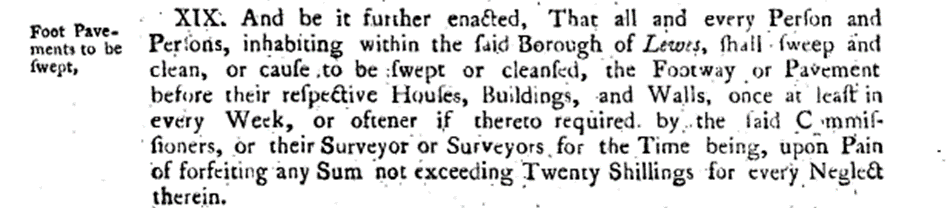
The Act’s 75 clauses explain many of the problems of the day. Property owners were not to expand their properties or their foundations into the street. If cellar doors were left open at night they were to be lit. Carts, waggons, coaches and carriages were not to be parked in the street, except when loading and unloading. Carts and waggons were not to be driven at faster than walking pace, and horses or donkeys were to be haltered and in someone’s charge. Trucks, sledges and hand-barrows were not to be pulled along the pavement. Bonfires and letting off squibs and crackers and other fireworks on the pavements was banned, as was carrying out trade activities, especially butchery. The commissioners were to employ scavengers, and only they were allowed to remove dirt, dung, filth and soil from the streets (this was a saleable commodity). The siting of privies, pig-styes, dung heaps, the waste products of butchery, ashes or rubbish were not to be allowed to annoy passers-by. Privies were only to be emptied between 11 pm and 5 am. The commissioners could buy property to widen the streets. Street names were to be installed and individual houses numbered. People who removed or damaged the Commissioners’ new lamp posts were to be fined. Publicans were to be fined if any if the town watchmen appointed were found loitering in their public houses while supposed to be on duty. And, under clause 19, everyone had to sweep the pavement in front of their house at least once a week, or oftener if required.
5. Cleaning up Lewes
The two constables, Thomas Johnston and John Bray Cater, who oversaw the passing of the 1806 Lewes Town Act were also keen to ensure that the town cleaned up its act in other ways.
When a complaint was made to them that putrid meat was being offered for sale in the town’s market they called together a jury of four eminent butchers, and when the jury condemned the meat as unfit they had it burnt in the street opposite the Crown Inn.
When they were informed that short-weight bread was being sold in various bakers’ shops in the town they also got out their weights and measures and found that although most bread on sale passed the test, some did not. The shopkeepers selling it were summoned before the magistrates, but pleaded that they were only selling the bread on behalf of the town’s wholesale bakers. These wholesale bakers were next brought before the magistrates, and the case being proved, they were fined five shillings for every ounce short. The total fines and costs that the bakers had to pay amounted to £26.
During the same year the authorities were busy checking shopkeepers’ weights and measures, with any found deficient being seized and sold for scrap.
Source: Lewes Town Book
6. Emigration to Australia
In the years after the introduction of the New Poor Law there was increased interest in emigration from England in the hope of finding a better life elsewhere. Local agents brokered travel to Canada, the United States and Australia, advertising the high wages there without perhaps also explaining that prices were higher too. The 13 April 1839 Sussex Express reported that 40 people, with their entire families, had left Lewes for Australia on the previous Monday, and that several of the men were blacksmiths, who were in demand there. Not all early Australians were convicts.
7. How the Post Office worked in Lewes in 1899 (by Chris Grove)
Information below from the 1899 Kelly’s Directory explains the operation of the Post Office in Lewes a century and a quarter ago. It is quite remarkable how things have changed – our grandparents could not have imagined the way the service runs today!
Lewes Post Office locations and business hours
65 High street, Postmaster, Arthur George Turner.
Post, M. O. (money orders) & T. 0. (telegraph office), T. M. 0. (telegraph money orders?), Express Delivery, Parcel Post, S. B. (savings bank) & Annuity & Insurance Office, Money orders are granted & paid from 8.00 a.m. to 8.00 p.m.
Savings Bank open same hours as for money orders.
Postal orders are issued & paid from 7.00 a.m. until 9.30 p.m.; on Bank holidays closes at noon.
Ordinary business at 7.00 a.m.; close at 9.30 p.m.
On Sundays, Christmas Day & Good Friday open 8.00 a.m. until 10.00 a.m.
Telegraph office open from 8.00 a.m. to 9.30 p.m.
On Sundays, Good Friday & Christmas Day, 8.00 a.m. to 10.00 a.m.
Postal Arrangements. –
Box at head office cleared at 6.30, 9.00, 10.45 & 11.40 a.m. & 12.15, 1.20, 2.30, 4.30, 5.00, 5.30, 7.40, 8.00 & 9.20 p.m. on week days; 9.00 p.m. on Sundays
Local Posts.- 3.00, 6.30 & 9.00 a.m. ; 2.00, 2.30, 4·30 & 5.30 p.m. week days; 3.00 p.m. on Sundays
Box at the Railway Station Office cleared ten minutes later than the above times.
Lewes Town Delivery, 7.00 & 9.15 a.m. & 2.30 & 6.00 p.m.
General country delivery, 6.00 a.m.
On Sunday one delivery only of letters at 7.00 a.m.
Letters may be posted for first town till 6.00 a.m. & country delivery till 4.00 a.m.; at the Station office, 4.50 a.m.
Parcel Post.- Dispatched at 9.00, 10.45, 11.10 & 11.40 a.m. & 12.15, 1.20, 2.00, 2.30, 4.30, 5.00, 7.30, 8.00, 8.50 & 9.20 p.m.
Delivered same time in town as letters.
Town Sub-Post offices; M. O. O. (money order office), S. B. (savings bank) & Annuity & Insurance Offices.
15 High street, Cliffe (& telegraph office) (open 8 a.m. to 8 p.m. week days). – Horace William Scrase, sub-postmaster. Cleared at 6.45, 8.50 & 11.00 a.m. & 1.55, 4.05, 6.55, 7.15 & 8.50 p.m.
North street, H. Baker, sub-postmaster. Cleared at 6.30, 8.50 & 11.05 a.m. & 2.00, 4.05, 6.55, 7.20 & 8.30 p.m.
High street, Southover.- William Cruttenden, sub-postmaster. Cleared at 8.55 & 10.40 a.m. & 1.35, 4.00, 6.30, 7.15 & 8.30 p.m.
High street, St. Ann’s. – George Trayton Baker, sub-postmaster. Cleared at 6.30, 8.45 & 10.50 a.m. & 1.45, 3.55, 6.40, 7.15 & 8.45 p.m.
Malling street, Cliffe (post office only). – Mrs. Harriet Potter, sub-postmaster. Cleared at 8.30 & 10.50 a.m. & 1.45, 3.55, 6.45 & 7- 15 p.m.
8. An early assessment of the impact of the Railway
Mark Antony Lower wrote the following in early 1847 in his ‘Handbook for Lewes’:
“The Brighton, Lewes and Hastings Railway is now in full operation. It was opened from Brighton to Lewes in June 1846, and a few weeks subsequently to Hastings. The success of the undertaking has exceeded the anticipations of the company, while, upon the whole, the commercial position of the town of Lewes has been considerably improved.
The Branch Railway from Keymer, on the Brighton and London line, to Lewes, with a continuation thence to Newhaven, promises to add greatly to the convenience of the locality. Whether the valuable improvements at Newhaven Harbour, and the projected steam communication between the metropolis and Paris via Lewes, Newhaven, Dieppe and Rouen will have the effect of elevating our town to its predicted position as the ‘Liverpool of the South’ time only can determine.”
The destruction of the old mansion called the Friars is perhaps the only circumstance in connection with the formation of the railway that the antiquary and lover of the picturesque have occasion to regret. The Lewes station, a handsome and commodious edifice, with convenient sheds and warehouses, occupies the site. The passenger-entrance is in Friars Walk.”

Mark Antony Lower’s drawing of the new railway bridge at Southerham
9. A studio portrait by W.S. Branch of Lewes
This photographic portrait of a middle-aged Victorian lady holding a slim volume, perhaps a prayer book, offered for sale on ebay recently, was taken by Lewes photographer W.S. Branch, whose business was based on School Hill. According to Rendel Williams’ Sussex Photohistory website William Shelley Branch established his business at 47-48 High Street in 1878, and then moved to 16 High Street, on School Hill, where he was recorded from 1879 to 1887.
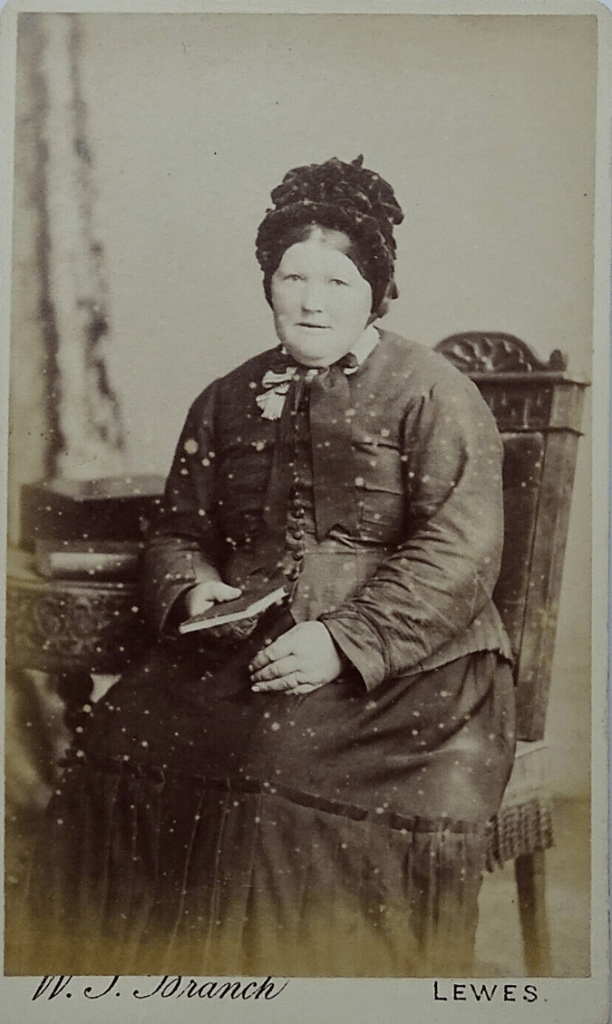

William Shelley Branch (1854-1933) was born in Hastings, but his mother Elizabeth Shelley was a native of Lewes. When her husband died, leaving her with two young boys, she returned to Lewes and established a haberdashery business. While William Shelley Branch was a photographer at 16 High Street, his mother ran a fancy goods store, selling wool and toys, from the same address, while his younger brother Henry Edward Branch was described in the 1881 census as a news reporter. About 1888 the whole family moved to Cheltenham, Gloucestershire, where William S. Branch established a photographic studio and his younger brother continued as a journalist. However, during the 1890s William abandoned photography and joined his younger brother as a journalist. He had a particular interest in chess, and is today best remembered as a chess historian, publishing on the game in newspapers as far afield as the U.S.A. He died in Cheltenham in 1933, aged 78

10. The Lewes Magistrates Bench in 1911
In 1911 there were altogether thirty two people qualified to serve as magistrates for the Lewes Petty Sessions, covering the town and its surrounding rural parishes. Twenty seven of them were named individuals, the great majority members of the local gentry including the Earl of Chichester, Viscount Gage of Firle Place, Rear-Admiral Brand of Glynde Place, Lord Monk Bretton of Conyboro and William Langham Christie of Glyndebourne. The remaining five were the Mayor of Lewes and the chairs of Seaford and Newhaven Urban District Councils and of Chailey and Newhaven Rural District Councils. They were, of course, all men.
Five of these magistrates were listed as residents in Lewes town:
Frederick George Courthope, of 10 & 11 Priory Crescent
Walter Francis Crosskey, MD, of 11 Albion Street
John Henry Every of The Croft
Francis Barry Whitfeld of Old Bank House, High Street
James Fletcher Yearsley of Clevedown, Brighton Road
The clerk to the magistrates was Augustus Fitt Drake, of 168 High Street.
Source: Kelly’s 1911 Directory
11. Territorial camps at Lewes 1910
One of many postcard images of the summer Territorial Army camps at Lewes in the years before the Great War, this one was taken by Bliss in 1910, and show camps both sides of the Lewes-Brighton railway line. The lines of horses by the tents on the Kingston side of the railway suggests that will have been a Yeomanry unit.

John Kay 01273 813388 johnkay56@gmail.com
Contact details for Friends of the Lewes History Group promoting local historical events
Sussex Archaeological Society: http://sussexpast.co.uk/events
Lewes Priory Trust: http://www.lewespriory.org.uk/news-listing
Lewes Archaeological group: http://lewesarchaeology.org.uk and go to ‘Lectures’
Friends of Lewes: http://friends-of-lewes.org.uk/diary/
Lewes Priory School Memorial Chapel Trust: https://www.lewesprioryschoolmemorialchapeltrust.org/
Facebook: https://www.facebook.com/LewesHistoryGroup
Twitter: https://twitter.com/LewesHistory



 Lewes History Group