
Please note: this Bulletin is being put on the website one month after publication. Alternatively you can receive the Bulletin by email as soon as it is published, by becoming a member of the Lewes History Group, and renewing your membership annually.
- Next Meeting: 13 May 2024, Paul Myles, ‘Lewes Little Theatre’
- Victorian & Edwardian Lewes project
- Victorian & Edwardian Lewes: an introductory course (by Sue Berry)
- A view of Lewes from the South East
- Lewes postal services before the Penny Post (by Chris Grove)
- Jane Austen’s connection to Lewes
- The River Ouse and South Street, from the Railway Land
- The Miss Dymonds’ Quaker School
- The journey from Lewes to London
- The Seaford and the Lyon (by Chris Taylor)
- Lewes Street Stories: South Street, by Heather Downie
1. Next Meeting 7.30 p.m. King’s Church Monday 13 May
Paul Myles The birth of Lewes Little Theatre
The recent discovery of an exchange of letters between the economist John Maynard Keynes (a member of the Bloomsbury group centred on Charleston Farm) and Rev Kenneth Rawlings, the rector of St Michael’s, showed how Keynes assisted Rawlings in the establishment of permanent amateur theatre premises in the County Town of Lewes. The timing coincided with the onset of World War II. Additional letters from Rawlings to others, including the town clerk, Lord Gage, Margaret Edwards and Major G.H. Powell-Edwards, reveal the tensions between the ardent pacifist Rawlings and establishment figures as war approached. Steadied by Keynes, Rawlings won through triumphantly, with the theatre viewed as an essential cultural asset during the dark war years. The theatre entertained locally-based troops throughout the war years. Paul Myles has researched this process, and has an article on the topic now published in The History of European Ideas.
This will be a live meeting at King’s Church. There is no need for LHG members to book – simply turn up in good time for the 7.30 pm start. There is an entry charge of £4 for non-members, with tickets available via ticketsource.co.uk/lhg.
2. Victorian and Edwardian Lewes project
Last month marked the publication of the latest volume in our Street Stories series, Heather Downie’s ‘South Street’. We are now keen to expand the range of LHG members’ research into a wider spectrum of projects, and have identified Victorian and Edwardian Lewes as a new theme.
We have selected this period because it has been much less fully covered than the town’s earlier history; because a fairly wide range of research resources and documents are available; and because many of those sources are more accessible to 21st century amateur historians. We envisage a range of individual and group projects on different aspects of Lewes life, and will be providing support and encouragement, initially in the form of the introductory course outlined below. This suggests some obvious areas of interest, but we shall be very pleased to have members identify and develop their own areas of interest.
The course, to be led by Dr Sue Berry, will run over five Tuesday mornings in the autumn, with sessions on alternate weeks between 24 September and 19 November. The venue will be the meeting room at King’s Church. LHG will cover most of the costs but we will ask attendees to contribute £20 each. Dr Berry is volunteering as leader and will not take a fee or make any other charges. Sue has published two books and over fifty fully referenced articles in peer-reviewed journals. Her work is in the Sussex Archaeological Society Collections, from which many articles can be downloaded free, the Journal of the Georgian Group (also downloadable), the Journal of Garden History and others.
Your executive is hoping that the outcomes of this project will be made available to members, and future historians, in a variety of ways. Some projects could prove of a calibre to justify publication in academic, peer-reviewed, journals. Other projects may more appropriately be published as LHG-sponsored topic-specific volumes similar to our Street Stories books, or as new research pages on the LHG website. We hope that some topics will form the basis of some of our future Monday evening meetings. Members may tackle any subject by themselves or as a group. Dr Berry has offered her expertise to provide guidance on research and/or publication.
3. Victorian and Edwardian Lewes: an introductory course (by Sue Berry)
Lewes lacks a book or a series of booklets about life in Lewes during the Victorian and Edwardian periods (1830-1914). Themes such as urban development, how people made a living, entertainment, and the development of health and social care are just some of the topics which we know little about and can explore. We are planning a short introductory course, with five weekday morning sessions in the coming autumn, in which we will look at what we know about the town, identify where there are gaps on our knowledge and consider how they might be addressed. The course is intended for people who may be interested in undertaking their own research into some aspect of the history of Lewes. We think that it helps research to have some background in what we know and the broader context into which the themes we can explore fit. For example, was the slow growth of the population typical of market towns or not? What key trends in education influenced what happened in Lewes, and what do we know about education here? It is hoped that some attendees will be interested in following through topics that interest them. A small informal research team led by Sue Berry will be set up if there is interest and it will be kept connected by email and occasional meetings to discuss research issues in detail. Each session below will include discussion of key sources such as the census, newspapers, archives, maps, plans, and images. The contents of the sessions are outlined.
Session 1: Lewes 1830-1914, an outline of what we know. We will start this session with a chat about what ideas you have which you might be interested in exploring. This will help define the later sessions. We will spend the rest of the session exploring what we know about the town during this period. We will look at the slow growth of the population of Lewes in this period and consider possible reasons why that might be; the towns’ physical expansion and what may have influenced what was built where; and spend a little time on the town’s social-economic structure and other key themes in brief. To provide a context for what occurred in Lewes, we will also explore briefly, what changed the structure of employment here, such as the growth of engineering at Newhaven, and competition from coastal resorts (especially Brighton and Eastbourne) and from the new towns to the north such as Haywards Heath and Burgess Hill.
Session 2: Population and employment. We will investigate sources such as street directories, and the censuses. Having had the brief introduction to the town in Session 1, we will look at the population of Lewes in greater depth, and ask how we identify the movers and shakers, the influencers who were the most significant, and distinguish them from those who excelled at self- publicity. Who identified the extraneous influences on the town and recognised that new directions and skills were needed, and that some trades would end up elsewhere, such as engineering becoming the core of Newhaven’s development from 1840? We will also review why we aggregate populations in small towns, rather than study by parish, for some aspects but not others, and consider what the censuses and directories help us with, but also their limitations. We will explore how other researchers have dealt with employment and socioeconomic structure, to ensure that what is done in Lewes can be compared with research elsewhere. We will ask why tables and graphs can be both useful and limiting when trying to interpret data, and consider the value of sampling – e.g. look at how two or three small town centre areas change over the period, and sampling suburbs, having reviewed them in 1901 to see which might be worth looking at earlier dates. The census and the street directories, allied with other resources, will help us to grasp the changing patterns of manufacturing, retailing and the professions as key employers here. The impact of industries on the town can be explored and we will look at sectors such as brewing and the railway as case studies. How many employees did these seemingly substantial sectors require?
Session 3: Worship. Church life, Anglican and non-conformist, was central in this period. We will begin with the 1851 religious census. This survey of congregations proved to be controversial in some towns because it challenged the perceptions of some members of the public who believed that most residents attended a place of worship, and if they did not then the only reason was that they were not enough in the town. This fallacy resulted in a surplus of churches in some towns such as Brighton. In Lewes, this rush to build more places of worship was less evident. We will discuss why this might have been. We will also follow the changes in the Anglican (parish) churches – most were altered during this period, as their archives show clearly. Some non-conformist groups either rebuilt or refurbished places of worship. The archives include plans and other resources and the local press can help us to understand how the different religious groups operated – many had extensive social activities.
Session 4: Education and leisure. This will begin with a brief survey of the state of education nationally in 1840 and the subsequent changes in the attitude of government towards it. Topics will include the battle over policy making and the push towards secular schooling, paid for increasingly through taxation. The row in Brighton about the School Board (established in the 1870s) going too far in provision in the eyes of government and its ramifications will serve as a brief case study of the very limited intentions of state policy. Topics will include – Trends in education for all social groups in Lewes, religious rivalry and the rise of state intervention locally. There is at least one good case study already published about the involvement of local people. What was taught and why will be part of this session. Sources that we will look at include school log books as a source of information about issues in schools with pupils and parents. The census and some limited information in the newspapers helps to compensate for a quite limited archive, we also have good images of lost buildings and some survivors.
Leisure activities were also important in the town. Horse racing both employed people here and provided an important part of the Lewes calendar – race days. Buit what else was there? As time went on and living standards rose for many, more novel leisure activities grew, such as amateur opera and theatre groups, athletics, football and films. Advertisements, the press and some archive will all help us to explore this.
Session 5: Local government and social and medical care. The basics of the evolution of local government in Lewes have been well covered and are easily written up. Voting patterns and how to study them using Colin Brent’s excellent case study in Southern History is a great example of what can be achieved. We will look at why there was change and the ever-broader range of functions that councils covered. There are minute books, press coverage and other sources.
Care for the poor and for the ill underwent quite radical change at the start of our project’s period. There seem slim resources for this important topic. Thanks to Ann Holmes, there is helpful introductory information on the LHG website, and the published study of the Lewes Victoria Hospital is also helpful. We will look at what provision there was, how it improved, especially from the 1870s, and consider how typical it was of small town. There are clusters of medics shown in the census, and advertisements in the press plus some more information in The Keep.
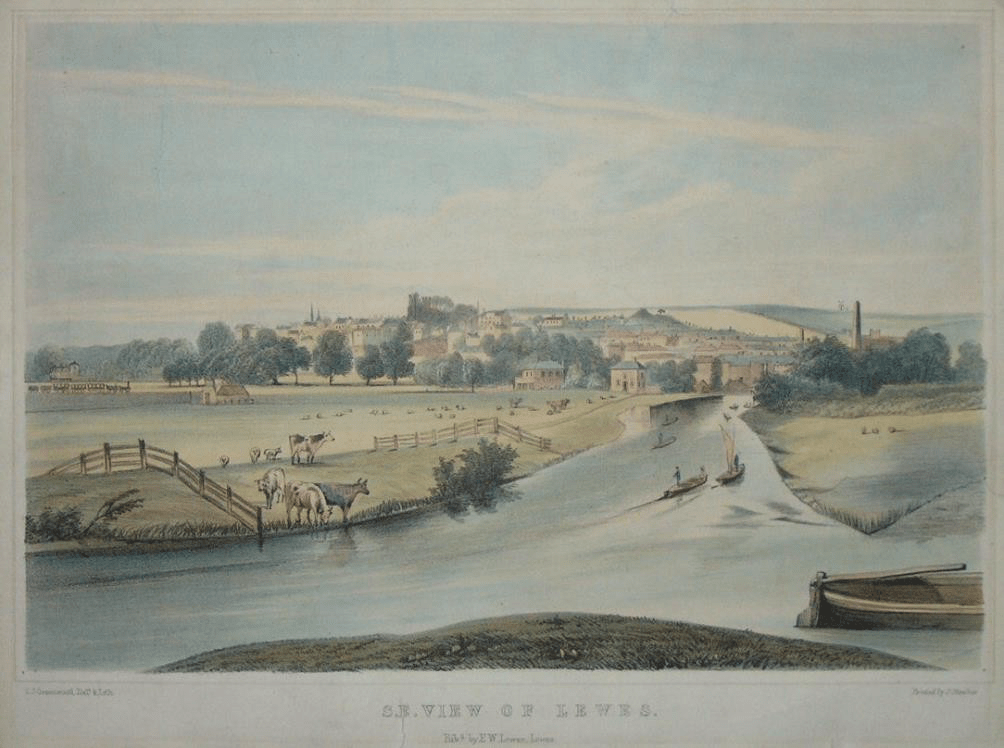
4. A view of Lewes from the South East
The view of Lewes shown below published in an 1825 edition of the Gentleman’s Magazine was drawn and engraved by C.J. Greenwood and published by E.W. Lower of Lewes. It features the junction of the traditional route of the River Ouse, close to South Street, and the more direct route of the new cut created by the Lower Ouse Navigation.
5.Lewes postal services before the Penny Post (by Chris Grove)
In 1839, the year before the introduction of the penny post, the postal arrangements in the town were described in a directory published by Pigot & Co.
POST OFFICE, 44 High street, Thomas Saxby, Post Master, and Receiving House, 51 High street, Cliff
- Letters from LONDON arrive every morning at four and evening at six, and are despatched every morning at nine and evening at a quarter before ten.
- Letters from BRIGHTON, PORTSMOUTH, etc, arrive every morning at five, and are despatched every evening at eight.
- Letters from BATTLE and HASTINGS arrive every morning at half-past four, and are despatched every evening at half-past nine.
- Letters from NEWHAVEN, SEAFORD, etc, arrive every evening at seven, and are despatched every morning at six.
- There are two deliveries of the London letters daily, viz. at seven in the morning and six in the evening.
6.Jane Austen’s connection to Lewes
The opening scenes of Jane Austen’s unfinished novel, ‘The Watsons’, includes a ball that is thought to be based on those then held at The Star [Bulletin no.141]. Jane Austen is known to have visited the Star Inn in 1803. What was her connection to the town?
Jane Austen’s elder brother Edward was adopted as the heir to an estate based in Godmersham, Kent, by Thomas Knight and his wife Catherine. Catherine Knight had, before her marriage, been Catherine Knatchbull, and her first cousin was Anne Elizabeth Knatchbull, eldest daughter of Sir Edward Knatchbull, 7th baronet, of Mersham Hatch in Kent, who had in 1788 married Colonel William Newton, Colonel of the Prince of Wales Own 10th Dragoons, who had inherited the house that we now call Southover Grange. The Prince of Wales (the future Prince Regent and then King George IV) was the Colonel in Chief of this regiment, a role he took seriously, and a visitor to Southover Grange. The family bond was reinforced by Mrs Newton’s sister, another Catherine Knatchbull, marrying Catherine Knight’s brother, Wyndham Knatchbull.
Jane Austen, when living at Chawton, regularly visited the Knights at Godmersham in Kent. It seems very likely that she will have mixed there with her hostess’s relatives, including her Lewes-resident cousin. Source: Judy Brent, ‘Southover House Histories’; Wikipedia.
7.The River Ouse and South Street, from the Railway Land
This postcard of the River Ouse, the chalk pits and cement works and, in the background, South Street, was mailed in 1910. The Snowdrop stands out in the centre of the picture.
The new straight cut of the river, although over a century old at this date, is very evident.

8.The Miss Dymonds’ Quaker School
The origins of the Quaker girls school in Lewes, founded by Mary Ann & Sarah Godlee, two of the daughters of Cliffe merchant John Godlee, were briefly recounted in Bulletin no.107. The school was initially started in Albion Street, but quickly proved so popular that it needed larger premises and moved to Dial House (220 High Street).
In 1840 two daughters of a Quaker tanner in Exeter, Miriam Dymond (1804-1876) and Josephina Sparkes Dymond (1810-1881) came to Lewes to take over the school. In the 1841 census it can be found in Friars Walk, and there were 14 resident pupils, all between the ages of 11 and 17. In 1844 they were joined by a third sister, Mary Dymond (1808-1855), who had been teaching in a similar Quaker girls school in Stoke Newington that had closed the previous year.
The three sisters taught the school, and attended and actively participated in the Quaker meetings, until 1855. By the time of the 1851 census it had moved to 65 High Street, on the corner of Watergate Lane, and in addition to the three teachers and their two female servants there were 24 boarding pupils, again aged 10-17. The reputation of the school amongst the Quaker community is shown by girls being sent there from all across the UK. Their surnames included some, such as Ashby and Lucas, that will be familiar to those well versed in the history of Lewes Quakers. The Miss Dymonds’ pupils also included two daughters of the famous Birmingham Cadbury family – the John Cadbury who founded the chocolate business was a Quaker from Devon, and his first wife was Miss Priscilla Ann Dymond of Exeter (1799-1828), a close contemporary of the three schoolmistresses.
As the 1850s progressed Mary Dymond became increasingly unwell, and in 1854 all three decided to leave the school. They moved to Bath, where Mary died within a few months. The 1861 census finds Miriam & Josephina as retired schoolmistresses living in Winscombe, Somerset. This was the home of the Quaker Sidcot school, at which they had all studied and of which their brother Henry Dymond, a noted Quaker minister, was then headmaster. By the following census they had returned to Exeter. Josephina Dymond had become the second wife of an Exeter businessman, but her elder sister Miriam still lived with them.
The Quaker girls school in Lewes continued on the corner of Watergate Lane for more than another decade, now in the hands of Miss Mary Trusted (a Quaker minister), her sister Catherine and Miss Rachel Speciall. A school could have a worse name than Trusted & Speciall. The school later moved to Brighton, and 65 High Street became the main Lewes Post Office.

65 High Street drawn by C. Walter Hodges [from David Hitchin]
Sources: Henry Dymond, ‘Memoir of Mary Dymond, late of Lewes’ (1857); David Hitchin, ‘Quakers in Lewes’ (2010)
9.The journey from Lewes to London
“The time is not very remote when the journey from Lewes to the metropolis by the clumsy conveyance known as a machine occupied two days of really ‘hard’ travelling, the intervening night being passed at East Grinstead. Now, thanks to the power of steam, it is performed in less than the same number of hours.”
Mark Antony Lower, writing in the 1852 2nd edition of his ‘Handbook for Lewes’. The improvements in the previous century were due first to the turnpike trusts and then to the railway.
10.The Seaford and the Lyon (by Chris Taylor)
On 20 August 1895, two ships collided in thick fog, 25 miles from Newhaven. The Steam Packet Seaford, a 997-ton steel screw steamer, was a cross-Channel ferry on its way from Dieppe to Newhaven with 255 passengers on board and a crew of 42. It had been built on Clydeside only the previous year for the London, Brighton & South Coast Railway Company. The SS Lyon was a 475-ton French cargo vessel making its way on the same route in the opposite direction.
Captain Richard Sharp commanded the Seaford. He and his officers quickly surveyed the damage and concluded that it was catastrophic: the ferry was in imminent danger of sinking. The Lyon sustained far less harm. Within minutes its captain, Pierre Gauvin, had drawn his ship alongside the stricken Seaford and the transfer of passengers between the two vessels began. After 45 minutes all the passengers and crew from the Seaford had climbed aboard the Lyon and were en route to Newhaven. There were a few injuries – a Frenchman broke his leg; an Englishwoman fell into the sea between the ships and was rescued – but no loss of life.
Within an hour of the collision, the Seaford sank to the bottom of the Channel, where it remains
to this day, a haven, according to divers, for particularly large fish, especially conger eels. The accident and its near-miraculous outcome attracted national attention. In Parliament the President of the Board of Trade, Charles Richie, expressed “great satisfaction at the prompt and efficient action taken by the captain of the Seaford and also by the Lyon after the collision, which probably was the means of preventing a deplorable loss of life.” The local press extolled the virtues of the British seamen who had displayed “matchless bravery at a moment when discipline might well have deserted the bravest of our sons”. With a mixture of magnanimity and self-congratulation, the Sussex Advertiser observed that “It is a pleasing trait of English character to know that bravery on the part of others than her own sons can be duly acknowledged when occasion warrants”, congratulating Captain Gauvin “and his efficient crew, without whose valuable services it would have been impossible to accomplish the extraordinary feat of rescuing every person on board the ill-fated ship.”
The idea quickly emerged to stage a commemorative gala concert in Lewes to mark the heroic rescue. T.H. Roberts, proprietor of Illustrated Bits – a weekly magazine, one of several founded in the early 1880s in imitation of the highly successful Tit Bits – was the prime mover. He contracted the performers and a local committee raised the funds through an appeal for public subscriptions, amounting to more than 70 guineas. The concert took place in the Assembly Rooms at the Town Hall on 10 October 1895. The audience included members of the crews of both vessels as well as civic dignitaries from Lewes, Brighton, Newhaven and Uckfield. The railway company ran special trains with cheap fares for those attending. The programme consisted of a series of light operatic, patriotic and comic songs performed by largely forgotten artistes of the period, including Horace Reynolds, Walter Churcher, Professor Plumbridge and Miss Brown. Both the Sussex Advertiser and the Dieppe local paper, l’Eclaireur reported the concert an outstanding success, realising a
tidy surplus for the organising committee to disburse to charitable causes.
Sources: Hansard 22 August 1895; Scottish Built Ships (clydeships.co.uk); South Coast Diving (pteris.com); Sussex Advertiser 23 August 1895, 16 October 1895; l’Eclaireur 17 October 1895
11. Lewes Street Stories: South Street by Heather Downie
The latest volume in our Street Stories series is now available to purchase at £8.50. Beautifully illustrated with maps, photographs and works of art, the 64 page volume, the story runs up and down the street, which initially served the wharves along the river and the riverside chalkpits, but in the 18th century became the main turnpike route from Lewes to the eastern parts of the Sussex coast. By the 20th century South Street was part of the main trunk road along England’s south coast, and over-run with heavy motor traffic. Then the creation of the Lewes by-pass and the Cuilfail tunnel, and the decline in commercial traffic along the Ouse, radically changed its nature once again.
Copies of the book can be purchased directly via the Lewes History Group website (https://leweshistory.org.uk/), or from the Lewes Tourist Information Centre (on Lewes High Street next door to the Town Hall).

John Kay 01273 813388 johnkay56@gmail.com
Contact details for Friends of the Lewes History Group promoting local historical events
Sussex Archaeological Society: h t tp : / / s u s se x pas t . co . u k / e v e n ts
Lewes Priory Trust: h t tp : / / w w w . le w esp r io r y . o r g . u k / ne w s – l i s t i n g
Lewes Archaeological group: http://lewesarchaeology.org.uk and go to ‘Lectures’
Friends of Lewes: h t tp : / / f r i e n d s – o f- l e w es . o r g . u k / d ia r y /
Lewes Priory School Memorial Chapel Trust: https://www.lewesprioryschoolmemorialchapeltrust.org/
Facebook: https://www.facebook.com/LewesHistoryGroup
Twitter: https://twitter.com/LewesHistory



 Lewes History Group