
Please note: this Bulletin is being put on the website one month after publication. Alternatively you can receive the Bulletin by email as soon as it is published, by becoming a member of the Lewes History Group, and renewing your membership annually
1. Next Meeting: 10 June 2024, John Lamb, ‘The 150th anniversary of Lewes Rowing Club’
2. Victorian & Edwardian Lewes introductory course
3. Victorian & Edwardian Lewes: research projects
4. A view of Lewes from the South East
5. The Lewes Union in 1852
6. Lewes Trades and Professions from Pigot & Co’s 1828 Directory
7. An Edwardian postcard of Malling Street
8. Ashley Cooper’s Botanical Purifying Pills (by Chris Grove)
9. The Ragged School in St John Street
10. Lewes History for Sale: The Riverside Centre, Railway Lane
11. Guided church tower tours at St Thomas à Becket, Cliffe (by Peter Varlow)
12. Lewes Street Stories: South Street by Heather Downie
1. Next Meeting 7.30 p.m. King’s Church Monday 10 June
John Lamb The 150th anniversary of Lewes Rowing Club
1874 saw Disraeli’s Conservatives win a thumping victory over Gladstone’s Liberals in the general election. It was also the year that Levi Strauss patented his jeans with copper rivets and the year that the Lewes Rowing Club was born, at a meeting in the Lamb Inn.
In this talk John Lamb, current club chair and a former Mayor of Lewes, will trace the development of one of the oldest sporting clubs in the town. Founded at a time of increasing leisure and a quest for new ways of filling it, Lewes Rowing Club gave the citizens of the town access to one of its greatest assets; the Ouse. 150 years after its formation, the club is still going strong with members taking to the river in canoes, traditional wooden rowing boats, up-to-date motor boats and sailing yachts, venturing up and down the river and out to sea. In recent years rowing races between Newhaven and Lewes, a big feature of the early days, have been reinstated. The club’s main contribution to the life of the town is that it has enabled residents to enjoy the delights of boating on the Ouse ever since its formation.
This will be a live meeting at King’s Church. There is no need for LHG members to book – simply turn up in good time for the 7.30 pm start. There is an entry charge of £4 for non-members, with tickets available via Ticketsource.co.uk/lhg.
2. Victorian & Edwardian Lewes: introductory course
Booking is now open for the introductory course on Victorian & Edwardian Lewes to be held on alternate Tuesday mornings starting on 24 September, and led by Dr Sue Berry. The venue will be the meeting room at King’s Church. We hope that this course will set the context and offer guidance for more detailed studies of particular topics, but joining the course does not commit you to join any of the research projects to be established nor, if you already have the necessary knowledge, is it essential for subsequent participation. There will be a course fee of £20 to cover the costs of the five sessions. Book your place at Ticketsource.co.uk/lhg.
Course sessions and topics:
Session 1: Tuesday 24 September Lewes 1840-1914, an outline of what we know
Session 2: Tuesday 8 October Population and employment
Session 3: Tuesday 22 October Worship
Session 4: Tuesday 5 November Education and leisure
Session 5: Tuesday 19 November Local government and social and medical care.
3. Victorian & Edwardian Lewes: research groups
The overall aim of the Victorian & Edwardian Lewes project is to increase our knowledge and understanding of the way our town developed in a critical period of English history for which there are a good range of reasonably accessible sources that you do not need to be a professional historian to be able to interpret. The project is modelled on our successful Street Stories, which have seen a number of individual and group studies brought through to a successful conclusion, with some formally published in our ‘Street Stories’ series and others on our website. We hope that there is the interest, and we are confident that we have the sources available, to develop a much clearer picture of the town’s history in this period than is currently available. As with the Street Stories projects, we expect that some topics will attract small teams of researchers, but others may prefer individual studies. The key LHG contribution will be to ensure that our researchers in one area know what others in related areas are doing – we can learn from each other’s experiences and cooperation is generally more productive, and more fun, than duplication of effort.
We already know that Lewes, a large Georgian town by Sussex standards, grew much more slowly in the study period than many others in Sussex, and more slowly than the national population increase. This is despite the arrival of the new railways early in Victoria’s reign, with later additions that made Lewes a local transport hub. While the situation of Lewes is not unique, it does demand an explanation, and this will most likely prove to be related to the impact of industrialisation on the town’s economy, and its competitive situation compared to nearby rivals that developed far more rapidly. New jobs and new commercial opportunities certainly appeared in Lewes during the study period, but did others disappear? What went, and why? Case studies of particular trades and businesses may help explain.
History bequeathed Lewes a healthy number of Anglican churches, and all seven survived until 1914 – six are still active today. There were also a fluctuating number of non-conformist churches and chapels with quite a variety of broadly Christian beliefs. Victorian evangelical preachers were the celebrities of their day, attracting large crowds. We already have a small group interested in researching church and chapel activities and their roles in the town’s commerce, its politics and its social life. Again, we shall start by seeking to establish the facts, and then progress to explanation.
Education and leisure both saw huge changes. School attendance became compulsory in the 1870s, with a school system established that has developed to today’s, and literacy the norm for those born from that decade onwards. But how widespread was working class children’s education before it became compulsory, and how was it provided? And what became of the Georgian town’s network of private schools, that recruited from the town, the surrounding countryside and in some cases from across the Empire? In 1837 most leisure activities were for the benefit of the affluent and genteel – the Sussex Archaeological Society, founded in 1846, is one example. By 1914 Saturday afternoons were free time for most people. A whole host of sport and social clubs were established and many flourished – one such Lewes club is the subject of this month’s Monday evening talk. Who were the key movers and shakers?
Other areas in which we already know there is interest include the changes in local government; the progressive expansion of the Borough and its powers; the change in its Parliamentary representation from mainly Whig/Liberal to reliably Tory; and the changes in the provision of health and social care. But we are also sure there will be many other areas of interest that we have not, so, far identified. We are relying on our members to fill the gaps. All ideas welcome.
4. A view of Lewes from the South East
My thanks to Chris Grove and Heather Downie for pointing out that the view of Lewes from the south-east by C.J. Greenwood included in Bulletin no.166 cannot possibly have originated from an 1825 issue of the Gentleman’s Magazine as stated, as it clearly shows an early railway train travelling towards Lewes, and the railway did not arrive in Lewes until 1846! The error is mine, and does not appear in the website cited as the source.
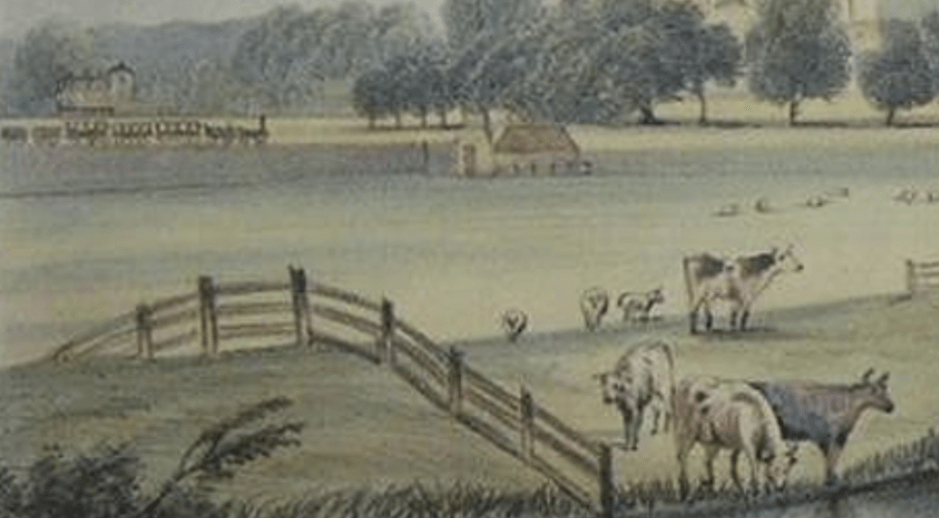
The artist C.J. Greenwood does not figure in Christopher Wood, ‘The Dictionary of Victorian Painters’, indicating that he did not exhibit at any of the main academies of his day. Unusually for an artist, he does not have a Wikipedia entry. He was however quite a prolific commercial topographical artist, but most of his works survive as lithographs or etchings. Churches, gentlemen’s country seats and early railway scenes predominate. He has one lithograph in the Government Art Collection – a view of Petworth House, described as the seat of Colonel Wyndham, but his subjects range across the Great Britain. His dated works are all from the 1840s or early 1850s. Colonel George Wyndham, the eldest illegitimate son of the 3rd Earl of Egremont, inherited Petworth from his father in 1845, and became Lord Leconfield in 1859.
5. The Lewes Union in 1852
“The Lewes Union comprises the seven parishes, embracing an area of about the same number of square miles. The number of Guardians is 11, viz for St Anne’s, one; St Michael’s, two; All Saints, two; St John’s, two; Cliffe, two; Malling, one; Southover, one. The average annual expenditure during the three years preceding the formation of the Union was £5,770. The expenditure for the year ending 25 March 1852 was £3,391 18s 6d.
No general poor house has been established, but the old parochial houses have been appropriated to the purposes of the Union. The able-bodied paupers occupy the poor-house of the Cliffe, the aged poor that of All Saints and children that of St Anne’s. The number of persons who received relief last year was 783 and the number admitted to the poor-houses 118. Board Day, Friday. Clerk, W.P. Kell, Esq. Relieving Officer, Mr J. Cooke.”
Source: Mark Antony Lower, ‘Handbook for Lewes’, 2nd edition (1852)
6. Lewes Trades and Professions from Pigot & Co’s 1828 Directory
Pigot & Co’s 1828 Directory is the earliest of the many 19th century county, regional or local directories to be found on the library shelves at The Keep that include lists of the various tradesmen practicing in each town and, later in the century, village within the area covered. As there were many local entrepreneurs keen to earn their livings using whatever opportunities became available to them, directory job descriptions can be abbreviated and over-simplified, but they do offer an impression of the way a town’s inhabitants made their livings at a particular date.
I have selected as examples three different business areas in Lewes in about 1828 – ‘about’ because the date is not printed in the directory itself, but handwritten by a later scholar. These are the town’s boarding schools, its breweries and its watch and clock makers.
Boarding Academies: At this date Lewes was a popular location for boarding academies for young ladies and gentlemen – the later censuses show that in the Victorian era boys and girls were despatched from home to boarding school at really quite young ages. There were a dozen establishments listed under this heading, seven for ‘gentlemen’ and five for ‘ladies’. The boys’ academies were invariably run by gentlemen and the girls’ by widowed or unmarried ladies. Despite the category heading, it was noted that one boys’ school also accepted day students and one girls’ establishment was entirely for day pupils. They were, listed alphabetically:
Ade, Miss (ladies), High Street Denham, Rev Mr (gents), High Street
Boys, William (gents), High Street Dunn, James Tracey (gents), Friars Walk
Brown, Mary & Lucy (ladies), High Street Godlee, Miss (Quaker ladies), High Street
Button, Miss (ladies), 3 North Street Holman & Francis (ladies, day), St John Street
Button, William (gents), Cliffe Horsfield, Rev T.W. (gents), High Street
Carleton, Edward (gents), Cliffe Mullens, James (and day), Market Street
Some of these schools were long-lasting and had high reputations, such as the Lewes Free Grammar School, and William Button’s school for non-conformist boys in the Cliffe. Miss Godlee’s school for young Quaker ladies attracted pupils from across the country, and the Victorian censuses show that by then some Lewes schools recruited children from British families living across the Empire. Others might have only a small number of pupils – in the case of Rev Thomas Walker Horsfield to supplement his income as minister of Westgate Chapel – and last only for so long as their proprietor was interested in the project. An odd feature is that all the proprietors listed in 1828 had surnames starting with a letter in the first half of the alphabet. In the earlier, 1823, edition, there were a similar number of academies, but over half the proprietors differed.
Brewers: In 1828 there were five breweries in Lewes, all of them easy to identify.
Beard & Chitty, Fisher Street Verrall, William junior, Southover
Berry, Thomas junior, Malling Street Wood & Tamplin, Bear Yard
Langford, Benjamin & John, Castle Brewery
At this date there were still those, such as John Ellman, who advocated that a good housewife should brew her own beer, and also small scale commercial operations, but most people now purchased their beer ready-brewed from a large scale brewer. As the century progressed each brewery tried to build up its own pub chain. The story of the Castle Brewery, bankrupt in 1856, has been told in Bulletin no.144, but the others all survived until the end of the 19th century. Harvey’s, Ballard’s and the Hillmans’ breweries lay in the future.
Watch and Clock Makers: In 1828 there were still five clockmakers listed in Lewes, four of them also producing watches.
Atwood, William, 184 High Street Holman, John, Keere Street
Davy, Ebenezer, 193 High Street Hooker, William, (clocks only), 12 Cliffe High Street
Gold Isaac, School Hill
By this date watchmakers especially, while still marketing instruments under their own names, were beginning to buy in more and more components ready-made from centres of mass production elsewhere. The same five names appeared in the earlier 1823 edition.
7. An Edwardian postcard of Malling Street
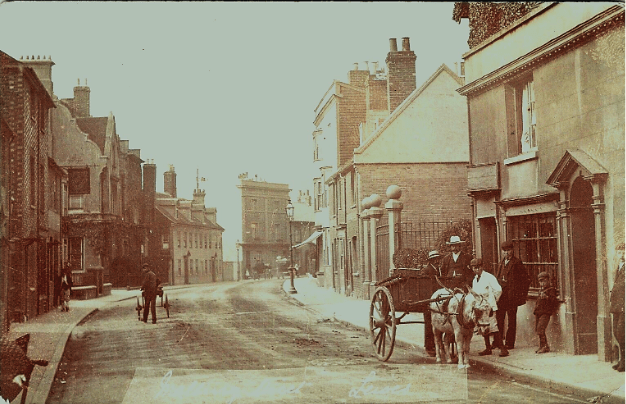
Most of the section of Malling Street shown in this Edwardian postcard was demolished in the 20th century to make way for first Phoenix Causeway and later the Cuilfail tunnel. The inn sign visible on the left is that of the Hare & Hounds public house.
8. Ashley Cooper’s Botanical Purifying Pills (by Chris Grove)
The advertisement below appeared in the 29 July 1839 Sussex Advertiser: Messrs Lee, the proprietor of the newspaper, were not only printers and publishers but also bookbinders, booksellers and stationers and ran a medicine warehouse.
“Ashley Cooper’s Botanical Purifying Pills, as established by 30 years’ experience, are prescribed by most of the eminent Physicians and Surgeons in London, and are always administered at several public Hospitals as the only certain remedy for Gonorrhea, Gleets, Strictures and all other forms of venereal disease, either sex, cured in a few days, by one small pill for a dose, with ease, secrecy and safety. Their operation is imperceptible: they do not require the slightest confinement, or any alteration of diet, beverage or exercise. They do not disagree with the stomach, nor cause any offensive smell to the breath, as is the case for all other medicines for use in these complaints, and after a cure effected by the use of these pills the party will not experience any return of the complaint, as generally occurs after taking Balsam of Copaiba, and other drugs of the like nature, which only possessing a local action, merely suppress the complaint for a time without eradicating it from the constitution, and the patient on undergoing a little more fatigue than ordinary finds all the symptoms return, and that they are suffering under the complaint as much as at first, and are at last constrained to have recourse to these pills as the only certain cure. They are likewise a most efficient remedy for pimpled faces, scurf, scorbutic afflictions, and all eruptions of the skin. Captains of vessels should make a point of always taking them to sea, their unrivalled efficiency in curing scurvy being known throughout the world. Local agents: Lee & Co, Medicinal Warehouse, 64 High Street, Lewes, Brew, Medical Hall, East Street, Brighton.”
9. The Ragged School in St John’s Street
When the trustees of the Lewes Ragged School decided to bring their work to an end in 1916 it was stated that the school had existed for ‘upwards of seventy years’. The 19 May 1916 Sussex Express, reporting the decision, states that this marked the end of 72 years’ work. This suggests that the school was formed before 1846, making it an early member of the Ragged School movement. Ragged schools are first recorded in London in 1840, established for children of the poor whose clothing and footwear was unsuitable for attendance at the normal schools of the day, and who were educated free of charge by philanthropists. The London Ragged School Union was established in 1844, with Lord Shaftesbury as its president. Charles Dickens visited a London Ragged School in 1843, and experience that inspired him to write ‘A Christmas Carol’. The inspirational Baptist preacher Charles Spurgeon and his Metropolitan Tabernacle were important later sponsors of the Ragged School movement.
The movement included day schools, evening schools and Sunday schools, but the Lewes Ragged School seems to have been primarily a Sunday School with volunteer teachers, though its activities also included at least some evening classes for young adults. It appears to have originated well before children’s education became compulsory in the 1870s, but continued for several further decades after that change. The school was supported financially by voluntary donations and legacies. In its later years its proprietor and leading light seems to have been the solicitor Isaac Vinall (1843-1907), whose father and grandfather were both pastors of Jireh Chapel and who was himself a leading member of that chapel.
The origins of the Lewes Ragged School are not recorded, but it operated in rented premises. It is tempting to imagine that the self-educated Methodist shepherd-schoolmaster John Dudeney (1782-1852) may have played a role in its foundation. He is said to have started a school in Lewes as early as 1804, when he was still a young man, and by 1814 he had moved his school to St John’s Street. His school remained there until 1864, when his son, also John Dudeney (1810-1886), moved it to Abinger Place. The Lewes Ragged School is first recorded in St John’s Street in 1870, and it occupied the former Dudeney school premises in 1877 & 1879, when they were first mortgaged and then sold by the younger John Dudeney.
In 1879 the trustees of the Ragged School, displaced by the sale, purchased their own freehold premises in St John’s Street. They bought the building that had formerly accommodated the Bethesda Chapel. Flush toilets were installed in 1882 – doubtless a novel experience for at least some of the scholars. The school remained there until the Ragged School closed in 1916. The closure was caused by the collapse of much of this building following a heavy fall of snow, as tenders for rebuilding proved unaffordable. The trustees decided to sell the building, as they believed there were by then more than enough other Sunday Schools in the town and social conditions had improved. The proceeds of the sale eventually went to supplement the resources of the Lewes Exhibition Fund, though it took several years to conclude the necessary formalities to the satisfaction of the Charity Commission.
A snapshot of the operation of the Ragged School comes from Holman’s Lewes Directory of 1887. At that date there were 470 scholars on the school roll, with an average attendance of 247. Isaac Vinall was the superintendent. There were 136 teachers, attending monthly in rotation, and 15 librarians. In addition to the Sunday School there was a Young Men’s Weekly Evening School and a Sunday evening prayer meeting attended by teachers, parents and scholars.
The archives of the Vinall family included a substantial number of glass lantern slides thought to date to the mid-1890s. These include local pastoral scenes but also several slides of members of Jireh Chapel and its Sunday School processing to their annual summer picnic at the Dripping Pan, and eleven other slides featuring boys and girls who were Ragged School pupils.
Sources: Wikipedia; British Newspaper Archive; ESRO AMS 6918/3; ESRO DL/A 25/3; the slides featuring Ragged School children are AMS 6918/2/26-36.
10. Lewes History for Sale: The Riverside Centre, Railway Lane
Offered for sale at £825K by Flude Property Consultants, Brighton, is the Riverside Centre on Railway Lane, backing on to the River Ouse. The building is currently set out for office use. It was built in 1901 as the Sunday School for the Lewes Tabernacle, which stood nearby on the High Street. The architect was E.J. Hamilton of Brighton and the builder Edward Hammond of 73 North Street, Lewes. Tabernacle itself was demolished in the 1950s, to be replaced by Christ Church on Prince Edwards Road, but the former Sunday School building passed to East Sussex County Council, who for many years used it for further education classes.


Sources: Flude Property website; https://christ-church-lewes.org/church-history; ESRO DL/A 25/178;
11. Guided church tower tours at St Thomas à Becket, Cliffe (by Peter Varlow)
Three years ago, the tower spiral stair of St Thomas in Cliffe was impassable, and no-one could see and admire or wind up its 350-year-old clock every day. Neither could they see its belfry and 15th century oak bell frame and four bells.
The earliest bell came to Cliffe from the South Malling collegiate church, thanks to a survey in 1555, by Lewes bellfounder William Wynberry, of Malling’s remaining assets, already crumbling and robbed after its suppression in 1547. One bell was “delyvered to Mr. Everarde and Browne, parishioners of Mallinge, to the use of the churche of Clyff”; other goodies that came with it included “A cope of grene vellett, A Chalesse, A paire of Awlter canstickes, and ij other greate cansticks, the sealinge of or Ladie chapell, the setes of the churche, the case of a paire of organs, the stone walles of the churche, an Awlter clothe, A towell, iij curtynes of silke, and the lente Clothe”. This munificence perhaps reflected the Catholic Queen Mary’s re-furbishing ambitions.

In 2021 St Thomas’s took the plunge and raised nearly £27,000 for stonework, lighting, a new handrail made by Tom Gontar at Glynde Forge, and a lot of oak floorboard repairs. Scores of Lewes people chipped in, and special thanks were due to donors including Friends of Lewes, the National Park, the Town Council, and even the Worshipful Company of Clockmakers. Now guided tours are starting again, fortnightly from 18th May, and culminating in two tours during September’s Heritage Open Days. After an introduction to the church interior, the tour is a rare, if not unique, chance to climb a parish church tower, up 57 steps of the spiral stair to the (reputedly) second-oldest turret clock in Sussex – James Looker, blacksmith of Ditchling, made it in 1670 for £5 10s and was to keep the same in repair for three years. Visitors will see and hear the clock strike 12 noon at close quarters on the big tenor bell. Also in full view is the ‘lovely and very special’ oak four-bell frame which may date from c1400 – and is ‘very pretty’, with its bell gear.
Tours are all on Saturdays at 11.30 am, on 1,15 & 29 June, 13 & 27 July, 10 & 24 August, and 7 September. Tickets are £5, booked in advance at the Lewes tourist information centre (01273 483448; now relocated to the District council office in the shopping precinct). The Lewes HOD tour details will be in their leaflet when published, and will be bookable free online.
Sources: J.R. Daniel-Tyssen, ‘Survey of the Church of the College of Malling’, Sussex Archaeological Collections, vol. 21, p182; Thomas Woollgar, Spicilegia, vol. II, p. 342; ‘The Church Bells & Clock’; Peter Hayward, Blyth & Co, site visit, 29 April 2023; Michael Royalton Kisch, site visit, 14 May 2023; https://st-thomas-lewes.org.uk.
12. Lewes Street Stories: South Street by Heather Downie
Sales of this new volume in our Street Stories series have been very encouraging to date, due both to its excellent content and some outstanding illustrations, such as this remarkable watercolour of South Street by Benjamin Abbott, dating to 1835-1845, and made available by kind permission of Nick Darton.
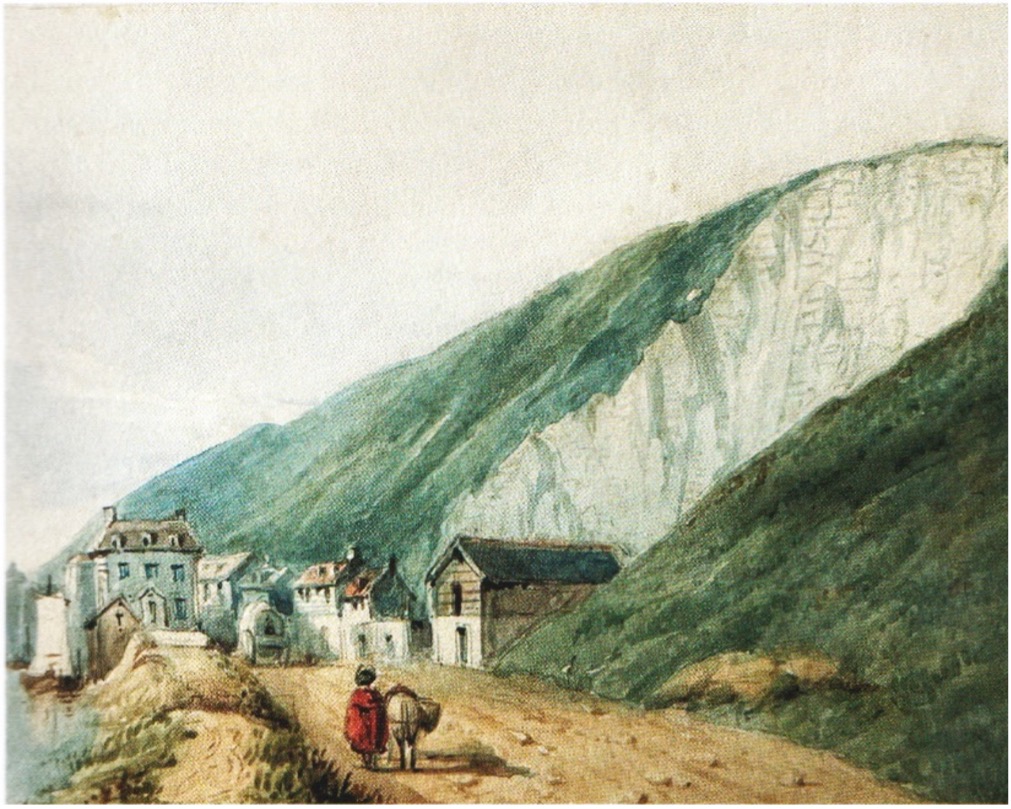
Copies of ‘South Street’ are available at our monthly meetings and can also be ordered for postal delivery via our website: https://leweshistory.org.uk/2024/03/26/lewes-street-stories-south-street-story/.
A major outlet for our other recent publications has been the Tourist Information Centre by the Town Hall. This has unfortunately had to close for urgent repairs, and its re-opening date is uncertain. However, the TIC has established a temporary base in the Lewes DC Information Office in the pedestrian precinct, but whether it will be able to resume its full range of activities, including the sales of our publications, in the limited space there remains to be seen.
John Kay 01273 813388 johnkay56@gmail.com
Contact details for Friends of the Lewes History Group promoting local historical events
Sussex Archaeological Society: http://sussexpast.co.uk/events
Lewes Priory Trust: http://www.lewespriory.org.uk/news-listing
Lewes Archaeological group: http://lewesarchaeology.org.uk and go to ‘Lectures’
Friends of Lewes: http://friends-of-lewes.org.uk/diary/
Lewes Priory School Memorial Chapel Trust: https://www.lewesprioryschoolmemorialchapeltrust.org/
Facebook: https://www.facebook.com/LewesHistoryGroup
Twitter: https://twitter.com/LewesHistory



 Lewes History Group