
Please note: this Bulletin is being put on the website one month after publication. Alternatively you can receive the Bulletin by email as soon as it is published, by becoming a member of the Lewes History Group, and renewing your membership annually
1. Next Meeting: 8 July 2024, Nick Kelly, ‘Canals and Inland Waterways in Sussex’
2. Victorian & Edwardian Lewes introductory course
3. Garden Street Auction Rooms (by Mary Anne Francis)
4. The escape and recapture of three Russian prisoners (by Chris Grove)
5. The Crown Hotel
6. School Hill by Norbert Sullivan Pugh
7. Lewes photographs from a holiday album
8. Leisure activities in Lewes in 1900
9. Lewes Racecourse Plan in 1903
10. Amusements in Lewes in 1852
11. A new owner for 1 Little East Street
12. Lewes History for Sale: The Old Library on Albion Street
1. Next Meeting 7.30 p.m. King’s Church Monday 8 July Nick Kelly Canals and Inland Waterways in Sussex
Before the arrival of the railways, and especially given the state of the roads across the Weald, the only practicable way to move heavy goods to and from Sussex was by boat, and Lewes owes its existence to its location on the navigable and tidal Ouse. With the onset of the Industrial Revolution the need for such transport greatly increased. The 18th century especially saw huge developments in water transport, with new canals and navigations across the country connecting mines and factories with their markets and ports. In his talk Nick Kelly will relate the Ouse Navigations upstream and downstream of Lewes in this period to other contemporary Sussex endeavours to improve the capacity and convenience of the transport of goods.
This will be a live meeting at King’s Church. There is no need for LHG members to book – simply turn up in good time for the 7.30 pm start. There is an entry charge of £4 for non-members, with tickets available via Ticketsource.co.uk/lhg.
2. Victorian & Edwardian Lewes: introductory course
We have a handful of places remaining available for the introductory course on Victorian & Edwardian Lewes to be held on alternate Tuesday mornings at King’s Church starting on 24 September, and led by Dr Sue Berry. This course will set the context and offer guidance for more detailed studies of particular topics within the V&E Lewes theme, but joining the course does not commit you to join any of the research projects to be established nor, if you already have the necessary knowledge, is it essential for subsequent participation. There is a course fee of £20 to cover the costs of the five sessions. Book your place at Ticketsource.co.uk/lhg.
Course sessions and topics:
Session 1: Tuesday 24 September Lewes 1837-1914, an outline of what we know
Session 2: Tuesday 8 October Population and employment
Session 3: Tuesday 22 October Worship
Session 4: Tuesday 5 November Education and leisure Session 5: Tuesday 19 November Local government and social and medical care.
3. Garden Street Auction Rooms (by Mary Anne Francis)
Lewes residents may be familiar with the two ‘tin’ huts on the site at the corner of Garden Street and Southover Road, which are also conspicuous to anyone waiting at the station, or passing through – on Platforms 1 and 2 at the London end. They are due to be removed very soon to make way for a housing development and there are plans, initiated by Cllr Edwina Livesey, supported by Lewes District Council’s Arts Tourism Manager, Helen Browning-Smith, to mark their passing. They have a fascinating history.

As the signs on the outside proclaim, the huts have links with Gorringe’s Auction Rooms, though from 2017 all their sales were at their North Street premises. The placards note too that Gorringe’s incorporated ‘Julian Dawson’ whose antiques business also ran from the huts when they were part of Lewes’ cattle market, which was located on the site from 1883 to 1992.

The present sheds were probably once the church at the North Camp, Seaford, which was used to train soldiers in the First World War. This gives them an even further reach, as the North Camp is said to have included British troops and the 1st Battalion of the West Indies Regiment.
This is, for sure, a history worth marking – but one with lots of gaps. If you have any information about the ‘huts’ – which are really more like sheds or hangars – please contact maryannefrancis@hotmail.com who is co-ordinating the research arm of the ‘huts project’. Photos, memories, any other documents – all are of interest. People working on this project, who include artist Marco Crivello, and school and college groups, are hoping to use the site’s current hoardings to tell the huts’ story. It’s possible there will be other commemorative events later in the year.
It is likely that the huts will be taken apart and stored, rather than demolished, until a site can be found where they can be reassembled – this is very much early flat-pack architecture! If you have any ideas for suitable locations in which the huts can be given a new lease of life, please contact Edwina Cllr.livesey@lewes-tc.gov.uk. See Bulletin no.143 for an account of the auction rooms under Julian Dawson
4. The escape and recapture of three Russian prisoners (by Chris Grove)
The account below appeared in the 3 April 1855 Sussex Advertiser.
“On Wednesday morning last, three of the Finns, located at the War Prison, managed to effect their escape from the building, but they were shortly after retaken. Lieutenant Mann, the governor, took a party of the prisoners the Downs for an airing, between 9 and 10 o’clock, being accompanied by the usual guard of pensioners and warders, and leaving about 100 prisoners behind, under the care of a small body of the staff. While thus left, three of the prisoners, having equipped themselves in private clothes, scaled the roof of the guard house, which reached to the top the outer wall opposite to Little East Street, and dropped themselves into the street, a depth of from 10 to 12 feet. They then very leisurely strolled down East Street, past the Railway Station, through Friars Walk, and Walwer’s Lane. They were dressed in slate coloured coats and trousers, figured waistcoats, fancy silk neckties, and cloth caps, and had very much the appearance of the German musicians that frequent this country. On their route they repeatedly addressed those whom they passed with “good morning” in broken English.
Upon arriving at the top of Walwers Lane they solicited the services of a labourer, who was passing, to conduct them to a public house, and while he was the act of complying with their request, they suddenly took to their heels owing to a circumstance explained below. It appears that the act of their dropping from the wall, was witnessed by Captain Mailard, one of their officers, who is living opposite to the spot, and it is stated that he immediately caused alarm to be given at the prison. Some of the pensioners and wardsmen lost no time in pursuing the fugitives, and were speedily joined by a great number of men and boys.
Having traced them to the bottom of School Hill, they solicited the services of the son Mr. Smith, the butcher, who was following his avocation on horseback. He at once joined in the chase and galloped off at full in speed the direction of Southover, as far as the Tunnel. Having learned that the run-a-ways had not taken that route, he retraced his steps to the bottom of St. Mary’s Lane. In the meantime, the prison guard after making enquiries at the Railway Station, with very little success, dispersed itself and went the various lanes leading to the High Street. The person who went up Dolphin Lane saw the prisoners at the top, under the escort of their obliging guide and they, perceiving that their escape had been discovered, immediately took to flight, as stated above.
Two of them ran up the High Street, whilst the other took Market Street. The mounted pursuer, who was slowly coming up St. Marys Lane, saw them enter Fisher Street and was soon by their side. Being thus closely pursued, one of them turned into a narrow passage between the Corn Exchange and some stores behind the engine house, when his course being cut off he was soon captured. His companion ran through the Star Hotel kitchen, across the entrance hall, and out of the front door. His progress, however, was soon at a close, for he had only proceeded a few yards down the town before he was in the grip of one of the pensioners.
The third run-a-way, being an expert pedestrian, and not having the disadvantages of a horseman behind him, gave his pursuers a little more trouble. He ran up the lane by Mr. Broad’s, the tallow chandler, across Market Street, and to Castle Banks, when he jumped over the fence and secreted himself, best he could, under some bushes. His pursuers consisted of a corporal of the 73rd, a greengrocer named Beck, and a host of boys, who appeared highly delighted with the chase, manifested by the earnestness with which they ‘gave tongue’.
Mr. Patch, the purser at the prison, was also on the lookout, and from the road below he spied the prisoner who was quickly taken from his hiding place. Neither of them offered the slightest resistance, and they were at once marched off to their old shop, the crowd increasing every step the way. The prison guard, as might naturally supposed, were greatly annoyed at the escape, and their vexation was not diminished by the conduct of the fugitives, who had hearty laugh over the matter, and seemed to think it a fine joke. The arrival of the governor, however, shortly afterwards, caused them to put a different face upon it, and they were once confined in separate cells, and ordered to be kept upon short rations. The only explanation they give for their conduct is that they wanted to see a little of English life, that it was their intention to have stayed in the town during the night, and surrendered the next morning.
The clothes were purchased of Messrs. Brown and Crosskey, who sell wearing apparel at the public market in the prison, but the Governor, although he allowed them to make what purchases they choose, strictly prohibited their wearing any other than their uniform. The whole circumstance, of course, has caused considerable talk in the town and neighbourhood, and, as usual, has been greatly exaggerated by rumours.
On Saturday last, a number of the prisoners were again taken upon the downs.”
5. The Crown Hotel
This postcard view of the Crown Hotel and the adjacent Market Tower by the Photochrom Company was taken in the 1920s, when H.W. Walton was the proprietor of both the White Hart Inn and the Crown.
Another postcard of the Crown in my collection with the same two gentlemen posed in front of the hotel also includes the war memorial.

6. School Hill by Norbert Sullivan Pugh
This attractive framed oil painting of School Hill signed Sullivan Pugh is currently on offer by Sulis Fine Art for £249 [see https://www.sulisfineart.com/norbert-sullivan-pugh-framed-20th-century-oil-lewes-high-street.html]. Norbert Sullivan Pugh was evidently quite a prolific artist, as Google reveals a range of broadly similar 20th century paintings of traditional landscapes and streetscapes.
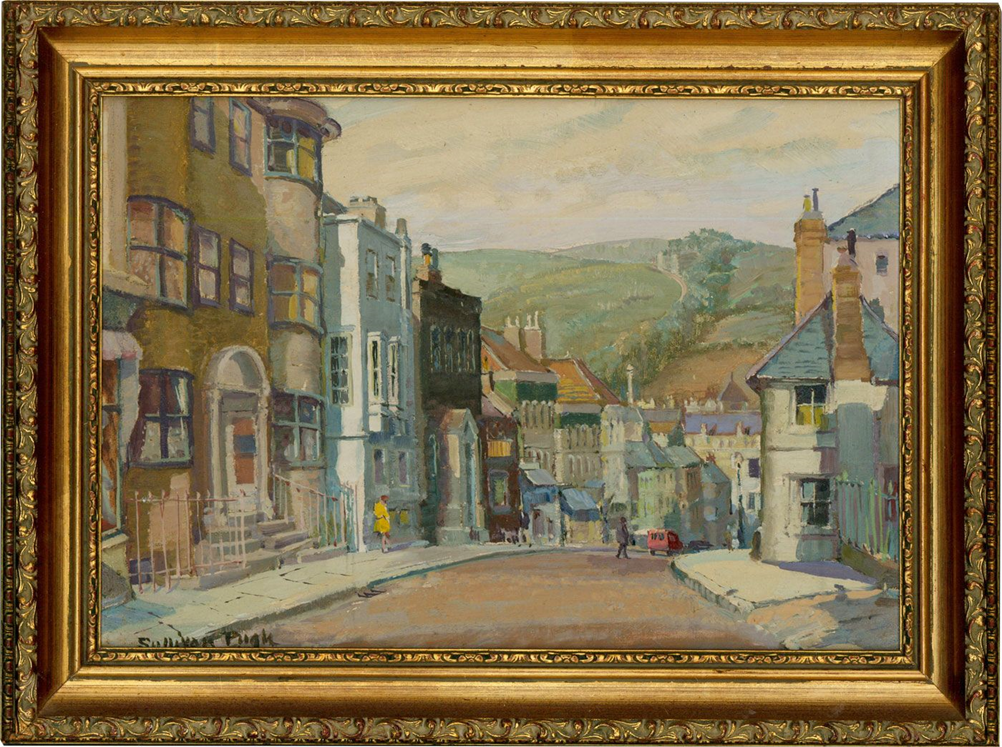
The earliest record I have been able to find about him is in the 1911 census, when young Bert Pugh, aged 6 and born in Ayrshire, was living in Wandsworth, with his parents and three younger brothers. The family was evidently a mobile one. His father had been born in Wigan and his mother in Suffolk. Bert was born in Kilmarnock in October 1904, but his younger brothers were born in Fulham in November 1905, in Morningside, Edinburgh, in February 1908 and in Tooting in 1910. This may be explained by his father’s occupation, which the 1911 census describes as ‘clerk of works, tramway, London County Council’. His father’s younger brother, living with them, was a contractor’s clerk involved in sewer construction, so it may be that they moved to wherever their construction projects took them.
According to an online biography Norbert Sullivan Pugh spent much of his life in London, joining the Chelsea Art Club. He studied for three years at a building school, at 17 becoming an architectural and ecclesiastical draughtsman, church craftsman and woodcarver, afterwards designing bookplates and practising calligraphy. While owning a commercial art studio in the Strand, he spent evenings studying from life and painting and began to exhibit in the capital. He also spent some years as a commercial artist with the advertising agency J. Walter Thompson. The 1941-2 winter number of The Hippodrome noted that he had two works accepted for the R.A. Summer Exhibition, and reviewed a collection of his pictures at the Archer Gallery. He then had a studio in Buxted, Sussex. The magazine classified him as a romantic. It commented favourably on his atmospheric Downs country scenes, figure groups, portraits and still lives, and “the artist’s belief that anything is paintable that has emotional interest”. It is most likely that it was during his period in Buxted that he painted this Lewes scene. His mother and all three of his brothers were living in Kent at the end of their lives.
Pugh later lived in Cornwall, and many of his pictures are of village scenes in Devon and Cornwall. He continued to paint until he was 94, and died in 2001 in Salisbury, Wiltshire. His death was registered under the name ‘Bert Pugh’. His family was notable for its longevity. His brothers born in 1905 and 1908 died in 2001 and 2004 respectively, while his mother lived long enough to qualify for a telegram from the Queen.
7. Lewes photographs from a holiday album
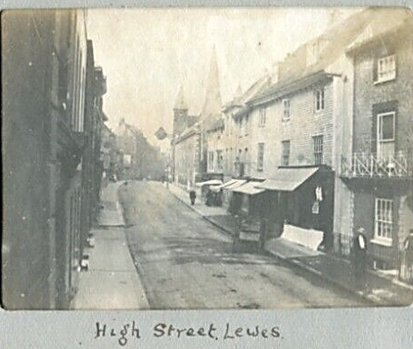
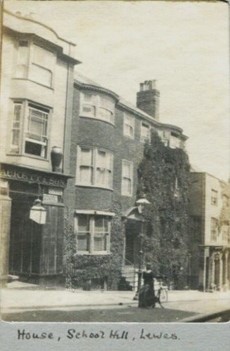
These two rather grainy photographs of Lewes High Street were included in a souvenir album of Sussex photographs created, probably after a holiday, by C.W. Murray dated ‘Summer 1902’. He also visited Newhaven, Hamsey, Ditchling, Westmeston, Hurstpierpoint, Southease and Litlington.The album attracted competitive bids when offered for sale on ebay.
8. Leisure activities in Lewes in 1900
The first Pike’s Blue Book for Lewes, Seaford and Newhaven on the shelves at The Keep is the volume issued for 1900-1. The list of spare time activities noted as available in the town started with no fewer than five freemasons’ lodges. There were also the Lewes Priory Cricket Club, the Southover Cricket Club, the Lewes Football Club, the Lewes Rowing Club, the Lewes Chess Club (which met in the Fitzroy Library) and the Lewes Cyclist Club (which met in the Bear Hotel, under the captaincy of George Holman). There were also the Southdown Foxhounds in Ringmer, with their pack of 50 couples of hounds.
While women might be numbered amongst the cyclists and those riding with the hunt, it is obvious that the great majority of these activities were aimed at men. Perhaps women were not expected to have any spare time.
9. Lewes Racecourse Plan in 1903
This plan shows the layout of Lewes racecourse as it was in 1903. The disassembled print from F.H. Bayles, ‘The Race Courses Atlas of Great Britain and Ireland’ was offered for sale on ebay at £110 by Antiqua Print Gallery Ltd, 80 Scrubs Lane, London.

10. Amusements in Lewes in 1852
“The inhabitants of Lewes are too commercial in their pursuits (and, shall we add, too intellectual in their character?) to need the excitement of public amusements. The Theatre, which existed in the last age, was never well supported, and gave way at length to a Mechanics Institution. Horse-racing too has seen its best days. Lewes races were formerly – especially during the regency of ‘the finest gentleman in Europe’ – among the most notable in the kingdom, lasting three days, and bringing a number of the sporting elite, as well as a still larger band of undesirable visitors, into the town. On the single day now dedicated to the sport a Queen’s Plate of 100 guineas is still run, or walked for, as the case may be. The race-stand is in ruins, having been accidentally burnt down some years ago by a party of Lancers from Brighton.
Cricket seems at present a more fashionable amusement, and the Dripping Pan witnesses the usual amount of ‘splendid’ bowling and ‘magnificent’ batting. There is an excellent Bowling Green within the Castle precincts, to which strangers are admitted under certain regulations. During summer the South Saxon Archers hold periodical meetings at Conyboro Park, three miles from Lewes. The club is limited to the gentry.
Exhibitions and concerts frequently take place at the Corn Exchange, connected with the Star Hotel, where also the South Downs Ball is given soon after Christmas. The winter balls of the nobility and gentry take place at the County Hall.”
Source: Mark Antony Lower, ‘Handbook for Lewes’, 2nd edition (1852)
11. A new owner for 1 Little East Street
Back in July 2023 [Bulletin no.156] we noted that the grade II-listed late-18th century terraced cottage at 1 Little East Street, adjoining Eastgate Baptist Church, was offered for sale at £350K by a local estate agent.
Failing to find a buyer by the traditional route, it has now been sold by auction. According to the Sussex Express the price realised was £154K. It is a very small cottage, and it does need a little work to bring it up to 21st century standards.
12. Lewes History for Sale: The Old Library on Albion Street
Currently offered for sale by Oakley Commercial at £650K is the grade II-listed Old Library building on Albion Street, presently used as offices. Designed by the Lewes stonemason and architect John Latter Parsons, it was built in 1872 to house the Lewes School of Science and Art that had been formed four years previously. After the School of Science and Art closed in 1932, it became the home of the Lewes Borough Museum, and later the Lewes Library.

Sources: Oakley Properties website; LHG Bulletins nos.86, 116 & 154.
John Kay 01273 813388 johnkay56@gmail.com
Contact details for Friends of the Lewes History Group promoting local historical events
Sussex Archaeological Society: http://sussexpast.co.uk/events
Lewes Priory Trust: http://www.lewespriory.org.uk/news-listing
Lewes Archaeological group: http://lewesarchaeology.org.uk and go to ‘Lectures’
Friends of Lewes: http://friends-of-lewes.org.uk/diary/
Lewes Priory School Memorial Chapel Trust: https://www.lewesprioryschoolmemorialchapeltrust.org/
Facebook: https://www.facebook.com/LewesHistoryGroup
Twitter: https://twitter.com/LewesHistory



 Lewes History Group