
Please note: this Bulletin is being put on the website one month after publication. Alternatively you can receive the Bulletin by email as soon as it is published, by becoming a member of the Lewes History Group, and renewing your membership annually
1. Next meeting: 11 November 2024, Chris Taylor, ‘Lewes Council Housing’
2. Grown in Lewes
3. Lewes Racecourse History Group: final exhibition
4. Two Georgian funerals
5. The Lewes Navigation
6. Military Exercises at Winterbourne, 1905
7. Two new images of South Malling Church
8. Developments at the Priory
9. Was Hitler the Anti-Christ?
10. A Cliffe Baptism certificate
11. No honour for George Holman
1. Next Meeting 7.30 p.m. Zoom meeting Monday 11 November
Chris Taylor: Lewes Council Housing, from 1920 to 1970
In this talk, Chris will outline the development of council housing in Lewes in the mid-20th century. A close look at specific episodes, drawn from five decades of house-building, will illustrate how Lewes councillors responded to national policy in the provision of homes for rent. Lewes Borough Council took it first steps into the housing market in the early 1920s with the opening of the first houses on the Nevill estate. Considerable expansion in the number of council homes followed as a result of ambitious slum clearances in the 1930s and a concerted, government-driven effort to eliminate sub-standard housing in the 1950s and 1960s. The consequences are visible in Lewes today, where a sizeable proportion of the housing stock was originally council-built.
Members can register without charge to receive a Zoom access link for the event at: https://us02web.zoom.us/webinar/register/WN_9GytjwX-R0qRZDfMG8bYsA#/registration.
Non-members can attend via Ticketsource.co.uk/lhg (price £4.00).
‘Grown in Lewes’ edited by Ruth Thomson & Sarah Bayliss is a new book about all things green in the town – both past and present. Its 192 pages are the work of over 50 authors and include 400 illustrations. The publication price is £16.50. The seeds were sown at a packed meeting in the Yarrow Room, Lewes Town Hall, in February 2023, and germinated to encompass topics as diverse as allotments, nurseries, seed merchants, notable gardens, graveyards, markets, wildflowers, trees, the Railway Land, artist-gardeners, and horticultural societies and their shows.
Copies of ‘Grown in Lewes’ will be on sale at:

3. Lewes Racecourse History Group: final exhibition
Barry Foulkes’ Lewes Racecourse History Group held what Barry described as its final exhibition at St Mary’s Hall on Saturday 14 September. On show was the astonishing archive that Barry and his colleagues have assembled to document the history of the racecourse from its establishment in the 18th century, when it frequently benefitted from royal patronage until its closure 60 years ago.

The archive covers almost every meeting, listing the runners, riders, trainers and owners of almost every race of which there is a record, and for good measure extends to the many racing trainers who established their stables in Lewes, and the successes of their horses and jockeys.
This is a truly exceptional collection of information about an activity, indeed an area of business, that played an important role in the life of the town over a period of more than two centuries. Barry and his colleagues are to be congratulated for their exceptional contribution to our understanding of this aspect of Lewes History.
4. Two Georgian Funerals
The Jireh chapel yard has a small number of memorials, one of them remembering Rev William Huntington, an eccentric London preacher who inspired the founder of Jireh, Rev Jenkin Jenkins. William Huntington described himself as ‘the converted coal heaver’ and added to his name as a qualification the letters S.S., standing for Sinner Saved. When he died at Tunbridge Wells in July 1813 his body was transported to Lewes on a hearse drawn by six horses and followed by a procession of mourners a mile in length. The Victoria County History of Sussex describes his as the most remarkable funeral that the county had ever witnessed.
Another memorable funeral took place at St Anne’s church in August 1832 after Charles Lee, King of the Gypsies, died in a tent near Lewes. He was buried in St Anne’s churchyard in the presence of a thousand spectators.
Source: J.M. Connell, ‘The Religious History of Lewes’ (1931), p.148
5. The Lewes Navigation
The excerpt below is taken from volume 5, p.270 of the Universal British Directory published in 1791, at the time when Britain’s canals were at the heart of the nascent industrial revolution, and the Lower Ouse Navigation was in progress.
“The river between Newhaven bridge and Lewes was navigable only for small barges at particular times of tide; but by widening, deepening, and some new cuts it is now constantly navigable for boats of larger burthen. A great purpose intended by this canal was to drain certain lands, lying to the east of Lewes, called the Laughton-levels.
For beach, gravel and other materials to be used for the making and repairing of roads, the tonnage is three-pence. For chalk, lime, dung, mould, soil, compost, or other articles to be used for manuring of land, two pence per ton. For other goods, wares and merchandises, four-pence per ton.
Vessels, rafts, etc, passing between Lewes-bridge and Southerham-corner are exempted from toll; also between Newhaven-bridge and Lock-hole.
By this canal the neighbouring lands will be materially benefitted by better drainage: as the embankments are to be continued on the east side of the river above Lewes-bridge to a place called Bushy-brook; and on the west side above Lewes-bridge to the upper end of the new cut; and on the north side of Glynde-Sewer, from Sound to the Swall-bank; and on the south side from Sound to a piece of land called the Cock-field, etc, etc, which lands are divided into five divisions, and are liable to certain rates which are under the direction of the commissioners of sewers. The lands below Newhaven bridge are exempted from rates, and they are to maintain their own walls, etc.”
6. Military Exercises at Winterbourne, 1905
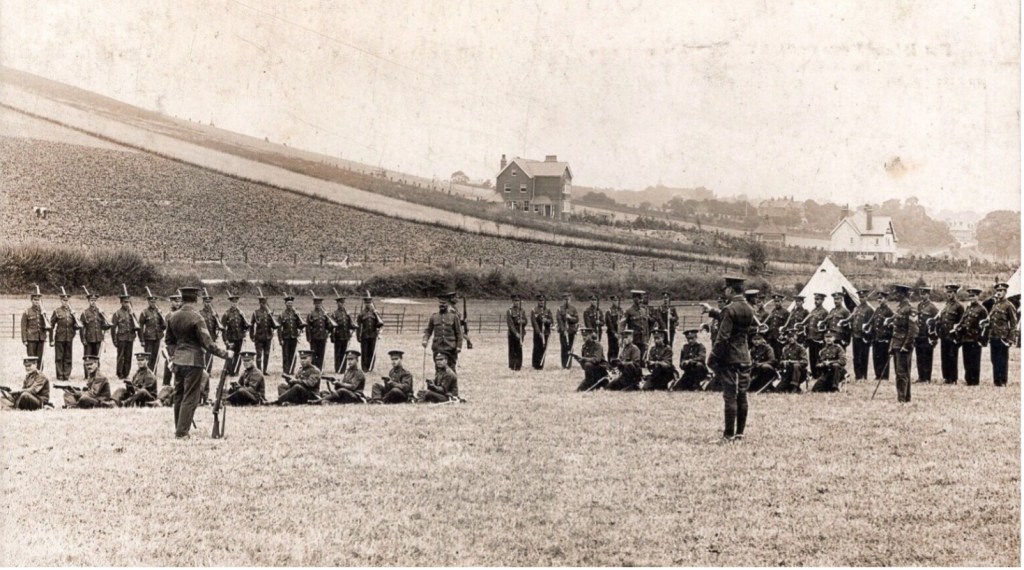
This postcard of one of the many summer territorial army camps on the Downs around Lewes in the Edwardian era was posted to Warnham, near Horsham, in 1906. This part of Lewes looks very different a century or so later.
7. Two new images of South Malling Church
A pair of small photographs of the exterior and interior came into my possession recently, acquired via ebay. The approximate size of cartes de visite, and mounted on card, they are identified as South Malling on the reverse in a hand from a century or so ago. The exterior view of the church looks quite similar to early Edwardian postcards views, though there is a little ivy on the church porch, and the 4-rail post and rail fence looks a little newer. On the reverse a modern hand has added ‘Trinity Church 1865’ but that does not seem credible. The A.H. Homewood and Mezzotint postcard views were taken in winter, but the new view was taken when the trees were in leaf.
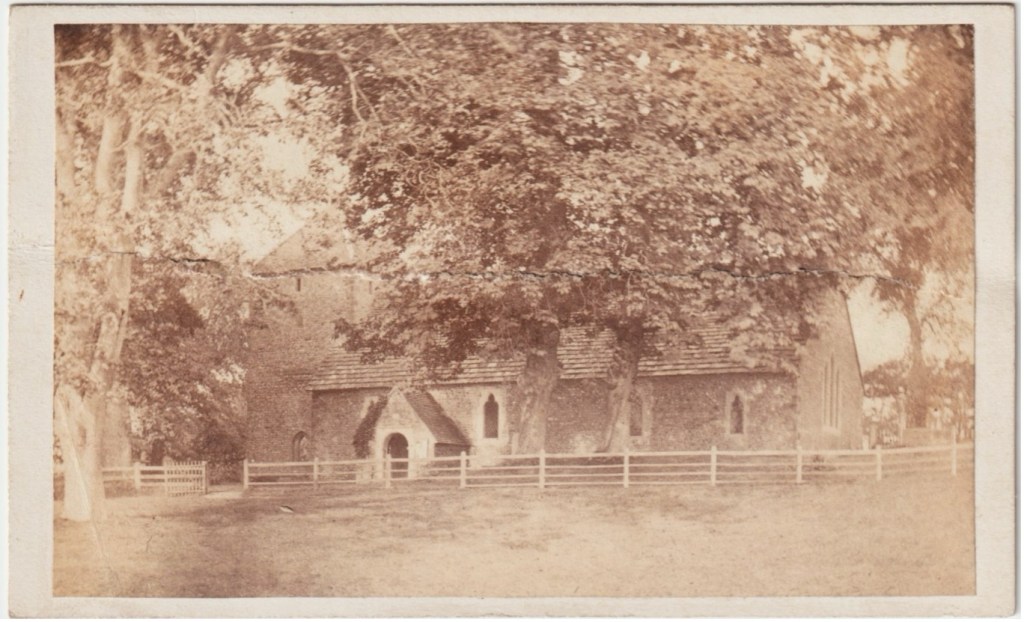
New image above: Mezzotint postcard view below

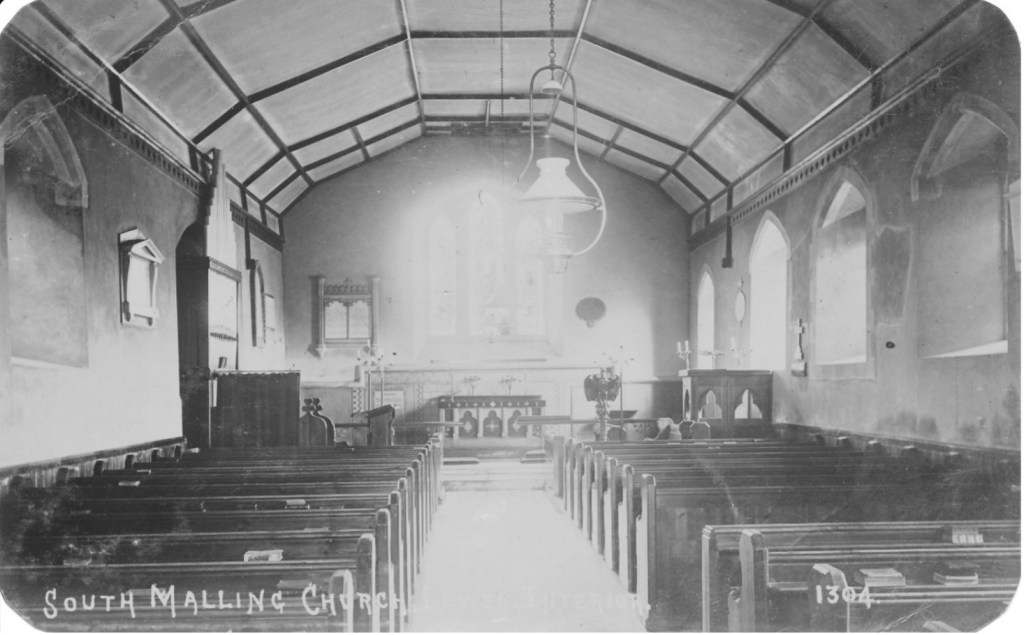
The interior view says on the reverse: ‘The Kempe Vault is immediately below the tablets’ – presumably the tablets marked with pencil crosses on the image. Comparison with the interior view looking east on the C.V. Travers postcard below (probably c.1910) shows that these tablets were at the east end of the north wall of the church. The organ pipes appear to have been re-located between the two photographs. The Kempe family, a descendant of whom was presumably responsible for these photographs, lived at Malling Deanery in the 18th century.

8. Developments at the Priory
In 1845 news of the discovery of the cists bearing the remains of William de Warrenne and his wife Gundrada during work to bring the railway from Brighton to Lewes attracted the attention of antiquarians across the country. Thus the 8 November 1845 Illustrated London News reported that it had commissioned the Brighton artist R.H. Nibbs to travel to Lewes to record the excavations, and then the editor himself had travelled to the spot to see for himself. At this date the cists containing the remains of William de Warrenne and Gundrada, carefully protected after their discovery by the chief officer of the London & Hastings Railway Police, were on display in the nave of Southover church, where they could be inspected by visitors on any day except Sundays. They had proved a very popular attraction. Unless they were Southover residents, such visitors were expected to contribute to the fund for providing them with a permanent home.
The editor also recorded the very recent discovery on the site of an earthenware urn encased in a leaden vessel, with the space between filled with clay, in which were a set of human lungs, stomach and intestines. These were thought to be part of the remains of the 3rd Earl de Warrenne, grandson of the dynasty’s founder, who had joined a French expedition to the Holy Land in 1147 only to be slain in an attack by the Turks. It was speculated that these were part of his remains, which had been bought home to the Priory for burial.
The priory church and its chapter house had been completely levelled on Thomas Cromwell’s orders, but some other monastic buildings had survived. The hall and refectory had been converted for use as a malthouse, while the priory’s immense cruciform pigeon house, which could accommodate three thousand pairs of doves, had survived until not long before 1845. Also demolished not long before 1845 was a large elliptical oven, 17 feet long and curiously built with tiles. The prior’s lodgings had been converted into a mansion house which had fallen into the hands of the Earls of Dorset, until destroyed by fire 150 years previously. This mansion had become known as the Lord’s Place, a name that came to cover the entire site.
It had been recorded in the Sussex Express (founded in 1837 by W.E. Baxter) that in 1828 & 1829 workmen had been employed to level the ground around the remaining Priory walls. Removal of the turf had revealed many of the foundation walls of the demolished buildings. W.E. Baxter had made a careful plan of them, that he still possessed. In 1835 part of the Priory grounds’ northern frontage had been laid out for the construction of the crescent of houses called Priory Crescent. W.E. Baxter’s ‘Guide to Lewes’ which contained much detail about the Priory site was described in this November 1845 article as ‘forthcoming’. It must have proved popular, as the only copy I have seen is a copy of the 6th edition dated 1852. Despite its evident popularity, very few copies seem to have survived.
9. Was Hitler the Anti-Christ?
The 2 December 1938 Sussex Express reported that the topic of the Rev Austen H. Atkins’ address to his congregation at Providence Strict Baptist Chapel, Little East Street, on the previous Sunday had been ‘Is Hitler the Anti-Christ?’. Mr Atkins said that he had been asked that question in the street. Rev Austen Atkins, pastor at Providence Chapel from 1934 to 1944, during which he also served as Honorary Secretary of the Lewes Free Churches Council, was not a man afraid to share views that might cause offence. After his address to his chapel’s anniversary service in 1940 a Lewes alderman and a Borough Council employee protested against his condemnation of the Roman Catholic Church. In the same year he gave a series of public talks on ‘God and the War’, declaring that in 1940, as in 1588 when the Spanish Armada threatened, God was on the side of Right, and that in both instances Englishmen could see the divine hand in the preservation of their nation. He preached his last service in Lewes in March 1944 to a large and appreciative congregation, after a decade of service to his church. He died in Essex in 1963 at the age of 66
10. A Cliffe Baptism certificate
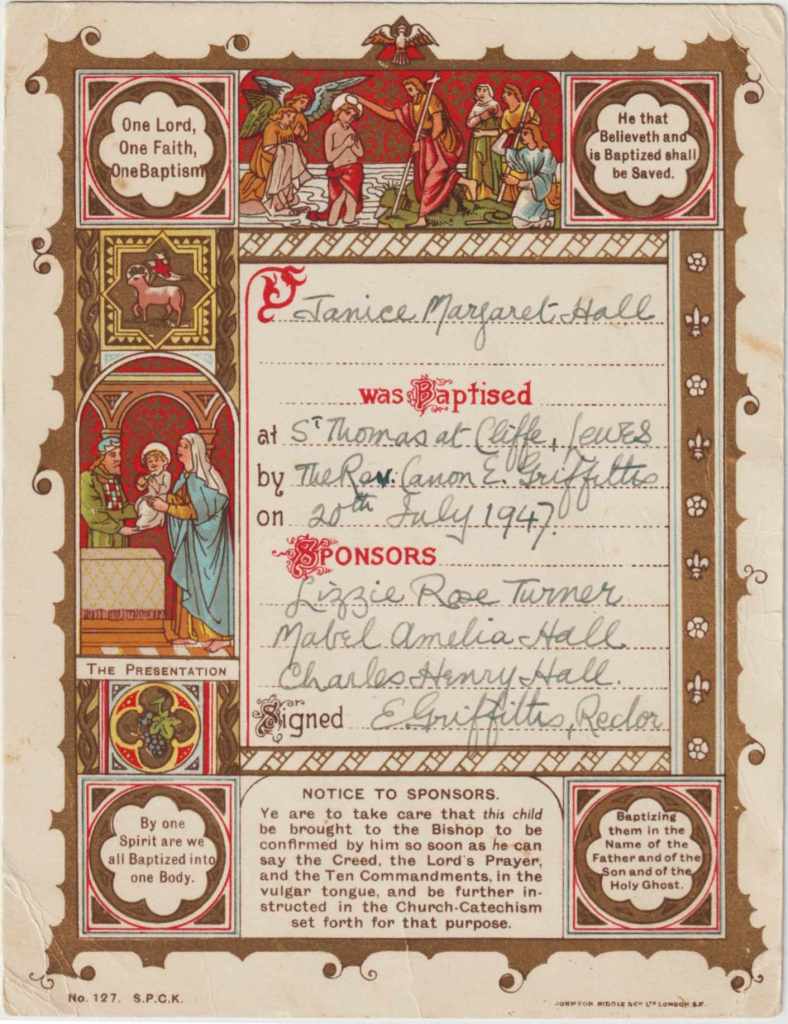
As recently as the 1940s Cliffe church was still issuing elaborate certificates such as the one below to children baptised in the church. I have seen several such certificates from before World War II, but this is later in date than the others I have seen. Does anyone know how long the issuing of such certificates by the Anglican churches in Lewes continued?
11. No honour for George Holman
On 31 October 1917, in the middle of the Great War, the House of Lords found time to debate the propriety of party funds being supplemented by donations made by those seeking to purchase honours, which there seems little doubt was a well-established custom. The Earl of Selborne’s contribution to the debate, recorded in Hansard, includes the following paragraph:
“The next case is even more remarkable. There is a gentleman in Lewes, in Sussex, called Mr George Holman, who has been seven time Mayor of Lewes. He has done public work of a great many kinds, but he has never asked for an honour. In 1912, at the end of his seventh mayorality, some of his friends in Lewes went to him and said: “We should like to get an honour for you. You have done so much public work that we think you ought to have a reward.” He said: “I should like an honour very much: I am greatly obliged to you”. One of his friends went straight to headquarters to the Whip and the Whip said: “Yes, it is a clear case for an honour. What is he prepared to give to my party fund?”. The friend returned to Mr Holman and told him what had been said. Mr Holman then remarked that in no circumstances would he give a penny to party funds. The friend returned to the Whip, and the Whip said on each occasion: “This is a very good case for an honour, but an honour he shall not have unless he contributes to my party fund”.”
In 1912 the Liberal prime minister was Herbert Asquith, and the chief whip was Percy Illingworth. While the system in force, in which of the order of £10,000 was expected for a knighthood, £30,000 for a baronetcy or upwards of £50,000 for a seat in the House of Lords, was not invented by Asquith’s government, they do seem to have made a sufficiently increased use of it to attract attention. However, in 1916 Asquith’s government was replaced by a Coalition led by the Liberal David Lloyd-George. This created a split within the Liberal party, in which Asquith, now out of office, retained control over party funds. Lloyd-George, desperate for party money, greatly increased the sale of honours, in a way that had already attracted public attention by the time of the 1917 debate. In the six years between 1916 and 1922 in which Lloyd-George remained prime minister over 1,500 knighthoods and 91 new peerages were created. Since there were many party donors who could not afford a knighthood, the Order of the British Empire was created to fill the gap, and another 25,000 people were given the OBE, which at that time was given the nickname of the Order of the Bad Egg.
A clergyman’s son called Maundy Gregory, whose roles included being an entertainer, a private investigator and, allegedly, a blackmailer, emerged as an honours broker for this system. He secured funds impartially for Liberal, Conservative and Coalition governments, and took a cut for himself. His activities in this arena were curtailed only in 1925, when the Act was passed that controls political donations to this day. These established the key principles still in force: that it is fine to give honours to party donors, and that it is fine to make a political donation in the hope of receiving an honour, as long as there is no formal link between the two. It is essential that a credible alternative reason for the award can be put forward, if only as a fig-leaf. After 1925 Maundy Gregory moved into related activities, such a brokering international and papal honours. In 1933 he attempted to revert to his old habits, and ran foul of a military man of principle, resulting in a conviction. To this day he remains the only person ever convicted under the 1925 Act.
Sources: Hansard; Andrew Cook, ‘Cash for Honours: the Story of Maundy Gregory’ (2008); http://www.globalsecurity.org.
John Kay 01273 813388 johnkay56@gmail.com
Contact details for Friends of the Lewes History Group promoting local historical events
Sussex Archaeological Society: http://sussexpast.co.uk/events
Lewes Priory Trust: http://www.lewespriory.org.uk/news-listing
Lewes Archaeological group: http://lewesarchaeology.org.uk and go to ‘Lectures’
Friends of Lewes: http://friends-of-lewes.org.uk/diary/
Lewes Priory School Memorial Chapel Trust: https://www.lewesprioryschoolmemorialchapeltrust.org/



 Lewes History Group