
Please note: this Bulletin is being put on the website one month after publication. Alternatively you can receive the Bulletin by email as soon as it is published, by becoming a member of the Lewes History Group, and renewing your membership annually
1. Next meeting: 10 February 2025, Chris Duffin, ‘It started with a tooth’
2. Victorian & Edwardian Lewes: Health & Social Care project group
3. Thomas Paine’s Legacy (by Leanne O’Boyle)
4. A week to celebrate Gideon Mantell (by Debby Matthews)
5. Railway lectures to the Lewes Mechanics Institution
6. A Bird’s Eye view of the Cliffe
7. Wilful Damage in North Street
8. The view down Malling Street
9. Does anyone recognise this house?
10. An Alfred Wycherley advertisement from the 1930s
11. The Lewes Press in Friars Walk
12. St Martin’s Lane by William Hyams
13. LHG meeting format preferences (by Chris Taylor)
1. Next Meeting 7.30 p.m. Zoom Monday 10 February 2025
Chris Duffin Gideon & Mary Ann Mantell and the discovery of Iguanodon
This month our speaker will be Chris Duffin, who will mark the 200th anniversary of Gideon Mantell’s presentation of the discovery of the to the Royal Society by speaking to us on the topic ‘It started with a tooth: Gideon & Mary Ann Mantell and the discovery of Iguanodon’. Chris, formerly a senior teacher, is now a scientific associate in the Natural History Museum’s Earth Sciences Department, and has received the Palaeontological Society’s Mary Anning Award for his outstanding contributions to the subject. For other events to celebrate this bicentenary see below.
Members can register without charge to receive a Zoom access link for the event at: https://us02web.zoom.us/webinar/register/WN_9GytjwX-R0qRZDfMG8bYsA#/registration.
Non-members can attend via Ticketsource.co.uk/lhg (price £4.00).
2. Victorian & Edwardian Lewes: Health & Social Care project group
The second group we hope to establish to learn more about the Poor Law, medicine and public health in our town will be led by Ann Holmes and Chris Taylor. The 1834 Poor Law Amendment Act, just a few years before the start of our study period, removed the responsibility for health and social care for those members of society unable to support themselves from the parishes to the new Lewes Poor Law Union and its elected Guardians. The new Union workhouses were designed to encourage independence but both national and local policy evolved as our study period progressed. It took Lewes over 20 years to build a new model workhouse, which then became redundant when the Lewes and Chailey Unions merged. Meanwhile public and philanthropic funds led to the foundation of the Lewes Dispensary, the Victoria Hospital and a whole range of public and private initiatives to improve public health. By the end of the period there were even Old Age Pensions to support those too old to be able to work. And, of course, there were always a number of private doctors based in Lewes for those who could afford to pay for their own treatment.
If you would be interested in joining this new group to investigate one or more aspects of this area please contact Ann Holmes [annholmeslewes@yahoo.co.uk].
3. Thomas Paine’s Legacy (by Leanne O’Boyle)
The 18th-century thinker and writer Thomas Paine lived in Lewes for six years (1768-1774), before heading to the American colonies in 1774. His time in Lewes was hugely influential on Paine and is where he wrote his first political pamphlet ‘The Case of the Officers of Excise’. This was part of the first national unionised action anywhere in the world.
Paine was active in his community and used his talents as a writer to try to bring about change locally, nationally and internationally. His pamphlet Common Sense, published in 1776, lit the touch paper of revolution and galvanised the colonists to fight for a new nation, a nation that Paine himself would name the ‘United States’.
Thomas Paine: Legacy will be opening Bull House, Paine’s Lewes home, to the public 20-22 February 2025. Members of the Lewes History Group are invited to a discussion at 2 p.m. on Saturday 22 February. This is an opportunity to learn about the plans for the building and contribute ideas. RSVP to info@thomaspainelegacy.org.
4 A week to celebrate Gideon Mantell (by Debby Matthews)
Gideon Algernon Mantell (1790-1852) was not just a local doctor for Lewes in the early years of the 19th century but went on to become nationally, and internationally, famous for his various geological and antiquarian finds. His contribution to our understanding of what lies below the ground came from him not just finding a range of artefacts locally, but also his dedicated cleaning, illustrating and recording of them. 2025 marks the 200th anniversary of his paper to the Royal Society ‘Notice on the Iguanodon, a newly discovered reptile, from the sandstone of Tilgate Forest, in Sussex’ communicated by Davis Gilbert Esq on 10 February 1825. Mantell was not yet a Fellow himself; this he gained in October 1825.
Local Lewes residents who annually put on some talk or event to commentate Mantell’s birth date of 3 February have decided this year to make a bit more of a festival of it. The week begins with his anniversary lecture to be held in the council chamber of Lewes Town Hall on Monday 3 February at 7.00 for 7.30 pm. Martin Simpson from the Isle of Wight will speak on ‘Gideon Algernon Mantell: Lone genius or master networker? The role of family, friends and colleagues in the success of a pioneer collector’. Tickets are £6 from Eventbrite see https://tinyurl.com/2xbj4j6w or, if still available, on the door.
Gideon Mantell is famous for his fossil discoveries, not only dinosaurs such as Iguanodon, but also many ammonites, crustaceans and fish from the Cretaceous rocks of Sussex. This talk discusses his mentors and the people who helped with his research, sometimes overlooked by historians. Martin Simpson is a freelance palaeontologist who specialises in Cretaceous fossils and is most famous for filling his house with 62,000 specimens, rather like his Victorian hero Gideon Mantell. Martin’s ambition was also to find new species, and has even named one after Gideon’s wife Mary Ann.
Running from Friday 31 January to the following Friday there will be a mini exhibition of items relating to Mantell’s life and career in the Information Centre window next to the Town Hall (187 High Street). On Sunday 9 February there are a couple of opportunities to join the guided walk around Lewes, run twice at 10.00 a.m. and 1.30 p.m. Debby Matthews will take people around the town from his birth place to his house on the High Street, using his diaries and writings to view the town as it was in his life time. Tickets £5 from the Tourist Information desk currently in the Precinct or email debby.matthews@yahoo.co.uk.
The week culminates with Chris Duffin’s Zoom talk, hosted by the Lewes History Group and advertised above. There are other events happening across Sussex and further afield to mark this important anniversary. Visit https://gideonmantell.wordpress.com/.
5. Railway lectures to the Lewes Mechanics Institution
The new steam-powered railways running regular services for transporting passengers as well as freight were a major innovation in early 19th century England, and one in which it was the north of the country that blazed the trail. There was already, from the first decade of the century, a tramway serving Offham chalkpits that used the power of gravity to truck chalk down to a cut in the Lewes Levels below and simultaneously raise the empty trucks back to the chalkpit on a separate line, so local people were familiar with the railway concept.
An intellectual powerhouse of the town at this date was the Lewes Mechanics Institution, based in the former theatre on West Street. This attracted not only those of the gentry interested in scientific developments but also young men of a practical bent from much more ordinary backgrounds hoping for careers based on the new technologies that underpinned the industrial revolution.
We know of at least three talks on the new railways given to members of this Institution long before the first real railway arrived in the town in 1846. In 1832 the young Quaker merchant Burwood Godlee, who at the age of 30 had already been delivering gas to light Lewes’s streets for more than a decade, delivered a lecture on ‘Railroads’. Four years later he spoke again to a packed audience on ‘Steam Power’, including a demonstration of what was described as “an ingeniously constructed engine”. In 1840 the solicitor Arthur Rennie Briggs delivered a lecture on the London & Brighton Railway, which was to open to customers in 1841.
Both Burwood Godlee and Arthur Briggs were amongst the Lewes townsmen who supported the creation of the network of railways that led to Lewes becoming a local railway hub. It is lucky that Burwood Godlee was so supportive of this mode of transport, as his mansion at Leighside, in what is now the Railway Land, became entirely surrounded by the different railway tracks.
Source: Gregory Mitchell, ‘The impact of the railway on early- to mid-Victorian Lewes’, an unpublished 1995 University of Brighton MA thesis available on the local history shelves in Lewes Library.
6. A Bird’s Eye view of the Cliffe
This postcard, used in 1910, shows the view down Cliffe High Street, and towards the town, taken from a perch high on Cliffe Hill.

7. Wilful Damage in North Street
On 13 September 1892 the Lewes bench heard a case against Emma Cox of North Street, summoned for breaking the window of her neighbour Emma Matilda Eades eleven days previously. She was legally represented.
The complainant said that she was indoors, between 8 and 9 o’clock, when she heard a window smash. Going to investigate she found a group of boys nearby, but when she spoke to them a boy named Fuller told her “It’s not us breaking your window; its Mrs Cox, and she’s gone indoors”. She then noticed Mrs Cox at her door, and told her that she had had three panes broken, and would not have any more. A pane of glass cost a shilling. Cross examined by the defence counsel she agreed there were a lot of little boys playing in the street.
George Fuller than gave evidence that he saw the defendant throw something at the window that broke the glass. He was playing with some other boys, but they were not throwing stones. Charles Piper produced a piece of coal, which he had found in a box in the complainant’s shop window.
Mrs Cox’s counsel submitted that the accident was more likely due to the boys playing nearby than to his client, who had no ill-feeling towards her neighbour, and who immediately after the incident had gone to fetch her husband, who had investigated the matter. The magistrates disagreed, found Mrs Cox guilty and fined her ten shillings, inclusive of costs.
The 1891 census shows Emma Cox aged 33, a fishmonger’s wife with an 8 year old son, living at 20 North Street. Next door was a grocer’s shop, though this was not in 1891 run by Mrs Eades.
Sources: 17 September 1892 Sussex Express; FindMyPast
8. The view down Malling Street
Postcard views looking up this part of Malling Street are quite common, but this mid-Edwardian postcard by the Mezzotint Company shows the less common view down the hill. The Wheat Sheaf Inn appears on the left, and the spire of Undercliffe House is also visible.

9. Does anyone recognise this house?
Does anyone recognise the bay-windowed semi-detached house in this picture? It comes from a postcard by an anonymous publisher that was mailed from Lewes to a family friend in September 1913.
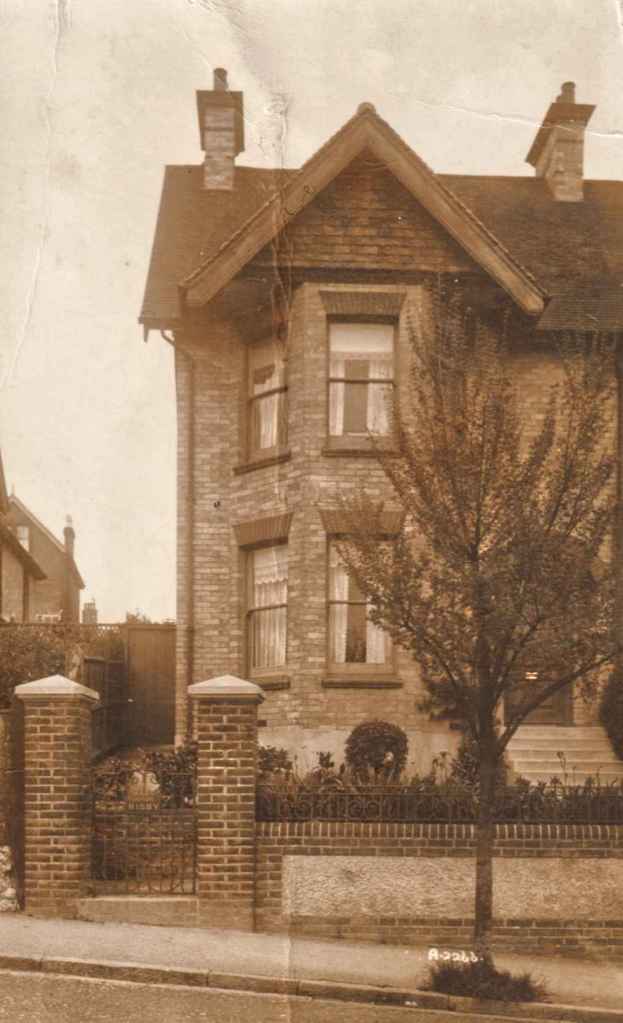
There are very similar garden walls in the Wallands, and the general period looks right.
10. An Alfred Wycherley advertisement from the 1930s
Offered on ebay in December 2024 was this advertisement for the house agent A. Wycherley at 56 High Street, Lewes, next door to the White Hart, and indicating the range of services they then offered to clients.

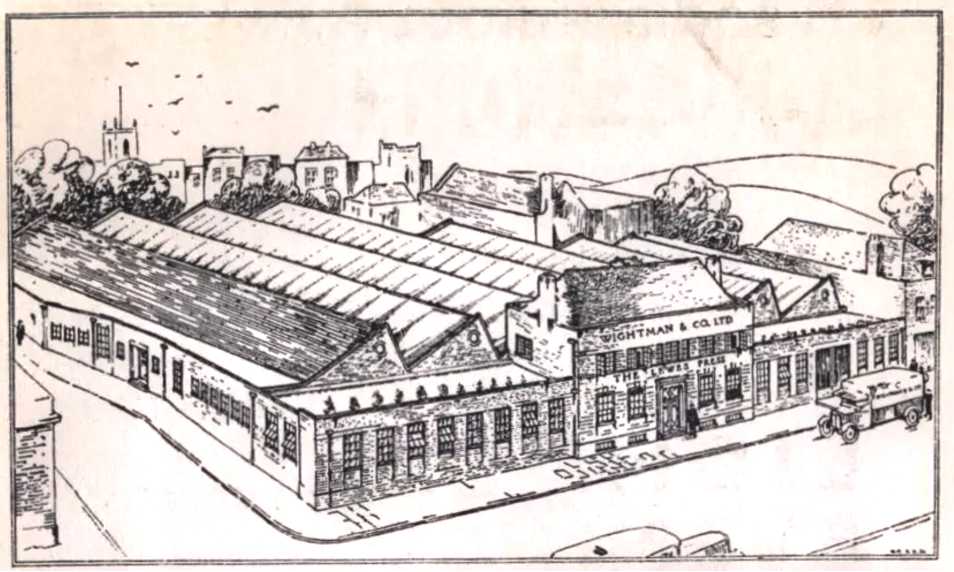
11. The Lewes Press, Friars Walk
These drawings of the Lewes Press building in Friars Walk are taken, respectively, from trade advertisements in the 1930s and in the 1968 edition of Kelly’s Directory for Lewes.

12. St Martin’s Lane by William Hyams
The watercolour below by the prolific Brighton-based marine and landscape artist William Hyams (1878-1952) was offered for sale recently at £275 by Jacob Boston Fine Art, a Salisbury-based antique dealer. Entitled ‘A street in Lewes’, it shows the upper end of St Martin’s Lane. From the dress of the lady shown descending the lane, this was one of his later works.

13. LHG meeting format preferences (by Chris Taylor)
We recently polled our membership on whether they wished to retain the present mix of live and Zoom meetings, or whether they would prefer to revert to all-live or all-Zoom meetings.
The outcome of the poll was:
- Live meetings all year 46 (33%)
- Zoom meetings all year 18 (13%)
- Mixed live and Zoom meetings, as now 77 (55%)
Total votes cast were 141 (c.28% of membership). While a higher rate of participation would have been desirable, the guidance to your committee from those members who did participate in the survey seems pretty clear.
John Kay 01273 813388 johnkay56@gmail.com
Contact details for Friends of the Lewes History Group promoting local historical events
Sussex Archaeological Society: http://sussexpast.co.uk/events
Lewes Priory Trust: http://www.lewespriory.org.uk/news-listing
Lewes Archaeological group: http://lewesarchaeology.org.uk and go to ‘Lectures’
Friends of Lewes: http://friends-of-lewes.org.uk/diary/
Lewes Priory School Memorial Chapel Trust: https://www.lewesprioryschoolmemorialchapeltrust.org/



 Lewes History Group