
Please note: this Bulletin is being put on the website one month after publication. Alternatively you can receive the Bulletin by email as soon as it is published, by becoming a member of the Lewes History Group, and renewing your membership annually
1. Next meeting: 10 March 2025, Jonathan Vernon, ‘The Friendly Invasion of Lewes’
2. Victorian & Edwardian Lewes: Health & Social Care (by Ann Holmes)
3. Janet’s Tea Rooms (by Sally Howard)
4. The story of Anne of Cleves House (by Sue Berry and Jane Vokins)
5. Bonfire troubles
6. An Errand Boy’s punishment
7. The last public execution at Lewes Prison (by Chris Taylor)
8. Edward Brummitt, Lewes photographer
9. No one recognised this house
10. A Royal Field Artillery Camp, near Lewes
1. Next Meeting 7.30 p.m. Zoom Monday 10 March 2025
Jonathan Vernon The Friendly Invasion of Lewes
This month the speaker of our last Winter Zoom meeting will be Lewes Town Councillor Jonathan Vernon whose topic will be the impact on Lewes of the 10,000 men of Kitchener’s New Army, who included a number of Caribbean troops and Jewish units, billeted in and around the town during the early months of the Great War.
Members can register without charge to receive a Zoom access link for the event at: https://us02web.zoom.us/webinar/register/WN_9GytjwX-R0qRZDfMG8bYsA#/registration.
Non-members can attend via Ticketsource.co.uk/lhg (price £4.00).
Please note that our April meeting, our first live event for 2025, will actually be held on Monday 31 March: Ruth Thomson will be speaking on ‘Grown in Lewes’
2. Victorian & Edwardian Lewes: Health & Social Care (by Ann Holmes)
Four members of our new Health and Social Care project group have now met to plan our research on this subject. Our next meeting will be at the Keep where we will begin our hunt for the documents relevant to our study. We hope to uncover lots of fascinating details about public health, medical doctors, hospitals and social policy, and especially about provision for the poor. We are also interested in changes in social attitudes throughout this period. We are, of course, open to more ideas and hope that others will join us.
3. Janet’s Tea Rooms (by Sally Howard)
Some of the questions following my January talk to the Lewes History Group concerned the location of Janet’s Tea Rooms, regularly visited by my grandmother while she was a nursery nurse at Glyndebourne in 1942. A photograph showed the café near the top of School Hill.
However, I have since discovered from an advertisement in the Sussex Express that in 1944 Janet’s Tea Rooms moved from 205 High Street (where my grandmother would have known it) to 195 High Street (further up School Hill, and just down from Aylward’s Corner). The advertisement notifying customers of the move included a warning note: “Mrs Martin wishes it to be known that she has no connection with any business which may be carried on at the old premises”.
4. The story of Anne of Cleves House (by Sue Berry and Jane Vokins)
In 1923 ‘Anne of Cleves’ House (then also known as The Porched House) in Southover, Lewes was conveyed to the Sussex Archaeological Society (SAS) by Frank Verrall. In 1928 he added to his gift the malt house behind the house, now the Every Building. This article is a short survey of the history of the house and the former malthouse as we see them today. It also asks what the best future might be for this interesting but inevitably expensive to maintain property. Anne of Cleves became a listed building in 1952 and is now Grade II*. The idea of protecting buildings of interest by listing them was developed as part of the 1947 Town and Country Planning Act and has proved effective. The majority of listed buildings are homes or in commercial use. Resources for the study of the property are at the end of this article.

The house was part of Anne’s divorce settlement of 1540, when Henry VIII offered a generous deal which included property as sources of income for her. They included the Priest’s House (which the Society also owns) and the Clergy House at Alfriston (now owned by the National Trust). Anne was given Hever Castle, taken from the Boleyn family, and royal residences at Richmond and Bletchingley as her residences. Henry VIII supplemented her income with cash gifts. Anne became his ‘sister’ so that her position at court was clear. She proved to be a very capable survivor in the challenging world of the Tudor court and became a wealthy woman. It is very unlikely that she ever visited her house in Lewes which would have been managed by her steward as part of her property portfolio. Towards the end of her life, without the patronage of Henry VIII her income was reduced but she remained wealthy. When she died in 1557, Queen Mary I ensured that Anne was buried in Westminster Abbey as a former wife of Henry VIII.
The house given to Anne as part of her divorce settlement stood at the street end of a generous plot of land sloping down to the Winterbourne which still flows (Fig.1). Today part of Southover Primary School stands on the former grounds. This former girls’ Grammar School was built when that land was sold in 1910 by the Verrall family. More of the gardens, to the east, were used in 1825 by the Verralls to build two pairs of attractive semi-detached villas.
Anne would not have recognised the house we see today had she visited it. By 1540, the oldest part was a large, rectangular timber-framed hall house which replaced the older house in the later 1400s. Below the hall house remained the small, barrel-vaulted undercroft of the 13th or 14th century which is still there. This house had a parlour and chamber at the west end of the building, then a hall where we see it today, then a cross passage running from the street to the back gardens. On its eastern side, service rooms stood between the passage and the cart entrance or store we see today with a chamber or loft above. This was the property Anne was given with its generous grounds.
When Anne died in 1557 the house was sold to or reverted to John Stempe who had been on the payroll of Lewes Priory. He sold it to Robert Saxpes a member of an affluent local farming family. Robert and then John Saxpes altered the house in the later 1500s and early 1600s (during the reigns of Queen Elizabeth I and King James I). This is when the major changes took place. When John died in 1608 the freehold capital messuage or mansion house with barns, stable, garden and great orchard adjoining was inherited by his daughter and co-heiress who married a merchant who lived in Southover. By the 1620s, the family moved to Cliffe the suburb of Lewes on the east side of the river Ouse.
Meanwhile, the west bay of the old hall house was demolished by the Saxpes c.1600 and rebuilt taller and as the front of a wing. This not only enlarged the house but also made the west end look more important, emphasizing the end where the family lived. The wing extends along Potters Lane overlooking the small garden used at present as a coffee shop. The two storied ‘false porch’ which juts out of the front was built by John Saxpes c.1599. It provided an entrance lobby for the house; new windows were also inserted into this street facade. The upper part of the porch may have been rebuilt during the 1920s restoration. The initials on the porch are IS for John Saxpes. It was known as The Porch House by 1825.
From then on, changes were made without enlarging the house. In the eighteenth century (1700s) the wagon entrance became a room and the height of the first floor was reduced. Tiles were hung on the principal elevations and the ground floor of the front rebuilt.
The site had a succession of owners until 1781 when the Verrall family bought it. By then there was a malthouse, stables and a wood house and the house was in multi-occupancy. The property continued to be subdivided until the Verrall family sold it. In 1841, there were four households headed by a labourer, a labourer and his wife, a gardener with his wife and daughter, and a maltster with his wife and daughter. By 1851 there were six households, three on poor relief. The multi-occupation continued until after 1901 but by 1910, the house was occupied by three people. The shop was still in use. When Frank Verrall gave the House to the SAS in 1923, the three occupants were allowed to complete their tenancies.

Drawing by RH Nibbs (1816-1893) showing the house in multiple occupancy.
Two doors are inserted either side of the main entrance, signs of which are visible today.
The date of this drawing is unknown but Nibbs produced drawings like this from the 1850s.

To help the house function as a museum, the west wing was altered in the 1920s by W.H. Godfrey, a well-known architect with an interest and expertise in working on historic buildings. So, it joins Michelham Priory where the Tudor wing was badly damaged and rebuilt in 1927 after a very serious and well-documented fire, and Lewes Castle and many other old buildings open to the public which have been altered and repaired to the extent that we have to be cautious about how we promote them. With the proliferation of interesting historic sites open to the public, there is the additional problem of whether the property is well located and distinctive enough for visitors to go and then recommend it to others. Many do not fulfil these criteria and do not flourish.
By 1650, a malthouse stood to the north of the house, beside Potters Lane, and it remained in use until the early 1850s. In 1858 the malthouse was used as an agricultural machine manufactory and in 1910 it was described as a builders workshop. Bought by Frank Verrall in 1928, it was given by him to the SAS. As the Every Wing, it was adapted by Mr. Godfrey to house fire backs and other iron goods made in the Weald of Sussex collected by Mr. Every.
Anne of Cleves House and the malthouse was given to the SAS at a time when many older properties were thought to be under threat and were cheap to buy. They were often taken without an endowment in the expectation that tourism would pay for the building’s upkeep. But the trustees have to make the building earn its full keep from tourism without the numbers required damaging what people come to see. This is an issue for smaller buildings and gardens such as Anne of Cleves, Priest House and Clergy House. They also have rivals in open-air museums such as the Weald and Downland at Singleton north of Chichester where houses such as Bayleaf give a good impression of life during the same period.
The well-intentioned belief that tourism will pay the costs of maintaining an old building is misplaced. In spite of looking as if it has a healthy bank balance, the National Trust struggles with the costs of building maintenance, because opening up old buildings can reveal issues that are not obvious even with the use of modern non-invasive checks. Many of the smaller properties donated to organisations such as the SAS were given before and after the First World War when they were regarded as unsuitable for occupation in a world wanting to have warmer, better lit houses with running water during a time when a mass-produced modern house, particularly in the interwar suburbs, offered more comfort. The older houses were not protected by listing because it did not exist at that time.
From the generosity of those wanting to keep these places, they became early museums and due to their rarity for a while, a novelty. But as time passed and other places opened with stronger identities and maybe more space around them, those that lack strong identities and central locations lost public interest and now struggle to cover their costs. There is also the issue that it is not in the best interest of small fragile buildings to bear the impact of the tourist numbers needed as running costs increase.
Domestic use with the protection of listing, which many now have, has proved effective, aided by the growing appreciation of the value of historic buildings in town and country. Historic buildings improve the quality of urban landscapes and their rarity now enhances their value as properties to own, complications arising from their accumulated layers of history notwithstanding. For a house like ‘Anne of Cleves’ is good care as a listed historic home (or home and business) the best plan for it now? If it remains a museum, then how will the site be effectively cared for and the displays revised to encourage people to return and to recommend it? Will people who enthuse over keeping the house open be willing to underwrite repairs? Grants are not easily obtained and in a shrinking economy, small heritage sites will find attracting visitors even harder than they do now.
Sources: The estimate for the balance and number of early listed buildings is from A. Emery ‘Introductory Reflections after greater medieval house of England and Wales’ in M. Airs and P. Barnwell (eds), ‘The Medieval Great House’, Shaun Tyas, 2011, 2; Historic Royal Palaces website, type in ‘Anne of Cleves’; Colin and Judith Brent’s Lewes House Histories; East Sussex Record Office (The Keep) HBR/1/1655, David and Barbara Martin, Anne of Cleves, Southover High Street (David and Barbara Martin, 2007); S. Berry and G Sheppard, ‘Cultural Heritage sites and Their Visitors: Too Many for Too Few?’ in G. Richards (ed) ‘Cultural Attractions and European Tourism’ (CAB International 2001), 159-171; Resources and images collected by Jane Vokins.
5. Bonfire troubles
The 19 January 1784 Sussex Advertiser reported the proceedings at the recent East Sussex Quarter Sessions:
“At the above sessions a bill of indictment was preferred against several persons for aiding and assisting in making a bonfire in the Cliffe on 5th November last; and it is rather extraordinary that one of them is a woman, and servant to a Reverend Doctor.”
6. An Errand Boy’s punishment
At the July 1860 Midsummer Quarter Sessions held in Lewes errand boy Obed Stevens, aged 12, was convicted of embezzling several small sums of money received on behalf of his master George Peter Bacon of All Saints, Lewes (publisher of the Sussex Advertiser). For these crimes he was sentenced to one month’s hard labour in Lewes gaol, and then to be sent to the Reformatory School at Redhill for 4 years.
The 1851 census finds him aged 3 in North Street, in the large family of journeyman carpenter William Stevens and his wife Winefred. By 1871 this Lewes family had moved to Tonbridge, where his father had become an upholsterer. Obed was with them again, now an unmarried tailor aged 24. The Reformatory School records note him as “discharged to his friends in Tunbridge”. However, undiscouraged by Obed’s poor start, two of his younger brothers aged 21 and 19 had both become printers.
Sources: 5 July 1860 Brighton Gazette; FindMyPast website.
7. The last public execution at Lewes Prison (by Chris Taylor)
A murder: On the evening of 1 February 1866, John Leigh, aged 27, walked into the parlour of the Jolly Fisherman Inn in Market Street, Brighton and, without saying a word, shot the landlady, Harriet Horton, twice with a Colt revolver. He then ran outside and shot at Brighton Police Superintendent Barnden, who happened to be passing, before being overpowered and taken into custody. Mrs Horton died a few hours later.
A motive: Harriet Horton was Leigh’s sister-in-law. He and Mary, his wife of a year, lived at no.8 St Ann’s Terrace in Lewes and were unhappily married. She had recently left him and gone to live with her sister Harriet in Brighton, refusing Leigh’s frequent pleas to allow him to see her and persuade her to return. Leigh blamed Harriet’s influence for these refusals and had confronted her several times over the preceding days, she on one occasion calling him ‘a thief, pirate and murderer’. The next evening he took his revenge.
A culprit: John Leigh’s back-story makes extraordinary reading. He was the illegitimate son of a Brighton gentleman ‘holding a very respectable position’, whose wife, somewhat unusually, agreed to take John in and bring him up as her own and only child. He soon began to indulge in wild habits however, and was a constant source of trouble to his parents. Aged 17, he joined the Royal Navy and served in the Crimea campaign. He narrowly escaped death when his ship was wrecked in a storm in the Black Sea, corroborating the old adage that those who are born to be hanged will never be drowned. He then served in China during the Second Opium War, receiving several severe wounds, which he bore with pride and would readily exhibit whenever requested. After that he claimed to have sailed on board the celebrated Confederate cruiser, the Alabama, which involved him in further daring exploits.
On returning to Brighton, he took over the Oddfellow’s Arms in Queen’s Road but the business soon failed. He then moved to Brentford, where the magistrates refused him a licence to run another pub, upon which he vandalised the premises and was sentenced to three months in gaol. Back in Sussex, he took up residence in Lewes and married Mary Whiteman at St Ann’s Church in February 1865. Nicknamed Captain Leigh, he became locally notorious, keeping a fast trotting mare and frequenting the smoking room of the Pelham Arms. According to the newspapers, he “took delight in little else but smoking, hard drinking, fast driving, and the company of the lowest members of the sporting fraternity.”
A trial: John Leigh appeared at Lewes Assizes on 22 March 1866, charged with murder and shooting with intent to inflict grievous bodily harm. His defence was that he was not in a sane condition of mind at the time, but it rested entirely on evidence that he had on two previous occasions suffered attacks of delirium tremens, resulting from drinking ardent spirits to excess. Not surprisingly, Chief Justice Erie was unimpressed and dismissed the claim. The jury convicted Leigh without retiring and Erie sentenced him to death. Mary was in court during the whole trial, but left just before the sentence was pronounced.
Leigh is said to have exhibited indifference to both the verdict and the sentence, even laughing as he went down the stairs leading from the dock. However, after the trial he adopted a more solemn demeanour, spending a lot of time with the Rev. Burnett, the prison chaplain. He received holy communion for the first time in his life on the Monday before his execution. No one visited him except his mother and two of his former companions at Brighton, whom he exhorted to “abandon idle and vicious courses”. Mary made an application to visit, but he refused to see her.
A hanging: Shortly after midday on 10 April 1866, John Leigh mounted the scaffold erected against the south-east side of the prison wall. He surveyed the crowd calmly. The executioner, in adjusting the rope, found removing the prisoner’s shirt collar difficult and Leigh told him to tear it. The formalities were completed, the drop fell, and Leigh died after a short struggle. His body, after hanging an hour, was cut down and buried the same day in one of the corridors of the gaol.
An immense concourse of spectators’ gathered to witness John Leigh’s execution, the first in Lewes for 10 years. Many came in by train from Brighton. Newspapers across the country carried a description of the spectacle in terms expressing considerable distaste:
“… among the crowd were a great many apparently respectable-looking young women and girls, many of whom had infants in their arms … the general appearance exhibited was that of persons who were out for a holiday, and who were enjoying the exhibition that had been provided for them. After the execution had taken place boys … assembled together in groups, exhibiting to each other how (it) was accomplished … joking and laughing upon the subject. Very few indeed … appeared to realise that a fellow-creature had but the moment before been violently deprived of life for a dreadful crime.”

A change in the law: Capital punishment was the subject of much discussion in the mid-1860s. A Royal Commission reported in December 1865 on the range of crimes for which the death penalty should be imposed and the manner in which it should be conducted. A minority favoured outright abolition, but the majority recommended retaining death sentences carried out behind prison walls. Accordingly, the Capital Punishment Amendment Act of 1868 abolished public execution, too late to save John Leigh. A further 100 years were to pass (slightly more in N. Ireland) before the entire grisly ritual, euphemistically referred to as ‘the last sentence of the law’, disappeared altogether.
Sources: 23 March 1866 Dublin Evening Post; 27 March 1866 Sussex Advertiser; 11 April 1866 Morning Herald (London); 14 April 1866 Bury Free Press; Image – Gravelroots.net.
8. Edward Brummitt, Lewes photographer
David Simkin, the expert on Sussex photographers, contributed an article to Bulletin no,129 about Edward Brummitt, a Lincolnshire man, who in 1891 established a short-lived photographic studio at 84 High Street, almost directly opposite to Edward Reeves’ business. The article included an account of his life, and showed one of his cartes de visite (CdV).
In February a new pair of Lewes CdVs appeared on ebay, one by Edward Reeves showing an older gentleman, identified on the reverse as ‘Grandpa Moorey’ and the other by E. Brummitt identified in the same handwriting as ‘Grandma and a grandchild’. The reverse of the Brummitt CdV appears identical to the one shown in Bulletin no.129. Edward Brummitt’s surviving photographs are so rare that he does not currently have an entry in David Simkin’s ‘Sussex Photohistory’ website.
9. No one recognised this house
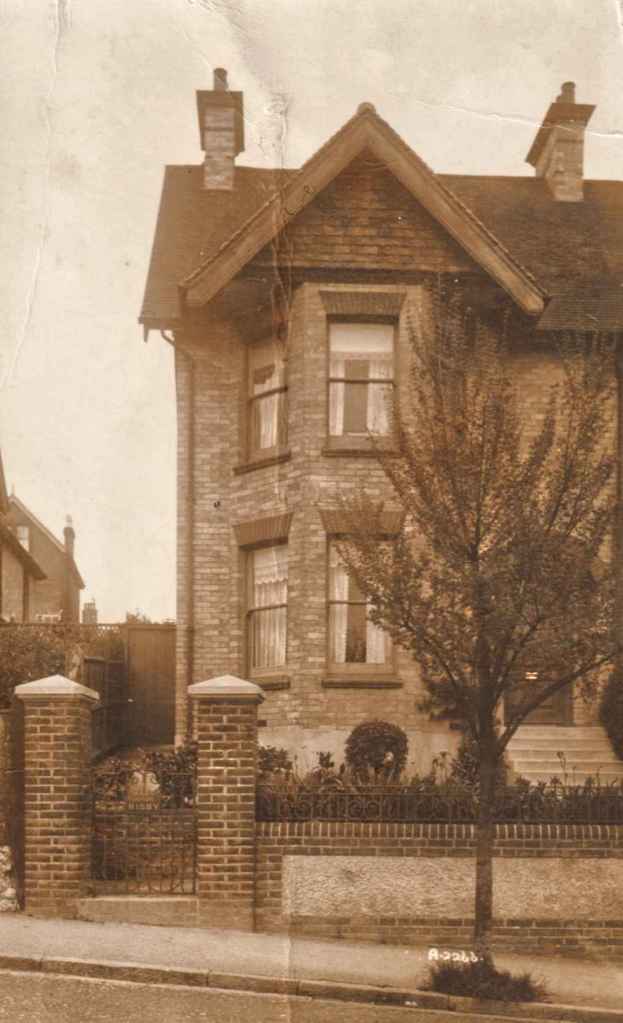
Sadly no one recognised this bay-windowed semi-detached house, shown in the last Bulletin.
The image, showing a late-Victorian or Edwardian semi-detached or end-terraced house, with formal gateposts and a flint & brick front garden wall on a road planted with new trees, has an air of the Wallands about it.
The image comes from a postcard by an anonymous publisher that was mailed from Lewes to a family friend in September 1913. There is, however, no clear evidence that the house itself was actually in Lewes.
10. A Royal Field Artillery Camp, near Lewes
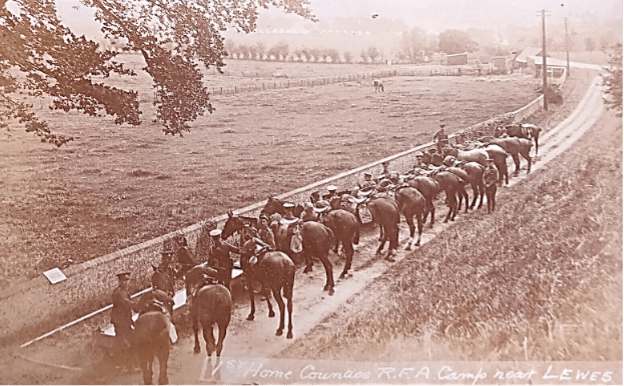
This postcard view titled ‘1st Home Counties R.F.A. Camp near Lewes’ looks as if the location ought to be easily identifiable, but I can’t work out where it was taken. Can you help?
John Kay 01273 813388 johnkay56@gmail.com
Contact details for Friends of the Lewes History Group promoting local historical events
Sussex Archaeological Society: http://sussexpast.co.uk/events
Lewes Priory Trust: http://www.lewespriory.org.uk/news-listing
Lewes Archaeological group: http://lewesarchaeology.org.uk and go to ‘Lectures’
Friends of Lewes: http://friends-of-lewes.org.uk/diary/
Lewes Priory School Memorial Chapel Trust: https://www.lewesprioryschoolmemorialchapeltrust.org/
Facebook: https://www.facebook.com/LewesHistoryGroup
Twitter: https://twitter.com/LewesHistory



 Lewes History Group