
Please note: this Bulletin is being put on the website one month after publication. Alternatively you can receive the Bulletin by email as soon as it is published, by becoming a member of the Lewes History Group, and renewing your membership annually
1. Next meeting: 31 March 2025, Ruth Thomson, ‘Grown in Lewes’
2. Victorian & Edwardian Lewes
3. Prince Edward’s Road Street Story project
4. Changes planned at Harvey’s Brewery
5. Royal Birthday Salutes
6. Default at the Stag
7. The Pells in postcards
8. Southover Manor School (by Chris Grove)
9. Duncan Grant’s view of the South Malling Chalkpits
10. Cliffe Bridge by Phyllis Robinson
11. Monday Night at Janet’s (by Sally Howard)
1. Next Meeting 7.30 p.m. King’s Church Monday 31 March 2025
Ruth Thomson Grown in Lewes
Following the publication of ‘Grown in Lewes’ last November, Ruth Thomson, one of its co-editors, will expand upon two of the topics that she researched and wrote about. One is the history of Elphick’s, the well-loved (and much-missed) family-run seed merchant and garden shop, that traded in Cliffe High Street for more than 150 years; the other is the rise and fall of the early 19th century Leighside estate, which has been partly incorporated into today’s Railway Land Nature Reserve. Ruth will recount how its owner, Burwood Godlee, left his mark on the Cliffe area of Lewes – having a hand in the building of several of its key landmarks. Ruth will also explain where the idea for the book came from and who has been involved.

Tony Elphick outside the shop
Part of the gardens at Leighside
This will be the first of our live events for 2025. Free admission for members and no need to reserve your place. Non-members are very welcome, but there will be a small admission charge.
2. Victorian & Edwardian Lewes
Health & Social Care project group: Four members of this new group have now met to plan our research on this subject. Our next meeting will be at the Keep where we will begin our hunt for the documents relevant to our study. We hope to uncover lots of fascinating details about public health, medical doctors, hospitals and social policy, especially about provision for the poor. We are also interested in changes in social attitudes throughout this period.
We are, of course, open to more ideas and hope that others will join us. Please email Ann Holmes [annholmeslewes@yahoo.co.uk].
Education project group: This is a promising area, and in the introductory course we thought we could see a fairly clear trend. In late-Georgian and early-Victorian Lewes there were a plethora of small and diverse private schools in the county town, some taking pupils from the Lewes market area, but others recruiting from much further afield, indeed across the empire. Some were day schools, others mainly or entirely for boarders. There seemed, however, to be rather a shortage of educational opportunities for the town’s poorer children.
By 1914 education had been compulsory for all for over 40 years, and many of today’s primary schools had been established. There were also more advanced opportunities for able children. However, many of the private schools had disappeared from the town – perhaps migrated to other communities on the coast.
It would be very useful to document this trend in more detail, and it should not be too challenging. We have excellent collections of local directories for the town, both in Lewes Library and at the Keep, and many schools ensured their schools featured regularly in the local press. Do we have any members who would be interested in taking part in this project, and in particular do we have a volunteer group coordinator? Please contact johnkay56@gmail.com.
Businesses project group: The introductory course also provided very clear evidence that the arrival of the railway did not lead to the growth and increased prosperity of Lewes that was seen in many other communities, locally and nationally. Indeed, the rapid growth of Georgian Lewes was curtailed once the railway arrived. A likely explanation is that the arrival of the railway facilitated the importation of cheaper factory-made goods, at the expense of local artisan production. Businesses that had both manufactured and sold products to local customers became just retailers, and employed fewer staff.
In addition many of the businesses that survived this initial impact were in fields where the trend was towards larger and larger scale operations, examples including the towns mills and breweries. Lewes was perhaps too small a base, and the local businesses either closed in the face of competition or were taken over by larger rivals based elsewhere. With the exception of the Phoenix Ironworks, no new mega-business developed that was based in the town.
This area offers a whole host of opportunities for more detailed work on particular trades or professions – the professions and trades such as printing and publishing being of particular importance to a county towns. We have several people interested in specific topics in this area, and Chris Grove has developed an impressive overview, but we don’t yet have a formal group.
3. Prince Edward’s Road Street Story project
Are you interested in joining others to create a Street Story for Prince Edwards Road? Two LHG members, Barbara Abbs and Ana Kirby, both residents of Prince Edwards Road, are interested in exploring the facts and figures as well as the history and stories that have resulted in the present day Prince Edwards Road. Whether you live in Prince Edwards Road or would just like to be part of this exploration please contact Ana via ana.kirby2@icloud.com.
4. Changes planned at Harvey’s Brewery
In new proposals to the South Downs National Park Authority John Harvey & Sons plan to convert 1-2 Cliffe High Street into a new public house; to convert the present John Harvey Tavern in Bear Yard into a visitor centre; and to convert some former office and ancillary space within the brewery itself into new visitor accommodation.
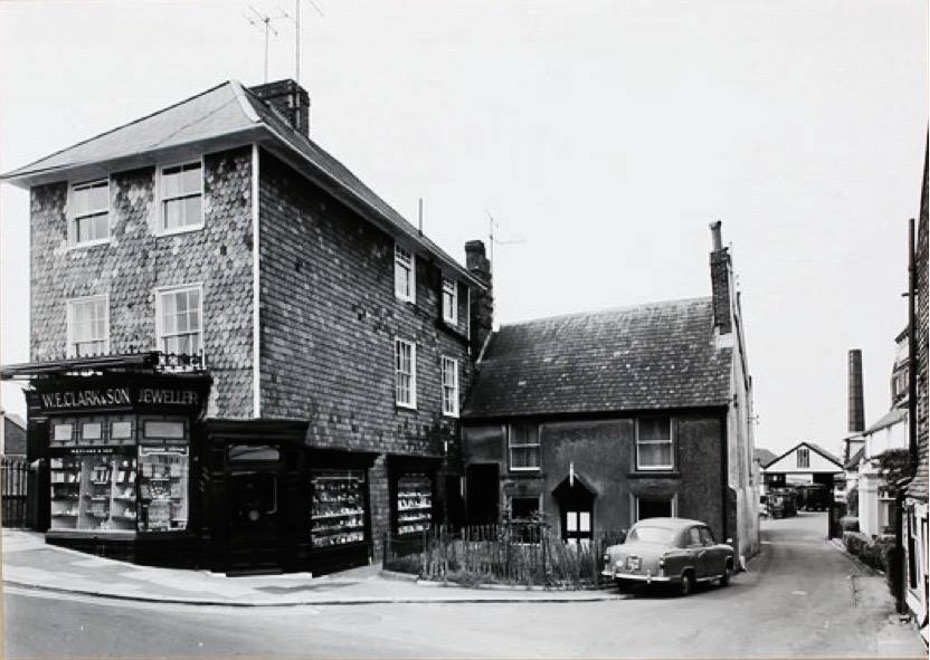
Sources: Planning applications SDNP/25/00909, /00928 & /00929; image of 1-2 Cliffe High Street from Ian Freeston.
5. Royal Birthday Salutes
The 24 August 1798 Kentish Weekly Post and Canterbury Journal included a report from Lewes that on 20 August the Park of Artillery at Ringmer and the 2nd Battalion of Grenadiers at Lewes barracks had formed up together and fired a royal salute and vollies in honour of the birthday of the Prince of Wales.
The 12 June 1815 Sussex Advertiser reported that the Ordnance stationed at Ringmer, near this town, had fired a royal salute in honour of the birthday of His Majesty. By 1815 King George III was permanently unwell, and the Prince of Wales had become the Prince Regent. The Ringmer artillery company were lucky to have only ceremonial duties to perform – less than a week later many of their contemporaries were fully engaged at the battle of Waterloo.
6. Default at the Stag
The 7 March 1848 Sussex Advertiser noted that debtors whose cases were to be heard at Lewes County Court on 3 April included Richard Eager, late of the Stag Inn, North Street, Lewes, licensed victualler who had also been licenced to let out horses.
7. The Pells in postcards
The establishment of the Pells as an area of parkland surrounding water bodies once used to power the paper mill has been fully described in ‘The Pells of Lewes’, edited by Ruth Thomson & Sarah Bayliss and published by the Lewes History Group in 2020. Their importance in the town’s recreation in the first quarter of the 20th century is well illustrated by the large number of picture postcards of the area published in this period. The majority of these postcards are hand-coloured – a laborious process in the days before colour photography. Below are some examples of these postcards, showing where townsfolk and visitors would gather, walk, and feed the ducks and swans.
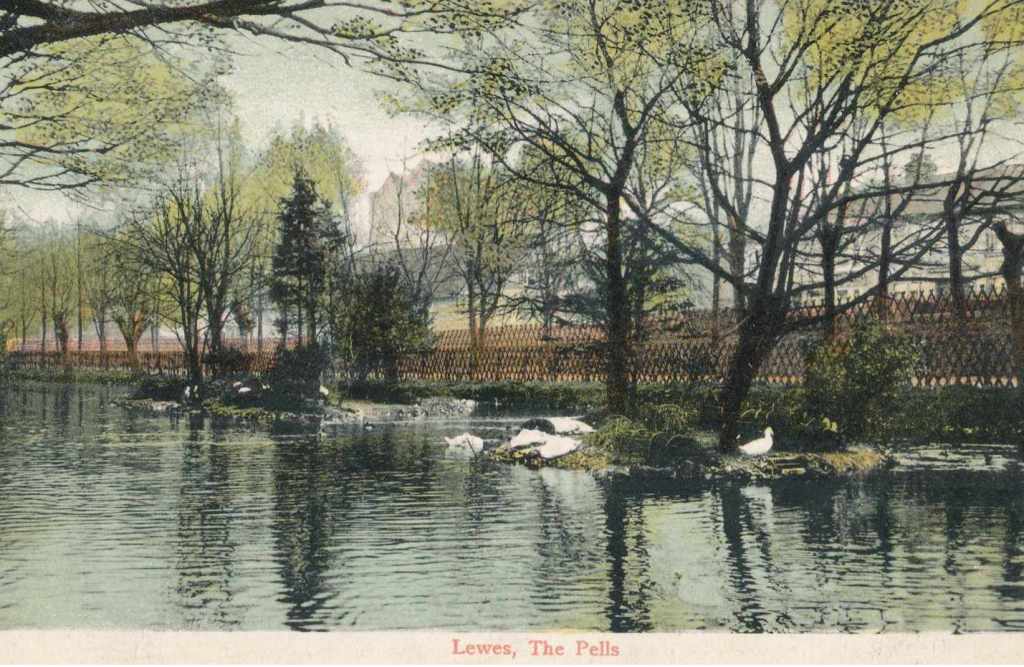
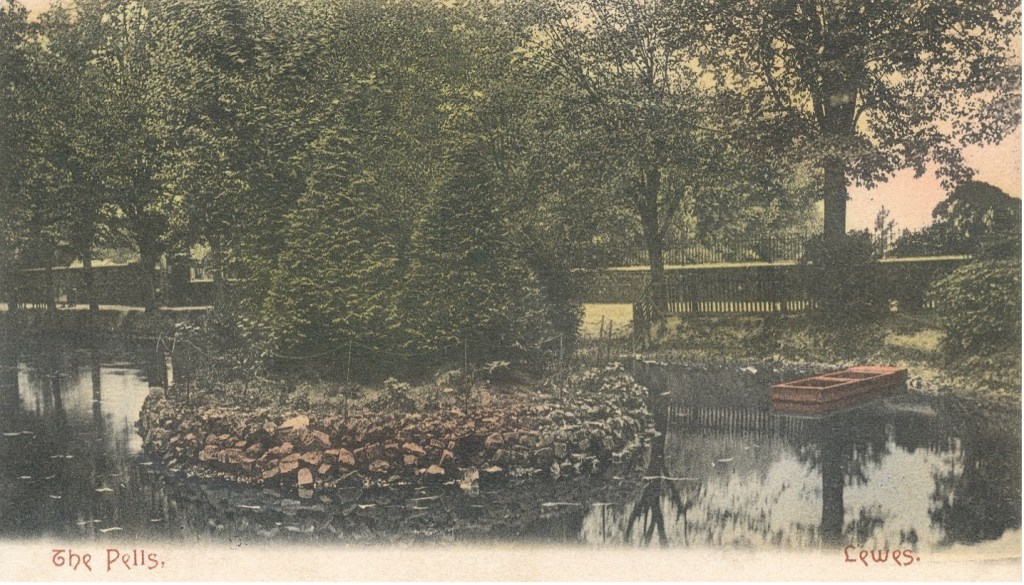


The islands would provide safe havens for wildlife, though a safety perhaps undermined by the punt shown in the second postcard above.
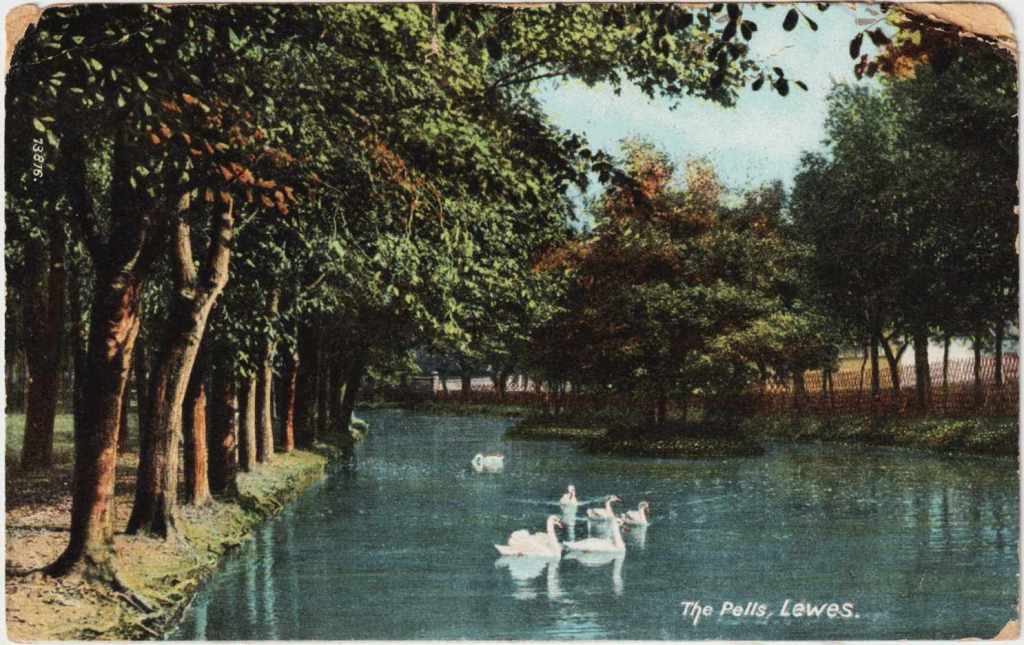

Swans and ducks feature in a good number of these postcards.


The majority of the postcards shown above date from the Edwardian era, but the final Photochrom Company postcard is from immediately after the Great War.
Our thanks to Charlie Freeman, who provided several of the postcards shown above.
8. Southover Manor School (by Chris Grove)
It seems fitting that Lewes had an educational establishment like Southover Manor School centuries after its Priory was lost. Before the Dissolution and the Reformation, the English aristocracy and landed gentry sent their daughters to Catholic convents. While that practice continued in Europe, in now-Protestant England, an alternative was needed. Governesses were employed to educate girls at home and the debutante system evolved to allow girls to find ‘a suitable partner’.
By the beginning of the 20th century, the diminishing availability of governesses resulted in the establishment of exclusive girls’ boarding schools. Southover Manor School was founded in 1923 at Undercliffe House, a turreted Gothic house built by architect James Berry in 1865, visible through woodland from School Hill and Cliffe; it was owned by Lord Monk-Bretton, the school’s principal sponsor. Themain driving forces were Beatrice Malcolm, the first headmistress, and parents who wanted a better education for their daughters.
By 1925, the school had 21 students, including eight boarders, and moved to the roomy Southover Manor and grounds, rented out by Frank Verrall on a 14 year lease for an annual rent of £300. By 1930, the school was listed in The Public Schools Yearbook (now The Independent Schools Yearbook)alongside Eton, Harrow, and Charterhouse, where, no doubt, the girls’ male relatives had long been educated. During its 60-year history, the school’s most famous pupil was Camilla Shand, now Queen Camilla, daughter of Major Bruce Shand, the vice Lord Lieutenant of East Sussex with a country estate at Plumpton. She started at the school, aged 11, in 1958 but soon moved to Queens Gate School in London.
To maintain its reputation as an exclusive school, Southover Manor School required fine premises, and attractive grounds and facilities. As pupil numbers rose, the school expanded its premises, purchasing Southover Old House in 1929 – formerly a large private house with an extensive lawn, a mature mulberry tree, well-stocked flowerbeds, and a greenhouse/ conservatory.
Over time, the school bought further buildings, including the Malt House, Southover Manor House itself and a number of properties along the south side of Southover High Street for boarders. A large two-storey annexe was built alongside the Manor House. This housed the administrative offices, including the office of the headmistress, the dining hall, and further classrooms. The school estate had many established trees, a swimming pool, tennis courts and playing fields for hockey and lacrosse.
The School Gardener: In 1954, at the Lewes and District Horticultural Show, the-then school gardener J. H. Reynolds, swept the board. He won four trophies,14 first prizes, seven second prizes, and three third prizes out of 350 show entries. He won the President’s Trophy for the most first prizes, the Champion Perpetual Challenge Bowl for the most points in all classes, the Chrysanthemum Cup, and the Jubilee Perpetual Cup for the highest points in monthly meetings and the annual show.
The School’s decline: The manor site and its many sprawling properties were never ideal for a boarding school, despite its extensive grounds and playing fields. A ministerial inspection in 1966 emphasised the inappropriateness of the buildings for education and deemed the capital programme to address the issues as beyond the means of the school. The school had faced closure in 1962, and again in 1966, but was saved by friends and parents, after the limited company was converted into a charitable trust. In the early 1980s, the school sold Southover Old House, and Southover Cottage as the first stage in securing more appropriate premises. But in 1983, the school governors agreed to close the school. The sale proceeds were used to establish a new charitable trust, the Southover Manor General Educational Trust, a grant-giving body now supporting schools and other educational organisations serving the young people of Sussex and, occasionally, the education of individual Sussex-based young people.
The school finally closed in 1984 and its properties and contents auctioned in 1985. The financial difficulties had taken their toll on the gardens, and the grounds became a temporary car park for local residents until redevelopment.
Sources: Photocopy of various pages on the history of Southover Manor School (with thanks to East Sussex and Brighton and Hove Record Office at The Keep) [ESRO AMS 6799-15-2 ] The Schools Of Lewes c13th to c21st by Brigid Chapman; Sussex Agricultural Express, 05 November 1954; https://southovermanortrust.org.uk/about-us/; Southover Manor School photographs archived by the Friends of Lewes [ESRO ACC 7987-13-1].
9. Duncan Grant’s view of the South Malling Chalkpits
This picture of the South Malling chalkpits by the River Ouse was painted by Charleston resident Duncan Grant (1885-1978). Painted in about 1933 in oil on board, it is in the collection of the Leicester Museum & Art Gallery.

10. Cliffe Bridge by Phyllis Robinson
This acrylic painting on board of Cliffe Bridge by Phyllis Robinson is offered for sale on ebay by a private seller. Also offered was a still life by the same artist. The artist’s viewpoint appears to have been on the bridge at Phoenix Causeway.

11. Monday Night at Janet’s (by Sally Howard)
The 19 November 1948 Sussex Express reported that Lewes now had a new literary circle, meeting at
8 p.m. on Monday evenings in Janet’s Tea Rooms and sponsored by the local branch of the Liberal Party. The aim was to foster literary appreciation, and use the winter months to attract all tastes for talks and informal discussions as monthly ‘Monday Nights at Eight’. After its first meeting the Monday Literary Club had a membership of 30.
At the first session experts at many branches of the pen had thrashed out a wide variety of questions on the subject. Mr F. Masters was question master of this Brains Trust and the team consisted of Miss Ruth Cobb, the well-known illustrator, Miss K.O. Morgan, history specialist at Southover Manor School, Mr Richard Finlay, a short story writer, and Mr Ian Parsons, a publisher.
The questions included the necessary ingredients for a best-seller; whether book reviewers should reveal the plots of the books they reviewed; and why women wrote better thrillers than men. They also considered wartime poetry and novels, and whether modern fiction was of a higher standard than that written a century ago. They also recommended fairy tales for children.
John Kay 01273 813388 johnkay56@gmail.com
Contact details for Friends of the Lewes History Group promoting local historical events
Sussex Archaeological Society: http://sussexpast.co.uk/events
Lewes Priory Trust: http://www.lewespriory.org.uk/news-listing
Lewes Archaeological group: http://lewesarchaeology.org.uk and go to ‘Lectures’
Friends of Lewes: http://friends-of-lewes.org.uk/diary/
Lewes Priory School Memorial Chapel Trust: https://www.lewesprioryschoolmemorialchapeltrust.org/
Facebook: https://www.facebook.com/LewesHistoryGroup
Twitter (X): https://twitter.com/LewesHistory



 Lewes History Group