
Please note: this Bulletin is being put on the website one month after publication. Alternatively you can receive the Bulletin by email as soon as it is published, by becoming a member of the Lewes History Group, and renewing your membership annually
1. No August meeting
2. Station Street (formerly St Mary’s Lane) by Debby Matthews
3. Two postcard views of the 2nd (1857-1889) Lewes Railway Station
4. William Page’s stereoview of All Saints Church
5. Charles Blaker’s sudden career change
6. A James Cheetham postcard of the River Ouse
7. A pen and ink drawing of Potters Lane (image from Richard Burger)
8. A Boarding School for four year olds
9. A letter to her father from a Quaker girl at school in Lewes
10. The Bow Windows Book Shop, 128 High Street
1. No August Meeting
As usual we shall be taking a short break in August, and our next meeting will be on Monday 8 September, when John Bleach will speak to us about lost churches in the Lewes area.
2. Station Street (formerly St Mary’s Lane) by Debby Matthews
The latest in Lewes History Group’s Street Stories series, this book by Debby Matthews summarises the results of years of research. It draws on a broad range of historical sources, including personal reminiscences, and is illustrated by many photographs, sketches and maps, some of them published for the first time.
Station Street is one of the main routes entering and passing through Lewes, meeting the High Street and Fisher Street at a crossroads that has for centuries played an important role in town life. It has even been described as the town’s centre point. Known as St Mary’s Lane for most of its history, from the medieval parish of St Mary in the Market Place, it was re-named Station Street in 1857, when it became the main route to the new (second) railway station. The old parish was incorporated into St John-sub-Castro.

The book tells the story of how St Mary’s Lane developed from Saxon times, looking at its buildings, businesses, shops, churches, inns and inhabitants. It explains how the street changed dramatically in the 19th century, when town improvements, the railway, new roads and a bridge over the valley at the bottom of the lane, where for centuries there had been tanneries, all had a considerable impact. The last three chapters describe the shops and businesses that have traded in the street since the 19th century.
Copies are available by mail order at leweshistory.org.uk/publications and at Lewes History Group events. Price £12.50
3. Two postcard views of the 2nd (1857-1889) Lewes Railway Station
Offered for sale recently on ebay, with starting bids at £35 each, were two picture postcards featuring the second Lewes railway station, opened in 1857 and replaced thirty years later by the present railway station. The postcards do not bear the name of any publisher, nor was either postally used, but picture postcards did not appear until more than a decade after this station was demolished, so they must have been produced as historical mementos.


4. William Page’s stereoview of All Saints Church
Sold recently on ebay was this early stereoview of All Saints church, Lewes, bearing on the reverse the label ‘Page, Stationer, Bookseller, Printer, etc, High Street, Lewes’.

The principle of the stereoview was discovered in the same decade as photography (the 1830s), and this seems likely to be an early example. His biography below suggests that this item probably dates to the 1850s or early 1860s, when professional photographers first appeared in Lewes. William Page is listed at 84 High Street in local directories between 1851 and 1866. In 1851 he was listed as simply a bookseller & stationer, but by 1859 he had become a ‘printer, publisher & bookseller, bookbinder, stationer, music seller & circulating library’. His 1866 entry was the same as in 1859, except that the ‘publisher’ was omitted. However, the local and national press report the bankruptcy of William Page of Lewes, bookseller and stationer, in January 1865.
The registers of St Michael’s parish tell us that William the son of William & Lucy Page was born on 11 December 1798 and baptised there two months later. His parents had married at the same church just seven months before his birth. He married Marianne Kent at St Michael’s in 1819, and had a daughter and a son by her given Wesleyan baptisms in 1821 and 1823, but his young wife was buried at St Michael’s in the summer of 1823, aged just 21. He then had another daughter and another son by a different wife, Betty Clark, given Anglican baptisms at St Michael’s in 1826 and at Cliffe in 1828 (when his residence was also given as Cliffe). The Anglican records give his occupation as a musician in 1826 and as a teacher of music in 1828. He is amongst the dozen Lewes musicians identified by Archer as greeting King William IV & Queen Adelaide when they visited Lewes in 1830. The Page family were back in St Michael’s parish for the 1841, 1851 & 1861 censuses, with William’s occupation given as stationer & music seller in 1851 and stationer & bookseller in 1861. His second wife Betty Page was buried at St Michael’s in December 1858, at the age of 55, so in 1861 his younger daughter, in her early thirties, was his housekeeper. His younger son, also in his thirties and described as a professor of music, was still living with them.
By 1871, following his bankruptcy, William Page had moved to St Anne’s parish. He was now living in the household of his married younger son, with both men described as professors of music. An 1878 local directory gives his address as 144 High Street, and his occupation as pianoforte tuner. He was still living with his son in 1881, when despite his being 82 years old, both men were still listed as employed as professors of music. By 1891 his son had also become a widower, and William Page, now at 92 a retired musician, was living with a married grandson. His death at the age of 93 was registered at Lewes later that year.
What remains unknown is whether William Page’s talents extended to photography, and he also created the image, or whether the actual photographs were taken by someone else and he was just the retailer. Although resident in Lewes throughout his long life, William Page is not identified as a photographer on the Sussex Photohistory website. He seems to have been primarily a musician.
5. Charles Blaker’s sudden career change
The 26 August 1811 Sussex Advertiser carried an advertisement by Verrall & Son for the sale by auction of a substantial freehold dwelling house and an old established grocer’s shop in the centre of the borough of Lewes that had commodious warehouses and a garden and yard. The property had been previously in the occupation of Mr Charles Blaker, who had gone into the service of the East India Company. Immediate possession could be had.
The sale was to take place on Saturday 7 September at 6 p.m. Further information was available from Mr J. Blaker or from Mr E. Verrall, attorney-at-law, Lewes. Also advertised in the following week’s newspaper was a 3-day sale of the stock-in-trade, shop fittings (only recently installed) and household furniture. The grocer’s goods included gunpowder, Souchong tea, coffee, snuff, tobacco, loaf sugar, soap, wax candles, oils, vinegar, tar, white lead, treacle, spices, canary, hemp & rape seed, confectionary, sauces, brushes and brooms. The furniture was that of a prosperous middle class household. Charles Blaker’s departure appeared to have been quite sudden, as the settlement of his accounts was delegated to his brother John Blaker.
Colin Brent’s ‘Lewes House Histories’ show that this property was 65 High Street, on the corner of Watergate Lane, and that it had been a grocer’s, in various hands, since at least the early 18th century. Charles Blaker, who was to be the last grocer here, had only been in occupation for a very few years. The purchaser, and the next occupier, was John Blaker, a linen draper, haberdasher and undertaker. John Blaker (1774-1851) & Charles Blaker (1786-1827) were two of the large family of Nathaniel Blaker of Portslade, a prosperous gentleman whose estate at his 1815 death was valued for probate at £25,000.
In the middle of the 19th century 65 High Street became the new home of a Quaker ladies’ school, run first by Miriam Dymond and later by the Misses Trusted and Speciall. By 1882 it had become the Post Office, run by Arthur Morris, bookseller and stationer.
6. A James Cheetham postcard of the River Ouse
This James Cheetham postcard, postmarked 1909, shows a rowing boat on the Ouse below Malling Deanery and boys playing on the riverbank. In the distance are the Offham chalkpits

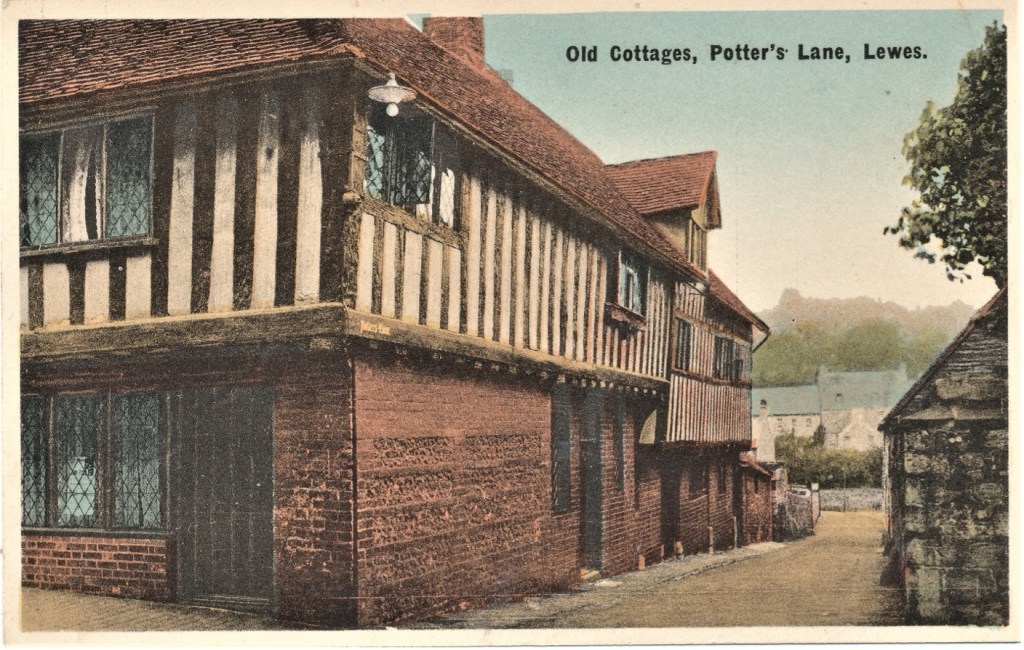
7. A pen and ink drawing of Potters Lane
United States resident Richard Burger recently sent us an electronic copy of a drawing of Potters Lane that has been passed down in his family. He has no known Sussex ancestry, and the most recent immigrants from England in this side of his family were in the 1880s, from Staffordshire. However, his great-grandparents dealt in antiques.

The drawing appears very competently executed, and is signed in the bottom right-hand corner, in what appears to be the same ink as used in the drawing itself, “ LES. HARDY ’26 “. Along the foot, in a cursive hand, has been added ‘Potters Lane, Lewes, Sussex, England. Leslie F. Hardy’. Would an English resident have thought it necessary to add the word ‘England’ to that description?

The image bears a striking resemblance to a common 1920s postcard of Potters Lane, with the details of the doors and windows a very close match. There are, however, a couple of intriguing differences. In the drawing the cottages are thatched, while all 20th century postcard views show them tiled. Also in the drawing the surfaces of Potters Lane and Southover High Street are shown as cobbled, which contemporary postcards do not suggest. Is this artistic licence? It seems unlikely that the “ ‘26’ “ means 1826 rather than 1926, as the Christian name Leslie, which derives from an Aberdeenshire surname, was rarely used in England before the second half of the 19th century. No artist of this name is known to Google, or to the standard reference works on exhibiting artists.
8. A Boarding School for four year olds
The 12 January 1824 Sussex Advertiser carried an advertisement that Mrs & Miss Fisher’s establishment at 3 North Street, Lewes, for young Gentlemen from four to ten years of age, as Boarders, would re-open on Tuesday 20 January 1824. “They avail themselves of this opportunity gratefully to acknowledge the kind patronage with which they have been favoured and beg to assure their friends and the public, that maternal care and tenderness is unceasingly exercised in promoting the health, comfort and improvement of those who may be committed to their charge.”
Unquestionable references could be given, and the terms known on application.
9. A letter to her father from a Quaker girl at school in Lewes
There was recently stiff competition on ebay to purchase an original handwritten letter sent to her father by a young lady at Lucy Godlee’s Quaker girls’ school in Lewes. Addressed from “Lewes 8th mo 14th 1833”, the letter was franked at Lewes on 16 August, and addressed to Edward Smith, 29 Haymarket, London. Quakers did not use the pagan names for the days of the week, or the months of the year. They also avoided the use of the plural ‘you’ for single individuals, even honoured and important ones, employing instead the otherwise obsolete singular ‘thou’ and ‘thee’.
The unsigned letter reads:
“My very dear Father
I do not know whether Lucy Godlee wrote to thee or not & so I write to thee earlier than I had intended but I must first tell thee that I think I shall be very happy here. I hope to receive a letter from thee soon. Give many kisses to dear little Lucy Anne & Martha & pray tell me when thou writes to me which I hope will be very soon how they are. I long to know when thou art coming to see me and whether T C Beck is coming with thee. M E hopes very much that he is. There is a very nice swing which is a great temptation to me to be idle but I try to conquer it.
I hope Aunt Cate will come with thee when thou comes.”
Lucy Godlee (1808-1903) was the youngest of the four daughters of Quaker merchant John Godlee who established a Quaker school in Albion Street in 1824, and then moved it to Dial House two years later [see Bulletin no.107]. Correct spelling and writing in a good clear hand were skills valued in young female Quakers. The sisters gave up the school in 1836, by which time the family fortunes, doubtless guided by their brother Burwood Godlee, had improved to the extent that the sisters no longer needed to work. The Keep has photographs of all the four sisters. Lucy Godlee never married and spent the rest of her life in the households of other family members, living in Lewes, Brighton, Southover and, eventually, Kensington, where she died in 1903, aged 94. A girls’ school continued at Dial House, but now run by the wife and daughters of the Welsh Tabernacle minister, Rev Evan Jones.

With the power of today’s online family history tools, a very strong candidate for the writer of this letter can be identified. Edward Smith of 29 Haymarket googles as a Quaker chemist, who was born in 1787 and died in December 1834, 16 months after he had received this letter. Edward’s father, also a chemist, was a well-known Quaker minister in London. Edward Smith married twice, and had two daughters. By his first wife, Elizabeth, a Manchester Quaker he married in September 1822, he had a daughter Catherine who was born on 15 May 1823, but her mother died in 1826. By his second wife, Eliza, who he married in 1829, he had another daughter, Lucy Anne, born on 1 June 1830. Catherine, the presumed author of the letter, would thus have been aged 10 in August 1833 while Lucy Anne, still at home with her father, was just 3.
What Catherine, orphaned by her father’s death in 1834, did in the next 20 years of her life remains to be discovered, but in 1854 she met and married Amos C. Wilbur in Bakewell, Derbyshire. He was the son of a Rhode Island Quaker minister, who had studied medicine and then established a drug store in Massachusetts. They met when he accompanied his father on a Quaker mission to England. He was more than 25 years Catherine’s senior – indeed not very much younger than her father. Catherine Wilbur accompanied her husband back to America, where they had a son and a daughter before her early death in Rhode Island in 1861. Her husband outlived her.
Sources: Familysearch; Geni.com online Quaker family trees for Edward Smith (1787-1834) & Amos C. Wilbur (1796-1873).
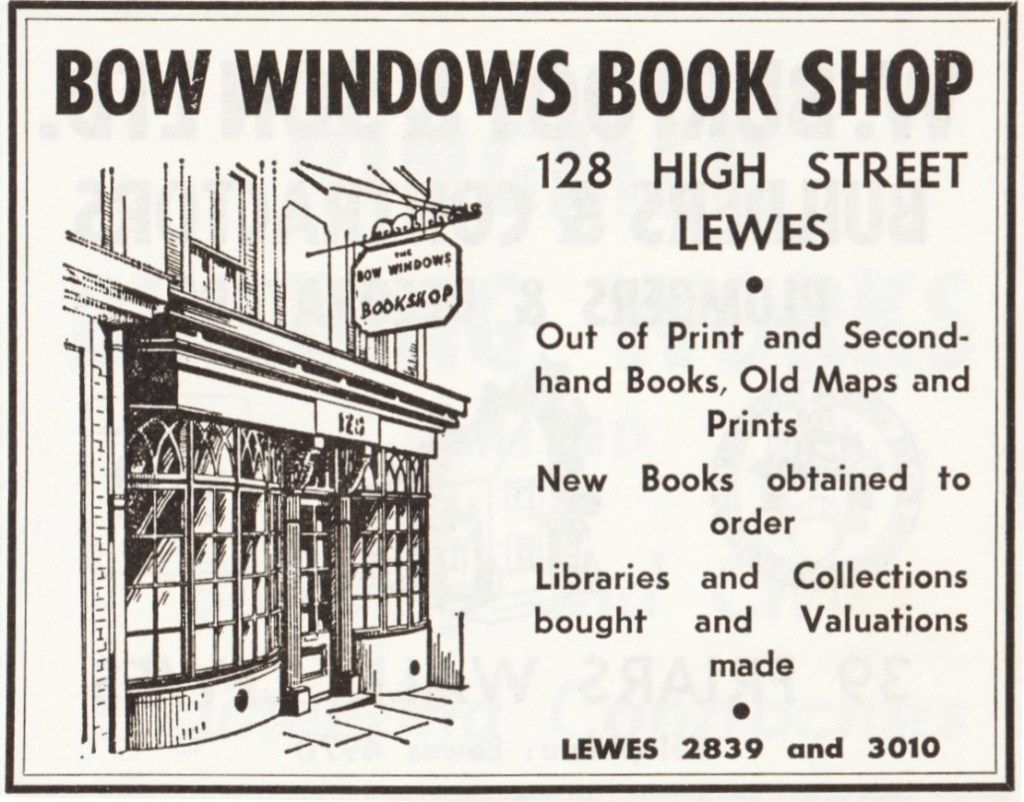
10. The Bow Windows Book Shop, 128 High Street
This advertisement for the Bow Windows Book Shop when it was based at 128 High Street, on St Anne’s Hill, is taken from a trade advertisement in the 1968 edition of Kelly’s Directory for Lewes
John Kay 01273 813388 johnkay56@gmail.com
Contact details for Friends of the Lewes History Group promoting local historical events
Sussex Archaeological Society: http://sussexpast.co.uk/events
Lewes Priory Trust: http://www.lewespriory.org.uk/news-listing
Lewes Archaeological group: http://lewesarchaeology.org.uk and go to ‘Lectures’
Friends of Lewes: http://friends-of-lewes.org.uk/diary/
Lewes Priory School Memorial Chapel Trust: https://www.lewesprioryschoolmemorialchapeltrust.org/
Facebook: https://www.facebook.com/LewesHistoryGroup
Twitter (X): https://twitter.com/LewesHistory



 Lewes History Group