
Please note: this Bulletin is being put on the website one month after publication. Alternatively you can receive the Bulletin by email as soon as it is published, by becoming a member of the Lewes History Group, and renewing your membership annually
1. Next Meeting: 10 Nov 2025: Sue Berry, ‘The Industrial History of Lewes, 1700-1914’
2. Views of Lewes from the River
3. A New Year Gathering in the Lewes Union Workhouse
4. Carvill’s Eucalyptus
5. The Lewes YMCA
6. A Soldier’s Daughter
7. Bonfire at Cliffe Corner
8. An Edwardian postcard view of Cuilfail
9. Miss Maude Devonshire’s reference
10. Peter Messer’s view of Bonfire Night
11. A Grand Organophonic Concert
12. Historic Lewes for sale: Dial House
1. Next Meeting 7.30 p.m. Zoom Meeting Monday 10 November
Sue Berry The Industrial History of Lewes, 1700-1914
Lewes has a rich industrial heritage, much evidence of which still survives. Sue will look at key sectors; why they developed and also the causes of their decline, with the brewing industry as one example. The Edwardian image below features two breweries. From the 1830’s Lewes had to try hard to maintain its regional standing and grew slowly, in spite of the number of railway lines. We shall explore some possible reasons for this lack of rapid growth and the reduction in processing.

Members can register without charge to receive a Zoom access link for the event at: https://us02web.zoom.us/webinar/register/WN_9GytjwX-R0qRZDfMG8bYsA#/registration.
Non-members can attend via Ticketsource.co.uk/lhg (price £4.00).
2. Views of Lewes from the River The views below of the River Ouse running through Lewes are taken from P.A.L. Vine, ‘Kent & Sussex Waterways’, published by Middleton Books in 1989. The first was taken in 1868 and the second (showing the edge of the Tabernacle Sunday School) ‘thirty years later’.

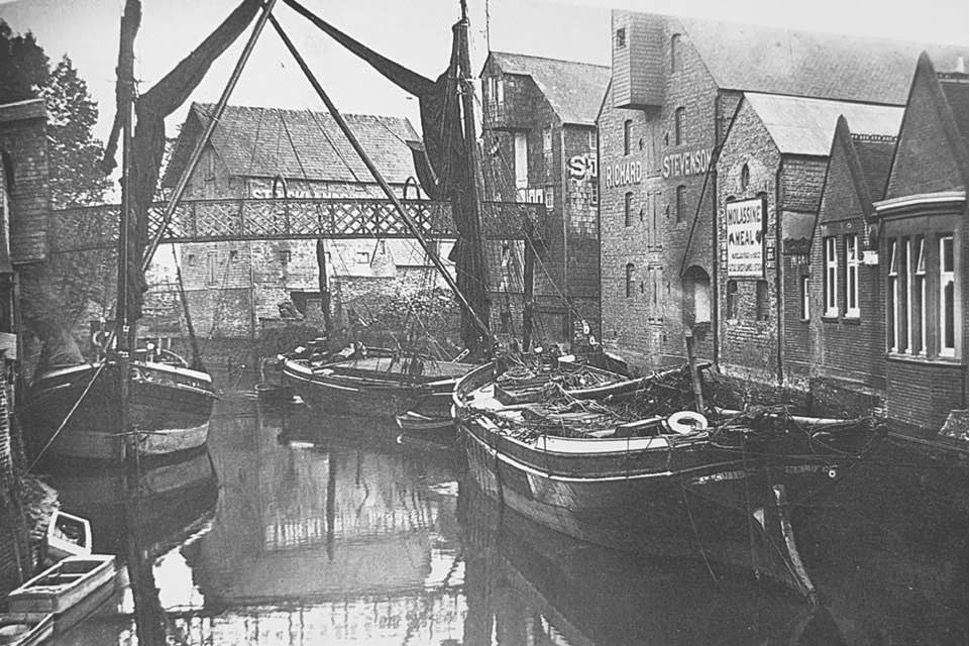
A third view, lower down the river, features the Snowdrop, Wharf House and the chalk pits beyond.

3. A New Year Gathering in the Lewes Union Workhouse
The 8 January 1891 Hastings & Bexhill Independent carried a long and very detailed account of the customary entertainment provided for the children and the old people in the Lewes Union workhouse at the start of each year, with the cost covered by the local gentry and tradespeople. The 1891 event was held after a special tea at 6 p.m. on New Years Day. Those attending included the Mayor (Alderman Buckman) and his wife. There was a specially-erected stage for the entertainers in the workhouse dining hall, and the Christmas decorations remained up.
The entertainment began with songs by the land agent Walter Feilde Ingram and his accompanist Miss Luckraft (daughter of the Naval Prison governor), but the main entertainment was the performance of a farce entitled ‘Cure for the Fidgets’ with a cast of local amateur actors. There were then more songs and further refreshments, including oranges, nuts and sweets. An anonymous gentleman provided packets of tea for each woman and tobacco for each man in the workhouse, and each was also given a knotted handkerchief containing a sixpence. There were toys, dolls and drums for the children. The evening concluded with dancing, in which several of the ladies and gentlemen attending selected partners from the inmates, and three cheers for the sponsors. The event was considered one of the most successful new year gatherings ever held by the Lewes Union.
Attendance at the event was confined to the ‘deserving poor’, the children and old people, although the less deserving paupers of working age, who were guilty of having failed to provide for themselves and their families, do seem to have shared in the gifts.
4. Carvill’s Eucalyptus
According to an advertisement in the 26 September 1895 Hastings and Bexhill Independent the best way to navigate the influenza epidemic was to use ‘Nature’s Disinfectant, Antiseptic and Deodorant, CARVILL’S EUCALYPTUS’ as a mouth and throat wash and a preventative against this infectious disease. A one shilling bottle would make three gallons. CARVILL’S EUCALYPTUS OINTMENT was also available at a price reduced to 6d per box. The provider of this magical all-purpose treatment was G.C. Carvill of Lewes, Sussex.
5. The Lewes YMCA
This view of the Lewes YMCA building at the Bottleneck is from a postcard by an anonymous publisher mailed from Lewes in 1927. The sender, writing from ‘St Wilfrids’ to his parents in Kirkby Lonsdale, Westmorland, marks the room in which he is staying with an X.
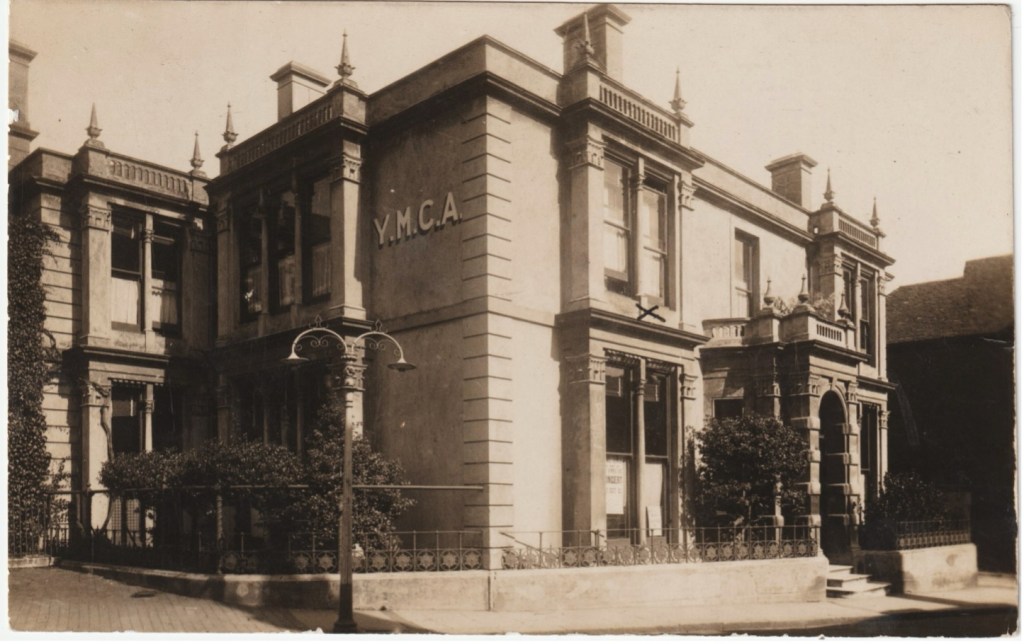
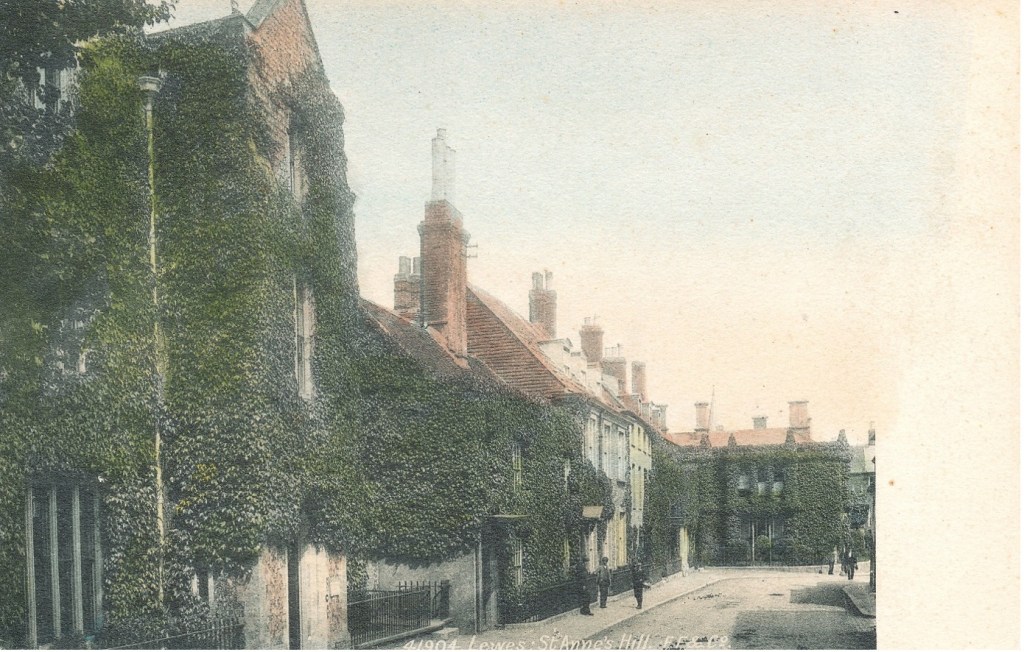
The ivy that had covered the YMCA building, and several of its neighbours, in several Edwardian postcard views (as below) had been stripped away by the 1920s.
6. A Soldier’s Daughter
At the Michaelmas Quarter Sessions in 1745 the magistrates gathered at Lewes considered the case of Elizabeth Gardiner, who had been apprehended in Southover and taken to the Lewes House of Correction. She claimed that she had been born in All Saints parish, Lewes, but as a young girl went to Gibraltar where her father was a sergeant on the King’s service. He had died three years ago. She had arrived in England in May, and on landing was given a pass to travel to Lewes, where she belonged. Her story was confirmed by Charity Blaber, widow, who said that about 20 years previously she was well acquainted with Robert Gardiner, a soldier then in Lewes with his wife and family, and that she had seen the baby girl delivered in All Saints parish. On this basis the magistrates decided that the girl should be discharged from the House of Correction and sent to All Saints parish.
Charity Blaber’s information was correct; the All Saints parish registers record the baptism of Elizabeth the daughter of Robarte Gardener and Elizabeth his wife on 8 April 1726. A son, called Robert after his father, had also been baptised at All Saints two years previously. What became of Elizabeth Gardener is not recorded, but Charity Blaber was buried at St Anne’s on 23 August 1774, having died in the nearby Pesthouse.
Anyone without evident means of support, and especially anyone begging or otherwise misbehaving, was liable to arrest and detention until the parish to which they belonged could be established. The complicated life stories of those arrested for begging, as elicited in such settlement examinations, were frequently brought before the magistrates for their decision about where their legal “home” was. The most difficult cases were those where the vagrant had been born abroad, beyond the reach of British social policy.
Source: Quarter Sessions order book, ESRO QO/18, & QR/466/103-5
7. Bonfire at Cliffe Corner
On 5 November 1783 a number of persons ‘erected a nuisance’ at Cliffe Corner by building up a large quantity of faggots and wood and then setting fire to them, thereby obstructing the highway.
Source: Cliffe parish records, ESRO PAR 415/12/
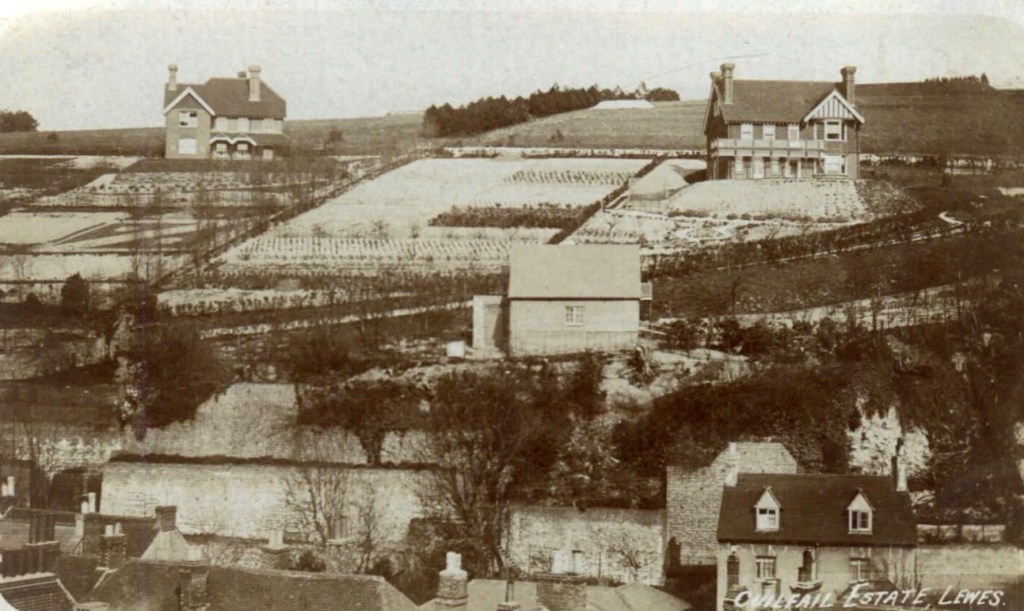
8. An Edwardian postcard view of Cuilfail
This postcard by an anonymous publisher was offered for sale recently on ebay.
9. Miss Maude Devonshire’s reference
In May 1912 Maude Devonshire, a teacher with three years’ service at The Pells School, was to be married, so of course gave up her job. She was, however, issued with a reference for future use by Rev F.J. Poole of St John’s Rectory, who was the correspondent to the Pells School managers. She presumably never needed to use it, as it has survived for over a century, to be offered for sale on ebay recently.
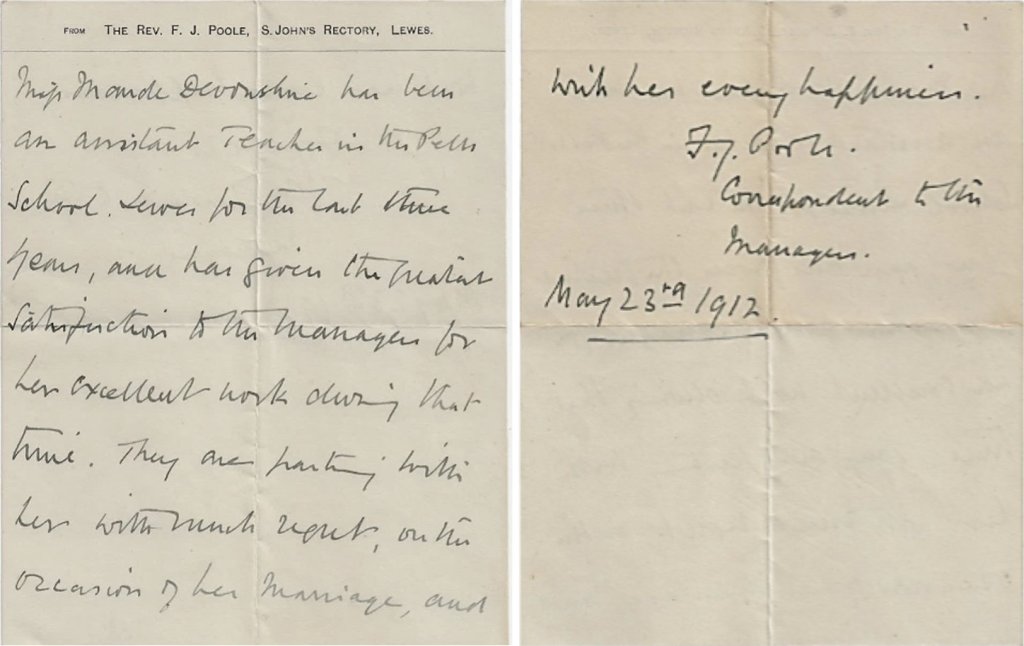
These days fewer and fewer people can still read handwriting. I have noticed on ‘Who Do You Think You Are?’ that younger subjects are now routinely offered a typed transcript of such handwritten documents, as if they were originally written in the Tudor Secretary hand, so for the benefit of younger readers:
“Miss Maud Devonshire has been an Assistant Teacher in the Pells School Lewes for the last three years, and has given the greatest satisfaction to the Managers for her excellent work during that time. They are parting with her with much regret, on the occasion of her marriage, and wish her every happiness.
F.J. Poole, Correspondent to the Managers”
Maud Devonshire had been born in Slough in 1890, and grew up there as a carpenter’s daughter. In the 1911 census she and another female teacher lodged in an ironfounder’s household in Lewes. She returned to Slough to marry Alfred Alden. He died in 1937, aged 53, but she lived on until 1963, when she was buried with her husband in Slough cemetery.
The writer of the letter, on behalf of the Managers of the National Pells School, was Rev Frederick John Poole, rector of St Joh-sub-Castro from 1910 until his death in 1923. He was born in 1852 in Letwell, Yorkshire, where his father held a comfortable rectory valued at £300 p.a. for 56 years. He was in his late fifties whe he came to Lewes from Walthamstow, and he also held a prebend at Chichester Cathedral and was the Rural Dean for Lewes. The 1911 census shows him living in St John’s Rectory with his wife, his younger son (a student), two daughters and a cook, a parlourmaid and a ‘betweenmaid’. Both his sons became clergymen.
10. Peter Messer’s view of Lewes Bonfire Night
This signed Peter Messer egg tempera on panel 24 inch by 32 inch picture of Bonfire Night was offered for sale at Gorringe’s Winter Sale in December 2020. Estimated price was £500-£800.

11. A Grand Organophonic Concert
The 13 August 1859 Sussex Express carried an advertisement for ‘A Grand Organophonic Concert and Ventriloquial Entertainment’ at the Corn Exchange on Wednesday 17 August, for one night only. The concert was on tour, as it could also be experienced at Diplock’s Entertainment Rooms, Eastbourne on the two following evenings.
This would be the first ever appearance in Lewes of Hoffman’s renowned Organophonic Band, or Human Voice Orchestra, which had traversed Great Britain over the previous 8 years. This unique entertainment would be accompanied by Mr Thurston, the celebrated polyphonist and ventriloquist. A variety of ballads, glees, solos, marches and concerted pieces were to be given by the band of unaided voices. Reserved seats were two shillings, second seats a shilling, and ‘promenade’ six pence. Tickets and programmes were available from the Star Inn and the town’s newspaper offices. The performance would start at 8.15 p.m.
There is no Instrument like the Human Voice,
The compass of which is not the work of man.
Mdme Goldsmidt
12. Historic Lewes for sale: Dial House
Dial House, 220-221 High Street, the prominent grade II-listed building in the shopping precinct with a Caen stone facade, is currently offered for sale by Stiles Harold Williams, who are seeking offers for the freehold in excess of £550K. Built as a private residence, it has housed Waterstones bookshop on the ground floor since 2014, and there are 10 apartments above and to the rear. However, if you purchase it you will not be able to move in. Waterstones’ lease runs to 2030, while the apartments all have 125 year leases starting from 2014. What is really on offer is the right to receive the £50K p.a. annual rent: £150 p.a. ground rent from each apartment and the remaining £48,500 p.a. from Waterstones. While this may seem a better investment rate than any available from your bank or building society, before leaping in you may need to consider the freeholder’s responsibilities to maintain and insure the building and the government’s plans for ground rents.

The history of this prominent Lewes house is surprisingly obscure. The Historic England listing describes it as ‘mid-18th century with early 19th century alterations’, but Colin Brent’s ‘Lewes House Histories’ entry for the property starts only in 1789. It was then owned, along with the adjacent 219 High Street, by the prosperous Quaker corn merchant Thomas Rickman who, in partnership with his son Thomas Rickman junior, used the wharf behind it, owned ships that traded from Lewes and Newhaven and also ran the extensive water mills at Barcombe Mills. Thomas Rickman senior died in 1803, followed by his son Thomas Rickman junior in 1812. While they certainly had the resources to have built such a grand residence, I have found no evidence that they did so. The land tax for 1809-1812 shows Thomas Rickman junior occupying 219 High Street himself, while 220-221 High Street was let. After his 1812 death his widow retained 219 High Street, but his other houses were sold. The sundial on the front of the house is dated 1824.
Throughout the remainder of the 19th century 220-221 High Street was used by a series of prosperous Lewes businessmen, almost all of them non-conformists. They included Thomas Dicker, a partner in the Old Bank; the draper Henry Browne, a partner in Browne & Crosskey, whose premises were nearby; the lime merchant George Newington, a partner in the Glynde chalkpits; and the solicitor Isaac Vinall. It remained in both residential and professional uses in the 20th century. When I came to Sussex in 1969 I signed the contract to purchase my first house there, in the offices of the solicitors Hillman, Hillman, Vinall & Carter – a firm formed by the merger of the Hillman and Vinall practices that had previously operated separately from these premises.
John Kay 01273 813388 johnkay56@gmail.com
Contact details for Friends of the Lewes History Group promoting local historical events
Sussex Archaeological Society: http://sussexpast.co.uk/events
Lewes Priory Trust: http://www.lewespriory.org.uk/news-listing
Lewes Archaeological group: http://lewesarchaeology.org.uk and go to ‘Lectures’
Friends of Lewes: http://friends-of-lewes.org.uk/diary/
Lewes Priory School Memorial Chapel Trust: https://www.lewesprioryschoolmemorialchapeltrust.org/
Facebook: https://www.facebook.com/LewesHistoryGroup
Twitter (X): https://twitter.com/LewesHistory



 Lewes History Group