
Nevill Memoirs > Jennifer Lewis
Click on images to enlarge | Download this article as a pdf document
How many people, I wonder, ever consider the history of the house when they move into a new home? Maybe, as they make changes, take out cupboards, lift up floorboards, strip walls, something sometimes makes them think about the people who have gone before. Who lived here, what were they like, and what stories are hidden within those as yet unfamiliar walls? And it’s the same with the garden. Few people, probably, make no changes at all. The garden, like the house is another place where a person can make his or her own mark, put their individual stamp on their home. ‘Look, I designed this section of the garden, that flowerbed was all my own idea, and you see those fruit trees, well, I planted every one myself.’ But as the changes take place, the soil is dug and a clearance is made, things that had not been obvious before suddenly see the light again and the gardener wonders: ‘Why is there a concrete post here, brickwork, rubble, a plastic toy, a small piece of a glass bottle, a bone?’ Gardens like houses hold secrets and can be rich in history.
This is an attempt to give, in words and pictures, some of the early history of a house on the edge of the South Downs in Lewes from 1934 – 1976, a house called ‘Lamorna’ by its first owners or, as it is today, number 30 South Way.
When Vera and Bill Euston moved into it after their wedding in 1934 the house was brand new and in a letter that Vera wrote to her cousin Audrey forty years later, at the time of her wedding anniversary, she was in reflective mood. She wrote:
‘It’s quite impossible to realise that all those years have passed since we first came to Lamorna in 1934. Then, there were no other houses in the road beyond our pair and the two opposite – all was downland, and there was no fence around the front garden so that the lorry bringing the furniture drove right up to the front door. The back garden again was just wild downland, with larks’ nests and flowering poppies. What a difference Bill has made to that piece of land!
I think this year the Spring garden is almost looking at its best. We have masses of bulbs and the most beautiful polyanthus, hundreds of them. I wish you could see them as I know you are so interested. So to complement Bill’s hard work I’ve two lovely displays (one in a small round basket) which is very effective for the smaller flowers.’
Before her wedding in 1934 Vera referred to ‘the little house in Southway’. Her parents’ home, where she was still living, was a moderately large detached house in Chertsey with a very big garden so to her the new place was much smaller in comparison but was all the young couple could afford. The one luxury or extra that they had asked for when it was built was for a beautiful brick fireplace to be installed in the sitting room instead of the typical 1930s style tiled construction that was fitted in the dining room and two larger bedrooms. The fireplace, though a fairly dominant feature, matched the style of the room with the oak beams and oak flooring in the bay window.
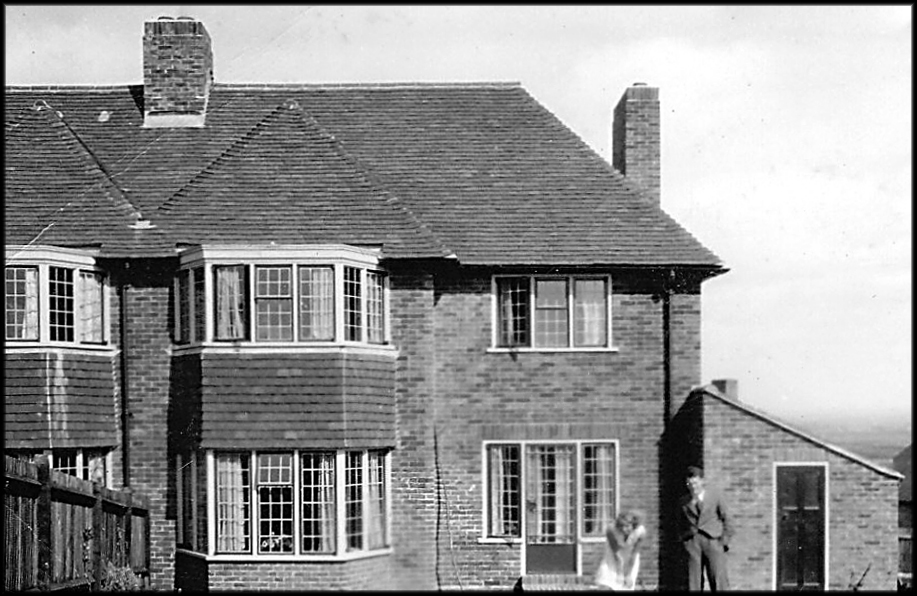
The first to occupy this brand new house in 1934
There is not a lot to be written about the house itself since the main part of it has not been altered to any great extent, though the fireplace was removed and the dining room now leads into a conservatory on the garden side. Vera loved the leaded windows, the sunny dining room and the equally bright warm bedrooms that faced south. The kitchen, however, was small, pokyand quite dark with barely enough room for a kitchen table and chairs although the north facing larder was for many years an asset to anyone not in possession of a fridge. Likewise there was no such thing as central heating and the only warmth in winter came from the coal fires and the boiler in the corner of the kitchen. In the early years Vera did not possess a vacuum cleaner and made do with a carpet sweeper but this was not too much of a problem as the house only had two large carpets, one in the sitting room and the other in the main bedroom. In fact before the war the dining room was not used at all, or rather it was, but as a store room for fruit and other garden produce! Wash day was sheer hard work inspite of a ‘copper’ rented from the gas board and slotted in under the draining board to the right of the sink beneath the kitchen window. In the opposite corner was a fitted dresser that came with the house. The top half was for storage and if you opened the doors, fixed to the inside of each one was a list of items you might wish to purchase from the grocery shop and beside the item a tab you could click across as a reminder for the next time you went shopping. It was quite a handy device but far more interesting to a small child who could be amused for ages flipping the marker into place thus messing up any real reminders. The lower half of this dresser or cupboard was another storage space, ideal for kitchen crockery and on top there was a flat area with an enamel surface that could be used for preparing food. This whole unit survived into the early fifties when a much larger purpose built wall cupboard was made by Bill. It never looked stylish but was practical and held a lot more china and general kitchen ware than the old dresser.
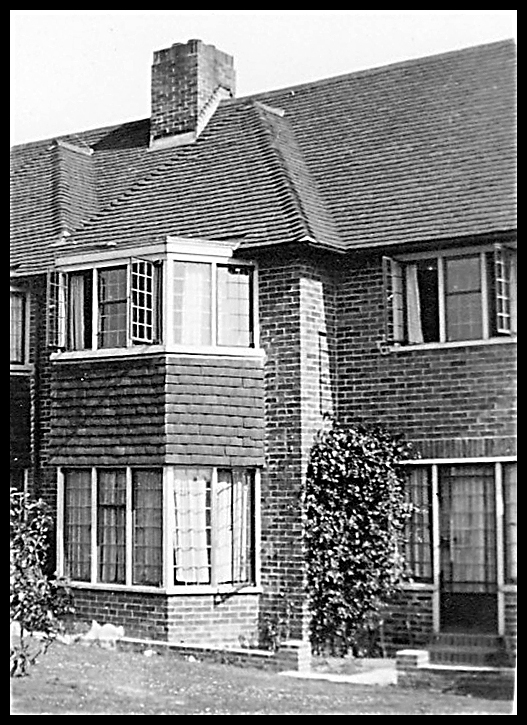
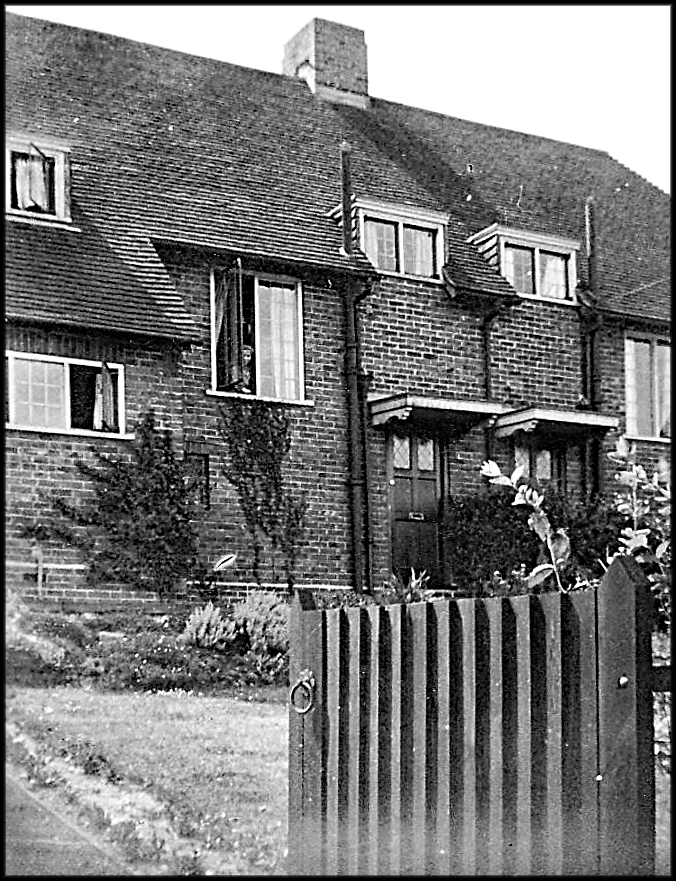
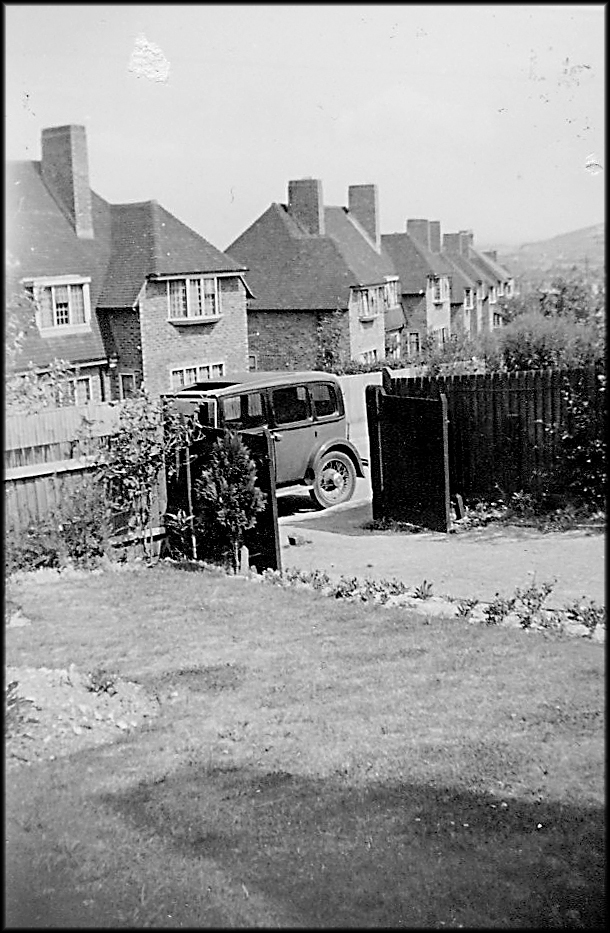
Photos from about 1937
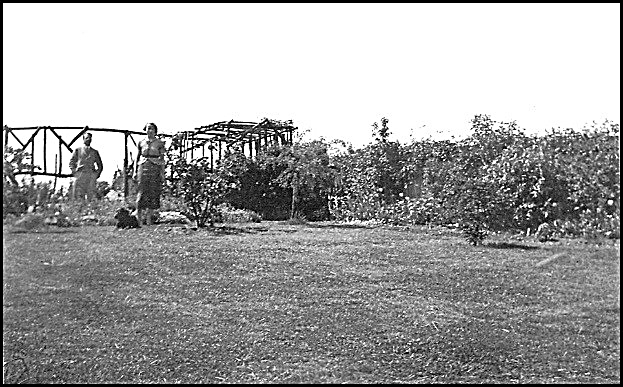
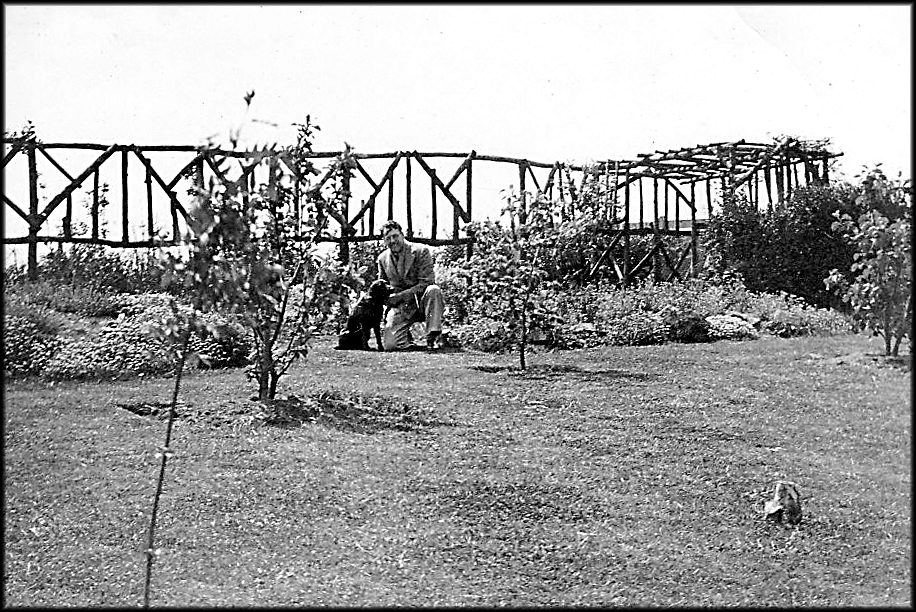
The construction of the trellis and arbour; fruit trees and yew newly planted
Once the young couple had moved in Bill took charge of the garden, a task he relished since he came from a long line of experienced gardeners. Nevertheless he was faced with a challenge: to transform wild downland with only a bare layer of soil resting on solid chalk into a fertile, flourishing, beautiful and productive garden.
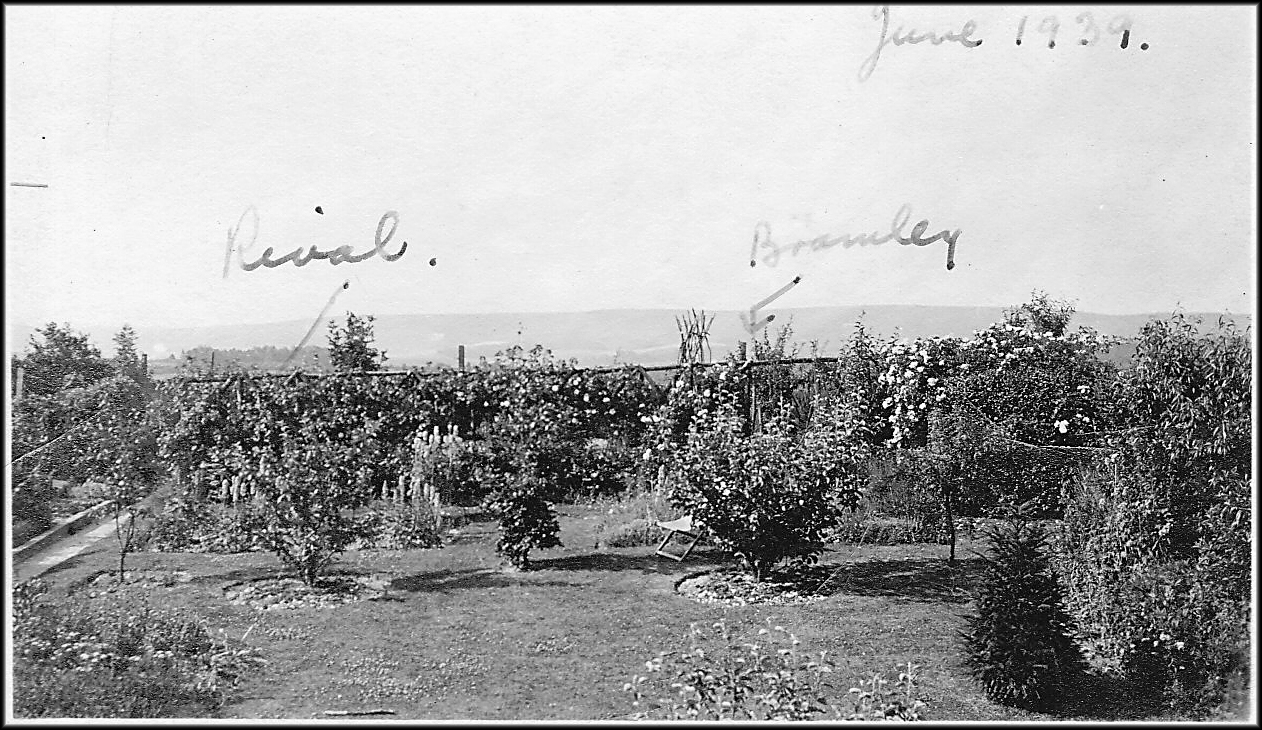
Raised bed on left, path, trellis, vegetable garden beyond and downs view
He’d grown up in Hampshire in a small village renowned for its rich acidic soil and magnificent brightly coloured rhododendrons and azaleas. This limy soil he now had to grapple with – what little there was of it – could not have been more different. But in no time at all he set about constructing flower beds, designing a sun terrace in front of the French windows of the dining room and getting to know which plants and trees grew best in an alkaline soil. The other important task was to improve the quality and depth of the soil in the borders and wherever he wished to plant a tree. This was not something that happened overnight, although he did purchase lorry loads of good loamy topsoil, but was something that was constantly being worked on.
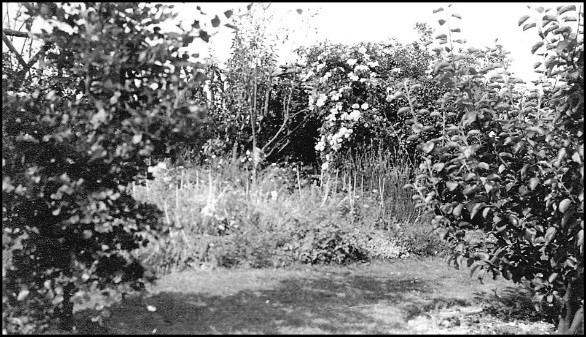
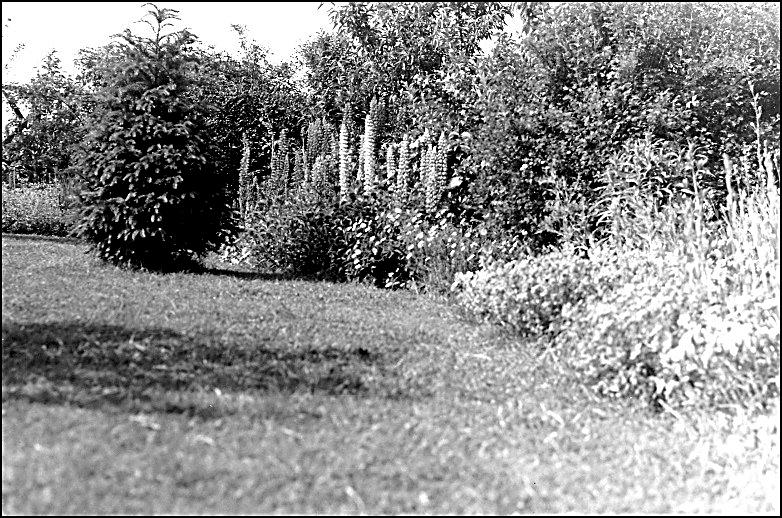
In these early years, before he had children, he must have spent hours indulging in this his favourite hobby and he created what could only be described as a most glorious garden. There are no colour photos to prove this but a considerable number of black and white pictures taken by admiring visitors have survived. If Bill and Vera possessed a camera then they scarcely ever used it. The garden in June was a riot of roses rambling all along the arbour he built and in a corner a special bower with an old bench where you could sit and dream under a scented pink canopy. Of all the garden flowers perhaps his favourites were delphiniums with their tall spikes in the most delicate and wonderful shades of blue. Lupins too loved the soil and grew abundantly. Slugs and snails it seems were not a problem since he never used pellets and would be described today as a wholly organic gardener. To the left of the arbour was the kitchen garden where he was able to keep the two of them well supplied throughout most of the year with fresh vegetables and soft fruit.

Before their first daughter was born Vera and Bill had a black Labrador dog, Prince, a most adored family pet who spent happy hours playing and sometimes digging in the garden and going for long walks on the downs. In later years there would be two cats, and a guinea pig but no other animal would ever touch Bill’s heart as much as his best dog, though he probably made the mistake of never even trying to replace him. It was as if he could not risk again the pain of that loss.
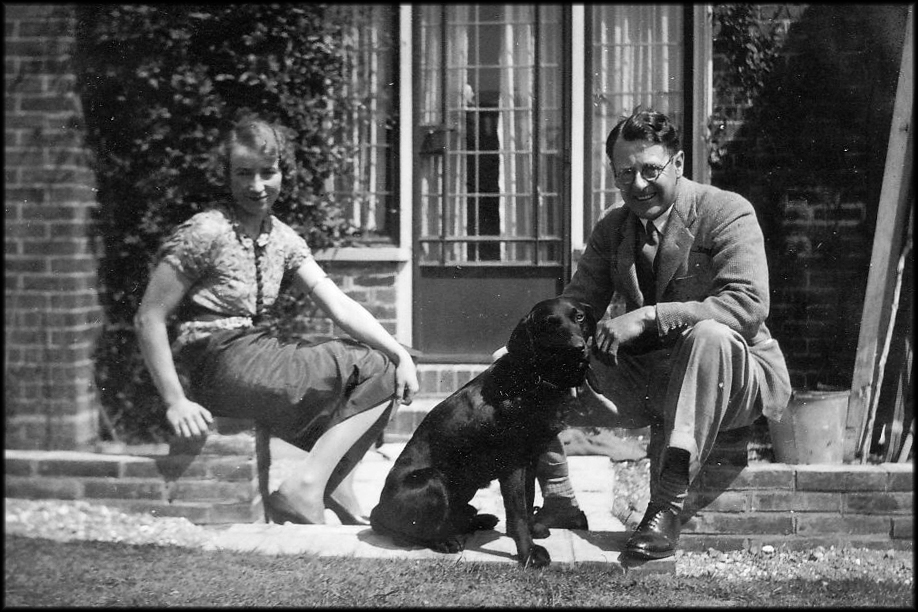
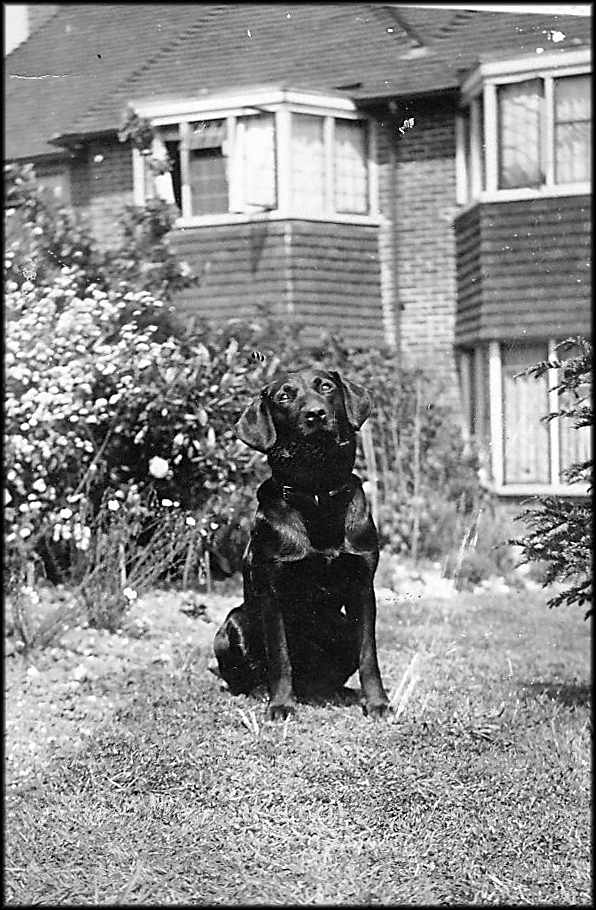
Vera, Bill and Prince
In the summer of 1939 the garden was looking splendid and in the September of that year England declared war on Germany. With the declaration of war came the need to make a few changes: to grow as much food as possible; to keep chickens and to build an air raid shelter. The chicken hut, for about six chickens, was beyond the arbour and their run was situated at the very back of the garden beside the privet hedge. Number 32 South Way had no shelter but a gap was made between the two front gardens near the front doors so that the two households could share the shelter should the need arise. Meanwhile the shelter itself had to be constructed and that meant hacking down into the chalk and stealing space from a flower and strawberry bed in the back garden. A heap of chalk dug out to make space for the underground shelter was formed to one side of the garden path and remained for years as a grass covered mound until the extension was built on the side, after the house changed hands. Part of what is the new, large kitchen is on the site of that mound which presumably was finally taken away to make room for level foundations. When the war was over the old shelter was partially filled in and somewhere under the grass or soil lies an old bike and any other rubbish from that time.
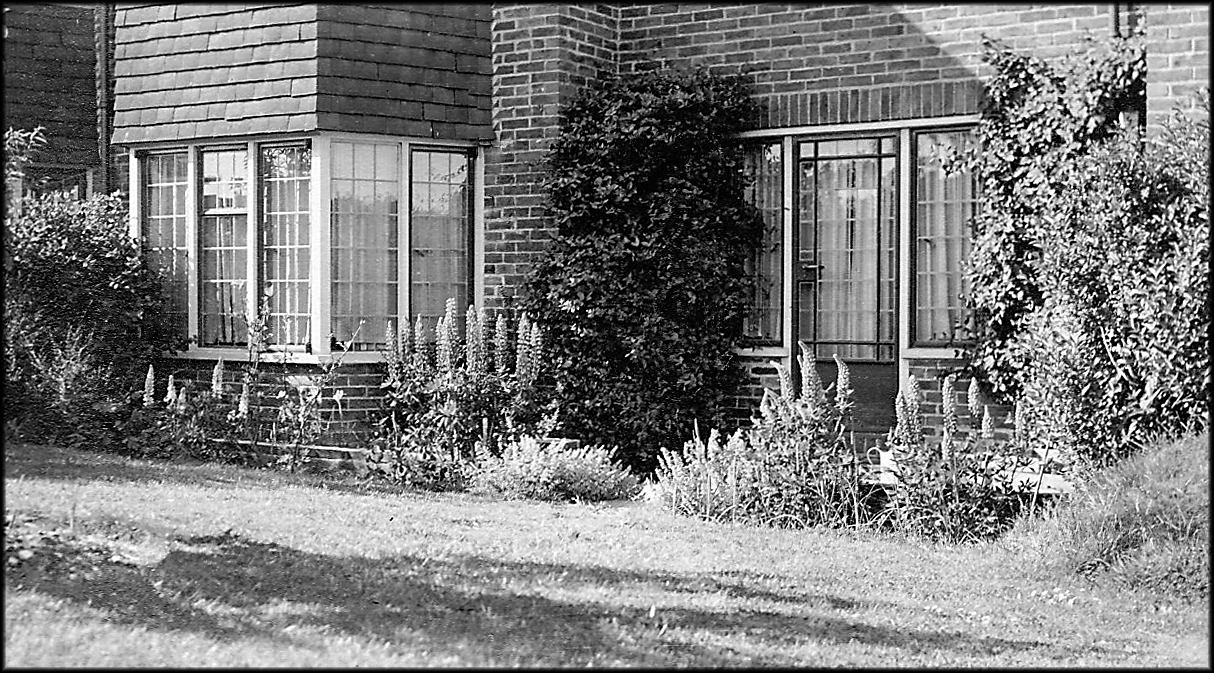
The back garden showing the grassy mound on the right
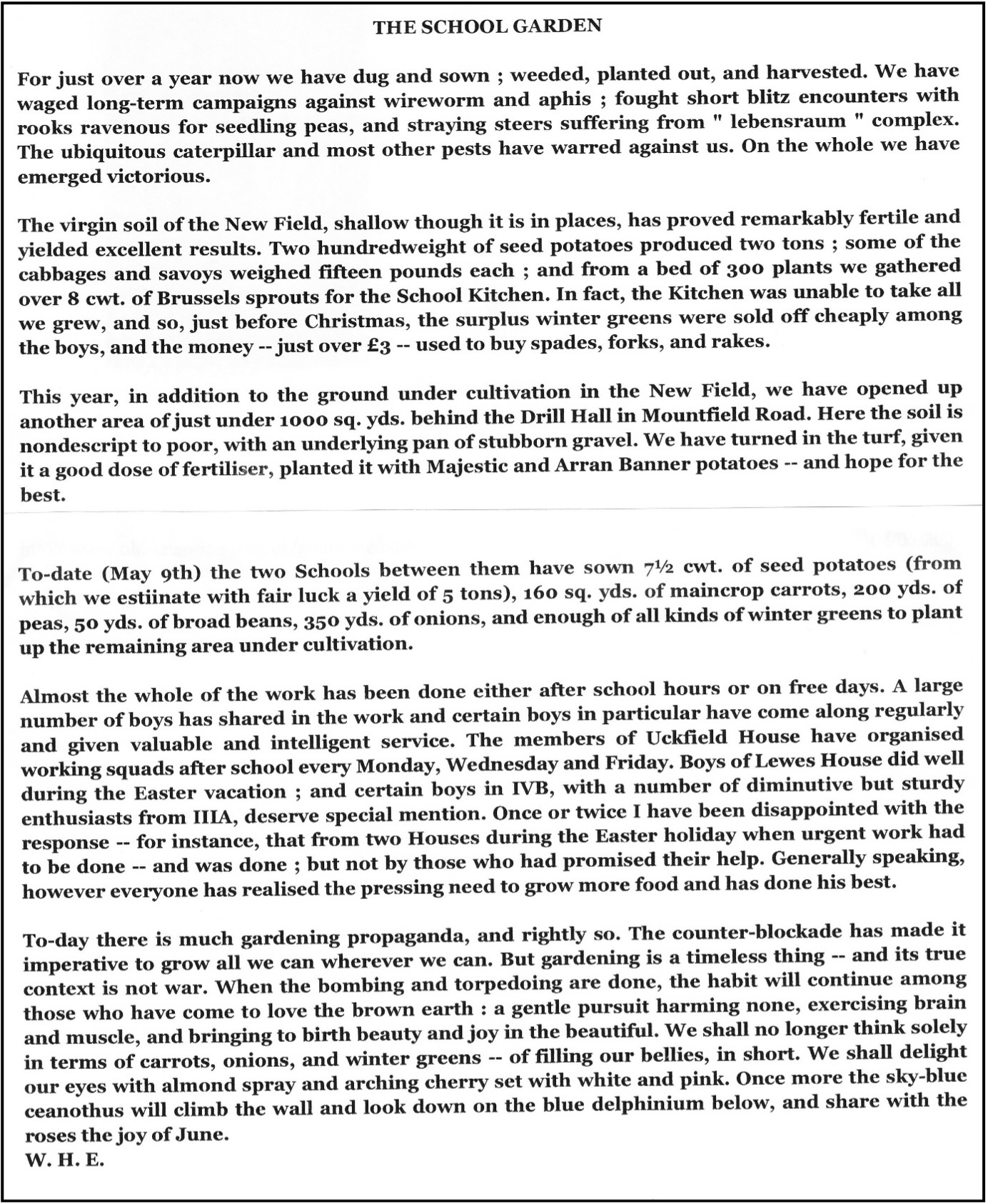
Bill felt that despite all his efforts he needed to grow more food so for a short while he rented an additional allotment. He also took examinations in gardening and helped to master mind the growing of vegetables for the lunchtime dinner service at the Lewes County Grammar School for Boys where he was the English master.
It was during this time that an evacuee, a boy aged about eleven, was placed with the young couple. He came from Tooting Bec in London but did not stay long as he was probably homesick and seemed nervous of the dog. Bill and Vera felt it had been an unsatisfactory placement all round and requested an older, more mature young person to come and live with them. And so it came about that Chibi, whose real name was Sybil Sturrock, came to 30 South Way. She tended to come and go because she was a young WAAF in her twenties and was parachuted into Yugoslavia to help save the lives of Allied airmen who had been shot down. Her task was to help them return to Britain and to get supplies and ammunition to the partisans. Hers was the middle bedroom and she was an extremely popular and well loved houseguest. Jennifer was born in August 1942 and when Chibi was there she told her stories of Yugoslavia, the country she loved so much.
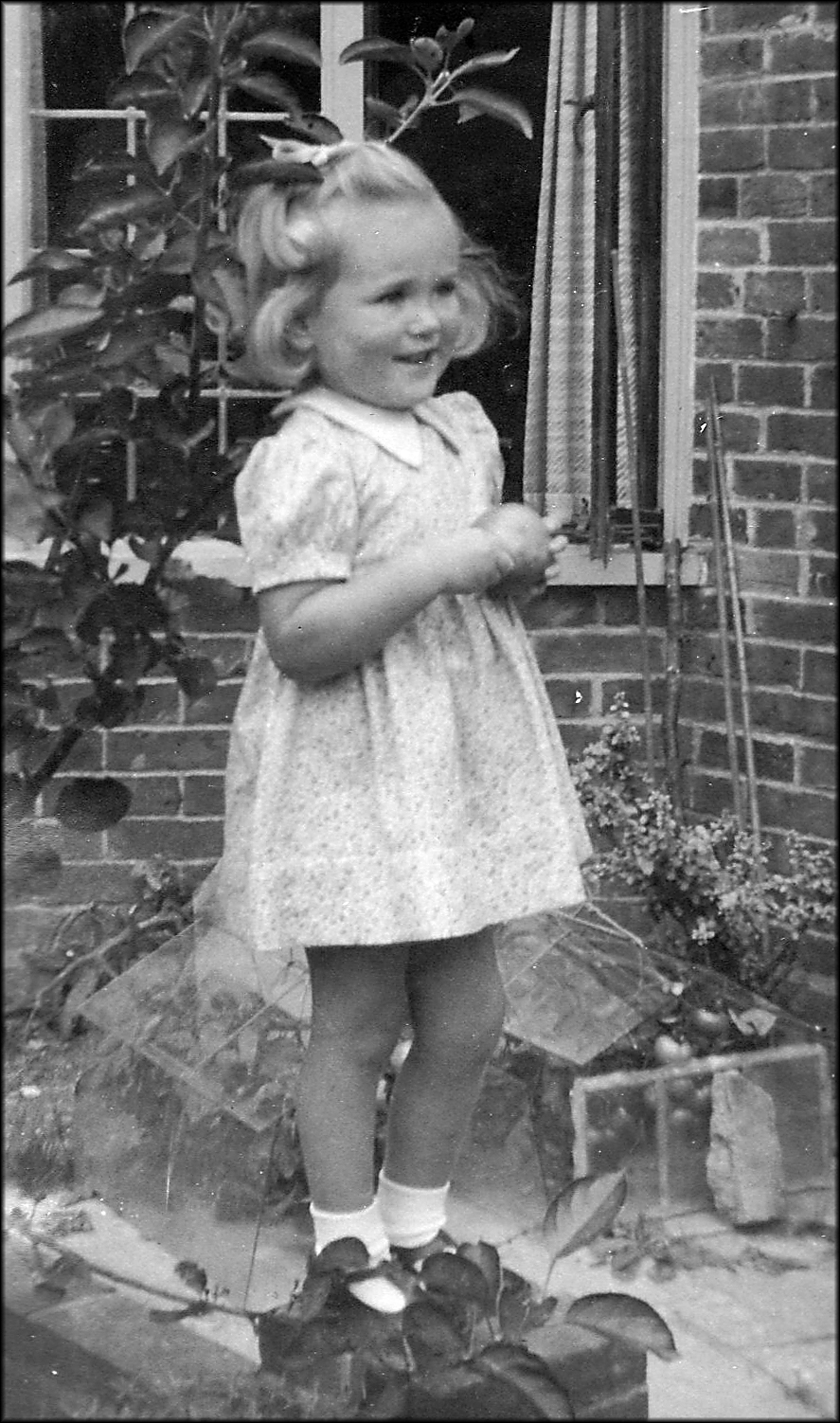
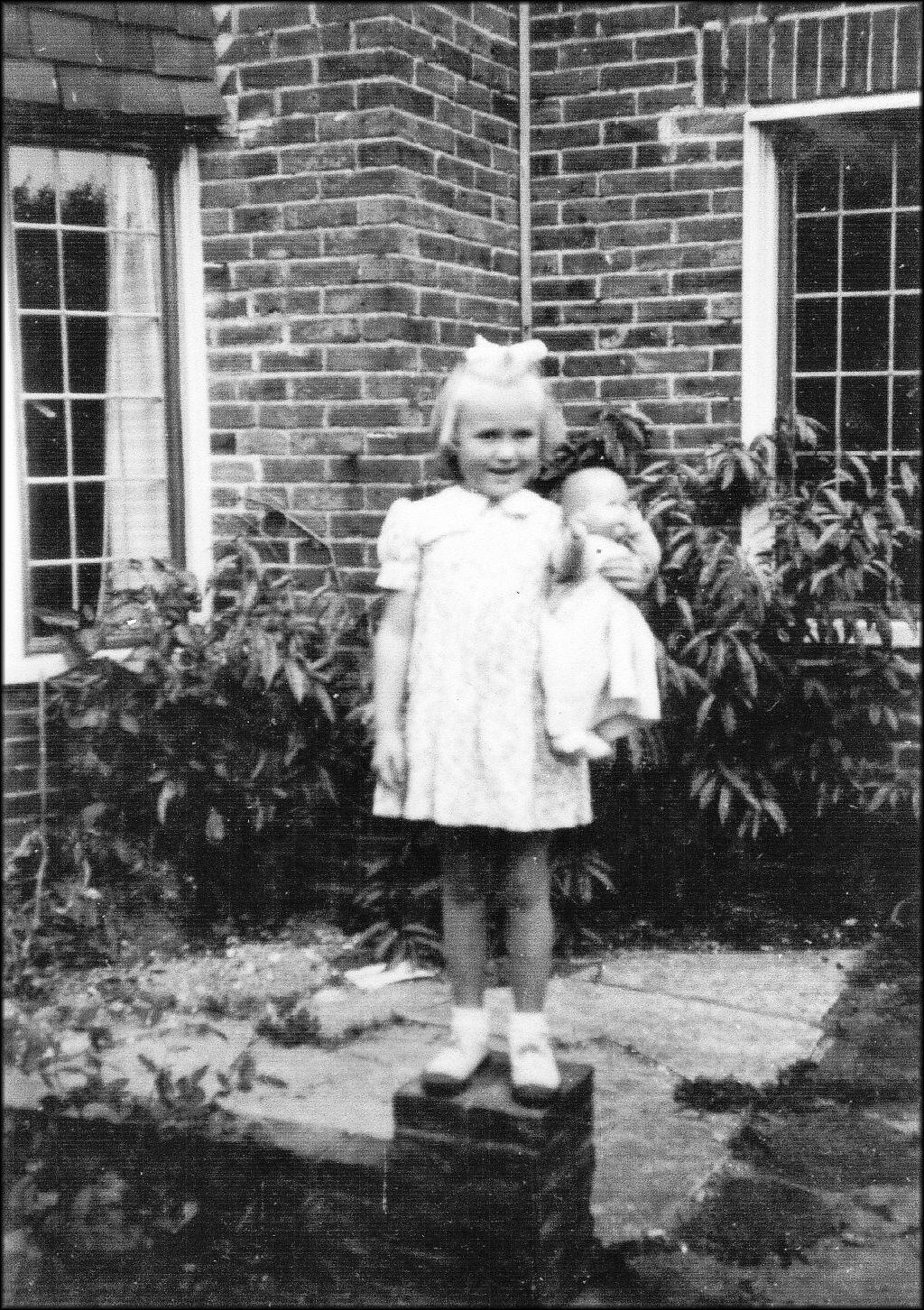
Jennifer
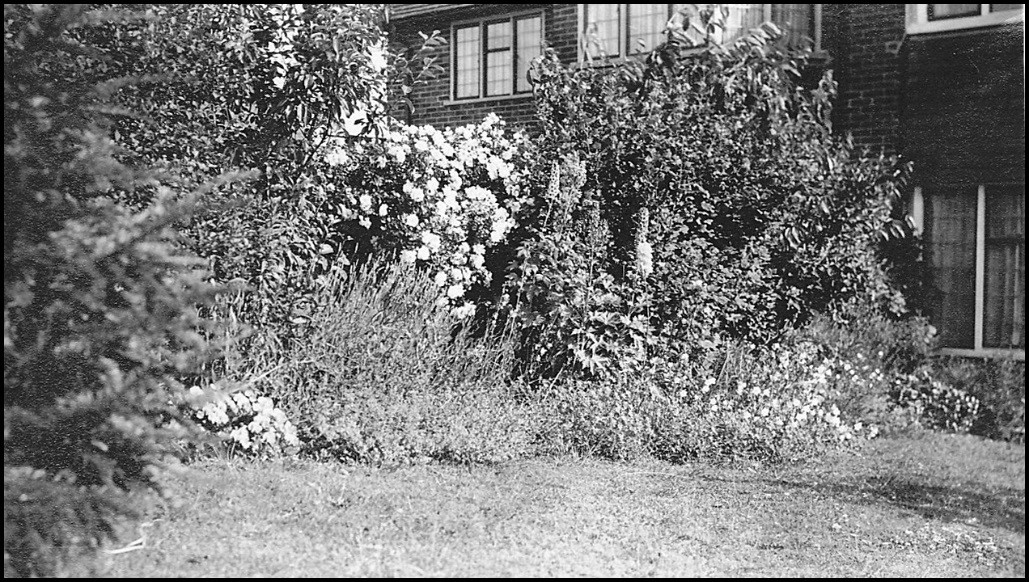
After the war, the chance of having a larger garden came Bill’s way when owners of houses along part of the road on the downs side were offered the right to purchase an additional piece of land, thus extending the length of their garden. This was just what he had always wanted and since the owner of number 32 had no wish to extend his garden Bill now had the opportunity to buy both pieces of land. It was really more than he needed but he was afraid that if left unpurchased the plot might end up becoming a dump and he did not want that next to his garden. He never actually cultivated this area but planted numerous flowering cherry trees, which he’d grafted himself and some additional fruit trees. It was also a great place for building a modest bonfire especially on Bonfire Night.
The new piece of land was always called ‘the new ground’ and was entered from the original garden by a small gate, the concrete post of which was still in evidence in 2009. This was now the true vegetable garden edged at the borders with fruit trees, gooseberry, redcurrant and blackcurrant bushes. To counteract the howling winds that could blow in from the downs he planted a Euonymus hedge which, as it grew taller acted as a substantial shield and gave shelter to his large and sunny plot. Again the soil had to be improved and lorry loads of dung and top soil were brought over the downs from Hawkenbury Way and the contents offloaded. A gap was made in the wire fence and hedge for this purpose. It is unfortunate that in the years that followed no person ever thought to take a photograph of this incredibly productive plot. In the summer there were long rows of runner beans and peas, potatoes, onions, lettuces, raspberry canes and two huge strawberry beds. One year he kept a tally on the amount of strawberries he’d grown and it came to more than a hundred weight. Neighbours all round were kept regularly supplied with a big bowl and we as children sometimes simply got tired of eating strawberries, though crushed up in a dish with fresh raspberries they were always delicious.
From then on, until he died, Bill kept the family going with seasonal fruit and vegetables. It was almost unheard of for Vera to have to buy apples or potatoes or any vegetables apart from salad stuff as Bill hated growing tomatoes, an allergy he developed from working as a young lad in the greenhouses on the estate his father managed in Ampfield, in Hampshire. He just said he couldn’t bear the smell of tomatoes. Perhaps that was the reason he never acquired a greenhouse because it seems strange that a man who knew so much about gardening never wanted one. His father and his father’s brothers, all five of them had spent their young years working in the glasshouses on large estates.
Bill liked trees in a garden, all sorts, so he planted a beech hedge in the front garden, a magnificent Japanese flowering cherry that in early spring spread like a soft white canopy over the driveway, pink cherry trees in the corners of the front lawn, a weeping cherry in the middle and a flowering crab, from which in later years hung a child’s swing, a silver birch and two conifers. Further on by the side of the garage there grew a mountain ash and in the borders of the back garden a tree that bore wonderful sweet tasting yellow cherries tinged with pink. There was also a peach, a dark red and bitter Morello cherry, Victoria plum, pear tree and apple trees of every variety: Bramley, Blenheim, Cox, Ellison’s Orange, James Grieves, Ribston, Russet and Beauty of Bath to name but a few.
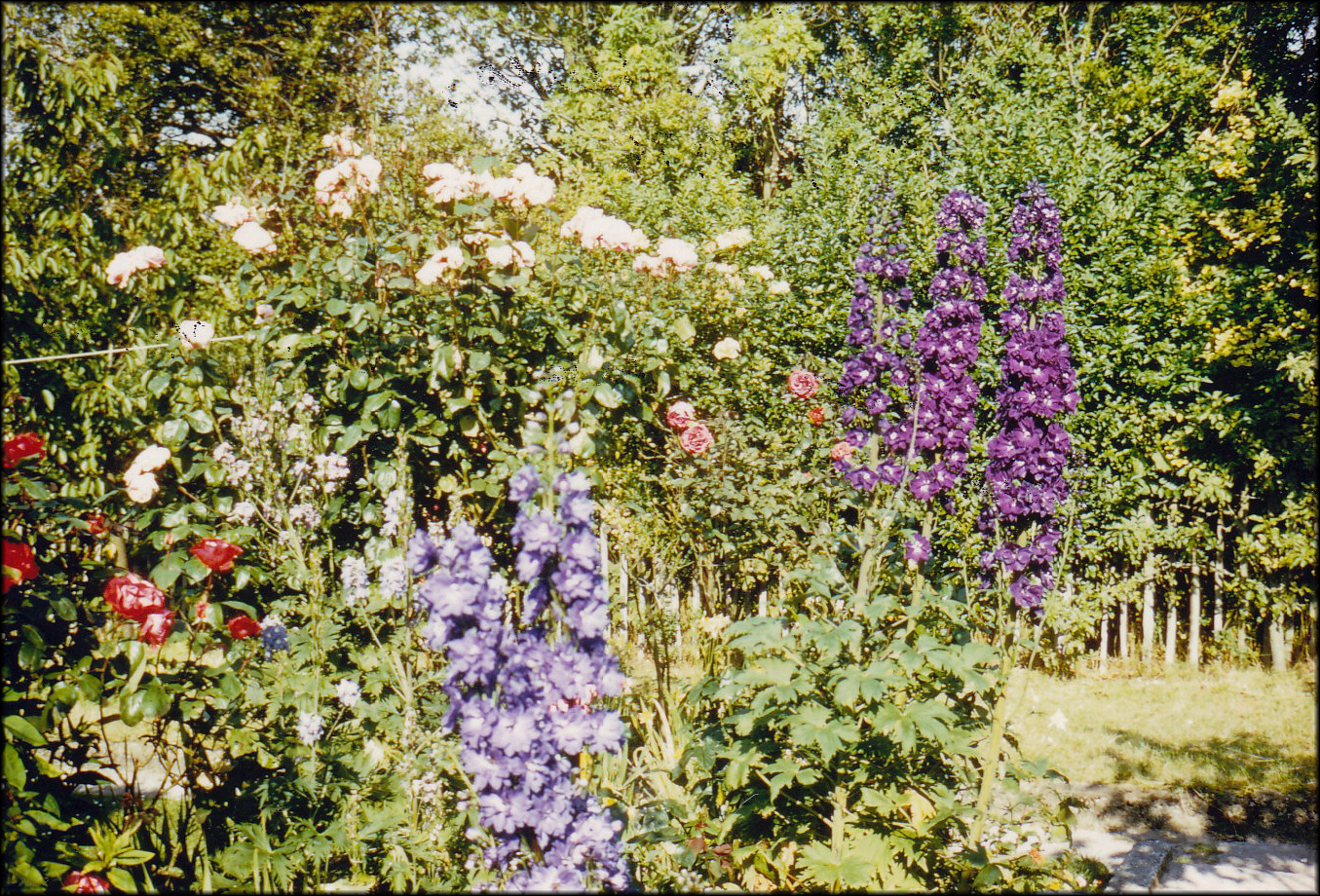
Gillian was born in 1946 and has special memories of the garden: her sandpit in the corner by the big bay window, the lovely little spot in the long raised border next to the garden of number 49 where shy sweet smelling violets grew, ready to be plucked for Mothering Sunday; black tulips, a red globed peony and clusters of scillas another of Bill’s favourite spring flowers, the unprepossessing yet gloriously scented Daphne Mezerium and polyanthus which he always grew from seed in abundance edging the lawn. These are just a few of the garden flowers that come to mind, and of course there were roses, roses everywhere.
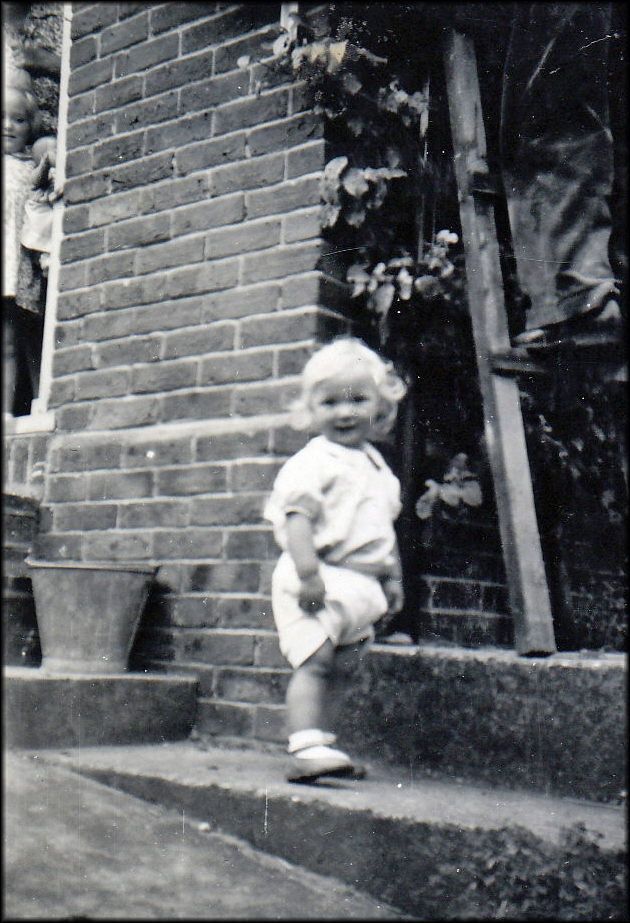
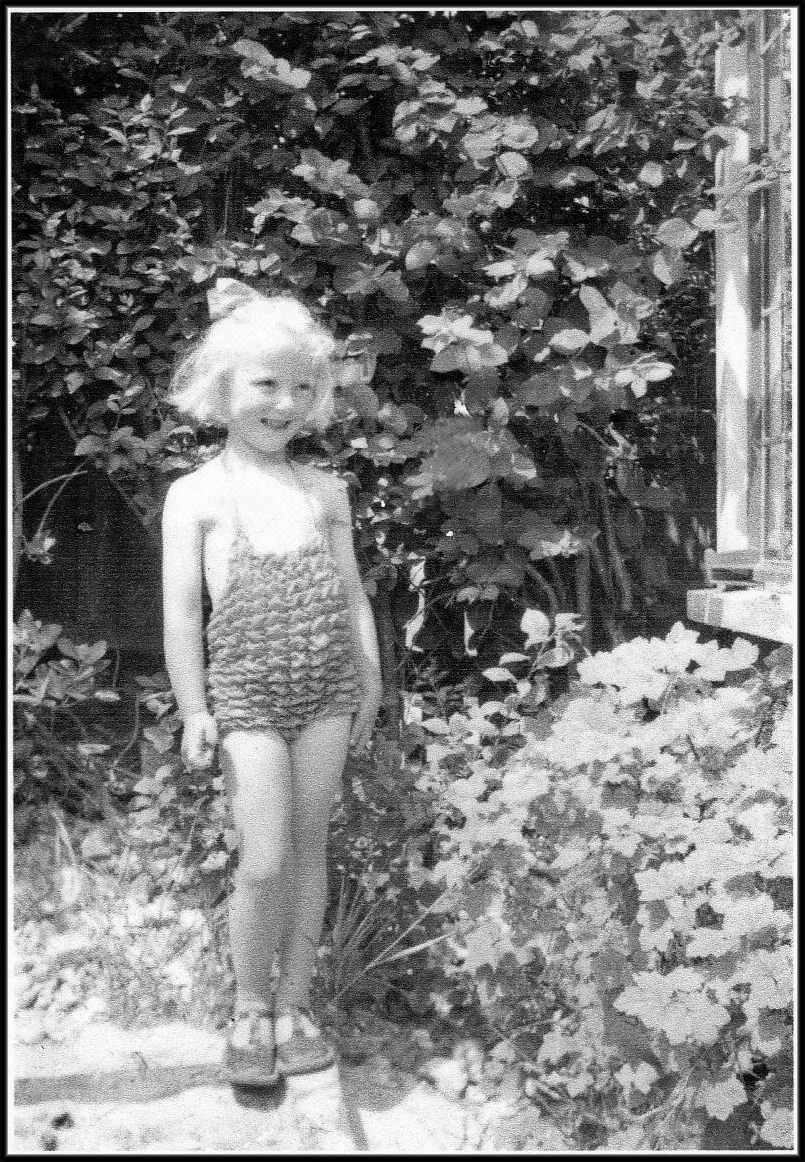
Gillian
Before he retired Bill embarked on one last major project, one of which he was very proud. What he needed when he had finally stopped teaching was his own purpose built shed, a place where he could raise a few trays of seedlings, store his many garden tools and have room for a proper work bench because his other hobby or passion beside gardening was woodwork. He designed and built it entirely himself, not always an easy task because his health had already begun to be a problem and sometimes he simply had to stop out of sheer exhaustion. But he finished it and in the following years it was his own very special place. Now it looks derelict, nothing more than a scruffy broken old shed but that was not always so.
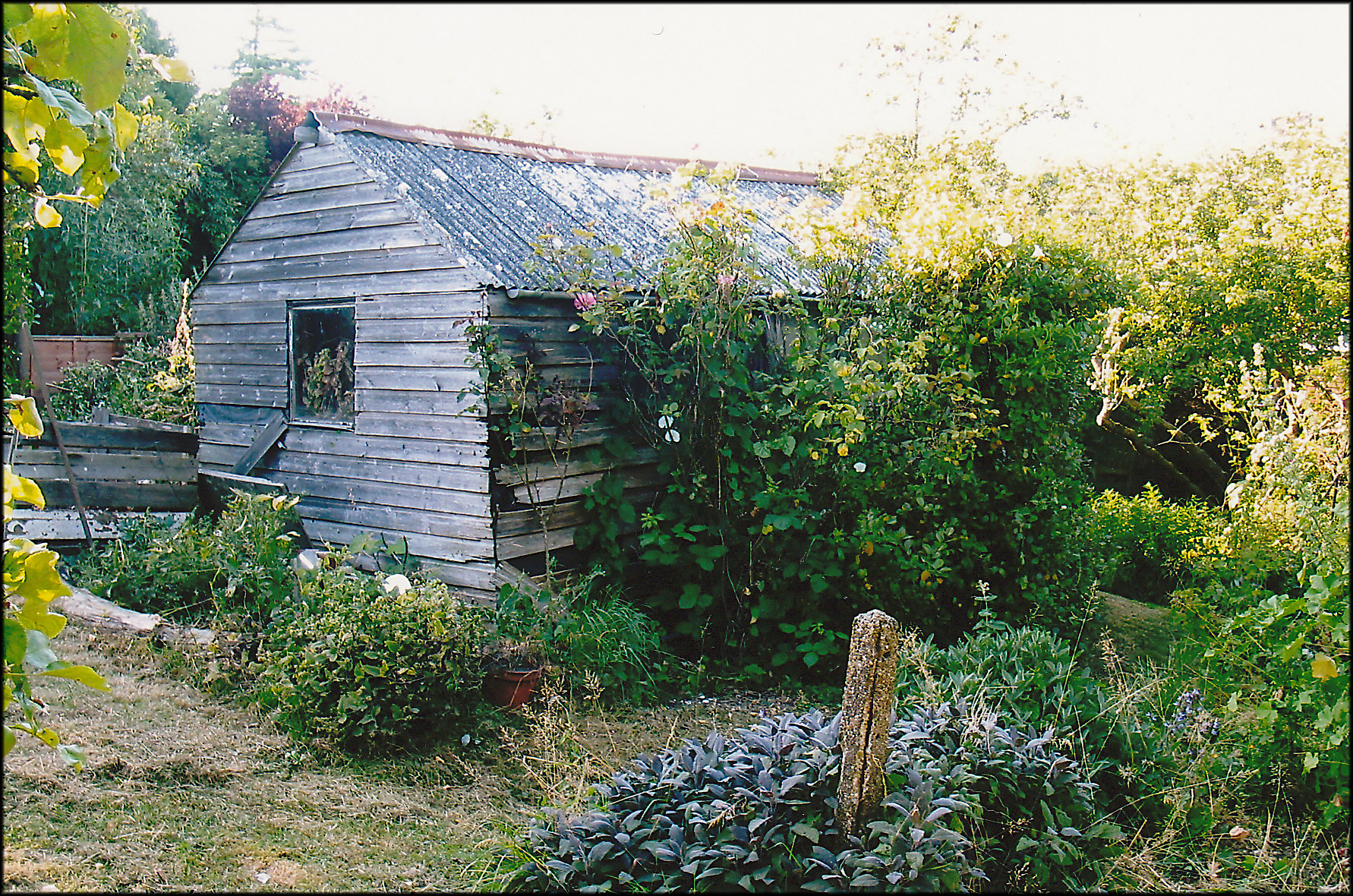
Bill’s shed still just about standing in 2009
Following retirement he was not able to enjoy gardening as much as he would have wished. The garden was really too large for someone whose health was failing but he still managed to grow more than enough vegetables, and Vera had ample soft fruits to store in her freezer. In the summer of 1976 when he died, although the garden was not as beautiful or as well kept as when he was a young man, nevertheless it was something to be proud of.
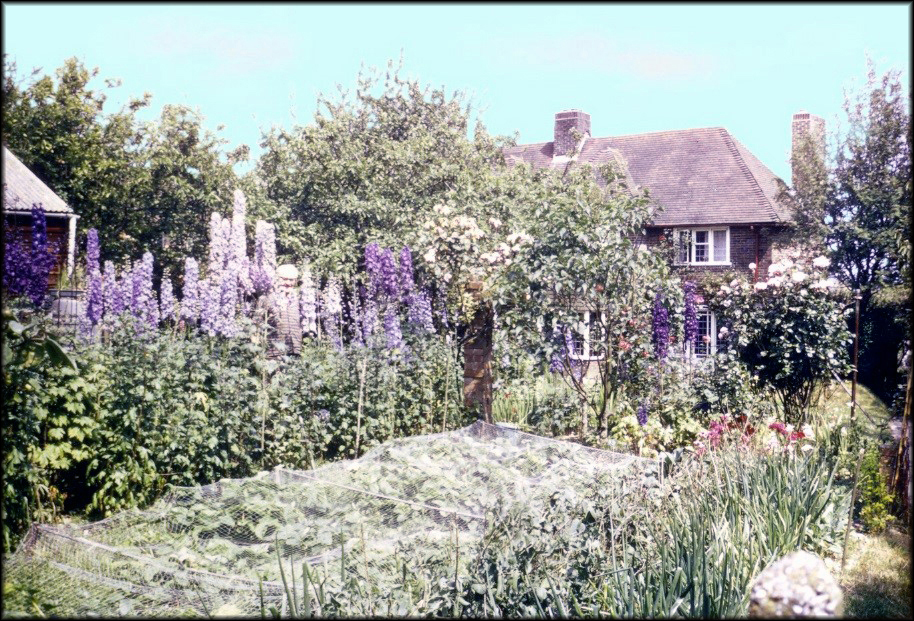
The garden about 1972 with Bill hiding behind his favourite flowers
In 1978 two photos were taken from the road and show the white cherry in the front garden which was just coming into flower; the pink cherry in the corner by the gatepost was still in bud.
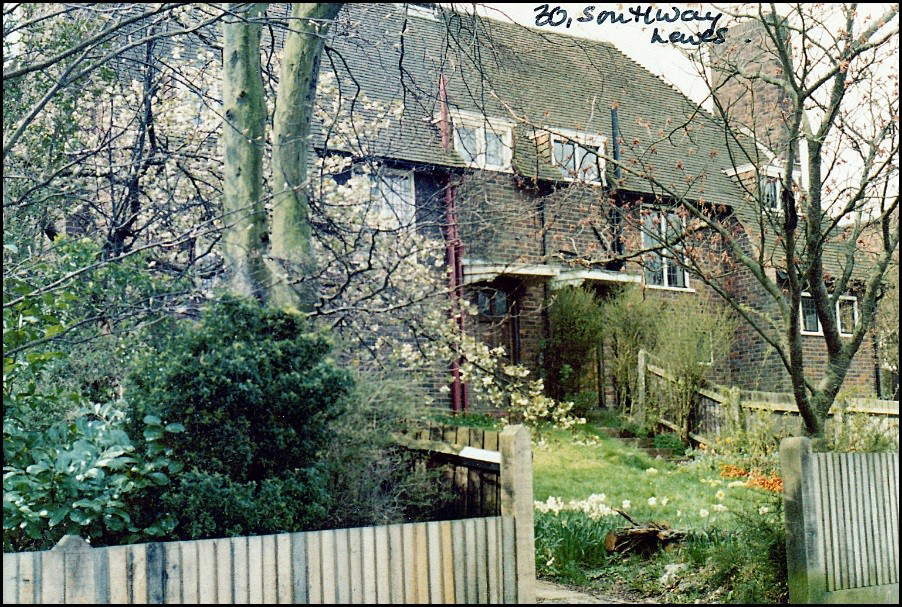
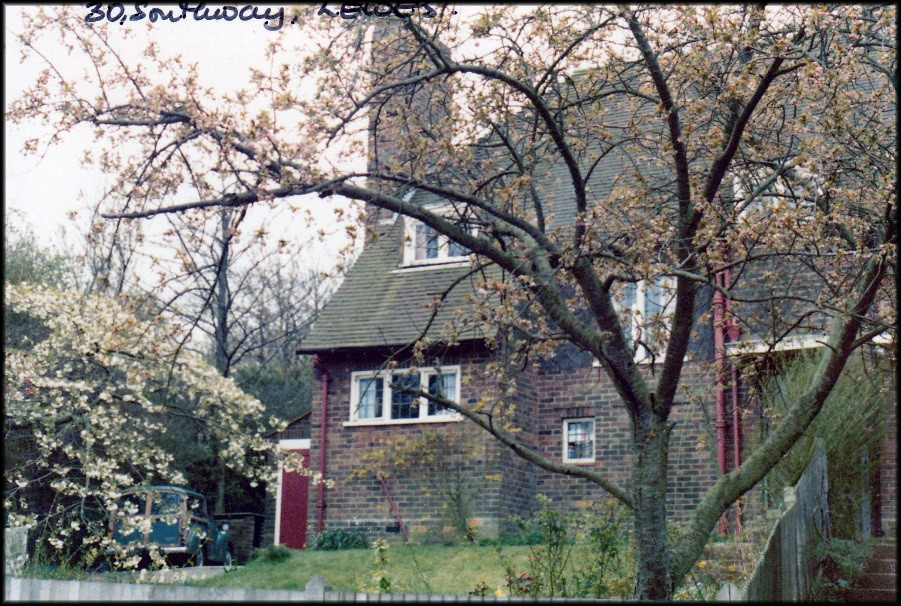
As a postscript it is perhaps fitting to include one of Bill’s Entries in number 16, May 1941, of The Barbican the yearly magazine of Lewes County Grammar School for boys in which he makes his report on ‘The School Garden’.
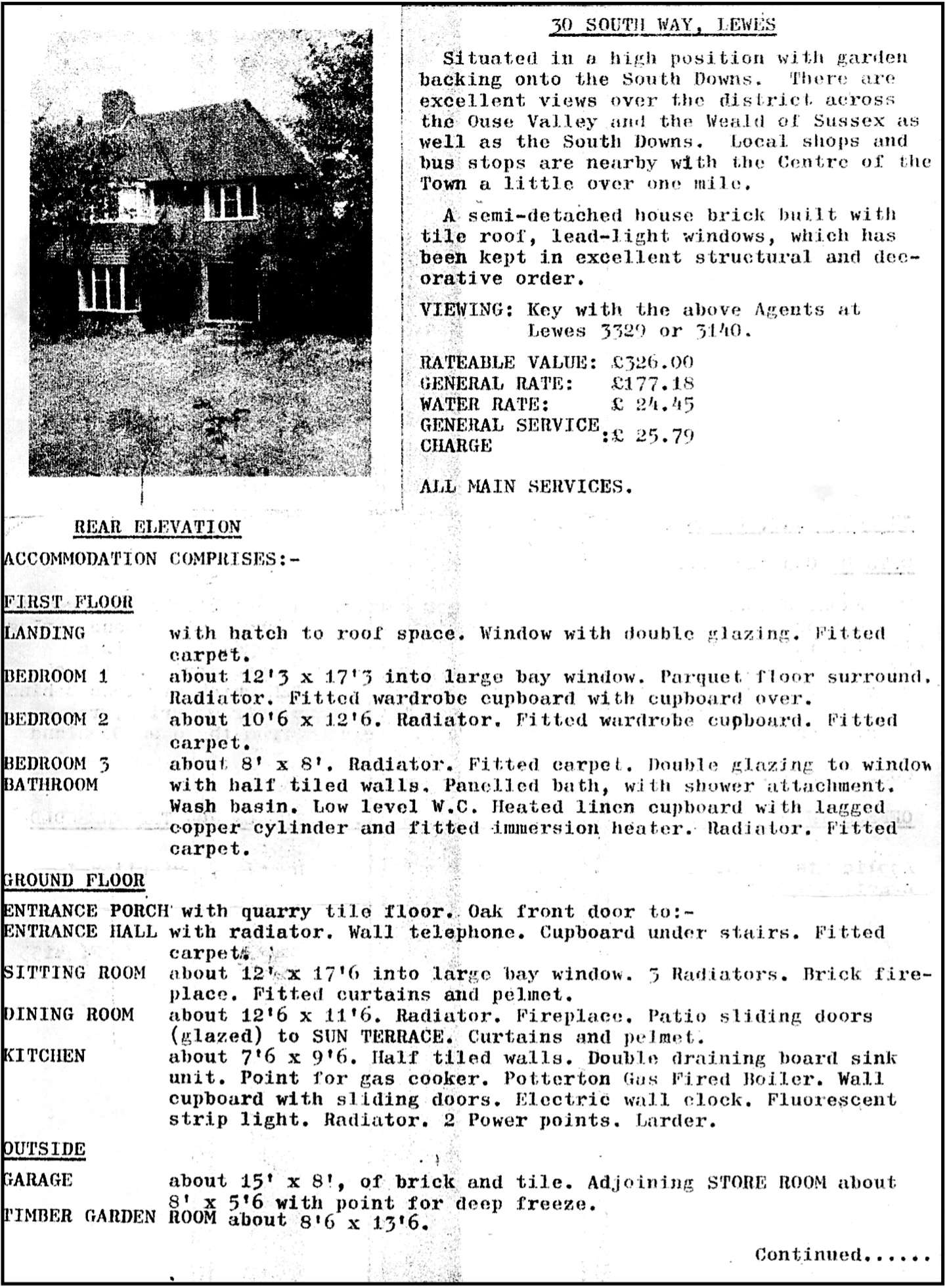
Estate Agent description, 1976
Jenny Lewis © 2014



 Lewes History Group