
Please note: this Bulletin is being put on the website one month after publication. Alternatively you can receive the Bulletin by email as soon as it is published, by becoming a member of the Lewes History Group, and renewing your membership annually
1. Next Meeting: 9 February 2026: three members’ short talks
2. Judith Brent
3. Dates of Lewes Floods
4. Coombe House Antiques, Malling Street
5. A portrait of Margaret Woods
6. John Braden: our first Medical Officer of Health (by Chris Taylor)
7. A felony at Malling
8. Lewes Castle painted by Mary Webster in 1838
9. The mail must get through
10. Two way traffic on School Hill
1. Next Meeting 7.30 p.m. Zoom Meeting Monday 9 February
Sheila Wood ‘What’s in a name?’
Paul Nicoll ‘How the Lewes By-pass saved the Rugby Club’
Chris Taylor ‘A Doctor in Edwardian Lewes’ [John Steinhaeuser]
This month’s meeting will again feature three shorter talks by members on their research into three different aspects of Lewes history. Sheila Wood will speak about the names given by residents to the houses in the developing Wallands area of Lewes a century or so ago, and the problems they caused for the authorities. Paul Nicoll will cover an aspect of the history of the Lewes Rugby Club and then Chris Taylor will tell us about the life and career of Dr John Steinhaeuser, who used his professional skills to help make Lewes a safer place to live.
LHG members will receive the Zoom link for the meeting.
Non-members can attend via Ticketsource.co.uk/lhg (price £4.00).
In our recent survey over 70% of members supported continuing with zoom meetings in the winter months.
2. Judith Brent
I am very sorry to have to record the sudden death on New Year’s Eve of Judith Brent, formerly an archivist with the East Sussex Record Office, going back to the days when our county’s archives were housed in cupboards on the upper floors of Pelham House. Judith and her husband Colin devoted much of their lives to unravelling the history of our county, and in particular its county town. Their house-by-house history of Lewes, Cliffe and Southover is an invaluable guide for much of the research our own group has carried out, in particular the various Street Stories projects.
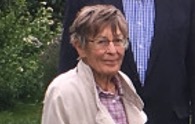
I have a particular personal debt to Colin & Judy. Some 50 years ago Colin ran a Local History evening class under the auspices of the Workers Educational Association – at a time when local history was a barely respectable endeavour. Judy joined in, and we were able to initiate our own research projects, with access to the original documents unimaginable today. I was one of the students and so began a life-long fascination with the subject.
3. Dates of Lewes Floods
The 14 November 2025 Sussex Express reported, on the authority of John Gower, flood lead for the Friends of Lewes, that properties in the town had been affected by flooding in 2000, 1960, 1938, 1911, 1909 and 1878. I have been unable to find reports of the 1938 & 1878 floods in the local press, though 1877 saw serious flooding in the brooks around the town. The other dates are well-attested and we have photographs from 1909, 1911, 1960 and 2000. In addition the 28 October 1891 Hastings & Bexhill Observer reports flooding on both sides of the river Ouse in the lower parts of the town.
To these floods we can add a report in the 7 November 1865 Sussex Advertiser of flooding affecting the lower parts of the town, especially the Cliffe, that was as bad as had been experienced in the great floods of 1852, when serious flooding in Lewes was reported in newspapers published across England. The 1852 floods were described as the worst since 1814, but at least the paper mill, the riverside wharves and the cellars of the Cliffe were also flooded in 1841. Peter Varlow’s new book on Cliffe church mentions the 1814 flood as caused by rapid melting of snow. Brigid Chapman in ‘The Chronicles of Cliffe and South Malling’ (2003) also reports floods in 1773,1772 and 1768 [Bulletin no.45].
On at least two other occasions in the 20th century (1914 & 1935) there was flooding of dozens of houses in Southover by the Winterbourne without any accompanying flooding from the Ouse.
4. Coombe House Antiques, Malling Street
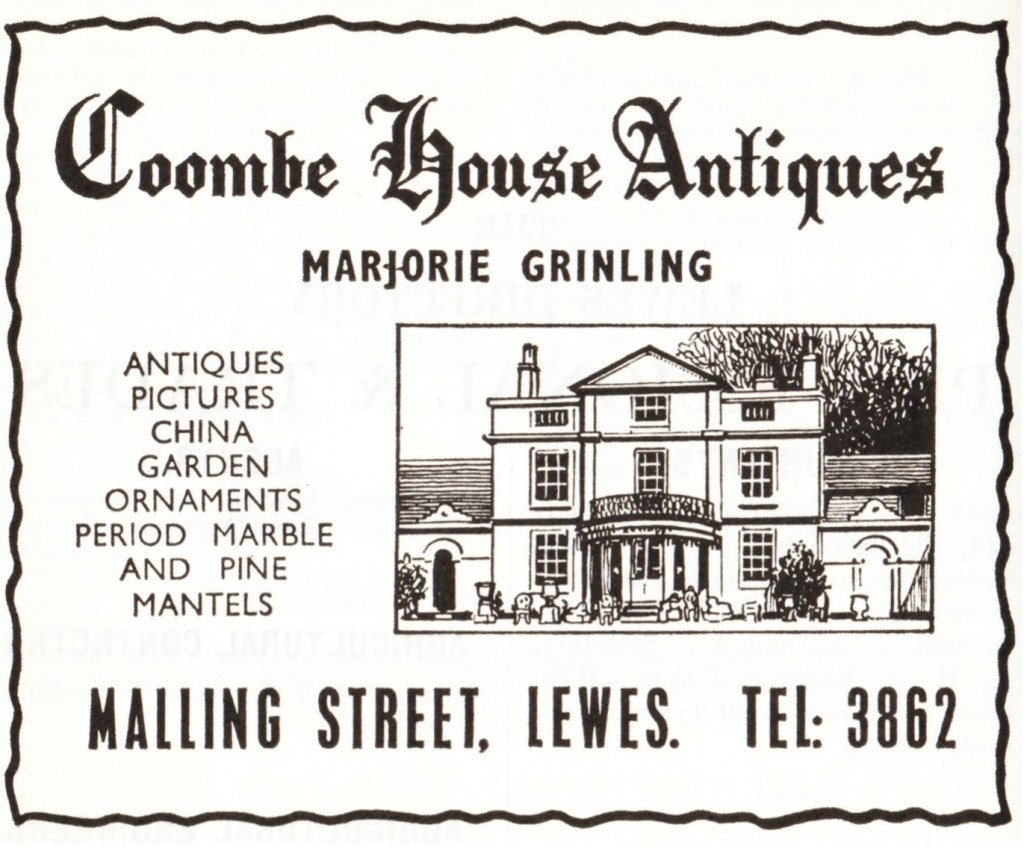
This trade advertisement for Coombe House Antiques, Malling Street, is taken from the 1968 edition of Kelly’s Directory for Lewes. This was once a very smart villa residence.
5. A portrait of Margaret Woods
This oil on board portrait, noted on the reverse to be of Margaret Woods of Lewes, spinster, 1778-1868, was offered for sale on ebay recently for £175 by Plardiwick Antiques of Stafford.
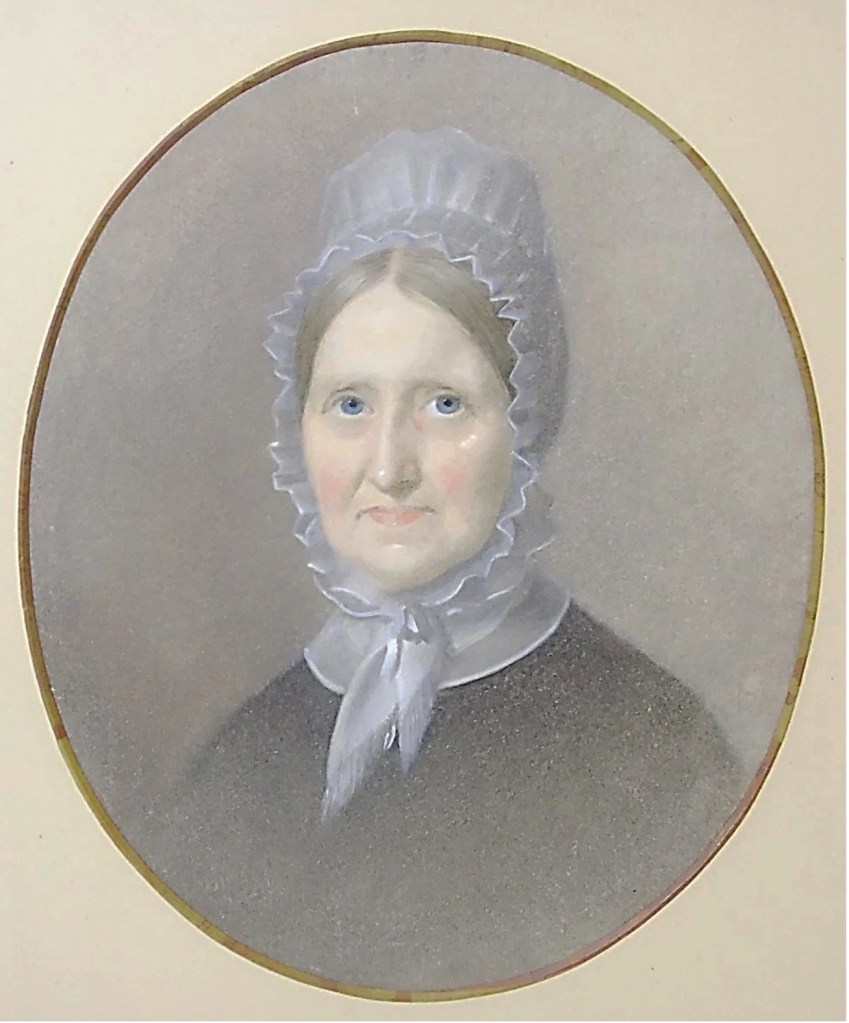
The 1851 and 1861 censuses find her living, together with her unmarried brother Joseph Woods, in one of the houses of Priory Crescent, Southover. They were prominent members of the Lewes Quaker community. Joseph & Margaret Woods both died at Priory Crescent, in January 1864 and December 1868 respectively, and they were buried side by side in the Quaker Burial Ground in Friars Walk. Though Joseph Woods was regarded in his lifetime as of delicate health, they lived to the ages of 87 and 90 respectively. They are both described as annuitants in the 1851 census and Joseph was a ‘fundholder’ in 1861. At Margaret Woods’ death she left an estate of £6,000, so they could afford to live comfortably.
Joseph and Margaret Woods were respectively the third and fourth children of Joseph Woods senior (1738-1812), a widely educated Quaker woollen-draper, and his wife Margaret Hoare (1748-1821). They were born in Stoke Newington, then a village a few miles to the north of London. In 1787, when they were both just children, their father and their uncle, the banker Samuel Hoare, were two of the five Quaker founders of the London Association against Slavery, the predecessor to the Committee for the Abolition of the Slave Trade. Their mother kept a journal from 1771 until her death from which extracts, published posthumously in both Britain and the United States, are today a major source for contemporary Quaker social history.
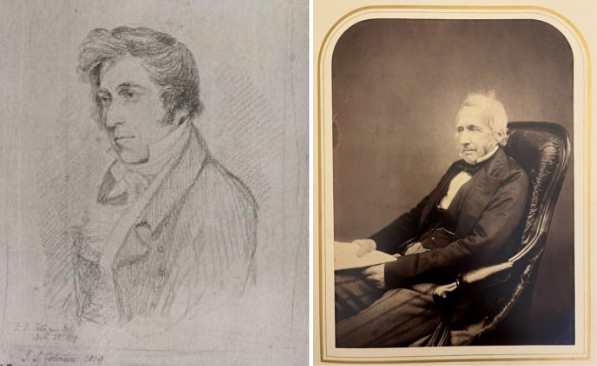
Joseph Woods, largely self-educated, trained as an architect. Although he does not seem to have had any great talent for the practical side of the business, he became the founder and first president of the London Architectural Society in 1806. After Waterloo he was able to travel extensively in France, Italy and Greece, and published ‘Letters of an Architect’ in 1828. However, he had wide interests that extended into other areas, becoming a Fellow of both the Geological Society and the Linnean Society, and a member of the Society of Antiquaries. After giving up architecture, he moved to Lewes in the early 1830s. Thereafter he focused much more on his botanical studies. He was a particular specialist in roses. He published widely in this field, including in 1850 a Flora of Great Britain and the parts of Europe in which he had travelled. The Linnean society has a collection of his manuscripts and journals. He was also a competent amateur artist, though his surviving artworks are few and far between. He was an excellent chess player.
Margaret Woods was herself a talented artist, and the Linnean Society has a volume of her intricate watercolours of flowers from her garden and from the places she visited in and around London. Each drawing is carefully documented, and a selection are featured on the Society’s website. They were drawn from 1802 onwards, for the benefit of her brother’s botanical work. Margaret’s portrait is unsigned. It appears to date from the time they lived in Lewes. It could perhaps be a self-portrait, a painting by her brother or the work of a contemporary Lewes artist.
Sources: FindMyPast; M.A. Lower, ‘The Worthies of Sussex’ (1865); David Hitchin, ‘Quakers in Lewes’ (2010); Linnean Society website; obituary of Joseph Woods in the 20 January 1864 Sussex Advertiser; the drawing of Joseph Woods by John Cotman is from the V&A Museum collection and the photograph from the Linnean Society website.
6. John Braden: our first Medical Officer of Health (by Chris Taylor)
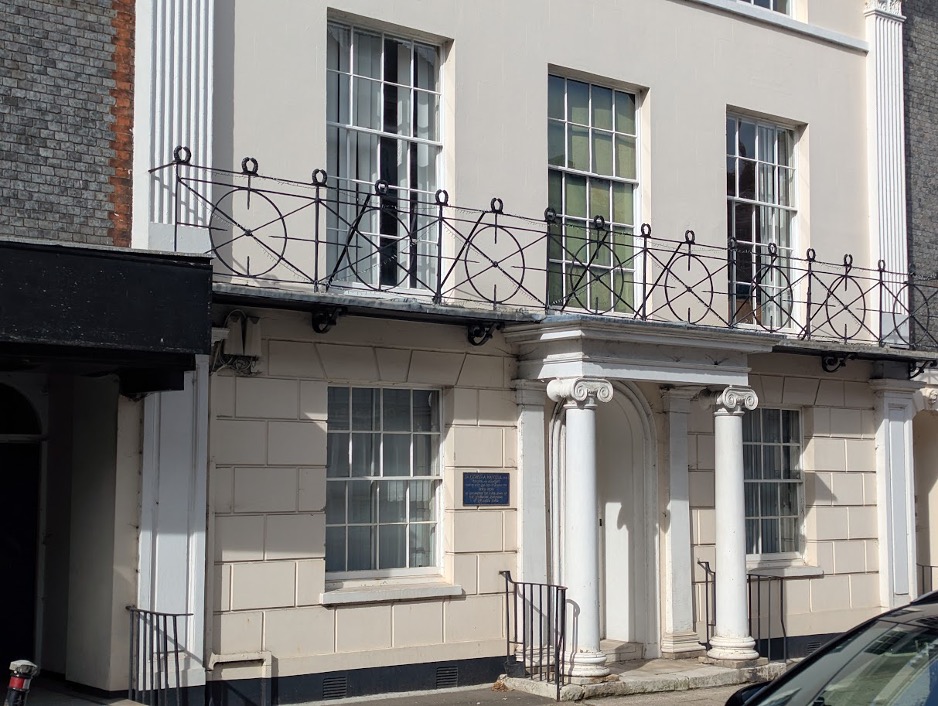
The Public Health Act of 1872 created local sanitary authorities to oversee services such as water supply, sewerage and refuse disposal in every part of England and Wales. The Act obliged each authority to appoint a medical officer of health (MoH) to advise, give direction and prepare annual reports on the sanitary state of the district, the incidence of diseases and the rate of infant mortality. It was decided to make a single appointment to cover Lewes, Cliffe and the rural districts; in 1873 Lewes doctor John Braden became the first MoH with a salary of £50 a year.
John George Braden was born in Whitechapel in 1836, the son of a sugar refiner with premises in Denmark Street. The 1851 census has John, aged 15, living at an address in Brick Lane, ‘learning his profession’ as an apprentice to the surgeon Thomas Mears. Apprenticeship was a common means of preparation for medical practice before a structured system of hospital-based training and standardised examinations were developed. Braden completed his successfully and was admitted to the Royal College of Surgeons in 1857. He set up in general practice in the Commercial Road area of London and in 1861 married Louisa Kennedy. The 1871 census has John and Louisa living at 166 High Street, Lewes (formerly the premises of Gideon Mantell) with daughter Mary aged 9, son Carl aged 5, baby Ethel and three servants. Carl had been born in Torquay, so it is possible that Braden practised there for a while before arriving in Lewes.
Braden’s annual reports demonstrate his strong commitment to public health awareness, a shrewd appreciation of the practicalities of public health measures and at times a dry wit. His time in office saw the extension of sewerage to most parts of the town and the near-elimination of cesspools. Throughout the 1880s he noted with approval the public’s increasing interest in sanitary matters. In 1888 he reported that ‘all classes are beginning fully to understand it is better to prevent than cure disease.’ He hoped, however, that this growing awareness would not encourage people to think that ‘almost every act in their daily life is fraught with sanitary danger’: reason should prevail.
His calm handling of a severe outbreak of enteric fever (typhoid) in 1874-5 earned Braden a vote of thanks from the Improvement Commissioners, who were until 1881 the sanitary authority for Lewes Borough. This outbreak supplied him with ammunition to argue for an isolation hospital for infectious diseases in Lewes, which duly opened in 1877. Braden’s riposte in 1882 to ratepayers who complained that the new hospital’s beds had so far been largely unoccupied was to suggest that ‘probably the same individuals would regret the inactivity of the fire engine’.
Braden became a well-known figure in the town. A stalwart of the local Conservative Association – one imagines him an enthusiastic supporter of Disraeli’s Sanitas Sanitatum, Omnia Sanitas dictum – and a vice president of the Lewes Cyclist Club, he found time to serve as president of the Lewes Photographic Society. The Sussex Express reported in April 1891 on ‘An enjoyable entertainment … given at St. Anne’s School-room on Wednesday evening by Dr. J. G. Braden’s exhibition of Sussex photographs… The frequent applause which greeted the views, which embraced a variety of subjects, indicated the keen appreciation of the audience.’
John Braden’s tenure as Lewes MoH came to rather an abrupt end in June 1892 when, after 20 years in office, he tendered his resignation. A combination of reasons probably explain his decision. Personal tragedy possibly played a part: Louisa had died in 1888 and three of their five children had died in infancy. A serious flu epidemic in 1892, which killed 47 people in January alone, caused him great distress: ‘l regret not being able to speak so favourably as usual on the general health of the town.’ The death rate in the first half of that year rose to 22.2 per 1000, the highest in 20 years and, very unusually, considerably above the national rate. Against this background, the Borough Council received a letter of complaint from Sir George Shiffner, Rector of Hamsey, accusing Braden of neglect in the case of a parishioner, to whom he had failed to make an arranged second visit and who had died. This was the first complaint ever made against him. Braden’s reply, endorsed by the council’s sanitary committee, denied any neglect and explained the difficult circumstances that had doctors working at full stretch. All these factors no doubt contributed to a degree of disillusion and prompted his departure.
The council having accepted his resignation with regret, Braden left Lewes with ringing endorsements of his work, including one from the Directors of the Victoria Hospital, expressing their high appreciation of his services as an honorary surgeon. He continued to practise for a few years at St Margarets at Cliff near Dover, where he was elected to the parish council. He left there in 1895, moving to Shalford in Surrey, where he died aged 70 in 1906.
Sources: Records of Lewes Improvement Commissioners (ESBHRO LEW/C/3/1); Sanitary Committee minutes (ESBHRO DL/D/169); Censuses 1841-1891; UK Medical Registers 1859-1959; 18 April 1891 Sussex Express; 7 December 1894 & 25 October 1895 Dover Express
7. A felony at Malling
The 15 March 1864 Sussex Advertiser reported that Hannah Carter, a respectable-looking woman who earned her living by hawking baby linen, etc, was brought before the Lewes bench charged with stealing a chemise and a night gown from a washing line in ‘the parish of Cliffe, Malling’. They were valued at three shillings and the property of Edward Ford.
Mary Ford, the prosecutor’s wife, deposed to missing the items in question on 7 March about 5 p.m., and she identified items shown to her as those that had gone missing. A label had been cut out. Her neighbour gave evidence that she had seen the prisoner nearby at the time. P.C. Gosden recovered the missing items in Hannah Carter’s possession at the Welcome Stranger at about 7 p.m. the same evening.
Hannah Carter claimed she had bought the items for a shilling from a woman she could ‘identify among a thousand’, but she was not believed. The bench sentenced her to six weeks’ hard labour
8. Lewes Castle painted by Mary Webster in 1838
Recently offered on ebay by Jacob Boston Fine Art was this fine signed and titled watercolour of the view inside the castle keep by Mary Webster (1794-1883). She adds a note ‘Sketched from nature, 25 August 1838’. Also offered by the same artist are about forty other views of Pevensey Castle, Herstmonceux Castle, Hastings Castle, Ashburnham Park, Priesthawes House near Hailsham, Ovingdean & Preston churches, the Royal Pavilion, the Downs near Brighton and a number of views in and around Eastbourne. The majority are from Sussex or from Broadstairs in Kent, but there are also a number from other counties. Each is titled, signed and dated. The Lewes Castle painting, offered at £250, is roughly A4 size.
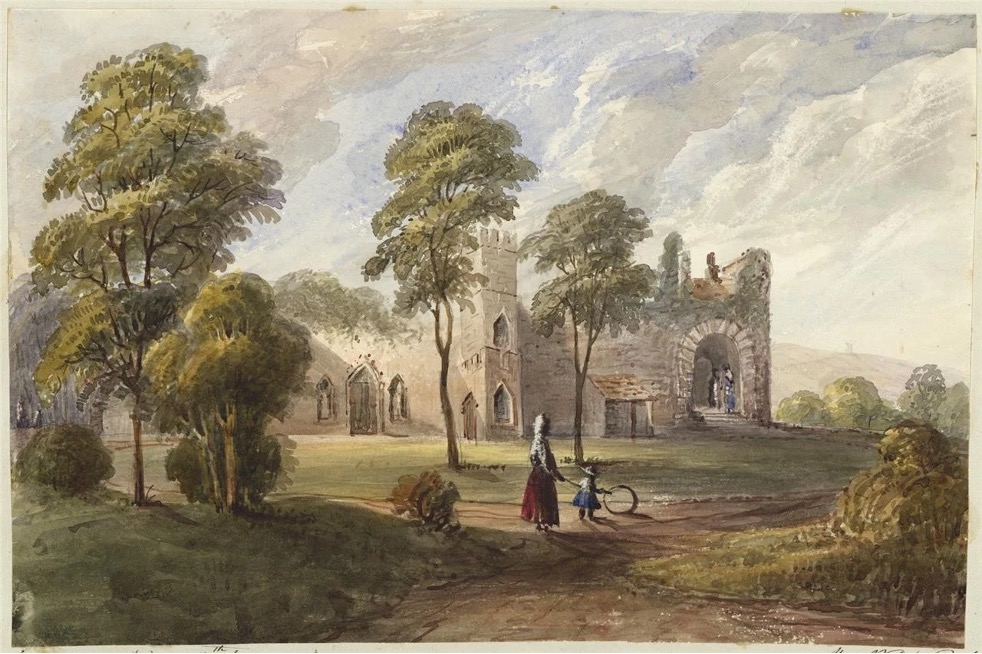
Mary Webster does not appear in the catalogues of exhibiting Victorian artists, but she seems to have been a talented and prolific amateur. Three albums of her watercolours painted between 1838 & 1850 were sold by the auctioneers Lyon & Turnbull for £6,300 in June 2025, and these watercolours come from them. The Lyon & Turnbull catalogue includes a brief biography.
Mary Webster was the eldest of 11 children born to John Webster, minister at Inverarity, near Dundee, and his wife, also Mary. After John’s death in 1807 the family moved to London. They appear to have continued to live together. The address that Mary provides in one album, 24 Brook Street, was also the address of her eminent brother John Webster MD FRCP FRS (1794-1876), who devoted much time and labour to the examination of lunatic asylums, prisons, and medical institutions at home and abroad’ [Royal College of Physicians, online]. A collection of Mary’s watercolours is held by Edinburgh Libraries, who remark that ‘the census records indicate that Mary was a lady of independent means, single, living in a household with her mother and grown-up siblings with servants’. This would support the evidence that she was able to travel widely and pursue her painting pastime. She was described in her family as a woman who was talented, travelled widely, and wrote and painted ‘en plein air’. The albums were consigned to auction by a family member.
9. The mail must get through
In the early hours of a dark November Friday morning in 1873 the Hawkhurst mail cart, scheduled to arrive at Lewes at ten minutes past five, was galloping down the Broyle when it collided with one of the timber waggons belonging to Messrs Chatfield of Lewes, also on the road at that early hour. It was the lighter mail cart that came off worse – its body was detached from its wheels, and it was completely disabled.
Luckily neither Cootes, the driver, nor his horse suffered serious injury. He extracted his bags of letters and papers from the stricken vehicle, slung them about his body, mounted his steed and completed his journey to Lewes as fast as he could. He arrived at his depot at ten past six, just an hour late.
Source: 28 November 1873 Hastings & Bexhill Independent
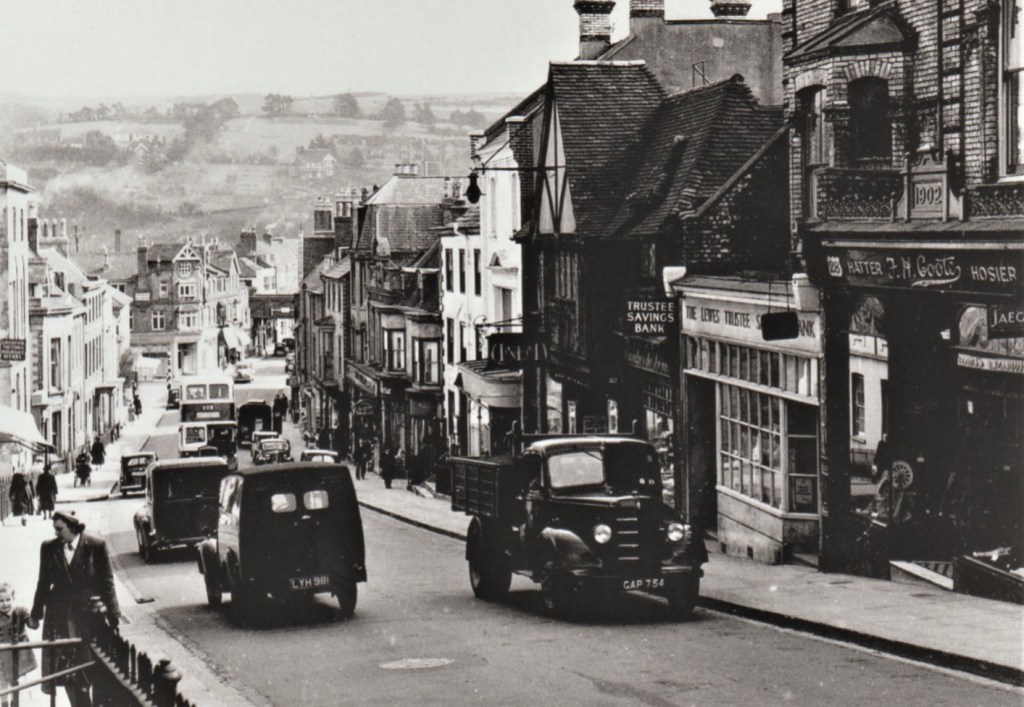
10. Two way traffic on School Hill There is no date attached to this photograph showing two-way traffic on School Hill, but the vehicles and the pedestrians’ attire suggest somewhere about 1950. The Cinema de Luxe, the Lewes Trustee Savings Bank and F.H. Coote, gents’ outfitters, at 25-28 High Street all match the entries in my 1951 local directory. The Seveirg building stands on the corner of Eastgate Street, and the Uckfield Railway line still crosses the High Street.
John Kay 01273 813388 johnkay56@gmail.com
Contact details for Friends of the Lewes History Group promoting local historical events
Sussex Archaeological Society: http://sussexpast.co.uk/events
Lewes Priory Trust: http://www.lewespriory.org.uk/news-listing
Lewes Archaeological group: http://lewesarchaeology.org.uk and go to ‘Lectures’
Friends of Lewes: http://friends-of-lewes.org.uk/diary/
Lewes Priory School Memorial Chapel Trust: https://www.lewesprioryschoolmemorialchapeltrust.org/
Facebook: https://www.facebook.com/LewesHistoryGroup
Twitter (X): https://twitter.com/LewesHistory



 Lewes History Group