Lewes History Group: Bulletin 178, May 2025

Please note: this Bulletin is being put on the website one month after publication. Alternatively you can receive the Bulletin by email as soon as it is published, by becoming a member of the Lewes History Group, and renewing your membership annually

1.    Next meeting: 12 May 2025, Debby Matthews, ‘The Station Street Story’
2.    Lewes Conservation Area Advisory Group (by David Attwood)
3.    Volunteer Archivist needed, Chailey Heritage (by Sharon Attfield-Davis)
4.    Mystery House identified (by Douglas Dodds)
5.    Did the arrival of the Railway benefit Lewes? (by Chris Grove)
6.    Drowned in the Ouse (by Sue Berry)
7.    Postcards of Landport (from Charlie Freeman)
8.    Ladies Hockey
9.    Lewes Tennis Club at the Priory
10.  Priory Crescent by Robert Taverner
11.  Lewes Borough Council’s response to the new NHS

1.    Next Meeting               7.30 p.m.          King’s Church       Monday 12 May 2025        Debby Matthews           The Station Street Story

At this talk Debby will share some of the information she has found out on this street, one of the main thoroughfares through the middle of Lewes. She will paint a picture of a thousand years of what was originally St Mary’s Lane, and given the name Station Street only on the arrival of the Victorian railway station at the bottom of the hill. Debby’s book on Station Street in the Lewes Street Stories series is scheduled for publication later this year. 

The book and the talk will provide an insight into the many shops, businesses, public institutions, manufacturers and social changes as they were experienced in this part of Lewes. They give us a picture of how ordinary people lived and worked over the years. This is a culmination of research begun over 15 years ago with a series of public exhibitions. Debby, who lives in the street, is grateful to all the many people who have helped by sharing their photos and stories.

Admission is free for members and there is no need to reserve your place. Everyone is very welcome, but there is an entry charge of £4 for non-members, with tickets available in advance via Ticketsource.co.uk/lhg.

The talk by Ruth Thomson on ‘Grown in Lewes’ that had to be cancelled in March has been rescheduled for 7.30 pm on Tuesday 3 June, and will be held at King’s Church. We apologise for the change of day, but the venue is not available for another Monday at this notice.

2.        Lewes Conservation Area Advisory Group   (by David Attwood)

The Lewes Conservation Area Advisory Group (CAAG) is looking for one or two new members. It was founded in 2009 to help protect and enhance the town, with a special focus on its two Conservation Areas. Our volunteer members include people with professional architecture, surveying and town-planning experience, as well as from heritage groups like the Georgian Group and the Victorian Society. CAAG’s core activity is meeting monthly to discuss and advise on new planning applications. If you have relevant interests or experience and would like more details about what we do, please contact the Chair, David Attwood on mail@davidattwood.plus.com.

3.      Volunteer Archivist needed, Chailey Heritage  (by Sharon Attfield-Davis)

The Chailey Heritage Foundation, founded in 1903 by the visionary and dedicated Grace Kimmins, is seeking to recruit a volunteer archivist.

With a rich and inspiring history, the charity has been a pioneer in supporting disabled young people, developing innovative fundraising methods, and even caring for injured soldiers during both World Wars. Our legacy also includes strong connections with the Royal Family and a lasting impact on the community. If you have a passion for local history, storytelling, and organisation, this could be the perfect role for you!

What You’ll Do:

  • Organise and catalogue important charity records, documents, and photos
  • Help digitize materials to make our history more accessible
  • Preserve the stories of the people and projects that have made an impact
  • Work closely with our team to ensure our history is celebrated and remembered

This is a flexible role that can be fitted in around work or other commitments.  The archiving will be mainly on site but much can also be done from home.  It may sometimes be helpful to visit the Keep in Brighton. If you would like to arrange a visit and find out more about volunteering at Chailey Heritage Foundation, please contact the Volunteer Coordinator on 01825 724444 ext 402 or 07909 234187.  Email volunteering@chf.org.uk

4.         Mystery House identified                                         (by Douglas Dodds)

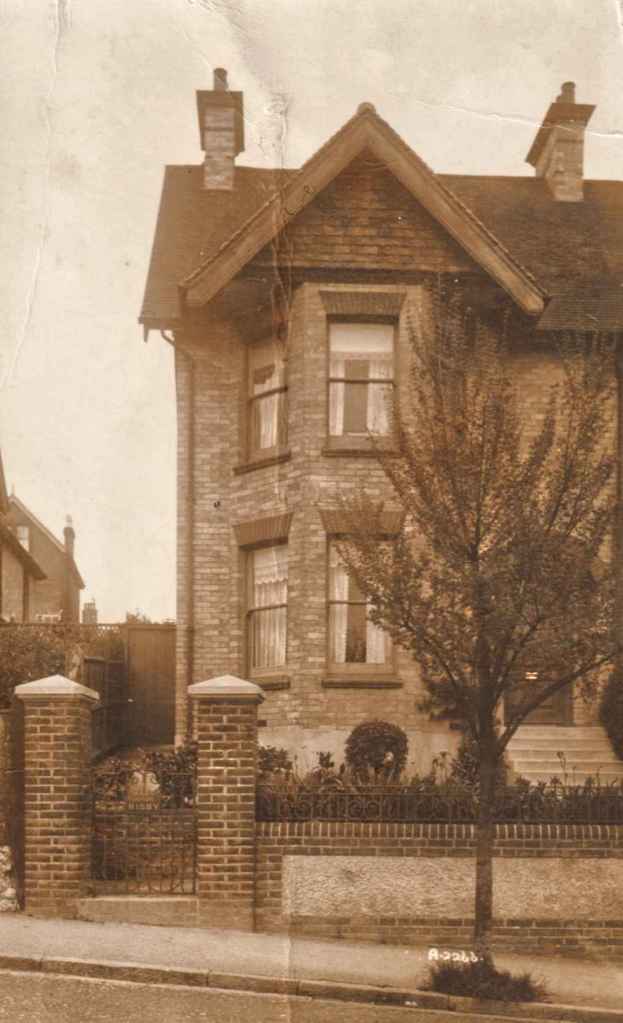
The mystery house shown in Bulletin No.175 seems to be 59 The Avenue, Lewes – see the image below from Google Street View. At some point someone has demolished part of the garden wall to insert a small shed where the original front gate was. They’ve relocated the entrance pillars and reduced the length of the wall as a result.  The postcard even shows the beginning of the flint garden wall of the house next door, still visible on Street View. The house itself looks much the same – you can still see details such as the slightly fancy chimneys, the top of the downpipe and the tiles above the bay window. The tree on the postcard obscures the archway over the front door, but that’s just about visible too.

Postcard View

Google Street View

5.         Did the arrival of the Railway benefit Lewes?        (by Chris Grove)

LHG Bulletin no.177, in referring to the Victorian & Edwardian Lewes course, concluded that there is “very clear evidence that the arrival of the railway did not lead to the growth and increased prosperity of Lewes that was seen in many other communities, locally and nationally. Indeed, the rapid growth of Georgian Lewes was curtailed once the railway arrived.” My own research presents a less black and white picture as the following graph, which shows the percentage change in population between each census for both Lewes and Brighton, indicates:
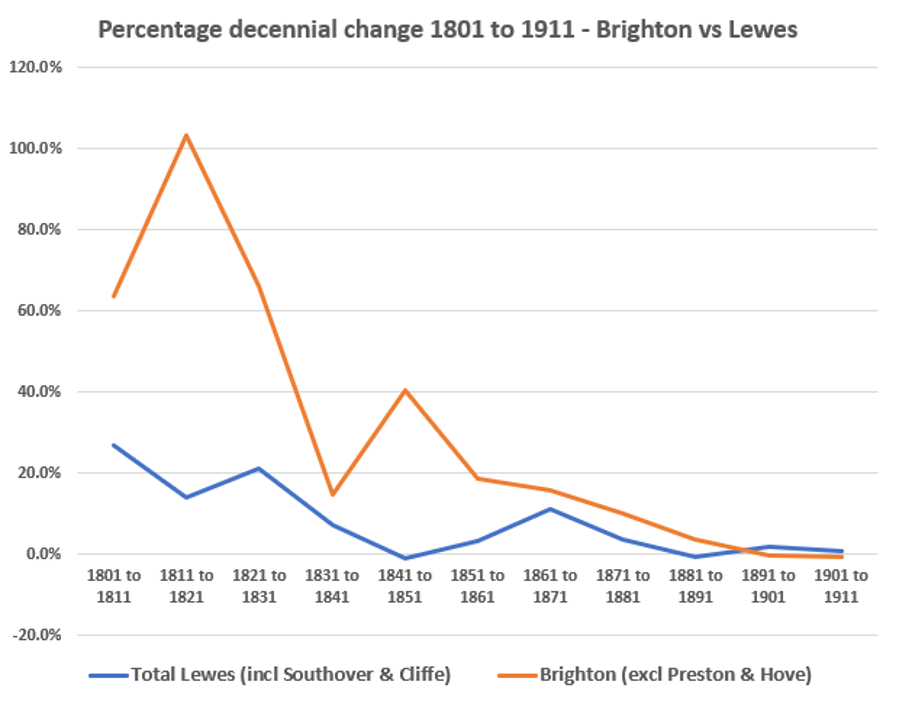
As can be seen, both towns flourished in the early nineteenth century with Brighton’s royal patronage and, being a seaside resort, allowed its growth to far outstrip the population growth in Lewes. However it is evident that the rate of population growth declined in both towns and had stagnated by the start of the twentieth century. The rate of growth for Brighton more than doubled between 1841 and 1851, the decade following the arrival of the railway, but then again slowed. For Lewes, the railway network that centred on the town, was constructed over a 12 year period from 1846. The graph shows that the rate of growth in Lewes’s population accelerated over this period before also declining from 1871.

What is clear is that both towns were expanding in terms of accommodation (for example, the number of inhabited properties in Lewes grew by 70% between 1841 and 1911) but population was growing far more slowly (for Lewes, the population grew by just 20% between 1841 and 1911). While both towns were expanding in terms of property, something was causing a slowdown in population growth. I would argue that it was increased prosperity that was causing this slowdown in population growth. As the residents of Brighton and Lewes became more affluent, along with rest of Victorian England, they wished to live more comfortably:

  • Residents wanted more space and were less inclined to sublet spare rooms (in Lewes, the number of households per property, including those for lodgers, fell by 18% over the 60 years to 1901);
  • Residents were less inclined to employ live-in domestic staff (in Lewes, the number of domestic staff per household fell by a third over the 60 years to 1901 as more day staff were employed);
  • As mortality rates improved, particularly for children, residents reduced the number of children they would have;
  • Shopkeepers and merchants were less inclined to live at their places of business and purchased more comfortable properties elsewhere in town.

The impact of these trends is best evidenced by comparing the average number of residents per property in Lewes in 1841 of 5.6 persons per property to 4.4 persons per property by 1901. It is also interesting to examine the rate of population growth in Lewes by parish. The following graph compares the growth rate in Brighton with a selection of the parishes of Lewes.
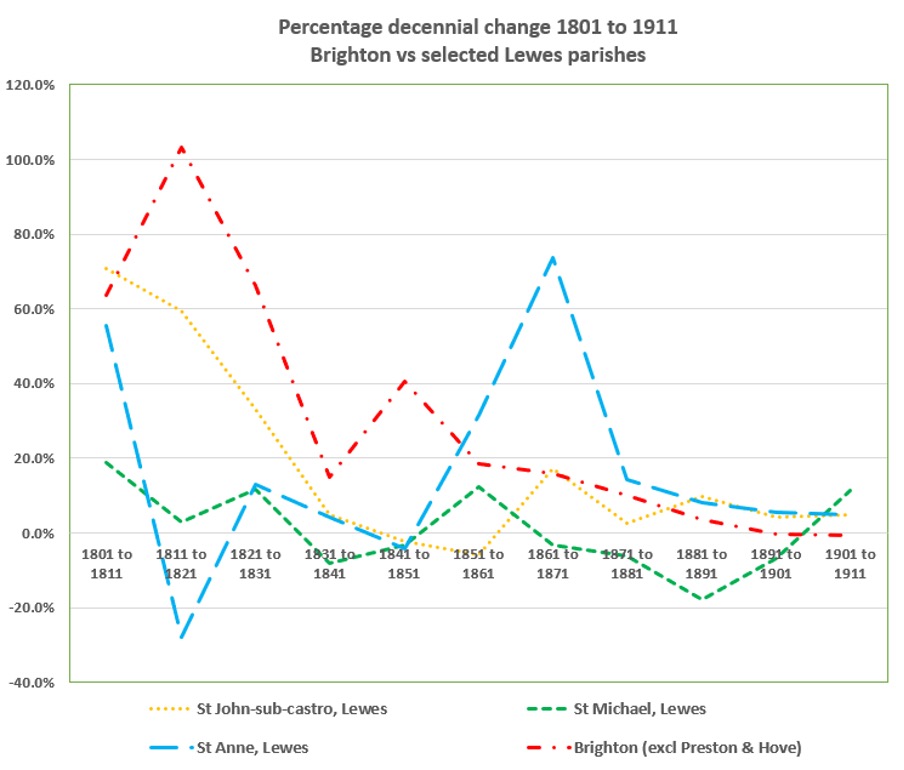
What is most striking is the rate of population change in the parish of St Anne which, by 1871, was growing four times faster than the rate of growth in Brighton. More modest growth can be seen for St John-sub-Castro but its growth was matching and then out-pacing the rate of growth for Brighton at that time.

The parish of St Michael is also interesting as its population fell by 14% over the 60 years to 1901 when the number of inhabited properties in the parish barely changed and then grew again between 1901 and 1911. The explanation is that there was no new building with the small parish of St Michael until a large meadow was sold for development and became St Swithun’s Terrace in the first decade of the twentieth century.

I would conclude that there is evidence that the coming of the railway to Lewes did contribute to growth in terms of population and the construction of houses but only where expansion was possible. However, I accept that there is less evidence of the railway bringing new businesses to Lewes but there is some (e.g. Russell & Bromley). There is also clear evidence that the building of new properties in Lewes is constrained by a number of other factors:

  • Parishes such as All Saints and St Michael are relatively small with limited scope for new building other than demolition and rebuilding or until green spaces are sold for development;
  • The Downs and flood plains constrain development in Southover and Cliffe;
  • There are historical sites throughout Lewes where, even in Victorian times, restrictive covenants prevented construction;
  • In contrast to the above constraining factors, the largest parishes of St Anne and St John-sub-Castro expanded rapidly to the west and less rapidly to the north as the town grew.

The following is an annotated (additional white text) version of the 1831 Lewes Borough boundary change map showing the parish boundaries:

6.         Drowned in the Ouse                                        (by Sue Berry)

A coroner’s inquest held on 24 July 1801 found that James Lempriere, going into the Ouse at South Malling to bathe, was drowned accidentally. As the inquest was so close to Lewes the coroner charged only the basic fee of £1. For inquests held further afield he also charged travelling expenses.

Drownings in the Ouse and other bodies of water occur regularly in the coroners’ records, and not all of them were accidental.

Source: East Sussex Coroners’ Records 1688-1838, Sussex Record Society volume 89 (2005), edited by R.F. Hunnisett, case 130.

7.         Postcards of Landport                   (images from Charlie Freeman)

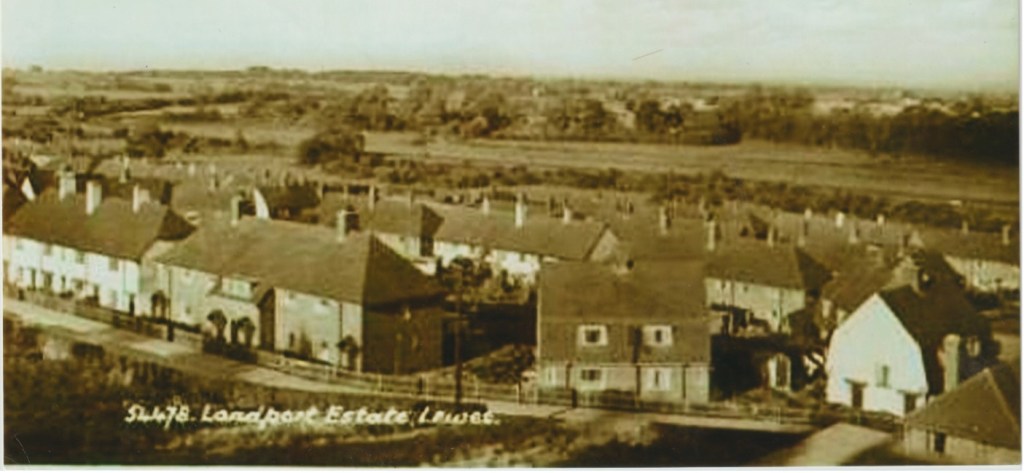
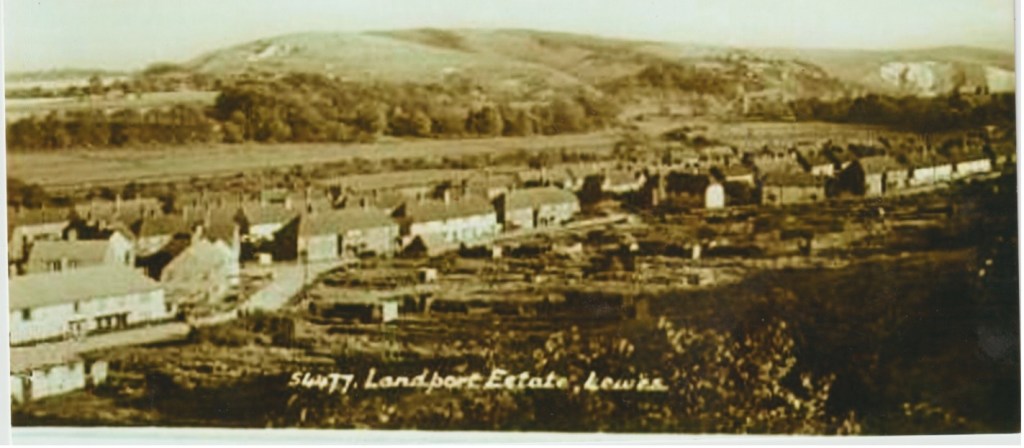
The three images below are photographic copies of three postcards of the Landport Estate that appear to have been taken after the completion of the pre-war phase 1 but before the addition of the prefabs soon after the end of the war. I have cropped most of the sky from the images below. Bob Cairns has identified the publisher as Kent photographer E.A. Sweatman.

8.         Ladies’ Hockey

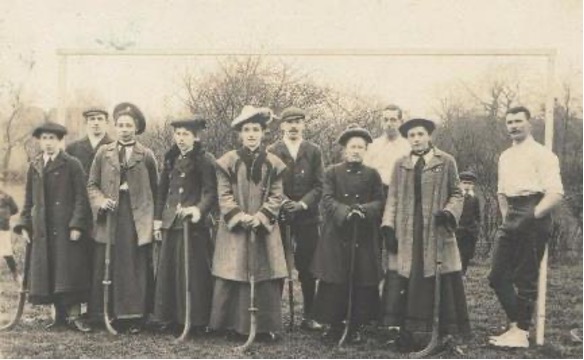
This postcard by an anonymous publisher featuring a ladies’ hockey team was mailed from Lewes to Miss F. Kenward, Hamsey Place, Hamsey, in March 1904. It was offered for sale on ebay.
9.         Lewes Tennis Club at the Priory

This postcard by an anonymous publisher shows a busy afternoon at the Lewes Tennis Club, down by the Priory. The two older ladies in the foreground appear engaged in a game of croquet. Hats were worn for both games.

10.      Priory Crescent by Robert Taverner

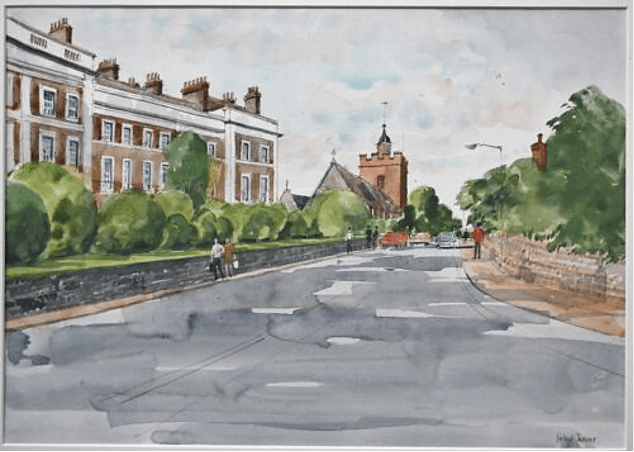
This 45 x 30 cm watercolour of Priory Crescent, with Southover church in the middle distance, was painted, probably in the 1980s, by Robert Taverner (1920-2004). Born in London, he taught for over 25 years at Eastbourne College of Art and Design, retiring as vice-principal in 1980. He was a regular exhibitor at the Royal Academy and at Glyndebourne. A retrospective exhibition of his work was held in Eastbourne in 2010. This painting is believed to date from the 1980s. It was recently offered for sale at £245 (or best offer) by a private seller on ebay.
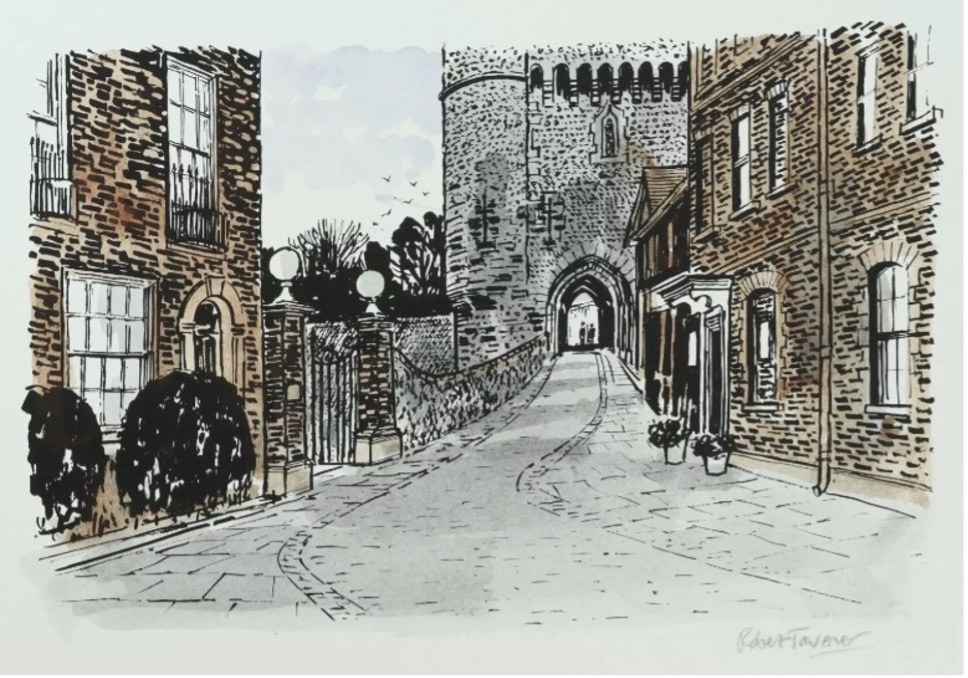
Also offered on ebay at £75 by the same seller, whose stock includes a number of the artist’s works, was this hand-coloured lithograph by the same artist of the view up to the Castle barbican.
11.      Lewes Borough Council’s response to the new NHS

In February 1944 the wartime coalition government announced, in Command Paper 6502, their intention to establish a comprehensive, ‘free for all’ National Health Service. The service was to be designed to cover the whole field of medical advice, including attention at home, in the consulting room, hospital or sanitorium for everything from minor ailments to major diseases. It was to include the ancillary services of nursing, midwifery and, ultimately it was hoped extended to dentistry, ophthalmology and mental health treatment. The cost of the new Health Service was to be borne partly from central funds, partly from local rates and partly by the contributions of the public from a new scheme of social insurance.

Lewes Borough Council had already established a Post-War Development and Housing Sub-Committee to plan the post-war future of the town. Its initial plans, published in June 1944 (the same month as D-Day), included:

  • the provision of the right amount of high-quality housing to remedy the shortage that had arisen from the cessation of building operations during the war, which they estimated at 1,800 new homes in the decade after the war;
  • improved sewers and surface water drainage;
  • new, brighter, streetlights;
  • new public conveniences at the Market Tower, Westgate Street, Nevill Crescent and Western Road;
  • demolishing the Fitzroy Library, and replacing it by a modern library building of twice the size on the same site;
  • the creation of a new public abattoir;
  • road improvements including the demolition of most of the north side of the High Street to create a new A27 dual carriageway that would leave St Michael’s church on an island between the two carriageways;
  • the provision of over 100 acres of new public open space; and
  • the acquisition of Southover Grange gardens to accommodate a new swimming bath and additional car parking.

Their report included detailed designs and specifications for many of these projects, and they were all fully costed.

It was left to this forward-looking body to respond to the new government proposals to establish the NHS. It had already identified as an issue “the inadequacy of proper modern maternity and child welfare and general health treatment facilities available to the townspeople of Lewes”, including the provision of a new health centre (for which they offered a detailed design) and a new maternity centre, the latter to be located on the Victoria Hospital site.

They thus warmly welcomed the coalition government’s intentions, as detailed in the White Paper. They expressed the hope, however, that individual local authorities would be consulted in the framing of the general plan for their area.

John Kay                                   01273 813388                         johnkay56@gmail.com

Contact details for Friends of the Lewes History Group promoting local historical events
Sussex Archaeological Society:  http://sussexpast.co.uk/events
Lewes Priory Trust:  http://www.lewespriory.org.uk/news-listing
Lewes Archaeological group:  http://lewesarchaeology.org.uk and go to ‘Lectures’
Friends of Lewes:  http://friends-of-lewes.org.uk/diary/
Lewes Priory School Memorial Chapel Trust:  https://www.lewesprioryschoolmemorialchapeltrust.org/

Facebook:   https://www.facebook.com/LewesHistoryGroup            
Twitter (X):   https://twitter.com/LewesHistory

Posted in Lewes, Local History, Social History, Uncategorized | Tagged , , , , | Comments Off on Lewes History Group: Bulletin 178, May 2025

Lewes History Group: Bulletin 177, April 2025

Please note: this Bulletin is being put on the website one month after publication. Alternatively you can receive the Bulletin by email as soon as it is published, by becoming a member of the Lewes History Group, and renewing your membership annually

1.    Next meeting: 31 March 2025, Ruth Thomson, ‘Grown in Lewes’
2.    Victorian & Edwardian Lewes
3.    Prince Edward’s Road Street Story project
4.    Changes planned at Harvey’s Brewery
5.    Royal Birthday Salutes
6.    Default at the Stag
7.   The Pells in postcards
8.    Southover Manor School (by Chris Grove)
9.    Duncan Grant’s view of the South Malling Chalkpits
10.  Cliffe Bridge by Phyllis Robinson
11.  Monday Night at Janet’s (by Sally Howard)

1.    Next Meeting               7.30 p.m.          King’s Church       Monday 31 March 2025
Ruth Thomson              Grown in Lewes

Following the publication of ‘Grown in Lewes’ last November, Ruth Thomson, one of its co-editors, will expand upon two of the topics that she researched and wrote about. One is the history of Elphick’s, the well-loved (and much-missed) family-run seed merchant and garden shop, that traded in Cliffe High Street for more than 150 years; the other is the rise and fall of the early 19th century Leighside estate, which has been partly incorporated into today’s Railway Land Nature Reserve. Ruth will recount how its owner, Burwood Godlee, left his mark on the Cliffe area of Lewes – having a hand in the building of several of its key landmarks. Ruth will also explain where the idea for the book came from and who has been involved.

Tony Elphick outside the shop

Part of the gardens at Leighside

This will be the first of our live events for 2025. Free admission for members and no need to reserve your place. Non-members are very welcome, but there will be a small admission charge.

2.        Victorian & Edwardian Lewes

Health & Social Care project group: Four members of this new group have now met to plan our research on this subject.  Our next meeting will be at the Keep where we will begin our hunt for the documents relevant to our study.  We hope to uncover lots of fascinating details about public health, medical doctors, hospitals and social policy, especially about provision for the poor.  We are also interested in changes in social attitudes throughout this period. 

We are, of course, open to more ideas and hope that others will join us. Please email Ann Holmes [annholmeslewes@yahoo.co.uk].

Education project group: This is a promising area, and in the introductory course we thought we could see a fairly clear trend. In late-Georgian and early-Victorian Lewes there were a plethora of small and diverse private schools in the county town, some taking pupils from the Lewes market area, but others recruiting from much further afield, indeed across the empire. Some were day schools, others mainly or entirely for boarders. There seemed, however, to be rather a shortage of educational opportunities for the town’s poorer children.

By 1914 education had been compulsory for all for over 40 years, and many of today’s primary schools had been established. There were also more advanced opportunities for able children. However, many of the private schools had disappeared from the town – perhaps migrated to other communities on the coast.

It would be very useful to document this trend in more detail, and it should not be too challenging. We have excellent collections of local directories for the town, both in Lewes Library and at the Keep, and many schools ensured their schools featured regularly in the local press. Do we have any members who would be interested in taking part in this project, and in particular do we have a volunteer group coordinator? Please contact johnkay56@gmail.com.

Businesses project group: The introductory course also provided very clear evidence that the arrival of the railway did not lead to the growth and increased prosperity of Lewes that was seen in many other communities, locally and nationally. Indeed, the rapid growth of Georgian Lewes was curtailed once the railway arrived. A likely explanation is that the arrival of the railway facilitated the importation of cheaper factory-made goods, at the expense of local artisan production. Businesses that had both manufactured and sold products to local customers became just retailers, and employed fewer staff.

In addition many of the businesses that survived this initial impact were in fields where the trend was towards larger and larger scale operations, examples including the towns mills and breweries. Lewes was perhaps too small a base, and the local businesses either closed in the face of competition or were taken over by larger rivals based elsewhere. With the exception of the Phoenix Ironworks, no new mega-business developed that was based in the town.

This area offers a whole host of opportunities for more detailed work on particular trades or professions – the professions and trades such as printing and publishing being of particular importance to a county towns. We have several people interested in specific topics in this area, and Chris Grove has developed an impressive overview, but we don’t yet have a formal group.

3.         Prince Edward’s Road Street Story project

Are you interested in joining others to create a Street Story for  Prince Edwards Road? Two LHG members, Barbara Abbs and Ana Kirby, both residents of Prince Edwards Road, are interested in exploring the facts and figures as well as the history and stories that have resulted in the present day Prince Edwards Road. Whether you live in Prince Edwards Road or would just like to be part of this exploration please contact Ana via ana.kirby2@icloud.com.

4.         Changes planned at Harvey’s Brewery

In new proposals to the South Downs National Park Authority John Harvey & Sons plan to convert 1-2 Cliffe High Street into a new public house; to convert the present John Harvey Tavern in Bear Yard into a visitor centre; and to convert some former office and ancillary space within the brewery itself into new visitor accommodation.

1-2 Cliffe High Street, about half a century ago

Sources: Planning applications SDNP/25/00909, /00928 & /00929; image of 1-2 Cliffe High Street from Ian Freeston.

5.         Royal Birthday Salutes

The 24 August 1798 Kentish Weekly Post and Canterbury Journal included a report from Lewes that on 20 August the Park of Artillery at Ringmer and the 2nd Battalion of Grenadiers at Lewes barracks had formed up together and fired a royal salute and vollies in honour of the birthday of the Prince of Wales.

The 12 June 1815 Sussex Advertiser reported that the Ordnance stationed at Ringmer, near this town, had fired a royal salute in honour of the birthday of His Majesty. By 1815 King George III was permanently unwell, and the Prince of Wales had become the Prince Regent. The Ringmer artillery company were lucky to have only ceremonial duties to perform – less than a week later many of their contemporaries were fully engaged at the battle of Waterloo.

6.         Default at the Stag

The 7 March 1848 Sussex Advertiser noted that debtors whose cases were to be heard at Lewes County Court on 3 April included Richard Eager, late of the Stag Inn, North Street, Lewes, licensed victualler who had also been licenced to let out horses.

7.         The Pells in postcards

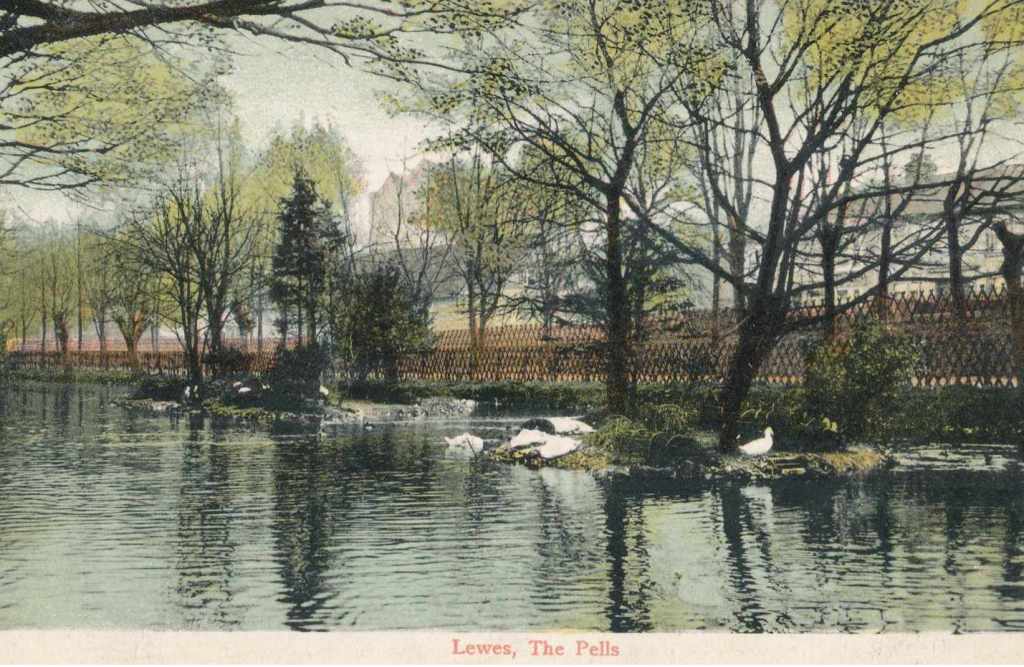
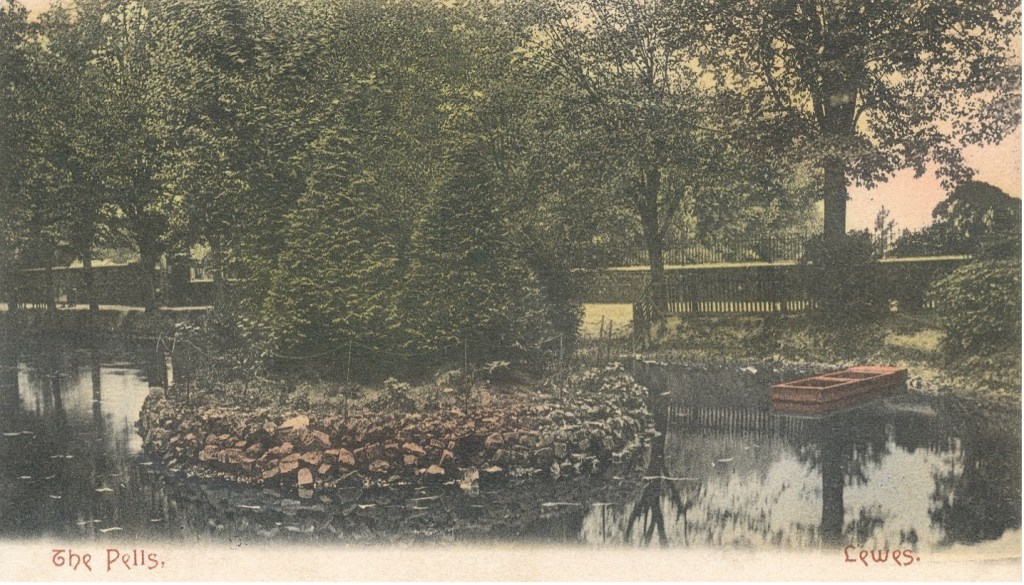
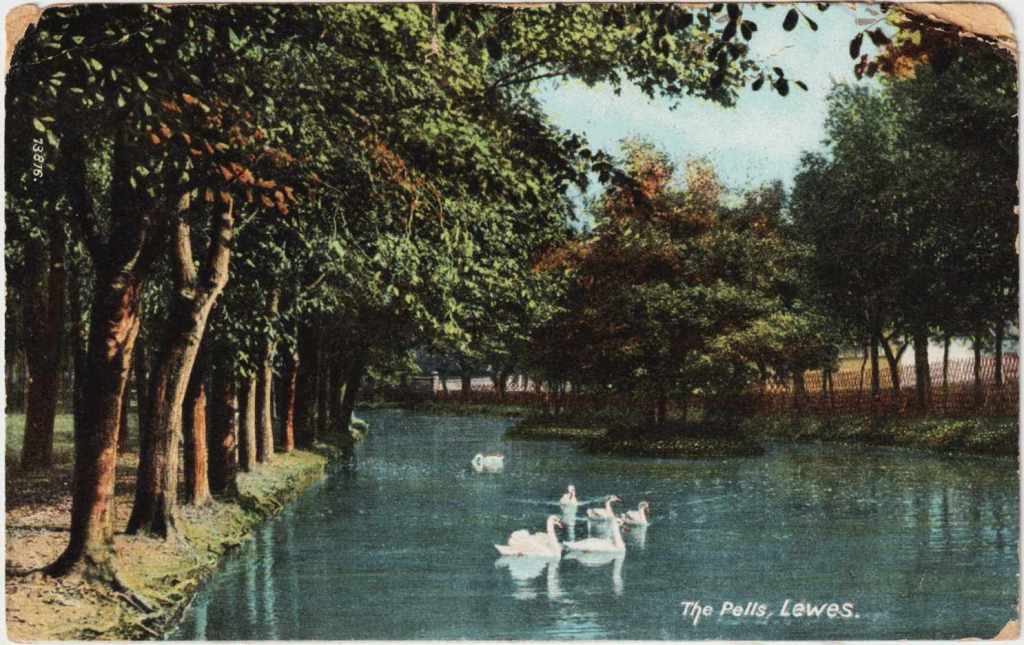
The establishment of the Pells as an area of parkland surrounding water bodies once used to power the paper mill has been fully described in ‘The Pells of Lewes’, edited by Ruth Thomson & Sarah Bayliss and published by the Lewes History Group in 2020. Their importance in the town’s recreation in the first quarter of the 20th century is well illustrated by the large number of picture postcards of the area published in this period. The majority of these postcards are hand-coloured – a laborious process in the days before colour photography. Below are some examples of these postcards, showing where townsfolk and visitors would gather, walk, and feed the ducks and swans.

The islands would provide safe havens for wildlife, though a safety perhaps undermined by the punt shown in the second postcard above.

Swans and ducks feature in a good number of these postcards.

The majority of the postcards shown above date from the Edwardian era, but the final Photochrom Company postcard is from immediately after the Great War.
Our thanks to Charlie Freeman, who provided several of the postcards shown above.

8.         Southover Manor School                                   (by Chris Grove)

It seems fitting that Lewes had an educational establishment like Southover Manor School centuries after its Priory was lost. Before the Dissolution and the Reformation, the English aristocracy and landed gentry sent their daughters to Catholic convents. While that practice continued in Europe, in now-Protestant England, an alternative was needed. Governesses were employed to educate girls at home and the debutante system evolved to allow girls to find ‘a suitable partner’.

By the beginning of the 20th century, the diminishing availability of governesses resulted in the establishment of exclusive girls’ boarding schools. Southover Manor School was founded in 1923 at Undercliffe House, a turreted Gothic house built by architect James Berry in 1865, visible through woodland from School Hill and Cliffe; it was owned by Lord Monk-Bretton, the school’s principal sponsor. Themain driving forces were Beatrice Malcolm, the first headmistress, and parents who wanted a better education for their daughters.

By 1925, the school had 21 students, including eight boarders, and moved to the roomy Southover Manor and grounds, rented out by Frank Verrall on a 14 year lease for an annual rent of £300. By 1930, the school was listed in The Public Schools Yearbook (now The Independent Schools Yearbook)alongside Eton, Harrow, and Charterhouse, where, no doubt, the girls’ male relatives had long been educated. During its 60-year history, the school’s most famous pupil was Camilla Shand, now Queen Camilla, daughter of Major Bruce Shand, the vice Lord Lieutenant of East Sussex with a country estate at Plumpton. She started at the school, aged 11, in 1958 but soon moved to Queens Gate School in London.

To maintain its reputation as an exclusive school, Southover Manor School required fine premises, and attractive grounds and facilities. As pupil numbers rose, the school expanded its premises, purchasing Southover Old House in 1929 – formerly a large private house with an extensive lawn, a mature mulberry tree, well-stocked flowerbeds, and a greenhouse/ conservatory.

Over time, the school bought further buildings, including the Malt House, Southover Manor House itself and a number of properties along the south side of Southover High Street for boarders. A large two-storey annexe was built alongside the Manor House. This housed the administrative offices, including the office of the headmistress, the dining hall, and further classrooms. The school estate had many established trees, a swimming pool, tennis courts and playing fields for hockey and lacrosse.

The School Gardener: In 1954, at the Lewes and District Horticultural Show, the-then school gardener J. H. Reynolds, swept the board. He won four trophies,14 first prizes, seven second prizes, and three third prizes out of 350 show entries. He won the President’s Trophy for the most first prizes, the Champion Perpetual Challenge Bowl for the most points in all classes, the Chrysanthemum Cup, and the Jubilee Perpetual Cup for the highest points in monthly meetings and the annual show.

The School’s decline: The manor site and its many sprawling properties were never ideal for a boarding school, despite its extensive grounds and playing fields. A ministerial inspection in 1966 emphasised the inappropriateness of the buildings for education and deemed the capital programme to address the issues as beyond the means of the school. The school had faced closure in 1962, and again in 1966, but was saved by friends and parents, after the limited company was converted into a charitable trust. In the early 1980s, the school sold Southover Old House, and Southover Cottage as the first stage in securing more appropriate premises. But in 1983, the school governors agreed to close the school. The sale proceeds were used to establish a new charitable trust, the Southover Manor General Educational Trust, a grant-giving body now supporting schools and other educational organisations serving the young people of Sussex and, occasionally, the education of individual Sussex-based young people.

The school finally closed in 1984 and its properties and contents auctioned in 1985. The financial difficulties had taken their toll on the gardens, and the grounds became a temporary car park for local residents until redevelopment.

Sources: Photocopy of various pages on the history of Southover Manor School (with thanks to East Sussex and Brighton and Hove Record Office at The Keep) [ESRO AMS 6799-15-2 ] The Schools Of Lewes c13th to c21st by Brigid Chapman; Sussex Agricultural Express, 05 November 1954; https://southovermanortrust.org.uk/about-us/; Southover Manor School photographs archived by the Friends of Lewes [ESRO ACC 7987-13-1].

9.         Duncan Grant’s view of the South Malling Chalkpits

This picture of the South Malling chalkpits by the River Ouse was painted by Charleston resident Duncan Grant (1885-1978). Painted in about 1933 in oil on board, it is in the collection of the Leicester Museum & Art Gallery.

10.      Cliffe Bridge by Phyllis Robinson

This acrylic painting on board of Cliffe Bridge by Phyllis Robinson is offered for sale on ebay by a private seller. Also offered was a still life by the same artist. The artist’s viewpoint appears to have been on the bridge at Phoenix Causeway.

11.      Monday Night at Janet’s                                           (by Sally Howard)

The 19 November 1948 Sussex Express reported that Lewes now had a new literary circle, meeting at
8 p.m. on Monday evenings in Janet’s Tea Rooms and sponsored by the local branch of the Liberal Party. The aim was to foster literary appreciation, and use the winter months to attract all tastes for talks and informal discussions as monthly ‘Monday Nights at Eight’. After its first meeting the Monday Literary Club had a membership of 30.

At the first session experts at many branches of the pen had thrashed out a wide variety of questions on the subject. Mr F. Masters was question master of this Brains Trust and the team consisted of Miss Ruth Cobb, the well-known illustrator, Miss K.O. Morgan, history specialist at Southover Manor School, Mr Richard Finlay, a short story writer, and Mr Ian Parsons, a publisher.

The questions included the necessary ingredients for a best-seller; whether book reviewers should reveal the plots of the books they reviewed; and why women wrote better thrillers than men. They also considered wartime poetry and novels, and whether modern fiction was of a higher standard than that written a century ago. They also recommended fairy tales for children.

John Kay                                   01273 813388                         johnkay56@gmail.com

Contact details for Friends of the Lewes History Group promoting local historical events
Sussex Archaeological Society:  http://sussexpast.co.uk/events
Lewes Priory Trust:  http://www.lewespriory.org.uk/news-listing
Lewes Archaeological group:  http://lewesarchaeology.org.uk and go to ‘Lectures’
Friends of Lewes:  http://friends-of-lewes.org.uk/diary/
Lewes Priory School Memorial Chapel Trust:  https://www.lewesprioryschoolmemorialchapeltrust.org/

Facebook:   https://www.facebook.com/LewesHistoryGroup            
Twitter (X):   https://twitter.com/LewesHistory
Posted in Lewes, Local History, Social History, Uncategorized | Tagged , , , | Comments Off on Lewes History Group: Bulletin 177, April 2025

Lewes History Group: Bulletin 176, March 2025

Please note: this Bulletin is being put on the website one month after publication. Alternatively you can receive the Bulletin by email as soon as it is published, by becoming a member of the Lewes History Group, and renewing your membership annually

1.    Next meeting: 10 March 2025, Jonathan Vernon, ‘The Friendly Invasion of Lewes’
2.    Victorian & Edwardian Lewes: Health & Social Care (by Ann Holmes)
3.    Janet’s Tea Rooms (by Sally Howard)
4.    The story of Anne of Cleves House (by Sue Berry and Jane Vokins)
5.    Bonfire troubles
6.    An Errand Boy’s punishment
7.    The last public execution at Lewes Prison (by Chris Taylor)
8.    Edward Brummitt, Lewes photographer
9.    No one recognised this house
10.  A Royal Field Artillery Camp, near Lewes

1.    Next Meeting               7.30 p.m.            Zoom        Monday 10 March 2025
       Jonathan Vernon          The Friendly Invasion of Lewes

This month the speaker of our last Winter Zoom meeting will be Lewes Town Councillor Jonathan Vernon whose topic will be the impact on Lewes of the 10,000 men of Kitchener’s New Army, who included a number of Caribbean troops and Jewish units, billeted in and around the town during the early months of the Great War.

Members can register without charge to receive a Zoom access link for the event at: https://us02web.zoom.us/webinar/register/WN_9GytjwX-R0qRZDfMG8bYsA#/registration.

Non-members can attend via Ticketsource.co.uk/lhg (price £4.00).

Please note that our April meeting, our first live event for 2025, will actually be held on Monday 31 March: Ruth Thomson will be speaking on ‘Grown in Lewes’

2. Victorian & Edwardian Lewes: Health & Social Care   (by Ann Holmes)

Four members of our new Health and Social Care project group have now met to plan our research on this subject.  Our next meeting will be at the Keep where we will begin our hunt for the documents relevant to our study.  We hope to uncover lots of fascinating details about public health, medical doctors, hospitals and social policy, and especially about provision for the poor.  We are also interested in changes in social attitudes throughout this period.  We are, of course, open to more ideas and hope that others will join us. 

3. Janet’s Tea Rooms        (by Sally Howard)

Some of the questions following my January talk to the Lewes History Group concerned the location of Janet’s Tea Rooms, regularly visited by my grandmother while she was a nursery nurse at Glyndebourne in 1942. A photograph showed the café near the top of School Hill.

However, I have since discovered from an advertisement in the Sussex Express that in 1944 Janet’s Tea Rooms moved from 205 High Street (where my grandmother would have known it) to 195 High Street (further up School Hill, and just down from Aylward’s Corner). The advertisement notifying customers of the move included a warning note: “Mrs Martin wishes it to be known that she has no connection with any business which may be carried on at the old premises”.                

4. The story of Anne of Cleves House        (by Sue Berry and Jane Vokins)

In 1923 ‘Anne of Cleves’ House (then also known as The Porched House) in Southover, Lewes was conveyed to the Sussex Archaeological Society (SAS) by Frank Verrall. In 1928 he added to his gift the malt house behind the house, now the Every Building. This article is a short survey of the history of the house and the former malthouse  as we see them today. It also asks what the best future might be for this interesting but inevitably expensive to maintain property. Anne of Cleves became a listed building in 1952 and is now Grade II*. The idea of protecting buildings of interest by listing them was developed as part of the 1947 Town and Country Planning Act and has proved effective. The majority of listed buildings are homes or in commercial use. Resources for the study of the property are at the end of this article.

The house was part of Anne’s divorce settlement of 1540, when Henry VIII offered a generous deal which included property as sources of income for her. They included the Priest’s House (which the Society also owns) and the Clergy House at Alfriston (now owned by the National Trust).  Anne was given Hever Castle, taken from the Boleyn family, and royal residences at Richmond and Bletchingley as her residences. Henry VIII supplemented her income with cash gifts. Anne became his ‘sister’ so that her position at court was clear.  She proved to be a very capable survivor in the challenging world of the Tudor court and became a wealthy woman. It is very unlikely that she ever visited her house in Lewes which would have been managed by her steward as part of her property portfolio. Towards the end of her life, without the patronage of Henry VIII her income was reduced but she remained wealthy. When she died in 1557, Queen Mary I ensured that Anne was buried in Westminster Abbey as a former wife of Henry VIII.

The house given to Anne as part of her divorce settlement stood at the street end of a generous plot of land sloping down to the Winterbourne which still flows (Fig.1).  Today part of Southover Primary School stands on the former grounds.  This former girls’ Grammar School was built when that land was sold in 1910 by the Verrall family. More of the gardens, to the east, were used in 1825 by the Verralls to build two pairs of attractive semi-detached villas.

Anne would not have recognised the house we see today had she visited it.  By 1540, the oldest part was a large, rectangular timber-framed hall house which replaced the older house in the later 1400s. Below the hall house remained the small, barrel-vaulted undercroft of the 13th or 14th century which is still there. This house had a parlour and chamber at the west end of the building, then a hall where we see it today, then a cross passage running from the street to the back gardens. On its eastern side, service rooms stood between the passage and the cart entrance or store we see today with a chamber or loft above. This was the property Anne was given with its generous grounds.

When Anne died in 1557 the house was sold to or reverted to John Stempe who had been on the payroll of Lewes Priory. He sold it to Robert Saxpes a member of an affluent local farming family. Robert and then John Saxpes altered the house in the later 1500s and early 1600s (during the reigns of Queen Elizabeth I and King James I). This is when the major changes took place. When John died in 1608 the freehold capital messuage or mansion house with barns, stable, garden and great orchard adjoining was inherited by his daughter and co-heiress who married a merchant who lived in Southover. By the 1620s, the family moved to Cliffe the suburb of Lewes on the east side of the river Ouse.   

Meanwhile, the west bay of the old hall house was demolished by the Saxpes c.1600 and rebuilt taller and as the front of a wing. This not only enlarged the house but also made the west end look more important, emphasizing the end where the family lived. The wing extends along Potters Lane overlooking the small garden used at present as a coffee shop. The two storied ‘false porch’ which juts out of the front was built by John Saxpes c.1599. It provided an entrance lobby for the house; new windows were also inserted into this street facade. The upper part of the porch may have been rebuilt during the 1920s restoration. The initials on the porch are IS for John Saxpes.  It was known as The Porch House by 1825.

From then on, changes were made without enlarging the house.  In the eighteenth century (1700s) the wagon entrance became a room and the height of the first floor was reduced.  Tiles were hung on the principal elevations and the ground floor of the front rebuilt.

The site had a succession of owners until 1781 when the Verrall family bought it. By then there was a malthouse, stables and a wood house and the house was in multi-occupancy. The property continued to be subdivided until the Verrall family sold it. In 1841, there were four households headed by a labourer, a labourer and his wife, a gardener with his wife and daughter, and a maltster with his wife and daughter. By 1851 there were six households, three on poor relief. The multi-occupation continued until after 1901 but by 1910, the house was occupied by three people. The shop was still in use. When Frank Verrall gave the House to the SAS in 1923, the three occupants were allowed to complete their tenancies.

Drawing by RH Nibbs (1816-1893) showing the house in multiple occupancy.


Two doors are inserted either side of the main entrance, signs of which are visible today.


The date of this drawing is unknown but Nibbs produced drawings like this from the 1850s.

Undated image showing the door in the west wing. The next door is hidden (see Nibbs above) but after the porch then we see the other door shown by Nibbs plus the shop entrance and window. From the internet, source unknown but will be acknowledged if anyone can identify it.

To help the house function as a museum, the west wing was altered in the 1920s by W.H. Godfrey, a well-known architect with an interest and expertise in working on historic buildings.  So, it joins Michelham Priory where the Tudor wing was badly damaged and rebuilt in 1927 after a very serious and well-documented fire, and Lewes Castle and many other old buildings open to the public which have been altered and repaired to the extent that we have to be cautious about how we promote them.  With the proliferation of interesting historic sites open to the public, there is the additional problem of whether the property is well located and distinctive enough for visitors to go and then recommend it to others.  Many do not fulfil these criteria and do not flourish. 

By 1650, a malthouse stood to the north of the house, beside Potters Lane, and it remained in use until the early 1850s. In 1858 the malthouse was used as an agricultural machine manufactory and in 1910 it was described as a builders workshop. Bought by Frank Verrall in 1928, it was given by him to the SAS. As the Every Wing, it was adapted by Mr. Godfrey to house fire backs and other iron goods made in the Weald of Sussex collected by Mr. Every. 

Anne of Cleves House and the malthouse was given to the SAS at a time when many older properties were thought to be under threat and were cheap to buy. They were often taken without an endowment in the expectation that tourism would pay for the building’s upkeep. But the trustees have to make the building earn its full keep from tourism without the numbers required damaging what people come to see. This is an issue for smaller buildings and gardens such as Anne of Cleves, Priest House and Clergy House. They also have rivals in open-air museums such as the Weald and Downland at Singleton north of Chichester where houses such as Bayleaf give a good impression of life during the same period.

The well-intentioned belief that tourism will pay the costs of maintaining an old building is misplaced. In spite of looking as if it has a healthy bank balance, the National Trust struggles with the costs of building maintenance, because opening up old buildings can reveal issues that are not obvious even with the use of modern non-invasive checks. Many of the smaller properties donated to organisations such as the SAS were given before and after the First World War when they were regarded as unsuitable for occupation in a world wanting to have warmer, better lit houses with running water during a time when a mass-produced modern house, particularly in the interwar suburbs, offered more comfort. The older houses were not protected by listing because it did not exist at that time.

From the generosity of those wanting to keep these places, they became early museums and due to their rarity for a while, a novelty. But as time passed and other places opened with stronger identities and maybe more space around them, those that lack strong identities and central locations lost public interest and now struggle to cover their costs. There is also the issue that it is not in the best interest of small fragile buildings to bear the impact of the tourist numbers needed as running costs increase.

Domestic use with the protection of listing, which many now have, has proved effective, aided by the growing appreciation of the value of historic buildings in town and country. Historic buildings improve the quality of urban landscapes and their rarity now enhances their value as properties to own, complications arising from their accumulated layers of history notwithstanding.  For a house like ‘Anne of Cleves’ is good care as a listed historic home (or home and business) the best plan for it now?  If it remains a museum, then how will the site be effectively cared for and the displays revised to encourage people to return and to recommend it? Will people who enthuse over keeping the house open be willing to underwrite repairs?  Grants are not easily obtained and in a shrinking economy, small heritage sites will find attracting visitors even harder than they do now.

Sources: The estimate for the balance and number of early listed buildings is from A. Emery ‘Introductory Reflections after greater medieval house of England and Wales’ in M. Airs and P. Barnwell (eds), ‘The Medieval Great House’, Shaun Tyas, 2011, 2; Historic Royal Palaces website, type in ‘Anne of Cleves’; Colin and Judith Brent’s Lewes House Histories; East Sussex Record Office (The Keep) HBR/1/1655, David and Barbara Martin, Anne of Cleves, Southover High Street (David and Barbara Martin, 2007);  S. Berry and G Sheppard, ‘Cultural Heritage sites and Their Visitors: Too Many for Too Few?’ in G. Richards (ed) ‘Cultural Attractions and European Tourism’ (CAB International 2001), 159-171; Resources and images collected by Jane Vokins.

5. Bonfire troubles

The 19 January 1784 Sussex Advertiser reported the proceedings at the recent East Sussex Quarter Sessions:
“At the above sessions a bill of indictment was preferred against several persons for aiding and assisting in making a bonfire in the Cliffe on 5th November last; and it is rather extraordinary that one of them is a woman, and servant to a Reverend Doctor.”

6. An Errand Boy’s punishment

At the July 1860 Midsummer Quarter Sessions held in Lewes errand boy Obed Stevens, aged 12, was convicted of embezzling several small sums of money received on behalf of his master George Peter Bacon of All Saints, Lewes (publisher of the Sussex Advertiser). For these crimes he was sentenced to one month’s hard labour in Lewes gaol, and then to be sent to the Reformatory School at Redhill for 4 years.

The 1851 census finds him aged 3 in North Street, in the large family of journeyman carpenter William Stevens and his wife Winefred. By 1871 this Lewes family had moved to Tonbridge, where his father had become an upholsterer. Obed was with them again, now an unmarried tailor aged 24. The Reformatory School records note him as “discharged to his friends in Tunbridge”. However, undiscouraged by Obed’s poor start, two of his younger brothers aged 21 and 19 had both become printers.

Sources: 5 July 1860 Brighton Gazette; FindMyPast website.

7. The last public execution at Lewes Prison          (by Chris Taylor)

A murder: On the evening of 1 February 1866, John Leigh, aged 27, walked into the parlour of the Jolly Fisherman Inn in Market Street, Brighton and, without saying a word, shot the landlady, Harriet Horton, twice with a Colt revolver. He then ran outside and shot at Brighton Police Superintendent Barnden, who happened to be passing, before being overpowered and taken into custody. Mrs Horton died a few hours later.

A motive: Harriet Horton was Leigh’s sister-in-law. He and Mary, his wife of a year, lived at no.8 St Ann’s Terrace in Lewes and were unhappily married. She had recently left him and gone to live with her sister Harriet in Brighton, refusing Leigh’s frequent pleas to allow him to see her and persuade her to return. Leigh blamed Harriet’s influence for these refusals and had confronted her several times over the preceding days, she on one occasion calling him ‘a thief, pirate and murderer’. The next evening he took his revenge.

A culprit: John Leigh’s back-story makes extraordinary reading. He was the illegitimate son of a Brighton gentleman ‘holding a very respectable position’, whose wife, somewhat unusually, agreed to take John in and bring him up as her own and only child. He soon began to indulge in wild habits however, and was a constant source of trouble to his parents. Aged 17, he joined the Royal Navy and served in the Crimea campaign. He narrowly escaped death when his ship was wrecked in a storm in the Black Sea, corroborating the old adage that those who are born to be hanged will never be drowned. He then served in China during the Second Opium War, receiving several severe wounds, which he bore with pride and would readily exhibit whenever requested. After that he claimed to have sailed on board the celebrated Confederate cruiser, the Alabama, which involved him in further daring exploits.

On returning to Brighton, he took over the Oddfellow’s Arms in Queen’s Road but the business soon failed. He then moved to Brentford, where the magistrates refused him a licence to run another pub, upon which he vandalised the premises and was sentenced to three months in gaol. Back in Sussex, he took up residence in Lewes and married Mary Whiteman at St Ann’s Church in February 1865. Nicknamed Captain Leigh, he became locally notorious, keeping a fast trotting mare and frequenting the smoking room of the Pelham Arms. According to the newspapers, he “took delight in little else but smoking, hard drinking, fast driving, and the company of the lowest members of the sporting fraternity.”

A trial: John Leigh appeared at Lewes Assizes on 22 March 1866, charged with murder and shooting with intent to inflict grievous bodily harm. His defence was that he was not in a sane condition of mind at the time, but it rested entirely on evidence that he had on two previous occasions suffered attacks of delirium tremens, resulting from drinking ardent spirits to excess.  Not surprisingly, Chief Justice Erie was unimpressed and dismissed the claim. The jury convicted Leigh without retiring and Erie sentenced him to death. Mary was in court during the whole trial, but left just before the sentence was pronounced.

Leigh is said to have exhibited indifference to both the verdict and the sentence, even laughing as he went down the stairs leading from the dock. However, after the trial he adopted a more solemn demeanour, spending a lot of time with the Rev. Burnett, the prison chaplain. He received holy communion for the first time in his life on the Monday before his execution. No one visited him except his mother and two of his former companions at Brighton, whom he exhorted to “abandon idle and vicious courses”. Mary made an application to visit, but he refused to see her.

A hanging: Shortly after midday on 10 April 1866, John Leigh mounted the scaffold erected against the south-east side of the prison wall. He surveyed the crowd calmly. The executioner, in adjusting the rope, found removing the prisoner’s shirt collar difficult and Leigh told him to tear it. The formalities were completed, the drop fell, and Leigh died after a short struggle. His body, after hanging an hour, was cut down and buried the same day in one of the corridors of the gaol.

An immense concourse of spectators’ gathered to witness John Leigh’s execution, the first in Lewes for 10 years. Many came in by train from Brighton. Newspapers across the country carried a description of the spectacle in terms expressing considerable distaste:

 “… among the crowd were a great many apparently respectable-looking young women and girls, many of whom had infants in their arms … the general appearance exhibited was that of persons who were out for a holiday, and who were enjoying the exhibition that had been provided for them. After the execution had taken place boys … assembled together in groups, exhibiting to each other how (it) was accomplished … joking and laughing upon the subject. Very few indeed … appeared to realise that a fellow-creature had but the moment before been violently deprived of life for a dreadful crime.”

Lewes Prison c.1900

A change in the law: Capital punishment was the subject of much discussion in the mid-1860s. A Royal Commission reported in December 1865 on the range of crimes for which the death penalty should be imposed and the manner in which it should be conducted. A minority favoured outright abolition, but the majority recommended retaining death sentences carried out behind prison walls. Accordingly, the Capital Punishment Amendment Act of 1868 abolished public execution, too late to save John Leigh. A further 100 years were to pass (slightly more in N. Ireland) before the entire grisly ritual, euphemistically referred to as ‘the last sentence of the law’, disappeared altogether.

Sources: 23 March 1866 Dublin Evening Post; 27 March 1866 Sussex Advertiser; 11 April 1866 Morning Herald (London); 14 April 1866 Bury Free Press; Image – Gravelroots.net.

8. Edward Brummitt, Lewes photographer

David Simkin, the expert on Sussex photographers, contributed an article to Bulletin no,129 about Edward Brummitt, a Lincolnshire man, who in 1891 established a short-lived photographic studio at 84 High Street, almost directly opposite to Edward Reeves’ business. The article included an account of his life, and showed one of his cartes de visite (CdV).

In February a new pair of Lewes CdVs appeared on ebay, one by Edward Reeves showing an older gentleman, identified on the reverse as ‘Grandpa Moorey’ and the other by E. Brummitt identified in the same handwriting as ‘Grandma and a grandchild’. The reverse of the Brummitt CdV appears identical to the one shown in Bulletin no.129. Edward Brummitt’s surviving photographs are so rare that he does not currently have an entry in David Simkin’s ‘Sussex Photohistory’ website.

9. No one recognised this house

Sadly no one recognised this bay-windowed semi-detached house, shown in the last Bulletin.

The image, showing a late-Victorian or Edwardian semi-detached or end-terraced house, with formal gateposts and a flint & brick front garden wall on a road planted with new trees, has an air of the Wallands about it.

The image comes from a postcard by an anonymous publisher that was mailed from Lewes to a family friend in September 1913. There is, however, no clear evidence that the house itself was actually in Lewes.

10. A Royal Field Artillery Camp, near Lewes

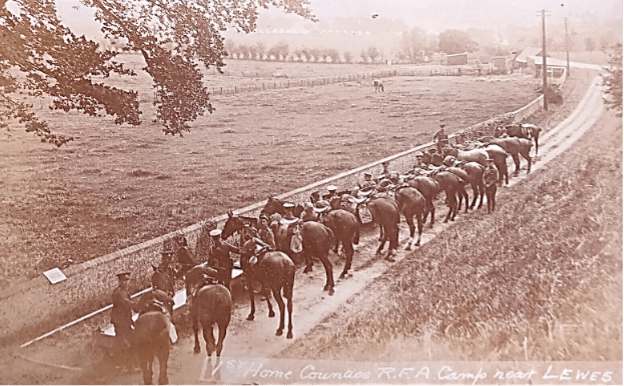
This postcard view titled ‘1st Home Counties R.F.A. Camp near Lewes’ looks as if the location ought to be easily identifiable, but I can’t work out where it was taken. Can you help?

John Kay                                             01273 813388                                       johnkay56@gmail.com

Contact details for Friends of the Lewes History Group promoting local historical events

Sussex Archaeological Society:  http://sussexpast.co.uk/events
Lewes Priory Trust:  http://www.lewespriory.org.uk/news-listing
Lewes Archaeological group:  http://lewesarchaeology.org.uk and go to ‘Lectures’
Friends of Lewes:  http://friends-of-lewes.org.uk/diary/
Lewes Priory School Memorial Chapel Trust:  https://www.lewesprioryschoolmemorialchapeltrust.org/

Facebook:   https://www.facebook.com/LewesHistoryGroup            
Twitter:   https://twitter.com/LewesHistory

Posted in Lewes, Local History, Social History, Uncategorized | Tagged , , | Comments Off on Lewes History Group: Bulletin 176, March 2025