Posted inUncategorized|Comments Off on February Zoom talk – It started with a tooth: Gideon and Mary Ann Mantell and the discovery of Iguanodon, led by Chris Duffin – Monday, 10th at 7.30 pm.
Please note: this Bulletin is being put on the website one month after publication. Alternatively you can receive the Bulletin by email as soon as it is published, bybecoming a member of the Lewes History Group, and renewing your membership annually
1. No August meeting 2. Christmas 2024 meeting 3. Heritage Open Days, 13-15 September 2024 4. The First Lady of Lewes Priory 5. Baxter’s Illustrated Guide to Lewes 6. John Shelley’s copy of Benjamin Franklin’s Essays 7. The King’s Arms, North Street 8. Charles Dawson of Castle Lodge 9. The Phoenix Workman’s Institute 10. Lewes Arms prints (by Mathew Homewood)
1. No August meeting
As usual, we have not planned a meeting for August. Our next Monday evening meeting will be on Monday 9 September.
2. Christmas 2024 meeting
We are planning a rather different format for our Christmas meeting this year, on Monday 9 December. Instead of a single long talk, we shall have a series of short presentations in which members will introduce us to specific Lewes heirlooms that have come into their possession. We already have three volunteers, who will be telling us about a timepiece made in Lewes, a bottle made for a Lewes wine merchant and an 18th century book printed and published in the town. We are seeking two or three further presentations of a similar nature – no more than 10 minutes per item. Please contact johnkay56@gmail.com.
Our Christmas meeting this year will, although in our winter Zoom period, be a live meeting at which we shall be offering mince pies and mulled wine to those members who arrive in time.
3. Heritage Open Days, 13-15 September 2024
This year’s Heritage Open Day weekend, run by the Friends of Lewes, will be from Friday 13 to Sunday 15 September. There will be free access to fourteen different buildings, some with special tours, and five different guided walks.
Lewes History Group will once again be taking part. You can find us throughout the Saturday and Sunday at Lewes House on School Hill. We will have on display an exhibition of members’ recent research and a selection of our publications for sale.
The event is preceded by a talk from Marcus Taylor at 7.30 p.m. on Tuesday 20 August 2024 in Eastgate Church Hall in which he will preview some of this year’s highlights. Places for the talk are available both live and on Zoom – free to members of the Friends of Lewes but available to others at a cost of £4 if you book through TicketSource. For details see www.friends-of-lewes.org.uk.
4. The First Lady of Lewes Priory
Bulletins no.128 & 163 recorded that when Lewes Priory was dissolved in 1538 its prior and monks were despatched to other duties or pensioned off, and the Priory itself was acquired by Thomas Cromwell. He promptly ordered the destruction of the Priory itself and the creation of a new mansion suitable for the residence of his newly-married only son Gregory. There is some uncertainty about Gregory’s date of birth – the online History of Parliament reports he was born before 1516, but Wikipedia thinks not until about 1520. The former seems more likely, as he was studying at Cambridge in the late 1520s.
Cromwell’s initial 1536 plans to establish a dynasty for his son had envisaged a Norfolk base, but the strong influence of the Duke of Norfolk in that county persuaded him to look elsewhere, and by late 1537 he had acquired Lewes Priory as an alternative. He wasted no time, with the huge Priory church demolished within weeks. Gregory & Elizabeth Cromwell and their baby son Henry arrived to take up residence in March 1538, and in her letter from that time included in Bulletin no.163 Gregory’s wife Elizabeth declared herself well pleased with their new home. Gregory Cromwell became a Sussex JP, alongside his father’s courtier-colleague Sir John Gage.
The Cromwells were not to remain in Lewes long. In 1539 Thomas Cromwell succeeded to the vacant post of constable of Leeds Castle, the previous constable having been executed and forfeited his post. Gregory & Elizabeth and their family were installed there in March 1539, after just a year in Lewes, and the Lewes premises were leased. His father forced Gregory, still a very young man, on Kent as one of the county’s two MPs, which displeased the Kent elite. He was not to remain long in Kent either.
Thomas Cromwell’s plans for his own retirement were based on his seat at Launde Abbey in Leicestershire, another monastic property that he had acquired. Those plans were of course dashed when in the summer of 1540, after the Anne of Cleves debacle, Cromwell himself fell foul of the tyrant he served and was executed. His properties were seized, and the Lewes estate became part of Anne of Cleves’ generous divorce settlement. Launde Abbey was eventually restored to Gregory & Elizabeth by King Henry VIII, with Gregory becoming the 1st Lord Cromwell. He attended the House of Lords in the 1540s, without making any great mark. He lived at Launde Abbey until his death in 1551 aged just over 30, and he is buried there in an elaborate tomb. He is believed to have died of the ‘Great Sweat’, which was rampant in that year.
Who was Elizabeth Cromwell, Gregory’s wife who had declared herself satisfied with her Lewes home? She is thought to have been born about 1518, one of ten children of the soldier and courtier Sir John Seymour. Her elder sister Jane (c.1509-1537) was a maid of honour to Queen Catherine of Aragon, and later the third wife of King Henry VIII, who died shortly after giving him the son that he craved, the future Edward VI. Thus at the time of Elizabeth’s marriage to Gregory Cromwell she was Henry VIII’s sister-in-law (for the few months until her sister’s death), and aunt to Edward VI.
Two of Elizabeth’s brothers also became courtiers who played prominent roles in England’s Tudor history. Edward Seymour (c.1500-1552) rose rapidly through the peerage to become the 1st Duke of Somerset. After the death of Henry VIII he became Lord Protector to the young Edward VI, his nephew. He was however forced out in 1549 and finally executed by his rival Northumberland in 1552. His younger brother Thomas Seymour (c.1508-1549) married Henry VIII’s widow Catherine Parr, who the king had left as one of the wealthiest women in England. He also famously dallied with the teenage Princess Elizabeth, who resided in their household. His numerous political intrigues, mainly against his brother, led to his execution in 1549.
If Elizabeth Seymour was indeed born about 1518, she cannot have been more than about 12 when she first married. Her first husband was the soldier Sir Anthony Ughtred (c.1478-1534), who was forty years her senior, and at the time Governor of Jersey. This seems unlikely to have been a love match, but she bore him two children, a son Henry born in Jersey in 1533-4 and a daughter Margery born about 1535 after her first husband’s death in Jersey, and after Elizabeth had returned to England.
Thus when Lady Elizabeth Ughtred married Gregory Cromwell in August 1537 she was probably still a teenager, though a widow with two young children. He was, in marked contrast to her first husband, close to her own age. They had been married only three months when her sister the queen died, and it was soon after this that they came to live briefly in Lewes. They had five children between March 1538 and 1545, three sons and two daughters. Her eldest son from this marriage was, like the eldest son of her first marriage, called Henry.
Thomas Cromwell’s sudden downfall in 1540 reduced at a stroke his dependents such as Gregory and his family from extreme wealth and influence to poverty. In one of Cromwell’s final letters to the king, beside pleading his innocence, he writes “I most humbly beseech your most gracious Majesty to be a good and gracious lord to my poor son, the good and virtuous lady his wife, and their poor children”. Elizabeth Cromwell herself, doubtless advised by her elder brother Edward, also wrote directly to her brother-in-law:
“After the bounden duty of my most humble submission unto your excellent majesty, whereas it hath pleased the same, of your mere mercy and infinite goodness, notwithstanding the heinous trespasses and most grievous offences of my father-in-law, yet so graciously to extend your benign pity towards my poor husband and me, as the extreme indigence and poverty wherewith my said father-in-law’s most detestable offences hath oppressed us, is thereby right much holpen and relieved, like as I have of long time been right desirous presently as well to render most humble thanks, as also to desire continuance of the same your highness’ most benign goodness. So, considering your grace’s most high and weighty affairs at this present, fear of molesting or being troublesome unto your highness hath disuaded me as yet otherwise to sue unto your grace than alonely by these my most humble letters, until your grace’s said affairs shall be partly overpast. Most humbly beseeching your majesty in the mean season mercifully to accept this my most obedient suit, and to extend your accustomed pity and gracious goodness towards my said poor husband and me, who never hath, nor, God willing, never shall offend your majesty, but continually pray for the prosperous estate of the same long time to remain and continue”
As noted above, these pleas were successful, and Launde Abbey and a title were restored to them.
Elizabeth’s two courtier brothers were executed in 1549 and 1552, and although she had a surviving brother and sister, they do not seem to have moved in court circles. In between, in 1551, her second husband Gregory Cromwell, the 1st Lord Cromwell, also died. The period of Seymour and Cromwell influence had passed – Gregory’s eldest son became a country gentleman.
Three years after Gregory Cromwell’s death, Elizabeth married again. Her third husband was Sir John Paulet (c.1510-1576), who as eldest son to the 1st Marquess of Winchester held the courtesy title of Earl of Wiltshire. He was a widower a few years her senior, with six children by his first wife. He had no more by his new Countess, probably in her thirties when she married him. She lived with him until her death in 1568, after which he married yet again, within six months of her death, to a very well-connected third wife. Her last father-in-law was a courtier with views flexible enough to hold very senior positions in the courts of Henry VIII, Edward VI, the Catholic Mary and her Protestant sister Elizabeth. After Elizabeth’s death her husband became the 2nd Marquess of Winchester, but it was his third wife who became the Marchioness.
Blended families were common in the 16th century, due mainly to the many premature deaths, and Lady Elizabeth’s seems to have been a success. Her eldest son Sir Henry Ughtred married Elizabeth Paulet, a daughter of her third husband, and her second son Henry, 2nd Lord Cromwell, married Mary Paulet, another of his daughters. Elizabeth & Mary Paulet were thus both promoted from being her step-daughters to become her daughters-in-law.
A recent addition to my collection is a copy of a pocket-sized booklet called ‘Baxter’s Illustrated Guide to Lewes’. Cheaply-produced, and originally sold for 2d, it includes 16 standard views of the town, focusing naturally on the main attractions. The total length is 40 pages, including advertisements. It was presumably intended as a keepsake for tourists.
Like many guidebooks it does not carry a date – no one wants to buy last year’s guidebook. So how old is it? Google quickly establishes that this guide went through many editions, some as late as the 1950s, though most of those shown have a landscape format to better-illustrate the pictures. None of the street-scenes include any motor vehicles though there is some horse-drawn traffic – but then the illustrations could be considerably older than the booklet itself.
The booklet’s text provides a few clues. The population of Lewes is stated to be 10,972. Mr Charles Dawson of Castle Lodge is mentioned as having discovered the famous Piltdown Skull “quite recently”. Most of the text outlines the town’s ancient history, with the latest date mentioned being the establishment of the Lewes Victoria Hospital in 1909.
The nine pages of advertisements offer the best guide to dating, as they at least are contemporary. J.C.H. Martin Ltd, motor engineers, Cliffe Bridge, advertise on the back cover. A few advertise telephone numbers – 45 for Martin’s; 67 for Browne & Crosskey, drapers; 81 for Baxter’s the publishers; 82 for Powell & Co, estate agents; and 94 for the White Hart. Others do not.
Census records show that 10,972 was the Lewes population in 1911 – by 1921 it had fallen to 10,797. The solicitor Charles Dawson claimed to have discovered the skull of Piltdown Man in 1912. One of the advertisers is Harris & Kenward (W.E. Clark), jewellers & silversmiths, Cliffe Bridge, and that firm’s website records that Wilfred Ernest Clark came to Lewes to take over that business in 1919. The other businesses advertising all ran from before the Great War until at least 1927. It thus seems likely that this particular edition was published c.1920 – after W.E. Clark arrived in 1919 but before the results of the 1921 census became available.
6. John Shelley’s copy of Benjamin Franklin’s Essays
Offered recently on ebay was a copy of Benjamin Franklin’s ‘Life and Essays’ published in London by T. Kinnersley in June 1816. The volume included a substantial biography of the famous American polymath, much of it autobiographical, plus extracts from his will and then more than thirty of his works on topics ranging from ‘The way to wealth’ and ‘Advice to a young tradesman’ via ‘The morals of chess’, ‘On early marriages’ and ‘Dialogue between Franklin and the gout’ to ‘Description of a new musical instrument’ and ‘The best method of guarding against lightening’. The flyleaf of the volume shows that it initially belonged to John Shelley, a Lewes carrier.
Benjamin Franklin (1706-1790) was a remarkable man. Initially a printer, newspaper publisher and postmaster in Philadelphia, he became wealthy and famous as a writer, inventor, scientist, economist, educator, diplomat and political philosopher. He identified and named the Gulf Stream, and was an early researcher into electricity. At one time a slave owner, he became an active abolitionist a century before this cause eventually triumphed in America. He spent twenty years in London up to the declaration of independence as a representative of the American colonies, was a key figure in the American Revolution, and became one of the group of five men who drafted the American constitution. As the American ambassador to France from 1776 to 1785 he oversaw the close association between the two nations. His political views were regarded as radical.
John Shelley appears in John Viney Button’s 1805 directory as a carrier based in Lewes High Street whose waggons went to London and back three times per week – he had an effective monopoly in this trade for that route. From 1783 he was based at the White Horse Inn, 166 High Street, one of three houses pulled down in 1812 to make way for Castle Place. There seem to have been two John Shelleys engaged in this trade, father and son. The business survived the demolition of the White Horse, moving into the Castle Precincts at Brack Mount House. Bulletin no.134 reported that John Shelley retired from the business in favour of Joseph Shelley in 1824.
7. The King’s Arms, North Street
This image of the King’s Arms at 47 North Street (on the corner of Wellington Street) was taken by the Charrington Brewery, to which it once belonged, as part of an architectural survey of the brewery’s pubs. The photograph is now part of the National Brewery Heritage Trust collection, which is accessible online. This public house was demolished well within living memory, after a period of dereliction. The photographs in the archive are not dated.
William Thomas Pike’s ‘Sussex in the Twentieth Century’, published in 1910, contains the photographs and brief biographies of the Sussex gentry and professional classes at that date – starting with those of the Dukes of Devonshire and Richmond. A number of their mansions are also shown. Smartly bound, it was sold to its subscribers, who were also those featured, so copies were included in many of the private libraries of the day. Copies of this book, many in excellent condition, appear regularly at local auctions. W.T. Pike of Brighton was also the publisher of the many ‘Blue Book’ local directories of the period, including that for Lewes, Seaford and Newhaven
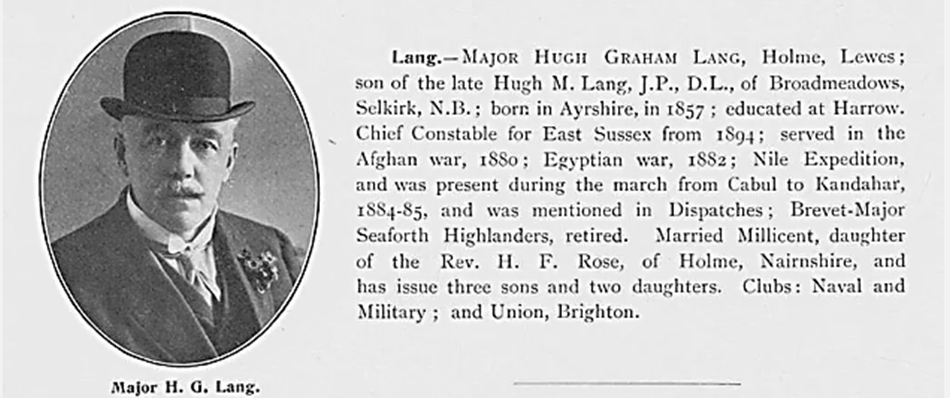
A typical entry, reproduced below, is that for the Uckfield solicitor Charles Dawson (1864-1916), who lived in Lewes at Castle Lodge. Long an enthusiastic amateur archaeologist, in 1912 he was to be the discoverer of ‘Piltdown Man’, later revealed as a hoax for which he became, posthumously, the prime suspect. Subsequent investigation of his collections and his publications have revealed that they included many examples of fakes or planted evidence, leading the academic Miles Russell to conclude from his detailed studies that the whole of Dawson’s academic career was “built upon deceit, sleight of hand, fraud and deception” with his motive being to gain academic recognition.
Charles Dawson was certainly less than popular with contemporary members of the Sussex Archaeological Society, some of whom resented the manner of his acquisition of Castle Lodge, and his displacement of the Society as its tenants. His reputation has been scrutinised in considerable detail, and perhaps with more balance, in a long article by John Farrant published in Sussex Archaeological Collections volume 151, pages 145-180 (2013).
9. The Phoenix Workman’s Institute
This institution was built and furnished in 1896 by the proprietor of the Phoenix Ironworks, for the use of employees. In addition to a large hall, there were two bath rooms and a servery for the sale of refreshments. In connection with the institute there were cricket, football and quoits teams, with the recreation ground being situated in the Paddock. Three generations of the Unitarian Every family, leading members of Westgate Chapel, ran the Phoenix Ironworks. They were, by Victorian standards, enlightened and liberal employers.
Sources: Pike’s Blue Book for Lewes, Seaford & Newhaven for 1900-1: LHGBulletins nos.112 & 155.
10. Lewes Arms prints (by Mathew Homewood)
This is a pencil drawing of the Lewes Arms that I created back in 2018. It is meticulously detailed, with almost every brick matching that of the building itself. I have now created a limited edition of 50 copies printed on high-quality thick ivory-coloured paper. The overall print is 28 x 28 cm, with the pub itself about 17 cm squared.
Most copies have already been sold, and one can be found on the wall of the front bar in the Lewes Arms itself. Copies are still available, unframed, at £45.00 each, signed and numbered. Please contact me via 01273 479467 or 07906 586726 for details.
Please note: this Bulletin is being put on the website one month after publication. Alternatively you can receive the Bulletin by email as soon as it is published, bybecoming a member of the Lewes History Group, and renewing your membership annually
1. Next Meeting: 8 July 2024, Nick Kelly, ‘Canals and Inland Waterways in Sussex’
3. Garden Street Auction Rooms (by Mary Anne Francis)
4. The escape and recapture of three Russian prisoners (by Chris Grove)
5. The Crown Hotel
6. School Hill by Norbert Sullivan Pugh
7. Lewes photographs from a holiday album
8. Leisure activities in Lewes in 1900
9. Lewes Racecourse Plan in 1903
10. Amusements in Lewes in 1852
11. A new owner for 1 Little East Street
12. Lewes History for Sale: The Old Library on Albion Street
1. Next Meeting 7.30 p.m. King’s Church Monday 8 July Nick Kelly Canals and Inland Waterways in Sussex
Before the arrival of the railways, and especially given the state of the roads across the Weald, the only practicable way to move heavy goods to and from Sussex was by boat, and Lewes owes its existence to its location on the navigable and tidal Ouse. With the onset of the Industrial Revolution the need for such transport greatly increased. The 18th century especially saw huge developments in water transport, with new canals and navigations across the country connecting mines and factories with their markets and ports. In his talk Nick Kelly will relate the Ouse Navigations upstream and downstream of Lewes in this period to other contemporary Sussex endeavours to improve the capacity and convenience of the transport of goods.
This will be a live meeting at King’s Church. There is no need for LHG members to book – simply turn up in good time for the 7.30 pm start. There is an entry charge of £4 for non-members, with tickets available via Ticketsource.co.uk/lhg.
We have a handful of places remaining available for the introductory course on Victorian & Edwardian Lewes to be held on alternate Tuesday mornings at King’s Church starting on 24 September, and led by Dr Sue Berry. This course will set the context and offer guidance for more detailed studies of particular topics within the V&E Lewes theme, but joining the course does not commit you to join any of the research projects to be established nor, if you already have the necessary knowledge, is it essential for subsequent participation. There is a course fee of £20 to cover the costs of the five sessions. Book your place at Ticketsource.co.uk/lhg.
Course sessions and topics:
Session 1: Tuesday 24 September Lewes 1837-1914, an outline of what we know
Session 2: Tuesday 8 October Population and employment
Session 3: Tuesday 22 October Worship
Session 4: Tuesday 5 November Education and leisure Session 5: Tuesday 19 November Local government and social and medical care.
3. Garden Street Auction Rooms (by Mary Anne Francis)
Lewes residents may be familiar with the two ‘tin’ huts on the site at the corner of Garden Street and Southover Road, which are also conspicuous to anyone waiting at the station, or passing through – on Platforms 1 and 2 at the London end. They are due to be removed very soon to make way for a housing development and there are plans, initiated by Cllr Edwina Livesey, supported by Lewes District Council’s Arts Tourism Manager, Helen Browning-Smith, to mark their passing. They have a fascinating history.
As the signs on the outside proclaim, the huts have links with Gorringe’s Auction Rooms, though from 2017 all their sales were at their North Street premises. The placards note too that Gorringe’s incorporated ‘Julian Dawson’ whose antiques business also ran from the huts when they were part of Lewes’ cattle market, which was located on the site from 1883 to 1992.
The present sheds were probably once the church at the North Camp, Seaford, which was used to train soldiers in the First World War. This gives them an even further reach, as the North Camp is said to have included British troops and the 1st Battalion of the West Indies Regiment.
This is, for sure, a history worth marking – but one with lots of gaps. If you have any information about the ‘huts’ – which are really more like sheds or hangars – please contact maryannefrancis@hotmail.com who is co-ordinating the research arm of the ‘huts project’. Photos, memories, any other documents – all are of interest. People working on this project, who include artist Marco Crivello, and school and college groups, are hoping to use the site’s current hoardings to tell the huts’ story. It’s possible there will be other commemorative events later in the year.
It is likely that the huts will be taken apart and stored, rather than demolished, until a site can be found where they can be reassembled – this is very much early flat-pack architecture! If you have any ideas for suitable locations in which the huts can be given a new lease of life, please contact Edwina Cllr.livesey@lewes-tc.gov.uk. See Bulletin no.143 for an account of the auction rooms under Julian Dawson
4. The escape and recapture of three Russian prisoners (by Chris Grove)
The account below appeared in the 3 April 1855 Sussex Advertiser.
“On Wednesday morning last, three of the Finns, located at the War Prison, managed to effect their escape from the building, but they were shortly after retaken. Lieutenant Mann, the governor, took a party of the prisoners the Downs for an airing, between 9 and 10 o’clock, being accompanied by the usual guard of pensioners and warders, and leaving about 100 prisoners behind, under the care of a small body of the staff. While thus left, three of the prisoners, having equipped themselves in private clothes, scaled the roof of the guard house, which reached to the top the outer wall opposite to Little East Street, and dropped themselves into the street, a depth of from 10 to 12 feet. They then very leisurely strolled down East Street, past the Railway Station, through Friars Walk, and Walwer’s Lane. They were dressed in slate coloured coats and trousers, figured waistcoats, fancy silk neckties, and cloth caps, and had very much the appearance of the German musicians that frequent this country. On their route they repeatedly addressed those whom they passed with “good morning” in broken English.
Upon arriving at the top of Walwers Lane they solicited the services of a labourer, who was passing, to conduct them to a public house, and while he was the act of complying with their request, they suddenly took to their heels owing to a circumstance explained below. It appears that the act of their dropping from the wall, was witnessed by Captain Mailard, one of their officers, who is living opposite to the spot, and it is stated that he immediately caused alarm to be given at the prison. Some of the pensioners and wardsmen lost no time in pursuing the fugitives, and were speedily joined by a great number of men and boys.
Having traced them to the bottom of School Hill, they solicited the services of the son Mr. Smith, the butcher, who was following his avocation on horseback. He at once joined in the chase and galloped off at full in speed the direction of Southover, as far as the Tunnel. Having learned that the run-a-ways had not taken that route, he retraced his steps to the bottom of St. Mary’s Lane. In the meantime, the prison guard after making enquiries at the Railway Station, with very little success, dispersed itself and went the various lanes leading to the High Street. The person who went up Dolphin Lane saw the prisoners at the top, under the escort of their obliging guide and they, perceiving that their escape had been discovered, immediately took to flight, as stated above.
Two of them ran up the High Street, whilst the other took Market Street. The mounted pursuer, who was slowly coming up St. Marys Lane, saw them enter Fisher Street and was soon by their side. Being thus closely pursued, one of them turned into a narrow passage between the Corn Exchange and some stores behind the engine house, when his course being cut off he was soon captured. His companion ran through the Star Hotel kitchen, across the entrance hall, and out of the front door. His progress, however, was soon at a close, for he had only proceeded a few yards down the town before he was in the grip of one of the pensioners.
The third run-a-way, being an expert pedestrian, and not having the disadvantages of a horseman behind him, gave his pursuers a little more trouble. He ran up the lane by Mr. Broad’s, the tallow chandler, across Market Street, and to Castle Banks, when he jumped over the fence and secreted himself, best he could, under some bushes. His pursuers consisted of a corporal of the 73rd, a greengrocer named Beck, and a host of boys, who appeared highly delighted with the chase, manifested by the earnestness with which they ‘gave tongue’.
Mr. Patch, the purser at the prison, was also on the lookout, and from the road below he spied the prisoner who was quickly taken from his hiding place. Neither of them offered the slightest resistance, and they were at once marched off to their old shop, the crowd increasing every step the way. The prison guard, as might naturally supposed, were greatly annoyed at the escape, and their vexation was not diminished by the conduct of the fugitives, who had hearty laugh over the matter, and seemed to think it a fine joke. The arrival of the governor, however, shortly afterwards, caused them to put a different face upon it, and they were once confined in separate cells, and ordered to be kept upon short rations. The only explanation they give for their conduct is that they wanted to see a little of English life, that it was their intention to have stayed in the town during the night, and surrendered the next morning.
The clothes were purchased of Messrs. Brown and Crosskey, who sell wearing apparel at the public market in the prison, but the Governor, although he allowed them to make what purchases they choose, strictly prohibited their wearing any other than their uniform. The whole circumstance, of course, has caused considerable talk in the town and neighbourhood, and, as usual, has been greatly exaggerated by rumours.
On Saturday last, a number of the prisoners were again taken upon the downs.”
5. The Crown Hotel
This postcard view of the Crown Hotel and the adjacent Market Tower by the Photochrom Company was taken in the 1920s, when H.W. Walton was the proprietor of both the White Hart Inn and the Crown.
Another postcard of the Crown in my collection with the same two gentlemen posed in front of the hotel also includes the war memorial.
6. School Hill by Norbert Sullivan Pugh
This attractive framed oil painting of School Hill signed Sullivan Pugh is currently on offer by Sulis Fine Art for £249 [see https://www.sulisfineart.com/norbert-sullivan-pugh-framed-20th-century-oil-lewes-high-street.html]. Norbert Sullivan Pugh was evidently quite a prolific artist, as Google reveals a range of broadly similar 20th century paintings of traditional landscapes and streetscapes.
The earliest record I have been able to find about him is in the 1911 census, when young Bert Pugh, aged 6 and born in Ayrshire, was living in Wandsworth, with his parents and three younger brothers. The family was evidently a mobile one. His father had been born in Wigan and his mother in Suffolk. Bert was born in Kilmarnock in October 1904, but his younger brothers were born in Fulham in November 1905, in Morningside, Edinburgh, in February 1908 and in Tooting in 1910. This may be explained by his father’s occupation, which the 1911 census describes as ‘clerk of works, tramway, London County Council’. His father’s younger brother, living with them, was a contractor’s clerk involved in sewer construction, so it may be that they moved to wherever their construction projects took them.
According to an online biography Norbert Sullivan Pugh spent much of his life in London, joining the Chelsea Art Club. He studied for three years at a building school, at 17 becoming an architectural and ecclesiastical draughtsman, church craftsman and woodcarver, afterwards designing bookplates and practising calligraphy. While owning a commercial art studio in the Strand, he spent evenings studying from life and painting and began to exhibit in the capital. He also spent some years as a commercial artist with the advertising agency J. Walter Thompson. The 1941-2 winter number of The Hippodrome noted that he had two works accepted for the R.A. Summer Exhibition, and reviewed a collection of his pictures at the Archer Gallery. He then had a studio in Buxted, Sussex. The magazine classified him as a romantic. It commented favourably on his atmospheric Downs country scenes, figure groups, portraits and still lives, and “the artist’s belief that anything is paintable that has emotional interest”. It is most likely that it was during his period in Buxted that he painted this Lewes scene. His mother and all three of his brothers were living in Kent at the end of their lives.
Pugh later lived in Cornwall, and many of his pictures are of village scenes in Devon and Cornwall. He continued to paint until he was 94, and died in 2001 in Salisbury, Wiltshire. His death was registered under the name ‘Bert Pugh’. His family was notable for its longevity. His brothers born in 1905 and 1908 died in 2001 and 2004 respectively, while his mother lived long enough to qualify for a telegram from the Queen.
7. Lewes photographs from a holiday album
These two rather grainy photographs of Lewes High Street were included in a souvenir album of Sussex photographs created, probably after a holiday, by C.W. Murray dated ‘Summer 1902’. He also visited Newhaven, Hamsey, Ditchling, Westmeston, Hurstpierpoint, Southease and Litlington.The album attracted competitive bids when offered for sale on ebay.
8. Leisure activities in Lewes in 1900
The first Pike’s Blue Book for Lewes, Seaford and Newhaven on the shelves at The Keep is the volume issued for 1900-1. The list of spare time activities noted as available in the town started with no fewer than five freemasons’ lodges. There were also the Lewes Priory Cricket Club, the Southover Cricket Club, the Lewes Football Club, the Lewes Rowing Club, the Lewes Chess Club (which met in the Fitzroy Library) and the Lewes Cyclist Club (which met in the Bear Hotel, under the captaincy of George Holman). There were also the Southdown Foxhounds in Ringmer, with their pack of 50 couples of hounds.
While women might be numbered amongst the cyclists and those riding with the hunt, it is obvious that the great majority of these activities were aimed at men. Perhaps women were not expected to have any spare time.
9. Lewes Racecourse Plan in 1903
This plan shows the layout of Lewes racecourse as it was in 1903. The disassembled print from F.H. Bayles, ‘The Race Courses Atlas of Great Britain and Ireland’ was offered for sale on ebay at £110 by Antiqua Print Gallery Ltd, 80 Scrubs Lane, London.
10. Amusements in Lewes in 1852
“The inhabitants of Lewes are too commercial in their pursuits (and, shall we add, too intellectual in their character?) to need the excitement of public amusements. The Theatre, which existed in the last age, was never well supported, and gave way at length to a Mechanics Institution. Horse-racing too has seen its best days. Lewes races were formerly – especially during the regency of ‘the finest gentleman in Europe’ – among the most notable in the kingdom, lasting three days, and bringing a number of the sporting elite, as well as a still larger band of undesirable visitors, into the town. On the single day now dedicated to the sport a Queen’s Plate of 100 guineas is still run, or walked for, as the case may be. The race-stand is in ruins, having been accidentally burnt down some years ago by a party of Lancers from Brighton.
Cricket seems at present a more fashionable amusement, and the Dripping Pan witnesses the usual amount of ‘splendid’ bowling and ‘magnificent’ batting. There is an excellent Bowling Green within the Castle precincts, to which strangers are admitted under certain regulations. During summer the South Saxon Archers hold periodical meetings at Conyboro Park, three miles from Lewes. The club is limited to the gentry.
Exhibitions and concerts frequently take place at the Corn Exchange, connected with the Star Hotel, where also the South Downs Ball is given soon after Christmas. The winter balls of the nobility and gentry take place at the County Hall.”
Source: Mark Antony Lower, ‘Handbook for Lewes’, 2nd edition (1852)
11. A new owner for 1 Little East Street
Back in July 2023 [Bulletin no.156] we noted that the grade II-listed late-18th century terraced cottage at 1 Little East Street, adjoining Eastgate Baptist Church, was offered for sale at £350K by a local estate agent.
Failing to find a buyer by the traditional route, it has now been sold by auction. According to the Sussex Express the price realised was £154K. It is a very small cottage, and it does need a little work to bring it up to 21st century standards.
12. Lewes History for Sale: The Old Library on Albion Street
Currently offered for sale by Oakley Commercial at £650K is the grade II-listed Old Library building on Albion Street, presently used as offices. Designed by the Lewes stonemason and architect John Latter Parsons, it was built in 1872 to house the Lewes School of Science and Art that had been formed four years previously. After the School of Science and Art closed in 1932, it became the home of the Lewes Borough Museum, and later the Lewes Library.