A lovely and very special oak bellframe of c1400 is the highlight of guided tours beginning on Sat 18 May this summer up the tower of St Thomas a Becket Church, Cliffe. Guests get an introduction to the church interior, then climb the tower (57 fairly easy steps) to see the ancient clock (1670), then up to the belfry to see the bellframe, and bells dating from 1566.
Not many belfries survive like this, and few that are easily reached by stairs. Hear the big tenor bell strike twelve! Not to be missed – only £5, fortnightly Saturdays 11.30am, from 18 May to 7 Sept. Full info at www.st-thomas-lewes.org.uk/visiting
Please note: this Bulletin is being put on the website one month after publication. Alternatively you can receive the Bulletin by email as soon as it is published, bybecoming a member of the Lewes History Group, and renewing your membership annually.
1. Next Meeting: 15 April 2024, Heather Downie, ‘The South Street Story’
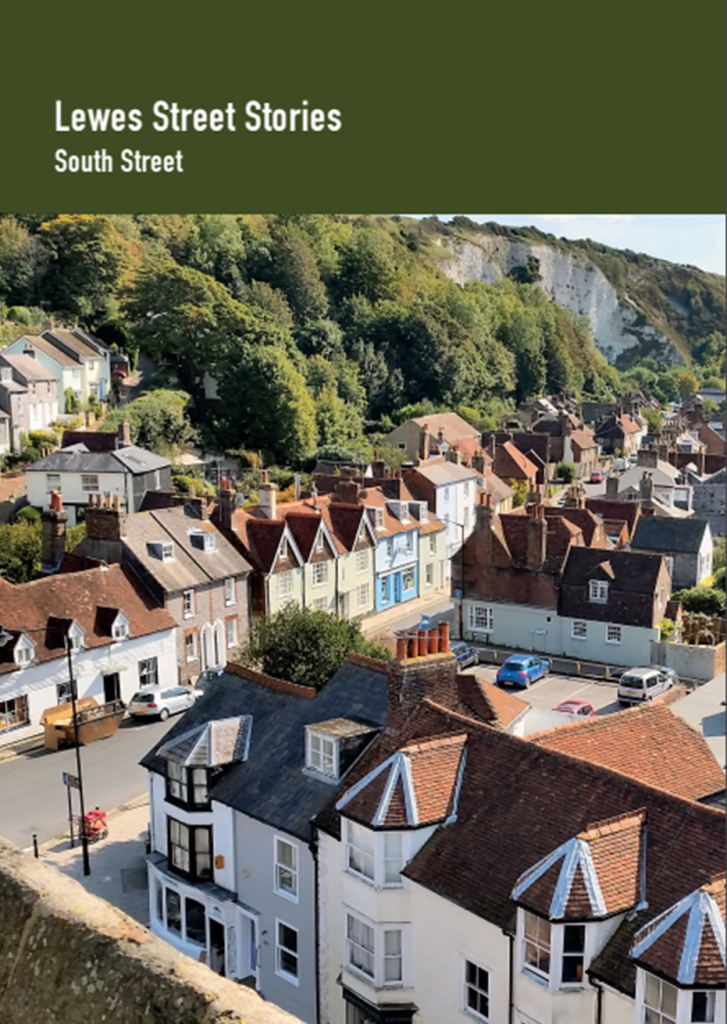
2. Lewes Street Stories: South Street, by Heather Downie
3. Rev Joseph Jackson Fuller preaches at Eastgate Baptist Chapel
4. Lewes Javelin Men at Brighton
5. An 1830 letter from Lewes to London
6. The County Prison on North Street
7. A postcard of the Paddock
8. Flour consumption in Lewes in 1801
9. The Alice May, Lewes
10. Glass lantern slide taken at Landport
1. Next Meeting 7.30 p.m. King’s Church Monday 15 April
Heather Downie The South Street Story
At our next meeting Heather Downie will give a talk to launch ‘South Street’, the latest addition to the LHG Street Stories series. South Street, in the parishes of Cliffe and South Malling, is a long street, and it also has a long history, including Britain’s worst avalanche. This is thus our most ambitious Street Story yet. South Street was not a home for the gentry but a working place, with timber yards and river wharfs, boat yards, gas works and chalk pits. By the 20th century a car service station had replaced the blacksmith, the main chalk pit had become a cement works and, for a time, there was a maker of cricket bats. Many of the workers in these industries lived in the rows of good Victorian cottages that were interspersed with pubs and beer houses.
As part of the route of the main south coast through route, the A27, 20th century South Street was blighted by heavy traffic until in the 1970s the new Lewes southern by-pass removed most through traffic from Lewes town centre and then in 1980 the Cuilfail tunnel diverted the A26 traffic away from South Street itself. It has now become a desirable cul-de-sac in which to live. As a background to the detailed account in the new book, Heather will give a largely pictorial review of this history, from the earliest maps to the latest houses.
This will be a live meeting at King’s Church. There is no need for LHG members to book – simply turn up in good time for the 7.30 pm start. There is an entry charge of £4 for non-members, with tickets available via ticketsource.co.uk/lhg.
2. Lewes Street Stories: South Street by Heather Downie
The latest volume in our Street Stories series has now been published and copies will be available to purchase on the evening at £8.50. Beautifully illustrated with maps, photographs and works of art, the 64 page volume, the story runs up and down the street, which initially served the wharves along the river and the riverside chalk pits, but in the 18th century became the main turnpike route from Lewes to the eastern parts of the Sussex coast. By the 20th century South Street was part of the main trunk road along England’s south coast, and over-run with heavy motor traffic. Then the creation of the Lewes by-pass and the Cuilfail tunnel, and the decline in commercial traffic along the Ouse, radically changed its nature once again.
If you are unable to attend our April meeting copies of the book can be purchased directly via the Lewes History Group website (https://leweshistory.org.uk/), or from the Lewes Tourist Information Centre (on Lewes High Street next door to the Town Hall).
3. Rev Joseph Jackson Fuller preaches at Eastgate Baptist Chapel
The 11 March 1893 Sussex Express reported that the preacher at the annual missionary service at Eastgate Baptist Chapel had been Rev J.J. Fuller of Africa, who it described as “a coloured gentleman born in slavery”.
The Rev Joseph Jackson Fuller (1825-1908) was indeed born to enslaved parents in Jamaica, but freed as a child when slavery was abolished in the British Empire in the 1830s. As a young lad at the final abolition, he recalled huge crowds attending the watchnight services and the ceremonial burial of a coffin containing slaves’ handcuffs, chains and shackles. Educated at a Baptist mission school, he and his parents joined a Baptist mission project to evangelise, educate and encourage an end to slavery in some of the traditional kingdoms of West Africa. Ordained in 1859, he worked for three decades evangelising and leading churches in Cameroon.
He married twice, and his second wife was the daughter of an English missionary. He visited England for the first time in 1869 to visit his wife’s family in Norfolk. He continued his mission until Germany claimed Cameroon as part of its new African empire.
He then retired to London, where his oratory, coupled to his vivid first-hand accounts of the end of slavery in Jamaica, made him one of the most popular Baptist preachers at a time when such men had celebrity status. In 1889 over 4,000 people came to hear him speak in Birmingham Town Hall. Eastgate Chapel will have been crowded to the rafters.
Sources: Wikipedia; Dr Israel Olofinjana’s Black Baptist website
4. Lewes Javelin Men at Brighton
John Docwra Parry, dedicated his book ‘An Historical and Descriptive Account of the Coast of Sussex’, published in 1833, to King William IV and Queen Adelaide. In the Brighton section of this early guide Parry describes one of the Brighton events to mark the 1789 birthday of the Prince of Wales, the future George IV. Sir Ferdinando Poole, a horse racing enthusiast and a personal friend of George IV when Prince of Wales, lived at The Friars in Lewes.
“A very military and striking procession was presented by the javelin men, headed by Sir Ferdinando Poole, the sheriff. His order, which smacks so truly of feudal times, consists of the chief tradesmen of Lewes, from whence they proceeded to pay their respects to the prince. Their uniform is a superfine blue coat, buff waistcoat, and buckskin breeches, with other appendages, the effect of which was striking. Their swords were sustained by blue belts over the shoulder with crested plates. Their horses had blue and buff girths and breast-plates, and the head-dresses of the horses were also of corresponding decoration.
The trumpeters, which preceded the procession, were dressed at the expense of Sir F. Poole; their coats were buff, with blue collars and cuffs, and blue waistcoats: they had silk banners to their trumpets, with heraldic bearings. The ordering of this procession depended in a considerable degree on Colonel Pelham; and it was observable that blue and buff cockades were assumed by all the country. Upward of 500 people dined at the Castle; and an ox was roasted and distributed to the populace with plenteous supplies of strong beer. A very brilliant firework was played off, and a general illumination exhibited. Brighton was never so joyous or gay before.” We have, as a nation, a long reputation for pageantry and, where Lewes is involved, fireworks
5. An 1830 letter from Lewes to London
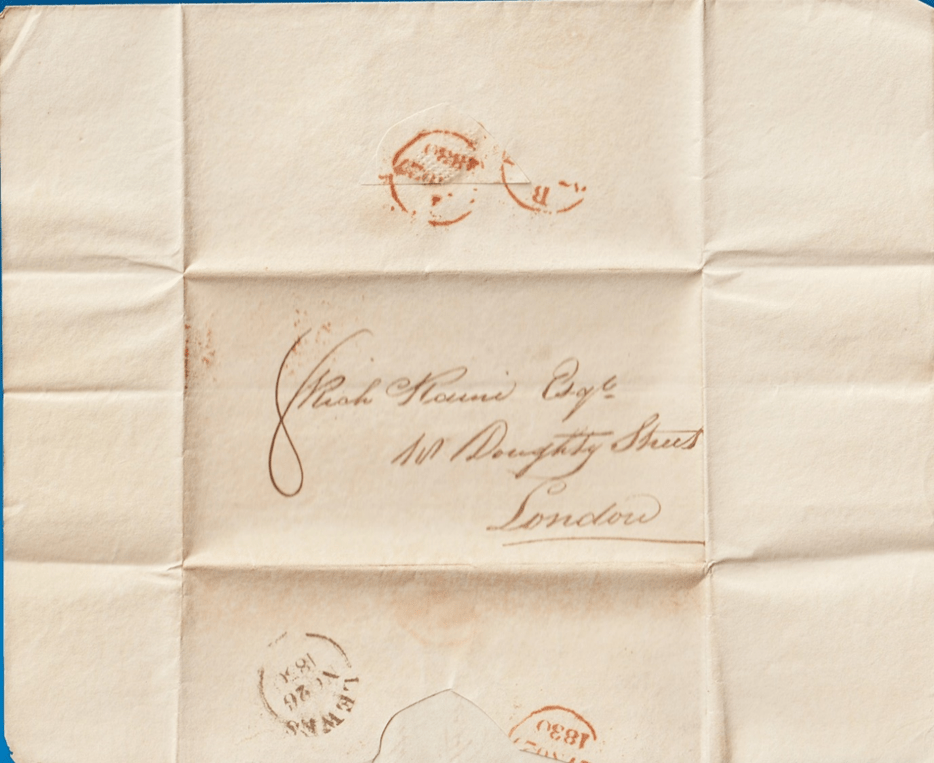
The letter below was sent from Lewes to London in November 1830, a decade before the establishment of the penny post, and was a routine acknowledgement of the payment of an account. The sender was Thomas Hillman (1810-1856), at the time aged 20, the second son of the Cliffe corn, coal and lime merchant John Hillman (1780-1864), whose counting house, wharf and coal yard were at 24 Malling Street, next door to the Dorset Arms. The paper on which the letter was written was cleverly folded to create an envelope, closed with a flap and a slot cut in the paper. The envelope was postmarked by the letter carrier. The recipient was Richard Raine, a well-known London surveyor, who often acted as an enclosure commissioner.
The partnership as corn, coal and lime merchants between the brothers Robert, John & Charles Hillman had been dissolved in 1826, after which John Hillman had established his independent business at his new wharf, employing his sons. They embarked on a range of businesses including farming, taking the lease of Gote Farm, Ringmer, for some years from 1833 and later Lower Stoneham Farm from 1855. Although managed as a partnership it was Thomas Hillman’s younger brother John Hillman junior who actually lived at the farms.
John Hillman senior lived in Cliffe until his eighties, but had retired from business by 1851. Thereafter his sons ran a range of businesses, both individually and as partners in various combinations. John Hillman junior and the youngest brother Alfred focused on corn, farming and later brewing, while Thomas and Robert were more involved in the coal and lime aspects of the business. They were all Anglicans and Tories who supported the Corn Laws. John Hillman senior’s obituary described him as having a strong mind, great energy and an inflexible disposition so that having once determined on an object he rarely failed to accomplish it.
Thomas Hillman married Fanny Stanton, from a Lincolnshire family, in 1838, when he was in his late twenties but she was only 16. The baptism of their eldest son, Thomas Stanton Hillman, followed unusually promptly for this social level, and they also had a daughter. In the 1851 census they lived in Malling Street and Thomas Hillman said he employed 50-75 men. The family owned numerous properties in the Cliffe, where they had considerable influence. Thomas Hillman became, for example one of the Cliffe Feoffees and a trustee of the Lower Ouse Navigation. In the 1847 Lewes borough election he and his brother Robert nominated the two unsuccessful candidates who stood against the Peelite Henry Fitzroy and the Liberal Robert Perfect. In the early 1850s his family moved to a smarter Lewes address, 208 High Street, where he died in 1856 at the age of 46. Like most of the family, he was buried in South Malling churchyard. His daughter married a Lincolnshire man and his widow moved away to live with them for the rest of her life. She died in Thanet in 1903, but appears to have been brought back to South Malling to be buried with her husband – at least, she is remembered on his memorial. His son Thomas Stanton Hillman became a gentleman farmer, owning land in Ringmer and living at Delves House. He returned to Lewes later in life and he too is buried in South Malling churchyard.
6. The County Prison on North Street
From Mark Antony Lower, ‘Handbook for Lewes’ (2nd edition), 1852
“Lewes had a prison in early times. The West Gate of the town was long used for this purpose, and probably also the great vaults beneath the Star Hotel. Till towards the end of the last century the prison for the Eastern division of Sussex stood in the Cliffe. The accommodation being inadequate to the increased population of the district, the present building [on North Street] was erected on a spot which was then surrounded by open fields, though now hemmed in by houses. It is a gloomy and spacious structure. It was erected in the year 1793, but several additions have been made to the original plan. It contains the governor’s apartments, a treadmill, and a chapel where morning and evening prayers are read by the chaplain.
There are separate sleeping cells for 142 prisoners, and the average number of criminals last year was 155. Horsham Gaol having been laid down, this has been made a County Prison for the eastern division of Sussex; and a small prison for debtors has been erected within the walls. This establishment is excellently conducted, though an occasional influx of criminals renders the space insufficient. A larger building upon the “model” system has therefore been erected near the western entrance to the town. It is expected to be ready to receive its unhappy inmates in the course of the present year. The present governor is Mr John Sanders, and the chaplain the Rev Richard Burnet, B.A.
Since this prison has been constituted the County Gaol it has been the scene of two executions. By an unhappy coincidence both the criminals were women, and both suffered for the same crime – that of poisoning their husbands. The first execution took place in 1849 and the second in 1852. So much for the exemplary effect of capital punishment!”
7. A postcard of the Paddock
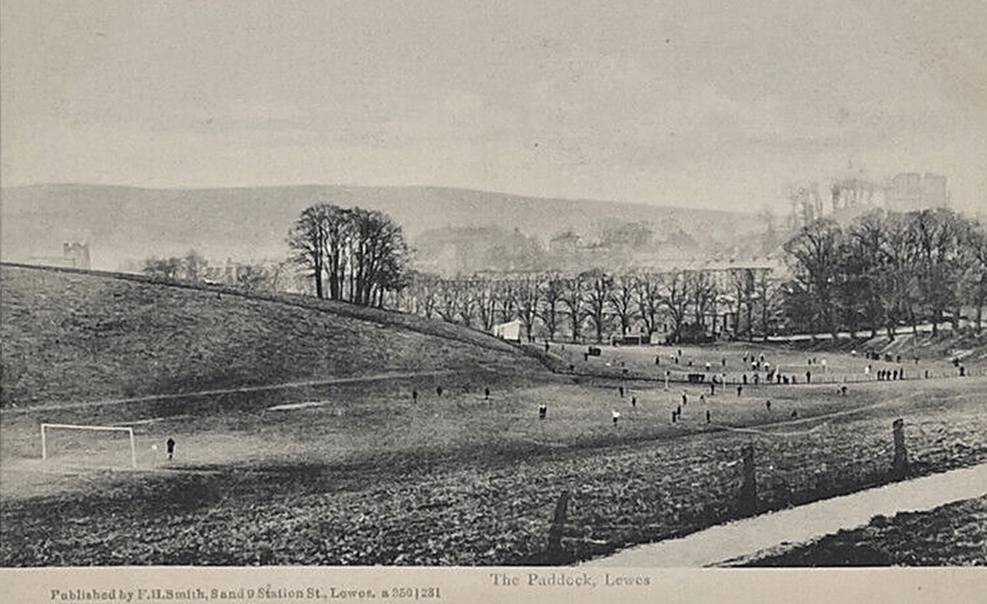
This early Edwardian postcard of football in the Paddock, published by F.H. Smith of 8 & 9 Station Street, is not one that I have seen before. It was offered on eBay in February 2023. Like quite a few other Edwardian postcards, this one was printed in Germany. After the Great War, many postcards carried a different message, to ensure buyers knew they were entirely British made.
8. Flour consumption in Lewes in 1801
“It is proved by the evidence of the books of several bakers in Lewes that the poor consume a much larger quantity of flour in times of dearth than in times of plenty.”
Source: The February 1801 issue of the Monthly Magazine. The implication is presumably that in good times the poorer families could afford a more varied diet, but in hard times they could afford only bread.
9. The Alice May, Lewes
This lead crystal beaker, diamond-engraved with the picture of a square-rigged barque and the words Alice May of Lewes, 1886, was offered for sale on eBay recently at £285 plus postage. According to the seller such ship’s tumblers were usually engraved to mark the launch of a ship.
10. Glass lantern slide taken at Landport
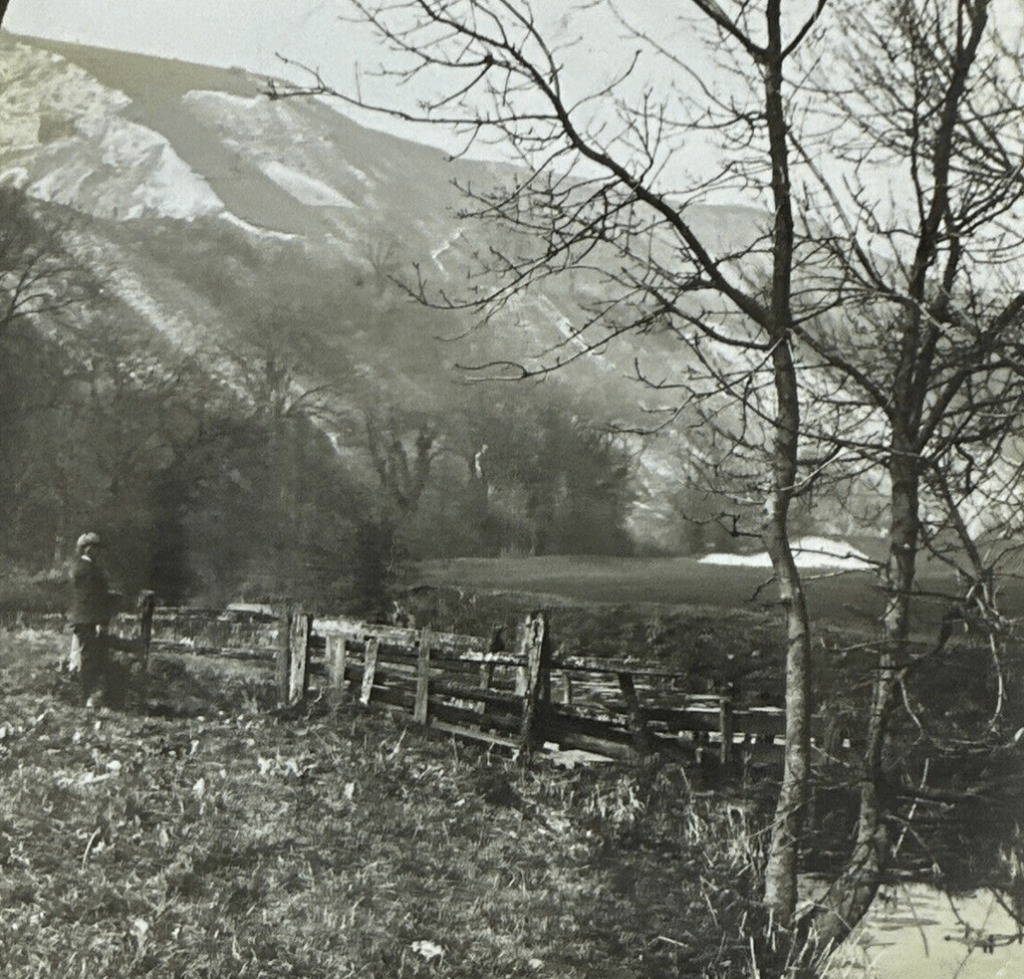
This glass magic lantern slide offered recently on eBay shows the view from Landport towards the chalk quarries at Offham. It most probably dates from the late 19th or very early 20th century.
A gripping tale emerges from a recently-discovered exchange of letters between the colossus Maynard Keynes and the Lewes Reverend Kenneth Rawlings. Early attempts at establishing a theatre were nearly scuppered by Rawlings’ pacifist preachings from the pulpit, because of which the town turned against him. The theatre won through by entertaining troops in Lewes throughout WWII, supported by Keynes and other establishment figures.
The exchange of letters from 1936 to 1944 shows the way in which Keynes assisted Rawlings in the establishment of permanent amateur theatre premises in the County Town of Lewes. The timing coincided with the onset of World War II, and additional letters from Rawlings to others including the town clerk, Lord Gage, Margeret Masterman and Major G. H. Powell-Edwards reveal the tensions between the ardent pacifist Rawlings and establishment figures as war approached. Steadied by Keynes and like-minded influential figures, Rawlings won through triumphantly, the theatre effort viewed as an essential cultural asset during the dark war years.
Paul Myles notes in an article published in The History of European Ideas that Keynes could observe Rawlings enact what became an aim of the Council for the Encouragement of Music with the Arts, of which he became president soon after its conception in 1940 —that of providing a theatre for every town in England.
LHG Members can attend our talks for free.
Non-members can buy a ticket (£4) fromTicketSource.
See the Talks page for a list of forthcoming monthly events organised by the Lewes History Group.








 Lewes History Group