
Please note: this Bulletin is being put on the website one month after publication. Alternatively you can receive the Bulletin by email as soon as it is published, by becoming a member of the Lewes History Group, and renewing your membership annually.
1. Next Meeting: 8 January 2024, Arthur Redmonds, ‘Lewes Castle’
2. A.G.M. Report
3. Treasurer’s Report (by Ron Gordon)
4. Contacting the Lewes History Group
5. Meet the Georgians
6. The view from the Castle before 1883
7. Trouble and Strife in Green Walk
8. A Quarrel at the Market
9. School Hill in 1905
10. A James Cheetham postcard of Friars Walk
11. Churches & Chapels in Lewes c.1847
12. Southern Railway locomotive no.41 at Lewes
1. Next Meeting 7.30 p.m. Zoom Meeting Monday 8 January
Arthur Redmonds Exploring the Medieval History & Archaeology of Lewes Castle
Our first 2024 talk will explore the medieval history and archaeology of Lewes Castle, focusing on its relationship with Lewes and the surrounding Sussex countryside, and how it might have impacted and influenced the everyday lives of people around it. As part of an academic study at the Universities of Exeter and Cardiff, funded by the South West and Wales Doctoral Training Partnership, Arthur Redmonds has been exploring how the medieval castle influenced those who experienced them within their localities and landscapes, and has studied Lewes castle as one of his key examples. His talk will explore the impact of the castle on everyday life in the medieval town, and will touch briefly on the sources and methods used.
He will start with considering how medieval castles operated, who worked within their lands and the types of sites and landscapes we might associate with them, before contextualising Lewes within the story of other castles both within Sussex and nationally. Next, he will explore the castle’s biography, and its influence on the town and countryside at each stage of its life. This will include its construction, occupation, and finally its decline and partial abandonment. Along the way, he will briefly touch on some of the more important historical events in which the castle played a part, including its role in the 1264 Battle of Lewes and its assault during the 1381 Peasants Revolt.
This meeting will be held by Zoom. Members will be sent a free registration link in advance. Non-members can buy a ticket (£4) at http://www.ticketsource.co.uk/lhg. The emailed ticket will include a Zoom registration link for the talk, to complete in advance.
2. A.G.M. Report
- The annual reports were approved.
- Appointment of officers. The following officers were appointed for 2024:
- Chair: Neil Merchant;
- Treasurer: Phil Green;
- Secretary: Krystyna Weinstein;
- Executive committee: Ann Holmes (Chair for EC meetings), John Kay (Bulletin editor), Victoria Moy (Communications), Ian McClelland (Chair for evening meetings & ‘Street Stories’ lead), Barbara Merchant (Website manager) & Chris Taylor (Membership).
- Membership subscription. It was agreed that the annual subscription should remain at £10 p.a. per member, and that admission to evening meetings should be free for members. Admissions charges for non-members should remain at £4 per meeting.
3. Treasurer’s Report (by Ron Gordon)
The Lewes History Group accounts for 2023 have now been audited and approved by Mike Stepney, as below.

The History Group is most grateful to Ron Gordon, now stepping down as treasurer, for the way he has guided our finances for over a decade, ever since the first establishment of the group.
4. Contacting the Lewes History Group
Please note that our contact email address is now info@leweshistory.org.uk.
The old address (leweshistory@gmail.com) is to be retired.
5. Meet the Georgians
Dr Sue Berry will be leading a 5-week course called ‘Meet the Georgians’ from 10.30 to 12.30 on Tuesday mornings starting on Tuesday 20 February and running until Tuesday 19 March. The course will be held in Room 1 at King’s Church and there is a course fee of £25 to cover room hire costs. The course will cover the history of ‘The long 18th century’, from 1680 until 1830. He course will cover the heyday of the country house, the rise of the towns and their impact, the improvements in agriculture and the start of the industrial revolution, the development of service industries and the rise of non-conformity.
You can reserve a place, subject to availability, via https://ticketsource.co.uk/lhg
6. The view from the Castle before 1883
Marcus Taylor has acquired a pair of photographs taken from the Castle and looking towards the south-east, that together provide a panorama of Southover, from the railway station to the King’s Head.
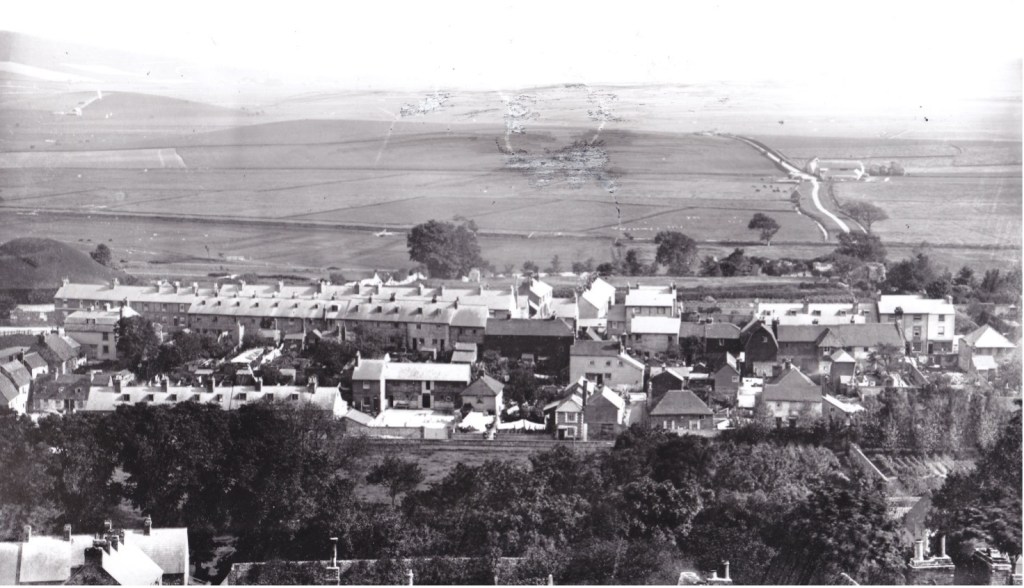

The second photograph features prominently the Mount, Mountfield House and the Dripping Pan, and on the right hand side Garden Street, the end of Priory Street and some of the trees in the garden of Southover Grange. To the far left can just be seen the second version of Lewes railway station (replaced by the present station in 1887). Marcus points out that the cattle market by the station, created in 1883, has not yet appeared – the image shows the tannery previously on that site, remembered in the street name Tanners Brook. According to ESRO DL/D 145/22 Mountfield House was built in 1863. Are there any other dating features to spot?
Prominent in this view, just to the left of centre and accessed from Mountfield Road opposite the Dripping Pan, is a large villa identified from a late 19th century map by Mick Symes as Priory Villa. This was later known as Priory House, and was demolished in the 1960s.
The first known owner and occupier of Priory Villa was a railway engineer called Edward Oliver, for whom this villa will have been very conveniently located. He was born in County Durham about 1826, and his father and at least two of his brothers became civil engineers, specialising in the development of the Victorian railway system and settling in Chesterfield, Derbyshire. He is first noted in St Michael’s parish Lewes in the 1851 census, just five years after the arrival of the railway here, when he was described as an unmarried railway contractor aged 25. Later that same year, at Slaley in Northumberland, he married the daughter of a land agent and farmer living there.
Edward & Margaret Oliver then had two daughters born in Lewes in 1858 and 1861. The 1861 census finds the family living at Priory Villa, and in that record Edward Oliver’s occupation is described as ‘railway inspector engineer’s department’. A large railway contractors’ partnership that included Edward Oliver and two of his brothers had been dissolved in 1854. Their eldest daughter, aged just 3, was buried at St Michael’s later in 1861. Edward Oliver and his family continued to live at Priory Villa until in 1877, when they left for Croydon, perhaps an even better location for a Victorian railway engineer. The local newspapers record that their surviving daughter died in 1877 aged 16. She is buried in Queens Road Cemetery, Croydon, where in due course she was joined by her parents Edward Oliver (1826-1891) and his wife Margaret (1829-1904).
In the 1881 census the resident at Priory Villa was the prosperous boot manufacturer Albion Russell, whose shop at 187/188 High Street was on the corner of Fisher Street and High Street, next to the Star Inn, the premises currently occupied by the Tourist Information Centre. He was the son of a Chiddingly cordwainer, who had established himself in business in Lewes on a substantial scale, initially at 37 High Street. In the 1861 census, when he was living over the shop at 187/188 High Street, he was described as a master bootmaker employing 30 men and 6 boys. He was still there in 1871, but by 1881 Albion Russell was in partnership with his son Albion Russell junior, who had recently married and lived over the shop.
Albion Russell senior died at Priory Villa in 1888, and the departure of his funeral cortege from there was described in detail in the local press. His executors were his son Albion Russell junior and his son-in-law George Frederick Bromley, who had initially managed his Eastbourne shop – the business that eventually became the London department store Russell & Bromley.
By 1891 Albion Russell junior was living at Priory Villa with his wife and six children, who were all under ten. However, his much loved second daughter died at there in 1892, and by 1901 the family had moved to King Henry’s Road. Resident at Priory Villa in 1901 was the retired brewer John Hampton, whose mother had been a Miss Monk and who had been the last brewery manager of the Monk family brewery in Bear Yard, which closed in 1898. John Hampton died at Priory Villa in 1908, and after his widow’s death there in 1910 both Priory Villa, standing in an acre of land, and the household furniture and effects were put up for auction.
By the 1920s Priory Villa had become Priory House, and the new owner was Frederick Thomas Tickner, a draper’s son who had for many years been a china, glass, boot and shoe dealer. He had previously lived over his shop at 8 Cliffe High Street, but he also owned other properties across the road. He died in 1929 aged 66, but his widow continued to live at Priory House until the end of World War II, when she returned to her native Worcestershire, living on to the age of 90.
The final occupier of Priory House was the antique dealer Elgar Alfred Geering, who had married in Brighton in 1909, but who in 1911 was a Brighton-born cabinet maker living in St Pancras, London.
His antiques business was based at 1 South Street, and he remained at Priory House until at least 1964. Later in the 1960s the house was demolished, to be replaced by the present flats.

7. Trouble and Strife in Green Walk
Three local newspaper reports of cases brought before Lewes magistrates for their decision between 1848 and 1855 illuminate aspects of Lewes social life that are now largely forgotten, not featuring in the everyday experience of the diary-writing classes. All three cases involve the same woman, Ann Evans, who was living in Green Walk.
In November 1848 Ann Evans was prosecuted for assaulting a neighbour, Jane Sales, who had reportedly taunted Mrs Evans about her husband being transported. The case report noted that Ann Evans, “perhaps acting on Lord Mansfield’s dictum that the greater the truth, the greater the libel, had taken it upon herself to inflict summary punishment, which she did instantly and according to the evidence with hearty good will”. The magistrates found the case proved, and Ann Evans was fined 40 shillings plus costs, or in default one month in the House of Correction. She will not have had the money – more than a month’s income for her single-parent family.
Six months later in July 1849 another woman, Frances Evans, who also lived in Green Walk, prosecuted Ann Evans for assault before the same bench of magistrates. Her case was that when passing the defendant in the street she was insulted by being “holloaed at”. On her return she said she was swinging a basket as she passed the defendant, who “fixed her by the bonnet”, which she then tore into ribbons. The complainant was then dragged into the house, where defendant cried “bring me a poker, young’un”. The complainant said she was so stunned by the encounter that she didn’t know who hit her with the poker, but she was struck by it. Ann Evans (Frances’s teenage daughter) deposed to having seen her mother in a state of insensibility. The defendant denied any assault, and called a witness who had seen the complainant strike her with her basket as she went past her. The poker was not used. The bench dismissed the case as unproven.
In a third case in April 1855 Ann Evans was the prosecutor, alleging an assault by her neighbour Barbarie Puttick, who pleaded not guilty. Ann Evans gave evidence that she had a girl of about 14 ‘very apt to run away’, in consequence of which she locked up her clothes. Her daughter had run away from her last two places. On 13 April she sent the girl downstairs to have breakfast with her brother, but instead she absconded, which she was able to do because the defendant had lent her a bonnet. Even an unruly teenager could not be seen out bareheaded. When the girl returned at seven that evening Ann Evans took the bonnet, lit it and carried it to the defendant’s house. However, it was wet, and would not burn properly, she took it home again, put it on the fire, and then carried it to Mrs Puttick’s house on a stick. While she was doing so she alleged Mrs Puttick came out and rushed at her with a broom, hitting her in the face and then on the head, knocking her down. In getting up she accidentally broke the defendant’s window. She had not entered her neighbour’s house. Another neighbour supported her account, adding that Mrs Puttick had said that she had plenty more bonnets she would give the girl, and also that she had not stolen a sheep or been transported. She also confirmed that the window had been broken accidentally when Ann Evans got up after being knocked down. The defendant said that the girl had come to her in the morning, saying that she was hungry, and asking to borrow a bonnet. In the evening the complainant had opened her door and put a lighted bonnet in her house, so her aunt, who had breathing difficulties, was almost suffocated. She had put the broom, which she had in her hand, up to keep the plaintiff out of her house. The window had been broken deliberately. Her aunt was still too unwell to attend court. The magistrates found the assault proved, fining the defendant half a crown, with 7s 6d costs. She was allowed a week to pay. Ten shillings was the best part of a labourer’s weekly wage.
The people concerned in these incidents are all readily identifiable, and some aspects of their lives are recoverable using the online family history resources available today.
Ann Evans had been born in Ringmer as Ann Oliver, where she was baptised in April 1821, the elder of two children of labourer John Oliver and his wife Caroline. A younger brother was born in 1823, but her mother was buried at the parish expense the following year, 1824. Her father was one of a group of Ringmer labourers who found it especially difficult to find regular employment, so was frequently to be found amongst the parish labour gang, whose activities included work on the local turnpikes. It was the Ringmer parish gang, including John Oliver, who dug the cutting for the Lewes-Brighton road that divides Falmer north from Falmer south. Like others of this group, he was despatched as one of the Ringmer contingent to the Sussex militia, and when harvest was over he was given a small sum of money by the parish to go hop-picking in the Weald. He lived in a cottage in the particularly impoverished Ringmer hamlet of Ashton Green, called by the vicar ‘Sodom’ when he entered the baptisms and burials of its residents in his parish registers.
John Oliver was, of course, unable to both work and care for his two young children, and was perhaps not especially interested in their welfare. A neighbour was paid five shillings a month by the parish to look after them, with the parish doing its best to reclaim at least some of the cost from their father – and on occasion taking him to court for “failing to support his family”. He was himself several times before the magistrates, jailed for 6 months for larceny in 1826, and with several other convictions for poaching and assault before his 1855 death. He had two younger brothers, Thomas and William, both of whom fell foul of the authorities. Thomas Oliver was one of the members of the ‘Ringmer Gang’ taken to the assizes in 1827 for a string of local burglaries and sentenced to hang but reprieved to be instead transported for life. William Oliver was also in prison on more than one occasion, including for poaching, participating in a riot against the 1835 introduction of the New Poor Law system and for absconding, leaving his wife and children destitute. In the 1841 census, shortly after his wife’s death, William Oliver’s children were abandoned to the care of the Chailey Union workhouse. He too was sentenced to transportation in the 1840s for another offence, stealing fowls. The 1851 census finds him in a convict barracks in Kent and in 1852 he was actually sent to Tasmania. John Oliver certainly knew people who were actually transported to the Antipodes – he was the intended recipient of an 1845 letter addressed to ‘Ringmer Oliver John, Sussex, England’ that was detained by the Australian post office for lack of the necessary postage.
It seems fair to assume that Ann Oliver’s childhood will not have been easy, but when she married James Evans at Cliffe church on 15 September 1839 she was jumping out of the frying pan into the fire. Both parties were just 18, and within a very few weeks the new family was joined by a baby daughter Louisa, who may have been the teenager ‘very apt to run away’ in the 1855 case. James Evans was one of a family of eight sons and two daughters who also grew up in Ashton Green, where his father, a labourer but the son of a former proprietor of the Cock Inn, was the headborough – responsible for law and order in the days before the 1841 formation of the Sussex police. He was not very successful in instilling respect for the forces of law and order amongst his own sons. James’s elder brother John Evans spent his life on the run after stealing a donkey in Ringmer and selling it to a Dorking dealer, only for the dealer to sell it on to a gypsy who brought it back to South Malling, where it was recognised. The police were amazed to discover that the gypsy’s story checked out – but the dealer gave them enough information to identify the real culprit. Despite advertising his detailed description in the regional newspapers the police never caught up with John Evans, though the 1851 census finds him, his wife and children camped by the roadside in Ashdown Forest on census night. Two other brothers, George and Caleb Evans, were convicted and sentenced to transportation in 1841 as part of the ‘Barcombe Gang’ for crimes including poaching, vicious gang attacks on gamekeepers, barn-breaking, burglary and sheep stealing. George Evans was regarded as the ringleader. Caleb Evans had enlisted as a soldier, but deserted. They were both sent to Tasmania on the convict ship ‘Tortoise’ in 1841. Another brother, Edward Evans, was also in and out of prison for the relatively minor crimes of poaching and assault. To be fair it should be noted that the oldest and youngest Evans brothers appear to have lived unblemished lives, raising large families and the youngest rising to the post of farm bailiff.
James Evans, however, was no such paragon. He had two convictions as a teenager, before his marriage to Ann Oliver. In 1837, aged 16, the magistrates fined him a shilling, with 16 shillings costs, for malicious damage to a duck, despite an alibi from his father to which the magistrates gave no credence. A few months later he was up before Quarter Sessions for the theft of four tame rabbits from a village shoemaker, and for this more serious crime he was given 6 weeks hard labour. A high proportion of country crime involved the theft of meat. James and Anne’s eldest daughter was baptised at Barcombe, but after the arrest of the Barcombe gang they moved on to Hurstpierpoint, where the 1841 census finds the couple, both 20, with their 1-year old daughter, and also James’s youngest sister, aged 12. Another daughter was born in Hurstpierpoint. A son Henry followed, baptised at Ringmer early in 1843, though said in the 1851 census to have been born in Laughton. Then disaster struck – in the autumn of 1843 James Evans was arrested for stealing a sheep from Broyle Place Farm (where his father worked), convicted at Lewes Quarter Sessions and sentenced to 10 years transportation. He followed his brothers George and Caleb to Tasmania, travelling on the ‘London’ in 1844.
This left Ann Evans with no easy way to support her brood of young children, the oldest just four. Another daughter, Cordelia, was added in May 1844. This daughter, born after her father’s transportation, was baptised at Chailey, after Ann and her children were sent to the Union workhouse there. A woman in this position was in a desperate situation, as women’s wages were too low to support a family. A young widow could try to find a new husband, but this option was not open to the wife of a transportee. However, Ann Evans managed to escape the workhouse, and had established herself in Green Walk by 1848. She is found there in the 1851 census, with her three children Louise (11), Caroline (9) and Henry (7). She was described in the census as a pauper, ‘husband a convict’. Her last baby, Cordelia, had died before her first birthday. In the 1850s she had two more children whose births were registered in Lewes, a daughter Agnes in 1854 and a son Lewis in 1856. By the 1861 census she was a lodging house keeper in William Street, Brighton, living with her two youngest children and three lodgers. I then lose sight of her – Ann Evans is a very common name – but by 1871 Agnes was a teenage servant in a Hove household, and Lewis a teenage house-painter boarding in a painter’s household in Brighton.
Jane Sales (1804-1886), born Jane Taylor, was a native of Lewes and nearly 20 years older than Ann Evans. She married Richard Sales in 1828, and had at least 7 children. She lived in Green Walk in the 1841 census, but had moved to North Street by 1851. Her husband did labouring jobs – a fishmonger’s labourer in 1851 and a farm labourer in 1861 & 1871. One of her unmarried sons became a bricklayer’s labourer, another a railway porter.
Frances Evans (1814-1853) was Ann Evans’ sister-in-law. Born Frances Barrow at Heathfield in 1814, she married George Evans there in 1832 when they were both 17. They had two children baptised at Ringmer in 1833 (Ann) and 1837 (John) before they moved to Barcombe, where George was arrested and transported. In the 1841 census Frances and her two children John (4) and Harriet (2) were in the Chailey Union workhouse at Chailey. Her eldest daughter Ann, aged 7, was in the Ringmer workhouse, used by Chailey Union to house its school-age children. Frances was pregnant with another daughter, born several months after George’s departure for Tasmania, who she called Georgina. Two years later she had another child, Charles, baptised at Chailey. In 1851 she and her family were living in Green Walk, where she was a charwoman and her teenage son John an errand boy. She was buried at Ringmer in 1853, aged 39.
Barbara Puttock (1820-1906), born Barbara Pannett, lived in 1851 with her chalk pit labourer husband, her two small children and her widowed mother in her aunt’s house in Pleasant Place. Her aunt had also been married to a chalk pit labourer. Widowed later in life she became an upholsterer, sharing a home in Station Street with her adult children.
James Evans and his elder brothers George and Caleb Evans all survived their convict ship journeys and were in due course granted their tickets of leave. Transportation almost invariably resulted in a married man’s family being permanently split asunder. A descendant reports that all three Evans brothers later married (George in his first wife’s lifetime) and fathered new families.
Sources: British Newspaper Archive, especially the 4 November 1848 Sussex Express and the 21 July 1849 & 24 April 1855 Sussex Advertiser; birth registration indexes on www.gov.uk; overseers of the poor records for the parish of Ringmer; online prison and convict records; FindMyPast & Familysearch websites.
8. A Quarrel at the Market
The article below was published in the 11 Jan 1879 Sussex Advertiser
“The hour at which the stock market is to be closed and the wattles cleared ought to be clearly understood. At present the owners of stock do not seem to have any definite ideas as to what time they may keep their animals exposed for sale, and the want of this knowledge on Tuesday week led to a disgraceful disturbance in the High street.
It appears that the owner of two large pigs had not removed them at the time the person employed to clear the hurdles came to cart them away.The official accordingly placed the wattles in his van, leaving the pigs to wander whither they would. The owner of the animals naturally resented this summary proceeding, and after loud and angry disputation attempted to prevent the horse and van from moving on, whereupon the driver struck him a violent blow in the face, followed by a second, knocking the man down. Blood was copiously shed, the poor fellow being apparently too much stunned to attempt to protect himself. Meantime the the pigs had wandered some distance up the street, but were subsequently taken charge of and removed.
We do not know whether the owner of the pigs was infringing the market rules or not; be this as it may, the market authorities will hardly support their servant in such proceedings as disgraced the High street on Tuesday, and which would probably not have occurred had it been the rule that the hour of removal of the wattles and the closing of the market should be thoroughly explained to all who bring animals for sale. A “knock-down” argument may be very effectual, but it is not one that in the long run is likely to attract persons to select Lewes for the disposal of their stock.”
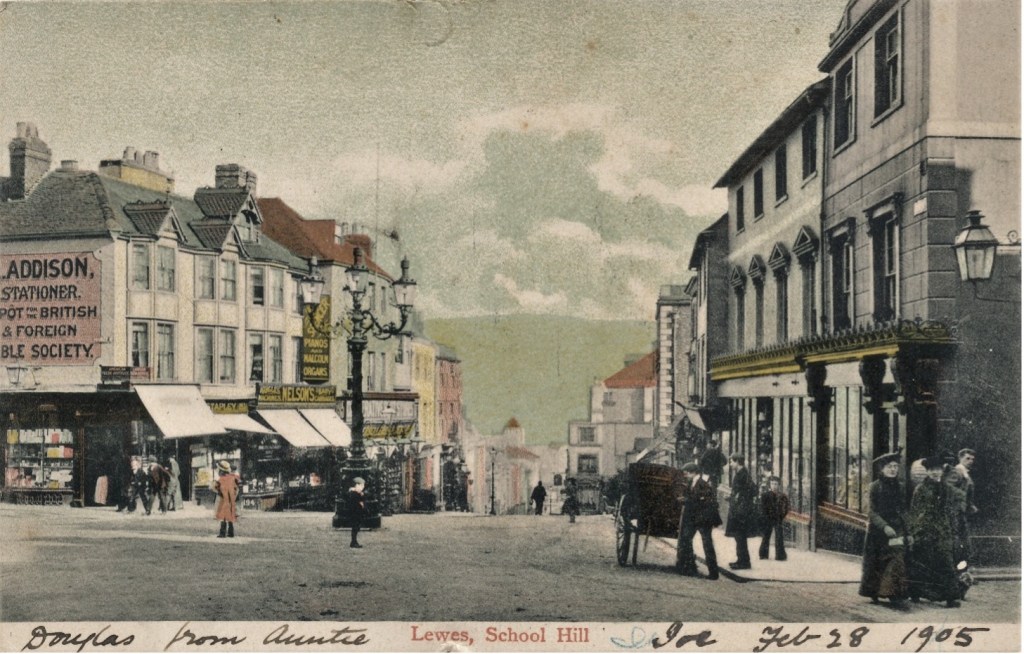
9. School Hill in 1905
This colour-washed Edwardian postcard shows the view from the top of School Hill, including the gas streetlight replaced in 1920 by the war memorial. The publisher did not add his name, but the number 42068 appears on the reverse. Like many Edwardian postcards this one was printed in Germany – the printer added this information in the square that was to be covered by the stamp.
10. A James Cheetham postcard of Friars Walk
This Edwardian postcard has the caption ‘Victoria Hospital, Lewes’ in James Cheetham’s distinctive handwriting, though this is not one of the minority of his postcards that carry his name as publisher on the reverse. The prominent corner building, until recently the National Westminster Bank, is inscribed ‘Lewes Dispensary’ on the cornice but ‘Victoria Hospital, Lewes Dispensary and Infirmary’ over the Friars Walk entrance. To its rear can be seen Browne & Crosskey’s furniture store on Friars Walk, while across the road are the first Lewes railway station building and, beyond that, the Railway Inn.

11. Churches & Chapels in Lewes c.1847
The 1st edition of schoolmaster Mark Antony Lower’s ‘Handbook for Lewes’ is not dated, but describes the 1845 excavations at the Priory, the arrival of the railway in 1846, the resignation of an MP in 1847 and names the minister of the Wesleyan Chapel on St Mary’s Lane as a man known to have been in Lewes for 1845-7. The handbook’s second edition was dated 1852.
In it he lists the capacities of the various churches and chapels in the town.
All Saints church 750 Tabernacle 1200
St Anne’s church 450 Jireh chapel 1200
St John’s church 1000 Old chapel 450
St Michael’s church 600 Baptist chapel 600
Cliffe church 500 Unitarian chapel 400
Southover church 400 Wesleyan chapel 350
Malling church 250 Bethesda chapel 350
Noting the total capacity of the seven Anglican churches at 3,950 and the seven chapels at 4,550, he calculates that the total number of 8,500 places could accommodate 85/92 of the 1841 census population of 9,199. As most held two services on a Sunday “it shows that no one can reasonably neglect a regular attendance on divine service of the ground of insufficient accommodation.”
12. Southern Railway locomotive no.41 at Lewes
This photograph by H.C. Casserley of Berkhamsted dated 9 October 1932 shows Southern Railway 4-4-2 locomotive no.41 at Lewes railway station, heading towards Eastbourne. Henry Cyril Casserley (1903-1991) was a prolific railway photographer, who travelled all over the country to photograph steam engines in the 1920s and 1930s. He was the author of almost 20 books, mostly written during his retirement during the 1980s and 1970s, after the end of the age of steam.
The locomotive shown is an H1-class 4-4-2 locomotive, built by the London, Brighton & South Coast Railway in 1905-6. Only five engines of this class were ever built, and this was the last, completed in 1906. They weighed over 100 tons, and initially pulled the London-Brighton express trains, such as the Pullman ‘Southern Belle’, described by the LB&SCR as ‘the most luxurious train in the world’. Replaced as the company’s top locomotives in the mid-1920s, they were then employed on other express services such as the boat trains for the Dieppe-Newhaven ferry. It’s LB&SCR number was 41, and initially retained that number when the Southern Railway was formed in 1923. In 1931 it was decided to renumber the fleet, with no.41 becoming no.2041. It was withdrawn from service in March 1944
In this photograph the tender carries the ‘Southern’ name, but still the old LB&SCR number 41. I think the building in the background over the tender is the old entrance lodge to Leighside.

John Kay 01273 813388 johnkay56@gmail.com
Contact details for Friends of the Lewes History Group promoting local historical events
Sussex Archaeological Society: http://sussexpast.co.uk/events
Lewes Priory Trust: http://www.lewespriory.org.uk/news-listing
Lewes Archaeological group: http://lewesarchaeology.org.uk and go to ‘Lectures’
Friends of Lewes: http://friends-of-lewes.org.uk/diary/
Lewes Priory School Memorial Chapel Trust: https://www.lewesprioryschoolmemorialchapeltrust.org/
Facebook: https://www.facebook.com/LewesHistoryGroup
Twitter: https://twitter.com/LewesHistory




 Lewes History Group