
Website links mentioned by our January speaker, Chris Hare:
Worthing Heritage Trails – worthingheritagealliance.uk
Richard Jefferies Society – richardjefferiessociety.org
Other talks by Chris Hare – historypeople.co.uk
Website links mentioned by our January speaker, Chris Hare:
Worthing Heritage Trails – worthingheritagealliance.uk
Richard Jefferies Society – richardjefferiessociety.org
Other talks by Chris Hare – historypeople.co.uk
Please note: this Bulletin is being put on the website one month after publication. Alternatively you can receive the Bulletin by email as soon as it is published, by becoming a member of the Lewes History Group, and renewing your membership annually
1. Next Meeting: 8 Dec 2025: Members’ short talks & AGM
2. A.G.M. Agenda
3. Grown in Lewes (by Ruth Thomson & Sarah Bayliss)
4. A postcard view of Paddock Road
5. Lewes as a public transport hub in 1828
6. The theft of an egg
7. The 1857 Lewes Railway Station
8. The tallest Lewes chimney
9. The Blind Preacher
10. Rebuilding the Crown Inn
11. Gateway House, 18 East Street
12. The Lewes Skating Rink
13. A.G.M. Reports (by Ian McClelland & Phil Green)
1. Next Meeting 7.30 p.m. Zoom Meeting Monday 8 December
John Kay: ‘Frank Richardson the Ox-man’
Sue Berry: ‘Arthur & John Morris of Lewes, Georgian builders and architects’
Sara-Jane Hall & Chris Levack ‘New Road, Old Names’
There will be three short talks by members at our Christmas meeting this year, covering quite a diversity of topics.
Members can register without charge to receive a Zoom access link for the event at:
https://us02web.zoom.us/webinar/register/WN_FoB2t6wqSri–hcLsCe_3Q
Non-members can attend via Ticketsource.co.uk/lhg (price £4.00).
2. A.G.M. Agenda
Our December meeting will be preceded by a short A.G.M.
Acceptance of Annual Reports. Please see item 12 below.
Appointment of officers. The following officers have so far been nominated for 2025:
a. Chair: Ian McClelland
b. Treasurer: Phil Green
c. Secretary: Krystyna Weinstein
Executive committee: Ann Holmes (Chair for EC meetings), John Kay (Bulletin editor), Ian McClelland (Chair for evening meetings & ‘Street Stories’ lead), Bill Kocher & Paul Yates (Website managers) & Chris Taylor (Membership)
Any other nominations, seconded and with the candidate’s consent, should be sent to info@leweshistory.org.uk by 5 December.
Membership subscription. Your Committee recommends that the annual subscription should remain at £10 p.a. per member, and that admission to evening meetings should be free for members. Admissions charges for non-members should remain at £4 per meeting.
Questions and comments.
3. Grown in Lewes (by Ruth Thomson & Sarah Bayliss)
It is now a year since Grown in Lewes was published and we hope many of you have enjoyed reading it and some helped to make it possible. We could not have achieved it without our 54 authors, many other contributors and supporters. We entered the book for a national award (the Alan Ball Awards, 2024) and came runners-up in the Community History section. The judges were said to be ‘extremely impressed by every aspect of the book, its content, illustrations, presentation, and the research and community effort behind it’. So, its quality has been recognised nationally, as well as locally. Among the many compliments we have received, the most common goes along the lines of: ‘I thought I knew a lot about Lewes, but this book has been a revelation!’
As the season for present-giving approaches, we would like to make you an exclusive one-off offer of two copies for £25.The books can be collected from 2 Pelham Terrace, BN7 2DX at a mutually convenient time [contact growninlewes@gmail.com].
The books are still available, at the cover price of £16.50 each, from two independent shops in Lewes – Closet & Botts (in-store and online) and Leadbetter & Good – and also at City Books in Brighton. With very best wishes and thank you for being part of Grown in Lewes.
4. A postcard view of Paddock Road
This postcard of Paddock Road, offered recently for sale on ebay, is by an anonymous publisher and was never used postally. It was perhaps kept as a keepsake by a resident, or former resident.
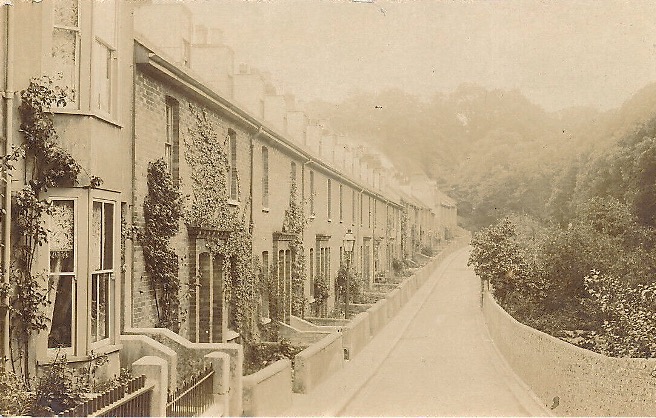
The only clue to the postcard’s date is a note in the space for the stamp that a half-penny stamp was required for inland use, but a penny stamp if sent abroad. The half-penny postcard rate was abolished in 1919, so the view must date from before then.
This postcard sold for £36 after 16 bids from 5 different bidders.
5. Lewes as a public transport hub in 1828
By 1828, near the end of King George IV’s reign, Lewes was already a transport hub at the centre of the local turnpike network, along which coaches and carriers’ vans plied their trade. There were daily coach services from Lewes to London and Brighton, and also regular services to Eastbourne, Hastings, Tunbridge Wells, Maidstone and Chatham. Travel to the west involved an initial trip to Brighton. The busiest coach office was 48 High Street, opposite the Star Inn, where Simcock and partners had their offices. They had a coach to London leaving at 9 a.m. every morning except Sunday. On most days there was also a second coach. On Monday, Wednesday and Friday this left at 5 a.m., giving plenty of time for business in town later in the day. On Sunday, Tuesday and Thursday there was a coach that had started from Eastbourne, but left Lewes for London at 11 a.m. They had a monopoly of the London-Lewes-Eastbourne route, but in 1828 three out of four coaches terminated at Lewes. The rise of Eastbourne as a seaside town still lay in the future.
There were four regular coaches every day to Brighton, by 1828 already a far larger town than Lewes. The first started from the Dorset Arms at 8 a.m., but the others were all towards the end of the working day. One left from the White Hart at 4.30 p.m., the next from Simcock’s coach office at 4.45 p.m. and the last called ‘The Safety’, departed from the Pelham Arms at 5 p.m. Simcock’s office had a coach to Eastbourne departing at 2.15 p.m. on Monday, Wednesday and Friday – presumably the return leg of Eastbourne to London coaches on the intervening days. The other coach services all departed from the Crown. At 9 a.m. on Monday, Wednesday and Friday there was a coach to Chatham calling at Uckfield, Tunbridge Wells and Maidstone, while at 10 a.m. on Tuesday, Thursday and Saturday a coach called ‘Newmans Patent’ headed for Hastings via Battle.
The coaches were supplemented by a network of carriers’ vans and waggons. Two of those heading to Brighton would carry passengers as well as parcels – presumably in rather less comfort than on the coaches. There were two services to London every weekday – J. Jarrett’s van left his office every day except Sunday, supplemented on Monday, Wednesday and Friday by Kenward’s van from the White Swan, and on Tuesday, Thursday and Saturday by Joseph Shelley’s waggon from his High Street office. There were four services most days to Brighton – Moon left his High Street office at 7 a.m. every day, followed by Joseph Fennell from the Dorset Arms at 8 a.m. (every day except Monday), while at 9 a.m. Thomas Lomas left the White Swan (except Sunday) and Edmund Levett left from an unspecified location.
Carriers’ services to other locations were less regular. James Hoad left the Bear for Hailsham on Tuesday and Friday; Banks left the Swan for Framfield on Monday and Friday; T. Wood left the Dorset Arms for Tunbridge Wells and Maidstone on Wednesdays and Saturdays, and Cook left the Bear for West Hoathly on Wednesday. This was far from the full carrier network: “Carriers go from the Dorset Arms on certain days to every town and village in the vicinity of Lewes”.
Sources: Pigot & Co’s 1828 directory; Colin Brent, ‘Lewes house histories’.
6. The theft of an egg
The 15 March 1864 Sussex Advertiser reported that George Thorpe, a pot boy at the Stag Inn, and Robert Viney, a young jockey, had been charged before the magistrates with stealing an egg from John Hubert Verrall at Lewes All Saints on 2 March.
The prosecutor lived with his father, Mr John Verrall, auctioneer, and kept chickens in a stable at the back of his house in Market Street. For the last fortnight he had missed about two eggs daily, so he marked one, put it in a manger and kept watch. He saw the pot boy take it away and give it to the jockey. The stable was not locked. A constable apprehended the lads with the marked egg.
The defending solicitor observed that the jockey could not be charged with theft, on the evidence. He should have been charged with receiving. Both lads were of previous exemplary character, as testified by trainer, Mr Bosham, and Mr Abrahams of the Stag Inn. They were both discharged, the bench remarking that it was a great temptation to leave eggs in such situations without lock or key.
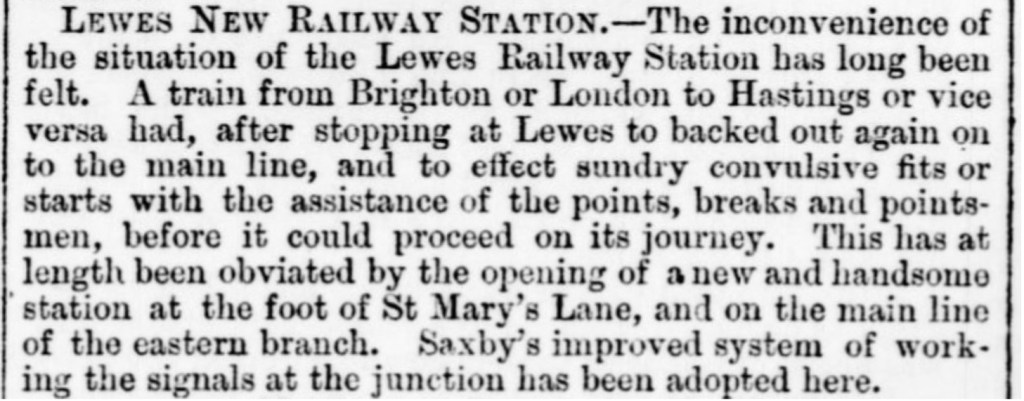
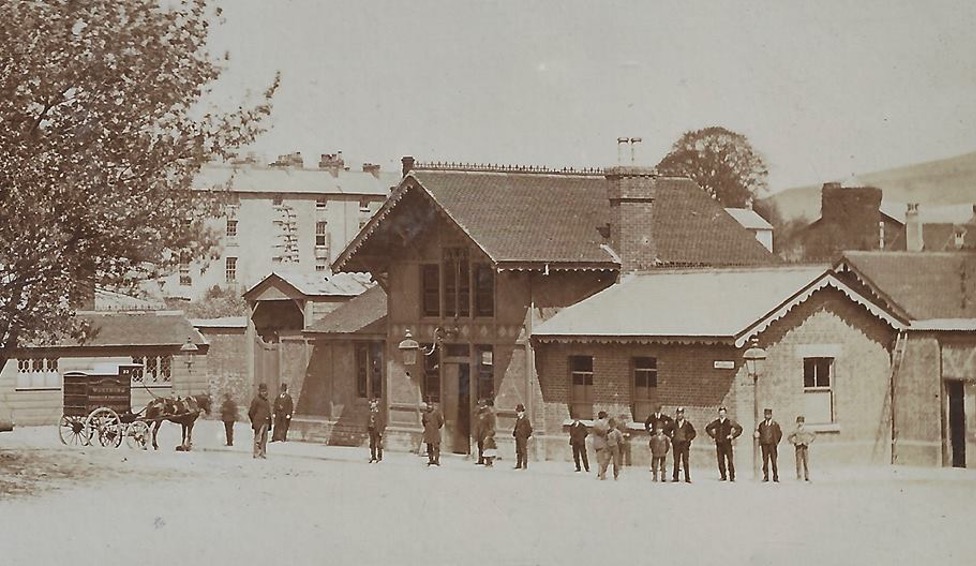
7. The 1857 Lewes Railway Station
The 5 November 1857 Brighton Gazette explains the reasons for building a new Lewes railway station at the bottom of St Mary’s Lane barely a decade after the elaborate initial version had been completed at the end of Friars Walk, where the Premier Inn now stands
8. The tallest Lewes chimney
The 15 September 1877 Southern Weekly News reported that a large chimney shaft just completed at the steam saw mills of Messrs Parsons Brothers was the highest in Lewes. The total height of the shaft, erected by a Cliffe builder, was 175 feet. Other improvements in progress there included the erection of a new engine house and saw mills. Mr Reeves, the photographer, had been successful in capturing a view of the shaft, which towered high above the houses in the neighbourhood.
Parsons Brothers were based at Eastgate Wharf.
9. The Blind Preacher
Rev William Wedlock, who served as superintendent of the Sussex Wesleyan Mission and minister of the Lewes Wesleyan church from 1863 to 1865 was an unusual man. Despite completely losing his sight he remained as powerful a preacher as ever.
William Wedlock was a Cornishman born about 1804, and in 1829 he and his Irish Protestant wife Catherine were despatched as Wesleyan missionaries to British Honduras. His two predecessors had both succumbed to the local conditions within months of arrival, so the Wesleyan Conference’s solution was to send out a married man this time. He served in Honduras until 1832, and was then moved to Jamaica, where he remained until 1837. Both countries had slavery in operation at his arrival, though emancipation throughout the British Empire occurred while he was in Jamaica. He was successful in building up the church in Honduras, where most of the members were free black men. However, he had to return to England in 1837 due to failing eyesight, probably the result of an infectious disease such as river blindness.
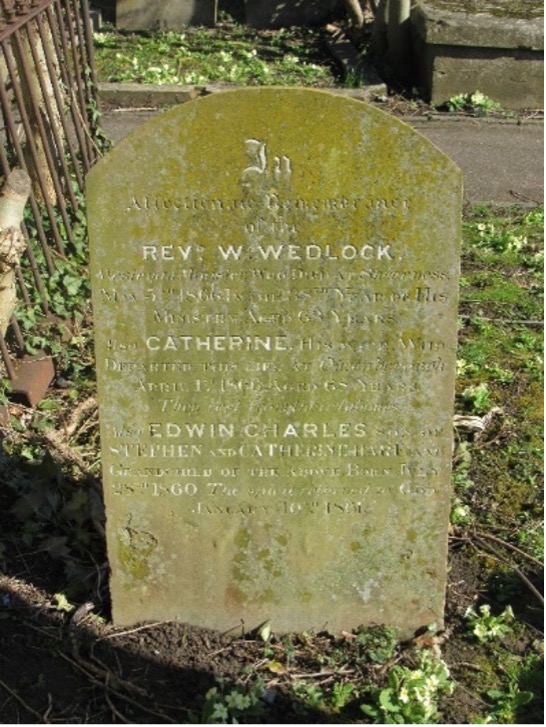
Despite this disability he undertook almost 30 years of service in Wesleyan circuits including Deal, Towcester, St Neots, Gosport, Sittingbourne, Sheppey, Poole, Portland, Barking and Guernsey before being moved to Lewes. He had four surviving children, two born in British Honduras, one in Jamaica and the last in Deal. He was noted as completely blind when he arrived in the Channel Islands in 1860. Lewes was his final post, and in 1865 he announced his retirement to Queenborough in Sheppey, where a married daughter had settled. Only just over 60, his retirement was brought on by declining health. The grateful Lewes Wesleyan congregation bought him an easy chair, and paid for it to be transported to his daughter’s residence. He died within a year, and both he and his wife are buried in Sheppey cemetery.
10. Rebuilding the Crown Inn
The Crown Inn is listed as grade II* by Historic England, and is described in the listing as:
“House, now hotel. Late C18. Grey headers with red brick dressings. Shallow paired bracketted cornice to slate roof with end stacks. 3 storeys; regular 5 window front, glazing bar sashes with gauged heads, except C20 casements on second floor. Central doubled casement on centre of second floor in segment-headed surround. Central Venetian window on first floor. Window to extreme left on ground floor in raised surround, with shallow casement and night-safe in blocked part below. Central entrance with paired pilaster surround with tall thin windows separating the outer pilasters. Central glazed door with radiating fanlight in arched surround with rusticated pilasters supporting moulded arch with keystone.”
The listing number is number 1191714.
However, an advertisement in the 23 March 1812 Sussex Weekly Advertiser suggests the building may date to the Regency, rather than the 18th century date suggested above. The brewers, Messrs Langford, seeking a new tenant, noted that this commodious inn in the centre of the town and adjacent to the market had recently been taken down and rebuilt, on an improved and extended plan.
11. Gateway House, 18 East Street
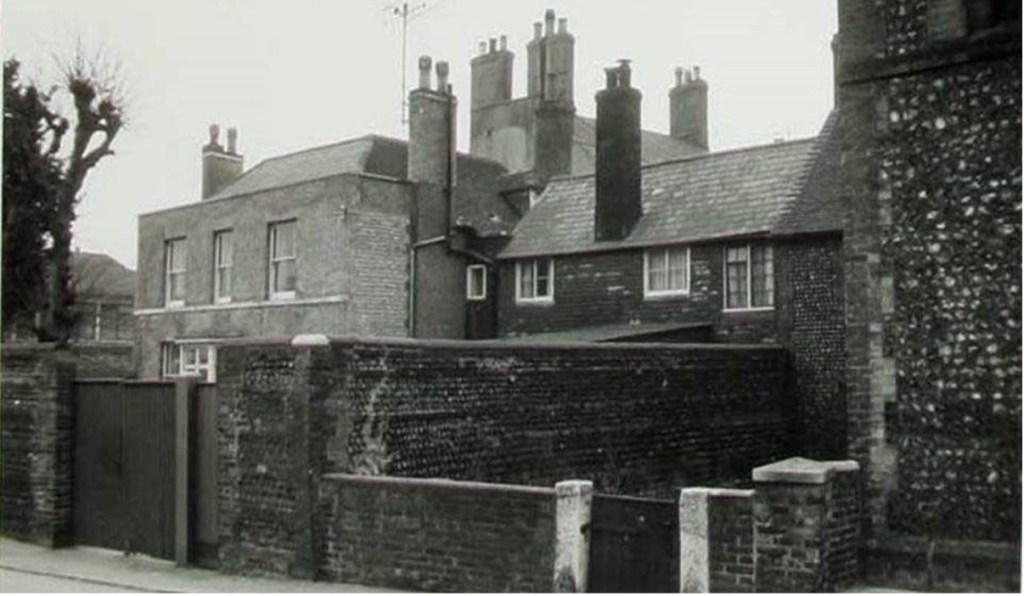
Gateway House, noted in the 1925 Medical Officer of Health’s report to Lewes Borough Council as a home run by the Diocesan Purity Association, was a Magdelen Home [https://www.childrenshomes.org.uk/list/Sussex.shtml]. Its annual reports from 1930 to 1954, when run by the Diocesan Moral Welfare Association, survive as ESRO CHC 42/8.
Its original frontage was onto Eastgate Street, but the entrance was moved to the side, and it was given the address 18 East Street The building was originally listed as grade III, described as being early 19th century, two storeys high, with a yellow brick façade fronting Eastgate Street but red brick against East Street. When listed a modern French window had replaced the original front door, the entrance had been changed, the glazing bars were missing from the windows and there were modern extensions to the north. It was de-listed and demolished in 1970.
Two 1962 photographs of the building from the Historic England collection are show below [BE 256/261 & 256/264]. In the first the side of Eastgate Baptist Chapel can be seen to the right. The second shows the view from a location on Eastgate Street in front of the Chapel.

12. The Lewes Skating Rink
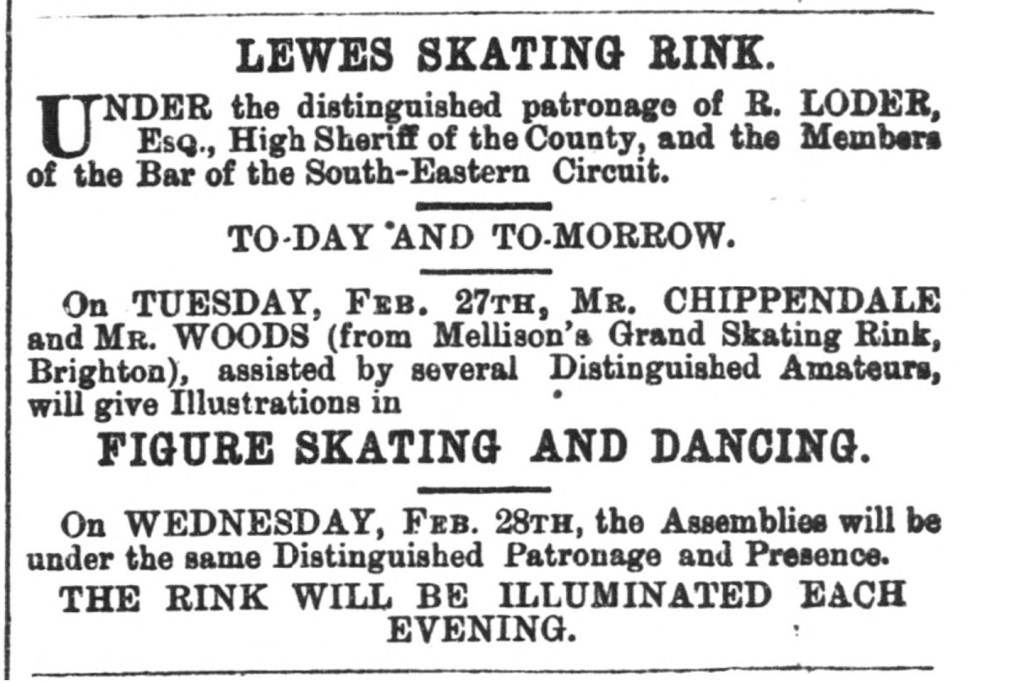
The 27 February 1877 Sussex Advertiser reported:
“It will be seen by an announcement in our business columns that special arrangements have been made for the Lewes Skating Rink during the present week. The patronage of the High Sheriff of the county has been kindly conceded and the presence and aid of Mr Chippendale and Mr Woods, two of the most celebrated and skilful amateur rink skaters of the day, have been secured. The hall will be brilliantly illuminated and a ‘feast of lanterns’ forms part of the programme. The presence of so large a number of persons as the business of the Assizes invariably congregates from all parts of the county will naturally swell the attendance at the rink on the coming occasion. Fortunately the area of the rink is fully sufficient, not only conveniently to accommodate a considerable body of spectators, but also to afford ‘ample space and verge’ for the unimpeded exertions of the skaters. There will doubtless be very full gatherings.”
13. A.G.M. Reports
Chair’s Report (by Ian McClelland)
This has been another successful year for LHG – thank you for your membership and support.
We continued our practice of hosting our monthly talks on Zoom in the winter, and in King’s Church in the summer. Average attendance at our live meetings was 146. And the most popular live talk being Debby Matthews’s talk on Station Street. Membership has remained more or less the same as last year at about 520. As you will see from the financial report we end the year in a healthy state.
We have continued to publish our monthly Bulletin. We also participated successfully again in both the Lewes Society’s Fair and the Heritage Open Days weekend, both in September. This year we also published ‘Station Street’ by Debby Matthews as part of the Street Stories project.
Once again thanks are due to all our EC members for their commitment and contributions:
Thanks are also due to our various volunteers, including Tessa Bain who maintains our display boards.
EC membership
We are still keen to recruit someone to continue the work of keeping us in the public eye. Fortunately, thanks to all the PR work of the past years, what needs to be done is well documented. However we need to look to the future so we would like to recruit someone who is also familiar with social media to support our public presence. If you know of anyone who might be interested to take on this role please encourage them to get in touch via info@leweshistory.org.uk.
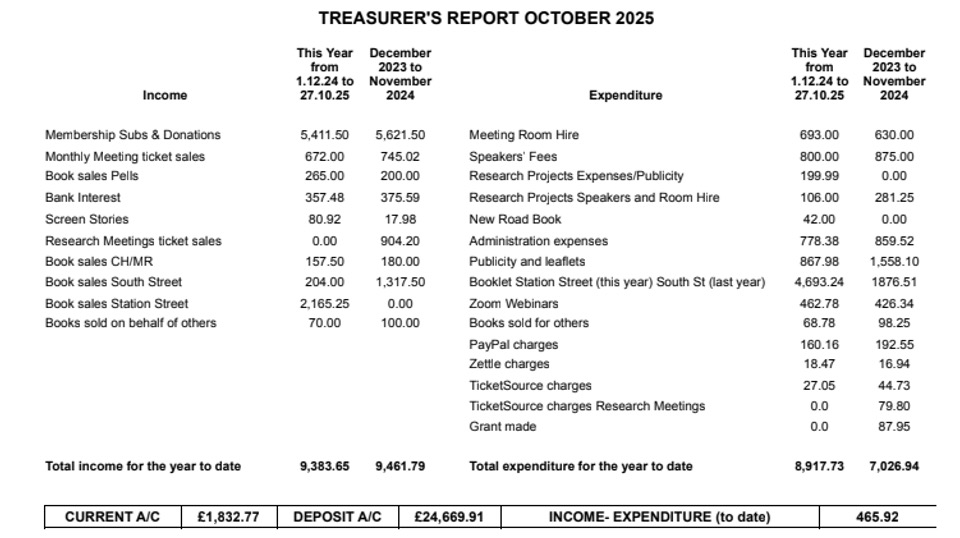
Treasurer’s Preliminary Report (by Phil Green)
Below are our interim accounts for 2024-5, but our financial year is not yet complete. Final accounts will be published early in 2026.
John Kay 01273 813388 johnkay56@gmail.com
Contact details for Friends of the Lewes History Group promoting local historical events
Sussex Archaeological Society: http://sussexpast.co.uk/events
Lewes Priory Trust: http://www.lewespriory.org.uk/news-listing
Lewes Archaeological group: http://lewesarchaeology.org.uk and go to ‘Lectures’
Friends of Lewes: http://friends-of-lewes.org.uk/diary/
Lewes Priory School Memorial Chapel Trust: https://www.lewesprioryschoolmemorialchapeltrust.org/
Facebook: https://www.facebook.com/LewesHistoryGroup
Twitter (X): https://twitter.com/LewesHistory


Website archived by the British Library

 Lewes History Group