
Click on cover image below for more details

Click on cover image below for more details
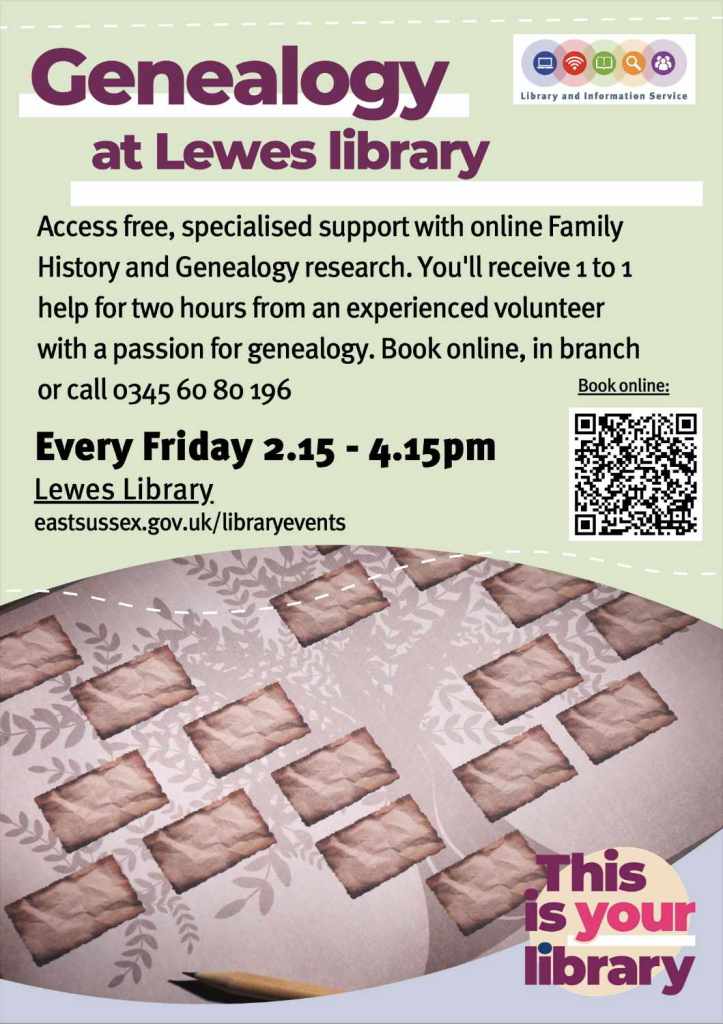
There’s a new free Genealogy service available now at Lewes Library,
every Friday 2.15 – 4.15pm.
Customers can access specialised support with online Family History and Genealogy research. You’ll receive 1 to 1 help for two hours from an experienced volunteer with a passion for genealogy.
Book online, at the Library or call 0345 60 80 196.
Please note: this Bulletin is being put on the website one month after publication. Alternatively you can receive the Bulletin by email as soon as it is published, by becoming a member of the Lewes History Group, and renewing your membership annually
1. Next meetings: 3 Jun 2025, Ruth Thomson, ‘Grown in Lewes’
9 Jun 2025, Anthony Dicks, ‘The Piltdown Men’
2. Heritage Open Weekend Committee (by Sue Berry)
3. Dr Richard Russell
4. The monastic diet at Lewes Priory (by Chris Grove)
5. A Parish Boundary marker on Malling Street
6. The burial of Henry Pelham, an MP for Lewes borough
7. A sale at Malling House
8. Joseph Rickman’s obituary
9. Lewes Prisoner of War Depot, 1917
10. 1930s advertisement for the Phoenix Iron & Steel Works
11. Eulogy for a Tin Hut, Lewes, 1902-2003 (by John Rose)
1. Next Meetings
Rescheduled April Meeting 7.30 p.m. King’s Church Tuesday 3 June 2025
Ruth Thomson Grown in Lewes
June Meeting 7.30 p.m. King’s Church Monday 9 June 2025
Anthony Dicks The Piltdown Men
This month we shall have two meetings, including our rescheduled April meeting.
In its day the discovery of ‘Piltdown Man’ caused quite a sensation and made a national reputation for the solicitor Charles Dawson, who claimed its discovery. Although he practised in Uckfield, Dawson’s home was at Castle Lodge House, Lewes, which at least some members of the Sussex Archaeological Society believed he had acquired by false pretences, at their expense.
Piltdown Man was not finally established as a fraud until after his death. Anthony Dicks will argue that while Charles Dawson was undoubtedly a fraudster, he could not possibly have carried out the fraud unaided. Indeed, it is likely that his early involvement was as an unwitting victim of the Piltdown forgery himself – although he certainly then tried to take full advantage of it. He will review the other contenders as participants in the fraud (with a conclusion), and also several other examples of Dawson’s own fraudulent (and criminal) activities.
Admission to both meetings is free for members and there is no need to reserve your place. Everyone is very welcome, but there is an entry charge of £4 for non-members, with tickets available in advance via Ticketsource.co.uk/lhg.
2. Heritage Open Weekend Committee (by Sue Berry)
The very successful Heritage Open Weekend which is held every September is organised by a small committee. We do not meet often but we need another committee member to help with planning the weekend and to help with the running of the weekend itself. This year’s festival, with an architecture theme, is to take place over the weekend of Friday 12 to Sunday 14 September.
For more information, please contact the Chair – Peter Earl on 07772 031269 or email at pgearl@tiscali.co.uk
3. Dr Richard Russell
From ‘Baxter’s Guide to Lewes’, 6th edition, published in 1852:
“R.D. Russell, M.D., F.R.S., born in 1687, was the son of a surgeon at Lewes and was educated at the Free Grammar School. He removed to Brighton in 1747, where he not only established his own fame, but established the prosperity of the town. He was the author of several medical works, which greatly increased his reputation. He died in London on 25 December 1759 and was buried at South Malling”.
The 24 December 1759 Sussex Advertiser reports: ““On Wednesday last died, at London, Richard Russell of Malling, near Lewes, MD, a gentleman greatly esteemed in his profession in these parts”. He actually died on 19 December 1759, a few days before Christmas Day. His memorial in South Malling church includes the statement (in classical Greek) ‘The sea washes away the ills of man’.
Richard Russell was the eldest of seven children of the Lewes surgeon and apothecary Nathaniel Russell, who lived at 78 High Street in St Michael’s parish. He was apprenticed to his father and later studied medicine at Leyden, in the Netherlands. In 1719 he married Mary Kempe, heiress to Malling Deanery, without her father’s permission, though father and son-in-law were later reconciled. He began his medical practice in Lewes but moved to Brighton and in 1750 published a Latin treatise in which he recommended drinking and bathing in seawater, especially from the sea around Brighton, to treat enlarged lymphatic glands. His work was translated into English and published as ‘Glandular Diseases, or a Dissertation on the Use of Sea Water in the Affections of the Glands’. Under this snappy title, it went through six editions before 1769. His Brighton house was on the site of the Royal Albion Hotel. After his death his son, the barrister William Kempe (who changed his surname after inheriting his maternal grandfather’s estate based on Malling Deanery) rented out the house to seasonal visitors. His tenants included the Duke of Cumberland, the brother of King George III and the general who vanquished Bonny Prince Charlie at Culloden in 1745. The Duke was visited there by his nephew, the Prince of Wales and the future George IV, which proved to be a key event in Brighton’s history.
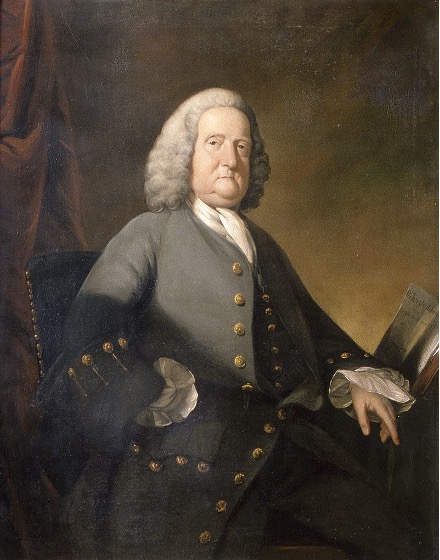
Dr Richard Russell, painted about 1755 by Benjamin Wilson (1721-1788). This portrait is owned by the Brighton & Hove Museums and Art Galleries. The book by his left hand is the Latin edition of his most famous treatise.
Sources: Wikipedia; M.A. Lower, ‘The Worthies of Sussex’ (1864); L.W. Lauste, ‘Dr Richard Russell, 1687-1759’, Proceedings of the Royal Society of Medicine, vol.67, pp.327-330 (1974).
4. The monastic diet at Lewes Priory (by Chris Grove)
The Cluniac Order followed the Rule of St Benedict, which included strict directives for daily living including diet and the timing of meals in the refectory (the monastic dining room). The Rule allowed monks a midday ‘dinner’ every day and, additionally, a supper between Easter and Holy Cross Day on 13 September. Eating meat (the flesh of quadrupeds) was forbidden, except in cases of sickness, when meat was served in the Infirmary. The Prior’s high status meant he entertained many guests in his private dwelling where meat was served. The monks had a personal daily ration of a third of a kilogram of bread and there was a daily allowance of wine for its supposed health benefits (the Rule recommended half a bottle of wine for the sick and infirm).
Large volumes of low alcoholic ale were drunk every day. Monks complied with the strict Rule regarding the refectory diet, but as the standard of living rose from property gifted by landed gentry, greater quantities and varieties of food were consumed in the misericord, a room close to the kitchen where some relaxation of monastic rules was permitted. By the 12th century, the monks were eating as rich a diet as the landed gentry.1
Most of the food was grown or produced at the Priory’s own manor farms. The home farm, Priory Grange, 2 covered all arable land in Southover. Priory accounting records from 1533-34 were retained by Thomas Cromwell and confirm that substantial quantities of meat were consumed. The annual production by the home farm for consumption by the Priory included 69 oxen, 29 cows, 1 bullock, 21 calves, 779 sheep, 12 lambs, 115 pigs, and 83 piglets. More than 600 rabbits came from the Upper and Lower Rise south of the Priory. Nearly 1,000 doves came from Falmer and Swanborough, 84 geese from Falmer, Swanborough and Langney Grange (near Eastbourne), 3 and 36 hens from the same manor farms. More than 200 cheeses came from Swanborough, each weighing 22lb. Some 25,000 eggs and most of the fish were purchased, although some fish came from the Priory’s own ponds. Wheat and barley came from the downland manors and rectories, and more than 100,000 kgs of grain were used to produce more than 50,000 loaves per year. Nearly 100,000 litres of beer were produced. Oats and beans were used in pottage – a thick soup or stew made by boiling vegetables, grains, and, if available, meat or fish. It is believed that the Priory was self-sufficient in vegetables and fruit grown within the Priory precinct. The monks’ diet was clearly deficient in fresh fruit and vegetables and excessive in meat. 4
Richard Lewis’ excavation of the Priory from 1969-82 included analysis of plant remains. The most common remains were sloe stones with grape seeds the second largest. Other remains included apple, blackberry, and elderberry. 5
The range of gardens in the Priory is indicated by the surviving accounting records of the granator (responsible for the sale and purchase of grain), the larderer (responsible for secure food storage, and abattoir activities), and the hosteler (responsible for looking after guests): Onions and garlic were grown in the vine garden (red wine was preferred to white wine but it is likely that most of the consumed wine was purchased). Mustard and saffron were grown in the ‘convent garden’. Apples, pears, onions, and hemp were grown in the hosteler’s garden.
Wheat was grown in the upper croft (this was probably the upper level where The Mount, Dripping Pan and upper Convent Field are today – the east of the Priory Precinct). Barley was grown in the lower croft (probably the lower Convent Field down to the Cockshut stream). Ewes grazed in the orchard and in the cemetery, alongside what is now Trinity Southover Church, and the ‘great garden’ next to the cemetery. 6 There were physic herb gardens for medicinal plants where raised beds prevented plants becoming waterlogged; kitchen gardens; rose and flower gardens; and orchards. Another garden was the Cloister garth, the formal area surrounded by the Cloister.
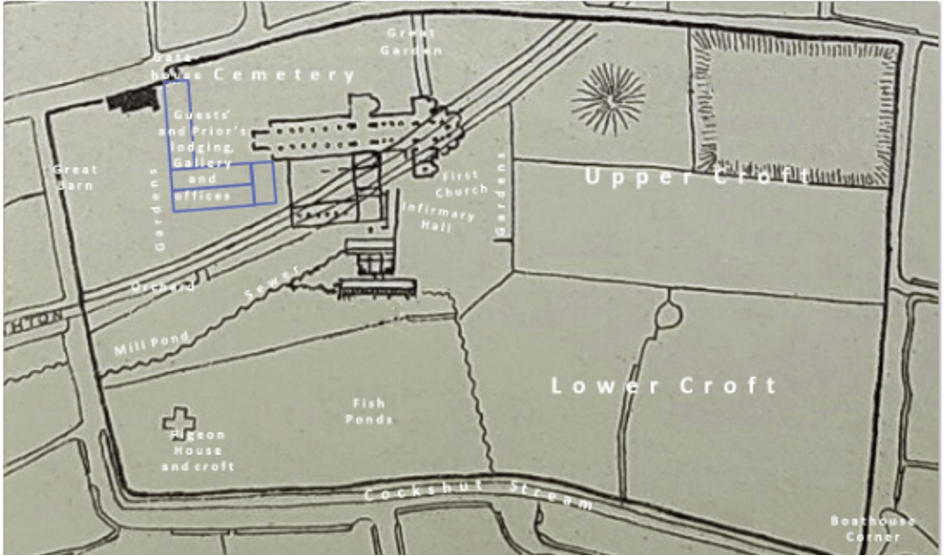
Sources: The information on monastic diet comes largely from Graham Mayhew ‘The Monks of St Pancras’; Barbara Harvey ‘Living and Dying In England 1100-1540:
The Monastic Experience’;
References: 1; From ‘Living and Dying In England 1100-1540: The Monastic Experience’ by Barbara Harvey, Chapter II Diet. 2; https://en.wikipedia.org/wiki/Monastic_grange. The word grange comes through French graunge from Latin granica meaning a granary. 3; In Victorian times the Langney grange farm was incorrectly called a priory, and this has continued into modern times. 4; From Chapter 5 of Graham Mayhew’s ‘The Monks of St Pancras’. 5; Chapter 20 ‘Plant remains’ from Malcolm Lyne’s Lewes Priory Excavations by Richard Lewis 1969-82. 6; Page 197, ‘Pre- Georgian Lewes c890-1714, the emergence of a county town’ by Colin Brent.
5. A Parish Boundary marker on Malling Street
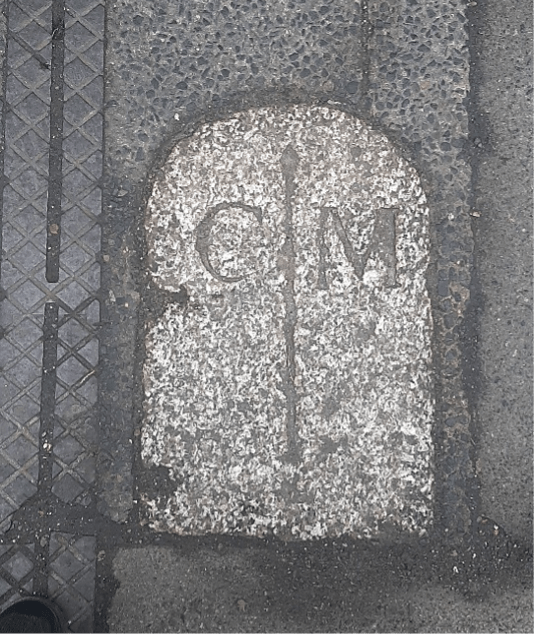
A contributor to the Lewes Present Facebook page drew attention to this carved stone in the Malling Street pavement. It was placed there to mark the boundary between Cliffe parish and South Malling parish.
Cliffe parish and this part of South Malling are today both constituents of the area for which Lewes Town Council is responsible (which includes much of Malling Down and the chalkpits along the B2192). South Malling parish no longer exists – it has been carved up between Lewes, Ringmer and Glynde. However, before 1834 which side of this boundary you lived would have determined the parish from which you needed to seek help should you by mischance fall on hard times.
6. The burial of Henry Pelham, an MP for Lewes borough
Henry Pelham (1759-1797) was born in July 1759 and died in January 1797, at the age of 38. He was the second son of Thomas Pelham, the 1st Earl of Chichester, and it was his elder brother, another Thomas Pelham, who was to inherit the title. As was usual for members of this family Henry was baptised at Stanmer, where the Earl had his country house, but buried in the Pelham family vault under the chancel of Laughton church, the family’s ancestral parish.
Henry Pelham was educated at Westminster School but did not attend university. Instead he joined the 3rd Foot Guards as a teenager in 1775, and followed a military career until he retired in 1792 with the rank of Lieutenant-Colonel. His military career, which often took him abroad, did not prevent him from serving as MP from Lewes from 1780 (as soon as he reached the age of 21) until he stepped down in 1796. He was initially a Whig, like all the Pelhams, but became a supporter of William Pitt the younger when political allegiances became more complicated. His father and elder brother had both represented the county of Sussex in Parliament before they entered the House of Lords. In 1782 he was appointed Secretary to the Lord Lieutenant of Ireland, and for part of the time he was in that post his elder brother, a more active and successful politician, held a more senior role in the government of that country.
In 1788 Henry Pelham married. He had three daughters, but was in poor health by the 1790s. He died at his house in Jermyn Street, Mayfair, on 17 January 1797. The hearse with his remains set out for Laughton, with six of the undertaker’s men on board. A mourning coach containing family members followed. However, near Maresfield the hearse was overturned “owing to the badness of the roads and the cloudiness of the evening”. Two of the undertaker’s men were “considerably hurt”. The mourning coach only avoided the same fate because its frightened horses bolted onto the better side of the road. The hearse was righted, the journey was resumed and on the following day his body joined those of other distinguished members of his family in the Laughton vault.
In 2010 this vault was opened, apparently for the first time since the burial of the 3rd Earl of Chichester in 1886. The occasion was a crack in the entrance stone, that required repair. I was lucky enough to be able to enter the vault, which has 48 recesses, the majority occupied by the coffins of members of the family. They included those of two brothers who both served as 18th century Prime Ministers, Henry Pelham and Thomas Pelham-Holles, Duke of Newcastle. The vault was still in good repair, ventilated and dry, and the air quality was excellent.
Sources: History of Parliament online and press reports of the journey and the burial.
7. A sale at Malling House
The 4 October 1824 Sussex Advertiser noted the forthcoming auction on 6 & 7 October by Verrall & Son on the premises at Malling House of the valuable household furniture, fine old port wine, greenhouse plants, garden frames and lights, light waggon, cart, manure, etc, belonging to William Baldock esq (leaving the county).
The household furniture included a set of mahogany dining tables (4 ft 9 x 13 ft 6); clawed, Pembroke, card, work, pier & dressing tables; high and low wardrobes and drawers; commodes; mahogany & painted chairs; two pier glasses (one 30 inches x 48, and one 24 x 42); 2 rich cut chandaliers [sic]; two mahogany bookcases (one 9 ft wide by 9 ft 3 high, one 8 ft by 7 ft high); Brussels, Wilton, Venetian & other carpets; a capital 6 ft 6 wide bedstead with dimity furniture and bedding complete; several tent and servants’ complete beds; a set of elegant chintz curtains; two clocks; a chamber organ; a grand rocking horse; a long dinner service of embossed white china; two sets of blue dinner ware; tea and coffee services; knives and forks; glass and stone ware; Slater’s patent range; kitchen and pantry requisites; 120 dozen of wine bottles; a few books; 12 beautiful orange and lemon trees set with fruit; about 500 other plants and pots; a marquee; a light waggon; a cart; a child’s carriage; harness; saddles; manure; two young sows; and numerous other effects. Together with 80 dozen of fine old crusted port wine, from 7 to 9 years in bottle, and about half of the favourite vintage of 1812.
8. Joseph Rickman’s obituary
An 1810 newspaper obituary of Joseph Rickman read as follows:
“At Dublin, aged 64, Mr Joseph Rickman, a native of Lewes, and formerly one of the people called Quakers. He had for the last two or three years held forth as a street-preacher in most of the principal towns of the kingdom, and particularly in the Metropolis, with a degree of eccentricity bordering on insanity. He was by profession a surgeon and apothecary, and practised many years at Maidenhead, Berks.”
Joseph Rickman (1749-1810) was a middle son of John Rickman (1715-1789), the founder of the Quaker Rickman dynasty of Lewes, who purchased the freehold of the Bear Inn, Cliffe, and established a brewery there. John Rickman’s eldest son, Richard Peters Rickman (1745-1801), inherited the brewery, while his youngest son, Thomas ‘Clio’ Rickman (1760-1834), was a celebrated but eccentric London bookseller best remembered as a biographer of Tom Paine, who he knew in his Lewes childhood. Another account of Joseph Rickman’s death describes him as a dissenting minister and says that he died as a result of a ruptured blood vessel.
Joseph Rickman was apprenticed to a Lewes surgeon & apothecary. He married in Staines in 1772 and had a large family. He practised as a druggist in Maidenhead, before returning to Lewes, in partnership with a son, Thomas. He and Thomas both left the Quakers, his son because he wished to marry his first cousin, which the Quakers did not permit. This Thomas Rickman (1776-1841) became very interested in architecture and it was he who introduced the terms Norman, Early English, Decorated and Perpendicular to describe the early varieties of Gothic architecture in our island. He has a Wikipedia entry. Generations of this Rickman family showed remarkable talents in a range of different fields but they were often unconventional in character.
Sources: 30 November 1810 Kentish Gazette; 27 November 1810 Kentish Weekly Journal; David Hitchen, ‘Quakers in Lewes’ (2nd edn: 2010); Mark Antony Lower, ‘The Worthies of Sussex’ (1865).
9. Lewes Prisoner of War Depot, 1917
This postcard was offered for sale recently on ebay. The central sign reads “P.o.W. Depot, Lewes, Sussex, 1917”, while the image shows a hundred or so men, some wearing a variety of uniforms but others apparently dressed in civilian clothes.
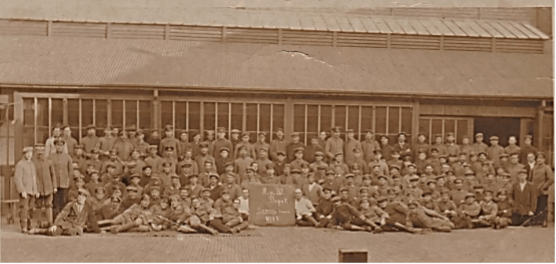
According to the ‘Sussex in the Great War’ website the North Street prison was used to house German prisoners between 1917 and 1919. It had ceased to be a Naval Prison in 1910, and according to the Historic Environment Record for the site the building was transferred in 1911 to the Prison Commissioners, who promptly sold it to the Sussex Territorial Army. These Great War prisoners do not seem to have had the same positive impact on the local community as the Finnish prisoners captured in the Crimean War and housed there 60 years previously.
10. 1930s advertisement for the Phoenix Iron & Steel Works
This trade advertisement for the Phoenix Iron & Steel works dates the origins of the Every iron foundry to 1832, with steel added from 1900. At this date it will have been the town’s largest employer. The fourth generation of the Every family sold the business in 1951, but the Phoenix Ironworks was still in business in 1968, known as the East Sussex Engineering Company Ltd, North Place, Lewes. In 1976 the business was purchased and stripped of its assets by Aurora Holdings, finally closing when the last few workers were made redundant in 1986.

Source: image from ebay; information from https://www.abandoned-derelict.co.uk/old-foundry-workshops-sussex/
11. Eulogy for a Tin Hut, Lewes, 1902-2003 (by John Rose)
Your wrinkled skin was not to know
A gasp of admiration for your beauty.
You never heard the lilt of soaring strings
Nor glowed with works of splendid art
Nor yet afforded holy space
For simple worship for the poor.
No. An Isolation Hospital for you
Set down in a damp chalk-pit.
Your bolted panels served to give
Crude shelter to the victims of disease.
Eight men: eight women too
Cast out in horror as the smallpox raged.
Still you served as
Later on the burgers cowered
When TB came to plague the town.
Yet following the war to end all wars
And soldiers were returning to the hero land
You were transported to a field at edge of town
Set down by the grateful burgers
(Feeling sure the germs had mostly gone)
To make a pair of Council Houses.
Re-assembled. Semi-detached.
Still later
When the families had left their hollow homes
Your walls echoed shouts and laughter
Of naked football lads
And teams in whites athirst for
The ritual break for tea.
After a century of corrugated service
You’ve been unbolted yet again
This time to take the mournful route
To the knackers yard.
You’ll serve again no doubt
Perhaps remodelled as a myriad supermarket cans
For sausages or beans
So on
Ad infinitum.
A poem written by the late John Rose at Lewes in December 2004 in memory of the tin hut then lately removed from its final resting place in Southover.
John Kay 01273 813388 johnkay56@gmail.com
Contact details for Friends of the Lewes History Group promoting local historical events
Sussex Archaeological Society: http://sussexpast.co.uk/events
Lewes Priory Trust: http://www.lewespriory.org.uk/news-listing
Lewes Archaeological group: http://lewesarchaeology.org.uk and go to ‘Lectures’
Friends of Lewes: http://friends-of-lewes.org.uk/diary/
Lewes Priory School Memorial Chapel Trust: https://www.lewesprioryschoolmemorialchapeltrust.org/
Facebook: https://www.facebook.com/LewesHistoryGroup
Twitter (X): https://twitter.com/LewesHistory


Website archived by the British Library

 Lewes History Group