South Street History > The People, and Social Activities
Censuses showing residents’ occupations
Shown below are estimated numbers indicating the occupations of South Street residents by type of work; also how many residents were born outside Sussex:
1841 Census occupations for South Street (Cliffe and South Malling)
In this census there are about twice as many manual labourers as skilled artisans. There are quite a number of agricultural workers until late in the century. Note that all residents are from Sussex.
- Shops/retailing: 8 (including baker, grocer, 2 butchers and 2 dairymen)
- Publican/inn keepers: 4 (Fountain, Thatched House, Old Ship, Snowdrop)
- Trades: 13 (including 2 shoemakers, 3 sawyers, tailor, basket maker, blacksmith)
- Manual workers: 29 (including 22 general labourers, 1 agricultural labourer)
- River Workers: 7 (5 bargemen, 2 shipwrights)
- Women workers: 7 (governess, 4 laundresses, milliner, servant)
- Independent means: 9
- Workhouse: 27 inmates (18 male, 9 female, aged from 1 month to 65 years)
All the South Street residents are born in Sussex.
1851 Census occupations for South Street (Cliffe and South Malling)
There is a big increase in the number of workers living in the street, a wider variety of trades and many women and boys working. There are a lot more workhouse inmates. Now a few residents are from outside Sussex.
- Shops/retailing: 17 (including 3 bakers, 3 grocers, 2 coal merchants, and a dealer in Berlin wool – a form of needlepoint)
- Publicans/Inn Keepers: 4 (Fountain, Thatched House, Old Ship, Snowdrop)
- Trades: 25 (including 3 blacksmiths, clockmaker, ostler, rat catcher, tanner)
- Manual workers: 39 (including 13 agricultural labourers, 8 chalkpit/lime burners, 2 iron foundry labourers)
- River Workers: 6 (5 bargemen, ship’s carpenter)
- Women Workers: 27 (7 servants/maids, 6 dressmakers/seamstresses, 7 laundresses/washerwomen, 2 school mistresses)
- Boys/apprentices: 17 (including 5 errand boys, shepherd boy, 3 trade apprentices)
- Clerks/administrators/professional: 6 (including 3 proprietors of houses)
- Pensioners: 3
- Workhouse: 59 inmates (37 male, 22 female, aged from 1 month to 72 years)
Birthplaces other than Sussex: 4 Kent, 2 London, 1 Plymouth, 1 Ireland
1861 Census occupations for South Street (Cliffe and South Malling)
By this date there are even more women in employment and more residents are what I have classed as white collar workers. There are slightly fewer inmates in the workhouse. There is also a big increase in the number of residents from outwith Sussex.
- Shops/retailing: 8 (including 2 bakers, butcher, corn merchant)
- Publicans/Inn Keepers: 5 (Fountain, Thatched House, Old Ship, Anchor, Snowdrop)
- Trades: 35 (including 3 blacksmiths, clockmaker, 3 tailors, 2 whitesmiths, 3 shoemakers, 4 carpenters, 6 sawyers, shepherd, mechanic & engine builder)
- Manual workers: 30 (including 11 agricultural labourers, 5 chalkpit/ lime burners, 2 iron foundry labourers, 2 gardeners)
- River Workers: 6 (6 bargemen)
- Women Workers: 39 (8 servants/maids, 11 dressmakers/seamstresses, 12 laundresses/washerwomen, school mistress, 3 milliners, 2 shop girls)
- Boys/apprentices: 5 (including 3 errand boys, shepherd boy, watchmaker’s apprentice)
- Clerks/administrators/professional: 10 (including 3 proprietors of houses, various clerks and a barge owner)
- Pensioners: 2
- Workhouse: 49 inmates (23 male, 26 female, aged from 6 months to 70 years)
Birthplaces other than Sussex: 5 Kent, 3 London, Hertfordshire, Essex, Hampshire, Derbyshire, Staffordshire, 3 South Wales, 2 Scotland, 1 born in France but British subject.
1871 Census occupations for South Street (Cliffe and South Malling)
Now there are an equal number of people with skills, as there are manual workers. Still many women in employment, but fewer boys as presumably more of them were in education. Again more residents came from outwith the county. The South Street workhouse had closed when the new workhouse in De Montfort Road was opened in 1868.
- Shops/retailing: 15 (including 3 bakers, 2 butchers, corn merchant, 4 hawkers)
- Publicans/Inn Keepers: 5 (Fountain, Thatched House, Old Ship, Anchor, Snowdrop)
- Trades: 36 (including 3 blacksmiths, 3 printers, 2 whitesmiths, wheelwright, 2 shoemakers, 5 tailors, 4 carpenters, 2 sawyers, shepherd, organ builder)
- Manual workers: 36 (including 7 agricultural labourers, 17 general labourers, 8 chalkpit/ lime burners, 2 railway workers)
- River Workers: 9 (6 bargemen, 2 ship’s carpenters, barge builder)
- Women Workers: 37 (6 servants/maids, 7 dressmakers/seamstresses, 11 laundresses/washerwomen, 3 school mistresses, 2 nurses)
- Boys/apprentices: 5
- Clerks/administrators/professional: 8 (including 2 railway clerks, solicitor’s clerk and a barge owner)
- Other: 3 unemployed labourers, 2 on parish relief, and 2 retired. Note: by this date the workhouse had moved to De Montfort Road
Birthplaces other than Sussex: 5 Kent, 9 London, Surrey, Essex, 5 Hampshire, 3 Isle of Wight, Oxfordshire, 8 Lincolnshire, 2 Suffolk, Devon. Lodgers at Old Ship from Ireland and New York.
1881 Census occupations for South Street (Cliffe and South Malling)
There are now more men working in trades and fewer manual labourers.
- Shops/retailing: 11 (including 3 bakers, 2 butchers, 5 grocery store workers, 2 drapers, post office)
- Publicans/Inn Keepers: 5 (Fountain, Thatched House, Old Ship, Anchor, Snowdrop)
- Trades: 40 (including 2 blacksmiths, 4 whitesmiths, 3 tailors, 5 carpenters, 2 sawyers, gas fitter, piano tuner)
- Manual workers: 34 (including 6 agricultural labourers, 14 general labourers, 8 chalkpit/lime burners, 3 railway workers)
- River Workers: 8 (6 bargemen, barge builder, ship’s cook)
- Women Workers: 28 (9 dressmakers/seamstresses, 5 laundresses/washerwomen, 2 milliners, 2 school mistresses, 2 mother’s helps)
- Boys/apprentices: 5
- Clerks/administrators/professional: 5 (accountant, solicitor’s clerk, 2 commercial travellers)
Birthplaces other than Sussex: 3 Kent, 8 London, 9 Surrey, 2 Hampshire, Berkshire, Suffolk, Devon, Dorset, Manchester, Cheshire, Sunderland, 2 Scotland, 2 West Indies (Barbados).
1891 Census occupations for South Street (Cliffe and South Malling)
Like 10 years earlier, South Street had become the home to many skilled craftsmen.
- Shops/retailing: 9 (including 3 bakers, 4 grocery store workers)
- Publicans/Inn Keepers: 5 (Fountain, Thatched House, Old Ship, Anchor, Snowdrop)
- Trades: 46 (including 4 wheelwrights, blacksmith, 2 whitesmiths, 2 tailors, 7 carpenters/cabinet makers, 3 sawyers, plumber, stationary engine driver, machine man, shoe maker)
- Manual workers: 27 (including 6 agricultural labourers, 8 chalkpit/ lime burners, 3 railway workers)
- River Workers: 6 (3 bargemen, 2 barge builders)
- Women Workers: 26 (6 dressmakers/seamstresses, 5 laundresses/ washerwomen, 2 milliners, 2 school mistresses, 6 servants)
- Boys/apprentices: 12 (7 errand boys, 4 apprentices)
- Clerks/administrators/professional: 8 (various clerks, commercial traveller, assistant gas manager)
- Other: 5 living on own means
- Women Workers: 25 (3 dressmakers/seamstresses, 3 laundresses/washerwomen, 6 servants, 4 nurses)
Birthplaces other than Sussex: 6 Kent, 5 London, 3 Hampshire, 2 Essex, Suffolk, Somerset, Huntingdonshire, Durham, Scotland
1901 Census occupations for South Street (Cliffe and South Malling)
A similar employment profile to the 1891 census.
- Shops/retailing: 18 (including 4 bakers, greengrocer, cattle dealer, steward in private club)
- Publicans/Inn Keepers: 5 (Fountain, Thatched House, Old Ship, Anchor, Snowdrop)
- Trades: 46 (including 5 wheelwrights, 3 blacksmiths, whitesmith, 7 carpenters/cabinet makers, 5 printers, 3 house painters, electrical engineer, basket maker, 2 gardeners)
- Manual workers: 36 (including 4 agricultural labourers, 6 chalkpit/lime burners, 3 railway workers, 3 iron foundry labourers)
- River Workers: 5 (3 bargemen, 2 barge builders)
- Women Workers: 25 (3 dressmakers/seamstresses, 3 laundresses/washerwomen, 6 servants, 4 nurses)
- Boys/apprentices: 9 (6 errand boys, 4 apprentices)
- Clerks/administrators/professional: 11 (teacher, accountant, book keeper, various clerks, gas manager)
- Other: 4 living on own means
Birthplaces other than Sussex: 7 Kent, 13 London, 2 Surrey, 4 Hampshire, Wiltshire, Somerset, 2 Dorset, Devon, 3 Essex, 5 Staffordshire, Norfolk, Leicestershire, 5 Wales, 2 Scotland, 2 Ireland
1911 Census occupations for South Street (Cliffe and South Malling)
The street continued to be the home to skilled artisans. There are no longer agricultural labourers and fewer women are working – in particular work as a washerwoman seems to have vanished.
- Shops/retailing: 21 (including 4 bakers. 5 butchers, 2 grocers, 2 drapers, 5 hawkers/pedlars)
- Publicans/Inn Keepers: 3 (Fountain, Thatched House, Snowdrop)
- Trades: 54 (including 2 blacksmiths, 2 house painters, 6 gardeners, 3 carpenters, 5 printers, 4 drivers, motor engineer, scenic artist in theatre, actor)
- Manual workers: 47 (including 16 general labourers, 11 cement/lime workers, 4 iron foundry labourers, 3 railway labourers)
- River Workers: 3 (2 bargemen, 1 barge builder)
- Women Workers: 17 (including 4 maids/servants, 3 nurses, 4 dressmakers, milliner)
- Boys/apprentices: 6
- Clerks/administrators/professional: 18 (various clerks, book keeper, cashier, optician, 2 golf professionals, gas works manager)
Birthplaces other than Sussex: 4 Kent, 18 London, 2 Surrey, Somerset, Berkshire, 2 Essex, Cambridgeshire, Wiltshire, Oxfordshire, 3 Staffordshire, Wales, France, India (British)
1939 Register occupations for South Street (Cliffe and South Malling)
A register was taken in 1939 to enable the issuing of identity and ration cards. It has limited data but does give an indication of residents’ occupations. There were now more than twice as many skilled workers as manual labourers and no longer any workers on the river. Women’s work included the cinema, telephony and typing.
- Shops/retailing: 12
- Publicans/Inn Keepers: 3 (Fountain, Thatched House, Snowdrop)
- Trades: 50 (including blacksmith, 4 lorry drivers, 3 house painters, 2 gardeners, 3 carpenters, 2 plumbers, 3 electrical engineers, analytical chemist)
- Manual workers: 20 (including 13 general labourers, 8 cement workers)
- River Workers: 0
- Women Workers: 26 (including 5 servants, nurse, 2 cinema employees, telephonist, shorthand typist)
- Boys/apprentices: 1
- Clerks/administrators/professional: 3 (clerk, cashier, book keeper)
Other: quite a number of retired: Places of birth not recorded.
South Street families
In the 20th century and earlier many related families lived on the street, sometimes moving between different houses. Names such as Vinall, Leney, Philcox, Funnell, Woolmer and Hoad, had long connections to the street.
Many barge builders, barge owners and lightermen lived on the street. A lighter is a type of flat-bottomed barge used to transfer goods and passengers to and from moored ships. Lighters were traditionally unpowered and were moved and steered using long oars called “sweeps” and the motive power of water currents.
The Robinson Family
The most influential barge family was the Robinsons. A register of barges employed on the river Ouse under the Act of 1795 gives the names of barge, owner, master, bargeman, stretch navigated, mileage, tonnage, and date of certificate, 1798-1811.
| Barge Name | Barge owner | Bargeman | Navigation |
| ? illegible | Harry Robinson | John Robinson | Newhaven to Landport |
| Woodlark (?) | Harry Robinson | John Robinson | Newhaven to Landport |
| Cliffe | George Robinson | Thomas Robinson | Newhaven to Sheffield Bridge |
| Elizabeth | George Robinson | Thomas Robinson | Newhaven to Landport |
| Mary | George Robinson | John Robinson | Newhaven to Landport |
| Susanna | George Robinson | Thomas Robinson | Newhaven to Sheffield Bridge |
William Robinson barge master (1736-1815): in 1801 he owned nine barges, sailing between Lewes and Newhaven and was designated ‘The Admiral’. He rented and then owned numbers 26 and 28 South Street from 1776 until his death in 1815. In 1796 these houses were occupied by his sons, W. [William Robinson (1759-1838)] and H. [Henry Robinson (1769-1851)], and between 1800-1815 by his sons George Robinson (1776-1834) and Henry Robinson (1769-1851). William Robinson, senior (1736-1815) died in 1815 and bequeathed number 26 to Henry (1736-1815) and number 28 to his wife Mary, and daughter Sal, both cottages being sold in 1826.
In 1784 William Robinson (1736-1815) bought land for £20 and built a house there (now number 79), inscribing the letters R M W on the facade. These are said to be the conjoined initials of W. Robinson (WR) and his wife. On his death he bequeathed the house to his son, George (1776-1834), who lived there, selling the house in 1830.
In 1800 W. Robinson bargemaster, presumably William Robinson senior (1736-1815), bought two cottages in South Street, believed to be numbers 97 and 99. At his death in 1815 he left the house to his son, William Robinson (1759-1838). In 1831 William junior sold the cottages to his brother T. (Thomas?) for £76, occupier W. Robinson.
Samuel Robinson (1797-1881) bargemaster, grandson of William Robinson (1736-1815). From around 1859 Samuel owned number 101 South Street, which became the Anchor pub. He also bought present house numbers 10 and 12 South street and lived in number 10. At his death in 1881 he left the three houses, to his daughter, Frances Davis, who had been born at number 101, the Old Anchor. Her daughter, also Frances, died in number 10 in 1953 at the age of 82. She had been born in number 10 and lived there all her life.
The Colwell family
Thomas Norman Colwell (1820-1875) was born in Lewes. The 1861 census records him as cooper and brewer living in South Street. By 1871 he is living in number 22 South Street and is listed as a ship’s carpenter, and later as a shipwright. In 1866 a newspaper describes an exhibit at a Presbyterian Bazaar held on Chapel Hill as a ‘specimen of local talent. A working model of a steam ship and four-oared galley, drafted and built by Thomas N. Colwell, regatta boat builder of South Street’. In the 1867 Kelly’s Directory he is listed as Thomas Cowell and Son, barge and regatta boat builders.
Thomas Norman Colwell, junior, (1841-1922): in censuses between 1871 and 1901 he is a barge and boat builder, living in 38 South Street. His sons, William Norman (1841-1922) and Thomas George (1857-1924) were also part of the business, living at 38 South Street and 42 South Street. By 1891 Thomas George was a solicitor’s clerk and lived at number 22 South Street. William Norman was still a barge and boat builder in 1901 but by 1911 was working as a foreman at a coal wharf.
William Norman’s son, William Colwell (1864-1928) lived at 34 South Street and was also a barge and boatbuilder. By 1911 he had moved to 22 South Street and is a barge and boat builder for a coal merchant. The funeral report of his daughter Emily (1900-1956) says she was the daughter of one of the last barge builders of Lewes, having his works in South Street.
The Higham family
William Higham (or Heigham) was born in 1781 in Shoreham and died in 1838. The 1832 Pigotts Sussex Directory describes him as a Barge builder Cliffe. According to his wife’s death certificate he was a Master barge builder.
William’s son, Robert was born about 1806 in Whitby, Yorkshire but by 1837 he was landlord of the Schooner beer house (now 128 South Street) and gave evidence at the Avalanche inquest. In 1838 he advertised a ‘thoroughly repaired deck barge’ for sale from Robert Higham barge and boatbuilder, and in 1839 he advertised a new deck barge for sale, lying at Higham’s Wharf in South Street. By 1843 he had moved from Lewes and settled in Kent.
A second son of William, John (1811-1902) also lived in South Street for a time but had moved to Kent by 1851, where he continued as a shipwright. In 1838 he had described himself as a shipwright and beer seller at a house called The Schooner.
A third son, Samuel (1817-1892) was also a master shipwright but did not live in South Street and in the 1866 street directory is listed as Samuel Higham Barge Builder, East Street.
Higham’s Wharf in South Street remained named after the family.
Other early barge owners
In 1801 Mrs Sarah Gaston owned both the larger and smaller timberyards on the west side of South Street and owned five barges sailing between Lewes and Newhaven.
Mrs Rebecca Hillman, of 18 South Street, was a dealer in sand and beach and owned barges from the 1840s. She was listed in Kelly’s Directory of 1855 as a barge owner.
An newspaper advertisement in 1843 offered for sale five barges at the Cliffe Timber Wharf in South Street. The property of the recently deceased Mr H. Clear, they were named as The Eclipse, Sampson, William, Hoathly and Martha.
The two World Wars
The First World War
The Lewes War Memorial lists 251 names of the men from Lewes who died in the First World War, fifteen of these men had lived in South Street.
The fifteen men were aged between 17 and 48 years. Two men were in their teens, three in their forties, the rest were between 23 and 33. Six of the fifteen had joined the Royal Sussex Regiment.
According to the 1911 census, their occupations included very local employment such as at the cement works or gas works.
The tragic deaths of so many young men, some of whom were neighbours, must have affected and saddened the whole street. Four of these young men were very near neighbours and lived in little cottages in South Street. Union Place or Terrace was one such row of six cottages, now demolished, and situated behind what is now 37A-E South Street. Charles Frost, Ernest Larkin and James Richard Wood lived in 3, 5, and 6 Union Place, and Frederick James Allen lived next door at 3 Thorpes Cottages. They were aged between 26-33 when they died. All four joined up with the Royal Sussex Regiment, three were in the 39th Division.
There were many moving accounts of such losses in the local newspaper, and through these more is revealed about the families of the soldiers. An article appeared the Sussex Agricultural Express, Friday 22 June 1917, which included a photo of Private Ernest Larkin from 5 Union Place, one of the four neighbours listed above. The article quotes from Ernest’s commanding officer’s letter to Mrs Larkin, ‘It is with great regret that I have to tell you of the death of your son…….he was my groom…ready, willing, and cheerful under all circumstances…..I feel I have lost not only an excellent groom, but also a friend’.
The article also tells us that Ernest (one of 13 children) had four brothers and a brother-in-law also serving in the forces; at the time of writing one was in hospital and another, as a result of wounds, had lost a foot.
The four families lived on as neighbours in their cottages for at least 10 years, the Larkins remaining in Union Place for 20 years. Mrs Larkin’s death and funeral in 1935 was also reported in the newspaper.
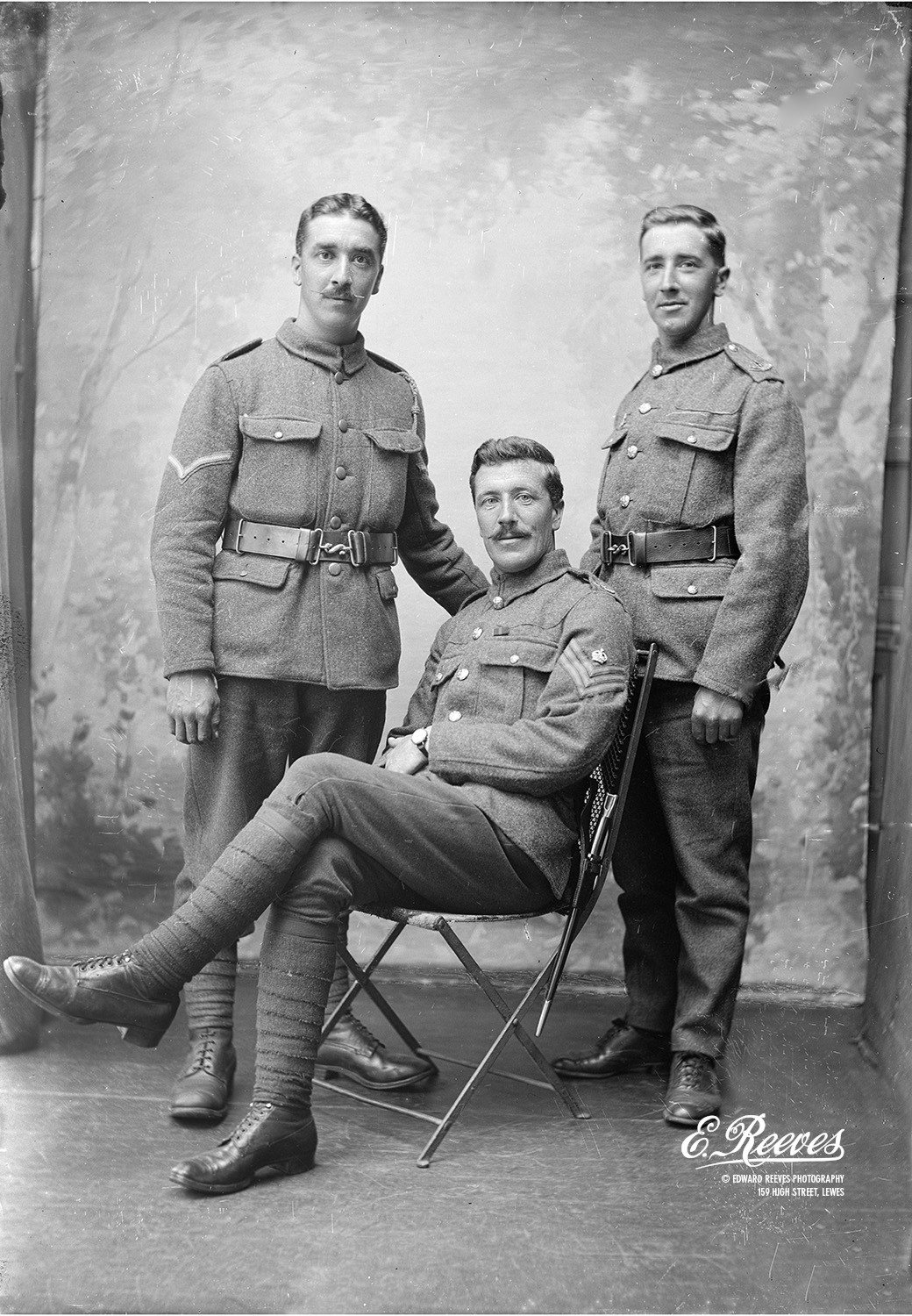 In addition, there is the remarkable survival of the six Cox brothers, who lived in 3 Rusbridge Cottages (South Street).
By 1914, three of the brothers had married and lived elsewhere in Lewes, but three were still living with their widowed mother in Rusbridge Cottages. All six joined up and served in the War and all survived. The photograph shows John George Cox (seated) and two of the other brothers (Arthur, Leonard, Robert, Richard or Reginald). All six were still alive when their mother died in 3 Rusbridge Cottages in 1935.
Click image to enlarge
© Edward Reeves Photography, Lewes
Another survival story is that of the Hylands. Edward Hylands and his wife, Winifred, lived in Wharf House, (number 138), then in number 79 and finally in number 82. Their sons, Ernest (b. 1896), Percy (b. 1898) and James (b. 1889) all joined up, survived and returned to Lewes.
The Second World War
There were fewer deaths of South Street men in the second World War. They included Leslie Alfred Funnell, second son of Mr and Mrs W. Funnell of number 109, William Henry Shipp, son of Mr and Mrs Shipp, number 57 (although William had moved away from South Street), William Thomas Abrey of number 13 and another non South Street resident, Frank Chadwick, who was married to Ivy, the eldest daughter of Mr and Mrs Frank Hoad of the Snowdrop.
There was an Air Raid Warden post at Fuschia Cottage, by Cliffe Corner.
There were two British Concrete Federation air raid shelters at the rear of the Thatched House pub in Union Place, each able to hold 50 people, and public shelters for 24 in South Street and 50 at Cliffe Corner. There were also communal shelters at the rear of number 57, at the rear of number 27 and at the side of Wille Cottages. Further brick communal shelters were provided for 120 in the Odeon Car Park (entered from the site of 20 South Street) and another at the rear of number 30 for 36 people.
Active Station No. 8 was at the Snowdrop, an observation post dug into the ground, with corrugated iron shuttering and covered with the displaced turf and manned by ‘A’ Company, 16th Sussex Home Guard no. 4 Platoon. Also at the Snowdrop were Local Defence Force Volunteers, who manned a road block to check ID cards for all entering the Street.
In March 1941 a 26 ton tank skidded on turning from Cliffe High Street into South Street, hit a parked van and crashed into a shed in Rusbridge Square, killing a boot and shoe repairer in his workshop and injuring his customer.
South Street Social Activities
Lewes Rowing Club
The Rowing Club was founded in 1874 under the presidency of the Rt. Hon. Earl of Lewes. In the early days it met in the Lamb Inn, and after a short time based at the wharf just south of Wharf House, it found a home on The Island where it remains to this day. Although all sorts of boating takes place, including canoeing, rowing has recently revived with the formation of the Lewes Pilot Gig Club based there.
The Society was founded by Tom Wheeler in 1913, originally as a Juvenile Bonfire Society to give children the opportunity to enjoy Bonfire. There were some fancy dresses and a bonfire behind the Thatched House pub, but no organised processions. A year later the Society was suspended due to the First World War. In 1919 the celebrations were resumed and there were processions, fancy dress and a bonfire in front of Wille Cottages, which was the firesite until 1924. Some of the earliest Bonfire Society costumes were Italian national dress, Egyptian costume and later the Valencian. Siamese costumes followed.
In 1925 the firesite was moved to the chalkpit behind the Snowdrop, and by then the Snowdrop had become the Society’s headquarters. In 1937 the headquarters became the Thatched House and remained there until after 1938, when celebrations were largely suspended for the duration of the Second World War. In the 1950s the Society experienced a large drop in members, although they revived in the 1960s. In 1959 the Society suffered a severe setback when, a week before November 5th, the loft storing their torches was destroyed by fire. Thanks to help from the residents of Undercliffe House on Malling Hill, some 1,500 sticks were cut to replace the lost torches. The following year, Bonfire was cancelled due to floods affecting much of the lower lying parts of the town. With the closure of the Thatched House pub in 1966, the Society headquarters moved to the Snowdrop, where it continued until 1974 when it transferred to The Dorset. However, after a year the Dorset was no longer able to host the Society and it returned to the Snowdrop.
In 1977 the firesite was the South Street Recreation Ground (later known as the Timberyard Recreation Ground and now Hillman Close) as the tunnel works meant the chalkpit could no longer be used. This site was used until 1982 when works on the Ouse banks meant another venue was needed. A new site was found down Railway Lane on the former British Rail East Goods Yard (now part of the Railway Land) and it continues there. Torches were made at various locations on the street, including the stable block at the back of the Snowdrop, the Air Raid shelter behind number 57 and in a shed in Tom Wheeler’s garden, which had to be left in 1986 when the plot was developed. In 2011 the South Street and Waterloo Bonfire Societies jointly bought a piece of land off the Uckfield Road for those purposes. In 1993 the Society dropped the word ‘Juvenile’ from its name and became the South Street Bonfire Society.
The Wheeler family played a prominent role in the Society for many years. Tom Wheeler was Secretary, Treasurer or Chairman of the Society from its foundation until 1954 and wrote the Founder’s and other poems about the Society. He was also an amateur magician, entertaining at children’s parties. He died aged 93 in 1977 and had run a general store at number 51 South Street.
Tom’s brother Harold, who was connected to the Society for 65 years, lived in number 105. Another brother, Edgar, was also a founder member of the Society. Leslie Wheeler (son of Edgar) was chairman of the Society from 1952 to 1964. The Wheelers’ father, Thomas Albert Wheeler, lived at number 27 from 1905 to 1910. In 1911 he moved with his family to number 31, initially a greengrocer’s shop and then a general store. There were many other family members on the street, and at various times there were Wheelers in numbers 5, 27, 31, 51, 54 and 105.
In recent years the Bonfire Society and the Snowdrop pub have held a light-hearted summer sports day, including competitions for dogs and a drag queen contest.
For more detailed information on the South Street Bonfire Society, see South Street Bonfire Society: the first hundred years, 1913-2013 by Bruce Wadey (2014), and South Street Juveniles, 1913-2013: a celebration souvenir produced by the South Street Bonfire Society.
Wheelbarrow Race 1910
The photograph (from collection of Bob Cairns) was taken outside the Thatched House pub in South Street by Harry Bartlett at the finish of the miniature wheelbarrow race held on Whit Monday 1910.
The annual Wheelbarrow Race (from 1903?) was between the ‘champions’ of each of two pubs situated opposite one another in South Street – most likely the Thatched House and The Fountain, and started at Library Corner on School Hill. The race had just one rule: that the wheel of the toy wheelbarrow must remain in contact with the road throughout, and the first one back to The Thatched House was declared the winner. The annual race ceased following the outbreak of the First World War in 1914. This information is from an article by John Davey in Lewes History Group Bulletin, number 29, 8 December 2012.
Brigid Chapman in Chronicles of Cliffe and South Malling gives slightly different versions of the origins of the race.

South Street Wheelbarrow Race, Lewes, 1910

South Street Social Gathering during Covid restrictions 2020 [JHD]
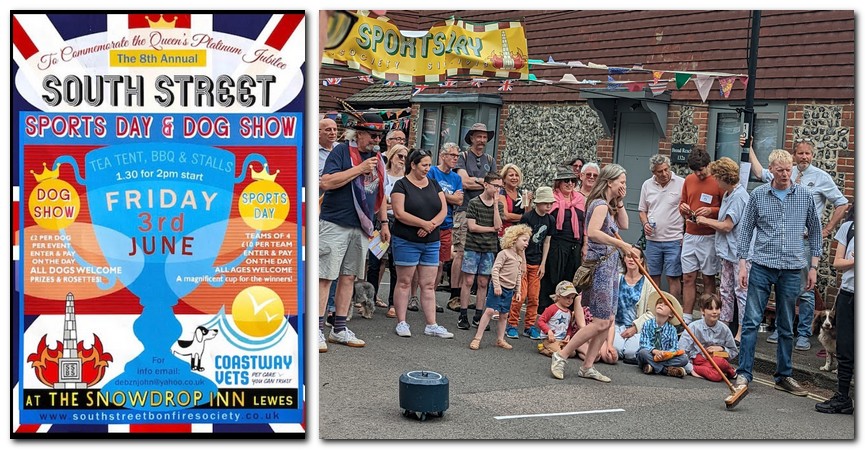
Snowdrop Sports 2022; Curling on castors: 2022 [JHD]
Click image to enlarge
South Street Public Houses
The Fountain (7 South Street): now a private house

Fountain Inn, Lewes, c.1903. From the Bob Cairns Collection

The Fountain pub outing c1920 [By kind permission of the owners]
Probably the oldest pub on the street, likely dating to 1749. It was sold in 1771 as ‘a brew house known as the Fountain’.
1787: Described as a ‘good accustomed public-house‘. In 1830 there is a newspaper report of a cock fight there.
1851: The case of a travelling pedlar staying at the Fountain, arrested by a Brighton policeman for allegedly stealing spectacles, and accused of being German. The policeman was charged with false imprisonment, and compensation of 40s was awarded to the plaintiff.
1867: Advertisement for ‘lad as ostler, one that will make himself useful in the house and will keep the stables and premises clean. Age 15 to 18 years. One from country preferred‘.
1899: Prosecuted for selling whisky at 4.54 per cent under the legal standard. Fined 80s and 8s costs.
1969: closed.
Landlords:
| 1749-1771 R. Hood | 1879-1899 William Weller |
| 1772-1787 Nicholas Hubbard | 1900-1902 Frederick Charles Pinyoun |
| 1788-1810 Dan Grover | 1903-1905 Charles E Walker |
| 1820-1839 Ben Garnham | 1905-1929/30 William Brown |
| 1841 John Burton | 1930-1951 Jesse Brooker |
| 1850-1877 Thomas Packham | 1951-1969 Elsie Brooker |
Thatched House (37 South Street): Known locally as ‘The Thatch’. Demolished
 Established by 1805 when there was an advertisement for a sale of linens at the Thatched House, the landlord at the time being Mr Leney. By 1825 the pub was owned by Wood and Tamplin.
In 1913 the South Street Juvenile Bonfire Society was formed and the Thatched House was the headquarters of the South Street Bonfire Society for many years, with the fire site behind the Inn. It hosted victory celebrations in 1945 and a Coronation street party was held in its car park in 1953.
Thatched House. Image from Friends of Lewes ‘Lewes 1952-2002’
Click image to enlarge
Landlords
| 1825-1830 R. Dray | 1892-1902 William Dawes |
| 1830-late1830s Mrs Dray | 1908-1913 owned by S & EG Brewers, landlord William John Stoveld |
| 1841-mid 1850s David Wren | 1913-1915 James Howell |
| 1858-1876 Richard Simmons. In 1851 there were 9 lodgers and 8 in 1871 | 1915-1929 Lillian Maud Legg/Howell |
| 1871 Edward Monk | 1929-1830 William Hathaway |
| 1876-1879 William George Randall | 1930-1931 Herbert Frank Hatton |
| 1879-1880 William Weeks | 1931-1932 Rupert George Brackley |
| 1880-1881 Margaret Muggeridge | 1932-1934 Herbert Ernest Rogers |
| 1881 George Thomas Cosham | 1934-1935 Robert Starnes |
| 1881-1882 William Franklin. There were 5 lodgers and 2 troopers of the 7th Hussars in 1881 | 1935-1966 Gerald Victor Conway |
| 1882-1892 Henry Blackford | 1966 pub closed |
The Old Ship (49 South Street): Demolished. Listed in 1681 and 1685, called the Old Ship pub from 1749
Described in 1755 as a beer house adjacent to the River Ouse. In 1757 landlady Sarah Ansell married Evan Davies and he took over the lease. In 1767, presumably following the death of Sarah, Davies married Mary Head. In 1775 a Dragoon at the Ship public house was discovered to have stolen gold braid from a storehouse; ‘he swam across river, took to the flood and made towards the Rise – at present a perfect peninsula’. In 1796 an obituary reported that ‘On Wednesday last, died at the age of 101 years Mr Edwin [sic] Davies, master of the Ship public house, South Street. The above venerable publican had enjoyed a good state of health till within a few days of his dissolution, and has left several children the youngest of whom is only seventeen years of age’. Mary Davies, his widow, married John Ellis on 13 September 1797 in St. Thomas’s Church and Ellis became the landlord.
A report in 1827 said that ‘A few days since died, Mrs Mary Ellis, landlady of the Old Ship public-house in the South-street, Cliffe, wherein she had resided full 70 years, and during the whole of that long period, had vended ONLY the genuine extract Sir John Barleycorn, as manufactured at the well-conducted Castle Brewery here, equally to the satisfaction of the respective proprietors and the public; and with a degree of creditable demeanour, though peculiar to herself. The age of the deceased is not exactly known. She was twice married, and her last husband survives deeply to lament his heavy and irreparable loss.‘ This suggests she moved into the Old Ship in 1757, 10 years before she married Davis, perhaps as a maid.
1832-35, during landlord James Cooter’s time, the Old Ship hosted meetings of the Bundle of Sticks club, which sought to elect parliamentary candidates who were independent of party or creed.
Between 1850 and 1853 The Old Ship was home to a friendly society – Court of the Ancient Order of Foresters, which stored its petty cash, account books and regalia in a ‘court’ box kept in the pub by the landlord, who acted as ‘court treasurer’. The Court moved in 1853, after a fracas when the landlord threatened the life of any man who should take anything out of the room. During the altercation Court officers escaped with their property through a window at the back.
In 1860 advertisements appeared, including in a Surrey newspaper, describing ‘An old established public house known as the Old Ship with delightful pleasure gardens and brook land immediately opposite, situated on an island, accessible by a drawbridge over the splendid River Ouse, abounding in a rich and picturesque scenery, and affording every facility for the letting of pleasure boats, holding of picnics, etc.‘
In 1881 the census records the Old Ship housing four boarders and two officers of the 7th Hussars.
1895 landlord James Bunce was convicted for permitting drunkenness on his premises, including the landlord, landlady and barmaid.
Landlords
| 1749-1751 J Ansell | 1858-1859 John Philcox | 1885-1886 Alfred Staplehurst |
| 1752-1857 Sarah Ansell | 1861 William P Gorringe | 1886-1888 Thomas Banks |
| 1758-1796 Evan Davies | 1865 R W Baker | 1888-1889 John Holford |
| 1797-1827 John Ellis | 1865-1867 Richard Botting | 1889-1891 Joseph Leister |
| 1829-1830 James Hall | 1871 Thomas Patching | 1894-1895 George Taylor |
| 1832-35 James Cooter | 1872-1874 John Thomas Wright | 1894 Charles Leister |
| 1839-1842 John Kirby | 1874-1878 James Simmmonds | 1894-1895 James Bunce |
| 1841 Mr Wells | 1878-1880 James Thoms | 1895-1896 Henry Blaber |
| 1845 Thomas Weymark | 1881 Naomi Wilmhurst | 1896-1905 William Avery |
| 1851 Benjamin Blaber | 1882-1883 James Weaver | 1905 Robert Cornick |
| 1853-1855 John Knight | 1883-1884 Jeremiah Brooker | 1905-1907 Henry Songhurst |
| 1856 Mark Henley | 1884-1885 George Goldring | 1907 pub closed |
Old Anchor (101 South Street): also known as the Anchor, and the Anchor Inn
Street directory for 1858 lists Samuel Robinson as beer retailer and victualler. Robinson was recorded at 101 South Street in 1851, occupation barge master. William Blaber became landlord in 1874 and ran it for nearly 20 years.
Landlords
| 1858-1859 Samuel Robinson | 1893-1897 John Brooker |
| 1861 Reuben Gower | 1897-1898 George Weller |
| 1865-1872 Edmund Levitt (or Levett) | 1898 George Lucas |
| 1872-1874 Samuel Moore | 1898-1907 John Brooker |
| 1874-1893 William Blaber | 1907 pub closed |
Snowdrop Inn (119 South Street): Originally the British Queen. South Street’s only remaining pub
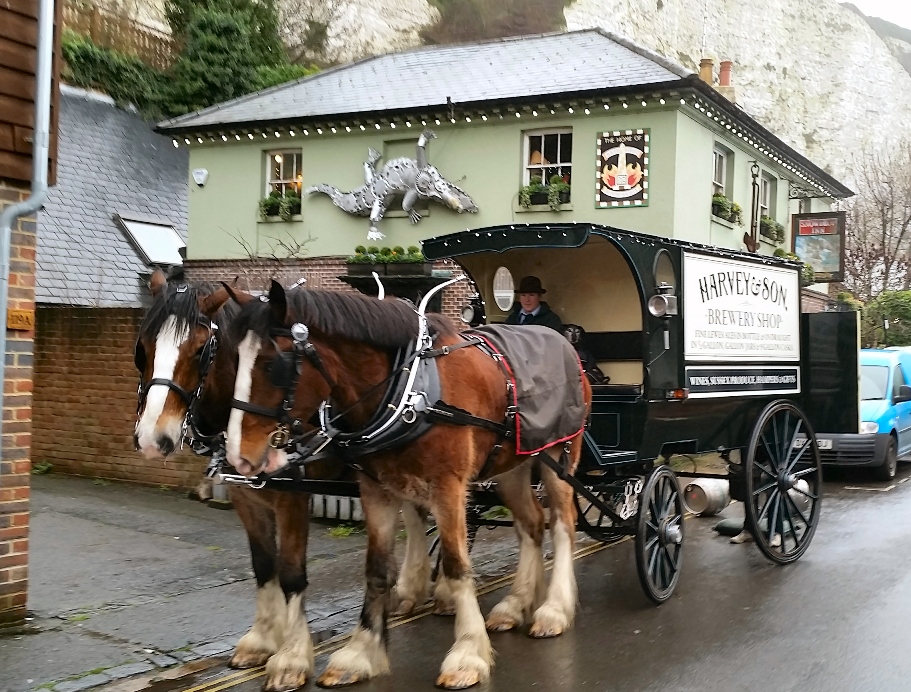
Beer delivery at the Snowdrop Inn, 2017 [JHD]
The site of Boulder Row, the cottages destroyed by the avalanche, was sold in December 1837 by the Church Wardens and Overseers of the Poor of South Malling to Thomas Berry and his brother James. Between 1838 and 1839, Thomas Berry built on the site a public house and five cottages. The Railway Inn in Ringmer, built by Berry between 1839 and 1841 was of almost identical design.
In 1839 the Sussex Advertiser reported that Thomas Wymark, keeper of the British Queen beershop, South Street, South Malling (landlord Mr. T. Berry) had made an application for a Victualler’s license. Wymark declared that his house was the only one from the bridge to the end of town on the Eastbourne Road which had accommodation for wagons and other vehicles and it is almost certain that this is the building which became the Snowdrop.
His application was supported by the Guardian and Churchwardens and Overseers of South Malling parish, but there was opposition to the license and it was stated that there was no necessity for another licensed house as there were already seven public houses and 14 beer shops in Cliffe and South Malling. The case was adjourned. There followed further court hearings, until in August 1840 Thomas Wymark was granted a license for the British Queen.
The change of name to the Snowdrop must have occurred prior to 1845 but after 1840. It is possible that naming a pub for the avalanche might have seemed tasteless in 1838, only two years after the disaster, but by 1844, or a little earlier, it might have been seen as a commemoration of a noteworthy event.
Fuller details of the British Queen, connecting it to the Snowdrop, can be found in an article in the Lewes History Group Bulletin 131, June 2021.
1867 Sale advertisement: ‘…freehold of The Snow Drop Inn. Situate at South Street… with large open yard, extensive stables sufficient to accommodate twenty horses, (one of which is suitable for a skittle alley, and has been used as such) with spacious lofts over, double Coach house, pig-pounds, and other conveniences. The House contains bar, bar-parlour, tap-room, kitchen and beer store; also four good bed-rooms, one of which is suitable for a sitting-room. There is a pump and an excellent supply of good water. The house and buildings are in good repair. Also being sold are 5 freehold cottages adjoining.’
1893: ‘Emma Reading pleaded guilty to committing wilful damage at the Snowdrop Inn to the amount of 2s. Charles Nevell (Novell?), landlord, said the prisoner kicked the door after being put outside. Fined 12s, inclusive; in default, seven days hard labour.’
2008: The Snowdrop closed. Punch Taverns said it had not been given any notice of closure by the licensee but was trying to reopen the pub as soon as possible.
An interview in 2010 says that the pub was semi-derelict when bought in 2009 for by Dominic McCartan and Tony Leonard. It says that the pub had been known for live music, vegetarian food and was John Peel’s favourite pub.
Landlords
| 1839-1845 Thomas Weymark (or Wymark) | 1879-1884 George Payne | 1909-1914 Henry Robinson |
| 1845-46 Richard Harvey | 1884-1886 Alfred Griffin | 1914-1915 Charles Pankhurst |
| 1846 License transferred from Mr Richard Harvey to his brother, Mr George Harvey | 1886-1888 George Fuller | 1915-1919 Albert Slarks |
| 1851 Henry Hards | 1888-1889 James Bravery | 1919-1922 Frederick Searls |
| 1854 John Stace | 1889-1890 James Allen | 1922-1932 Ernest William Brown |
| 1854-1855 Robert Simmons | 1890-1892 Thomas Downey | 1932-1946 Frank Leslie Hoad |
| 1858-1860 Henry Hawes | 1892 Albert Thomsett | 1946-1953 Ernest Frederick Hoad |
| 1860-1863 Benjamin Hudson | 1892-1893 Thomas Henry Lyell | 1953-1976 Frank Leslie Hoad |
| 1863-1871 Edmund Geering | 1893-1894 Charles Novell | 1978 Lionel Read |
| 1873-1874 Edward Knight | 1894-1896 Charles Lewis | 1979-1981 Kenneth Franmpton |
| 1874 Richard Goodsell | 1896-1899 Otto Bugmann | 1988 Keith Tutton |
| 1874-1877 Charles Lewis | 1899 William Percival Harding | 1989-2003 Tim and Sue May |
| 1877 William Miller | 1899-1900 James William Finch | 2004- 2009 D’Arcy and Tanya Gander (Punch Taverns) |
| 1877-1879 Edmund Manktelow | 1900-1909 Thomas Fish | 2009- Dominic McCartan and Tony Leonard |
The Schooner Beer House (128 South Street)
1837: Robert Higham of the Schooner beer house gave evidence at the Avalanche inquest, describing his house as opposite where houses were destroyed.
1838: A newspaper article reports John Higham as saying that he was shipwright and beer seller at a house called ‘the Schooner’.
The present owner of number 128 reports there is a hatch way in the house that is likely to have been used for serving beer.
The Bargeman’s Arms (possibly in South Street)
In 1865 Edmund Evans was indicted for keeping a ‘common, ill-governed and disorderly house’ and ‘causing certain persons of evil name to frequent the said house’. The house was also known as Aunt Harriet’s and had been ‘a disgrace and nuisance to the neighbourhood’.
The address given in the newspaper reports is St Thomas’s at Cliffe. Brigid Chapman and others suggest it was in South Street (as part of the street is in Cliffe), citing Samuel Robinson, beer retailer and bargemaster, listed in South Street in the 1858 Melville Directory.
However Harriet Vinall had a beer house at 13 Cliffe High Street in 1861. There was a Samuel Robinson at The Anchor, number 101 in 1858 but this was in South Malling and not Cliffe. The Directory does not give pub names or addresses. In The Pubs of Lewes, the Russells list three landlords under the Bargeman’s Arms: Samuel Robinson 1858, Harriet Welfare 1862, and Edmund Evans in 1865, but there is no evidence for a location in South Street.