
Nevill Memoirs > Vivi Church neé Auld
Vivi in conversation with her neighbour Jenni Bonsor and Ann Holmes, 30 August 2022
Click on images to enlarge | Download this article as a pdf document
Life-long resident of South Way
Genevieve Margaret Church is my married name. I was Genevieve Margaret Auld. I was born in the Wickham Nursing home in King Henry’s Road but I have actually lived in South Way all my life. We lived in two places. Until I was nine we lived in 26 South Way. It was a rented bungalow. My parents wanted to buy their own house. My father was cutting the hedge, which in those days was as big as it is now, and Mr. Green, who lived opposite, was in his front garden. They were chatting across the road – there was no traffic in those days – and Mr Green said, “Oh, by the way, I shall be selling up.” “Oh really, when are you thinking of going?” It was just a handshake over the garden fence! So in 1949, we moved to our present house, which is number 37.
I’ve been at number 37 ever since except that I went to university and then I was teaching up in Surrey. I was in digs there so my main home was obviously here. And then, when I got married, Gerald liked Lewes, so we came back to live in the same house.
Tell us about your early life
 I was an only child but I was exceedingly fortunate in having great friends almost across the road and a couple of doors way. We were always in each other’s houses and our parents never wondered where we were because they always knew we were in the other house. We’re still great friends.
Jenny and Jill Euston lived in number 30. Their parents moved into it when it was brand new. My great friend, who was closer to me in age, was Jean, Jean Nellar, and she lived at number 41. She was two years older than me. Jenny Euston was two years younger. And then her sister was born just after the war. I’ve got loads of photos of Jenny, Jean, and myself because we were always together. It was lovely.
Top: Jean Nellor and Vivi, below: Jean Nellor, Jennifer Euston, Vivi. All at 26 South Way
Everything was done in the dining room in our house when we moved into number 37. Well, we’ve only got one external wall so it got quite nice and cosy because it was coal fires. You just froze in the rest of the house. The lounge was too big to heat. I remember ice on some windows on the inside because there was no central heating. We’ve still got the original, lovely 1930s fire surround in the dining room. I think we’re the only ones in the road now. My mother thought it was such lovely wood. And I suppose, partly because of her, I like it too. My father would be marking, my mother sewing and I would be doing my homework all in the dining room, lovely and warm and cosy. If my father wanted a book from his study, which is our little back bedroom, he used to send me up: “it is cold up there – you could go and get it!”
It’s dreadful to think that (freezing houses) might happen again. I mean, just after the war is one thing. It’s not acceptable now. My mother liked to air the sitting room once a week so on Sundays she always lit a fire there. I wasn’t allowed to do homework on a Sunday. I would have liked to do my weekend homework then but, having a school teacher for a father; I had to do it on Friday evening. “Get it over and done with – then you’re free”. So it was very much a bit like going into the parlour on a Sunday. I think most of us did this once a week actually.
Do you remember anything about the war?
We had an air raid shelter in our garden, on the front lawn. That’s why it’s never been even. There was one at the bungalow too and another one that I knew at number 24. Uncle and Auntie Tarrant moved in there after the war. Uncle Tarrant used to keep all his gardening tools in it. We’d each got our own individual Anderson shelter. There was one in 39. I don’t think there was ever one in number 35 but I suppose, because most people had decent sized gardens up here, they had their own. I don’t remember the communal shelter at number 20.
I remember sleeping in ours very well. Every evening we used to go in, I remember. My parents had a big mattress, and I had a bolster. The walls of these wretched shelters were made of corrugated iron. One of my early memories was watching the snails if it had been raining. You’d see the snails crawling up the corrugated iron.
My father also had an upturned wooden box and he used to sit there with his tin hat on, waiting to hear whether he was required down at the prison. He was one of the two or three air raid wardens at the prison. That’s where they used to sound the air raid warnings. When there was notification that enemy aircraft were approaching he got down to the prison and he sounded the actual air raid warning. And then he stayed at the prison, depending on how long the raid lasted. If it didn’t last too long – because they were all making for London of course – then they’d sound the all clear. But sometimes, during the Blitz and all that, they’d be down there for ages.
I think I heard that they were aiming for Newhaven. If they hadn’t dropped all their bombs in Newhaven, then they wanted to get rid of them. A bomb dropped in Ferrer’s road and some of the ceilings came down on the houses. They also aimed at Lewes Station. And there was a raid down North Street – they came back and just dropped them. Yes. Willy- nilly. Yes. We did suffer from that point of view.
I was only five when the war ended. I do have some vivid memories. I mean, when the V 2s came over, towards the end of the war, you didn’t get much warning of them coming and we didn’t have time to get in the shelter so Mummy used to say “no, we’re not going out.” Sometimes Jenny and Jean were with us in the bungalow. I do remember, very clearly, the three of us sitting with an eiderdown pulled over us under the stairs. They remember it too. I also remember getting under the bed in the bungalow.
After the war my father collected all the shrapnel that fell in the garden of number 26. He got a whole boxful from the dog fights and everything that went on over here. Oh, yes, it was quite something. It was very rowdy here at times during the times during the war. They had a very good view of the glow in the sky when London was blitzed from our house apparently.
All the houses on the south side backed onto the Downs. They had a big gun called Big Bertha, which was just outside the hedge at number 26. Well. This area was in danger for two reasons: the Germans twigged that if they followed the Ouse on a moonlit night it led them in the right direction for London from the coast. It gave them a start. So it was the Ouse they were after. They knew that Lewes was an important junction for the south coast. So the station was a very important target for them. They didn’t twig that there was a radar station just up by the reservoir for quite a long time, but they did eventually. And so yes, in several ways we were quite an important target – they offloaded bombs in the hope that they might actually hit something. They missed. I mean, they didn’t get the station or the radar. So I think that’s why the gun was there – because of the radar. It was up by the reservoir somewhere. So I think it was quite eventful at times.
Auntie Molly, Jean’s mum, was on her own during the war. Well, she had Jean but Jean was tiny. Her husband was in the army. If you were on your own, and you lived round here, you were expected to take the WAFs who worked at the radar. She had some lovely ones actually. So they were great company because she was on her own otherwise. You saw quite a lot of those around here, that and Land Girls. I do remember seeing the Land Girls. If you’d got room then you were asked to take somebody. The Eustons at number 30 had the boys from Tooting Bec School who were evacuated here. They came to the boys’ school. I expect Brian Beck told you all this because he’d have much better memories of this than I would have. (See Brian Beck on air-raid shelters)
There were other visitors to the Nevill during the war. French Canadian soldiers were based near here. My parents were delighted to welcome them into the house, speak French and entertain them. They were very sad when so few of these very young men returned after the Dieppe Raid.
Can you remember any big events happening on the Estate?
Well, the one street party I do remember is VE Day. I remember the trestle tables, just a bit further round the bend, outside number 53 on the North side of South Way. Later, we had our picture taken on the Downs.
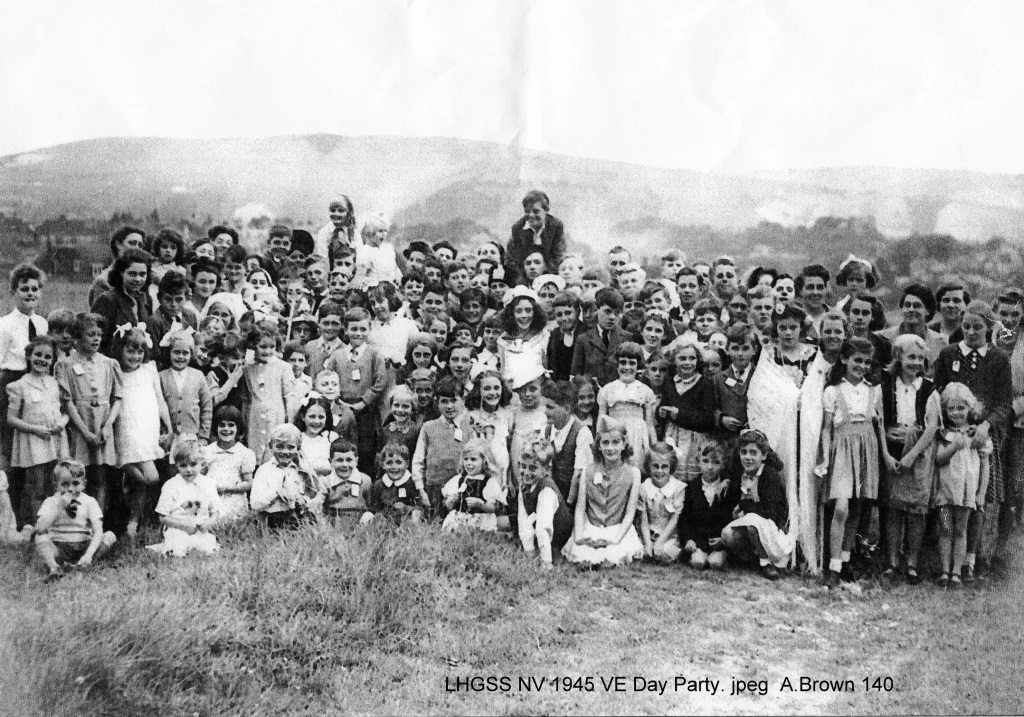
The little boy, Jill Kitching’s little brother, from number 20, who sat next to me, was incubating measles which he promptly passed on to me. And my mother never forgot that, because I then spent my fifth birthday in Brighton Hospital because I had one of the bad cases. My deafness was caused by that in the first place. Goes back all that way. I remember Jean came to visit and, because it was 1945, we had the most disgusting jelly and blancmange. A real treat!
In those days, there weren’t the antibiotics. We’re talking about 1945, just after VE Day, so we were just getting over the war. And antibiotics were kept strictly for the troops and couldn’t be given to civilians. So they gave you an alternative, which wasn’t nearly as effective. My tonsils went septic. That travelled to the middle ear. So I had mastoids. I cannot understand people who don’t have their children vaccinated for measles. It could be so horrible.
Was there a fair on the green, a sheep fair?
Well, there were both sorts of fairs. There was a proper fair with swing boats and roundabouts. We all went across the Downs to school; it was a shortcut. We used to come home saying: “The fairs arrived!” Our parents needed a strategy. Jenny and Jill’s Mum and Dad, Jean’s mother, my parents, used to debate “Oh no! Right: who’s on duty.” One set of parents would definitely go with us.
And then later in the year, the sheep came along. They used to bring the hurdles first. We’d climb all over them. And that was great fun. I didn’t quite know what a sheep fair was. We used to collect ‘chocolate drops’. Oh, you know what don’t you – to our parents’ disgust! “Look, we’ve got some chocolate drops!” We saw the sheep in the pens and we saw the lorries that delivered them. But what actually happened? I don’t know. None of us, including my friend who lives in the road called Sheepfair now can understand why it was called Sheepfair. She found out there was never a sheep fair up there. Because it was down here wasn’t it!
And of course, the other event was Racing, which wasn’t quite as popular with our parents. We didn’t realise that, of course, racing was very, very important. We used to get little lectures that we weren’t to talk to any of these people as we came across the Downs. Everybody in these houses in South Way, the whole time the races were on, would keep all the windows shut and back doors locked. You tried not to put washing out because washing was stolen from clothes lines. It was a very mixed crowd, shall we say? You’ve got quite a lot down from London. Some of them were really rough. Yes. Quite a rough crowd. I don’t mean all of them, but some of them were and the thefts in this area used to go up tremendously on Race Days.
Did you ever go to the races? Did you ever go across the Downs to see them?
I went. Jean’s mother, Auntie Molly, (in my day, all our mothers’ friends were called auntie) volunteered for all sorts of things with the Red Cross. She’d done quite a lot of studying with them. She used to be on duty with Red Cross and St. John’s up at the race course, you see. So she used to say to Auntie Vera (she was Jenny and Jill’s mother) “I’ll take the girls out with me if you like, if you think they’d like to see the race.” So we went. We were never so bored! Because once the horses had gone past that was it, really. Whereas the adults were saying: ”Oh, look at the view. Look!”
Did you play on the Downs when you were a child?
My knowledge of the rest of the estate is very sparse. Living here in South Way, which was so close to the Downs, if we wanted to go anywhere we usually went across the Downs into the town. We didn’t really have any reason to go actually into the Nevill Estate. Oh yes, but in those days we weren’t allowed to go far. Jean did go up on the Downs once. She wasn’t with Jenny, Gill and myself. I don’t know who she was with – it might have been Jill Kitchen who lived in number 20. They were about the same age actually. They went up on the Downs and some chap exposed himself. And after that things were curtailed… But of course Hawkenbury Way was built – I remember that being built just after the War. Apparently some of the German prisoners of war were involved in building them. I can remember all our parents saying, “Oh, those Jerry built houses”. It took a while for them to be lived in. It was essentially for prison officers and prison staff. They had built that part of Hawkenbury Way so we were allowed to play on the road. There wasn’t any traffic, you know – it was perfectly safe to play on South Way – but it was a nuisance if you played a ball game because of the hill…..
Which school did you go to?
Miss Walker’s
Oh, well, to start off with there was a Western Road Primary School which was in Western Road next to the Windmill Pub which is no longer there. That was the primary school for this area. But they didn’t take you till you were seven. So from the age of five to seven, your parents, you know, had to find somewhere else. There was St Anne’s. There was the other school that I think may have taken children of that age – that was the Old Grammar School. But I followed Jean. We did this you see, we followed each other. I suppose you would call it an old fashioned Dame school in a way. It was known as Miss Walker’s. It was the bottom house of Hill Road where it joins King Henry: a detached house in a lovely garden with a lovely view over Hamsey. She took us from five to seven. There were already quite a few houses on Hill Road but further up the road I think a lot of them are a lot more modern.
Miss Walker followed the Montessori method of teaching. As a child I never understood what that meant. I’m still not quite sure what it means. She took children from Lewes and a few of the surrounding villages. She had a lovely sitting room with a big inglenook fireplace. We used to sit around there while she read us stories. She used to get us to read. Lovely way to start school. It was a private school. There was another school: Leicester Road School but I think it was in one of those big houses in St Anne’s Crescent, actually. I don’t know what age they took children but I think it was fee paying. Jenny Euston went there. She didn’t follow us to Miss Walker’s. Whether Miss Walker gave up I don’t know but Jenny went to Leicester Road until she went to Western road.
When we went to Miss Walker’s school we weren’t allowed to go on our own. We went with my mother or Auntie Molly. One of them took us to school along the Chalky Road. This is what all of us old Lewesians call the top of Prince Edwards. You see there were allotments on either side. It was just like a causeway. They built up a mound of chalk between the allotments.
Mr and Mrs Chandler and their son lived in number 4 South Way. Mrs Chandler used to say if the weather was bad, we were allowed to cut the corner off South Way and go through their garden and down their path to Nevill Road to get to the Chalky Road. We kept our shoes a bit nicer for school by taking the shortcut. And the path is just about still there: it’s periodically cleared. And of course it was also nice because the road used to flood even then. You could cut off quite a bit of the floods by going through her garden into Nevill Road.
Western Road
Then, at seven, we all of us transferred to Western Road, which was really when I met children from the rest of the estate. Where they went before, I really don’t know. It might have been St Anne’s. Mr. Cull was the headmaster of Western Road at the time. His wife took the first years. It was such a lovely atmosphere at that school. Obviously for us coming from Miss Walker’s it was a bit of a bit of a shock. It was very different. I can remember the boys in the playground. They didn’t have much time for the girls, of course, and they used to play cricket and all sorts of things. I remember I got hit in the eye once by cricket ball. It was really bad. Mr. Cull was lovely. I remember he was he was on playground duty. I was yelling blue murder, of course. He took me back into his classroom sat me on his knee, put his arms around me and wiped my face. Can you imagine that these days? He was just so nice. When my mother came to collect me, he explained to her what had happened, and the eye was bathed. The teachers were lovely. They really were. So we were there until we did our 11 plus. I’m not quite sure but I think that about the time I was to leave Western Road that they started building the local primary school, Wallands. So I think Gill, Jenny’s younger sister, went to Wallands. So Nevill estate and Landport went to Wallands after that.
Lewes County Grammar
A lot of the children from Western Road ended up going to the secondary modern; to Mountfield Road as it was known. After we went to the Lewes County Grammar I didn’t see a lot of them. Two or three went to grammar school but not very many. When I was in the first year at grammar school, I made some very good friends. They lived in Houndean Rise. Western road took children from Houndean Rise as well. I was us in touch with these friends till last year to when sadly – that was it – they’ve just died sadly. In those days when you went to grammar school, you were asked in the first year “What does your father do?” I shall always remember Julia. She was only a very slight girl but she had a very deep voice. She said “Daddy’s in drains”. I can still see the teacher’s face. It turned out Daddy was very high up in the county council in all the drainage system round here.
In the sixth form we were only small groups, studying French, Latin or whatever. And they were short of space in the main building. So sixth formers were told you can go to the Grange for your lessons in minute little rooms on the first floor, quite high up, overlooking the road. There were only a few of us. We were there for the two years.
After school I went to Bedford College in Regent’s Park, which was part of University of London, to do a language degree. I did French and English. Then I did teacher training in Reading because Reading had a very good reputation at the time for teacher training. This is when I got to know Chichester because I did my teaching practice in Chichester High School for Girls from 1961 to 62. I was listening to Kate Moss, the writer, on the radio recently. I love her books: Labyrinth. She was being interviewed on the region. I thought that was so interesting: the way that history for her was just part of growing up. But what interested me was that she went to a comprehensive in Chichester with 2000 pupils. I thought – my word that’s a bit different from Chichester High School back in ‘61.
So then I taught in the London Borough of Sutton and Cheam in Surrey. I had a very nice digs with a delightful couple who were about my parents’ age, and they had an only son who had just got married. They said, “Oh, you must meet Christopher and his wife, Jean, you know, it would be young company for you” because I didn’t know anybody and a lot of the staff were quite a bit older. So I met their son and daughter in law, who lived locally. I got on ever so well with them. They used to ask me round and we used to go out. Jean used to talk about this chap that she considered to be like a brother to her. She’d known him all her life. She was an only child, her father died in the war. She was always talking about this Gerald, who really helped them with decorating their house when they were just married. Their mothers were great, great friends and worked together. Then one day she said “Oh the ballet is coming to Sutton – we thought we’d like to go and see. Would you like to come?“ And I said “Yes, I love ballet.” And she said “um.. we thought we’d make a foursome of it. So Gerald is coming in as well.” I thought at long last I get to meet this Gerald. She’s been on about him for long enough. That was that! He was working in Barnet, his parents lived in Wimbledon. Wimbledon to Cheam is no distance at all. I can’t remember if the firm was moving, or what was happening, but it was time for him to look for something else. We got engaged, and he’d come down here. Until he met me he’d never heard of Lewes. The rest is history. I just came back here again.
Gerald found something else in London and commuted for a little while but didn’t like it. The job at County Hall came up. That was on the doorstep. So what could be better? After he moved down here he travelled up to Wimbledon almost every weekend because he was an only son, only child. We did persuade his parents to come and live here. They were building those flats just past the Kings Head if you go down Southover High Street near the Grange gardens. There was a lovely Victorian/ Edwardian private house and they built flats on the back of it for elderly people with close connections with Lewes. And Gerald said that would suit Mum and Dad down to the ground.
So I came back here. I did a bit of teaching, some at the Priory, but not for long. And then I did a lot of tutoring because I’d done a lot of sixth form work in Cheam which I thoroughly enjoyed. Then they built the University. There were quite a lot of parents looking for people who would tutor their children who were in the first year at university. That suited me beautifully especially once I got the arthritis. I had a really bad case. I was always going to hospital for tests and treatments, and the consultant said, “Well, you can’t hold down a job and do all this”. So that was best I could do. I couldn’t do a proper job anyway so it was very useful that I could have them come to my house. One funny thing was that sometimes I would start off with the children and the parents would come. “We’d like to brush up our French.”
Tell us about your parents
A lot of people will remember my father. There are still people on the estate who were taught by him. He was head of the Modern Languages Department at the Boys Grammar School. Bill Euston at number 30 was head of English. They were pals. There were quite a few teachers from the boys’ school who lived on the other side of the estate actually and there were a number of single lady teachers who owned houses in South Way. Could you imagine on a teacher’s salary now being able to afford a house in South Way? He was quite well known on the Nevill. When Brian Beck sees me, (I haven’t seen him for quite a while) he says: “I remember your father used to say to me….. “ He would have remembered Bill Euston too. (Chris Field wrote in his memoir: “Duggie Auld lived near us in Nevill Estate, would often pass us on the way to school in the morning on his bike – calling out “Bonjour mes amis!” to which we were expected to reply “Bonjour, monsieur.” You were not allowed to speak in English in his room, only in French, after the first couple of weeks of term” But Vivi says her father was never called Duggie and never rode a bike!
 My father was responsible for the Twinning Association between Lewes and Blois. He didn’t actually start it. It was started by a teacher of English (Monsieur Piole) in Blois who, after the war, thought what had happened was so dreadful. In his youth I think he’d been an English assistant in Hastings. He wrote after the war to the head of the school he knew in Hastings, and asked if anybody in East Sussex would be interested in twinning to create a link between the young so that this war never happens again. And a letter came to the Boys Grammar school to Mr. Bradshaw, who was the headmaster then, who said to Daddy, “Oh, this is right up your street would you would you be interested in this?” Daddy thought it was a brilliant idea so he wrote back straightaway. Monsieur Piole and my father became great, great friends.
Monsieur Piole and D. Auld on cross channel ferry, July 1947. From Lewes Past, 2023
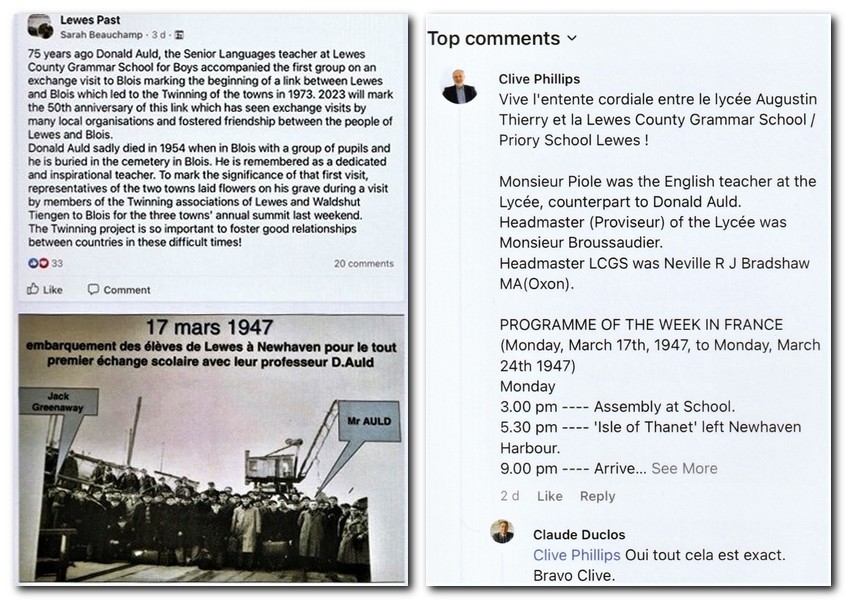 Above: Boat to France, 1947, and Programme for week in France, 1947. Both images from Lewes Past
 Clearer image of 1947 school group, © 2023 OLO
I think Brian Beck was on one of the first visits. He always used to say, “I can remember you when you went on the first visit.” It was always during the Easter holidays. In the early days my father used to be clear to the parents that it was not a Cook’s tour. When the boys went over there, they stayed in individual families; they did not stay all together. So they had to speak French, and get to know the French way of life. At the beginning the exchange was essentially between young people in the schools so they got to learn about other country and got to improve their friendship at the same time. It was not between the towns at all. To my father, that wasn’t the idea.

Top: 1948 group photo outside Mairie at Blois, Below: Blois party 1949. From Old Lewesians Twinning website, and © 2023 OLO
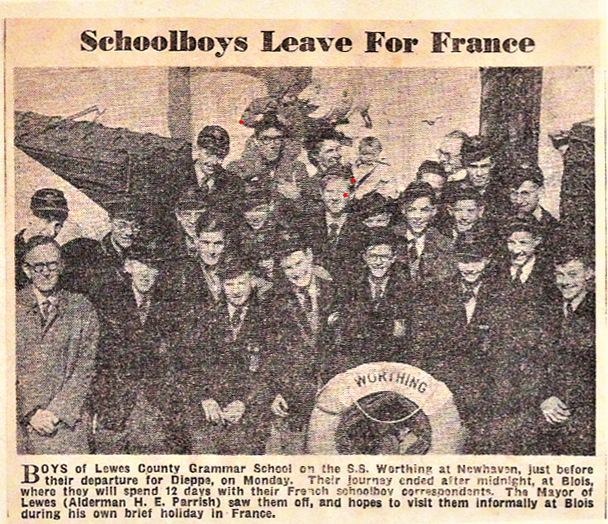
Lewes County Grammar School Boys and D. Auld, 1954

Above: Death of Mr Auld, reported in Sussex Gazette & County Herald April 1954
Below: Mr Auld’s grave 1955 and 2022, see account of visit by Twinning Association
 My father died over there in his friend’s house and is buried there. The people of Blois thought so highly of him they said to my mother that they would be honoured if they if they could give him a place in Blois. Mummy agreed, knowing how much Daddy loved it. The irony of it is she’s buried here in England. My mother came from France. She was from Rennes, the capital of Brittany. My father met her because he did French at university. If you did a modern language you did a year as an assistant in the country where people spoke the language you studied. He was sent to Rennes. My mother was then studying to be a University librarian. My father turned up at the University Library late. They were just closing the door. The chap who was closing the doors said “I’m sorry, you’re too late.” Daddy must have explained that he needed this book for tomorrow, Sunday. And he was told “Well, you could be lucky, you might find Genevieve Dottin because she’s working late on part of her studies.”
My parents got married in ‘31. They lived in Brighton at first for two or three years. My father taught at Brighton Tech. That’s long before I was born. My mother was foreign so once a fortnight she had to report to the police station. It must have been terribly difficult for her. You know, coming in not knowing a soul. She had worked in the library in Rennes. She’d got her qualifications but they were not British. And in those days, of course, when you were married that was it. Married women didn’t work anyway. Whether she had to report to the police once they got to Lewes, I don’t know.
They were in the process of building the boys Grammar School. It’s a very 1930s build. When it opened brand new, they’d have been looking for new staff. Head of Modern Languages came up and my father thought right, that’s great.
They probably moved to Lewes in about 1932, first of all to number 25 South Way which they rented for a little while. Then they thought: well, we really ought to buy a house instead of renting. So they started buying a house in Ferrer’s Road. John Christie’s firm  had built houses, just like ours, in Ferrer’s Road. And then they lost two babies while they were living there. My mother said, “I just can’t stay here.” You know, it is just there are too many memories. She was told that that was it – she’d never have any more children – but don’t believe what doctors tell you anymore! I turned up you see. They had loved living in South Way. Then the bungalow, number 26 came up for rent. “Okay” they thought “well, for the time being.” That’s how you know, they ended up there. They went back to France regularly before the war but she couldn’t tell her family about me because of the war – not until I was five.
1939 Register shows Auld family living at 26 South Way
Because my father was teaching French my parents always spoke French at home. He thought it was very good for him. So there was one rule that you spoke French at home. I had no idea how it was spelt or anything but I was bilingual. My mother could never understand why the predecessors to Jenni and Mike at number 35 next door did not do the same. Her mother was French but she couldn’t speak a word of French. And she used to say to me, “Vivi, you’re so lucky, I’ve got all my family in France on my mother’s side. And I can’t speak to them because they don’t speak English. I don’t speak French.” So they didn’t have much contact. My mother never understood how you could not speak to your own baby in your own language. But other people spoke English, you see. I’d got my friends around me and I went to their houses all the time. It wasn’t a problem. But I wouldn’t answer in French if they were playing in my house. And when Mummy called out in French and said stop doing that. I used to make out I didn’t understand. Jenny and Jean used to say, “what’s your mum say?”
When did you first visit France?
After the war, because my mother had lost touch with her family, she didn’t know if they were alive or dead you see. I was born in 1940. They didn’t know about me till about 1945. My mother got a letter – I think it was through the Red Cross. She’d been writing to the Red Cross to find out if they’d heard anything. She knew from what was said at the beginning of the war that her family would be up to their eyes in the resistance movement. And she really thought they had probably had very nasty, nasty end. It turns out that in actual fact, they all survived, but she didn’t find out till 1945.

 My mother joined the Free French in England and even wrote to General de Gaulle offering to help. She knew the beaches in Brittany inside out and thought she could help if landings were being planned. He wrote back to thank her but said he could not take her away from her baby. My parents were invited to meet the French President at the Royal Academy after the war. I remember that my mother had a Free French brooch with the cross of Lorraine. I had one too. They were much remarked upon when we went on the train to see my father’s parents in Birmingham.
The family in France found out about me, you see, through the Red Cross. Our first visit – I think it was in ’46. We were on one of the first ferries. After we got off, on its next trip into Dieppe harbour, it blew up because the harbours were mined. I was only six years old. We had to wear life jackets from the minute we left Newhaven till we got to Dieppe. I don’t remember this but my parents told me that there were warnings all the time about the possibility of mines and about the lifeboats but my mother, understandably, couldn’t wait to see her family. We got into Dieppe safely and had a lovely holiday with the family. And that’s when I realised that my parents weren’t peculiar. They were a bit odd speaking this language that nobody else did, you see. I discovered, because I’ve got lots of cousins about my age, that they spoke that funny language too.
The Blois exchange after the war
So after that I disappeared to France during the summer holidays with my parents. The Blois school exchange was set up. We had a Mayor of Lewes called Dick Whittington (nothing to do with those Whittingtons!) and he was a great friend my father’s. He and his wife were great ballroom dancers. They won prizes with their dancing. When we went to Blois there was always a Ball in the ballroom of the castle, even when it was just the schools. Blois has a beautiful castle. My father happened to say to Dick “You know, it’s a lovely atmosphere, why don’t you come over, in not an official capacity but just come over “. Apparently he and his wife did. They loved it and had a whale of a time. Anyway, it was soon noticed and word got around that Dick and his wife Jessie were brilliant dancers. I can just about remember this, because there was nobody there to babysit me. Everybody wanted to go to the Ball. Yeah, I was usually seated on somebody’s lap fast asleep. But I do remember that in this huge room they were all dancing. Evidently, people noticed Dick and Jessie. People just stepped back to the sides. They had the whole room to themselves. That’s absolutely fantastic. You know, I can remember my parents talking about that, you know, the Mayor of Lewes and the Mayoress. Then later on the twinning became official. I don’t remember when that was but it didn’t happen till quite a long time after my father died. Then the Mayor went there in his official capacity. French Mayors have a sash. They had seen photographs of the Lewes mayoral chains and everything. They said to him, “next time you come couldn’t you ……”. Oh the Town Council wouldn’t have any of it – oh no, my word no! The treasures were not going abroad.
Did you ever hear any stories of what had happened to your family in the war?
Oh, well, yes. My Mummy was absolutely right. Her brother and his children, who were teenagers, some of them were up to it in resistance movements. Her brother was Rector of the University of Toulouse. And Rectors in France – it’s not like over here – it is very much you are in charge of the education. It’s a very academic post. My uncle and his colleagues used to forge papers in the cellars of the university. Toulouse being near the Pyrenees, they used to smuggle people through the Pyrenees to Spain to get back to this country. They helped foreign nationals, you know: anybody who was trapped. And the Germans got wind of it eventually because you always get some people who talk. My uncle told us, they said: “may we inspect your cellars. We’ve been hearing about other parts of the university building….” My uncle had heard that in Germany, German universities have a charter by which they’re given autonomy and they can refuse entry to other people. So he said to them: “Well, I’d love to show you all round, but I’m afraid I’d be breaking a century old law. I believe you have the same law at the University of Heidelberg whereby, you know, it’s an infringement of the university’s rights, you know, if you do that.” The Germans left! They couldn’t believe it but the Germans were very credulous in many ways! (I remember that later we went to see Heidelberg, Gerald and I.)
My grandfather was Dean of the University of Rennes before the war and amongst the staff there were many Jews who became great friends. My mother had a lot of Jewish friends. 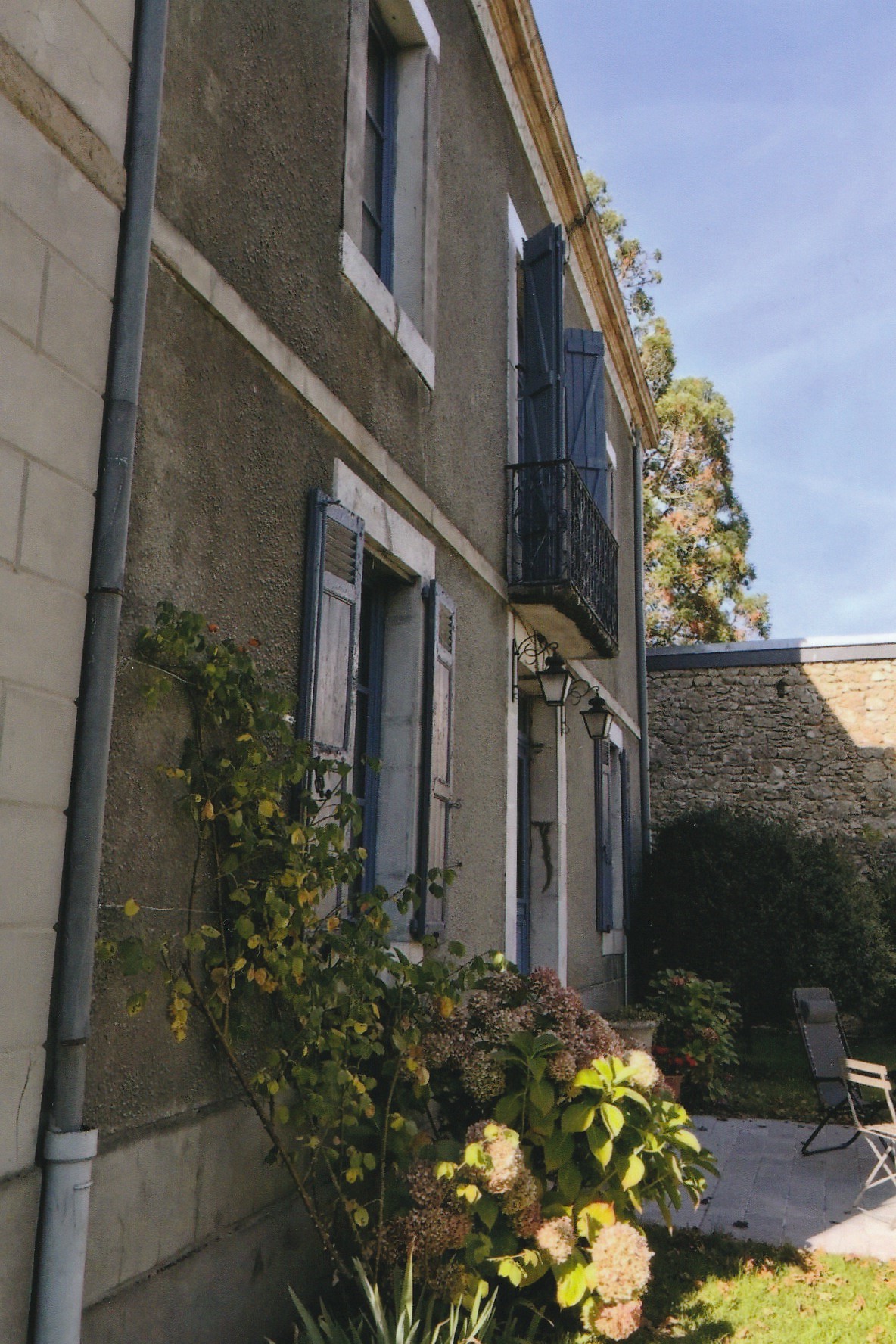 And you know, after the war, when she got back in touch, she tried to find them. My grandmother moved to Toulouse to be near her son after he got the job at Toulouse University. So they moved from Brittany. She didn’t like the south of France one bit but for sheltering people it was good. So the Jews that they could save, they brought down from Brittany. Then my uncle’s sons, who were in their teens, used to take them across the Pyrenees. The family had a country house in the Pyrenees, and the boys knew all the little ways, you know, like the back of their hand. So he got the teenagers, who thought it was a terrific adventure, to take them across the Pyrenees into Spain, which is what they did. They smuggled British airmen and a lot of Jews through the Pyrenees.
The safe house in the Pyrenees, 2023
My grandmother had a lovely little flat, also in Toulouse, where she lived on her own. My uncle arranged for his mother to shelter refugees while they were waiting for their papers to be forged in the university cellar. She had a very close Jewish friend staying with her. It was a tiny flat: she had one bedroom, dining room, sitting room and kitchen. And Toulouse in those days when I first went there: Daddy in Drains would not have approved. The water table was very high and the loos were very basic. My grandmother’s was like everybody else’s. So anyway, one day there was a knock at the door.
And apparently whenever you had a knock at the door that you weren’t expecting, if you were sheltering somebody, that was where she used to shelter her friends – in the loo you see. They said: “We’ve come to search your flat. We hear that you’re sheltering people.” So my grandmother said: “Well, it’s very small, do come in.” So they went in went from room to room. I knew her flat very well – it’s where we used to stay. The loo had a kind of little ante room where she kept all her brooms and things and then you went through to the loo. The Germans noticed this other door and they said to her: “We haven’t seen that – what’s in there.” And my grandmother said apparently: “Well, you could go and have a look. But “she said “I’d be terribly ashamed – you know Toulouse. So you know about the state of the lavatories in Toulouse.” She said, “I really will be ashamed to show you.” They roared with laughter and walked out. And my grandmother promptly fainted.
Those were the stories I heard lots and lots of times after we went there. My mother said: “I imagined all this, but if I’d known…..” When Toulouse was liberated by the Americans they raided the Gestapo headquarters. Top of the list for execution was my uncle. So when we went back to France they’d got so much to share about being occupied.
Did your friends and relatives ever come to stay in Lewes?
Most of the old ones never did. But my cousin’s children – I think nearly all of them have been to see us while they were in their teens. They came for their holidays in the summer to improve their English. Now sadly most of my generation have gone. Those that are left; one or two have got dementia. But the children, because they came to us when they were teenagers, they will ring me up. Oh, that’s lovely. Their parents spoke very fluently because half of them taught English. Their children understand it but they don’t speak it. Hélène rang me up yesterday or the day before. So I can carry on with my French. I did go to a French conversation group, in Kingston. They were English people who spoke French very well. But it was very much based on certain grammatical things and all I wanted to do was to have a chat! I don’t know any other French people.
Let’s go back to the houses and the kind of people who lived in South Way?
 I think I remember most of the people because Jean and I sometimes, to make sure we hadn’t got dementia, would say: “can you name all the people in South Way?“ Aunt Molly lived in number 41 which is the last house like ours – built by the Ringmer Building company. They moved into it when it was new before I was born and she said it was so lovely because they just had the Downs on the other side of the road. They stopped building for a few years, and there weren’t any other houses on the opposite (even) side of South Way then beyond number 32. Evelyn, number 26, the bungalow where we first lived, was named after the owner’s daughter. Next door were the Johnstons. I remember them very well. He owned a tobacconist in the town. Their daughter, Carol, was a big girl when we were little. And she had a great friend who was about her age, Andrea Butchers, who lived our side (at 43) and they were thick as thieves. They used to come and borrow Jean and myself when we were little if they were playing doctors and nurse. We weren’t so keen.
Hubert Green was the first person to live at Number 37, our house. The house was called Woodstock because that’s where he came from. He had a little Austin 7. The house always had a garage because Mr. Green, who bought the house from when it was new, was one of the two people in South Way who’d got a car. He had a little green Austin Seven which, of course, explained why those garages are so small and narrow. Uncle Bill Euston also had a little a black Austin Seven. The people who were buying the new houses were asked if they wanted a garage or not. And so that’s why some of the houses don’t have garages
Next door at number 35 here was a Mr. and Mrs. Douswell. She used to fascinate me as a small child. Poor soul, she had Parkinson’s. And I could remember my mother saying to me: ”don’t stare, just look”. But she was a brilliant knitter. She got her needles in the right place. It is rather sad actually. They had a daughter, Mrs. Courtney – Nancy. She was one of my teachers at Western road school. She taught standard three, I remember that. Her husband died; got killed in a motorbike accident and apparently she went white overnight. But she was so pretty because she still had a very young face and this snowy white hair. I do remember that. She lived with her parents. They were there a long time. Then the Fords moved in in ‘54. That was the year my father died. And they were they were lovely. They just got married and moved in there. They were there quite a long time. And then of course they sold to the Whittington’s who sold it to Jenni (interviewer) and Mike Bonsor in ’91.
Those houses further up the road go back to about 1938. They were built not long before the war. They were brand new when they were moving people out of London. So part of South Way was lived in by Londoners, quite a lot of whom stayed actually because they liked it very much. They had children here who went to the schools and they put down roots. This is it. The new building started a bit earlier on our side. And there are some similar in style the other side as well. Some of the houses changed hands. A lot stayed in the same family for a long, long time.
So are you happy still living in South way? You’re very happy with the neighbours, aren’t you? Particularly the ones next door!
Well you’re such a lovely bunch. I mean, we’re so lucky aren’t we.
Vivi Church August 2022
In conversation with Jenni Bonsor and Ann Holmes
Transcribed and edited by Ann Holmes
With thanks for information and pictures from:
Lewes County Grammar School’s Old Lewesian website
Lewes Twinning Association
Sarah Beauchamp in Lewes Past



 Lewes History Group