
Please note: this Bulletin is being put on the website one month after publication. Alternatively you can receive the Bulletin by email as soon as it is published, by becoming a member of the Lewes History Group, and renewing your membership annually.
- Next Meeting: 13 November 2023, Graham Mayhew, ‘Lewesians and the Great War’
- The St Michael’s Church Helmet
- Two postcard views of Malling Street
- A Lewes Camberwell Beauty
- An unexpected arrival
- Lewes in the Crimean War
- The Lewes Co-operative Society fleet of milk carts
- Southover Rectory
- The People’s Deanery (by Chris Taylor)
- A Wartime Accident (by Rob Parsons)
- Next Meeting 7.30 p.m. Zoom Meeting Monday 13 November Graham Mayhew Researching ‘Lewesians and the Great War’
Back in 2014, the centenary of the outbreak of the Great War, the local branch of the Royal British Legion approached Lewes Town Council with a proposal to recognise the 140 men whose names were, for one reason or another, omitted from the list compiled in 1922 and inscribed on the War Memorial. In 15 cases relatives simply returned the form too late. In other cases they had moved away or thought that the circumstances of the death did not make the name eligible for inclusion. As it was impracticable to add so many additional names to a listed War Memorial, the Town Council instead commissioned Graham to complete a more fitting tribute, the book ‘Lewesians and the Great War’, which includes all 390 names, with brief biographies of each. The book, which took nine years to research and runs to 544 pages, is a comprehensive and scholarly volume, illustrated with many photographs, and accompanied by accounts of the comprehensive social changes that the war brought to the town. Copies are available from the Town Council at £20.
Graham will tell us how he set about this huge task, and provide insight into the enormous amount of material that is available to those researching a community or its individuals in this period.
As we have now moved on from British Summer Time, this meeting will be the first of our winter series held by Zoom. Members will be sent a free registration link in advance. Non-members can buy a ticket (£4) at http://www.ticketsource.co.uk/lhg. The emailed ticket will include a Zoom registration link for the talk, to complete in advance.
- The St Michael’s Church Helmet
A copy of the helmet of Tudor knight Sir Nicholas Pelham hang’s over his memorial in St Michael’s church. But why was armour hung in English churches? The church have arranged for Fergus Cannan-Braniff, head of religion and philosophy at The Skinners School, Tunbridge Wells, and the author of numerous publications about medieval life, art, belief and conflict, to talk about the helmet in St Michael’s church at 7.30 pm on Wednesday 29 November. Admission is free, but there will be a retiring collection.
For details see: https://leweshistory.org.uk/2023/09/21/talk-on-the-st-michaels-church-helmet-st-michaels-church-wednesday-29-november-2023-730pm/
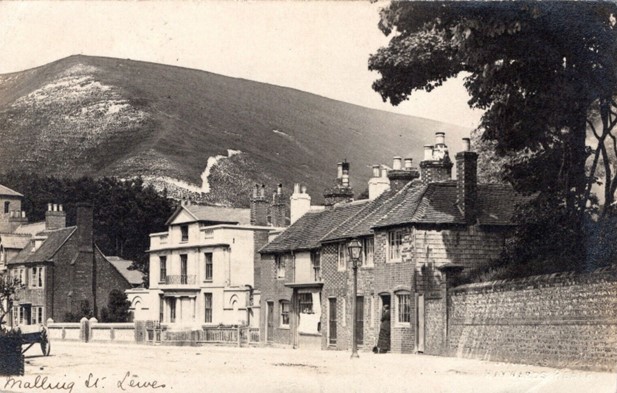
- Two postcard views of Malling Street
The first postcard shows the view down Malling Hill. This postcard, by an anonymous publisher, was sent from Lewes to France with a birthday message in December 1909.

The second postcard view of Malling Street, published by F. Douglas Miller of Haywards Heath, was mailed to Wiltshire in December 1912 by a visitor staying at the Pelham Arms for a few days. The original photograph had been taken several years earlier, as the second cottage from the end in the row featured was, rather incongruously, was extended upwards in the mid-Edwardian era..
- A Lewes Camberwell Beauty
One of the more unusual Lewes items offered for sale on ebay recently was a preserved butterfly, a Camberwell Beauty, collected in Lewes in 1902. Very distinctive, it was first recorded in Britain in 1748. It is a rare migrant, still seen on occasion in 2023, but does not breed here.

The collector, Hugh John Vinall (1876-1950), was in the 1901 census aged 25, and an unmarried solicitor living with his parents and three younger brothers in the High Street, opposite Tabernacle. His father was solicitor Isaac Vinall, and his grandfather and great-grandfather, both John Vinalls, had been pastors of Jireh Chapel. He was educated at Brighton College and articled to his father. By 1911 he had married, and was living in St John-sub-Castro parish with his wife and three young daughters. He appears in inter-war directories as living at 1 Park Road, in the Wallands. He was a member of Jireh Chapel and the Loyal Orange Order, and a supporter of Bonfire.
Sources: Familysearch; Jim Etherington’s PhD thesis; memories of his daughter Kathleen Vinall, at The Keep.
- An unexpected arrival
The St John-sub-Castro parish registers record the baptism on 16 September 1627 of baby Edward Shine, son of David & Katherine Shine of Tralee, County Kerry. They add that Katherine “was sudainly surprized with her paines of travel under the castle wall”.
- Lewes in the Crimean War
The 20 November 1855 Sussex Advertiser published a letter sent home to his Lewes family two months previously by a young man who had recently joined the Army Works Corps:
“We had a comfortable voyage, and landed quite safe of the 11th August at Balaklava. We are stopping at present in tents, and are all very comfortable together. We have had a good deal of sickness, but it is not so bad now. We lost between 50 and 60 men during a month with the diarrhoea and the cramp. I don’t think they will keep us here much longer, by their talk, but we don’t know how that will be. I took a walk on the 16th of August and saw about 3,000 dead and wounded Russians on the ground. It was a dreadful sight, and I was forced to run away, or I should have been shot. I got a Russian gun when I was there. I was in the town of Sebastopol on the 10th of September, and I got a few things, but I did not stop long as I was in great danger, and the place was a blaze of fire.”
The anonymous writer than names a number of local men and boys he has met up with in the theatre of war. The year-long siege of Sebastopol, the capital of Crimea, culminated in the Russian withdrawal from the town on 9 September. This was the final event in the Crimean War.
The same newspaper carried an obituary of William Smith, who had been a prisoner of war held by the French for twelve years during the Napoleonic wars. He was said to have remarked not long before his death on the striking contrast between “the indulgences and comparative liberty” with which contemporary Russian prisoners of war held in the Lewes War Prison were treated and the way in which he and his fellow captives had been held in France. He recalled being held for nine months confined in the fortress of Biche, spending two thirds of that period confined in an underground cell.
The Russian prisoners of war confined in Lewes had been captured in the Baltic, and the majority were Finns. They were based in the former House of Correction in North Street, under the command of Lieutenant Mann, R.N., a building that had been redundant since the opening of Lewes Prison two years earlier. The officers were allowed to live out on parole, and in the spring of 1855 had all taken lodgings for the summer in Ringmer. The non-commissioned officers, or ‘younkers’, were confined in the prison, but allowed out in the town on parole, where they generally conducted themselves with propriety. The men were allowed visitors and permitted to keep their knives, with which they manufactured wooden toys for sale to the locals. They were taken out onto the Downs every day in groups, for air and exercise. When their uniforms wore out they were provided with new clothes of similar material, but with jackets instead of their long-tailed uniform coats, that reached almost to their ankles.
There were of course some interesting escapades. Some prisoners found ways of escaping over the walls and entertained themselves without supervision, surrendering themselves back into prison at the end of the day. A few, despite not speaking English, managed to form relationships with young women in the town. There were some more serious disturbances in 1855, as a result of which 25 men considered ringleaders were sent off to a harsher treatment regime at Sheerness and all the men’s privileges (including their keeping their knives) were withdrawn for a time. However, despite the regular exercise in the fresh air, and the best medical attention Lewes could offer, many of them suffered from pulmonary complaints. Some had to be confined to the prison hospital under the care of Dr Burton, the prison surgeon, and there was a steady number of deaths from a condition diagnosed as ‘phthisis pulmonaris’ [tuberculosis], which they had probably brought with them. The casualties were buried in St John-sub-Castro churchyard, where a memorial was later erected to their memory.
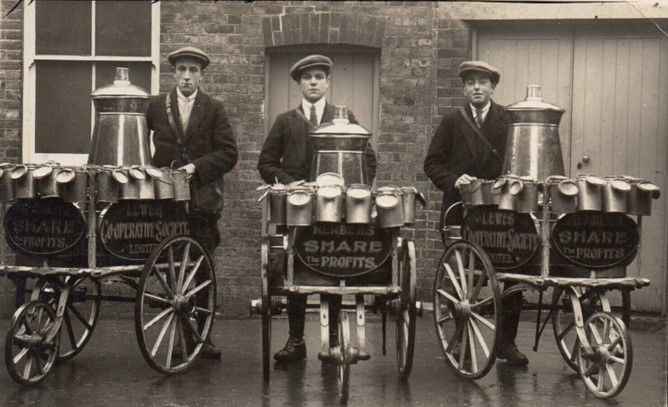
- The Lewes Co-operative Society fleet of milk carts
This postcard view shows the fleet of milk carts owned by the Lewes Co-operative Society proudly posed for the camera, with their operatives, in the days when your milk was ladled out from a churn in the street. The postcard, offered on ebay in September 2023, was by an anonymous publisher. After competitive bidding (5 different bidders offered over £50) it sold for a little under £70.
The Lewes Co-operative Industrial and Provident Society was established in 1864 by a group of working men whose business model was to purchase groceries in bulk, and then retail them to members at market prices, with any profits returned to members as a dividend. In 1867 they were based in Norfolk Street, but by 1878 they had moved to West Street, where they were to remain for decades. The society’s name suggests they were also one of the many mutual insurance ‘clubs’ that flourished in the days before the welfare state. In 1870 they also established a Building Society, to assist members who were regular savers to purchase their own homes, and which later became an autonomous organisation with its own premises elsewhere in the town.
The records of the Borough of Lewes show that they obtained permission to re-build their main store in West Street in 1905, and for a new dairy, also in West Street, in 1913. Their bakery was round the corner in Edward Street. In the 20th century the Lewes Co-op established branches in Uckfield and Heathfield.
Both the co-operative itself and the building society have their records deposited at The Keep, but the Society’s deposited records date from the end of the Great War up until 1958. The only records in this archive from before the Great War seem to be the plans for the 1905 rebuilding of the West Street store, now an auction house. There will however be many other records of their early activities in the local press and other contemporary sources. Researching the early history of this movement, which survived in Lewes until well within living memory, would make an interesting contribution to our proposed Victorian and Edwardian Lewes research theme.
Sources: The Keep online catalogue: image from ebay.
- Southover Rectory
This Edwardian postcard titled Southover Rectory was published by F. Douglas Miller of Haywards Heath. Its foundation stone was laid in August 1834, when Southover did not have a rectory of its own. It was built on part of a 30 acre tract of land called The Hides, sloping down from Western Road to the Winterbourne, most of which has since become Lewes cemetery. The access was from Rotten Row. It remained the rectory of Southover for about 85 years before being sold to John Henry Every, owner of the Phoenix Ironworks. In September 1955 his grandson sold the house and its land to East Sussex County Council, as “a site for educationally sub-normal children and a site for rebuilding Southover Church of England School”.

St Anne’s Special School had been established in De Montfort Road in 1951 but moved to the former rectory in 1960. The special school closed in 2005, and for the past 18 years East Sussex County Council has allowed the house to become increasingly derelict.

Source: The two lower photographs are from https://www.derelictplaces.co.uk/threads/st-annes-school-lewes-march-2017.34605/, taken five years ago in 2017.
- The People’s Deanery? (by Chris Taylor)
Lewes Borough Council expanded its housing stock considerably in the 1960s. Councillors extended the building at Landport, Winterbourne and Church Lane, completed the De Montfort and St Pancras developments and opened the protracted negotiations that eventually produced the Malling estate. However, by the end of the decade, nearly 400 households were still on the waiting list for council accommodation and more than 200 were living in unfit properties scheduled for clearance over the next five years. Consequently the council was on the lookout for more.
At their meeting in February 1969, members of the Housing Committee discussed the impending sale of Malling Deanery and instructed the Town Clerk to indicate the council’s interest in buying it. The mansion comprised a main hall, drawing room, two further reception rooms, 20 bed and dressing rooms and five bathrooms. It was set in 30 acres of land on both sides of the Ouse, with three cottages, a chauffeur’s flat, stabling, farm buildings, paddocks, gardens and a tennis court. The councillors were “of the opinion that the property, with its extensive frontage to the River Ouse, occupies a very dominant position in the Borough and that the whole is situate in an area of outstanding amenity value. For this reason (the council) considers that Malling Deanery should be in public ownership”.

1969 sales particulars, from Country Life
The council commissioned Sir Hugh Wilson and Lewis Womersley – a London-based planning consultancy – to provide detailed advice on how the property could be used for maximum public benefit. In return for a fee of 100 guineas, Sir Hugh made the following recommendations:
- the mansion and cottages to be converted into bed-sits for 24 elderly singles and couples, with shared bathrooms, sitting rooms and lounges and a live-in warden
- the ground floor rooms to provide meeting space for old people’s clubs and activities
- the site to include shops to serve the yet to be built Malling estate
- the river frontage to provide facilities for boating and perhaps training in sailing
- the grounds to provide public open space for a country park with recreational facilities including an athletics track and sites for camping and caravans
- a riverside footpath to link the Deanery with Cliffe High Street.
The vendor was Robert Lamdin, who had bought the Deanery in 1951 from the Sanderson family and had made several unsuccessful attempts since then to obtain planning permission to build housing in the grounds. In April 1969 he agreed to sell the entire site to the council for £47,500. However, the agreement was contingent on the Ministry of Housing and Local Government granting the council permission to borrow the bulk of the money it needed to complete the purchase: £46,320, repayable over 60 years.
Despite many months of sometimes tortuous negotiations, that permission never came. There were two main reasons for this. First, the ministry did not accept that the Deanery’s relatively urban location met its criteria for designation as a country park. And second, the high cost of converting the mansion into flats (estimated at more than £150,000) was “above the ministry’s yardstick” for sanctioning local authority loans. Consequently the scheme foundered and the site was sold in early 1970 to Vilshire Properties Ltd. They then offered to sell it to the council, without the land on the Pells side of the river and an area next to Malling Church, for £37,500, or to lease it to them, rent-free for the first six months. Neither offer was accepted.
The Malling Deanery scheme was popular locally. Most councillors were in favour and it attracted support from local organisations, including the Lewes and District Sports Advisory Council. At one low point in the loan negotiation with the ministry, a group of ‘four Lewes people’ offered to buy the Deanery and either lease it to the council or sell it to them when the finance became available. Nothing came of this, but present-day passers-by, when glimpsing the mansion in its beautiful riverside setting, might very well indulge themselves in a sense of what could have been.
Sources: Lewes Borough Council minutes ESRO DL/D/1/31-32; Malling Deanery prospective development papers ESRO DL/D/10/11; Barbara Merchant, From Green Croft to Riverdale, Lewes History Group website: https://leweshistory.org.uk/projects/the-lewes-street-stories-initiative/from-green-croft-to-riverdale-the-story-of-a-sussex-meadow/; Sussex Express, 1969-1970; Ruth Thomson and Sarah Bayliss (eds) The Pells of Lewes, Lewes History Group.
- A Wartime Accident (by Rob Parsons)
Robert Arthur Elliston’s ‘Lewes at War, 1939-1945’ (1999) records that on 17 July 1942 three Canadian soldiers who had been to Lewes in search of entertainment in the public houses of the town, had managed to miss their unit transport back to camp, so set out to walk back to Firle Park.
The trio were later seen by a Canadian Provost Sergeant at Cliffe Corner heading back into town. Two of the three made it back to camp. The next morning the body of Rifleman Alphonse Louis Eugene Ducharme of the Royal Winnipeg Rifles, part of the 3rd Canadian Infantry Division, aged
32, was recovered from the Ouse near Eastwood’s Cement Works.
At the inquest evidence was heard to the effect that on the way home there had been an altercation. The survivors were unable to give any clear account of exactly what had happened. The deceased had drowned and it was thought that the abrasions on his head might have occurred after he had fallen in the water. Verdict: accidental death.
John Kay
Contact details for Friends of the Lewes History Group promoting local historical events:
Sussex Archaeological Society
Lewes Priory Trust
Lewes Archaeological Group
Friends of Lewes



 Lewes History Group