Please note: this Bulletin is being put on the website one month after publication. Alternatively you can receive the Bulletin by email as soon as it is published, by becoming a member of the Lewes History Group, and renewing your membership annually
1. Next Meeting: 20 April 2026: Matthew Hyde ‘Jireh Chapel and its pastors, 1805-1998’
2. Burwood Godlee’s screw propelled boat (by Joanna Hodgkin)
3. Lewes sailors at the Battle of Trafalgar
4. Drowned in the Ouse
5. A duel at Lewes Castle
6. The loss of the Galway Lass
7. An application to the Guardians
8. Lewes institutions in 1921
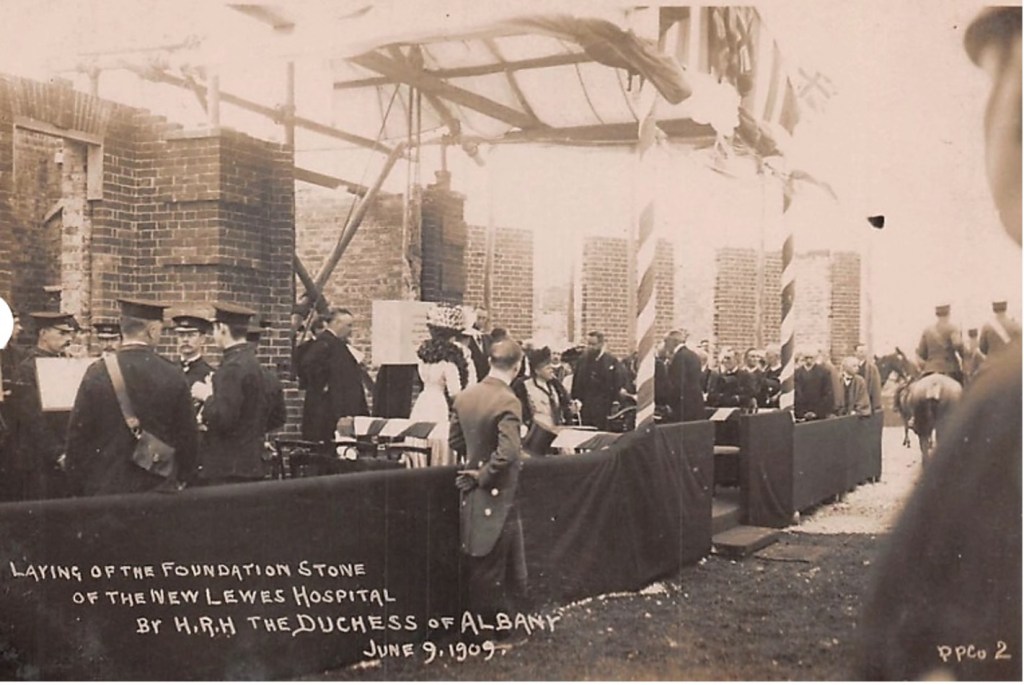
9. Laying the Foundation Stone of Lewes Victoria Hospital in 1909
10. Public Health in Lewes a century ago
1. Next Meeting 7.30 p.m. King’s Church Monday 20 April
Matthew Hyde Jireh Chapel and its pastors, 1905-1998
Jireh Chapel is perhaps best known today as being a Grade 1 listed building, but behind its architecture is another story worth telling. Matthew’s talk will focus on those who led the church, from the Welsh Ambassador to the Yorkshire Civil Servant. Many were local celebrities, and they and the chapel’s members made wide ranging contributions to the life of the town.
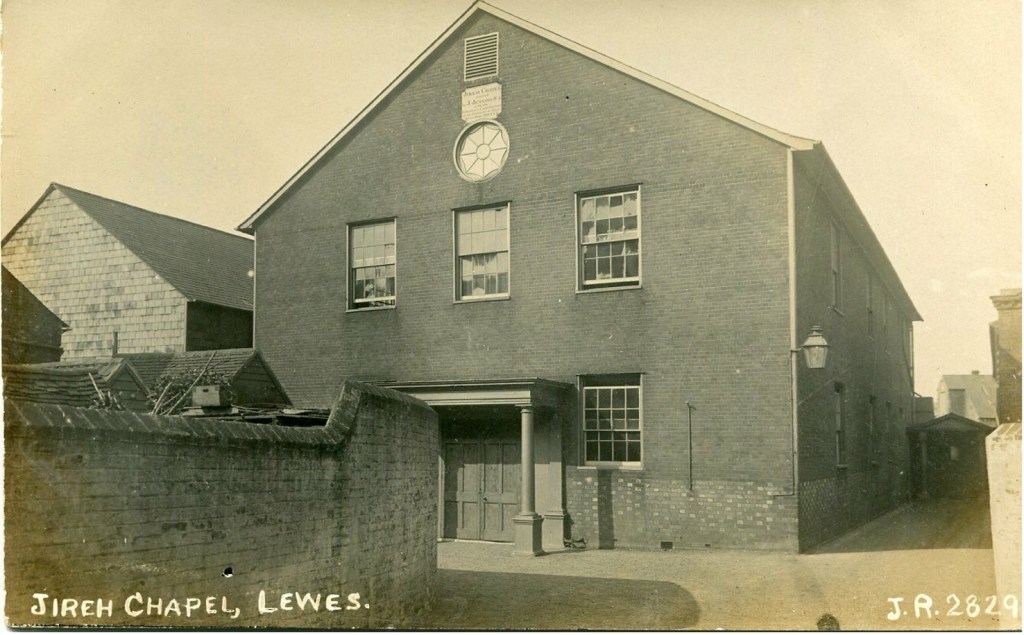
Jireh Chapel has recently become the home to the congregation that previously met at Galeed Chapel, Brighton, and Matthew is their pastor.
2. Burwood Godlee’s screw propelled boat (by Joanna Hodgkin)
In November 1872, when Burwood Godlee was 70, he received a letter from CW Merrifield of the South Kensington Museum – now the Victoria and Albert Museum – concerning a revolutionary boat Godlee had built fifty years before. Merrifield, whose full title was Superintendent of the Naval Museum and Principal of the School of Naval Architecture, said he was ‘much interested in your model of a double boat with a screw’ and asked if he would ‘lend it to the Naval Gallery at South Kensington’. A short history of the boat would, he said, ‘much add to its value’.
Burwood Godlee replied at once: ‘The original boat, or as I always termed it catamaran, as well as the model and not a few other boats and machines of various kinds, were the work of my own hands and formed the amusement and delight of my youth and middle age, as does the remembrance of them and the study of machines of every kind that of my mature years.’ He attributed his fascination with all things nautical to having grown up ‘by a navigable river’ and having ‘a father who spent the early part of his life at sea and often interested me by his tales of adventure’ as well as ‘having ever had a passionate fondness for mechanical art’. As to where the idea of a screw propeller originated, ‘I cannot say what particular circumstance led me to think of the screw as a propeller. I remember carrying out the same idea with moderate success by priming a pump by a screw writhing in a cylinder which it loosely filled. I cannot say that anything beyond my own reasoning on the subject suggested the idea.’ Building a catamaran ‘was of course not original’. He had heard about them from his father and ‘I adapted this from its being a form of boat to which it was easy to attach a screw’ and he had read of ‘its stability in the water’.
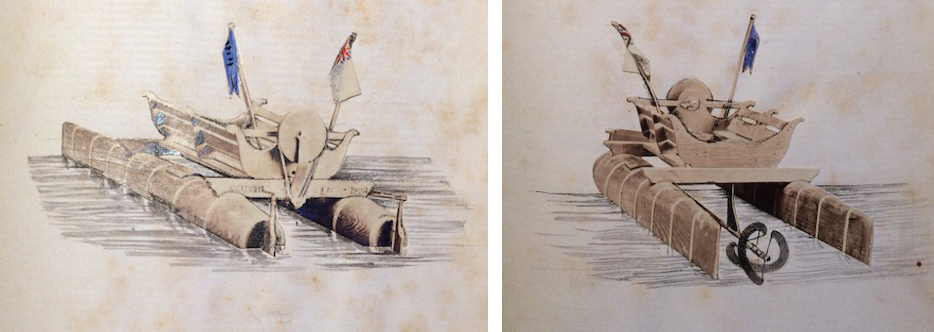
When the prototype was launched, he was “very much surprised and disappointed to find that my boat, which I fancied I had planned so as to form the least possible resistance to its forward motion, was propelled much more easily from the stern than if the stern was foremost”. He admitted that “Of course it was wholly a failure as a competitor with an oar, and steam power as applied to navigation was scarcely thought of”. Merrifield replied by return: “I regard both the model and the account of it as of great interest. There was no effective screw navigation until long after 1822, although I find that a boat was propelled by a screw in the Greenland Dock at the rate of 2 miles an hour in 1794 or 5”.
Two years later, responding to an article in The Times on the history of screw propellers, Burwood Godlee wrote to the editor: “In the naval department of the Kensington Museum there is a model of a trim boat or catamaran … driven by a screw propeller … My double boat wanted only the Steam Engine (which in 1824 was hardly recognised as a motive power for boats) to make it a success. I ask for no honour for my invention, but should one leaf of laurel spontaneously be accorded me, I would accept it with pleasure and with pride.” Sadly, the letter was not published.
The precise date of the launch of his screw-propelled catamaran is uncertain. In his letter to The Times he said it might have been 1824, but in that year his sister kept a record of the family’s activities, and the boat is not mentioned. Most probably it was 1823.
Burwood Godlee named his catamaran the ‘Sarah’ after the most colourful of his siblings, and she commemorated the occasion with a mock-heroic poem in celebration. It begins:
Success to the skiff that glides over the waves!
By genius projected & diligence framed
The next two lines refer to admiring ‘naiads’ who ‘peep forth from their caves’, with an asterisk to explain that the classical allusion is intended to ‘characterise the crowds stationed on the bridge’. The launch of young Godlee’s strange boat attracted a large audience. According to Sarah the spectators were amazed:
The gazers astonished all pause & enquire
What enchantment of wonder, what magic is here?
No force to impel it of air or of fire!
No rope from the shore & no rower is near!
’Tis the magic of art, the enchantment of skill,
Which lend to our vessel its wonder & pride –
The owner’s on board – & it moves at his will –
Regardless of wind & opposing the tide.
But in another note to the poem she mentions ‘the critics of our family’ and describes them as ‘a formidable band!’ so it’s safe to assume that the boat’s failure was a cause of satisfaction to at least some of their neighbours.
The poem was copied out more than forty years later for one of their Wellingham cousins and Burwood pencilled a note alongside it explaining that: “The ‘Sarah’ was a catamaran designed and built by the brother of the author about the year 1822. She was fitted up with a screw paddle, invented by the designer & driven by a multiplying wheel on deck with an ordinary winch. The ‘Sarah’ was probably the first actual floating craft ever driven by the screw, which is now in 1866 commonly in use in the royal navy and mercantile marine & acknowledged to be the most powerful propeller ever invented.” In 1866 he had not heard about the Greenland Dock experiment that Merrifield mentioned. The model was eventually returned to the family, and if it has survived, its present whereabouts are unknown.
Sources: All material is from the Nicholas Godlee Archive now in Friends House Library, Euston Road, London. The illustration of the ‘Sarah’ was most likely done by Sarah Godlee Rickman, an accomplished artist and craftswoman.
3. Lewes sailors at the Battle of Trafalgar
The following extract is from a letter sent home by a J. West, a sailor on the ‘Britannia’, that took part in the battle at Trafalgar. It was published in the 17 February 1806 Western Flying Post, a Dorset newspaper.
“I am sorry to inform you that I am wounded in the left shoulder, and that William Hillman was killed at the same time. The shot that killed him and three others wounded me and five more. Another of my messmates, Thomas Crosby, was also killed. They both went to their guns like men and died close to me. Crosby was shot in three places. Pray inform their poor friends of their death, and remind them that they died at the same time as Nelson, and in the moment of victory. Remember me to all my relations and friends. Tell them I am wounded at last but do not much mind it, for I had my satisfaction of my enemies, as I never fired my gun in vain. I was sure to hit them. I killed and wounded them in plenty. I should have written you sooner but the pain in my shoulder would not let me.”
The newspaper adds that West, the writer of this letter, and Hillman were both from Lewes, and Crosby from the parish of Beddingham near Lewes. The 100-gun ‘Britannia’ was, alongside the ‘Victory’, one of the largest Royal Navy ships at Trafalgar. Launched in 1762, Trafalgar was her last engagement. In 1806 she was converted into a hulk at Devonport, becoming a prison ship.
4. Drowned in the Ouse
A London newspaper, the 1 October 1807 edition of The Sun, reported that on Sunday se’nnight, as Samuel Hillman, a bargeman, was seeking mushrooms in a brook adjoining an old cut of the river, near Old Eye, he saw floating on the water a hat, and on his nearer approach discovered, immersed and in an upright position, the body of a man. He procured assistance and soon dragged it to the land, from whence it was removed to the Thatched House in South Street, Lewes.
The remains were recognised as those of a Mr Godly, a Hartfield farmer, who had left the Wheat Sheaf on Malling Street on horseback between eight and nine o’clock on Saturday night to go home, contrary to the advice of the landlord and others, as he was much inebriated. At his departure he took the right course, and how he could have pursued one so contrary as that which led to his fatal catastrophe was difficult to ascertain. On the brink of the river, near where the body was found, there were evident marks of a horse plunging, as if to avoid water.
The animal, a black mare apparently in foal, was found on Sunday morning grazing near Southerham. Three fresh wounds on her flank led to the initial conclusion that she belonged to a smuggler and had suffered from the illegal practices of her master, but it is now believed the wounds were inflicted by the deceased, as in his pockets were found three case knives and a butcher’s knife, sheathed but much stained with blood. The knives were all new, most likely purchased on Saturday for domestic purposes, but cruelly applied by the man, under the influence of intoxication, to impel the poor animal forward. His watch and about twelve guineas in cash and notes, were found in his breeches pockets, suggesting he had not been the victim of a highway robber. They were taken proper care of, as he had left a widow and two or three children to bewail his loss.
5. A duel at Lewes Castle
The 27 June 1836 Sussex Advertiser carried a tongue-in-cheek account, modelled on the accounts that more traditionally appeared in the likes of the fashionable Morning Post, of what it described as “a brilliant affair of honour” that had occurred in Lewes during the previous week.
The parties were described as two honourable members of a smoking room, Mr S – and Mr H – , who had quarrelled. A pair of huge horse pistols were sent for and the parties, attended by one second between the two, adjourned for the sake of privacy to the high road adjoining the bowling green. There the pistols were loaded, and the parties shook hands with their friends, for there were many spectators, and took their stations.
Mr H – was observed to falter on taking his ground, and had certainly forgotten to cock his pistol. Mr S – firmly presented his weapon and, taking a direct aim, fired. Then, “dreadful to relate”, his opponent took to his heels and ran home as fast as his legs could carry him, frightened out of his wits at the discharge of a blank cartridge.
6. The loss of the Galway Lass
The 19 October 1875 Hastings & Bexhill Independent carried the sad news that the coal brig ‘Galway Lass’ belonging to Lewes coal & lime merchant Robert Hillman had been lost at sea with all hands. The 189-ton brig had sailed from Sunderland five days previously with a cargo of coal bound for Dieppe, but late that same night had struck some rocks at the extreme point of Flamborough Head.
Six of the crew of eight, the master, his mate, the cook and three sailors (two of them the master’s sons) were from Newhaven. The other two sailors were Charles Earl from Southover and Nelson Tasker from Ringmer, both of whom were teenagers. Seven bodies had been washed ashore.
7. An application to the Guardians
When the Lewes Board of Guardians met on 29 March 1877 under the chairmanship of Mr E. Morris they considered an application from several of the old people who were inmates in the House for leave of absence on Easter Monday. As the Master reported favourably on their conduct on previous occasions when they had been allowed leave, their request was granted.
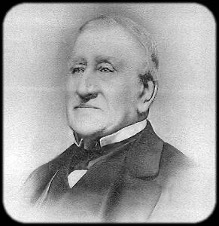
The board heard that the number of inmates was 98, compared to 92 for the equivalent week in 1876. The number of vagrants admitted during the week was 28, compared to 20 in 1876. There were 31 children in the House.
Source: The photograph of Ebenezer Morris is from https://www.thegilberts.net/FamEbenezerM.htm; other information from the 7 April 1877 Sussex Advertiser.
8. Lewes institutions in 1921
The 1921 census of Lewes had a special section for the town’s institutions – a somewhat smaller section than usual, as at the time both the Lewes Prison on Brighton Road and the former Naval Prison on North Street were empty and unoccupied. The Naval Prison had closed in 1910 and the building was used by the territorials. Lewes Prison closed in 1916, apart from wartime use for Irish prisoners, and did not reopen as a local prison until 1931.
Five other institutions were however listed:
- Children’s Home, Lewes St Ann – 47 residents
- Victoria Hospital, Lewes St Ann – 27 residents
- Infectious Diseases Hospital, London Road, St John-sub-Castro – 3 residents
- Home For Little Girls, Danny Cottage, Prince Edwards Road, St Ann – 9 residents
- Nursing Home, Sussex House, Priory Crescent, Southover – 27 residents
The Children’s Home was one of the buildings in the former Union Workhouse complex, and it continued to operate throughout the inter-war period. The last two listed are new to me. Danny Cottage was 14 Prince Edwards Road, and the full name of the institution there was “Lewes Home for Little Girls from Workhouses” [https://www.childrenshomes.org.uk/list/Sussex.shtml]. The Keep has an undated advertisement for the Sussex Nursing Home, Priory Crescent, in the records of the Lewes & District Nursing Association [ACC 5301/1/16].
9. Laying the Foundation Stone of Lewes Victoria Hospital in 1909
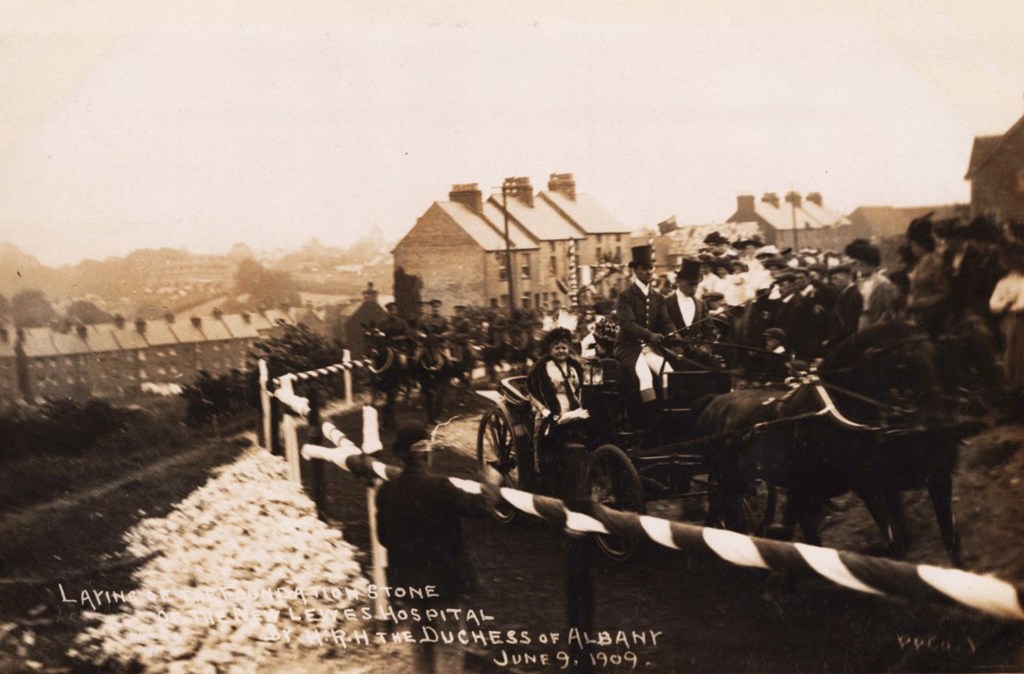
The foundation stone for the new hospital was laid on 9 June 1909 by the Duchess of Albany, a German Princess who had married one of Queen Victoria’s younger sons. Below are two postcard photographs of this event, part of a series. Other photographs taken at the same event have been published in Bulletins nos. 60 & 147.
10. Public Health in Lewes a century ago
The Medical Officer of Health’s annual report to the Borough of Lewes for 1925 illustrates just how much life has changed locally in the last century.
The crude birth and death rates for Lewes at 15.1 and 10.4 per thousand people were then, as now, a little lower than those for the country as a whole. The birth rate has fallen, nationally, by over a third since then, but the crude death rate has not changed very much. A key difference, however, is that in 1925 nearly half of all deaths occurred in people aged under 65 – over the past century the chance of dying before the age of 65 has more than halved. Infant mortality (before your first birthday) was 5.2% in Lewes in 1925 (9 deaths out of 171 live births, compared to 7.5% for England & Wales), far higher than today’s 0.4% for England & Wales. Of the nine babies lost, seven were boys.
The Medical Officer, Dr William Alexander Daw, reported 17 cases of scarlet fever and 4 cases of diphtheria in 1925, but none of those patients died. However, the 26 cases of tuberculosis included six deaths. Patients with fever were accommodated in the Lewes Isolation Hospital, Nevill Road, run by the Borough Council. Those with TB were sent to the Darvell Hall Sanatorium, Robertsbridge. Pretty well everyone else who could not be treated at Lewes Victoria went to Brighton, where the County Hospital (which treated venereal disease) was supplemented by the Royal Alexandra Hospital for children, the Maternity Hospital in West Street and the Brighton Smallpox Hospital. Lewes also had a home called Gateway House run by the Diocesan Purity Association, that could accommodate 10 people and was supported by voluntary subscription. Were the mothers of the nine illegitimate children born in Lewes in 1925 accommodated there?
The Medical Officer and his Sanitary Inspector were also responsible for oversight of the water supply and waste disposal. They tested the water supply provided by the Lewes Water Company, which supplied almost all the town, and declared it excellent. The Cliffe Well and some private wells were still in use.
Practically everyone in Lewes had water closets (a very different situation from that in the surrounding country villages at that time). Some were hand flushed, while others had flushing systems, which the Borough Council encouraged and subsidised. The town’s sewerage system converged on a central station near Southerham, where the effluent was processed through screens and settlement tanks before being discharged into the River Ouse “at a suitable state of the tide”. Refuse from galvanised dustbins, also supplied by the Borough Council, was deposited at the Corporation Tip in Ham Fields, described as being at a suitable distance from the town. This was sorted and burned. The residue was mixed with sewage sludge and used for filling up low-lying ground nearby. So different from our own day, when the privatised Southern Water simply pours untreated sewage into the River Ouse at all stages of the tide.
Source: W.A. Daw’s 1925 Annual Report to Lewes Borough Council, posted by Mick Symes on the Lewes Past website.
John Kay 01273 813388 johnkay56@gmail.com
Contact details for Friends of the Lewes History Group promoting local historical events
Sussex Archaeological Society: http://sussexpast.co.uk/events
Lewes Priory Trust: http://www.lewespriory.org.uk/news-listing
Lewes Archaeological group: http://lewesarchaeology.org.uk and go to ‘Lectures’
Friends of Lewes: http://friends-of-lewes.org.uk/diary/
Lewes Priory School Memorial Chapel Trust: https://www.lewesprioryschoolmemorialchapeltrust.org/
Facebook: https://www.facebook.com/LewesHistoryGroup
Twitter (X): https://twitter.com/LewesHistory