Monday, 20 April, at 7.30 pmat Kings Church (please note the later than usual date).
The chapel, founded in 1805, proved extremely popular, so it was extended in 1826 to accommodate a congregation of 1,000 in its box pews and galleries, beneath a barrel-vaulted timber roof. It is a timber framed Georgian structure, clad in mathematical tile. It is a classic of its type, and was listed grade 1 in 1952.
Members will not need to register in advance to attend this talk.
Please arrive in good time for a prompt start at 7.30 pm.
PS We would very much appreciate some help with putting out the chairs for the talk. We need to start doing this from 6.30 pm, and all volunteers will be welcome. Many thanks in advance.
Please note: this Bulletin is being put on the website one month after publication. Alternatively you can receive the Bulletin by email as soon as it is published, bybecoming a member of the Lewes History Group, and renewing your membership annually
1. Next Meeting: 9 March 2026: Chris Taylor ‘Hospitals in Lewes’ 2. The distress sale of Miss Sarah Harben’s stock in trade 3. The Great Lewes Gale of February 1866 4. Caleb Rickman Kemp, Mayor of Lewes 5. Edward Reeves opens his Lewes business 6. A new Soup Kitchen for Lewes 7. Executions in Lewes 8. Historic Lewes for Sale: 1 Prince Edward’s Road 9. Commemorating a remarkable Lewes doctor (by Chris Taylor)
1. Next Meeting 7.30 p.m. Zoom Meeting Monday 9 March Chris Taylor Hospitals in Lewes
In his talk Chris will offer a survey of the various institutions that have, over several centuries, provided people in Lewes with medical care and treatment, including the medieval Priory, an 18th century pest house, 19th century infirmaries and a 20th century sanatorium.
LHG members can register free to receive the Zoom link for the last of our winter Zoom meetings. Non-members can attend via Ticketsource.co.uk/lhg (price £4.00).
Postcard showing Lewes Victoria Hospital, c.1920
2. The distress sale of Miss Sarah Harben’s stock in trade
This notice of a distress sale of the stock of Sarah Harben’s haberdashery and millinery business comes from the 30 December 1793 Sussex Advertiser. When a business was unable to pay its debts, the standard process was for the debtor to hand over control of their entire estate and all their personal property to trustees for their creditors. Sarah Harben’s business may have been a casualty of the failure of Thomas Harben’s Lewes bank earlier in 1793. A business owner unable to satisfy their creditors was likely to find themselves in gaol for debt, at least until their creditors were satisfied that they had done all they could to meet their obligations.
The Thomas Dicker mentioned above had been the managing clerk of Thomas Harben’s bank. After its failure he become first the managing clerk, and some years later a partner, in another Lewes bank that had been formed in 1789 by Francis Whitfeld, Joseph Molineux, Richard King & Benjamin Comber. Harben’s bank was the original Lewes Old Bank, but after its failure Whitfeld & company, previously called the New Bank, took on the Old Bank’s name and its accounts, as well as its managing clerk. Banister Flight had been one of Thomas Harben’s partners in the Lewes Old Bank until its collapse. Thomas Harben’s other banks, based in Brighton & Horsham and with different sets of partners, also collapsed in 1793. These bank failures were the consequence of a cash-flow crisis. As banks are legally liable to repay all their depositors on demand but make long-term loans using the money they have deposited, any loss of confidence, whether well- or ill-founded, would create a run on their available cash. When the cash ran out, and an anxious depositor could not be repaid, the bank had failed. In fact, after the delay necessary to realise their assets, the Harben banks were able to repay all their creditors in full. Nevertheless, the reputations of both the bank and its partners were gone forever.
The surname Harben is uncommon locally, so it seems likely that Sarah Harben will have been a relative, very likely one who had received a loan from the Harben bank to establish her business that she was unable to repay until her stock was sold. It is significant that her trustees are both associated with the Harben bank. The forced sale of her stock by the trustees for her creditors at below cost price will have done nothing to help her overall situation. She was collateral damage.
3. The Great Lewes Gale of February 1866
On Sunday 8 February 1866 a violent gale affected Lewes. There was furious wind and rain all day, causing havoc in the town. Those venturing out of doors were, according to the 14 February 1866 Sussex Advertiser, in continual danger from falling chimney pots and flying tiles. The river was high, and the Pells and other areas bordering it were flooded. The newspaper listed the most serious damage to the town.
At 10 New Street the tile roofing was partly blown away.
In Sun Street one house lost most of its roof tiles, many lost tiles and chimney pots.
In Fisher Street many tiles were blown from roofs into the road
In Abinger Place the tile fronting of Mr French, greengrocer, was badly damaged.
A small tree was blown down in the swimming baths.
The brickwork over the back doorway of a house in Castle Banks was forced away
Nearby Mr Crosskey’s stable was shorn of most of its roof.
The soot shed of Mr Tidman, chimney sweeper, ‘lost its head’ with the rain then falling on his soot supply, causing may pounds of damage.
The Dispensary called on Mr Tidman’s services, where the collapse of Mr Crockford’s chimney brought a great heap of soot down, and scattered the fire onto the carpet.
Mr Twigg, fruiterer, North Street, had a tall chimney blown to the ground.
The stone roof was much damaged at Mr Hammond’s, 92 High Street.
The stone roof was partly stripped from Mr George Baker’s house, at the top of Keere Street.
In Priory Street, Southover, plenty of loose tiles and chimney pots were lost.
The ‘Morning Star’, St Ann’s, had the front tiling much damaged.
Some cottages nearby lost part of their roofing.
A chimney at Mr Burfield’s, greengrocer, lost most of its supporting brickwork.
Mr Wilmshurst’s house lost a number of tiles.
White Lion Lane, an area where the houses are not kept in very perfect repair, had tiles and chimney pots flying about in all directions. There was so much debris that the lane became impassable until it was removed.
In Lansdowne Terrace and Friars Walk a number of chimney pots and loose roofs came to grief, in addition to clay tiles and slates being lost.
The Windmill beer-house near the gaol had its sign blown off.
A summer arbour at a house opposite Southover church collapsed.
At the County Gaol the great number of slates blowing off the roof made it dangerous for the officers move about the prison. A skylight was lifted off the Governor’s residence and had to be replaced by tarpaulin. One of the windows at the chaplain’s residence was blown in.
The police station and County Hall also lost some roof slates.
Some of the old Horsham stone that covers Southover church was blown off.
At St John’s church a portion of one of the Gothic widows was blow in.
The tower over the Fitzroy Memorial Library was much damaged and expected to fall.
The steam shaft at the Sussex Advertiser office became unstable and threatened to fall.
Mr Markwick’s mill at Malling sustained some serious injuries and the blacksmiths’ services were requisitioned on Sunday night.
The office chimney of Mr Hillman’s (brewers) was blow down.
A signal post with an iron ladder attached was blown across the track just before a train was due, but the driver managed to stop the train in time and the obstruction was removed.
Fortunately, there were no serious injuries. A tile fell off a house onto the head of Mr Read, milkman, without doing him much harm. A little child blown down by the force of the wind in Southover could not get up again, but after crying in the road for some time two men carried her to her house, unhurt.
4. Caleb Rickman Kemp, Mayor of Lewes
The 3 January 1884 Hastings & Bexhill Independent carried a biography of Caleb Rickman Kemp, who was the third mayor of the borough of Lewes, and a leading member of the Society of Friends.
“The Mayor of Lewes (Alderman Caleb Rickman Kemp) is the youngest son of the late Mr Grover Kemp, who was for many years the junior partner, and subsequently the senior partner, in the firm of Messrs Glaisyer & Kemp of North Street, Brighton. His worship was born in 1836, and is therefore 47 years of age. He received a commercial education and training which has since stood him in good stead, but before settling in life he accompanied his father and the late Mr William Holmes of Alton, Hants, on a six month tour amongst the British West Indian Islands, during which time, under the auspices of the Society of Friends, the party visited the various mission stations on the islands, holding meetings with the coloured inhabitants, and making inquiries into the condition of the freed population. In the course of their journey they went to Trinidad, Barbadoes, Antigua, Grenada, Montserrat, Nevis, St Christopher, etc, holding some fifty meetings, besides inspecting schools and colleges. This was the winter of 1857-58 and soon after his return Mr Kemp settled in Lewes, and succeeded in business the late Mr Richard P. Rickman, joining his partners, Mr George Newington and Mr John Clay Lucas. Mr Kemp, in the same year, married Jane, youngest daughter of Mr John Morland of Eastcheap, E.C., and Heath Lodge, Croydon. A few years later his present residence, Bedford Lodge, Rotten Row, was erected. Until the formation of the Town Council in November 1881 Mr Kemp took no part in the local government of the town. In compliance with a numerously signed requisition, he the offered himself as a candidate, and was returned high up on the poll, and on the first meeting of the Council on 9 November following he was unanimously chosen one of the aldermen of the borough. In the earliest days of the Corporation he rendered valuable assistance as the Chairman of the Finance and General Purposes Committee, and on 9 November last, when chosen Chief Magistrate of the Borough, it was universally admitted that he was eminently fitted for the post, and a worthy successor of the two gentlemen who had previously filled the mayoral chair. The Mayor is a leading member of the Society of Friends. He has held official positions in the Society, both locally and nationally, and is at the present time one of the Executive Committee. At the annual meeting of the Friends in London in 1879 he was, with others, appointed to visit the whole of the Communities of Friends in Ireland, and in this inspection, he took a great deal of interest, having visited Ireland some years before. He is also one of the Committee of the British and Foreign Anti-Slavery Society, a position his visit to our colonial possessions when a young man fully qualifies him for; and he is also a member of the Committee of the British and Foreign Bible Society, Mrs Kemp being the local hon. secretary of the Lewes Auxiliary. The Mayor has been a total abstainer for several years, but hitherto has not placed himself in the front rank of the movement. It may here perhaps be noted that from figures recently published, it appears there are about 17 Mayors in the kingdom who do not touch alcohol as a beverage. In politics Mr Kemp is an ardent Liberal and has for years taken an active part in the Liberal organisations. In accordance with Lewes usage, however, his Worship immediately after his election resigned his position as Chairman of the Committee of the Lewes Liberal Association. He is also a member of the Reform Club. As regards local institutions and charitable organisations, there is scarcely one with which the Mayor is not connected. He is a Director of the Lewes Infirmary, Vice-President of the Young Men’s Christian Organisation, Chairman of the Committee of the British Schools, a manager of the Savings Bank, etc. Amongst a large circle of friends he is greatly esteemed, and is uniformly kind and courteous to all. He is a frequent speaker at public gatherings, especially with those connected with some philanthropic or religious object, his remarks being invariably well chosen and gracefully received.”
Caleb Rickman Kemp (1836-1908) was one of the large family of the Brighton Quaker minister Grover Kemp, who was a partner in a prominent North Street, Brighton, chemist’s business. Both his grandmothers were members of the Rickman family of Lewes. The 1851 census finds Caleb Rickman Kemp as a scholar attending a Quaker boarding school in Hitchin. After leaving school he did two years’ work in a draper’s shop and then learned the craft of flour milling in Mitcham, joining the Croydon Quaker meeting, before moving to Lewes. By 1861 he was a merchant, but a visitor in a Guildford household. In the later censuses he was at his home in Rotten Row, Lewes St Ann, with his wife, who he had actually married at Croydon in October 1859, the year after he established himself in business. She was from the family who ran the Moorland sheepskin business, and connected to the Clarks who made and sold shoes. His house, built in 1865, was called Bedford Lodge after the Quaker Peter Bedford who had been a source of inspiration in his teenage years, but who had just died. In 1882 he added a vinery and a greenhouse to Bedford Lodge. The Kemps had no children but kept two or three female servants. Like many Quakers, he kept a journal for much of his life. His father, Grover Kemp, died in 1869.
In the censuses he described himself variably as a merchant (1861), merchant and ship owner (1871) or lime burner and coal merchant (1881). His partnership’s principal chalkpits were those at Brigdens in Glynde (on the slopes of Mount Caburn); Balcombe Pit in Beddingham near Glynde railway station; and above Glyndebourne Farm, of which his partnership held the lease for some years. All three were owned by the Glynde Place Estate, whose scion Henry Brand was a Liberal MP whose long service was rewarded by his becoming Speaker of the House of Commons and, after his retirement, Lord Hampden. The business also had a yard, warehouse, stable, coal shed and counting house in South Street, Cliffe. At the time he was elected mayor he was still active in business, but The London Gazette records that in 1890 he retired from his partnership with John Clay Lucas and Frank Newington (trading as G. Newington & Co). In the 1901 census he described himself simply as a magistrate. However, he retained some business interests: at his death he was chairman of the Lewes Gas Company and a director of the Lewes Water Company.
He was, after the deaths of Richard Peters Rickman in 1876 and Burwood Godlee in 1882 by far the most influential of the Lewes Quakers. He had begun to speak at the Croydon Quaker meeting at the unusually young age of 17, and had been made a Quaker minister at the age of 21. It was then that he joined his father in visiting the Quaker communities in the West Indies, after which he came to Lewes, taking the place of Richard Peters Rickman in the lime merchants’ partnership. His Quaker influence was not confined to Lewes: he was Assistant Clerk to the London Yearly Meeting for 18 years, and then from 1890 to 1899 the Clerk, a post he filled conscientiously, and with dignity, scarcely ever missing a meeting throughout his 27 years in post. He also joined the Committee of the British and Foreign Bible Society in 1880, becoming chairman in 1890 and later vice-president. This was an organisation in which he worked together with other Christians from a range of different theological backgrounds, including the church of England.
In Lewes he supported the Mechanics Institute, the Workman’s Institute, the Chess Club, the fund to create the Pells swimming baths, poetry evenings and the Sussex Archaeological Society. He was a member of the jury at the Borough of Lewes law days from as early as 1861. He was a prison visitor and a member of the Sussex Discharged Prisoners Aid Society. He was for a period chairman and treasurer of the Lewes Town Mission and in 1897 helped to establish the Lewes Evangelical Free Church Council. In the same year he spent £450 putting Fitzroy House into repair and repaying the debts of the former subscription library there to enable it to become a free library for the whole town. He presented a clock to the Borough of Lewes for use in its Council Chamber, and also a set of councillors’ chairs that remain in use today. At the coronation of King Edward VII he joined a deputation led by the Archbishop of Canterbury that presented a bible to the new king. Victorian Quakers mixed with their Lewes and national peers more freely than their predecessors had, though concerts and other events involving music were still a step too far and, like many Quakers, he avoided consuming alcohol.
Caleb Rickman Kemp died on 1 October 1908 and was buried in the Quaker burial ground at Lewes, where he has an unostentatious memorial. He had an obituary published in The Times. Despite his generosity he left an estate of nearly £50,000. His wife Jane survived him, and was one of his executors.
Mr J. Barnett of 68 High Street, Lewes, watch and clock maker, advertised in the 5 November 1844 edition of the Sussex Advertiser that he had disposed of his business to Mr Edward Reeves.
Edward Reeves also advertised that he had available an extensive collection of watches, both new and second hand, and every description of clock. He also offered gold and gilt jewellery, spectacles for those who needed them to read, and could repair any of these goods. Old gold and silver were taken in part exchange.
Edward Reeves had thus already been established in Lewes for 14 years when in 1858 he moved his business to 159 High Street and created a daylight photographic studio in the garden.
6. A new Soup Kitchen for Lewes
The 30 March 1878 Sussex Advertiser reported that a new and commodious soup kitchen had just been completed for the benefit of residents in St John-sub-Castro parish. It had been erected at the edge of the churchyard, and had served its first customers on the previous Wednesday. The kitchen had been fitted up and the approach tastefully planted with evergreens by Mr Joseph King, who was one of the Poor Law Union guardians for the parish.
The 1871 & 1881 censuses identify Joseph King as a resident of 13/14 North Street. In 1871 his occupation is described as ‘rag merchant & marine store dealer’ (rag and bone man), but by 1881 he was described as a general dealer (another synonym for rag and bone man). In each census he employed three men and one or two boys. This was an occupation that would have brought him into daily contact with the poverty to be found in every Victorian town.
By 1892, now based at 13-15 North Street, he advertised his services as a valuer for businesses or for probate, and also as a provider of very cheap new and second hand beds, mattresses and furniture on hire purchase terms. He had been established in business for 30 years. The business survived, as Joseph King & Son, into the Great War.
7. Executions in Lewes
Up to 1831 people sentenced to capital punishment in Sussex were executed at Horsham Gaol, but it was then decided that such punishments would be carried out at the House of Correction in North Street, Lewes, redesignated as the Sussex County Gaol. Three people were executed there at well-attended public hangings over the next twenty years: 1831 John Holloway, for murdering his wife 1848 Mary Ann Geering, for murdering her husband & two adult sons 1852 Sarah French, for poisoning her husband at Chiddingly
In 1853 the old North Street Prison was replaced by the new Lewes Gaol. Ten more hangings for murder were carried out there, the first two in public. 1856 John Murdoch, aged 18, for strangling the Hastings gaoler 1866 John William Leigh, for shooting his sister-in-law, a Brighton landlady 1868 Martin Henry Brown, for murdering & robbing a fellow labourer on Newmarket Hill – his intended target was a shepherd 1881 Percy Mapleton, the Preston Park railway murderer 1887 William Wilton, for murdering his wife in Brighton 1892 George Henry Wood, for the rape and murder of a 5-year-old girl in Brighton 1912 Albert Rumens for murdering a 10-year-old girl, daughter of a Wadhurst neighbour 1912 George Mackay, alias John Williams, for shooting and killing a police inspector during an Eastbourne housebreaking 1914 Herbert Brooker for cutting his girlfriend’s throat during a train journey from London to Brighton 1914 Percy Clifford for shooting his wife in Brighton
8. Historic Lewes for Sale: 1 Prince Edward’s Road
The house at 1 Prince Edward’s Road, BN7 1BJ, originally called ‘The Limes’, was built in 1870 by iron-founder John Every, one of the first houses on the Wallands Estate. The 1875 O.S. map shows both King Henry’s Road and Prince Edward’s Road laid out, but in this was the only house to have actually been built in this neighbourhood. In style it resembles the houses of the earlier development of Wallands Crescent, across the Offham Road.
John Every lived here until his death in 1892, and his widow was still here in 1901. A solicitor lived here in 1911 and a retired Indian Army major general was in residence in 1938, by which time the name (still ‘The Limes’ in 1927) had changed to ‘North Corner’. In 1951 & 1964 it was the Prince Edward Nursery School and by 1968 the North Corner Tutorial College. In 1984 it became the North Corner care home. The care home closed shortly after receiving an ‘Inadequate’ CQC rating in 2023, and the 16-bed house (with some of the rooms in a modern extension to the rear) now has planning permission for reconversion to a single residence.
The property is currently on the market with the Oakfield Estate Agency at £2.25M.
Sources: Oakfield estate agency advertisement; Sheila Wood’s website at www.flutewood.org.uk; Familysearch & local directories.
9. Commemorating a remarkable Lewes doctor (by Chris Taylor)
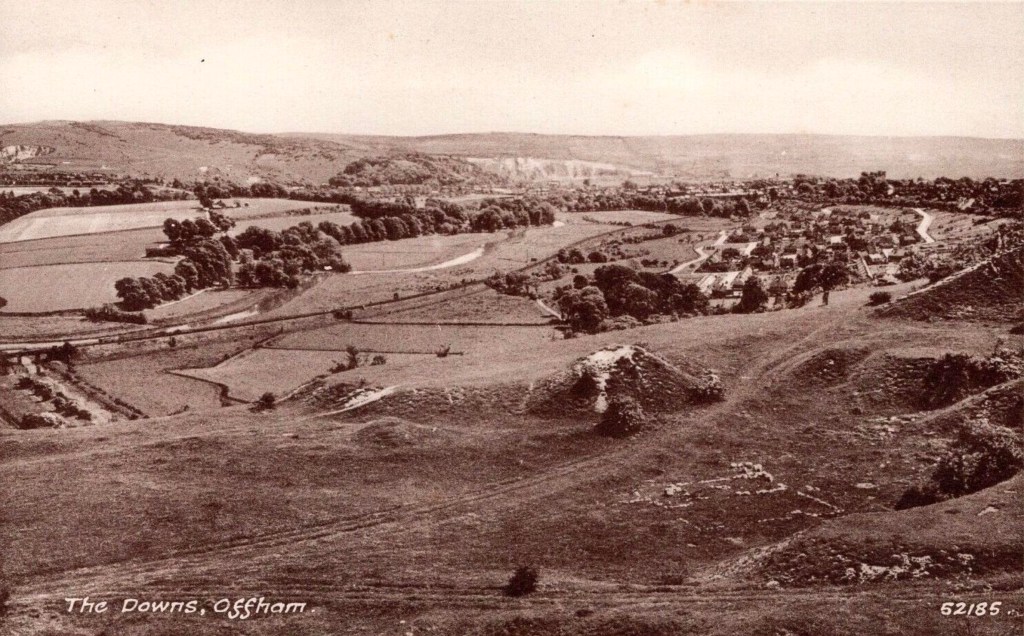
Dr. John Steinhaeuser (who in 1917 anglicised his surname to Stenhouse) served as Medical Officer of Health for Lewes Borough between 1898 and 1922. An enthusiastic promoter of measures to improve the health of Lewes people, he wrote extensively on the causes and treatment of TB. In 1905 he started the Lewes Sanatorium at Offham to provide rest, sunshine and good food for those in the early stages of the disease. He served heroically in France as an army surgeon during World War 1, enduring hardships from which his own health never recovered. He died aged 52 in 1923. Stenhouse practised medicine and lived with his wife and three children at St Andrew’s Place in Southover Road. The Town Council have now placed a plaque there to mark the life of this distinguished Lewesian.
Please note: this Bulletin is being put on the website one month after publication. Alternatively you can receive the Bulletin by email as soon as it is published, bybecoming a member of the Lewes History Group, and renewing your membership annually
1. Next Meeting: 9 February 2026: three members’ short talks 2. Judith Brent 3. Dates of Lewes Floods 4. Coombe House Antiques, Malling Street 5. A portrait of Margaret Woods 6. John Braden: our first Medical Officer of Health (by Chris Taylor) 7. A felony at Malling 8. Lewes Castle painted by Mary Webster in 1838 9. The mail must get through 10. Two way traffic on School Hill
1. Next Meeting 7.30 p.m. Zoom Meeting Monday 9 February Sheila Wood ‘What’s in a name?’ Paul Nicoll ‘How the Lewes By-pass saved the Rugby Club’ Chris Taylor ‘A Doctor in Edwardian Lewes’ [John Steinhaeuser]
This month’s meeting will again feature three shorter talks by members on their research into three different aspects of Lewes history. Sheila Wood will speak about the names given by residents to the houses in the developing Wallands area of Lewes a century or so ago, and the problems they caused for the authorities. Paul Nicoll will cover an aspect of the history of the Lewes Rugby Club and then Chris Taylor will tell us about the life and career of Dr John Steinhaeuser, who used his professional skills to help make Lewes a safer place to live.
LHG members will receive the Zoom link for the meeting. Non-members can attend via Ticketsource.co.uk/lhg (price £4.00).
In our recent survey over 70% of members supported continuing with zoom meetings in the winter months.
2. Judith Brent
I am very sorry to have to record the sudden death on New Year’s Eve of Judith Brent, formerly an archivist with the East Sussex Record Office, going back to the days when our county’s archives were housed in cupboards on the upper floors of Pelham House. Judith and her husband Colin devoted much of their lives to unravelling the history of our county, and in particular its county town. Their house-by-house history of Lewes, Cliffe and Southover is an invaluable guide for much of the research our own group has carried out, in particular the various Street Stories projects.
I have a particular personal debt to Colin & Judy. Some 50 years ago Colin ran a Local History evening class under the auspices of the Workers Educational Association – at a time when local history was a barely respectable endeavour. Judy joined in, and we were able to initiate our own research projects, with access to the original documents unimaginable today. I was one of the students and so began a life-long fascination with the subject.
3. Dates of Lewes Floods
The 14 November 2025 Sussex Express reported, on the authority of John Gower, flood lead for the Friends of Lewes, that properties in the town had been affected by flooding in 2000, 1960, 1938, 1911, 1909 and 1878. I have been unable to find reports of the 1938 & 1878 floods in the local press, though 1877 saw serious flooding in the brooks around the town. The other dates are well-attested and we have photographs from 1909, 1911, 1960 and 2000. In addition the 28 October 1891 Hastings & Bexhill Observer reports flooding on both sides of the river Ouse in the lower parts of the town.
To these floods we can add a report in the 7 November 1865 Sussex Advertiser of flooding affecting the lower parts of the town, especially the Cliffe, that was as bad as had been experienced in the great floods of 1852, when serious flooding in Lewes was reported in newspapers published across England. The 1852 floods were described as the worst since 1814, but at least the paper mill, the riverside wharves and the cellars of the Cliffe were also flooded in 1841. Peter Varlow’s new book on Cliffe church mentions the 1814 flood as caused by rapid melting of snow. Brigid Chapman in ‘The Chronicles of Cliffe and South Malling’ (2003) also reports floods in 1773,1772 and 1768 [Bulletin no.45].
On at least two other occasions in the 20th century (1914 & 1935) there was flooding of dozens of houses in Southover by the Winterbourne without any accompanying flooding from the Ouse.
4. Coombe House Antiques, Malling Street
This trade advertisement for Coombe House Antiques, Malling Street, is taken from the 1968 edition of Kelly’s Directory for Lewes. This was once a very smart villa residence.
5. A portrait of Margaret Woods
This oil on board portrait, noted on the reverse to be of Margaret Woods of Lewes, spinster, 1778-1868, was offered for sale on ebay recently for £175 by Plardiwick Antiques of Stafford.
The 1851 and 1861 censuses find her living, together with her unmarried brother Joseph Woods, in one of the houses of Priory Crescent, Southover. They were prominent members of the Lewes Quaker community. Joseph & Margaret Woods both died at Priory Crescent, in January 1864 and December 1868 respectively, and they were buried side by side in the Quaker Burial Ground in Friars Walk. Though Joseph Woods was regarded in his lifetime as of delicate health, they lived to the ages of 87 and 90 respectively. They are both described as annuitants in the 1851 census and Joseph was a ‘fundholder’ in 1861. At Margaret Woods’ death she left an estate of £6,000, so they could afford to live comfortably.
Joseph and Margaret Woods were respectively the third and fourth children of Joseph Woods senior (1738-1812), a widely educated Quaker woollen-draper, and his wife Margaret Hoare (1748-1821). They were born in Stoke Newington, then a village a few miles to the north of London. In 1787, when they were both just children, their father and their uncle, the banker Samuel Hoare, were two of the five Quaker founders of the London Association against Slavery, the predecessor to the Committee for the Abolition of the Slave Trade. Their mother kept a journal from 1771 until her death from which extracts, published posthumously in both Britain and the United States, are today a major source for contemporary Quaker social history.
Joseph Woods, largely self-educated, trained as an architect. Although he does not seem to have had any great talent for the practical side of the business, he became the founder and first president of the London Architectural Society in 1806. After Waterloo he was able to travel extensively in France, Italy and Greece, and published ‘Letters of an Architect’ in 1828. However, he had wide interests that extended into other areas, becoming a Fellow of both the Geological Society and the Linnean Society, and a member of the Society of Antiquaries. After giving up architecture, he moved to Lewes in the early 1830s. Thereafter he focused much more on his botanical studies. He was a particular specialist in roses. He published widely in this field, including in 1850 a Flora of Great Britain and the parts of Europe in which he had travelled. The Linnean society has a collection of his manuscripts and journals. He was also a competent amateur artist, though his surviving artworks are few and far between. He was an excellent chess player.
Joseph Woods drawn by John Sell Cotman in 1819 and photographed as an older man
Margaret Woods was herself a talented artist, and the Linnean Society has a volume of her intricate watercolours of flowers from her garden and from the places she visited in and around London. Each drawing is carefully documented, and a selection are featured on the Society’s website. They were drawn from 1802 onwards, for the benefit of her brother’s botanical work. Margaret’s portrait is unsigned. It appears to date from the time they lived in Lewes. It could perhaps be a self-portrait, a painting by her brother or the work of a contemporary Lewes artist.
Sources: FindMyPast; M.A. Lower, ‘The Worthies of Sussex’ (1865); David Hitchin, ‘Quakers in Lewes’ (2010); Linnean Society website; obituary of Joseph Woods in the 20 January 1864 Sussex Advertiser; the drawing of Joseph Woods by John Cotman is from the V&A Museum collection and the photograph from the Linnean Society website.
6. John Braden: our first Medical Officer of Health (by Chris Taylor)
The Public Health Act of 1872 created local sanitary authorities to oversee services such as water supply, sewerage and refuse disposal in every part of England and Wales. The Act obliged each authority to appoint a medical officer of health (MoH) to advise, give direction and prepare annual reports on the sanitary state of the district, the incidence of diseases and the rate of infant mortality. It was decided to make a single appointment to cover Lewes, Cliffe and the rural districts; in 1873 Lewes doctor John Braden became the first MoH with a salary of £50 a year.
John George Braden was born in Whitechapel in 1836, the son of a sugar refiner with premises in Denmark Street. The 1851 census has John, aged 15, living at an address in Brick Lane, ‘learning his profession’ as an apprentice to the surgeon Thomas Mears. Apprenticeship was a common means of preparation for medical practice before a structured system of hospital-based training and standardised examinations were developed. Braden completed his successfully and was admitted to the Royal College of Surgeons in 1857. He set up in general practice in the Commercial Road area of London and in 1861 married Louisa Kennedy. The 1871 census has John and Louisa living at 166 High Street, Lewes (formerly the premises of Gideon Mantell) with daughter Mary aged 9, son Carl aged 5, baby Ethel and three servants. Carl had been born in Torquay, so it is possible that Braden practised there for a while before arriving in Lewes.
No.166 High Street, John Braden’s home
Braden’s annual reports demonstrate his strong commitment to public health awareness, a shrewd appreciation of the practicalities of public health measures and at times a dry wit. His time in office saw the extension of sewerage to most parts of the town and the near-elimination of cesspools. Throughout the 1880s he noted with approval the public’s increasing interest in sanitary matters. In 1888 he reported that ‘all classes are beginning fully to understand it is better to prevent than cure disease.’ He hoped, however, that this growing awareness would not encourage people to think that ‘almost every act in their daily life is fraught with sanitary danger’: reason should prevail.
His calm handling of a severe outbreak of enteric fever (typhoid) in 1874-5 earned Braden a vote of thanks from the Improvement Commissioners, who were until 1881 the sanitary authority for Lewes Borough. This outbreak supplied him with ammunition to argue for an isolation hospital for infectious diseases in Lewes, which duly opened in 1877. Braden’s riposte in 1882 to ratepayers who complained that the new hospital’s beds had so far been largely unoccupied was to suggest that ‘probably the same individuals would regret the inactivity of the fire engine’.
Braden became a well-known figure in the town. A stalwart of the local Conservative Association – one imagines him an enthusiastic supporter of Disraeli’s Sanitas Sanitatum, Omnia Sanitas dictum – and a vice president of the Lewes Cyclist Club, he found time to serve as president of the Lewes Photographic Society. The Sussex Express reported in April 1891 on ‘An enjoyable entertainment … given at St. Anne’s School-room on Wednesday evening by Dr. J. G. Braden’s exhibition of Sussex photographs… The frequent applause which greeted the views, which embraced a variety of subjects, indicated the keen appreciation of the audience.’
John Braden’s tenure as Lewes MoH came to rather an abrupt end in June 1892 when, after 20 years in office, he tendered his resignation. A combination of reasons probably explain his decision. Personal tragedy possibly played a part: Louisa had died in 1888 and three of their five children had died in infancy. A serious flu epidemic in 1892, which killed 47 people in January alone, caused him great distress: ‘l regret not being able to speak so favourably as usual on the general health of the town.’ The death rate in the first half of that year rose to 22.2 per 1000, the highest in 20 years and, very unusually, considerably above the national rate. Against this background, the Borough Council received a letter of complaint from Sir George Shiffner, Rector of Hamsey, accusing Braden of neglect in the case of a parishioner, to whom he had failed to make an arranged second visit and who had died. This was the first complaint ever made against him. Braden’s reply, endorsed by the council’s sanitary committee, denied any neglect and explained the difficult circumstances that had doctors working at full stretch. All these factors no doubt contributed to a degree of disillusion and prompted his departure.
The council having accepted his resignation with regret, Braden left Lewes with ringing endorsements of his work, including one from the Directors of the Victoria Hospital, expressing their high appreciation of his services as an honorary surgeon. He continued to practise for a few years at St Margarets at Cliff near Dover, where he was elected to the parish council. He left there in 1895, moving to Shalford in Surrey, where he died aged 70 in 1906.
Sources: Records of Lewes Improvement Commissioners (ESBHRO LEW/C/3/1); Sanitary Committee minutes (ESBHRO DL/D/169); Censuses 1841-1891; UK Medical Registers 1859-1959; 18 April 1891 Sussex Express; 7 December 1894 & 25 October 1895 Dover Express
7. A felony at Malling
The 15 March 1864 Sussex Advertiser reported that Hannah Carter, a respectable-looking woman who earned her living by hawking baby linen, etc, was brought before the Lewes bench charged with stealing a chemise and a night gown from a washing line in ‘the parish of Cliffe, Malling’. They were valued at three shillings and the property of Edward Ford.
Mary Ford, the prosecutor’s wife, deposed to missing the items in question on 7 March about 5 p.m., and she identified items shown to her as those that had gone missing. A label had been cut out. Her neighbour gave evidence that she had seen the prisoner nearby at the time. P.C. Gosden recovered the missing items in Hannah Carter’s possession at the Welcome Stranger at about 7 p.m. the same evening.
Hannah Carter claimed she had bought the items for a shilling from a woman she could ‘identify among a thousand’, but she was not believed. The bench sentenced her to six weeks’ hard labour
8. Lewes Castle painted by Mary Webster in 1838
Recently offered on ebay by Jacob Boston Fine Art was this fine signed and titled watercolour of the view inside the castle keep by Mary Webster (1794-1883). She adds a note ‘Sketched from nature, 25 August 1838’. Also offered by the same artist are about forty other views of Pevensey Castle, Herstmonceux Castle, Hastings Castle, Ashburnham Park, Priesthawes House near Hailsham, Ovingdean & Preston churches, the Royal Pavilion, the Downs near Brighton and a number of views in and around Eastbourne. The majority are from Sussex or from Broadstairs in Kent, but there are also a number from other counties. Each is titled, signed and dated. The Lewes Castle painting, offered at £250, is roughly A4 size.
Mary Webster does not appear in the catalogues of exhibiting Victorian artists, but she seems to have been a talented and prolific amateur. Three albums of her watercolours painted between 1838 & 1850 were sold by the auctioneers Lyon & Turnbull for £6,300 in June 2025, and these watercolours come from them. The Lyon & Turnbull catalogue includes a brief biography.
Mary Webster was the eldest of 11 children born to John Webster, minister at Inverarity, near Dundee, and his wife, also Mary. After John’s death in 1807 the family moved to London. They appear to have continued to live together. The address that Mary provides in one album, 24 Brook Street, was also the address of her eminent brother John Webster MD FRCP FRS (1794-1876), who devoted much time and labour to the examination of lunatic asylums, prisons, and medical institutions at home and abroad’ [Royal College of Physicians, online]. A collection of Mary’s watercolours is held by Edinburgh Libraries, who remark that ‘the census records indicate that Mary was a lady of independent means, single, living in a household with her mother and grown-up siblings with servants’. This would support the evidence that she was able to travel widely and pursue her painting pastime. She was described in her family as a woman who was talented, travelled widely, and wrote and painted ‘en plein air’. The albums were consigned to auction by a family member.
9. The mail must get through
In the early hours of a dark November Friday morning in 1873 the Hawkhurst mail cart, scheduled to arrive at Lewes at ten minutes past five, was galloping down the Broyle when it collided with one of the timber waggons belonging to Messrs Chatfield of Lewes, also on the road at that early hour. It was the lighter mail cart that came off worse – its body was detached from its wheels, and it was completely disabled.
Luckily neither Cootes, the driver, nor his horse suffered serious injury. He extracted his bags of letters and papers from the stricken vehicle, slung them about his body, mounted his steed and completed his journey to Lewes as fast as he could. He arrived at his depot at ten past six, just an hour late.
Source: 28 November 1873 Hastings & Bexhill Independent
10. Two way traffic on School Hill There is no date attached to this photograph showing two-way traffic on School Hill, but the vehicles and the pedestrians’ attire suggest somewhere about 1950. The Cinema de Luxe, the Lewes Trustee Savings Bank and F.H. Coote, gents’ outfitters, at 25-28 High Street all match the entries in my 1951 local directory. The Seveirg building stands on the corner of Eastgate Street, and the Uckfield Railway line still crosses the High Street.