Lewes History Group: Bulletin 120, July 2020

Please note: this Bulletin is being put on the website one month after publication. If you would like to receive the Bulletin by email as soon as it is published, please contact the Membership Secretary about joining the Lewes History Group, and to renew your membership at the start of the calendar year. 

  1. Lewes History Group way forward
  2. New Membership Secretary needed (by Neil Merchant)
  3. The High Street in the 1920s
  4. The Borough of Lewes celebrates Queen Victoria’s Diamond Jubilee
  5. John Levett’s trial
  6. An 1848 Portrait
  7. Sale of the Century
  8. Leicester Road in the 1940s
  9. Cliffe Corner
  10. Lewes Railway Station (by John Hollands)


  1. Lewes History Group way forward

For all of us the year 2020 is turning out rather differently than expected. To date there have been just a handful of virus-related deaths in Lewes, but the Coronavirus is definitely still amongst us. It seems very unlikely that the government will be encouraging large indoor gatherings such as our Monday evening meetings anytime soon. Even if they were to be permitted, I’m sure many of us would have our doubts about attending them.

In the immediate future, which may well turn out to mean for the remainder of 2020, the only way we can continue this aspect of our programme is through virtual meetings, most probably using the Zoom platform. Not all our planned talks are suitable for delivery in this manner, but many are, so if some initial tests are successful, we shall be restarting in September with a presentation from the team whose study of the Pells area of Lewes has resulted in the completion of a new volume in our Street Story series.

Many of us who had never even heard of Zoom a few months ago have now becoming reasonably adept users for our work, social life and family interactions. Hosting a meeting requires some knowledge, but to join one you just need an email address, an appropriate laptop, tablet or phone with a camera and a web browser, and to download the free Zoom application.


  1. New Membership Secretary needed                             (by Neil Merchant)

We still haven’t managed to find someone to take this on. After 9 years in the role, I really would like to step back and find a successor. It’s healthy for the group to bring in new enthusiasms and thinking. The membership secretary is a key role for the Lewes History Group’s continuing success, and a member of our executive committee. Core activities are:

  • Managing membership and our membership spreadsheet: signing up and recording new members; handling the annual renewal process; keeping our records up to date; passing cash and cheque receipts to the treasurer; updating our Gmail contacts list.
  • Maintaining supplies: maintaining a stock of supplies (membership card blanks, labels, A4 paper, stamps, envelopes, ink cartridges), and recording and claiming back expenses incurred.

As for equipment, software and skills you’ll need a PC or Mac, word processing, spreadsheet and email experience, and a printer. Don’t worry if you’re afraid you don’t have the skills: I’m happy to do a long handover and coach as needed (albeit probably remotely). The skills are very useful to have, and you’d be central to our success. We can also look at customising the role to your preferences if need be.

Do get in touch if you’re interested, either via the website ‘contact us’ page, or via our phone number 01273 447566. Come on in – the water’s lovely!


  1. The High Street in the 1920s

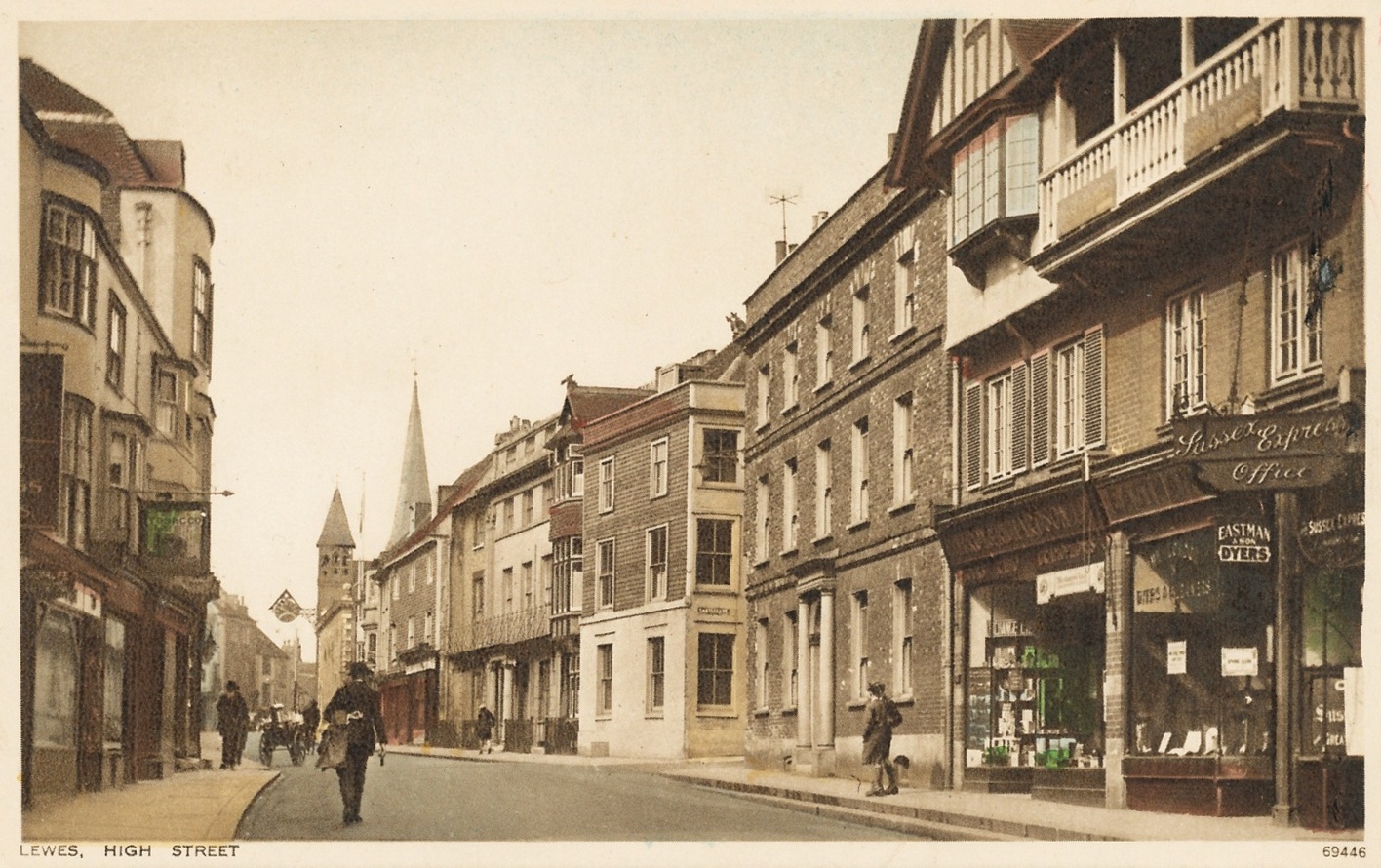
Lewes High Street early 1920s postcard

Postcard no.69446 published by the Photochrom Company Ltd of London & Tunbridge Wells features the upper part of the High Street, looking towards St Michael’s church in the early 1920s. The Photochrom process produced colourised images from black and white negatives. If all the traffic was removed the view would not be very different almost a century later.


  1. The Borough of Lewes celebrates Queen Victoria’s Diamond Jubilee

Still on the shelves of the modernised Lewes Library are two bound copies of the printed programme for the celebrations held over three days in June 1897 to mark Queen Victoria’s Diamond Jubilee, together with a detailed account of the impeccable organisation that underpinned them. Leading the events were the Mayor, Alderman Frederick Flint, his wife the Mayoress and his two young daughters.

The programme starts on Sunday 20 June when ‘Old Gabriel’, the town bell, tolled for two solid hours, from 9-10 a.m. and then from 1.30 to 2.30 p.m. in the afternoon. Following that at 3.30 p.m. was a service of Public Thanksgiving at All Saints church, in which all the civic organisations participated. Then, at 9 p.m. on the eve of Monday 21 June was a giant torchlight procession. Arrangements for this were the responsibility of the town’s Bonfire Societies, with the important stipulation that no Roman candles or sky rockets were to be let off, to avoid setting fire to the elaborate street decorations. The procession was to start at the Swan Inn, Southover, and then proceed via Southover High Street, Priory Street, Station Street and School Hill to Cliffe Corner. It then reversed and went via Albion Street, East Street, West Street, Mount Pleasant, Offham Road, The Wallands and St Anne’s Crescent to the top of the High Street and then to its conclusion outside County Hall.

The big day was Tuesday 22 June, when ‘Old Gabriel’ was again rung for three periods of an hour, starting at 8 a.m., 12 noon and 6 p.m. At 9 a.m. was a Royal Salute of 21 guns. This was followed by the inauguration at 10.30 a.m. of the adoption of the Fitzroy Memorial Library by the Borough Council under the Public Libraries Acts and at 11.30 a.m. by the opening of the new Recreation Ground down at the Pells. At 1.30 p.m. the town’s children were to assemble at their schools and other appointed places from where they marched to the front of the County Hall to sing hymns and the National Anthem. From there at 2.15 p.m. they were to process down to Ham Meadows, headed by the Town Band, where at 3 p.m. there was a flight of 60 homing pigeons, one for each year of the Queen’s reign, and then at 4 p.m. tea was to be served to an estimated 2,300 children in marquees set up in Ham Meadows.

From 4 p.m. there were sports for adult residents of Lewes, ending with the presentation of prizes at 6.30 p.m. by the Mayoress. These started with a 200 yard flat race for men aged 15-30, followed by a 100 yard race for women aged 15-30, a 100 yard race for veteran men aged over 50 and a 100 yard race for veteran women aged over 50. All these races were handicapped and carried prizes of 8 shillings for the winner, 5 shillings for the runner-up and half a crown for the third candidate. At a time when few working men earned as much as a pound a week, these were of significant value. The young women could win the same amount as the young men, despite having to run only half as far.

These events were followed by a number of less straightforward events, with slightly lower prizes. There was a 150 yard boot race, in which young men had to take off their boots, run 100 yards, put on and lace up their boots and then complete the distance to the winning post; a 50 yard egg and spoon race for women over 15; a 100 yard three-legged race; a 150 yard ginger beer and biscuit race, in which young men had to run 100 yards, drink a bottle of ginger beer, eat a lunch biscuit and then complete the distance to the winning post; a 50 yard flat race for women aged 30-50; and an open competition for grinning through a horse collar. The judges for these events were Miss Fowler Tutt and Councillor Lenny, with Mr A.E. Rugg acting as referee.

At 7.30 p.m. the children were dismissed, but there was dancing for the remaining adults at the Dripping Pan. Events were terminated at 10 p.m. when 84 beacon fires were to be lit across Sussex – it was expected that a good number of these would be visible from Lewes, especially those on Kingston Hill, Caburn and Firle Beacon. Every child aged between 5 and15 and attending the town’s public elementary schools was given a commemorative mug. These were also available for other children whose parents made an application.

Two lasting memorials of the Jubilee were intended. The first was to secure the future of the Fitzroy Library. Up to this time it had been managed by the Lewes Library Society, who had informed the Borough that they would be unable to continue their responsibilities after the end of the current year. The Borough Corporation had agreed to adopt the Public Libraries Act which enabled them to carry on the Library in the Fitzroy Memorial Building. To facilitate the change the shareholders agreed to transfer the stock of books and Alderman Caleb Rickman Kemp, JP, agreed to pay off the liabilities of the Library Society and cover the expenses of putting the building into good repair, a generous gesture that was anticipated to cost him between £200 and £300. A tablet was to be erected to commemorate the change.

It was also agreed to create a new Recreation Ground on the remaining part of the Town Brook that had been bequeathed to the town by the attorney John Rowe in 1603. The new Recreation Ground was about an acre in extent, and was laid out with 400 yards of paths, flower borders and a children’s play area with swings, etc. There are Edwardian postcards featuring the Borough’s Recreation Ground in Bulletin’s nos.33 & 38.


  1. John Levett’s trial

The 24 June 1845 Sussex Advertiser reported that John Levett, aged 25, the guard on the London to Brighton coach, had been brought before two Lewes magistrates, Henry Blackman and George Molineux, charged with theft. The landlord of the Maidenhead Inn, Uckfield, had given Levett £24 19s 0d to deliver to the Lewes bank of Messrs Molineux, Whitfeld, Dicker & Molineux. Levett said that when the coach arrived in Lewes the bank had shut, so he delivered it instead to a boy at Mr Molineux’s house.

The coach had arrived at the Star Inn, just 40 yards from the bank, at 6 p.m. George Whitfeld, partner at the Lewes Old Bank, stated that the bank usually closed at 5 pm, but that on Tuesdays it stayed open until 6 or 7 pm ‘on account of business’. On that particular Tuesday evening he closed the bank at twenty to seven. The Uckfield innkeeper had come to Lewes to track down his money, the best part of a year’s wages for a working man. He had caught up with Levett, made him retrace his steps, and gone to Mr Molineux’s house, where he had interviewed both Mrs Molineux and the boy. Molineux’s boy was described as equivocal in his evidence.

The main evidence against Levett was that prior to this event he had debts with various local establishments, but that immediately afterwards he had repaid them all, and bought himself new clothes and a gold ring. He had also freely entertained his associates. A passenger on the coach had noted him counting about 20 sovereigns. The magistrates committed Levett to Quarter Sessions for trial, where the 8 July 1845 Sussex Advertiser reported that a jury found him guilty. He had a previous conviction for stealing a bottle of port wine and a bottle of ginger beer from William Rose, landlord of the Star Inn, so was sentenced to be transported for 10 years.

A feature of this case is that the magistrate George Molineux, who made the committal, was the senior partner in the Lewes Old Bank that featured in the case, while his eldest son George Molineux junior was also a partner. It isn’t clear which Mr Molineux’s house John Levett claimed to have left the money at, but ‘Mrs Molineux’ will have been either the magistrate’s wife or his daughter-in-law, while ‘Molineux’s boy’ could have been one of his younger sons, then aged about 10 & 15; his eldest grandson, who was just four; or a young male servant in either household. I think that today we would consider that a conflict of interest.


  1. An 1848 Portrait

The following extract is from the 1848 diary of Mary Ann Berry (born 1822), eldest daughter of the builder and developer James Berry (1796-1877) and granddaughter of the timber-merchant and Tabernacle founder Charles Wille senior (c.1768-1849). In 1848 Mary Ann was a young woman, engaged to be married, and her life revolved around the activities of Tabernacle. She had lived all her life at Coombe Cottage, Malling Street, but visited her grandfather at his Albion Street home most days, dining with him on Thursdays.

 “On Thursday 3rd August dear Grandpapa gave me his portrait. I had asked him to have it taken for me by the photographic process and he was kind enough to have it taken in the regular way instead, which is far preferable to the ugly metallic Daguerrotype portraits. It is an excellent likeness and smiles just as he does when he looks at me. He went to Brighton on purpose that it might be made on Monday. I could not think what made him look so wicked when he told me he had been to Brighton, but this beautiful picture explains all. I gave him so many kisses for it and he was so pleased that I was satisfied and delighted.”

The portrait was a present to mark her 26th birthday. Photography was still in its early days in 1848 – it was not until the1850s that there were several commercial photographers active in Lewes. However, the first Brighton studio had been established by William Constable in 1841, the same year that the railway reached that town.


  1. Sale of the Century

An auction sale to be held at the Star Inn on Friday 21 May 1790 by Verrall & Son was advertised as comprising the Star Inn itself and forty other freehold houses in Lewes, all formerly the estate of Thomas Sergison esquire, deceased. The properties were to be sold in individual lots. The sale was widely advertised and attracted considerable interest.

Copies of the printed auction particulars were available from the offices of Verrall & Son and at the Star Inn itself, but also at other leading inns in Brighton, Eastbourne, East Grinstead, Tunbridge Wells, and via other auctioneers in Chichester, the City of London and at Lincoln’s Inn.

In 18th century Lewes an extensive residential property portfolio brought political power, as tenants could be compelled to vote in the way their landlord directed, or replaced by alternative tenants who would. Thomas Sergison (1701-1766), born Thomas Warden, had changed his surname in 1732 when he inherited Cuckfield Place from his great-uncle, Lord of the Admiralty Charles Sergison. The Lewes houses that he built or purchased gave him such influence, which he first tried to exert (unsuccessfully) in the 1734 election, when he stood as a Tory in alliance with a non-conformist candidate on an anti-excise platform against the two sitting Whig MPs supported by the Duke of Newcastle. He failed in 1734, and again in 1741, despite using his Star Inn as a Tory campaign base, pitched against the Whig White Hart. Thomas Sergison’s additions to his Lewes property empire in an effort to increase his support were matched by the Whigs. In the end he came to an accommodation with Newcastle, so that from 1747 until his death in 1766 elections were uncontested, and much expense was avoided. Thomas Sergison held one Lewes seat himself throughout this period, and Newcastle’s nominee the other. Sergison’s brothers and his sons-in-law also benefitted from Newcastle’s patronage, mostly at a cost to the public purse. The grand staircase that is such a feature of today’s Town Hall was installed in the Star Inn by Thomas Sergison, who moved it there from the decaying mansion of Slaugham Place.


  1. Leicester Road in the 1940s

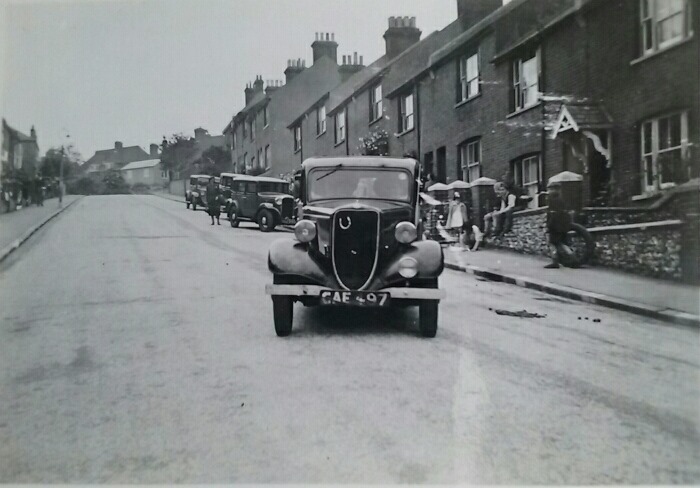
Leicester Road Lewes, postcard

This photograph of Leicester Road was posted on the Lewes Past website in May 2020, by Frances Kelly. She comments on how wide the road looks with so many fewer cars than there are today.


  1. Cliffe Corner

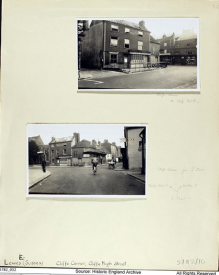
Cliffe High Street junction with Malling Street, Lewes, 1940s 1These two 1940s photographs of the houses that once stood at the junction of Cliffe High Street and Malling Street were posted on the Lewes Past Facebook pages in March 2020 by Anna Cornwall.

The building on the north-west corner of the junction (2 Malling Street) and the roofless but once-elegant Georgian house at 28 Cliffe High Street that included the Air Raid Precautions premises were demolished to improve visibility at the junction and create a car park.


Click on image above to go to the Historic England website for a larger zoomable image, and more information.
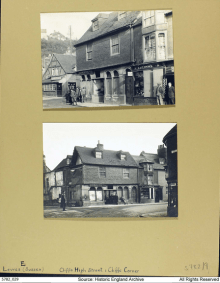
Cliffe High Street junction with Malling Street, Lewes, 1940s 2Across the road, at the south-west corner, was what had once been an elegant shop, sadly decayed by the time these photographs were taken.

This too were demolished, later replaced by the public conveniences that became the Nutty Wizard. These photographs were also posted by Anna Cornwall on Lewes Past.

Click on image to go to the Historic England website for a larger zoomable image, and more information.


  1. Lewes Railway Station                                                 (by John Hollands)

I am a former Lewes resident with a strong interest in both the history of Lewes and the history of railways. Some LHG members may remember the talk I once gave to the group on the railway history of the town. Recently I acquired this early 20th century picture postcard published by W.H. Smith & Sons in their “Kingsway Real Photo Series”. This series was produced over a number of years from 1908 onwards and is believed to contain at least one view of every railway station where the Company had a bookstall.
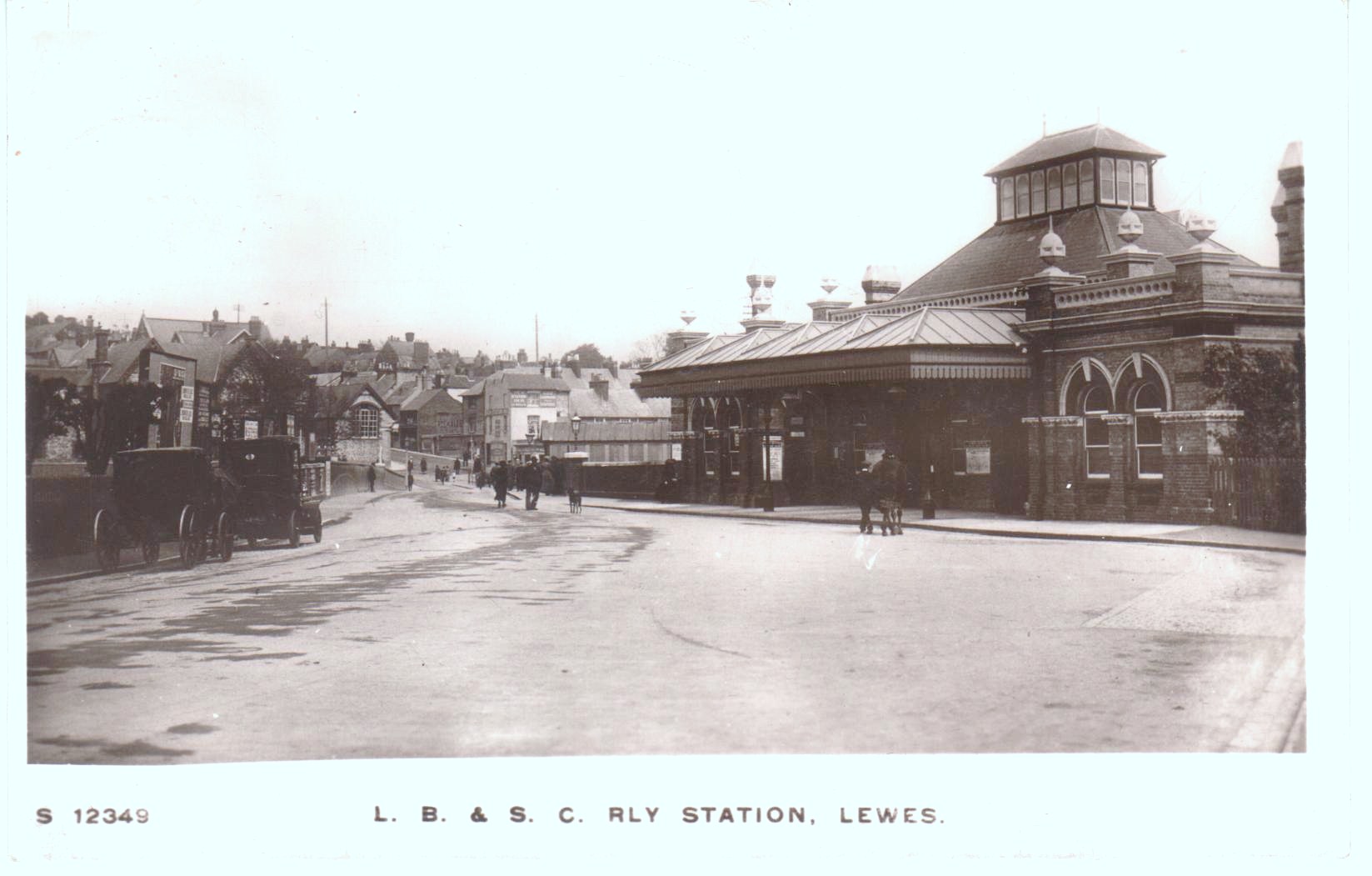
Lewes Railway Station, early 20th Century postcard

The oblique view of the station frontage is interesting in that it also shows a horse cab and an early motor car standing in Station Road, and in the middle distance the New Station Inn and the Central School, whilst the building whose roof stands up above the others I take to be the Foresters’ Hall.

Equally interesting is the message written in pencil on the back. It was addressed by “George” to a Miss A Hayward with an address in Canterbury, and has a Lewes postmark the bottom half of which has not registered, so rather frustratingly the posting date cannot be read. It bears a George V halfpenny stamp. I would date it as pre-WW1 by a year or two.

The message reads: “Dear A, Just a PC trusting it will find you in the best of condition. The brigade started marching to Sevenoaks today. Twelve of us were kept back to clear the camp, take the tents down etc., doesn’t it seem funny, Alice, to do a little work. I bet it will be miserable here tonight with only twelve of us, but never mind, we are living like fighting cocks, that is the main point, isn’t it. No more this time. Sincerely yours, George.”

So, it’s a tantalising reminder of the regular army camps on the Downs near Lewes at this time. Maybe a LHG member with a particular interest in military history can fill in some more details.


John Kay

Contact details for Friends of the Lewes History Group promoting local historical events:

Sussex Archaeological Society
Lewes Priory Trust

Lewes Archaeological Group and go to ‘Lectures’
Friends of Lewes
Viva Lewes
The Arts Society: Uckfield & Lewes – meets 2nd Wed. Guests £7 per talk

Lewes History Group Facebook, Twitter

Posted in Biographical Literature, Cultural History, Legal History, Lewes, Local History, Military History, Social History, Transport History | Comments Off on Lewes History Group: Bulletin 120, July 2020

Lewes History Group: Bulletin 119, June 2020

Please note: this Bulletin is being put on the website one month after publication. If you would like to receive the Bulletin by email as soon as it is published, please contact the Membership Secretary about joining the Lewes History Group, and to renew your membership at the start of the calendar year.

  1. Unlocking from Lockdown
  2. Ousedale House
  3. John Phipps Townshend: the Lewes Pedestrian
  4. A Motor Car Endurance Race
  5. David Pyott, Lewes Watchmaker
  6. Renovations at the White Hart
  7. Scotch Derricks (by Dave Hood)
  8. Houses on Garden Street (by Ron Gordon)
  9. Lewes as a Market Town
  10. Places of Worship in Lewes in 1909
  11. Anne of Cleves House (by Jayne Shrimpton)


  1. Unlocking from Lockdown

The first “baby steps” towards emergence from lockdown are now being implemented, often at very short notice. Understandably the priority is starting to return the economy towards back towards its normal level of activity. While new Coronavirus infections in the community continue at their present significant level this process will be slow, and large public meetings attracting their fair share of the more vulnerable members of the community cannot resume soon. We have now postponed our planned June and July meetings, and it remains questionable whether we shall be able to resume in September. Your committee is exploring the options for virtual, or largely virtual, events if, as seems quite likely, our regular meetings cannot resume then.


  1. Ousedale House

Ousedale House, Offham, Lewes, Edwardian postcard

This Edwardian postcard by an anonymous publisher features Ousedale House, below the A275 to Offham, with Offham church in the distance. It was offered for sale on ebay in April 2017.


  1. John Phipps Townshend: the Lewes Pedestrian

John Phipps Townshend was born in Lewes on 11 June 1792 and baptised at All Saints church two months later. He was the second child and eldest son of staymaker Samuel Townshend and his wife Susannah, who had married at All Saints on 5 September 1790 and had their eldest daughter born on the following day. Susannah was still a teenager when she married and they were to have eleven children in all, though four were buried in St Michael’s churchyard as babies or toddlers. Samuel became Lewes town crier, and the couple lived at a number of addresses in St Michael’s, including the Clock House immediately west of St Michael’s church, before returning to All Saints. Samuel seems also to have been an early Bonfire Boy – the 16 November 1812 Sussex Weekly Advertiser reported that town crier Samuel Townshend had been fined forty shillings for lighting a jack-in-a-box in the street. Susannah Townshend lived to the age of 71, and Samuel to 82, before their burials at All Saints.

When John Phipps Townshend came of age in the early 19th century he became known as ‘The Lewes Pedestrian’, and part of a national craze for extreme walking. The pedestrians set themselves ever more challenging targets, walking ever longer distances in ever shorter times and with ever more challenging conditions. They became national celebrities and huge sums were wagered on their success – including by the pedestrians themselves. In 1822 John Phipps Townshend set himself the target of walking 1,000 miles in 18 days on a Newcastle course, well over 50 miles per day. Just to make it a bit more interesting, he was to walk half of the course backwards. He was quite a small man, only 5 feet 5 inches tall, and due to bad weather and swelling ankles he struggled to maintain his schedule, but in the end completed the course with 12 minutes to spare.

He continued his feats through the 1820s and 1830s. He briefly held the record for walking from London to York and back (396 miles in just under 5 days 15 hours, also achieved in 1822). In 1825 he walked 64 miles per day for 10 successive days. He won the first London to Brighton race, and humbly called himself ‘The Champion of Living Pedestrians’. One common type of race involved the runner collecting stones set out at intervals and returning them, one at a time, to the start. John Phipps Townsend participated in races with up to 300 stones set out in a long line, involving running a total of over 50 miles. As a handicap he used specially large stones from Brighton beach, and he collected his stones with his mouth, while other competitors could use their hands. It took him a little less than 8½ hours, but few others could complete the course. His party trick was to stand on one leg – his record for this was over 7 hours. While doing so he could change his shoes and stockings, shave and eat his supper.

In the end his body gave up under the strain and he had to retire. He ended his life in the Lewes Union’s Cliffe workhouse, where he died in 1845 aged 53. He was buried at Southover. His death was reported, and his exploits remembered, not only in the local press but also in national journals such as the Illustrated London News and newspapers from every corner of the United Kingdom.

Sources: Familysearch; British Newspaper Archive; Colin Brent, ‘Lewes House Histories’; Davy Crockett website http://ultrarunninghistory.com/1000-milers-1/;  Damian Hall, ’A Race through the Greatest Running Stories’ (2017).


  1. A Motor Car Endurance Race

From: A.R. Headland, ‘Some Reminiscences of Battle between 1897-1905’, privately held.

“An endurance test for motor cars was carried out about 1900. Twenty three cars started from Hastings to travel to Lewes, to see how many could cover that long distance without stopping. I believe I am right in remembering that we were told that seven succeeded. It was thought to be highly successful.” 


  1. David Pyott, Lewes Watchmaker

The 9 November 1858 London Gazette included the usual long list of insolvent debtors whose estate and effects had been vested in trustees for their creditors. One of these debtors was David Pyott, clock and watch maker, late of 188 High Street, Lewes, but now in Lewes gaol. Imprisonment for debt was a hazard faced by every Victorian businessman, but who was David Pyott? His is not a common Sussex surname.

An 1858 trade advertisement provides the key information that David Pyott’s business was that previously run by the Holman family.

Pyott of Lewes advertisement 1858

Henry James Holman clock, Lewes

Henry James Holman clock: image from W.F. Bruce

In 1787 John Holman (c.1766-1855) had entered into a partnership with the established Lewes clockmaker William Kemp (1722-1798), which lasted until at least 1797. John Holman continued the business, and was in due course joined and then succeeded by his son Henry James Holman, baptised at St Michael’s in 1816. In December 1847 Henry James Holman, son of John Holman, married Maria Martin at St Nicholas, Brighton, and this marriage was followed by the baptisms of four children, Bessie and Harry Frank in January 1849, Charlotte Anna in March 1852 and Charles Edgar in June 1853. These children were all baptised at St John-sub-Castro, because by then the business had moved to Fisher Street. In the 1851 census Harry James Holman, aged 35, was a master watch and clock maker employing one man and living in Fisher Street with his wife Maria and young son Harry Frank, aged 2. The family was sufficiently established to employ a teenage servant girl. Both John Holman and Henry James Holman served as members of the ‘Twelve’, with John Holman serving twice as high constable and Henry James Holman chosen as headborough the year after he married.

However, in August 1853 Henry James Holman of Fisher Street, aged 37, was buried at St John-sub-Castro. His very elderly father John Holman, described as a retired watchmaker, was buried two years later, aged 89. This left Henry’s widow Maria in a vulnerable position, with at three young children to support and a business to run that required technical skills she was unlikely to possess.

The 16 May 1857 Sussex Express reported that Maria Holman, widow of the late Mr Henry Holman, watchmaker, of Fisher Street, Lewes, had married David Pyott, also a watchmaker, formerly of Islington. The marriage had taken place in London three days previously. David Pyott had been born in Scotland about 1832, but his father had migrated south to Stockton-on-Tees in the mid-1830s. By 1851 the Pyott family were living in St Martin-in-the-Fields, London, and by 1861 David’s father had moved on again to Portsea Island, Hampshire. All the male members of the Pyott family trained as watchmakers and they seem all to have been prepared to move to wherever their skills were needed: David’s elder bother practised his trade first in Clerkenwell and then in Loughton, Essex, while a younger brother with a Portsmouth-born wife settled in Coventry.

Maria Holman’s marriage thus brought the necessary technical skills into the family business, but her new husband was many years her junior. In the 1851 census her age was reported as 36, a year older than her first husband, but the only matching birth record at Hever, Kent, where she said that she was born, suggests that she had knocked a couple of years off her real age. By the date of her second marriage she was in at least her early forties, while her new husband was only in his mid-twenties.

A new baby was very promptly added to the family. In September 1857 David Pyott advertised for an apprentice at Pyott’s watch manufactory (late Holman’s). Soon afterwards he moved the business from Fisher Street to a more prominent location at 188 High Street, next to the Star Inn, a shop that in the 1860s was to become Albion Russell’s boot and shoe manufactory and is today the Tourist Information Office. He was there when the 20 April 1858 Sussex Advertiser records him giving evidence in a case where a watch had been stolen. Unfortunately the marriage proved neither a professional nor a personal success. David Pyott’s new business apparently failed to cover its costs, and the report of his bankruptcy hearing in the 30 November 1858 Sussex Advertiser notes only assets below £14 against debts of almost £400. In 1861 David & Maria Pyott were in a cottage in Watergate Lane with three Holman children and their new toddler, but soon afterwards they separated. Late in 1863 Amelia Shelley, the youngest of at least nine children of a non-conformist Alfriston tailor and just into her twenties, gave birth in Brighton to a baby named David Pyott Shelley, and the 1871 census finds David Pyott as a watch and clock maker living in Croydon, with Amelia Shelley as his housekeeper and their son. All three then disappear from the record. David’s wife Maria Pyott stayed in Lewes with her children. She became a dressmaker, assisted by a daughter, while her two Holman sons entered the grocery business. In the 1880s she lived at 14 Waterloo Place, and she died in 1885.

Sources: Information from Marion Smith; online London Gazette, Familysearch, British Newspaper Archive & Lewes Town Book; there is a biography of John Holman in George Holman, ‘Some Lewes Men of Note’ (4th edition, 1927).


  1. Renovations at the White Hart

The 24 September 1838 Sussex Advertiser carried the following advertisement under the heading “ROYAL SUSSEX HOTEL & WHITE HART INN, LEWES”

“Francis EMARY returns his sincere thanks for the kind and liberal support he has experienced since taking the above Inn, and begs to assure the Nobility, Gentry, Commercial Gentlemen and inhabitants of Lewes and its vicinity, that they may depend on the strictest attention being paid to their comforts and convenience, combined with economical charges. 

The house has recently been fitted up and furnished with every attention as regards luxury and comfort, and no pains will be spared to render this house worthy of the patronage with which it has heretofore been distinguished.  

Wines of the finest vintage and flavour. Balls, public parties, etc, supplied. Superior post horses and carriages of every description. Lock-up stables, coachhouses, etc.” 


  1. Scotch Derricks                                                                       (by Dave Hood)

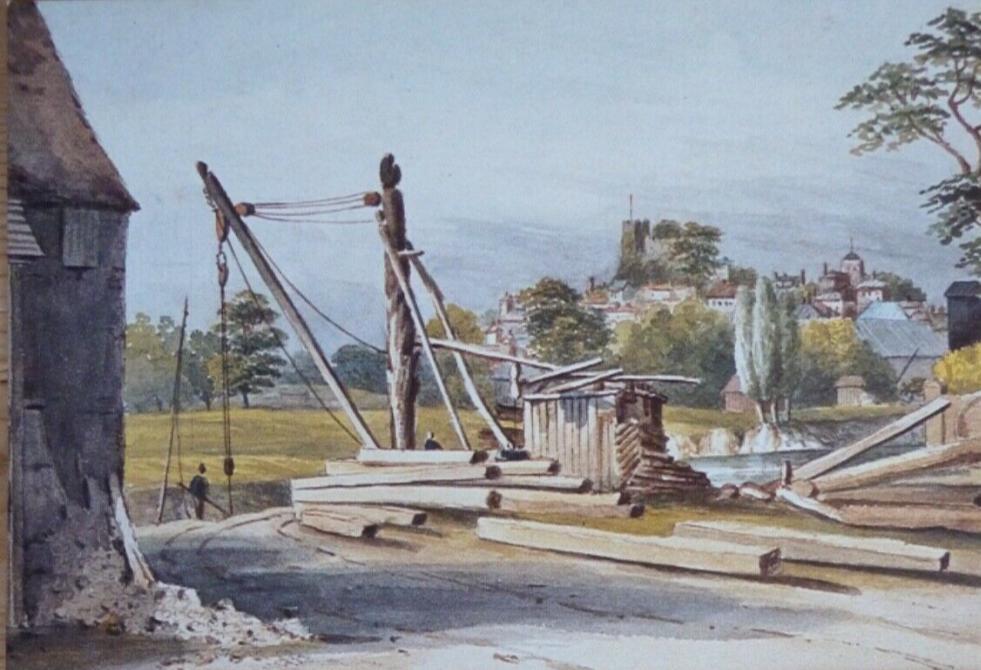
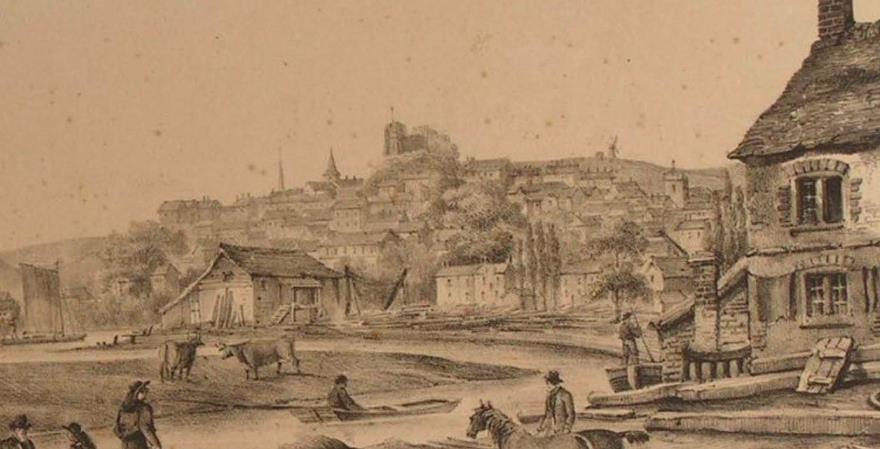
Timberyard in the Cliffe, 1830s watercolour

The image of the Cliffe timberyard derrick by the Ouse on page 3 of Bulletin no.115 is of great interest to me – I have seen pictures of this derrick before.  This particular design was quite common and was known as a ‘Scotch Derrick’. The location is the timberyard off South Street – currently where the houses of Hillman Close overlook the river. I know of three other images that, in my opinion, show the same derrick:

[1] It can be seen in the middle distance, in the frontispiece of Rev T.W. Horsfield’s ‘History and Antiquities of Lewes’ (1824)

Scotch derrick in Lewes, from Horsfield frontispiece image 1824

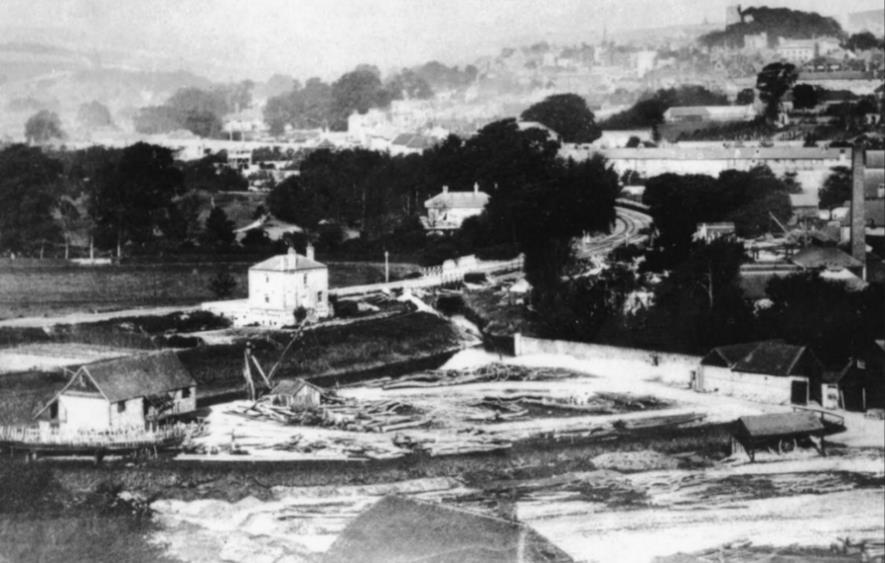
[2] A photograph of the timberyard taken from Chapel Hill (c.1860s ?)

Timberyard in Lewes, photograph from Chapel Hill c. 1860s
Photograph from the John Davey collection

[3] A photograph taken c.1869 from the west bank of the Ouse showing the construction of the first gasholder on the site, with Chapel Hill in the background – the derrick is on the right of the picture.

Gas holder construction, Lewes c. 1869

I first saw this image in P.A.L. Vine, ‘Kent & East Sussex Waterways’, but it also appears in Colin Brent, Victorian Lewes where it is credited as being from the part of the Edward Reeves Collection purchased by the Sunday Times and deposited with the Sussex Archaeological Society.

The first two of the above images also show the distinctive shed on the left of the derrick. In the last one it has probably been demolished. The derrick thus seems to have had quite a long life (at least 45 years ?) and one wonders how much was still the original when it was used to build the gasholder. The vertical timber certainly looks as though it could be.

The gasholder photograph shows the first of three gasholders was being built. A second was built sometime between 1879 and 1899 (according to OS maps) and there are a number of Edwardian postcard views taken from Chapel Hill that show them both. There are at least three images where the Scotch derrick can just about be made out by the river, although the image quality is not great.

A third gasholder was built sometime between 1911 and 1932 and after a while the first one was dismantled (again going by OS maps). The timber derrick doesn’t seem to appear on photos from this period. However, a photograph posted some time ago on the Lewes Past website, with no date or source, showed a more recent Scotch derrick made of iron or steel being used to build what I think, judging from the buildings in the background, is this third gas holder.

Scotch derrick and building of third gas holder, Lewes


  1. Houses on Garden Street                                  (by Ron Gordon)

Houses on Garden Street, Lewes, J C Postans drawing 1897

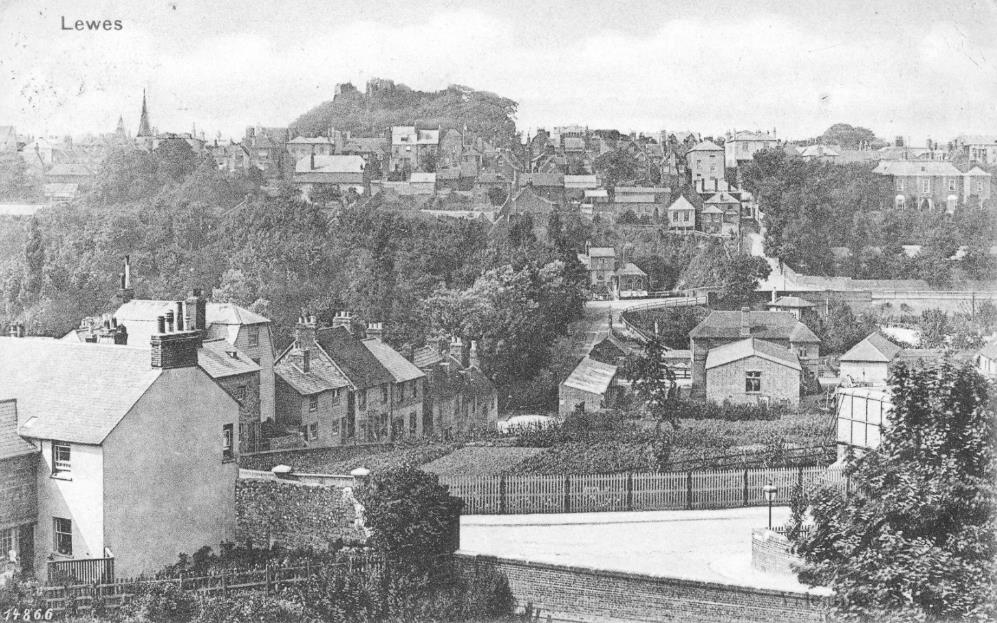
The artist for this 1897 drawing was J.C. Postans, who was my great-great-grandfather, and at the time the Congregational Minister at Linden Grove, Peckham. Sketching and painting were his hobby, and he would travel on holiday by train with a tricycle in the guards van, which he then used in the area where he stayed. We have sketches of his from Lewes, Barcombe, Worthing, Hastings and many other places. His view of the houses running down Garden Street above is notably similar to that shown in the early Edwardian postcard below of Lewes as seen from Southover. The first house has since been replaced.

Houses on Garden Street, Lewes, early Edwardian postcard 


  1. Lewes as a Market Town

 “The meetings of the Sussex Agricultural Society, instituted in 1796, are held in Lewes. The show of cattle for the premiums offered by this society generally takes place in the beginning of August, and is numerously attended by the gentlemen and farmers of this and the neighbouring counties. The market is daily supplied with necessaries for the table, but Saturday is the market day for corn. There are two fairs for black cattle and one for sheep annually, this last is very extensive, not less than eighty thousand sheep being generally drawn together on the occasion.

Source: Edward Mogg, ‘Paterson’s Roads’, 17th edition (1824).


  1. Places of Worship in Lewes in 1909

In addition to the seven Lewes Anglican churches, each in 1909 with its own clergyman, there were ten other places of worship. Most of the non-conforming churches also supported their own priest, minister or pastor. They were:

St Pancras, High Street, St Anne’s (Roman Catholic) Rev W. McAuliffe
Tabernacle (Congregational), High Street Rev Burgess Wilkinson
Jireh Calvinist Chapel, Malling Street
Presbyterian Church of England, Market Street Rev Granville Ramage
Wesleyan Church, Station Street Rev Joseph Burrows
Eastgate Baptist Church, Eastgate Street Rev J.P. Morris
Providence Chapel, Lancaster Street Rev Henry Killick
Old Baptist Union, Eastport Lane
Friends Meeting House, Friars Walk
Unitarian Chapel, High Street

No minister is listed for Jireh, which had been led from 1859 to 1902 by Rev Matthew Welland, who had died in 1908, aged 90.

Source: The Lewes section of the 1909 ‘Blue Book’ local directory, available on the shelves in Lewes Library.


  1. Anne of Cleves House                                                          (by Jayne Shrimpton)

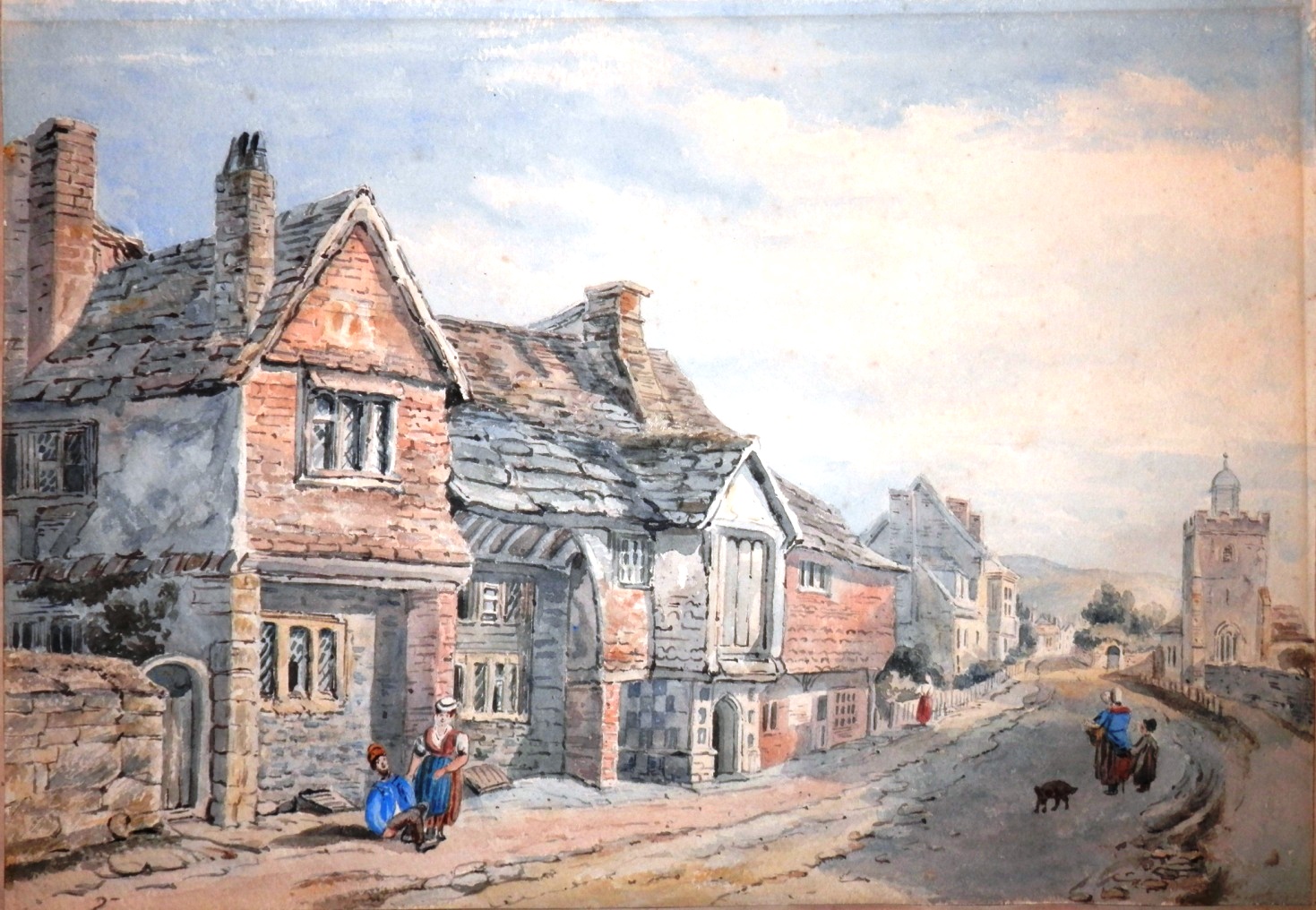
Anne of Cleves House, Lewes, attributed to Octavia Dodson, c. 1880

Members of the Lewes History Group and other Lewes residents may be interested to learn that the painting of Anne of Cleves House shown in Bulletin no.117, and tentatively attributed to Octavia Dodson c.1880, is indeed clearly much earlier in date. The dress of the people shown in the street indicates that it was painted c.1800-1825.

This unsigned image of Anne of Cleves House from https://ronsartblog.com was attributed on the website to a late-Victorian artist called Octavia Dodson, c.1880. Jayne Shrimpton is a fashion historian.


John Kay

Contact details for Friends of the Lewes History Group promoting local historical events:

Sussex Archaeological Society
Lewes Priory Trust

Lewes Archaeological Group and go to ‘Lectures’
Friends of Lewes
Viva Lewes
The Arts Society: Uckfield & Lewes – meets 2nd Wed. Guests £7 per talk

Lewes History Group Facebook, Twitter


Posted in Agricultural History, Biographical Literature, Cultural History, Ecclesiastical History, Economic History, Family History, History of Technology, Lewes, Local History | Comments Off on Lewes History Group: Bulletin 119, June 2020

Centenary of the Pells of Lewes

A community celebration of the centenary of the Pells area of Lewes has been delayed until 2021, but a new history book, and a bunting project decorating the area’s streets, park and swimming pool, have continued apace despite the Covid-19 lockdown.

The bunting is literally a community of flags – individuals’ work all coming together – and will be a lasting legacy of creativity in Lewes during lockdown.

The book titled The Pells of Lewes: Pool, Park, and People, will be published by the Lewes History Group later this year, and launched at the Group’s talk in September.

Full story from Sussex Express, 12 June 2020, courtesy of JPI Media:

Pells Centenary, Sussex Express 12 June 2020 p14-15
Click to enlarge page 14                         Click to enlarge page 15


Posted in Uncategorized | Comments Off on Centenary of the Pells of Lewes