
South Street History > History of the Houses
For extensive details of the individual houses visit the South Street data page.
The present houses are numbered from the Cliffe corner: odd numbers on the east side, even numbers on the west (river) side. Houses in Cliffe Parish are odd numbers 1 – 79 and even numbers 2 – 82, the remainder are in South Malling Parish. There are some gaps in the numbering where houses have been demolished or incorporated into an adjoining house. There was an earlier numbering for houses in the Cliffe Parish part of South Street.
Below are notes of some of the more significant events relating to the houses. They will be presented in order along the east side, odds from number 1 and continuing on the west side with even numbers from 140 (Rusty House) back to number 2.
Houses: East side
See the houses on Google Maps Street View
Number 1: The occupier in 1749 was a flax dresser, John Lambert. By 1765 the occupier was Abraham Curtis (1711-1773) and his descendants continued as occupiers there, trading in flax and associated products. A report in 1783 says the shop, with a store of tar, was menaced by a bonfire at Cliffe Corner.
In 1787 the Sussex Weekly Advertiser had a sale notice for a freehold house, warehouses and part of a rope walk adjacent (the walk ran behind number 1 along the bottom of Chapel Hill). In 1824 it was trading in rope, sacks and sacking, although the rope walk had gone, and in 1826, house numbers 3 and 5 were split off.
According to a newspaper report on the death of Ezra Curtis in 1836, he had ‘continued the trade in sacks, sacking, hair-cloth, tarpaulins, tilts, ropes, which had been conducted by the family for upwards of a century’. In that year it was advertised as a ‘roomy dwelling house, excellent front shop, large bake house, pump … & neat cottage…& stables’. By 1841 it was listed as a baker and remained so until at least 1914/15. From 1920/21 it was an antique dealer. In 1991 it became a specialist children’s bookshop.

Number 3: In the 20th century part of the cottage became an estate agent (Bingham, Heberlein & Co). The main part of the cottage was home to the Newnhams from 1914 for over 40 years.
Numbers 7, 9 and 11: Records of a house in 1681 and 1685.
Number 7 (The Fountain): Owned and occupied by Richard Hood from 1749 to 1771, when it was sold, being described as ‘house, stable and brew house, known as The Fountain’. A later sale advertisement in 1787 describes a ‘good accustomed public-house’. In 1788 it was owned by W. Verrall and occupied by Dan Grover, a victualler.
For further details of The Fountain see the Public House section.
Numbers 9 and 11: From 1749 they had a number of owner/occupiers until 1780, when number 9 is described as ‘newly erected house and garden‘.
Number 9 was from 1835 occupied by Trayton Funnell. He remained there until his death in 1884 and his obituary notes he had been a grocer for 52 years. A general store continued. By 1939 it was a fried fish and wet fish shop, and continues to the present as a fish and chip shop.
Number 11 was home to a shoe and boot maker (cordwainer), coal porter and lime burner. In 1887 it became a greengrocer.
Number 15: The ground at the back of numbers 13 and 15 below the Chalk Rock, was let in 1783 to J. Curtis (who also owned number 1), on which he built a spinning house.
Numbers 17 and 19: Owned by the Cliffe Feoffees from the early 18th century. It was one house until 1720 when it became two dwellings. In 1735-6 it was leased to a carpenter for 99 years. A 1762 advertisement describes the auction of the unexpired term of 70 years for a house and carpenter’s shop. The lease was reassigned in 1765 to ‘Thomas Woolgar (gent) or son’ – the lease had 30 years to run. Thomas Woolgar was an important Lewes man and spent a lot of his time compiling facts about the Lewes area. His writings are in the library of the Sussex Archaeological Society. It is believed that it was Thomas Woolgar who put two shoes (of different sizes) possibly belonging to his wife, Elizabeth, along with a cricket ball, in the wall of the sitting room. Shoes are usually put near a chimney breast to bring good luck. In 1775 Cliffe (which was quite separate from Lewes Town) formed its own cricket club and played up on Cliffe Hill. The ball is said to be the oldest cricket ball in the world.
Cliffe Feoffees sold number 17 at auction in 1985.
Number 21 and 23: Described as dwelling house, wood house and garden in 1735. From 1749 to 1771 occupied by W. Tooth, a farrier, later taken over by his son, Edward. In 1774 Edward was also paid for the care of horses and cow doctoring at Hamsey. In the 1820s two well-built brick tenements lay behind, and in 1834/35 the main house was divided into two: numbers 21 and 23. In 1881 number 23 was occupied by Mrs Fleet, a milliner. Her name must have been given to Fleets Passage that ran alongside (between numbers 23 and 25) to access the rear cottages.
Number 25 (sometime Fir Tree Cottage): Occupied in 1749. 1836 sale advertisement for a ‘substantial dwelling house, neat entrance, large well-paved court in front‘. By 1871 it was occupied by Nehemiah Wimble Morris and his family, until the deaths of Nehemiah and his wife in 1892. For several years from 1966 it was the home of John Ravilious, the son of the artist, Eric Ravilious.
Numbers 27, 29, 31, 33 and 35: In the 18th century owner and occupier listed as for one house. In 1835 there were four properties, including a house and bake house, a cottage and two slaughter houses. By 1841 there remained a baker and a butcher, as well as a carpenter and bargeman. In 1861 an additional two cottages at the back are listed. In 1891 the numbers 31-35 and houses behind were listed as Thorpes Cottages, those behind being demolished in mid 20th century.

Numbers 37a-e: Owned by Cliffe Feoffees from early 17th century, there are records from 1662 of a house divided into several tenements, later clarified as six tenements under one roof. Simon Edwards (made a trustee of Feoffees in 1667) settled the property on his daughter on her marriage, and it continued in her family till 1757 when J. Goring and wife Ann granted a lease for 21 years to G. Bunting, bargemaster. The fraud was detected by Francis Wheeler, a solicitor in the parish. Goring was induced to forego his claim and the remainder of the lease was purchased in 1769 by the Cliffe Feoffees from G. Bunting as the least expensive means of gaining re-possession.
In March 1797, there was a unanimous decision at a public meeting of the inhabitants and parishioners of St Thomas at Cliffe, that a 99 year lease should be granted by the Feoffees for the purpose of erecting a ‘House of Industry to employ the poor people who now, or shall be, inhabitants of Cliffe’. The Feoffees therefore granted a 21 year lease to the Cliffe Churchwardens and Overseers of the Poor to be responsible for the new workhouse. In 1826 a house in the courtyard of the poor house was to be built to ‘lock up refractory and disorderly persons’. The House of Industry appears in the censuses showing there were 27 residents in 1841, 59 residents in 1851 and 49 residents in 1861.
A report in the Sussex Advertiser in 1866 reveals there had been an outbreak of cholera with three deaths and six or seven who had recovered. In 1868 a Workhouse for the whole of Lewes was opened in De Montfort Road and the workhouse in South Street closed. In 1873 the OS map shows six cottages backing onto the cliff, marked as Union Place. These were later called Union Cottages numbers 1-6, and by 1901 Union Terrace 1-6. The six cottages were last recorded as Union Place, in the 1938/40 street directory.
The Thatched House pub fronted onto South Street. It seems to have been built around 1803 on the site of five cottages and leased by the Feoffees. In 1946 the Feoffees were granted permission to sell land to the rear of the Thatched House public house, and draft contracts of sale to Tamplins Brewery were drawn up in 1946/47, describing it as the site of 1-6 Union Place, two air raid shelters and a small workshop. The land remained as part of the Thatched House until it ceased trading in 1969, and plans were drawn up for the pub to be demolished and a terrace of six Regency-style houses built on the site.
For details of the Thatched House see Public House section.
Numbers 39 and 41: Owned by Cliffe Feoffees from early in the 18th century. In 1720 it was described as a barn, formerly a house. In 1755 it was leased to Jas Hillman, bargeman, as a house and garden; in 1771 two barges were auctioned on his death. By 1780 it had become two cottages and gardens, on which in 1835 were erected a slaughter house and butcher’s shop. Although number 41 was for a time known as the Union Masters House, the occupants listed in the census had no connection with the House of Industry behind, while the Union Master resided in the House of Industry.
Numbers 45 and 47: Home of Jas Emery, goldsmith in 1681 and 1685. In 1715 the house was partitioned, the southern part sold to R. Mills, a bargeman. In 1764 the northern part (number 45) was occupied by George Newton, a farrier, and it continued as a blacksmith until the 1880s. In 1915 the death is recorded of the last survivor of the 1836 avalanche, Esther Rice, in number 47. In 1939 permission was granted to the Ringmer Building works to replace the cottages by a semi-detached pair of houses.
Number 49 (The Old Ship): This was listed in 1681 and 1685, and as the Old Ship pub from 1749 until its closure in 1907. Further details of the Old Ship under the Public House section.
In 1923 building control application was made for three cottages on the site for Lewes Housing Society Limited. They were now numbered 49, 49a and 49b.
Numbers 51 (Paymasters Cottage), 53, 55: These cottages were originally part of the Deal Yard (see Timberyards section) and for the first half of the 19th century owned by the Wille family.
Number 51 was a baker’s in 1871 and continued as such until around 1909 when it became a general shop. By 1914 the shop was run by the Wheeler family, until 1920 by E. Wheeler, and then until at least 1974 by Thomas (Tom) Albert Wheeler. Tom Wheeler was the founder of the South Street Bonfire Society. See also section on South Street Bonfire.
Number 57: Home of the Wille family until 1856, and continued in the ownership of the family until 1886 when a sale of the property of Chas Wille, a house and large yard, took place. The resident from 1861 to 1876 was Thomas Chatfield. According to his obituary Chatfield had lived nearly a century in Lewes, and had been Headborough and High Constable. He was described as a timber merchant and retired in favour of his son Edward. It was then the home of John Philcox and his family until around 1914. A later resident from around 1939 until 1953 was George Funnell, who died there at the age of 81, a wheelwright and carpenter and member of Lewes Town Band and the band of the 5th (Cinque Ports) Battalion, Royal Sussex Regiment. During the 2nd World War there was an air raid shelter to the rear of number 57, only recently removed. For a time the Bonfire Society used it for torch making.
Wille Cottages: Six cottages were built on the site of the former Deal Timberyard in 1898. These were numbered 4-9. Two further cottages, Garden Cottages number 1 and number 2, were built at the north end of Wille Cottages in 1986.

Number 79: In 1784 William Robinson, a bargeman, bought the land and built a house, inscribing the letters R M W on the facade. These are said to be the conjoined initials of W. Robinson (WR) and his wife. It remained in the Robinson family, bargemasters, until 1830 when it was bought by Barnard Garnham and tenanted.
Numbers 81, 83, 85, 87, 89, 91, 93 and 95: All the tenements were formerly held by Ranscombe Manor. Most of their history is obscure, although there are references to cottages in the 18th century, which can be seen with little detail on the Edwards map of 1799. From 1800 they were owned by George Wille timber merchant, who also owned the Deal Yard, and then in 1824 by Charles Wille. Early census data does not fit the present numbering, which is first given in 1891. It looks as if there were more than eight houses between numbers 81 and 95 until sometime before 1886 when eight houses are described.
Numbers 97 and 99: In 1800 Trustees of W. Kempe sold to W. Robinson, Cliffe bargemaster, a cottage near Cliffe Shallow, consisting of two dwellings. In 1812 William Robinson bequeathed the cottages to his son William, and in 1831 William junior sold the cottages to his brother, Thomas. See Robinson family history. Sometime before 1840, Thomas sold the cottages to T. Danniels who pulled them down and built two new cottages. Note that these two new cottages are very narrow, only one room wide.
Number 101 (Old Anchor): Bought in 1800, along with numbers 97 and 99 by William Robinson, bargemaster. In 1812 William bequeathed it to his son, Samuel Robinson. In 1858 Robinson is described as beer retailer and barge master (Melville’s Directory), and in the 1861 census the building is the Anchor beer house. Samuel Robinson died in 1881 and left the Anchor in trust for his daughter, Frances Davis. It remained a pub until 1907 when the licence was withdrawn, along with other Lewes pubs, as it was decreed there were too many pubs close together. For fuller details see Public House section.
Numbers 103, 105, 107 (number 105 does not now exist): 1829 is the first recorded date referring to three cottages with gardens, and relates to the land tax paid on them by victualler Barnard Garnham. The cottages were built by Garnham on the site of a former storehouse and garden purchased from George Robinson of Southerham Farm in the Parish of South Malling. In 1928 the properties were advertised for sale and described as ‘all draining into main sewers, all connected to the Water Company mains and each property containing an attic, two bedrooms, living room, scullery and W.C. and a garden for each tenement’. In 1970 the cottages were bought by Wealdgrave Properties Ltd, who subsequently removed number 105 in order to enlarge and develop numbers 103 and 107.
Numbers 109, 111: The early history of these cottages is obscure but probably linked to the adjoining terraced cottages. William Beck, lived in number 111 from 1900 and also owned numbers 109, 113, 115 and 117.
Numbers 113, 115, 117: In December 1837 the Church Wardens and Overseers of the Poor of South Malling sold the site of the cottages demolished by the avalanche to James and Thomas Berry. Between 1838 and 1839 Thomas Berry built five cottages on the site, three fronting onto South Street and two behind at right angles to the front cottages. They were constructed at the same time as he built the Snowdrop pub, all on the site of the demolished poor houses, Boulder Row. The two rear cottages were accessed through a narrow passage between numbers 111 and 113. In 1867 the cottages were put up for sale by auction as lot 2, along with the Snowdrop, lot 1. The cottages are described as ‘sharing a yard, a pump and an excellent water supply and all are let to respectable tenants‘. In 1873 the cottages were sold to William Beck and on his death in 1909 passed to his widow, who agreed that the cottages were in such a poor state that they should be pulled down. In 1910 planning was granted to demolish the rear two cottages and to rebuild those fronting the street.
Number 119 (the Snowdrop Public-house): Between 1838 and 1839, Thomas Berry built on the avalanche site a public house and five cottages (numbers 113-117), as described above. His design for the pub was almost identical to that of the Railway Inn in Ringmer, which he built between 1839 and 1841. Originally to be named the British Queen, at some point between 1840 and 1845 the pub was renamed the Snowdrop. The Snowdrop is the only pub in South Street to continue trading (2022).
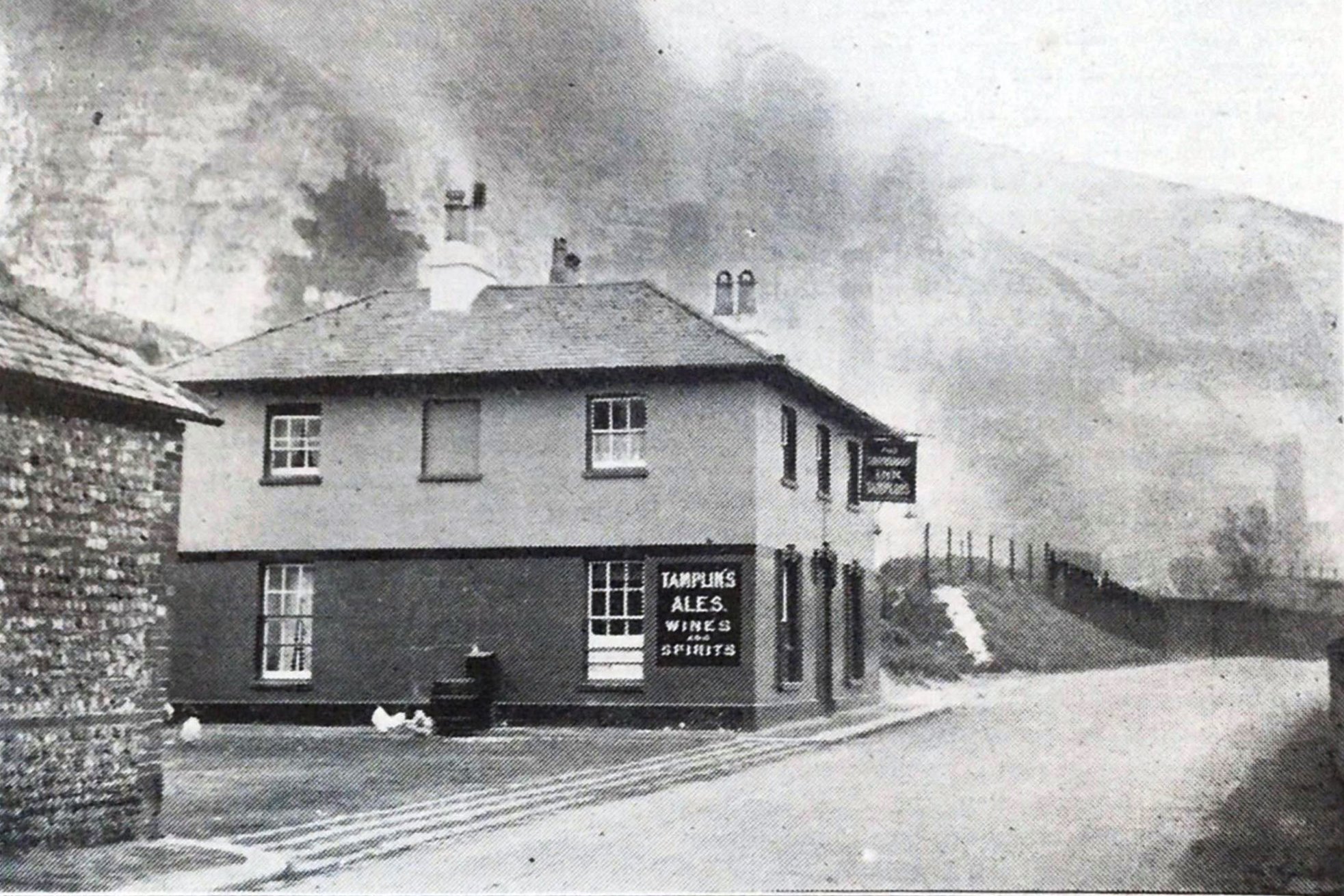
For fuller details see Public House section.
Number 119a: Tim May, a former landlord of the Snowdrop, divided the pub yard when he sold the pub, and in 2007 he built a detached house for his own use. When the foundations for the house were being built chalk blocks were found. They were part of the cottages of Boulder Row which had stood on the site until demolished by the avalanche in 1836.
There were a few cottages, called the Chalkpit Cottages, beyond the Snowdrop in the 19th century but they disappeared with the opening of the cement works.
Houses: West side
See the houses on Google Maps Street View
We now return along the west (river) side of South Street and look at the even numbers from 140 to number 2. Note there are gaps in the numbering although there do not seem to have ever been houses on those sites.
Number 142 (The Rusty House): The site was part of the cement works wharf and the works’ social club was there until the Cement Works closed in 1981. The social club building was then used as a Pattern Shop, which made wooden patterns for sandcasting metals, including specialised car components.
In 2014 work started on a contemporary 5-bedroom house, designed by architect Sandy Rendel, and the project was filmed for the television programme Grand Designs. The building was not universally popular in Lewes, partly because it obscures Wharf House, which for two centuries had formed the visual start of the street and appeared in pictures and photographs. The Corten steel exterior which gave the house its name was chosen partly to pay homage to Lewes’s history of iron making, although the iron works mostly produced fine cast ironwork somewhat different to the Corten steel. The house was completed in 2015 and has won some of architecture’s most prestigious awards including the RIBA 2017 National Award, a RIBA South East Award, and the Sunday Times British Home Award 2016 for the ‘best one-off home in the UK’.
Number 138 (South Street Wharf House – called the Boat House until 1921): Its distinctive facade formed the entry to South Street until obscured by the Rusty House and it can be seen in many early photographs and pictures of the Street. Described in Pevsner as ‘Wharf House: about 1760. A plain three-bay house. Pedimented doorcase and radiating fan light. Probably built for manager or owner of a riparian business’, it was home to Edward Hylands, lime burner from around 1891 to early 20th century. From 1916 it was the residence of Amos Woolmer, who was head lime burner for The Lewes Cement and Lime Company, and when it closed down he continued over at Eastwoods Cement Works. Three generations of the family worked at the cement works: Amos Woolmer and later Frank Woolmer owned both Wharf House and Riverside and the family lived there for many years through to 1989.
Number 136 Riverside: Owned for many years by the Woolmer family, who also owned Wharf House next door. For some years owned by Lewes Portland Cement and Lime Company as offices, its change of use to residential was granted in 1924. It was used in 1951 by Gerald Gilmer Fencing, and in 1987 planning permission for change of use from derelict warehouse to residential was sought by Tim and Sue May. They ran a successful Fish and Vegetarian restaurant there for a few years until they bought the Snowdrop pub across the road. By 1995 Riverside had changed hands and permission was granted from a change of use from restaurant to residential. It has been suggested that the building was used as a Methodist chapel for some years in late 19th or early 20th century – note the round window on the upper front facade, but no evidence has been found for this.
Number 134 Navigation Wharf: Dendochronology dating of roof beams suggest the building originated in 1802, and it was likely a warehouse connected with the river trade. It can be recognised in the Henwood painting of the Avalanche. In 1950 planning approval was given for conversion of store to offices and store for Gerald Gilmore fencing contractors. Change of use to residential was approved in 1984.
Numbers 132a (Broad Reach) and 132b (South Moorings): In 1987 planning permission was granted for a pair of semi-detached houses. In 2014 number 132a was renovated, elevating the roof and installing windows to the rear upper floor.
Number 130 (The Boat House – formerly Fairview): Permission was granted to construct a 2 storey dormer bungalow in 1980 (an earlier application had been refused in 1965). Due to it being built over half a metre below street level it was badly flooded in 2000. In 2023 it was replaced on the same footprint (but now finally raised to street level) with a 2 storey Baufritz eco-house. The construction of this house is timber framed with massive amounts of wood fibre insulation and triple glazing. The house has a whole house ventilation system with heat recovery, is heated by an air source heat pump via underfloor heating and has 24 solar thermal panels to provide its own electricity. There are two Tesla batteries. The house will produce at least 10MWhr of solar energy per year with well over half of it feeding back into the Lewes grid.
Numbers 128 and 126: In 1837 the landlord of the Schooner Beerhouse, Robert Higham, was witness at the inquest into the deaths caused by the avalanche in December 1836. It seems likely the Schooner was the present day numbers 128 and 126, as Higham describes his house as being opposite the cottages destroyed. The painting by Henwood of the avalanche clearly shows the gable end of number 128.
In 1839 Robert Higham, builder, advertised for sale a new barge, lying at Higham’s Wharf in South Street, and in 1840 a newspaper article reports a John Higham in an insolvency case, saying he was a shipwright and had been a beer seller in 1838 at a house called ‘the Schooner’. Inside the present 128 is a hatch through which it is likely the beer was sold.
From 1871 to around 1916 it was home to members of the Blunden family, several males being lightermen. It is likely that the Blundens split the house into two to accommodate the different families.
In the 1950s the houses were owned by Peter and Ernie Hoad, sons of the landlord of the Snowdrop. Ernest Hoad was granted planning permission for the bungalow, number 130, adjoining number 128, in 1980.
Numbers 124, 122, 120, 118: On the 1873 OS map this area is marked as a wharf (presumably Highams Wharf). A terrace of four houses was granted planning permission in early 1989.
It seems there were no properties between number 126 and number 82 until cottages 124-118 were built in 1989. There is no explanation for the house numbering system adopted by the 1891 census, in which the house numbers jump from 82 to 126.
Numbers 82-76: The actual number and dates of these cottages seem obscure. The 1873 OS map shows a block of six cottages. The 1891 census shows residents in only one house, number 78. The 1901 census shows only two houses, numbers 80 and 82. Street directories in 1907 record a number 74, and this had become 78a in 1909. It became 76 after 1938/40 when numbers 68-74 were built to replace Cottages on the Green. Today there are only four houses.
From 1888 number 82 was owned by John Funnell, wheelright, who seems to have converted two cottages into one house. In 1910 the house is named as ‘South View’. In 1914/15 it was the home of Edward Hylands and by 1939 was owned by his daughter, Mabel Hylands. A 1957 newspaper reported on Miss Mabel Hylands having a miniature farmyard in her garden, including hens, goats, tortoise, rabbits and cats. She was a foster mother, looking after 92 children between 1939 and 1954.
Numbers 74-68 (site of the Houses on the Green): The present terrace of four houses were built after 1938/40 but before 1951/52, on the site of the Houses on the Green which had been demolished.
The six cottages, known as the Houses or Cottages on the Green were built on part of the site of the Deal Timberyard, in the centre of a piece of ground lying alongside the river and wharf. In 1764 an auction was advertised at The Swan, of ‘several newly erected houses with a garden to each, and an acre of ground, lying near river, with an exceedingly good shore – very convenient for a wharf with a good warehouse or granary’.
The block of cottages formed a rectangle at right angles to South Street and can be seen on several maps. The wharf and part of Green Cottages can be seen in the print by Pollard ‘View of Lewes from South Street‘, and behind the ship in the photo of Highams Yard. The site was owned by Charles Wille and his son from 1805 as part of his timberyard. By 1910 they were in the ownership of John Funnell, who had lived in one of the cottages and later moved to 82 South Street. Number 4 Green Cottages ceased to exist from 1901 and was probably taken over as part of one of the other cottages. The last entry for the Cottages is in the street directory for 1938/40.
Numbers 66 and 66A (now The Moorings): In the 19th century the site was owned by John William Edward Funnell, who also owned Green Cottages and number 82. He was a wheelwright, coach builder and general smith. Part of the site was the blacksmiths (marked as ‘smithy’ on 1873 OS map) and a large barn housed the smith’s paintshop. In 1892 the certification of a Salvation Army Tent in South Street was agreed and in 1894 a foundation stone was laid for a Salvation Army Barracks, which was probably behind the blacksmith. There seems no information, other than newspaper reports, about the foundation and nothing as to when it ceased.

For a few years from 1951 Nellie and William Cochrane’s ‘stool ball and cricket bat maker’ was based in the barn. Nellie claimed to be the only female cricket bat maker in the UK, and Getty Images owns two fine photographs of the couple at work. The site of the blacksmith became a garage: Collin’s Garage in 1927/28, subsequently the South Street Garage, Venus Motors Used Car Business and the Lewes Service station.

In 1970 the Council purchased the whole site for the purpose of widening South Street, but this plan was superseded by the building of the tunnel and in 1984 the council sold the site in lots. In 1998 the cricket bat factory and the Lewes Service Station were demolished and four houses and a maisonette were built to replace them (the Moorings).

Numbers 64, 62 and 60: This small terrace of houses seems to have been built in the early 1930s, with entries for residents first appearing in the 1934/36 street directory.
Numbers 58, 56, 54, 52, 50, 48, 46, 44, 42, 40, 38, 36, 34 and 32 (in 1881 and 1891 listed as New Row numbers 1-14): This terrace was built between the late 1850s and 1871. There were seven houses with residents recorded in the 1861 census: the numbers 36, 34, 32 with ornate brick frontages and the adjoining four houses, numbers 42, 44, 46 and 48. This census also describes three houses as under construction, presumably numbers 50, 52 and 54. Between 1861 and 1871 an additional two cottages were added at the north end of the terrace, numbers 32 and 34, and a further two cottages at the south end, numbers 56 and 58.
Number 30 (at one time named as Grove House): one of the larger and earlier houses on the street recorded in 1681 and 1685 as owned by Storer Bithwood, who also owned the surrounding timberyard and wharfs. Bithwoods widow, Elizabeth, bequeathed tenements, barns, buildings, gardens, wharfs and timberyards to her grandson in 1723.
In 1742 it was sold on, and according to Colin Brent was probably the residence until 1783 of timber merchants, who used the deal yard, and from 1762 until around 1797 of those using the great timber yard and the smaller timber yard. From around 1788 the house and great and small timberyards were owned by Edward Egles.
In 1833 Isaac Leney was tenant of what is described as a house and brew house. In sale particulars for 1839 it is described as a genteel residence. Leney remained in residence until 1863 when he is described as ‘late occupier’. In the 1851 census he is a coal merchant, farmer of 80 acres and brewer employing six men, and in 1861 a corn merchant employing seven men and two boys. Between 1891 and 1936/38 it was the home to various managers of the gas works.
Numbers 28-22: Houses numbers 28 and 26 share their early history and owned the site which became numbers 24 and 22. From 1776 numbers 28 and 26 were owned by William Robinson, bargemaster, as two houses in which members of his family resided. He also bought number 79 South Street in 1784. At his death in 1815 the two houses were lived in by his sons George and Henry (both were bargemasters) and Robinson bequeathed George’s house, number 28 to the ownership of his wife and daughter, and number 26 to the son Henry who was resident there. The Robinsons continued in residence until 1826 when both houses were sold to Charles Bunting, a butcher, who tenanted them.
Sometime before 1863 the houses were bought by Isaac Leney and in 1863 numbers 28 and 26 are described as two freehold cottages adjacent to [30] South Street, and two houses, numbers 22 and 24 newly erected. These newly erected houses with fine brick frontages were purchased by William Smith of Lewes, horse-dealer, in 1864.
Number 24 was the home of William Colwell, jun., barge and boatbuilder between 1909 and 1912.
Number 22 from 1867 (possibly from 1863 when first built) was occupied by Thomas N(orman) Colwell, and the street directory for that year records Thomas Colwell and Sons, Barge & Regatta Boat Builders at that address. The Colwell son, Thomas G., was the occupier from 1901 to 1907.
[Number 20]: Before demolition this was Delap Hall, but is now the access to the car park for South Cliffe residents, and was previously the car park for the Odeon. Owned by Chas Goodwin in 1681 and 1685 and described as a tenement and lands called the wish (a wish was low-lying damp meadow), otherwise Bustes Wish. 1702 Chas Goodwin died, leaving to his nephew T. Isted senior, a house, garden, orchard close, wharf, wood yard and lands in Cliffe. In 1706 it was described as a house and two acres adjacent to Bustwish in South Street. In 1716 T. Isted left it to his wife Elizabeth and then to children of his late sister, Frances Godlee/Godley as ‘a house lately divided into two dwelling & gardens, orchard, one & half acres‘. In 1752 Widow Godlee owned the house divided into two tenements, with orchard and garden, part of freehold called the Wish or Bustwish. By 1780 it was home to Dr John Delap, who lived there until his death in 1812.
Delap was ordained in the Church of England and the united livings of Iford and Kingston near Lewes in Sussex were conferred on him in 1765. He became rector of Woollavington in 1774, but he lived in South Street, Lewes, where he died in 1812, aged 87. Delap was the author of numerous works long since forgotten. He used to visit Henry and Hester Thrale in Brighton or Tunbridge Wells, and there met Samuel Johnson and Fanny Burney, who found his conversation onerous – Johnson for Delap’s obsession with his health, and Burney for the manner in which, despite being ‘commonly and naturally grave, silent, and absent’, Delap would ‘work… threadbare’ any subject raised in conversation on which he had anything to say. [Wikipedia and Dictionary of National Biography]
In 1826, when her husband William died after falling from his horse, Elizabeth Page opened the Delap Hall Seminary, where she offered spacious rooms for the reception of a select number of young ladies. The 1851 census showed that the house was occupied by Matthew Martin, a coal merchant and his family, including his 40 year old daughter, a school mistress. There were also three girl scholars aged 12 and 8, unrelated to the Martins, also living there. The 1855 street directory describes the house as ‘Mrs & Miss Martin ladies school’. In 1867 it became the Lewes Girls Home, which offered elementary education for girls aged 10-15 and trained them for domestic service. Knitting and needlework received much attention. The girls boarded at the Home under the supervision of a matron, employed by a committee of ladies, and the school was supported by quite a large number of subscribers. In the 1871 census there were eight girls boarding there, eleven in 1881, seven in 1891, and nine in 1901. [Some information from the Annual Reports for 1885 and 1888, The Keep XH 21]
Note: the description of this Home in the ‘Schools of Lewes’ by Brigid Chapman cannot be verified and the Quaker ladies mentioned as founding secretary and treasurer are not correct. Quaker Mary Trusted was the Home’s secretary for a short time and Quakers Rachel and Sarah Rickman served on the committee for a number of years, although the majority of the committee and subscribers were not Quakers. The Home closed in 1910 and became a private house. In 1934 it had become the entrance to the Odeon Cinema car park with the house demolished.
Although the house had the grand title of ‘Delap Hall’, Mark Anthony Lower in ‘The Worthies of Sussex’ says Delap lived in a small residence in South Street, which a subsequent tenant dignified as Delap Hall. There do not appear to be any pictures of the house, other than a small roofscape seen in a photograph taken from Chapel Hill but mostly obscured by the houses on the other side of South Street. The 1911 census says it has eight rooms, so it was a fairly substantial property.
Number 18: Its early history is obscure, although it was likely part of Charles Goodwin’s tenements and lands, including Bustes Wish. In 1843 the occupier is a widow, Mrs Rebecca Hillman, described as a barge owner and dealer in sand and gravel. She occupied the house until the 1860s. The house was occupied for the next 20 years by a master tailor, who employed six men and two boys.
Number 16: Its early history seems to be shared with number 14 but there are census and street directory entries for number 16 from 1841.
Number 14: In 1681 and 1685 this was ‘a house and garden’. From 1784 it was owned by Stephen Rushbridge (Rusbridge), a bricklayer and pattern maker, and then by his sons Ben and Charles, who continued the business until 1843. From 1851 until 1871 it was tenanted by John and then Samuel Vinall, builders, carpenters and undertakers. In 1911 it was shown as having 10 rooms and run as a boarding house.
Number 12, 10 and 8: First recorded in 1753 as a site within an orchard and backside of The Swan (Cliffe High Street). Described retrospectively in 1754 as two houses erected by W. Fenner, deceased, upon ground bought by him from T. Harben (owner of The Swan). A 1793 sale advertisement lists two new substantial brick-built freehold dwelling houses in Cliffe near the corner, one occupied by Mrs Corder, the other, with a carpenters shop, being sold by W. Fenner, the proprietor. From 1796 the two houses were numbers 10/12 and number 8. From 1835 numbers 10 and 12 were separate houses.
Number 12: For a time it was occupied by a series of boot and shoe makers. It was bought in 1859 by bargemaster Samuel Robinson, who owned many South Street properties. At the same time he bought number 10 as his home.
Number 10-8: From 1835 owned by Mrs Fenner, described as a proprietor of houses. In 1859 it was bought by bargemaster Samuel Robinson, who lived in number 10 until 1881. It was then lived in by his daughter Frances and her husband. In the 1880s widow Frances Davis and her daughter, also Frances, ran a confectioners shop there. The younger Frances Davis died in 1953 and her obituary says she was born in 10 South Street and lived there until her last illness. House numbering in the 20th century suggests that there were three properties, listed as 10, 10a and 10c, but number 10 also seems to have been combined with number 8 and then listed as 8/10 and 10a. At 10a there was a general store run by Walter Fuller from 1929/30, and a confectioner from 1957 until after 1974.

Image posted on Lewes Past Facebook group by Allison Reynolds
Click image to enlarge
Number 8: This was basket maker’s from 1855, and a butcher’s shop from 1861. In the 1970s it became Copper Corner Antiques. In 1984 it was bought by Giorgio Brigatti, who ran a workmen’s cafe from 1984-88. It then became La Scarpina restaurant for seven years, named for a small shoe found hidden in the roof of the building, and finally it became Giorgio’s Pizzeria Ristorante.
Numbers 6, 4, 2 and Rusbridge Yard: A number of cottages, some, including 2, 4 and 6 South Street were originally part of 30 Cliffe High Street. Known as the Corner House from 1681. It is difficult to disentangle the various residents listed in the census and street directories. Number 4 was likely to be Fuchsia Cottage (from 1902). In 1906 number 6 is listed as a fried fish shop in the street directory, and from 1913/14 became the Castle Garage, then Eastgate Motor Garage, reverting from 1924/25-1938/40 to Castle Garage. The Council bought the land for road widening around 1933 and the properties were later demolished and public lavatories built, with a bus stop outside. In 1997 a change of use was granted from disused public toilets to the Nutty Wizard meeting place for young people. From 2019-2022 it was Irma’s Cafe and Bistro and, from 2022, Dill. The Nutty Wizard was recognised as having been Air Raid Wardens No. 2 Post in World War 2.
Rusbridge Yard and Rusbridge Lane: Land which became known as Rusbridge Lane and Yard was sold around 1785 to Stephen Rusbridge, clog maker and pattern maker of South Street. The Yard was owned for many years by members of the Rusbridge family. In 1825 they were described as three cottages tenanted and two cottages, one owned and occupied by William Rusbridge and one owned by F. (probably Frances) Rusbridge and tenanted.
In 1941 a 26 ton tank skidded when turning into South Street from the Cliffe. It crashed into a shed in Rusbridge Yard, which was a cobbler’s shop. The shoe maker was killed and a customer injured. In 1933 the Yard was purchased by the Council and later became a car park alongside the public conveniences.
Listed buildings
All South Street houses are listed as Grade II, descriptions are mostly from 1985.
Number 1: House, now shop. C16 with C19 cladding. Timber-framed and clad in painted brick on ground floor with painted tile hanging on first floor. Plain tiled roof with ridges of crossings to rear appearing over ridge to left and right. Shafted brick stack with oversailing courses on wing to rear to right. 3 gabled dormers. One and a half storeys; irregular fenestration of 3 windows on ground floor, glazing bar sashes in open boxes with large casement to left. Panelled door to right of centre with transom light and flat hood on brackets over.
Number 7: House. Early C19 with later C19 alterations. Painted mathematical tiles on cement plinth with tilehung gables. Sides tilehung over brick ground floors. Plain tiled roof with brick end stacks and stack on ridge to left of centre. 3 tall return gables, with short gap to right over entrance. 2 storeys and attics; 3 window front, in 2 – 1 rhythm, tripartite sashes. Entrance to right with half-glazed door in pilastered surround with flat hood on brackets over. A comment has been added in 2024: No. 7 (The Fountain): There are records of a house in1681 at this location. Owned and occupied by Richard Hood from 1749 to 1771, when it was sold, being described as ‘house, stable and brew house, known as The Fountain’. A later sale advertisement in 1787 describes a ‘good accustomed public-house’. In 1788 it was owned by W. Verrall and occupied by Dan Grover, a victualler.
Number 8-10: House, now house and cafe. Early-to-mid C19. Grey headers with red dressings. Plain tiled roof with brick stack at right end and 2 segment-headed dormers. 2 storeys and attics; 3 window front, glazing bar sashes in open boxes. C20 double shopfront on ground floor to right, with inset central portion replacing door. Single C20 shopfront with panelled door topped by very shallow overlight to right. Door to No 8 inset at angle on righthand corner of building. Included for group value.
Number 11: Cottage. C18. Channelled render with boxed eaves to plain tiled roof with central flat-headed dormers and brick stack to left. 2 storeys and attics; irregular single window front, sashes. Panelled door to right with pilastered surround and corniced hood. Included for group value.
Number 12: Cottage. Early C19. Painted brick ground floor, weather-boarded on first floor. Plain tiled roof with brick stack to right. 2 storeys; single window front, glazing bar sash on first floor, late C19 single shopfront on ground floor to right with panelled door topped by transom-light to left. Wing to rear. Included for group value.
Numbers 13 & 15: House pair. Early C19. Rendered to left, stuccoed to right on plinth, with central pilaster strip and moulded cornice to plain tiled roof. End stack to right and stack to rear left. 3 storeys and basement; regular 2 window front, shallower on second floor, glazing bar sashes. Paired central entrances with panelled doors with inset toplights in primitive Doric-columned surrounds with entablature hoods. 2 basement windows appear above pavement level.
Number 14: House. Late C18 or early C19. Incised stucco with plain tiled roof. Ridge of wing to rear appears over main ridge to left of centre. One segment-headed dormer to right. 2 storeys and attic; regular 2 window front, shallow glazing bar sashes in open boxes. Central half-glazed door in architrave surrounds with leaded segmental hood on brackets over.
Number 16: Cottage. Late C18 or early C19. Incised stucco with plain tiled roof. Brick stack on ridge to right. 2 storeys; single window front, shallow glazing bar sashes in open boxes. Fall-glazed door to left in architrave surround with flat hood on brackets over. Included for group value.
Number 17: House. Early C18, refronted in early C19. Channelled stucco on plinth with rendered parapet to plain tiled roof. Rendered end stacks and two flat-headed dormers. 2 storeys and attics with basement to left; regular 3 window front, glazing bar sashes in open boxes. Central entrance with panelled door up three steps, pilastered surround and entablature hood. Basement to left with small opening at pavement level only.
Number 18: House. Early C19. Stuccoed and rusticated on ground floor, channelled on first floor, with platband between. Wooden eaves soffit to Slate roof with two stacks at right end. 2 storeys; single window front, glazing bar sashes, segment-headed on ground floor. Panelled door with glazed toplights to left, in wooden pilastered surround with flat cornice hood on brackets over. Included for group value.
Number 25: House. Mid C18. Red brick with some blue brick. Moulded wooden eaves cornice to plain tiled roof with 2 brick stacks to rear. 2 storeys; regular 3 window front, margin-light sashes in open boxes. Central fluted pilastered surround with flat entablature hood over and panelled door with overlight, now partially hidden by gabled glazed conservatory porch.
Number 30: House. Mid C18. Roughcast on brick plinth with leaded parapet to slate mansard roof, half-hipped to right. 2 pedimented dormers. 2 storeys and attics; 4 window front, wide glazing bar sashes in open boxes with moulded surrounds. Arched entrance in second bay from left with moulded architrave surround, panelled reveals and radiating fan-light over panelled door with glazed top panels. The description shall be amended by adding “slate hung first floor west return elevation” as last sentence.
Number 138: Wharf House House. Circa 1760. Channelled stucco with moulded wooden corniced parapet to slate mansard roof with end brick stacks and two segment-headed dormers. 2 storeys and attics; regular 3 window front with narrower central window, all sashes except metal casement on ground floor to left. Central entrance with half-glazed door and blind wreathed and radiating fanlight. Wooden pilastered surround with open dentilled triangular pediment over.
Traffic
For many years in the second half of the 20th century the main road from Brighton to Eastbourne ran along Lewes High Street, down the Cliffe and along South Street. The photographs show the traffic problems this caused.

In the 1960s it was proposed to build an inner ring road across the Paddock, continuing over the Phoenix Causeway and out through South Street, necessitating demolishing houses on the west, river side, of South Street.
South Street residents were active participants in the protests which followed, particularly in 1968 and 1973. Fortunately for South Street the plans were changed: the bypass, opened in 1975, and the tunnel in 1980 took the A27 away from the street and resulted in the pleasant residential cul de sac it is today.

Later South Street developments
Cliff Rise
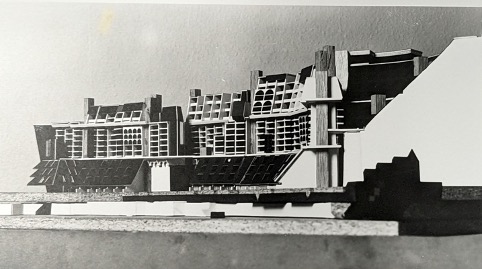
A South Street development which did not take place was Cliff Rise[sic]. In 1975 an outline planning application was submitted, by Councillor James Franks and architect Michael Blee, for a residential community of 500 homes, with underground parking, public open space and social facilities, involving an extension to the proposed Cuilfail tunnel. It was to be in one of the disused chalkpits opposite the Rusty House (number 142) and would rise from an embankment on the river to the top of the cliff, with access at top and bottom. The application was refused in 1976. Although such a large development sounds horrific, in many ways it was ahead of its time. It increased residential provision in Lewes without demolishing any existing building, on a site easily accessible to the town, and discussions took place about alternative energy provision: windmills on the edge of the cliff, solar panels and heat pumps from the river. Ref: Lewes 1952-2002.
According to the Sussex Express the development was costed at 9 ½ million pounds. Many South Street residents objected to the plans as described in the Sussex Express, 26th September 1975. They cited the lack of affordable housing and increased traffic in South Street, although the tunnel was be completed before the development.




 Lewes History Group