Meeting – Monday 13 December, 7:30pm

Christmas Meeting

John Farrant: Lewes Castle, 1600-1850

The speaker at our Christmas meeting will be John Farrant, who will be telling us about the changes at Lewes Castle between 1600 and 1850 – the period between its final appearance as a military asset during the Civil War and its becoming the centrepiece of the Sussex Archaeological Society collection. All are welcome.

To celebrate the Christmas season our normal coffee and biscuits prior to the meeting will be replaced, for those who arrive in good time, by mulled wine and mince pies.

Venue: The new King’s Church building on Brooks Road, Lewes. (Between Tesco car park and Homebase)

See the Meetings page for a list of  forthcoming monthly talks organised by the Lewes History Group.

Posted in Art & Architectural History, Lewes, Local History, Social History | Comments Off on Meeting – Monday 13 December, 7:30pm

Lewes History Group: Bulletin 4, (6 November 2010)

1. Talk on Monday 8 November: Colin Brent
2. Death of a Stage-Coachman
3. British School Accident
4. Dinosaur Doctor

1. Meeting on Monday 8 November

Our next meeting will be at 7.30 p.m. on Monday 8 November at the King’s Church building, Brooks Road. Colin Brent, doyen of living Lewes historians and author of several books about the town, will be speaking on the topic ‘Gems of Lewes Architecture & Design, 900-1900’. As usual, all welcome.

2. Death of a Stage-Coachman

From the Sussex Express published on Saturday 27 May 1871. ‘The stage-coach has long since disappeared from the road between Lewes and Brighton, and now perhaps the very last of the drivers has gone to his long home. James Button, who will be remembered by old travellers as one of the smartest whips on the road, died at Lewes union [workhouse] a few days since.’

3. British School Accident
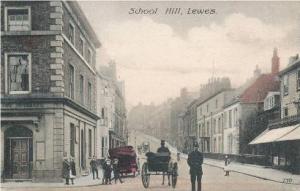
School Hill, Lewes

The Infirmary stood at the bottom of School Hill

From the same 1871 edition of the Sussex Express. ‘A lad named Albert Goldsmith met with an accident at the British School on Wednesday morning last. He was playing “leap-frog” with other scholars in the yard and fell, breaking the large bone of one of his legs. The schoolmaster, Mr James Richmond, at once sent for a cab, and the lad was quickly conveyed to the Infirmary, where the bone was set by J. Macrae, Esq, under whose care he is progressing favourably. Almost every week instances are given of the great value of the Infirmary to the town. The medical gentlemen resident in Lewes kindly give their services gratuitously, each taking charge of the institution in turn, for a month. The infirmary certainly deserves the support of the benevolent.’

4. Dinosaur Doctor

Edmund Critchley, who regularly attends our meetings and is himself a doctor, has recently published ‘Dinosaur Doctor, The Life and Work of Gideon Mantell’. Gideon Mantell (1790-1852) is best known for his discovery of the Iguanodon and his work as a geologist and paleontologist, but he was also a prominent local doctor, practicing from his High Street house below the Castle. He was the son of a town cordwainer, or shoemaker. He later moved from Lewes to Brighton and on to London. Edmund’s book is published by Amberley Publishing at £18.99, and is available in local bookshops, such as that at Barbican House.

John Kay

Posted in Art & Architectural History, Biographical Literature, History of Medicine, Lewes, Social History, Transport History | Tagged , , , , , , | Comments Off on Lewes History Group: Bulletin 4, (6 November 2010)

Lewes History Group Bulletin 3, 8 October 2010

1. Talk on Monday 11 October: Graham Mayhew
2. The Ragged School, St John Street
3. Lewes churchyards

1. Meeting on Monday 11 October

Our next meeting will be at 7.30 p.m. on Monday 11 October at the King’s Church building, Brooks Road. Graham Mayhew will be speaking on ‘Lewes Priory: Its Wealth & Influence’. His illustrated talk will encompass the impact of this huge medieval institution on Lewes itself, but also its wider influence on national and international affairs. Graham, one of the best known and most distinguished Sussex historians, has been researching the history of Lewes Priory for many years, and has uncovered a remarkable amount of information about its influence at all levels, including the highest levels, in medieval England. Graham is of course himself part of Lewes’s history. Both he and his father were distinguished local councillors, and both served as mayor, back in the days when Lewes was a Labour-run town.

2. The Ragged School, St John Street

The September edition of ‘Viva Lewes’ carried an interesting article about the Ragged School in St John Street, which thus impacts on two of our current History Group research projects. The article was centred on a series of Victorian lantern slides that have recently been acquired by the East Sussex Record Office, and are thus now available to the public for the first time for over a century – reference ESRO/AMS 6919. The article revealed that the Ragged School was founded by a members of Jireh Chapel, and in the 1890s, when the lantern slides were created, it was led by local solicitor Isaac Vinall, a member of Jireh. It was run initially as a Sunday School for the poorest members of the Lewes community with a rota of over 150 voluntary teachers. You could see it as evidence of the Victorian Big Society.

3. Lewes Churchyards

The inscriptions on churchyard monuments, and the monuments themselves, offer one unique view of the history of the former inhabitants of a place. usualy made of stone, they appear long lasting, but are like all man’s works less permanent than one might hope. The History Group has recently made contact with Chris Swarbrooke, who lives near Hastings but has the best collection of Lewes monumental inscriptions, though even his is far from complete. Preserving such records is one thing a good local history group should make a priority. Some Lewes churchyards appear unrecorded as yet – a spring and summer job though, not perhaps one for the winter.

Posted in Ecclesiastical History, Education History, Family History, Lewes, Local History, Social History | Tagged , , , , , , , , , | Comments Off on Lewes History Group Bulletin 3, 8 October 2010