Please note: this Bulletin is being put on the website one month after publication. Alternatively you can receive the Bulletin by email as soon as it is published, by becoming a member of the Lewes History Group, and renewing your membership annually
1. No August meeting
2. Lewes Societies Fair (by Chris Taylor)
3. Lewes Heritage Open Weekend (by Chris Taylor & Phil Green)
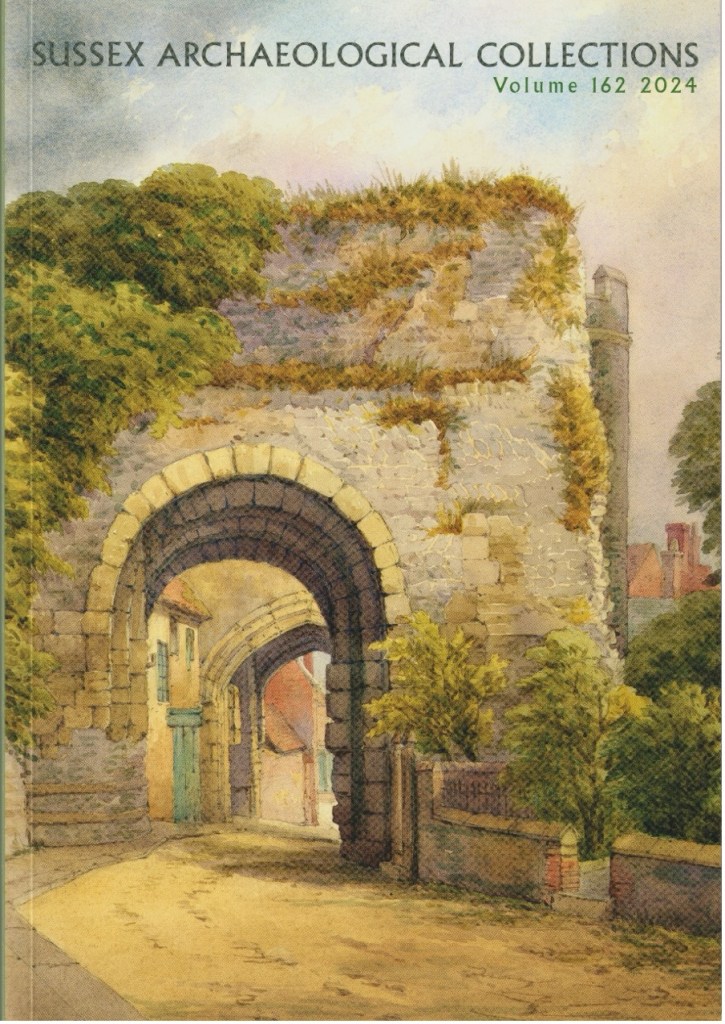
4. Sussex Archaeological Collections volume 162
5. Charles Green’s balloon journey from Lewes
6. The end of Shelley’s waggon
7. Lewes High Street by Bliss
8. The Lewes Mayoress’s Tobacco Fund
9. A Hunt meeting at Coombe Place in 1907
10. St Mary’s Hall, Nevill
11. Lewes a century ago, by Donald Maxwell
1. No August meeting
As usual, we shall be taking a break this month, with our next meeting on Monday 14 September, when Christopher Whittick will tell us the story of St Anne’s church and its parish.
2. Lewes Societies Fair (by Chris Taylor)
The Lewes History Group will once again be represented at this year’s Societies Fair, which is being held on Saturday 5 September from 10 am to 1 pm at the Town Hall. Please do drop in and say hello.
3. Lewes Heritage Open Weekend (by Chris Taylor & Phil Green)
This year’s Lewes Heritage Open Weekend, organised by the Friends of Lewes, will run from Friday 11-Sunday 13 September 2026.
As in previous years, we will put on an exhibition at Lewes House on Saturday and Sunday 12 and 13 September from 10 am to 4 pm each day. It will comprise general information about our activities and showcase some of the research done by members over the past year. We hope to have copies on sale of our soon to be published book, ‘All Change! Lewes Bus Station’ by Ruth and Neil Thomson, along with other recent LHG publications.
In addition to the usual number of buildings open to the public, a number of new guided walks will be offered in this year’s programme.
- a walk at Landport Bottom looking at the site of the Battle of Lewes, led by John Freeman of the National Battlefields Trust;
- a walk round the former ironworks sites of Lewes with David Joyce;
- three walks led by Sue Berry: Building pre-1914 Lewes, looking at who the builders were and the materials they worked with; Industry in Cliffe, 1600-1914; and Churches and Chapels, a social and political history, visiting four examples from different denominations and periods.
4. Sussex Archaeological Collections volume 162
The latest issue of SAC has recently been posted out to Sussex Archaeological Society members, the volume scheduled for publication in 2024 – they are running a little behind. Three of the four local history articles included are by authors who will be familiar to LHG members who attend our meetings or read these Bulletins.
Included are Sue Berry’s article on the Morris dynasty of Lewes stonemasons who were responsible for the design and construction of many major buildings in and around the Georgian town, and also Chris Grove’s account of the complex manoeuvres and rival plans that eventually led to that the arrival of the railway in early Victorian Lewes and Hastings. Also included are biographies by Frances Stenlake of two Brighton-based brothers, the musician Edouard de Paris and the artist George de Paris. The cover image for the volume is a watercolour by George de Paris of the Norman gateway to Lewes Castle that is from the Sussex Archaeological Society collection, thought to date from about 1880. The final history article is Derek Oakensen’s account of the rise and fall of the local prosecuting societies that abounded in Sussex prior to the creation of the Sussex Police. The first of these, founded in the 1770s, was the Lewes society.
As usual most of the volume reports the outcomes of archaeological excavations in the county. These include an impressive retrospective report by local archaeologist David Millum of the community excavations of three medieval pottery kilns at Streat carried out between 1979 and 1983. These were not formally reported at the time, and the finds were dispersed.
5. Charles Green’s balloon journey from Lewes
The 6 October 1828 Sussex Advertiser reported that Mr Charles Green’s second balloon ascent from Lewes gasworks the previous week had been watched by thousands of spectators from viewpoints in and around Lewes, but there had not been quite so many spectators as previously. On this occasion he was accompanied by W.H. Gardiner, esq, a gentleman living in East Hoathly.
The inflation of the balloon started early in the morning but was still not complete when Mr Gardiner took his seat in the car carried under the balloon at 3.30 pm. The wind caused the balloon to roll about, and it was almost 4 pm before the arrangements could be completed, and Mr Green joined his companion. When the ropes were detached the balloon soared aloft, with its occupants waving their flags to the spectators.
The wind carried the balloon and its occupants in a north-easterly direction, and it passed over first Ringmer Barracks, then Laughton Place and then Mr Gardiner’s father’s residence at East Hoathly. When nearly over this house a valve was opened and the balloon descended about a quarter of a mile. Some sand was then thrown out and the balloon rose rapidly, its gas expanding until the silk was as tight as a drum. It continued over Waldron and Heathfield, reaching its greatest altitude near Brightling. It passed Robertsbridge and Bodiam Castle, where it encountered a southerly current of air and floated over Bexhill towards Pevensey Bay.
Not wishing to travel over the sea the valve was opened again, until the balloon again encountered the north-easterly air current, which took it over Battle and gave the occupants a bird’s eye view of Hastings races. Some of the gentlemen there tried to follow its route, but could not keep up.
The aeronauts then began to make preparations for their descent, but as they had only a single bag of ballast, weighing 30 lb, this had to be gradual. The country, studded with woodlands and hop gardens, was far from ideal for this purpose. Here Mr Green’s skills were fully tested. It was rapidly descending onto a hop garden, when he averted disaster by casting away his flags, wine, seat and everything moveable, and managed to land safely in a clover field in Northiam. The violence of the landing still tore the neck off the balloon, and the wind dragged the silk a hundred yards along the ground before the grapnel gained a secure hold. The sudden stop threw Mr Green out of the car and into the surrounding netting, from which he continued to operate the controls with the greatest sang-froid. After a few minutes some men arrived, and enabled the aeronauts to escape their now unpleasant situation.
At its greatest altitude the balloon rose to about a mile and three quarters, but the aeronauts were never out of sight of land except when a cloud intervened. They could hear the cheers from the various villages they passed, and as they approached land were amused to see the workers in the hop gardens deserting their posts to watch. Their masters, attempting to recall their staff to their duties, very kindly wished the balloon and its occupants at the bottom of Pevensey Bay.
The landing point was 36 post miles from Lewes, and the total length of the journey was calculated at about 50 miles. This distance was travelled in 40 minutes, timed by Mr Gardiner’s watch. When in the air the passengers were not sensible of motion, and they were not cold, just a little damp when traversing clouds. When the balloon was at its maximum height Mr Gardiner threw out his seat, a deal board two feet wide, and by his watch this took two minutes to reach the ground. The car was four feet long, and just over two feet wide and 2 feet deep.
When the balloon passed quite low over Ringmer Barracks the aeronauts’ attention was attracted by the extraordinary speed of a horseman nearly under them, who seemed almost to keep pace with them. They concluded that this must be A. Donovan esq, the celebrated member of the East Sussex Fox Hounds on his well-known horse Hector. In passing East Hoathly they were amused to see a waggon laden with lime drawn by its horses into a ditch, while the attention of the driver was rivetted on the balloon.
Mr Green did not return to Lewes until after 3 pm on the following day, having returned his companion to his home in East Hoathly. When Mr Gardiner next came to Lewes to attend the theatre he was met at the entrance to the town by a large party headed by the town band, who escorted him to the White Hart and then cheered him to the theatre. Mr Green headed off to Brighton, where he was to make another ascent from the Royal Gardens, and intended afterwards to make an ascent from Chichester, mounted on a pony!
Charles Green (1785-1870) was Britain’s most famous balloonist of the 19th century. He used coal gas as a cheaper and more readily available gas than hydrogen. His first flight was in 1821, when he set off from Green Park to mark the coronation of King George IV, but got into trouble and had to be rescued by a ship that ran its bowsprit through the silk of his balloon. By 1835 he was a professional balloonist who had made over 200 ascents, rising to over 500 by his retirement in 1852. In 1836 he completed a trip of almost 500 miles from London to Germany. He died in London and is buried in Highgate Cemetery.
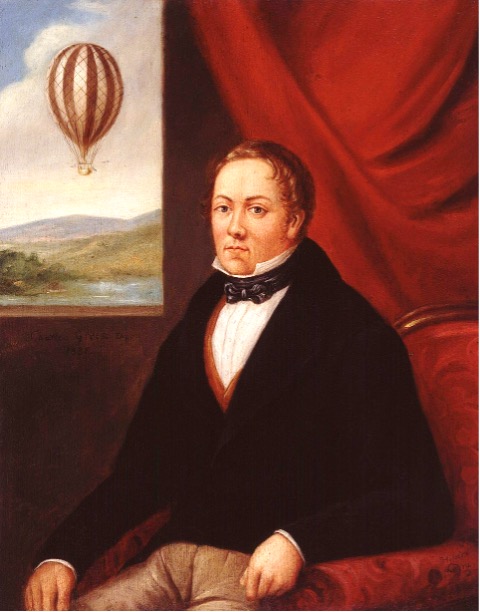
Sources: 6 October 1828 Sussex Advertiser; Wikipedia; this ascent was briefly described in LHG Bulletin no.20, while a well-known artwork of the occasion, as viewed from the top of School Hill and reproduced in Bulletin no.20, was identified in Bulletin no.104 as by the Lewes artist Thomas Henwood. The portrait above is from Wikipedia.
6. The end of Shelley’s waggon
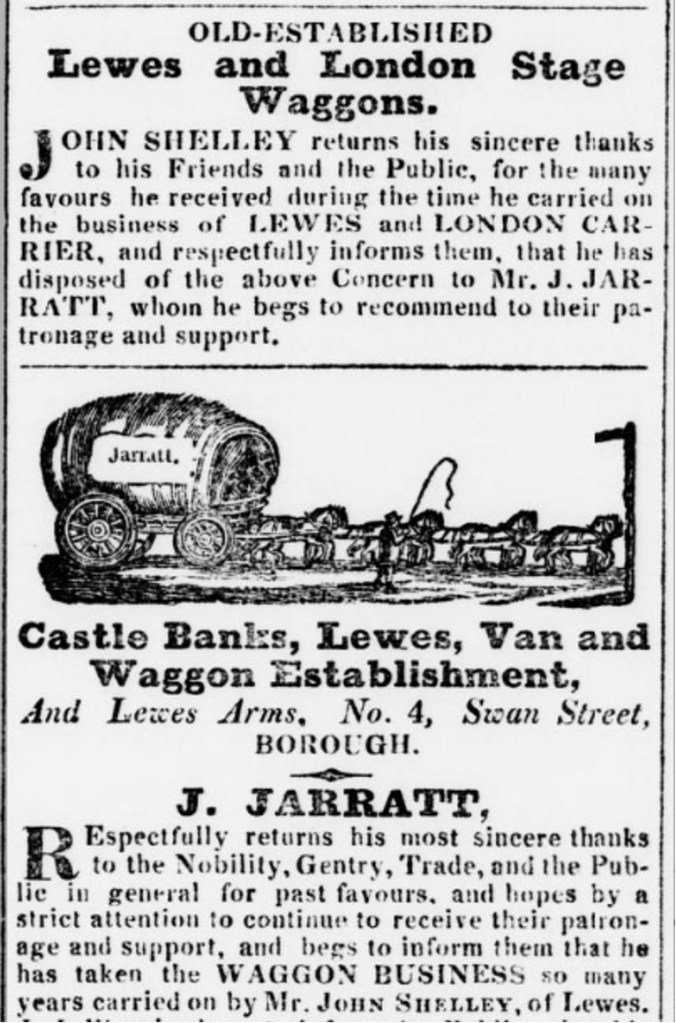
The complex network of carriers’ waggons and vans serving Lewes and the surrounding villages in 1828 was noted in Bulletin no.185. One waggon to and from London was provided every weekday by J. Jarratt, and this was supplemented by a second waggon, provided on three days each week by Kenward and on the other three days by Shelley. The 14 December 1829 Sussex Advertiser notes the consolidation of this service, when John Shelley disposed of his business to the Uckfield-based Mr Jarratt, who could also arrange onward distribution to a wide range of villages and metropolitan locations at either end of the main route.
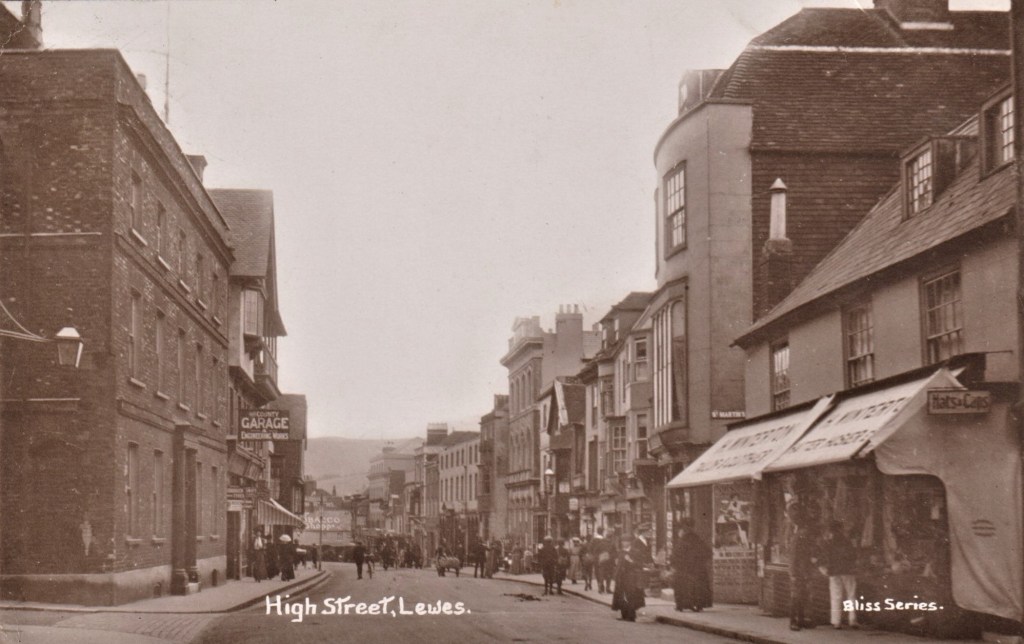
7. Lewes High Street by Bliss
This was one of a number of postcard views of the High Street published by the Lewes postcard publisher A.M. Bliss & Co of Lansdown Place in the years immediately before the Great War. According to the Sussex Photohistory website. Alfred Marsh Bliss had established this business in 1890 but emigrated to Canada at some date during the following decade. However, the business, in the hands of others, continued to carry his name into the 1920s. This postcard was sold in 1911, when the studio was owned by John Lee Dadford and managed by Walter Blink Gardner (1850-1923), who lived over the studio in the 1911 census.
This postcard features Barbican House and the entrance to the castle. Next door is the County Garage and Engineering Works, newly built after Smith’s fire had destroyed its predecessor. The High Street was at this date busy, but still car-free.
8. The Lewes Mayoress’s Tobacco Fund
The 2 October 1942 Sussex Express reported a meeting of the committee of the Mayoress of Lewes Tobacco Fund, held in the Mayor’s Parlour at Lewes Town Hall. Those present included the mayor, Alderman Crisp, the mayoress, Mrs H.J. Turquand, and Lady Boughey of Malling House, who acted as Hon Secretary, the former secretary being on service.
There was a credit balance of £69 19s 1d, including a recent donation of £2 15s 0d from Lady Boughey and her daughter. It was possible to send parcels of 120 cigarettes to prisoners of war held in enemy-occupied territory for 3s 9d each, but those sent to hospital patients in England had to be paid for at the ordinary retail price of 5s 0d for fifty. The names of prisoners of war who would like to receive parcels should be submitted to Lady Boughey at Lewes Town Hall. If this was done at once, the men would probably receive their cigarettes by the new year.
Lady Boughey had already lost her own eldest son in a naval skirmish in the North Sea, early in the war. The Earwig Corner allotments are dedicated to John Boughey’s memory.
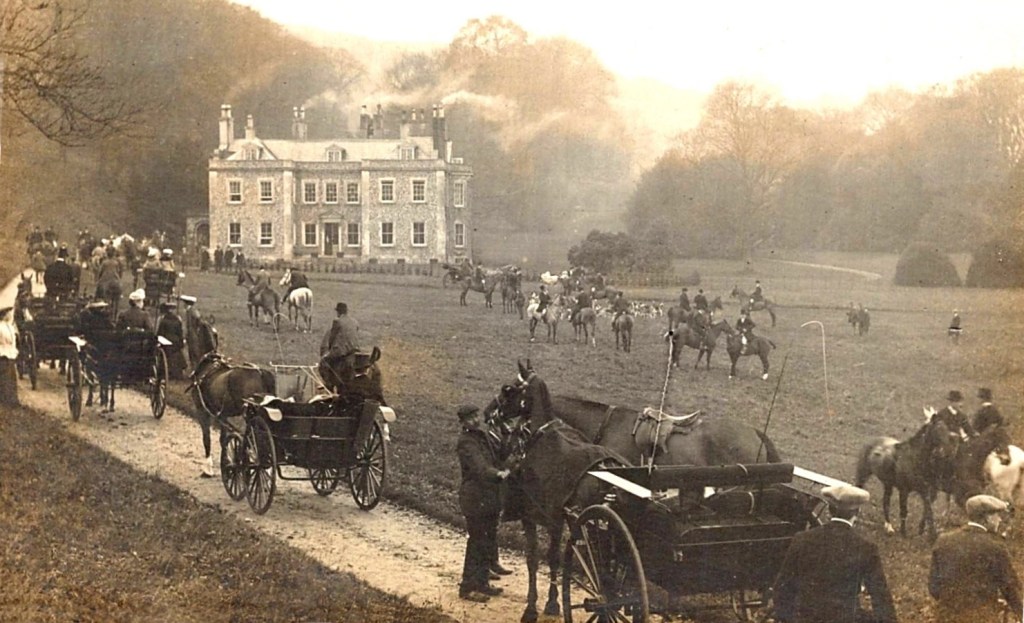
9. A Hunt meeting at Coombe Place in 1907
This postcard by an anonymous publisher has an inscription to say it was taken at Coombe, Hamsey, at a meet held on 2 December 1907. This is presumably the Southdown Hunt, based at Ringmer, which served the wider Lewes area. This postcard was sold recently on ebay after very competitive bidding. Local historic postcards seem no longer to be attracting quite the prices they were a few years ago, but there is evidently still a very good market for rare and unusual views, such as this one.
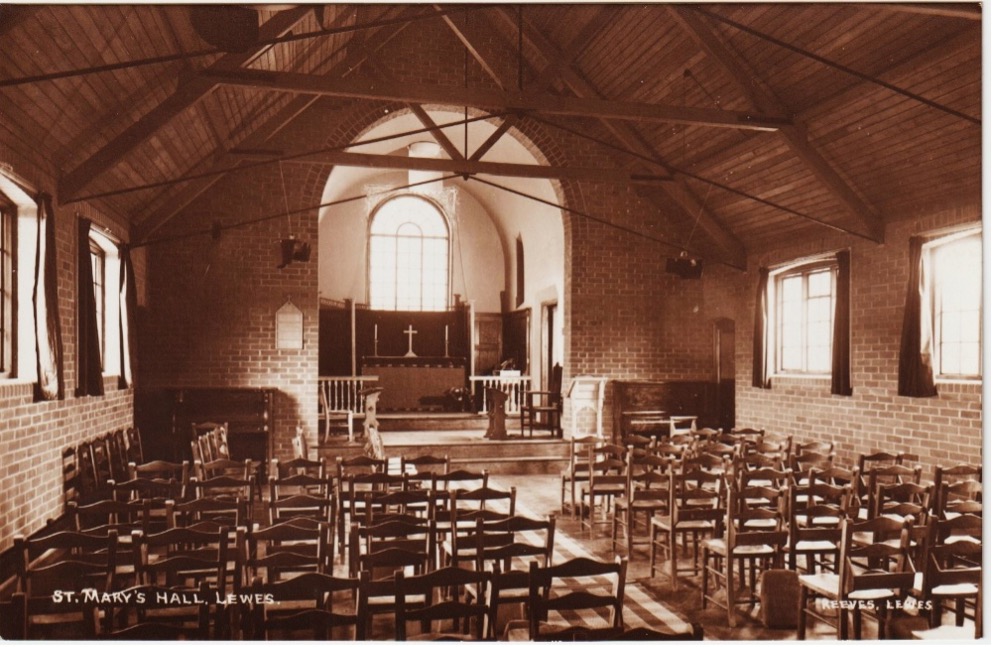
10. St Mary’s Hall, Nevill
This Reeves photograph of the interior of St Mary’s Hall, on the Nevill estate, was printed as a postcard, with a Kodak Ltd motif in the space for the postage stamp.
Can any members familiar with the hall suggest when it might have been taken?
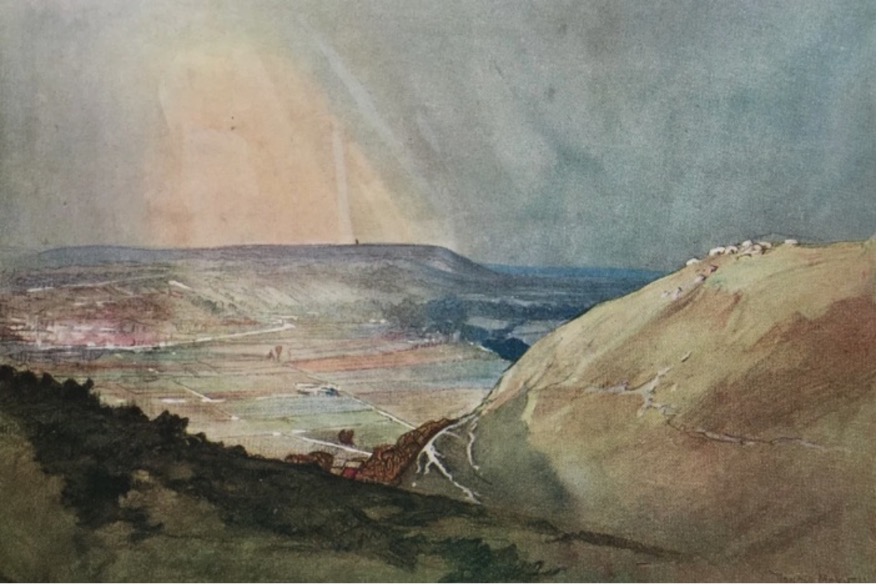
11. Lewes a century ago, by Donald Maxwell
This watercolour view over the Coombe and Malling Brooks towards Hamsey was created just over a century ago by Donald Maxwell (1877-1936), who titled it ‘The South Downs at Lewes’. He included this image in his book ‘Unknown Sussex’, published in 1923, which he both wrote and illustrated. ‘Unknown Sussex’ was the second of eight books in his ‘Unknown County’ series – it started with Kent, and continued into other counties of South East England. All the ‘Unknown County’ books were both illustrated and written by himself.
Donald Maxwell was born and brought up in Clapham, the son of a Cambridge-educated Methodist minister and schoolmaster who ran a successful private boarding school there, later inherited by another of his sons. He trained at art colleges including the Slade and the Royal College of Art, and exhibited at the Royal Academy for over 30 years, right up to the year of his death. He was described as a professional artist in the 1901, 1911 & 1921 censuses, specifying ‘landscape artist’ in 1921. For most of his adult life he lived in Kent, but he travelled extensively, in England and abroad. He was a keen yachtsman, and during the Great War he enlisted as an officer in the Naval Reserve, where he was put in charge of a motor launch. He was soon made an official war artist. Sent by the Admiralty to work in Palestine and Mesopotamia, there are hundreds of his drawings in the Imperial War Museum. In 1921 he accompanied the Prince of Wales (the future King Edward VIII) to India aboard HMS Renown. He also published extensively in newspapers and magazines, and illustrated books by others, including Hillaire Belloc and Rudyard Kipling (to whom his mother was related). Some of his works were purchased by the Southern Railway and displayed as prints in railway carriages. He died at the age of 59 and is buried in the churchyard at East Farleigh, near Maidstone, Kent. He left a wife and two children.
John Kay 01273 813388 johnkay56@gmail.com
Contact details for Friends of the Lewes History Group promoting local historical events
Sussex Archaeological Society: http://sussexpast.co.uk/events
Lewes Priory Trust: http://www.lewespriory.org.uk/news-listing
Lewes Archaeological group: http://lewesarchaeology.org.uk and go to ‘Lectures’
Friends of Lewes: http://friends-of-lewes.org.uk/diary/
Lewes Priory School Memorial Chapel Trust: https://www.lewesprioryschoolmemorialchapeltrust.org/
Facebook: https://www.facebook.com/LewesHistoryGroup
Blue Sky: @leweshistory.bsky.social