Please note: this Bulletin is being put on the website one month after publication. Alternatively you can receive the Bulletin by email as soon as it is published, by becoming a member of the Lewes History Group, and renewing your membership annually
1. Next Meeting: 13 July 2026: Joanna Hodgkin, ‘A Bear Yard family’
2. June Meeting
3. Open Day at Bridge Farm, Barcombe Mills
4. Lewes Festival of Democracy (by Leanne O’Boyle)
5. Local History Research: a practical 3-part course for LHG members
6. The High Street decorated for a Coronation
7. William Camden’s view of Lewes in 1610
8. The Lewes Season ended in early February
9. ‘The Kiss’ on the move
10. Golden Jubilee of the Phoenix Ironworks
11. A Prize Essay
12. Anne of Cleves House watercolour by James Lawson Stewart
1. Next Meeting 7.30 p.m. King’s Church Monday 13 July
Joanna Hodgkin A Bear Yard family
Joanna Hodgkin A Bear Yard family

While researching the life of Sarah Godlee of the Bear Yard in the Cliffe, author Joanna Hodgkin was fortunate to discover a private archive containing a treasure trove of letters, journals, poems, sketches and more relating to the Godlee and Rickman families of Lewes. Their triumphs, disasters, hopes, fears, passions and laughter are at the heart of her forthcoming book, At The Bear Yard. Her July talk to the Lewes History Group will introduce a remarkable family and give some idea of the range of the material which will soon be widely available. The silhouette shown is that of one of the characters Joanna will be telling us about, the schoolmistress Sarah Godlee. In the days before the invention of photography, silhouettes seem to have been especially popular with Lewes Quakers.
Admission is free for members and there is no need to reserve your place. Everyone is very welcome, but there is an entry charge of £4 for non-members, with tickets available in advance via Ticketsource.co.uk/lhg.
2. June meeting
Our apologies for the non-appearance of the speaker at our June meeting, which I fear was my fault. Detailed arrangements for the talk were made six months ago, but it appears that when it was time for the confirmation arrangements to be made, my reminder was sent to the wrong George Jones. Because we had all the detailed information necessary to advertise the event, and other preoccupying events in my life at the time (grandson’s wedding in Lisbon, first trip abroad for several years), I failed to realise that I had not received any response.
3. Open Day at Bridge Farm, Barcombe Mills
If you enjoyed Blake Galloway’s May talk to us about this official Roman settlement near Barcombe Mills you might also wish to visit the site of this year’s excavations at their Open Day (or open morning) on Saturday 11 July. There will be guided tours of the part of the site where this year’s excavations were carried out between 10 am and 12 noon.
There will also be an opportunity to visit the Finds Unit and see many examples of the more exciting finds to date. The number and quality of the finds of different kinds that have been discovered, dating right through the period of Britain’s Roman occupation, is truly astonishing.
There is no charge for attending the Open Day, but donations to support the ongoing annual excavation project will be very welcome.
For further information see: https://www.culverproject.co.uk/
4. Lewes Festival of Democracy (by Leanne O’Boyle
A joyful Lewes Festival of Democracy will take place between 1 pm and 6 pm on 4 July 2026, as Lewes marks the 250th anniversary of the Declaration of Independence that radical thinker and former Lewes resident Tom Paine did so much to inspire.
Guided by the Thomas Paine Legacy project and the Lewes Climate Hub, there will be a ‘Procession of Democracy’ starting at 1 pm from Bull House, led by a walking skeleton of Tom Paine followed by banners, musicians and costumed performers celebrating a range of movements promoting human rights, freedom and social change. The procession will end at the Castle’s Gun Garden at 3 pm, and will be followed by music, speeches and performances until 6 pm.
5. Local history research: a practical 3-part course for LHG members
Places are still available for this course planned for the autumn.
A key LHG purposes is to enable our members to undertake small-scale, manageable research projects into aspects of local history that interest them. We have designed this course to help members tackle some of the practicalities involved. Participants do not need to have any prior experience of historical research work.
Part 1 Wednesday, 7 October 10.00-12.00 at Lewes House of Friendship (208 High Street).
This will be a preparatory session to identify and determine the scope of the topics each participant would like to investigate; and to frame some preliminary research questions.
Part 2 Wednesday 14 October 10.00-12.00 Session at the Keep, Falmer: the East Sussex and Brighton & Hove Record Office, which houses collections of local historical documents of all kinds. This session will be led by record office staff and will introduce participants to the range of resources held at the Keep; how to order documents etc. Participants can stay on in the afternoon to work on resources if they wish.
Part 3 Wednesday 21 October 10.00-12.00: Follow-up session at the Keep, Falmer
Course members will be able to discuss their projects with one another and with others with experience of local history research, in order to identify and plan ways forward. Participants can stay on at the Keep in the afternoon if they wish.
Maximum number of course members: 10
Subsidised course fee: £10.00 per person
Apply via ticketsource.co.uk/lhg by 15 July 2026
6. The High Street decorated for a Coronation
According to a pencil note on the reverse the reason for the decorations in the High Street was the 1902 coronation of King Edward VII. The shop on the left carries the message ‘God Save the King’.

7. William Camden’s view of Lewes in 1610
William Camden’s ‘Britain, or a Choriographicall Description of the most flourishing Kingdomes, England, Scotland and Ireland’ was published in 1610. Camden himself wrote in Latin, but the text below of his section on Lewes was transcribed by University of California Professor Dana F. Sutton, from Philemon Holland’s 1610 translation. Below is the section on Lewes.
“Thence by Cuckfeld to Lindfeld, where in former ages was a small nunnery, and so by Malling, some time a mannour appertaining to the Archbishops of Canterbury, to Lewis, which peradventure hath his name of pastures called by the English Saxons leswa. This for frequencie of people and greatnesse is reputed one of the chiefest townes of the County. Seated it is upon a rising almost on every side. That it hath been walled there are no apparent tokens. Southward it hath under it, as it were, a great suburb called South-over, an other Westward, and beyond the river a third Eastward called Cliffe because it is under a chalkie cliffe.
In the time of the English Saxon government, when King Athelstan made a Law that money should not be coyned but in good townes, hee appointed two minters or coyners for this place. In the reigne of King Edward the Confessor it paid sixe pounds and foure shillings de gablo et theloneo. The king had there one hundred twenty seaven Burgers. Their custome an manner was this, if the king minded to send his souldiers to sea, without them, of all them whose lands soever they were was collected twenty shillings and all those had they that in the ships kept armour. Who selleth an horse within the Burgh giveth to the Provost one penny, and the buier another. For an oxe or a cow one halfe penny, in whatsoever place he buieth within the Rape. He that sheddeth bloud maketh amends for seaven shillings. He that commiteth adulterie or a rape, for eight shillings and four pense, and the woman as much. The King hath the Adulterer, the Archbishop the woman. When the mint or money is made new, everie minter giveth twentie shillings. Of all these paiments two third partes went to the King, and one third part to the Earle.
William de Warren the first Earle of Surrie built here a large castle on the highest ground for the most part with flint and chalke. In the bottom of the towne called South-over hee founded to the honour and memorie of Saint Pancrace a Priorie, and stored it with Cluniac Monkes. In the regard of the holinesse, religion and charity which hee found in the Monasterie of Clugni in Burgundie (for these bee the words taken out of the verie originall instrument of the foundation). Whiles going in pilgrimage together with his wife for religion hee turned in and lodged there. But this is now turned into a dwelling house of the Earle of Dorset. Howbeit their remaine still in the towne six Churches, amongst which not farre from the Castle there standeth one little one all desolate and beset with briers and brambles, in the wals whereof are engraven in arched worke certaine rude verses in an old and overworne character which implie thus much, that one Magnus descended from the bloud roiall of the Danes, who embraced a solitarie life, was there buried. But behold the verses themselves, imperfect though they bee, and gaping, as I may so say, with the verie yawning joints of the stones.
Which peradventure should be thus read
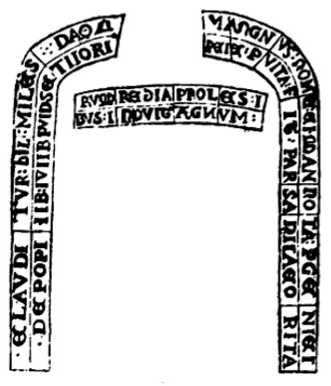
Clauditur hic miles Danorum regis proles,
Magnus nomen ei, magnae nota progeniei
Deponens Magnum prudentior induit agnum,
Praepete pro vita fit parvulus anachorita
A noble Knight
Sir Magnus hight,
A name of great of-spring
Is shut up here,
Though borne he were
In line of Danish King.
He, wiser man,
Put Agnus on
And laies down Magnus quite.
For swift life this,
Become he is
A little Anchorite.
About 347 yeeres since this place became famous for the mortall and bloudie battaile between King Henrie the Third and the Barons, in which the prosperous beginning of the fight on the kings side was the overthrow of the kings forces. For whiles Prince Edward the kings son, breaking by force through certain of the Barons troups, carelessly pursued the enemies over far, as making sure account of the victory, the Barons, having reenforced themselves, giving a fresh charge so discomfited and put to flight the kings armie that they constrained the king to accept unequall conditions of peace, and to deliver his sonne Prince Edward with others into their hands.
From Lewis the river, as it descendeth, so swelleth that the bottom cannot containe it, and therefore maketh a large mere, and is fed more full with a brooklet falling from Laughton, a seat of the Pelhams, a family of especiall respect, by Gline, that is in the British tongue The vale, the inhabitation of Morleyes, whose antiquitie the name doth testifie. And afterward, albeit it gathereth it selfe into a chanell, yet often times it overfloweth the low lands about it to no small detriment. Not far from the said mere, Furle sheweth it selfe, a principall mansion of the Gages, who advanced their estate by the marriage of one of the heires of Saint Clare, Princes favour, and Court Offices.”
Text taken from: https://visionofbritain.org.uk/travellers/Camden/11#pn_240. William Camden, ‘Britain, or a Chorographicall Description of the most flourishing Kingdomes, England, Scotland and Ireland’ (London, George Bishop & John Norton, 1610). Copyright 2004 by Dana F. Sutton. This text was transcribed by Professor Sutton of the University of California, Irvine, from Philemon Holland’s 1610 translation of the original Latin.
8. The Lewes Season ended in early February
From the 24 January 1825 Sussex Advertiser

9. ‘The Kiss’ on the move
This Sussex Express postcard shows Rodin’s ‘The Kiss’ being moved in 1933 from Lewes House to its new home in Cheltenham.

10. Golden Jubilee of the Phoenix Ironworks
One Saturday in September 1885 John Every junior marked the foundation of the Phoenix Ironworks by taking all his employees, together with their wives and families, for a day trip to the Swiss Gardens at Shoreham. The party of 250 left Lewes by an early train, and arrived at Shoreham by 11 am. At one o’clock the 150 adults were served dinner in the large tea room, a feast attended by Mrs & Mrs John Every junior, his son John Henry Every and his wife and a number of other family members and guests.
Mr James Broadbent, foreman of the works, presided and led the thanks from the ironworks’ staff. Their formal address noted that John Every senior, the founder of the firm, was still alive, though unable to join them for the celebrations. Originally just one of several small firms in Lewes, it had grown under the care of John Every junior to become the largest employer in the town, with extensive modern premises and a strong economic impact. He was thanked for sharing the prosperity of the business with its workforce, and for introducing the Saturday half-holiday, and the reduced 54 hour working week, on New Year’s Day 1872, many years before any other Lewes employer had done so. This had been done without any reduction in the weekly wages paid, indeed these had been increased further since. The workmen were always provided with the best and most up-to-date tools, and with his personal oversight.
John Every responded that 45 years ago trade had been very bad and hours and conditions harsh, but the arrival of the railways had greatly increased demand for the rails, engines and all the other iron equipment that they required. Then followed the steamship era. In these good times they had done work for nearly every country in the world, but now many other countries were making their own rails and railway stock, and their own ships, and some of them were even sending their finished goods to England. Under such circumstances he did not know how to keep their trade good, and he advised young men to emigrate. When he had been a workman himself he had appreciated the value of good tools, and so he felt it his duty to provide them for those he employed.
He also offered some personal advice to the younger people present, to enable them to secure a measure of prosperity in life. He recommended young men not to marry until they had saved a few pounds, and were able to provide and furnish a suitable home. They should then be careful to marry only a woman who was suitably domesticated, and could make a shirt as well as a shift. If there was real love a young woman would make herself capable of doing all these things, if she found it really required, and both would be better off for waiting. To young women he would say that they should refuse marriage until they were assured a comfortable house would be provided for them. In addition to this a good stock of clothes and a few pounds in money were essential for a good start in life. To those who were true to each other the time of waiting would not be ill-spent. Courting was for many the happiest period of their lives. It was the period when lovers looked upon each other as angels, an opinion that frequently changed after marriage.
He also offered some advice to married employees and their wives. He wished the wives to understand that that their husbands had many things to vex them in the course of their work, and they would get on much better if received at home with a smile rather than a frown. Cleanliness and frugality were essential points of domestic comfort. A clean grate, a cheerful fire and tidy children were great attractions in a workman’s home, and if wives studied this their husbands would go less frequently to public houses. Husbands should treat their wives with forbearance, as they also had many trials, especially where there were children.
As regards the drinking of beer, he had long been of the opinion that the less a man had during working hours the better for him. He did not mind him having a little at the end of the day, but the best plan was to take it home and enjoy it in moderation with his partner in life. After further speeches, the tables were re-laid for the children’s tea.
Source: 17 September 1885 Hastings & St Leonards Independent
11. A Prize Essay
The prize essay published in a 23 June 1911 Sussex Express competition set by ‘Uncle Tom’ was written by Ruth Moore, aged 13, a pupil at the Lewes Central Girls’ School.
“What lovely weather we had for the Whitsun holidays and how quickly they seemed to go. I did not go away, but I enjoyed myself very much. Our school broke up on Friday morning, June 2nd, so in the afternoon I went for a long walk with a friend. It was extremely hot, and when we reached home we both felt very tired. In the evening we went on the hill. It was so cool. I helped my sister the next morning and after dinner went round Winterbourne and came home about 5 o’clock. I did my mother’s shopping after tea.
The next day being Sunday I attended Sunday School, and in the evening drove to Ringmer with some friends and walked back to Lewes. It was such a lovely day Monday so I thought it would be nice on the hill. I went, but it was so hot and everybody seemed to be in the shady places, so I came home. My mother and father took me for such a lovely drive in the afternoon. We went to Wellingham. Everything looked so pretty along the country lanes and most of the cottages we passed were covered with roses, and the gardens looked so bright. I spent Tuesday on the hill with my friends, playing hide-and-seek amongst the furzes and in the long grass. Oh! it was such fun. The next day I went with several others for a picnic on Chapel Hill. We had such a happy afternoon, and as usual the time passed all too quickly, and the time came for going home, which we reached about eight o’clock, quite tired out.
I took my tea on the hill again the following day, but I came home earlier than I would have done as I had to attend Band of Hope. I went round the Pells on Friday, and Saturday took my tea on the hill. So ended our holidays. Hoping you had a very happy time, I will close.”
Ruth Moore, born late in 1897, was the last but one of the 12 children of coachman and groom Silas Moore. When she was born in 1897 her family lived at Castle Banks, but by 1911 they had moved to 2 Rusbridges Cottages, Cliffe. In 1919, at the end of the Great War, she married John H. Leister. In the 1921 census he was a road labourer and they lived on Soap Factory Lane. They had two sons and a daughter, and in the 1930s moved to Rushey Green, Ringmer, though her husband continued to work as a stoker at the Lewes Gas Works. From 1947 to 1959 they were landlord and landlady of the Brewers Arms in Ringmer, after which they retired to 5 Malling Hill Villas [25 Mill Road], Lewes, where she is listed, newly widowed, in 1982 in Chris Taylor, ‘Mill Road Street Story’. She died in 1987, a few months short of her 90th birthday. Her elder son was killed at El Alamein in November 1942, and his name is on the Ringmer War Memorial.

12. Anne of Cleves House watercolour by James Lawson Stewart
This watercolour of Anne of Cleves House in Southover High Street carries the signature of James Lawson Stewart. It was put up for auction by Elstob Auctioneers of Ripon in June 2026, at an estimated sale price of £40-£60 and sold for £130.
James Lawson Stewart (1841-1929) is a well-recorded artist, working across England, with many of his watercolours featuring architecturally accurate representations of historic buildings. He exhibited at national societies only rarely, but quite a number of his paintings survive today, some in regional and national collections. Most of his surviving pictures are small in size – this one is just 14 x 10 inches. In the past his pictures, notable for the quality of their draughtsmanship, have achieved much higher prices.
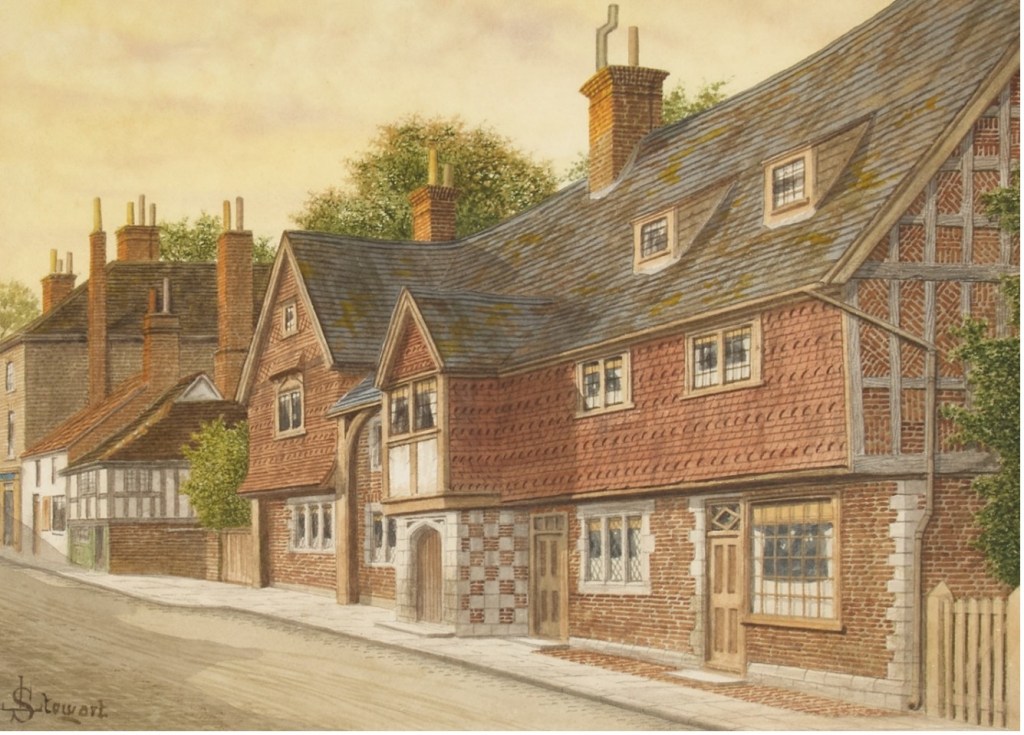
The artist’s dates given for James Lawson Stewart in the catalogue (and by some other auctioneers, including Christies) appear incorrect. He was born in 1841 and baptised in Southwark. In the 1901, 1911 & 1921 censuses he lived in Camberwell. In 1901 & 1911 he was described as a self-employed artist in watercolours but by 1921 (when almost 80) as an architectural draughtsman. He was accompanied by his second wife Elizabeth Mary, fifteen years his junior, and one of his two surviving children, a daughter who was a florist in 1901, a jeweller’s clerk in 1911 and a jewellery designer’s wife in 1921. He died at Northiam, near Rye, in 1929, aged 88.
Sources: https://www.elstob.co.uk/; http://jameslawsonstewart.com/biog.htm; FindMyPast.
John Kay 01273 813388 johnkay56@gmail.com
Contact details for Friends of the Lewes History Group promoting local historical events
Sussex Archaeological Society: http://sussexpast.co.uk/events
Lewes Priory Trust: http://www.lewespriory.org.uk/news-listing
Lewes Archaeological group: http://lewesarchaeology.org.uk and go to ‘Lectures’
Friends of Lewes: http://friends-of-lewes.org.uk/diary/
Lewes Priory School Memorial Chapel Trust: https://www.lewesprioryschoolmemorialchapeltrust.org/
Facebook: https://www.facebook.com/LewesHistoryGroup
Blue Sky: @leweshistory.bsky.social