Please note: this Bulletin is being put on the website one month after publication. Alternatively you can receive the Bulletin by email as soon as it is published, by becoming a member of the Lewes History Group, and renewing your membership annually
1. Next Meeting: 8 Jun 2026: George Jones, ‘Beowulf, a Sussex Legend’
2. Local History Research: a practical 3-part course for LHG members
3. When Lewes had only 17 telephone subscribers
4. A 17th century map of Sussex
5. Dealing with a Juvenile Delinquent
6. An Order for Clothes
7. Francis Godolphin Osborne, MP for Lewes 1802-1806
8. A tribute to Ellen Reeves, by Ruth Welland
9. The Prince of Wales visits the White Hart
10. Football in the street
11. A husband’s heartless conduct
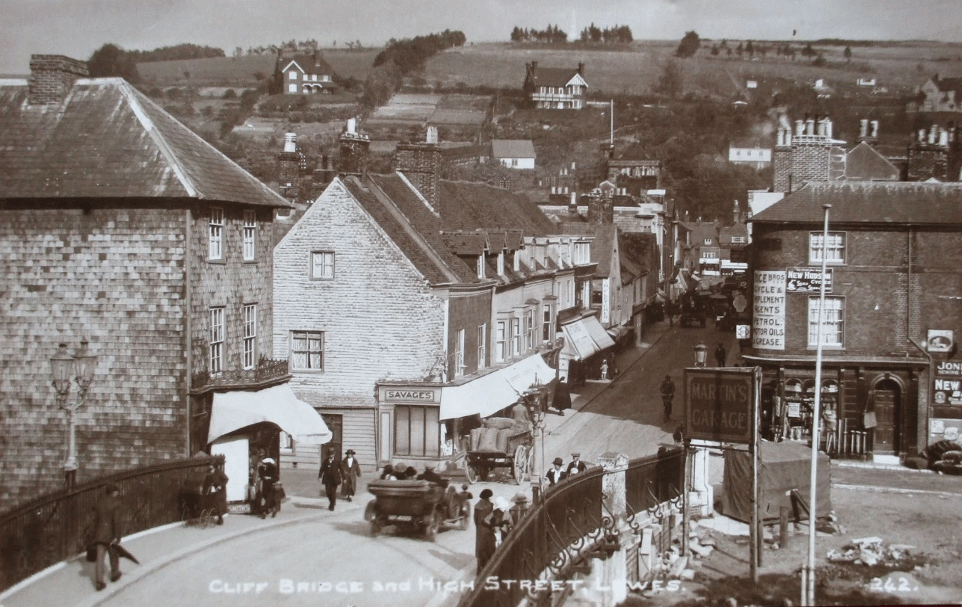
12. Cliffe High Street in the 1920s
13. LHG contributions to the Lewes community (by Phil Green)
1. Next Meeting 7.30 p.m. King’s Church Monday 8 June
George Jones Beowulf, a Sussex Legend
George Jones, who grew up in Lewes, is the author of ‘Beowulf Revelations’, a book published last year that presents a new interpretation of the Beowulf Manuscript, housed in the British Museum and the work of an almost forgotten Anglo-Saxon king. The Saxon kingdom ruled by Beowulf, also known as Beornwulf, in the early 9th century extended as far as the area around Lewes, and some of his coins have been found in this area. George’s talk will focus on the reality behind this story, highlighting connections to Lewes, Ringmer, the Ouse Valley and Hamsey church.
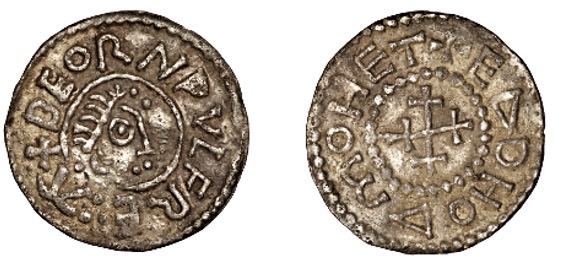
This silver penny issued by Beornwulf was found in a field near Lewes, and sold at auction for £5,000 in June 2024. His reign was short, so his coins are rare.
Admission is free for members and there is no need to reserve your place. Everyone is very welcome, but there is an entry charge of £4 for non-members, with tickets available in advance via Ticketsource.co.uk/lhg.
2. Local history research: a practical 3-part course for LHG members
One of our essential purposes is to encourage our members to undertake small-scale, manageable research projects into aspects of local history that interest them. We have designed this course to help members tackle some of the practicalities involved. Participants do not need to have any prior experience of historical research work.
Part 1 Wednesday, 7 October 10.00-12.00 at Lewes House of Friendship (208 High Street).
This will be a preparatory session to identify and determine the scope of the topics each participant would like to investigate; and to frame some preliminary research questions.
Part 2 Wednesday 14 October 10.00-12.00 Session at the Keep, Falmer: the East Sussex and Brighton & Hove Record Office, which houses collections of local historical documents of all kinds. This session will be led by record office staff and will introduce participants to the range of resources held at the Keep; how to order documents etc. Participants can stay on in the afternoon to work on resources if they wish.
Part 3 Wednesday 21 October 10.00-12.00: Follow-up session at the Keep, Falmer.
Course members will be able to discuss their projects with one another and with others with experience of local history research, in order to identify and plan ways forward. Participants can stay on at the Keep in the afternoon if they wish.
Maximum number of course members: 10
Subsidised course fee: £10.00 per person
Apply via ticketsource.co.uk/lhg by 15 July 2026
3. When Lewes had only 17 telephone subscribers
The opening of the automatic Lewes telephone exchange in 1961 brought a letter to the local press from Mr S. Godman of Pipe Passage about the very early days of the arrival of the telephone in Lewes. He noted a May 1893 list of the subscribers published by the National Telephone Company which stated that the exchange was open from 8 a.m. to 9 p.m. from Monday to Saturday. At that time there were public telephone rooms at 44 High Street and 216 High Street, and also at Mann & Co’s premises in Lansdown Place. The exchange was at 15 Fisher Street from 1898 onwards. He opined that as there were only 17 subscribers in Lewes in 1895, the lady dressmaker who ran the exchange for many years would have had plenty of time left for her main job.
The number Lewes 1 was held for many years by Chatfield & Son, timber merchants, whose office was at 183 High Street. In the early years they also had their own private telephone line between their office and their works at Cooksbridge, with its own line of poles running along the valley. Originally John Every’s Phoenix ironworks was Lewes 2, while John Every senior’s private address at The Limes, Prince Edwards Road, was Lewes 3, a number that later passed to Boots the Chemists. Lewes 4 belonged to Farncombes the printers of North Street; Lewes 5 to Isaac Vinall, solicitor, of 220 High Street; and Lewes 6 to Pannett & Co of 216 High Street.
By the mid-1920s quite a number of local businesses and even a few private individuals advertised telephone numbers in local directories. The County Council had numbers Lewes 8 and Lewes 9 at County Hall, while Lewes Borough Council had numbers Lewes 199, 200 and 348 – the latter one of the highest numbers in use at that time. By 1951 the use of the telephone had grown such that some numbers had four figures, though many of the old single- and double-figure numbers were still in use. By 1964, with the new exchange, they had all gone. All Lewes phone numbers had four digits, starting with a 2, 3 or 4. Boots the Chemists, previously Lewes 3, became Lewes 4003.
Source: 3 March 1961 Sussex Express: 1927-8, 1951-2 and 1964 local directories.
4. A 17th century map of Sussex
This hand-coloured engraving of a map of Sussex by Pieter van den Keere (1571-1646), after that of John Speed, was published in about 1627 by George Humble. This was the sort of information those running the country, or planning the Royalist and Parliamentary military campaigns of the civil war, would have had to rely on.
There may have been a good reason that the main rivers and their tributaries are carefully included, but roads were ignored. Newhaven appears as ‘Myching’, other local towns more recognisably as ‘Lewis’, Brighthelmeston’ and ‘Seaforde’. The English Channel appears as ‘The Brittish Sea’, perhaps following the 1603 unification under King James of the crown of Scotland with those of England, Wales and Ireland.
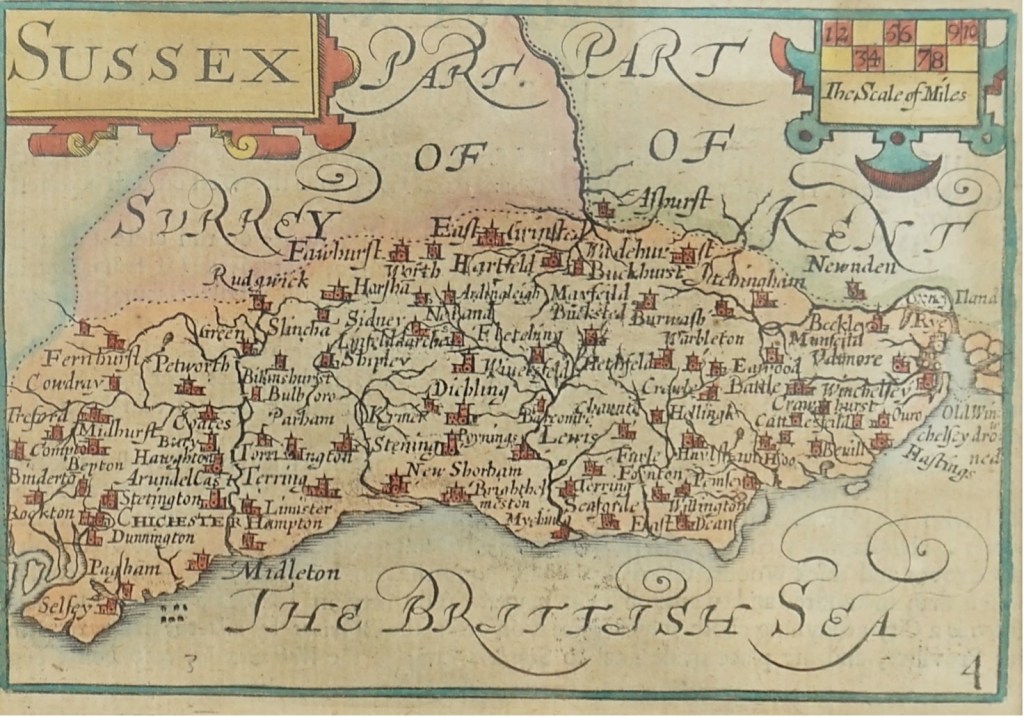
This copy was offered for sale at one of Gorringe’s 2022 auctions, estimated at £80-£100.
5. Dealing with a Juvenile Delinquent
On Tuesday 14 October 1851 Peter Miles, a lad aged about 11, was brought before Lewes magistrates charged with stealing a pair of scissors, value 6d. The prisoner was an itinerant hawker of shirt buttons, etc, and while disposing of his goods to an All Saints housewife had borrowed the scissors. The housewife discovered her loss shortly after he had completed his sale and left. Serjeant Kennard of the Sussex Police learned that a lad answering her description was at the Globe beer shop, and found him there with the scissors in his box. The prisoner, in his defence, said that the scissors must have fallen in his box, and he didn’t know they were there.
The magistrates, unimpressed by his tale, found him guilty, and sentenced him to 10 days hard labour in the House of Correction, and to be once privately whipped.
Source: 21 October 1851 Sussex Advertiser
6. An Order for Clothes
At the Epiphany Quarter Sessions held at Lewes in January 1740 the magistrates ordered that Thomas Taylor, master of the Cliffe House of Correction, was to be reimbursed by the County Treasurer for £1 9s 0d that he had spent on clothing for a poor maid of Rotherfield who had been committed to the house.
Source: Quarter Sessions minute book, ESRO QM/8
7. Francis Godolphin Osborne, MP for Lewes 1802-1806
Francis Godolphin Osborne (1777-1850), given the courtesy title of Lord Francis Osborne from the age of 12, was the second son of the 5th Duke of Leeds. His middle name came from his paternal grandmother, Lady Mary Godolphin, daughter of the 2nd Earl of Godolphin, who had married the 4th Duke of Leeds. When Francis Godolphin Osborne was just a year old his mother eloped with an army captain, best remembered as the father of the poet Lord Byron, and after they were discovered in bed together in Rottingdean his parents divorced. Both his parents remarried and had further children.
The 5th Duke of Leeds was a prominent opponent of the prime minister Lord North, and when William Pitt the younger became prime minister in 1783 he became Pitt’s Secretary of State for Foreign Affairs. He held this post until 1791, through much of his son’s childhood, but was not regarded as a success. He was simultaneously anti-French, anti-Russian and anti-American, and it was said that his most lasting achievement was to foster Thomas Jefferson’s implacable hostility to Great Britain and its government. It was instead King George III himself who set the main lines of Britain’s foreign policy during the time the Duke held this office. After he left office the Duke took little further part in politics. At the age of 18 the young Lord Francis Osborne was admitted to Christchurch, Oxford, and two years later he embarked on a tour of northern Europe. As soon as he came of age he became MP for the Cornish borough of Helston, which was controlled by his father. The sitting MP there was persuaded to resign in his favour. He served as MP for Helston from 1799 to 1802, and then for Lewes for a further four years, alongside Henry Shelley. Why did he move his seat to Lewes? It cannot be a coincidence that in 1801 one of his sisters married Thomas Pelham (1756-1826), an MP for the Sussex County seat, the Whig Home Secretary at the time and the future 2nd Earl of Chichester, who was the eldest son and heir of Thomas Pelham of Stanmer, 1st Earl of Chichester, who had himself been MP for Sussex prior to his elevation to the House of Lords. The 1802 election was reported in Bulletin no.142, when Lord Francis Osborne topped the poll, displacing the Whig Thomas Kemp. He did not stand again in 1806, when Henry Shelley and Thomas Kemp were returned unopposed.
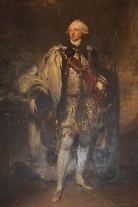
After four years away from Parliament Lord Francis Osborne was returned as MP for Cambridgeshire in 1810, a seat that he retained until 1831, when he retired on the grounds of ill-health.
As an independent Whig he spent his career as an MP in opposition, and often in uncertain health, but supporting Reform and the emancipation of Catholics and Dissenters, while presenting petitions opposing slavery. In 1832 he became the 1st Baron Godolphin, and entered the House of Lords. He lived at Gog Magog House, just south of Cambridge. He married in 1800 and had 5 children. His eldest son later became the 8th Duke of Leeds as well as the 2nd Baron Godolphin. The Rev Sydney Godolphin Osborne, whose Lewes charity was noted in Bulletin no.158, was his youngest son.
Sources: Wikipedia; History of Parliament online; image from geni.com/photo
8. A tribute to Ellen Reeves, by Ruth Welland
Matthew Hyde’s recently published ‘A Pastor’s Heart’, a biography of the Rev Matthew Welland, who was pastor of Jireh Chapel for almost 50 years after his appointment in 1859, includes transcripts of both Matthew Welland’s own journal and that kept by his only daughter Ruth Welland. One entry for Monday 10 August 1874 reports the death of her friend Ellen Reeves, eldest daughter of the photographer Edward Reeves, at the age of 18.
“Dear Ellen Reeves died today of brain fever, being ill a few days. She appeared to be well, except face ache, and was at chapel last Tuesday. How many warning we have of the uncertainty of life, and the certainty of death. These providences are saying to us, “Be ye ready also for in such an hour as ye think not the Son of Man cometh”. Her dear friends are greatly comforted by some letters of hers, which lead them to hope and believe she is now in glory.”
She followed this entry with a short poem:
“Dear Nellie’s taken by death’s hand, We hope she dwells with Christ above,
From all temptation, sin and fear, Whom we believe she loved when here;
We trust she’s with that happy band How can we wish her back with us
Of pilgrims who are gathering there. Where there’s temptation, care and fear
Farewell, dear Nellie, then we say,
For a short time in thy bright home,
Where sometimes I even hope to be
There where parting’s never known.”
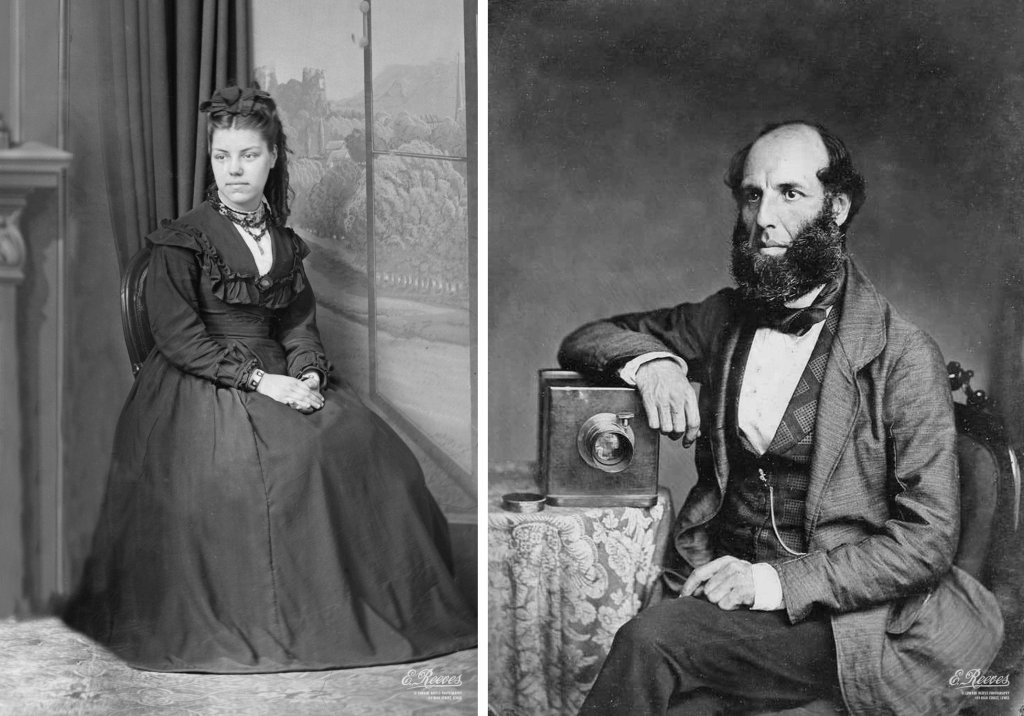
Above are studio portraits of Ellen Reeves, taken two years before her death, and her father. Edward Reeves was a leading member of the Jireh congregation, and Matthew’s book is illustrated by his studio portraits of chapel members. Ruth Welland herself died in 1885, aged 25
9. The Prince of Wales visits the White Hart
The 5 April 1870 West Sussex Journal reported that the Prince of Wales had paid an unexpected visit to Lewes, Ringmer and Glynde to attend a meeting of the Surrey Staghounds. The meeting was also attended by the Duc de Chartres, the master of the Staghounds, and other princes of the French royal family. The Prince of Wales (the future Edward VII) had never been seen in Lewes before, and his attendance at the meet was only confirmed when a telegram was received to say that a special royal train had left Victoria for Glynde with him on board.
On receiving the news hundreds of townspeople left Lewes on horseback, on foot or by train in the hope of seeing him when he left the royal train at Glynde station. At Glyndebourne Mr & Mrs Langham Christie entertained a large party of the local gentry to breakfast, to which the French princes were also invited. William Langham Christie, the future Tory MP for Lewes, was master of the Southdown Hunt based at the former horse artillery barracks at Ringmer, so the Prince of Wales and his retinue rode up the lane to Glyndebourne, where they assembled on the lawns.
The stag, one of two brought down for the purpose by the Staghounds, was uncarted nearby, in the presence of hundreds of horsemen and an uncounted number on foot. It was given a 13 minute start before the staghounds set off in pursuit. A shepherd boy stopped it crossing Glynde Reach, so it back-tracked to cross Moor Lane near Wakelands Farm, passed between the Southdown Hunt kennels and Chamberlains Farm, and then headed across Gote Farm towards the cottage of the Upper Stoneham shepherd, under the hill at Little Heaven. It proceeded up onto the Downs, where many more inhabitants of Lewes had assembled to attend the event. Seeing the town ahead the stag turned right, skirted the Bridgewick chalkpit and passed Upper Stoneham and Ryderswells, before crossing the Uckfield Road and heading for Barcombe Mills. The Prince of Wales was then still well up with the field. The stag then turned right, passed through Plashett Park Farm and by Broyle Mill, until it was recaptured by the huntsmen of the Staghounds and the Southdown Hunt, and returned to its cart, to travel home again to Surrey.
After an outing lasting two and a half hours the Prince of Wales, accompanied by the French princes and at a distance by the gentlemen of the hunt, proceeded to Lewes. Two gentlemen of his entourage galloped ahead to order refreshments for him at the White Hart. As he passed at a leisurely pace through the Cliffe and up School Hill the Prince of Wales politely acknowledged the salutations of those who gathered in shop doorways and in the windows above the street. After luncheon he took a cab to the railway station and returned to London on his special train.
10. Football in the street
The 28 January 1904 Hastings & Bexhill Independent reported, under the headline ‘Football in the Street’, that George Crowhurst, a lad living in Lewes, had been summoned for playing football in St John Street, Lewes, to the annoyance of ‘passengers’ a fortnight previously. He pleaded guilty.
P.C. Taylor deposed to seeing the lad playing football with other lads on the date mentioned. They were using a large india-rubber ball, which he saw the defendant kick, and causing an obstruction in the street. Superintendent Stevens, the deputy chief constable, said there had been complaints in the neighbourhood about lads playing football in the street after they left work at midday, and the police were compelled to take these proceedings in order to stop it. The bench fined Crowhurst a shilling, but warned him that the fine would be much heavier should the offence be repeated.
George Walter Crowhurst was born in Lewes in 1887, so 16 at the time of the offence. His father worked at the Candle Factory, as a porter in 1891 and a fat melter in 1901, when George, aged 13, was a grocer’s errand boy. The family lived at 1 Queen Street. The day after his conviction George Crowhurst signed up as a territorial in the Royal Sussex Regiment, giving his age as 17 and his occupation as a boot finisher for Albion Russell & Son, Lewes. A few weeks later he signed on as a regular soldier. He survived the Great War. In 1921 census he was married with five children, lived in Edward Street, Lewes, and was a tram conductor working for Brighton Corporation Tramways.
11. A husband’s heartless conduct
The 28 January 1904 Hastings & Bexhill Independent carried a sad tale of a young man called George Payne, described as a “strong-looking young man”, who had been prosecuted by the Lewes Board of Guardians for deserting his wife and two children, thereby causing their support to be chargeable to the Union.
Eight years previously the Guardians had “emigrated him” to Canada, but he had returned without their knowledge. He had then married a young laundress from Dorset at St Michael’s church, and they had lived together, on and off, until June 1903, when he had abandoned them in Cliffe. When the Guardians issued a warrant against him he returned and took the young children out of the workhouse, upon which the Guardians had dropped their case. Since then the family had been “tramping the country together”, a way of life for which the wife, described as a very respectable young woman, was ill adapted to.
About three weeks previously, when they were in Chichester, George Payne had told his wife that he didn’t want to work anymore, and that it was her turn to work to maintain him. He then abandoned her with the children, aged 3½ and 14 months, with no food at all, telling her that if she made any trouble for him and they met on the road he would do for her. She still bore the physical marks of his cruelty, including a black eye, while a blow to youngest child had left the marks of four of his fingers on its face.
The abandoned wife, aged 24, decided to take to the road, with her two children in a perambulator, to walk to the Lewes Union workhouse at Chailey. It was the middle of January. She spent the first night at Culham, the second at Billingshurst and the third at Wivelsfield, sleeping in sheds. On the Sunday she walked, pushing the perambulator, for 18 miles. When she reached the workhouse on the southern end of Chailey Common, with her crying children, the relieving officer ordered their admission to the workhouse. She had no food or money left when she set out on her journey, and there is no mention of her having eaten anything on her journey.
George Payne’s version of events was a little different. He claimed she had told him to go away, and that he had never done her any injury, though there might sometimes have been acts of ‘unkindness’. The police superintendent gave evidence that Payne had been before the magistrates before. He had been sentenced to one month’s imprisonment in 1903 for obtaining money by means of a false begging letter claiming he was medically unfit for work, and also six weeks for stealing five fowls from a henhouse in Southover. On that occasion the police found three of the fowls in Payne’s house in Priory Street, one of them cooked and partly eaten on the kitchen table. The magistrates considered the Guardians’ case proved, and sent him to prison for two months with hard labour. They hoped that during that time he would reflect on his conduct, and come out resolved to do better in the future.
Their hopes were not realised. In 1905 George Payne enlisted in the Royal Horse Guards under the name George Turner, but was discharged as unfit for service about 6 months later. By January 1906 he was back in Lewes and up to his old tricks. He called at the home of the brewer George Ravenhall Beard, who was also an officer in the local volunteer battery of the Royal Garrison Artillery. He showed his discharge papers, with the name George Turner, and asked to borrow ten shillings to go to London to draw his pension. He had not, in fact, served long enough to qualify for a pension. When the money was not repaid, and Mr Beard learned that the man’s real name was George Payne rather than George Turner, he called the police who arrested him in Croydon several months later. Back before Lewes magistrates George Payne pleaded guilty, and was sentenced to a further six weeks hard labour. He also seems quite likely to be the George Payne who appeared before the Lewes magistrates as a prolific poacher in the second half of the decade, although it is difficult to be sure as there were several George Paynes in the town at that date.
12. Cliffe High Street in the 1920s
There is no publisher’s name on this 1920s postcard, offered for sale on ebay recently, but the caption looks to be in the style of those published by James Hamilton of Brighton in the 1920s.
The open touring car crossing Cliffe Bridge could well date to that era, and the photograph was obviously taken between the 1919 fire at the Bear Inn and its replacement by J.G. Martin’s motor garage. The sign shows that J.G. Martin had already acquired the site.
13. LHG contributions to the Lewes community (by Phil Green)
You probably know that, as well as providing monthly talks, Lewes History Group supports members wanting to undertake research and publishes books on aspects of local history. However, you may not be aware that we also make donations to local projects that promote awareness of the history of the town.
So far this year we have contributed towards the cost of a plaque at the corner of St. Andrew’s Lane and Southover Road, on the former home of John Stenhouse, Medical Officer of Health (see Bulletin no.188) and also made a small donation to support the bid by the Lewes Town of Culture Partnership to make Lewes, in 2028, the first official “Town of Culture” .
John Kay 01273 813388 johnkay56@gmail.com
Contact details for Friends of the Lewes History Group promoting local historical events
Sussex Archaeological Society: http://sussexpast.co.uk/events
Lewes Priory Trust: http://www.lewespriory.org.uk/news-listing
Lewes Archaeological group: http://lewesarchaeology.org.uk and go to ‘Lectures’
Friends of Lewes: http://friends-of-lewes.org.uk/diary/
Lewes Priory School Memorial Chapel Trust: https://www.lewesprioryschoolmemorialchapeltrust.org/
Facebook: https://www.facebook.com/LewesHistoryGroup
Blue Sky: @leweshistory.bsky.social