Please note: this Bulletin is being put on the website one month after publication. Alternatively you can receive the Bulletin by email as soon as it is published, by becoming a member of the Lewes History Group, and renewing your membership annually
1. Next Meeting: Christopher Whittick, ‘The Church of Lewes St Anne’
2. Lewes Heritage Open Weekend
3. Volunteer at Bull House (by Leanne O’Boyle)
4. The George de Paris catalogue of views of Lewes churches
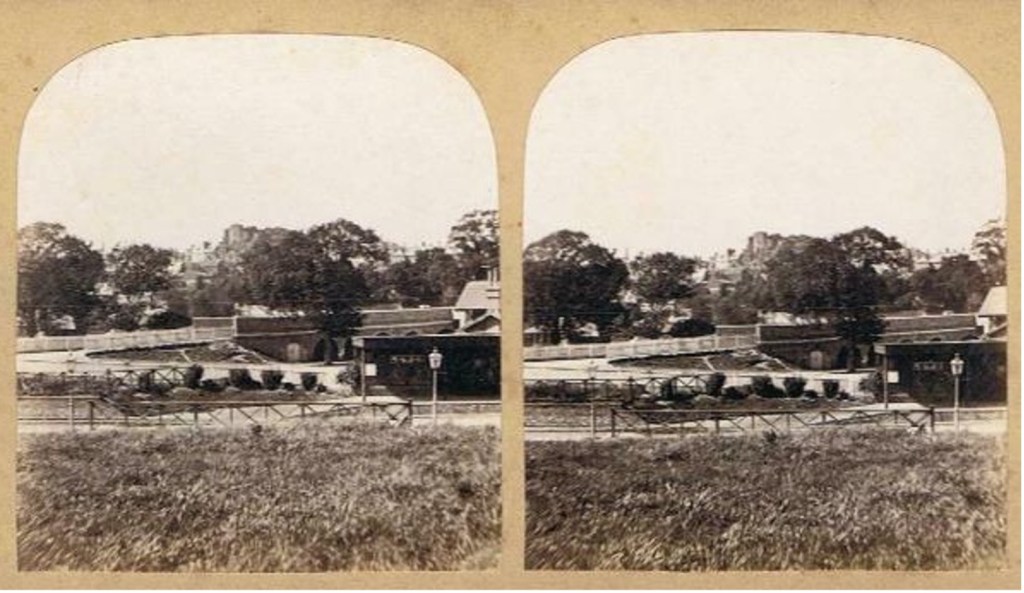
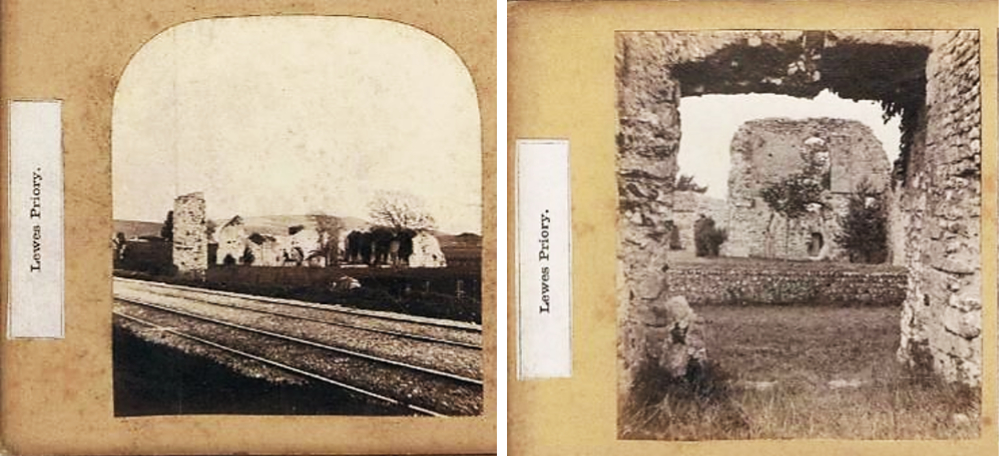
5. Three Lewes Stereoviews
6. The origins of the Lewes Dispensary
7. Salmon in the River Ouse
8. Cliffe High Street in World War II
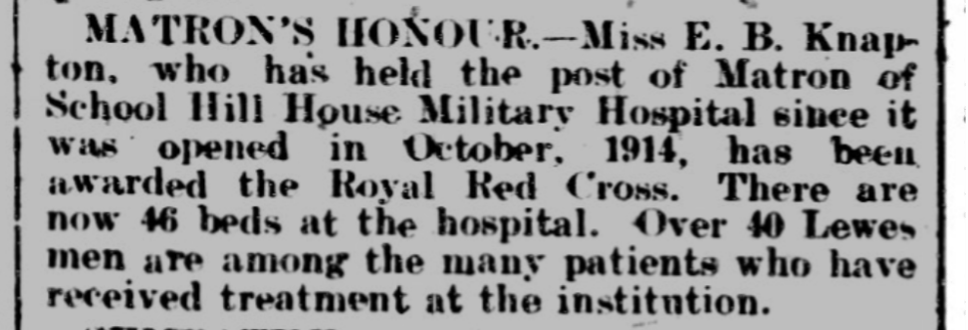
9. The matron at School Hill House Hospital10. A postcard view over Landport and South Malling
1. Next Meeting
Monday 14 September 7.30 p.m. King’s Church Building
Christopher Whittick The Church of Lewes St Anne: from prehistory to Walter Godfrey
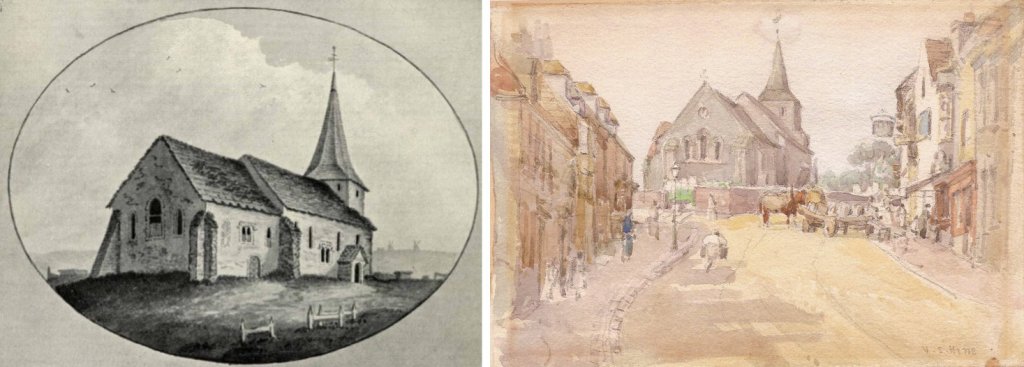
This illustrated talk will examine the site of St Anne’s church, discussing its possible pre-Christian origins, its role in the Battle of Lewes, and the reasons for its change of name. We will visit briefly the hospital of St Nicholas, both in the medieval period and during the redevelopment of the site in the 20th century. The talk will conclude with a discussion of the restorations of 1723, 1750 and 1844, and the discoveries made during Walter Godfrey’s improvements in 1926-1927. Below are a drawing made c.1780 from the Burrell Collection and a watercolour by the 19th century artist H.S. Hine showing the view to the church up St Anne’s Hill.
Admission is free for members and there is no need to reserve your place. Everyone is very welcome, but there is an entry charge of £4 for non-members, with tickets available in advance via Ticketsource.co.uk/lhg. Free entry for those under the age of 25.
2. Lewes Heritage Open Weekend
This year’s Lewes Heritage Open Weekend, organised by the Friends of Lewes, will run from Friday 11 September to Sunday 13 September 2026.
Do drop in to the LHG exhibition at Lewes House on Saturday and Sunday 12 and 13 September from 10 am to 4 pm each day. There will be general information about our activities and showcase some of the research done by members over the past year. We hope to have copies on sale of our soon to be published book, ‘All Change! Lewes Bus Station’ by Ruth and Neil Thomson, along with other recent LHG publications.
For the full programme of buildings open to the public and the new guided walks being offered in this year’s programme, please see https://friends-of-lewes.org.uk/hod2026/. The17 buildings open range from the medieval Hugh Rae building at 74/75 High Street to distinguished 20th century buildings. Not every property is open on every day, but the individual opening times are listed on the website. Advance booking is required for the walks planned and also for two of the properties that can be visited. This can be done through the website.
Advance booking is required for the walks planned and also for two of the properties that can be visited. This can be done through the website.
3. Volunteer at Bull House (by Leanne O’Boyle)
Would you like to help bring one of Lewes’s most fascinating stories to life?
Bull House, the former home of Thomas Paine, is now the home of Thomas Paine: Legacy — a museum and Centre for Democracy exploring Paine’s extraordinary life, ideas and continuing legacy. We’re looking for enthusiastic house volunteers to join our team. Our volunteers are at the heart of Bull House: they welcome visitors, lead tours, run the museum shop and help care for this remarkable historic building. They also share ideas and suggestions for improving the visitor experience, helping us shape the future of the house together.
You don’t need to be an expert historian. We’re looking for people who enjoy meeting others, have an interest in history and would like to play a part in an exciting and growing project. Full support and an introduction to the house and Paine’s story are provided.
Our visitors particularly value the personal, one-to-one experience that our volunteers provide, and we regularly receive wonderful feedback about the warmth of the welcome and the opportunity to discover Paine’s story through conversation.
As one volunteer says: “I’ve thoroughly enjoyed my time volunteering at Bull House. The enthusiasm and support from the entire team is truly inspiring and makes the experience both fun and rewarding.”
Another describes the privilege of being part of Paine’s Lewes story: “Tom Paine left a footprint in Lewes before giant steps on a world stage. As a volunteer in Paine’s Lewes home, at Bull House with Thomas Paine: Legacy, I think it a privilege for anyone with that ‘feel’ for history.”
Volunteers also become part of the wider Thomas Paine: Legacy community, with opportunities to attend special events, talks and activities throughout the year. Whether you can offer a regular commitment or occasional time, we’d love to hear from you.
Could you join us? To find out more about becoming a Bull House volunteer, please contact info@thomaspainelegacy.org. Come and help us share Lewes’s extraordinary connection with one of the great radical thinkers of the eighteenth century — and be part of Bull House’s next chapter.
4. The George de Paris catalogue of views of Lewes churches
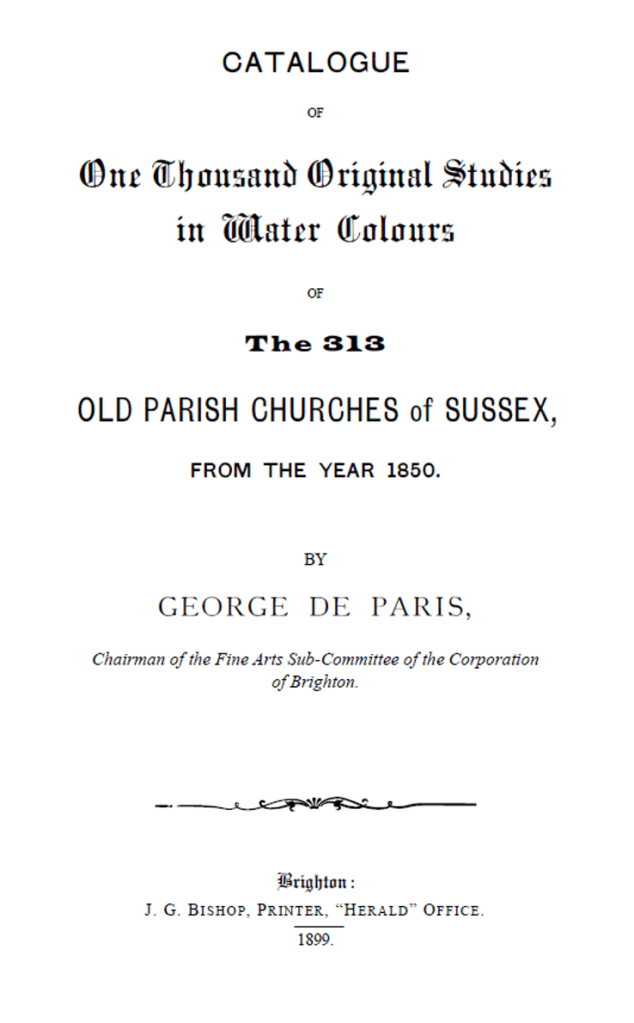
During the second half of the 19th century the artist George de Paris assembled a collection of a thousand original watercolours of the 313 ancient churches in Sussex. He had hoped that this remarkable collection could be preserved in a public collection, but the sponsorship necessary was not forthcoming and it was dispersed. Today only a small number are in public collections. Copies of his catalogue, printed in 1899, have survived to illustrate the nature of the collection.
The Lewes section of the catalogue is shown below. There were in all eighteen watercolours of different aspects of the seven Lewes parish churches. There was only a single watercolour of South Malling church, but two or more different views of each of the others. As he was born only in 1829 the watercolours of the old St John-sub-Castro church cannot have been drawn from life by George de Paris himself.
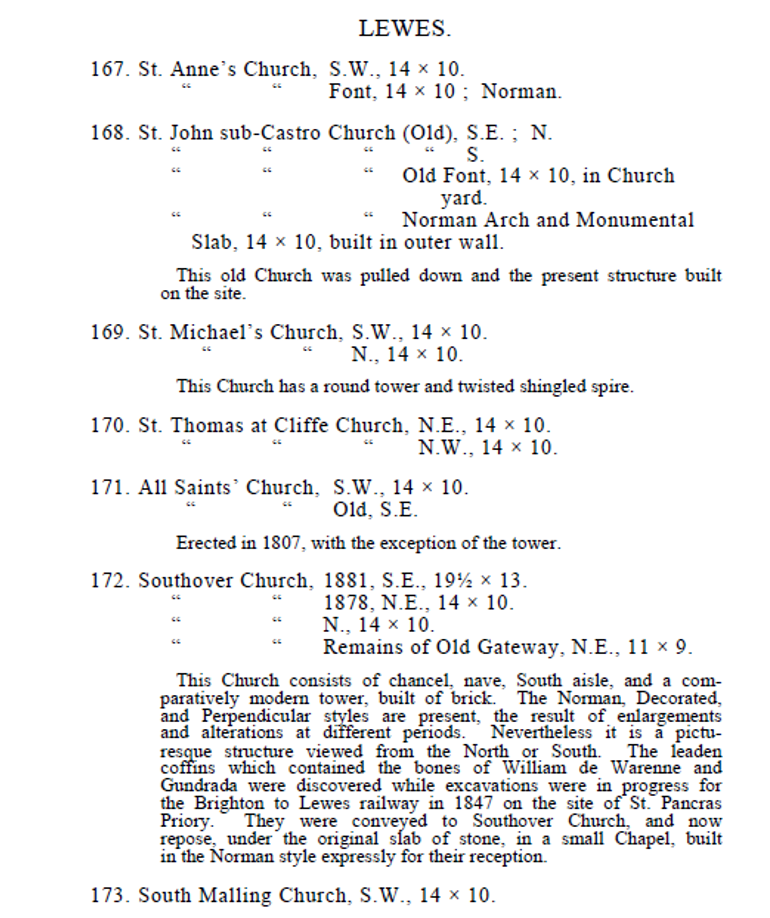
A supplementary catalogue of additional watercolours, either overlooked when the catalogue was produced or created after 1899, includes nine additional pictures of three of these churches. They were:
- An additional view of St Anne’s Church from the NW and a separate watercolour of a Norman pier there.
- Additional views of St Thomas, Cliffe, from the SE and SW and separate views of the hagioscope, of a recess in the south wall, of the stoup and of the piscina.
- An additional view of South Malling church from the SE.
Sources: For a biography of George de Paris (1829-1911) see the article by Frances Stenlake in Sussex Archaeological Collections, vol.162, pp.209-225; the Catalogue from the collection of Timothy de Paris is available online at https://georgedeparis.com/2023/07/catalogue-of-one-thousand-original-studies-in-water-colours-of-the-313-old-parish-churches-of-sussex-from-the-year-1850/. The supplementary catalogue is at https://georgedeparis.com/2023/07/supplementary-catalogue-of-the-old-parish-churches-of-sussex/.He was a prolific artist, producing also many other watercolours of secular building around the county.
5. Three Lewes Stereoviews
TThree stereoviews thought by the seller to date from the 1860s were offered on ebay recently. Stereoviews were first exhibited at the 1851 Crystal Palace exhibition, so they are amongst the earliest surviving photographs, and they were increasingly popular from the 1860s and 1870s onwards.
The top pair show the view up towards Lewes Castle from near the railway station, though it clearly dates from before the present railway station was built in 1887.
The other two stereoviews feature Lewes Priory. Only one of each pair of views is shown.
6. The origins of the Lewes Dispensary
From Mark Antony Lower, ‘Handbook for Lewes’ (1st edition, c.1847)
“Pest House Charity: The pest-house of the town, which stood near St Anne’s church, was disposed of by the authorities of the borough to the overseers of St Anne’s as a poor house, for the sum of £450. This transfer proving illegal, the commissioners of charities made representations which led to the institution of proceedings for the recovery of the charity, and the present generation has been called upon to refund, with interest, what their fathers had misappropriated. The necessary sum being now raised, the proper authorities have been memorialised to direct it to be applied to the support of a public dispensary for Lewes.”
Then in some late additions at the end of the preface that can firmly be dated to 1847 he adds:
“The town commissioners having procured a direction from the Court of Chancery that the Pest-house Charity, raised by subscription in 1742, and diverted from its original purpose in 1808, should be appropriated to the support of a public dispensary, the annual income, amounting to £40 p.a., is to be so applied. Twenty two of the principal inhabitants have been appointed trustees who, together with every subscriber of one guinea per annum, are governors of the institution. The management of the dispensary will rest with a Board of Directors, with proper officers, whose services, with the exception of the resident dispenser, will be honorary. The medical practitioners of the town have generously consented to divide amongst themselves the necessary personal attendance at the establishment. It is hoped that the income of the charity will be raised, by subscriptions, to the sum of £200 per annum. Hon. Sec. pro tem, W.P. Kell, Esq.”
In his, ‘Handbook for Lewes’ (2nd edition, 1852) this becomes
“The necessary sum being now raised, the Court of Chancery was memorialised to direct it to be applied to the support of a public dispensary for Lewes, and the annual income of the charity, amounting to about £40, is so appropriated. The fund is vested in trustees who, in conjunction with subscribers to a certain amount, constitute a board of directors. The medical practitioners of the town generously divide amongst themselves the necessary personal attendance at the Dispensary house, and all the officers connected with this praiseworthy establishment, the resident dispenser excepted, are also honorary. Treasurer, G. Whitfeld, Esq. Hon Secretary, W.P. Kell, Esq.”
In 1847 the new dispensary rented premises at 93 High Street, Westgate House. However, in 1854 they were able to purchase 11/12 High Street on the corner of Friars Walk (until recently the NatWest Bank and now Gail’s bakery). They remained there until the opening of the new Lewes Victoria Hospital in 1910, by which time the premises also included an infirmary and the first Victoria Hospital, as shown in the James Cheetham photograph featured in Bulletin no.162.
7. Salmon in the River Ouse
Several Lewes members of the River Ouse Preservation Association gathered at Barcombe Mills on a Saturday evening in the early autumn of 1875 at the invitation of Richard Henry Billiter, the proprietor of the mill. They included Messrs R. Crosskey, the brewers E. & E.T. Monk, and the printer & publisher G.P. Bacon.
When the mill pools were dragged with nets, the haul included several salmon between 5 – 10 lb in weight, a good number of roach and some small jack. The presence of the salmon justified the efforts to establish a Conservancy Board for the river.
The gentlemen preset were then entertained to supper by Mr & Mrs Billiter. The newspaper report in the 2 October 1875 South Eastern Advertiser does not mention what was on the menu.
8. Cliffe High Street in World War II
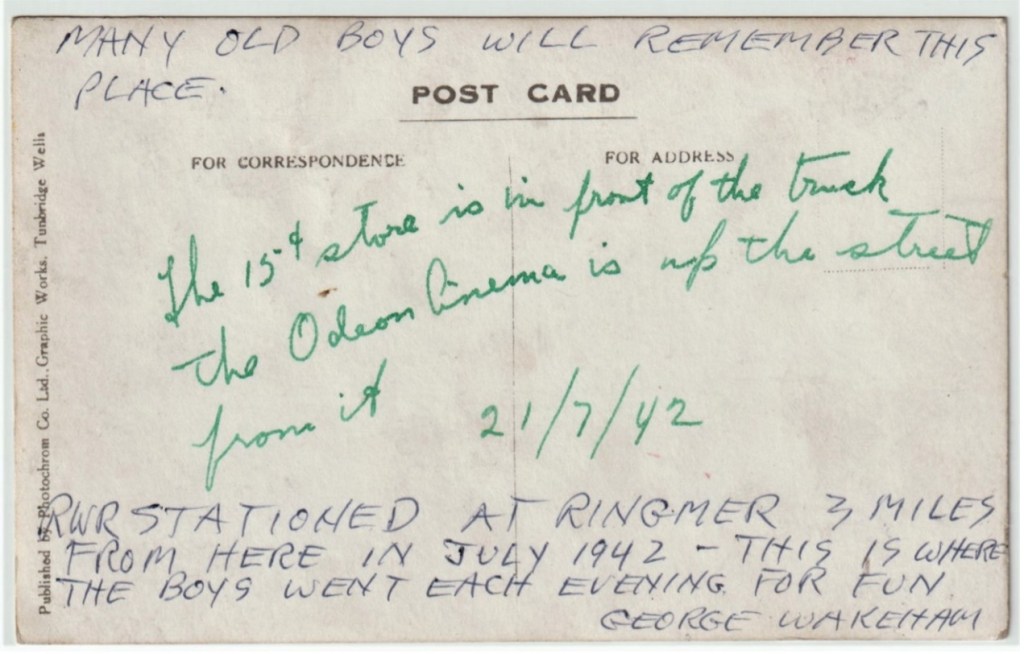
This Photochrom Company postcard, recently offered on ebay, was first purchased by George Wakeham, a Canadian soldier whose unit was stationed in Ringmer in July 1942.
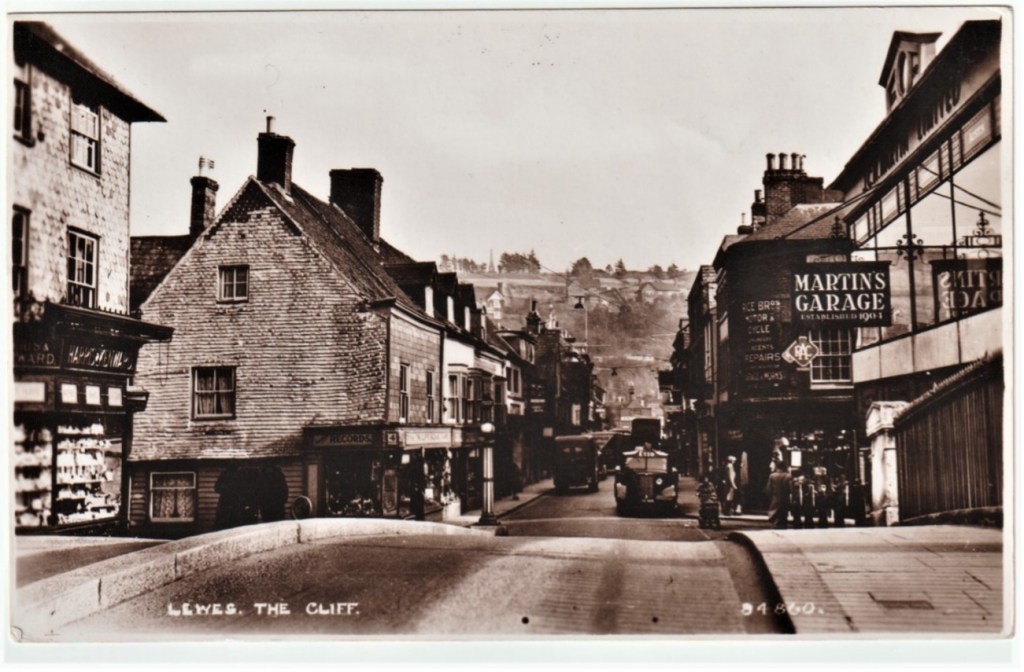
His notes on the reverse describe the 15-cent store as being in front of the truck and the Odeon cinemas just up the street. He notes “Many old boys will remember this place. … This is where the boys went each evening for fun”. His unit is described as the RWR. Google suggests this will have been the Royal Winnipeg Rifles, who came to England in 1940 and landed in Normandy on D-Day. Some years ago I acquired a postcard of Harrisons Lane, Ringmer, inscribed in the same way by the same soldier in June 1942. A large house on Lewes Road at the end of Harrisons Lane was requisitioned by the military in World War II and remembered as used by Canadian troops.
9. The matron at School Hill House Hospital
10. A postcard view over Landport and South Malling
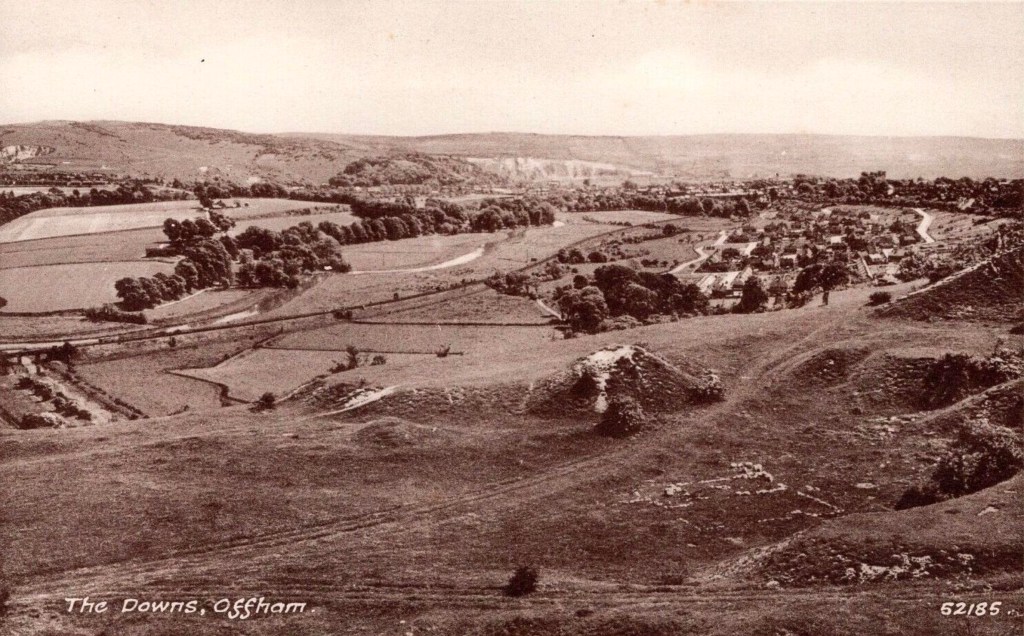
This postcard view taken from close to some old chalkpits on the Downs above the Offham Road was published by E.A. Sweetman & Son of Tunbridge Wells. E.A. Sweetman died in 1929, but the business was continued by his son Donovan Sweetman until his own retirement in 1964.
The company published postcard views from across England, but those I have seen of the Lewes area all carry numbers above 50,000, and seem to date from the 1950s. This example shows the Landport estate not yet fully developed. Beyond the River Ouse the tower of South Malling Church can be seen above the trees, still surrounded by fields. Just visible to the far left is some new residential development off Malling Hill.
John Kay 01273 813388 johnkay56@gmail.com
Contact details for Friends of the Lewes History Group promoting local historical events
Sussex Archaeological Society: http://sussexpast.co.uk/events
Lewes Priory Trust: http://www.lewespriory.org.uk/news-listing
Lewes Archaeological group: http://lewesarchaeology.org.uk and go to ‘Lectures’
Friends of Lewes: http://friends-of-lewes.org.uk/diary/
Lewes Priory School Memorial Chapel Trust: https://www.lewesprioryschoolmemorialchapeltrust.org/
Facebook: https://www.facebook.com/LewesHistoryGroup
Blue Sky: @leweshistory.bsky.social