Please note: this Bulletin is being put on the website one month after publication. Alternatively you can receive the Bulletin by email as soon as it is published, by becoming a member of the Lewes History Group, and renewing your membership annually
1. Next Meeting: 12 October 2026: Neil & Ruth Thomson, ‘The Lewes Bus Station Story’
2. All Change at Lewes Bus Station
3. Edward Bedford and Edward John Bedford
4. A posthumous son
5. Casualties of the December 1836 snowstorm
6. Repairs to St Michael’s tower
7. The East Sussex Technical School for Women and Girls
8. The Perils of Horse Transport
9. Lewes High Street in the 1930s
10. St Michael’s Almshouses, Keere Street
1. Next Meeting
Monday 12 October 7.30 p.m. King’s Church Building
Neil & Ruth Thomson The Lewes Bus Station Story
At the time of its opening in 1954, the purpose-built island bus station was considered to be state-of-the-art – providing not just a dedicated bus interchange but also essential facilities for the travelling public and for the Southdown bus company’s own employees. Its unnecessary closure in 2022 deprived passengers and staff of these services.
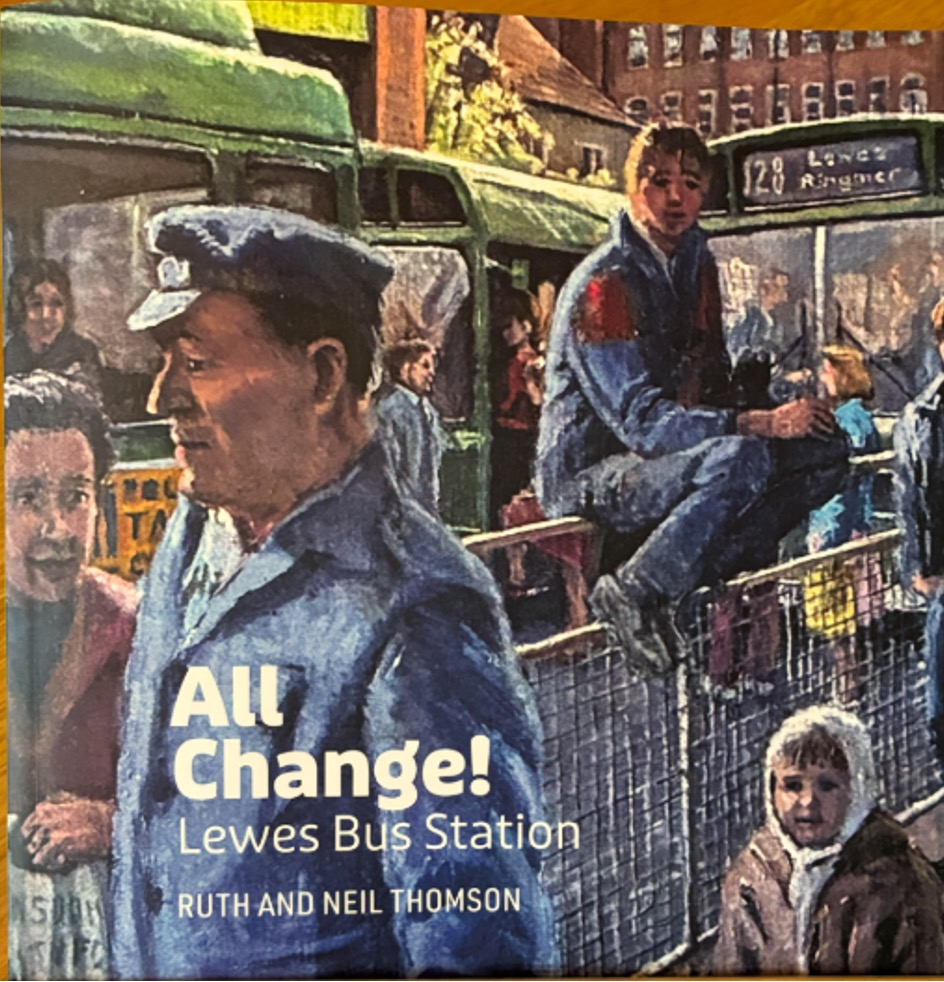
Coinciding with the publication of Lewes History Group’s latest title, ‘All Change! Lewes Bus Station’, in their illustrated talk, authors Neil and Ruth Thomson will explore the origins, rise and fall of this familiar, well-loved Lewes landmark, and the stories of the many local residents who worked there or used its facilities.
Admission is free for members and there is no need to reserve your place. Everyone is very welcome, but there is an entry charge of £4 for non-members, with tickets available in advance via Ticketsource.co.uk/lhg. Free entry for those under the age of 25.
Admission is free for members and there is no need to reserve your place. Everyone is very welcome, but there is an entry charge of £4 for non-members, with tickets available in advance via Ticketsource.co.uk/lhg. Free entry for those under the age of 25.
2. All Change! Lewes Bus Station
Ruth & Neil Thomson’s excellent account of the story of Lewes Bus Station has now been published by the Lewes History Group. This celebratory volume covers the story of the property from its construction for the Southdown Bus Company by the Ringmer Building Works in 1954, on what had previously been the large garden of 213 High Street, to its recent unnecessary closure by the Essex-based Generator Group.
For about two thirds of a century the distinctive modernist bus station served as a key public transport hub for residents in Lewes and the surrounding towns and villages. Its use was not confined to travellers. Local residents, especially generations of youngsters, also made good use of its shop, café and services. It was a workplace too, for the bus company staff and those providing the services, and by all accounts a popular one. Ruth and Neil have collected stories from dozens of people who were connected with the bus station in one way or another, and followed the twists and turns of its fortunes through nationalisation and then privatisation. Their 160-page book is lavishly illustrated throughout.
Our former much-loved bus station now sits in the middle of the town, increasingly derelict, and walled off behind ugly construction hoardings, while the Generator Group seek a buyer. Unless one can be found, at a time when builders have an extensive choice of greenfield sites in the villages around the town, it risk joining the Phoenix area and the decades-derelict Parsons Brothers timber workhouse behind Waitrose the former police garages and St Anne’s school (once the Southover Rectory) as yet another Lewes blot on the landscape, monuments to the triumph of developer greed over the public interest.
Copies will be available for purchase at our October meeting. The book is also available from the Tourist Information Centre, a number of other outlets in the town, at the Friday markets, directly from Ruth & Neil or by mail order via the Lewes History Group website (leweshistory.org.uk).
3. Edward Bedford & Edward John Bedford
Edward Bedford (c.1839-1923) and his son Edward John Bedford (1865-1953) both lived the majority of their lives in Lewes, and both made important contributions to life in the town. Edward Bedford was a grocer in Commercial Square, but his main contribution was in local administration. He collected the rates for St John-sub-Castro parish for an unbroken period of almost sixty years.
His son Edward John Bedford is today remembered mainly as a photographer, but that was only one of his talents. Starting out as a pupil-teacher at the Lewes School of Science and Art, he was successively assistant master at the Brighton Municipal School of Science and Art for 14 years, and head master of the Eastbourne Municipal School of Art and Design for a further 17 years, before returning to live in Lewes. Back in his home town his roles included head of the Lewes School of Science and Art where he had himself been a pupil, curator of the Lewes Borough Museum, secretary and treasurer of the Lewes Photographic Society and secretary of the Lewes Scientific and Literary Society. He played the organ at Cliffe and Glynde churches, and in Lewes Prison. He was at his death a prominent naturalist and the longest-serving member of the Sussex Archaeological Society.
Edward Bedford senior (c.1839-1923) was born in Southgate, Middlesex, and grew up in Edmonton, the son of a tailor. He is first recorded in Lewes in the 1861 census, when at the age of 22 he was described as a tea dealer’s assistant, living in the short section of the High Street either side of Station Street that lies within St John-sub-Castro parish. In 1863 he married Rosamond Randall, a London tailor’s daughter, at the Old Chapel at Chapel Hill. This chapel then housed the English Presbyterian congregation (with almost entirely Scottish ministers) that was a few years later to open a new chapel on Market Street. The couple lived at addresses in St John-sub-Castro parish for the rest of their lives. Birth registration records show that they had eight children born in Lewes between 1865 and 1875, but three died in early infancy, leaving them with a son, Edward John Bedford, and four daughters, all of whom survived to adulthood.
After their marriage the Bedfords opened a grocer’s shop at 5 Fisher Street, in Commercial Square, which they ran for more than 25 years. The shop engaged in the usual range of businesses, employing a shopman and a boy. In 1864 Edward Bedford was described as a grocer, tea dealer etc, and agent for wines. Three years later he was the defendant in a test case before Lewes magistrates when an inland revenue officer ordered a gallon of spirits from him, which he supplied under his agency with the European Wines Company. He was then brought before Lewes magistrates by the inland revenue under an obscure new Act of Parliament that required such agents to hold a personal spirits licence, rather than rely on the spirits licence of their supplier. As Edward Bedford’s own licence was only to sell wine, the magistrates reluctantly agreed they had to find him guilty. In general the Bedford’s grocer’s shop appears to have progressed smoothly, apart from the inevitable occasional shoplifter. At least towards the end of his period as a local grocer Edward Bedford developed wider business interests – in 1887 and 1889 he won the contract to supply the Lewes Union with groceries.
Grocers were necessarily numerate businessmen, and this gave them additional opportunities in Victorian England. In the same year that he married and established his shop, Edward Bedford also took on the paid role of assistant overseer for the parish of St John-sub-Castro. In theory the unpaid parish overseers of the poor chosen each year had to set and collect the rates to cover their share of the charges made by the Lewes Poor Law Union, but in practice the overseers delegated all the detailed work to a salaried assistant overseer. He was evidently assiduous in this role, one triumph being his ensuring that a reluctant Admiralty contributed their due share in respect of the part of the Naval Prison that lay in his parish (part of it was in All Saints).
It was doubtless this role that led to his being one of the three 1871 census enumerators for St John-sub-Castro parish. This was not his only public role in the town. In September 1871 the local press reported that as teacher of the infant class at the Tabernacle Sunday School he had treated the ninety scholars in his class to a tea, after which there was a magic lantern exhibition, singing and music from two large music boxes, to which his older former students were also invited. In the 1870s he also put himself forward for election as one of the town commissioners, sometimes elected, and sometimes not. When Lewes Borough Council was established in 1881 he was one of three candidates who applied to become their rate collector at a salary of £100 p.a., but he was not successful.
By 1891 he had been appointed as collector of the Queen’s taxes for Lewes and Seaford, and this enabled Edward Bedford, in his early fifties, to give up his grocer’s shop and pursue a full-time career in local administration. He had a portfolio career, bidding for such opportunities as arose. In 1891 he was one of four men who competed for the post of auditor to Lewes Borough Council, and he was also active in the commercial sector – when acting as a trustee for a Brighton auctioneer and house agent in that year he described himself as an accountant. He had a long-standing connection with the wine and spirits side of Beards Brewery in Star Lane, both as a travelling salesman and assisting in the office.
In the 1891 census he and his family, now with 5 children aged from 26 to 16, had moved to 10/11 St John’s Terrace. His son was working in Brighton but lived at home and commuted from Lewes. They remained at 10/11 St John’s Terrace in 1901, but by this date there were only three daughters still at home. The second daughter, Amy Elizabeth, had died at the age of 24 in 1893, while their son had established his own home in Eastbourne. Their eldest daughter, Rosamond Ann (now 35) helped her mother manage the home, while Katie Matilda (29) was a governess and Florence Randall (26) a milliner. Only the youngest daughter ever married. By 1911 Edward and Rosamond Bedford and their two remaining adult daughters had moved next door – to 9 St John’s Terrace. The daughter who had been a governess was now a teacher at Southover School.
In 1913 Edmund and Rosamond Bedford celebrated both their Golden Wedding and his half-century of employment as assistant overseer of St John-sub-Castro parish. In 1915 Rosamond Bedford died at the age of 78, and was buried at St John-sub-Castro, but Edward’s employment as assistant overseer continued for almost another decade. When Lewes Borough Council rationalised their rate collection system in 1921 they employed a man called Thomas Buckman as assistant overseer for the whole of Lewes at £200 p.a., except that Edward Bedford was to continue as rate collector for St John-sub-Castro at £75 p.a., while another old employee retained a similar role for Southover. He was also the treasurer of the Lewes Horticultural Society.
The 1921 census shows no fewer than three Bedford family households in St John’s Terrace. Edward John Bedford, returned from Eastbourne, lived at no.11, one of the original family homes. Edward Bedford senior was at no.9, with his eldest daughter Rosamond Ann as his housekeeper and Katie Matilda, now teaching at the Lewes Central School. Their married daughter Florence Randall Parker lived at no.5, with her husband (a gilder, picture restorer and picture framer) and children. Edward Bedford senior died in 1923 at the age of 84. His funeral service was held at St John-sub-Castro, but the minister of Tabernacle attended. His children’s three households continued in the same houses on St John’s Terrace for decades. Rosamond Ann Bedford (a long-standing District Visitor and Sunday School teacher) died in 1946, Katie Matilda Bedford in 1950 and Edward John Bedford in 1953. The last survivor was Florence Randall Parker, who died in 1958 in a Brighton nursing home as an 83 year old widow.
Edward John Bedford (1865-1953) was born and grew up at the grocer’s shop at 5 Fisher Street. He attended the Lewes School of Science and Art, and excelled at Art, becoming a pupil-teacher there. He won a national bronze medal for painting. After qualifying as a certificated teacher in 1883 he became an assistant master at the Brighton School of Art, to which he commuted from his parents’ home in Lewes. It was also in the 1880s that he took up photography as a serious hobby, becoming a member of the Royal Photographic Society. He photographed the town in which he grew up and also the local railways, a particular interest.
In 1897, when the Eastbourne School of Art became the responsibility of the Borough Council and moved to new premises, Edward John Bedford was chosen as its new head master. In his first year there were 90 students of different ages on the register. Forty of them attended full-time day classes that provided an extensive education in art, while the remainder attended evening classes, often of a more commercial nature, after the end of the working day. Edward J. Bedford was responsible for both, and so moved to Eastbourne. The 1901 census finds him aged 36 living in Gorringe Road, Eastbourne, accompanied by his housekeeper Flora Jane Barden, aged 31, who had previously been a mantle maker. She was to serve as his housekeeper for the rest of their lives, more than half a century.
At about the outbreak of the Great War, aged almost 50, Edward J. Bedford returned to Lewes, to pursue a freelance career as an art teacher and his interests in photography and natural history. In 1921 he became the curator of the new Lewes Borough Museum, then housed in the Market Tower, and also head master of the Lewes School of Science and Art. The school closed in 1932, and the Borough Museum moved into its Albion Street premises. Bedford retired as its curator only in 1950. The borough museum survived his retirement by only a few years, and the town Library then moved into its premises.
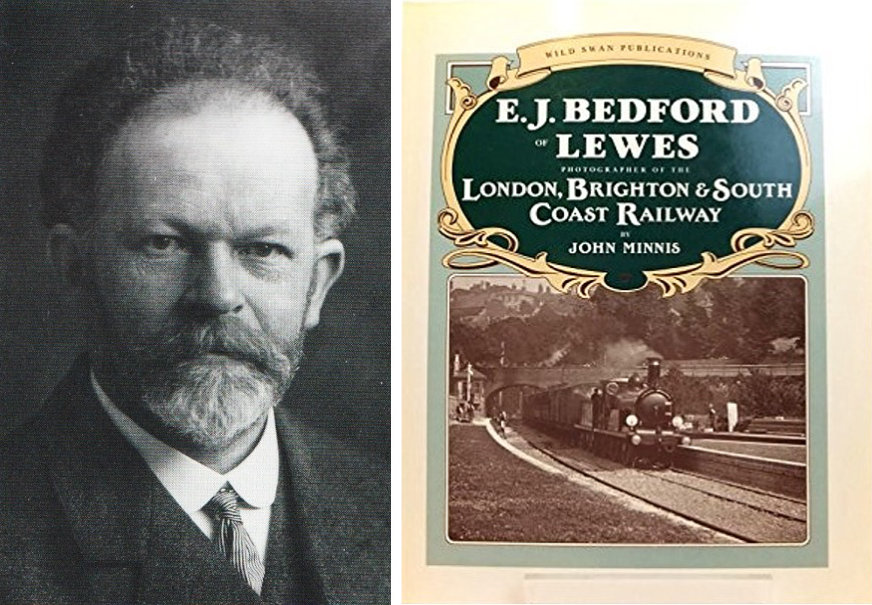
In February 1953, alerted by two days of uncollected milk bottles on his doorstep, both Edward J. Bedford and his housekeeper Fiona Barden were discovered dead in the house they shared at 11 St John’s Terrace. Miss Barden, whose age was underestimated at 80, was found collapsed in the basement kitchen, having suffered a stroke. Mr Bedford, aged 88, was found on an upstairs landing, having fallen down a flight of stairs. An inquest recorded verdicts of natural causes and misadventure. The event was widely reported in the national press, which described him as a naturalist and noted that the house was filled with his collections of butterflies and moths. He left an estate valued at a not inconsiderable £3,119.
His large collection of prints was acquired by John Kite and later his biographer John Minnis, who also acquired his large collection of lantern slides from a Cartmel bookseller. His watercolours of orchids were given to the National History Museum. Many of his railway negatives, along with those of G.F. Burtt, were acquired at auction in 1982 by the National Railway Museum, York, and some are reproduced in LHG Bulletin no.171. Over 500 negatives of his local photographs and some prints were deposited by the Sussex Archaeological Society with what is now Historic England, where they form collections EJB01/01 & EJB02/02.
Sources: John Minnis, ‘E.J. Bedford of Lewes: Photographer of the London, Brighton & South Coast Railway’ (1989); FindMyPast and Familysearch; British Newspaper Archive; Historic England photograph collection; Sussex Photohistory website; ESRO COR 1/5/1953/28; LHG Bulletins nos.47, 51, 55, 86, 111 & 173.
4. A posthumous son
The St John-sub-Castro parish registers record the baptism on 31 August 1634 of William the son of Widow Mills, whose husband “was lately executed”.
5. Casualties of the December 1836 snowstorm
The snowstorm just after Christmas 1836 is remembered mainly because of the avalanche that descended onto the cottages of South Street, but there were other casualties across the south of England. In Brighton all the shops were closed, with snow over the shutters, and two men were frozen to death. At Landport Farm 26 sheep belonging to Mr Tourle were frozen to death, and Mr Verral of Swanborough lost 19 sheep and a horse for the same reason. The mailman from Lewes to Uckfield and Tunbridge Wells was obliged to return to Lewes, because the snow on Malling Hill was twelve feet deep. The lad bringing the mail from Seaford to Lewes was almost buried at Northease, but managed to extricate himself and eventually got home. The Ditchling mailman was missing and was supposed to have lost his life in the snow.
A fly belonging to Mr Stevens went out of Lewes with a fare, but when the empty vehicle reached Ringmer turnpike gate on its return journey the snow was over the palings and it could proceed no further. The driver abandoned his vehicle and made his way home on foot, though his journey had lasting ill-effects on his health. Mr Stevens went out to Ringmer with assistance to extricate his horse, but finding that it could not be done he “mercifully spared the poor animal the misery of dying from cold by shooting him outright”.
Source: 1 January 1837 London Mercury & 7 January 1837 Cork Constitution
6. Repairs to St Michael’s tower
The 30 March 1878 Sussex Advertiser reported that the repairs to St Michael’s church tower had finally been completed by the shingler, Mr B. Bassett of Rotherfield. The weather vane and its gilded ball had also been renovated. The final step was the re-fixing of the vane and ball, and to demonstrate his confidence in his work Mr Bassett had then stood upright on the 18-inch-diameter ball, much to the surprise of the people walking along the street 100 feet below.
7. The East Sussex Technical School for Women and Girls
The 1899 edition of Kelly’s Directory lists this establishment, led by Miss Elizabeth Maddison, the Lady Superintendent, as at Southdown House, St Ann’s Crescent, having recently been moved there from Uckfield.
The school’s brief was to provide training for women and girls in plain cookery, laundry work, needlework and household work. It was intended both for girls who wished to go into service and for those who intended living at home. The lessons were by certificated teachers. The school’s term of instruction was three months, but some girls could take a second term if they wished.
The County Council provided a number of free places, with the recipients paying only a five shilling entry fee and their rail fares. Board, lodging and teaching were provided for them free. Pupils who could afford payment were admitted on terms arranged by the committee, the maximum charge being eight shillings per week. If there were still places free three weeks before the start of term they were offered to girls from outside the county, if they too paid the fees. Two lady pupils could be received on special terms, for periods of up to a month, and they could take as few or as many classes as they wished. Any girl in East Sussex could apply for a free place if her parents could not afford the fees. Applications were laid before the committee, who decided priorities. Applicants had to be of good character, in good health and at least 14 years of age.
8. The Perils of Horse Transport
The 13 October 1899 edition of the Sussex Express reported two local road accidents that had happened recently in Lewes.
On the previous Thursday morning Mr Batup of St John-sub-Castro was driving a friend to the station in his horse and cart when he passed Mr S. Watford, a well-known Cliffe butcher, near the Fitzroy Library, and offered him a lift to the station too. However, as soon as the horse started off again it began to kick viciously, so that both the cart’s shafts were broken off close to the vehicle. The body of the cart then tilted up and all the occupants were precipitated over the tailboard into the road. The horse’s continued kicking smashed the bottom of the cart to matchwood, and it then attempted to flee back home before it was restrained. None of the three travellers was seriously hurt, though Mr Watford continued on his journey somewhat bruised.
Two days later a St Anne’s builder, Mr Piper, hired a pony and cart from Mr A. Cox’s stables in Station Street to drive out to the Plashett in Ringmer. As soon as it was clear of the stable-yard gates the pony bolted, and rushed down Station Street towards Lansdown Terrace as fast as it could go. Mr Piper kept his presence of mind, and attempted to steer the pony round the corner at the bottom. The impetus proved too great, and the pony ran into the houses on the south side of the roadway. Again there was damage to the cart, and also to the frontage of one of the houses, but both Mr Piper and the pony emerged unscathed.
9. Lewes High Street in the 1930s
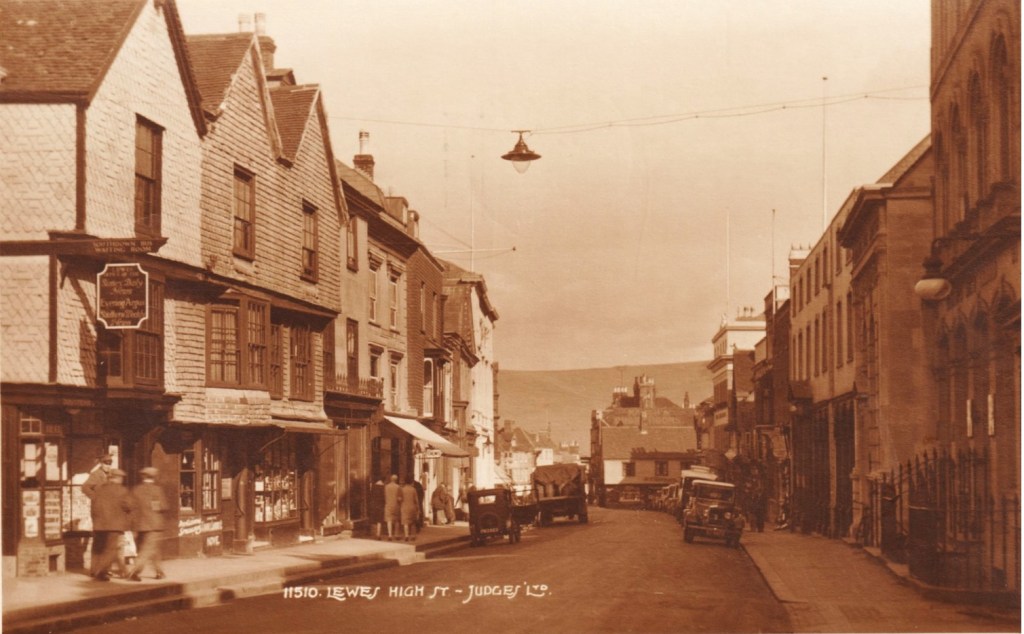
This postcard produced by Judges of Hastings features Lewes High Street in the 1930s. This copy was posted in September 1936. Parked vehicles are becoming prominent in the street scene.
In the foreground is the sign of the Southdown Bus Waiting Room, while hanging below it is the sign of the Lewes Office of the Sussex Daily News, the Evening Argus and the Southern Weekly News.
10. St Michael’s Almshouses, Keere Street
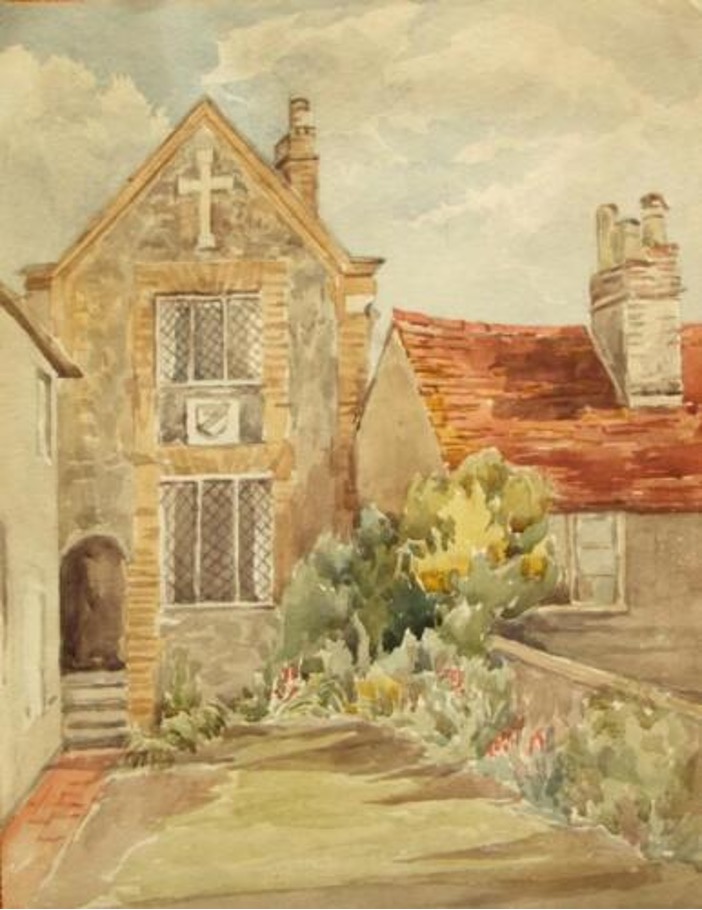
This unframed watercolour was offered for sale on ebay some years ago, with a £25 starting price. It was described by a Surrey based online art dealer as:
“H Fuller Mcclelland signed antique watercolour painting, Keere St, Lewes, 1921”
On the reverse side of the painting was written ‘Lewes, Sussex’, ‘Aug /21’ and ‘H F M’.
I can find no other evidence of an artist, or indeed a person, with the name H. Fuller Mcclelland.
The watercolour, however, seems an accomplished artwork of the Almshouses on Keere Street.
John Kay 01273 813388 johnkay56@gmail.com
Contact details for Friends of the Lewes History Group promoting local historical events
Sussex Archaeological Society: http://sussexpast.co.uk/events
Lewes Priory Trust: http://www.lewespriory.org.uk/news-listing
Lewes Archaeological group: http://lewesarchaeology.org.uk and go to ‘Lectures’
Friends of Lewes: http://friends-of-lewes.org.uk/diary/
Lewes Priory School Memorial Chapel Trust: https://www.lewesprioryschoolmemorialchapeltrust.org/
Facebook: https://www.facebook.com/LewesHistoryGroup
Blue Sky: @leweshistory.bsky.social