
Please note: this Bulletin is being put on the website one month after publication. If you would like to receive the Bulletin by email as soon as it is published, please contact the Membership Secretary about joining the Lewes History Group, and to renew your membership at the start of the calendar year.
- Next Meeting, Monday 13 April: David Smith ‘Lewes through the eyes of a flint knapper’
- Poster appeal (by Jane Lee)
- Home Guard training (by Ian Hilder)
- Lewes Postcards on Ebay
- The Detention Barracks, Lewes
- 6. Charles Aspull Wells and the Etna Ironworks (info from David Joyce)
- Next Meeting 7.00 p.m. for 7.30 p.m. Monday 13 April
David Smith Lewes through the eyes of a flint knapper
David Smith, perhaps better known as ‘The Flintman’, has been working in Lewes and the surrounding area for more than twenty years (see www.flintman.co.uk). His talk will be a brief look at the history of flint, its use and its versatility as a building material. With local references, the talk will also look at how flint has given Lewes its local distinctiveness. This includes looking at the good, the bad and the unusual. As well as many visual images, the talk will include a demonstration of the art of flint knapping.
As usual the meeting will be at the King’s Church building, Brooks Road, and all will be welcome. Coffee and biscuits will be served from 7 pm.
- Poster appeal (by Jane Lee)
Do you have a window that faces the street?
Would you be prepared to put up an A4 poster advertising the LHG talks each month?
If so, it would be really helpful for spreading the word about what we do.
Please email leweshistory (at) gmail (dot) com and I will get in touch.
- Home Guard training (by Ian Hilder)
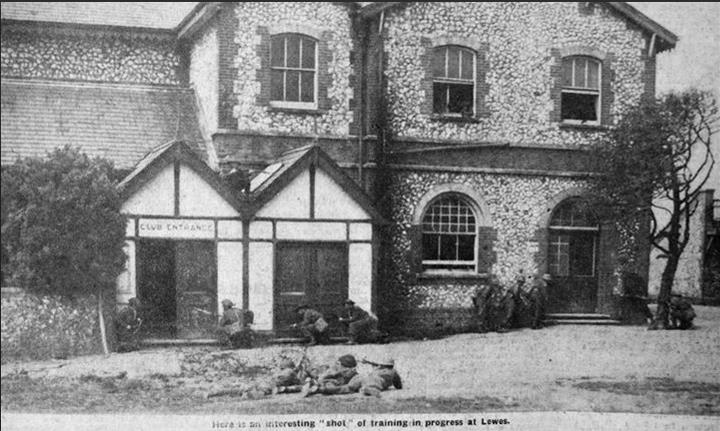
I am trying to identify the building in this Sussex Express wartime photo of a Lewes Home Guard mock attack. A clue is that the left-hand door has the words “Club Entrance” above it. Suggestions to date include the back of Lewes Grammar School, or alongside the wall of Lewes Prison. Any other ideas to hildergen (at) aol (dot) com.
- Lewes Postcards on Ebay
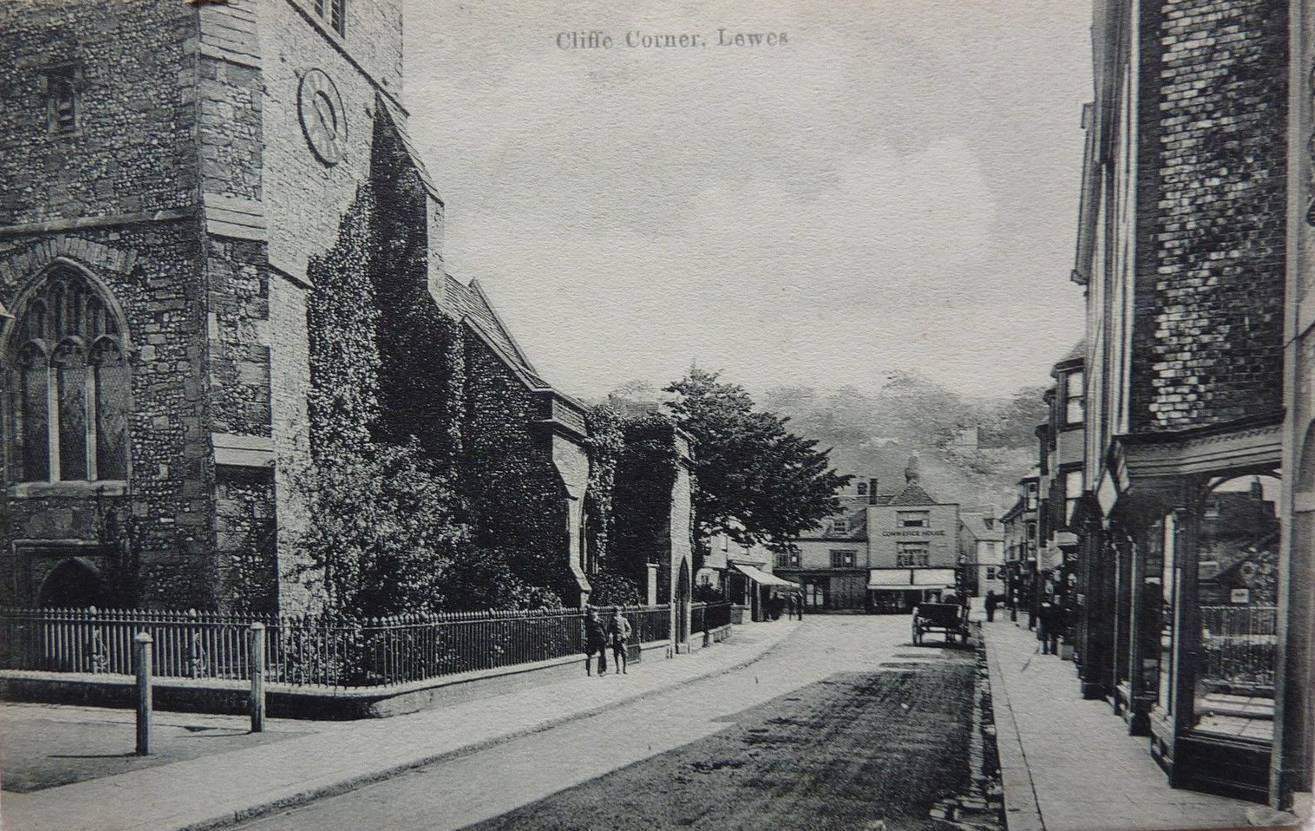
This postcard of Cliffe High Street looking towards Cliffe Corner carried a 1905 postmark
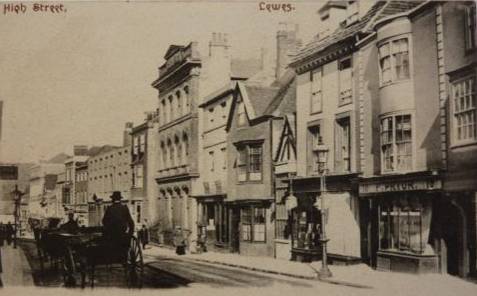
This postcard is in the distinctive style of the Mezzotint Company of Brighton, but on the reverse states it was published by the Lewes High Street stationer A. Addison
- The Detention Barracks, Lewes
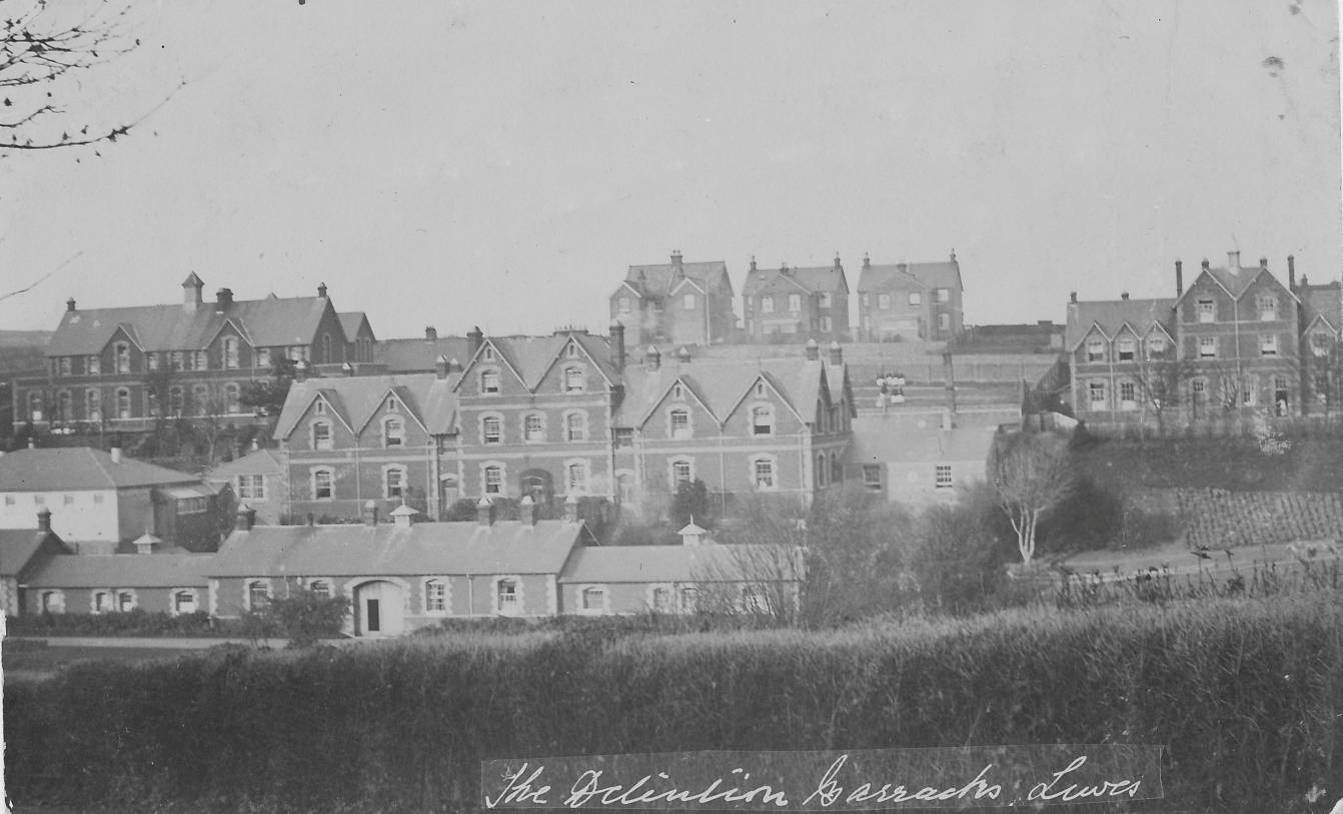
This postcard showing the old Lewes Union Workhouse, called at this date ‘The Detention Barracks, Lewes’, was dated 16 April 1916 and sent to a serving soldier at the front. The recipient was presumably one of the ‘gunners’, probably the Lewes Territorial Company of the Royal Garrison Artillery. The card was evidently sent in an envelope, and the message reads:
“So glad to receive P.C. for I have now heard from all the gunners except Mr Cox. Will send a “letter” as soon as I get one! I often hear from your wife, in fact, we find we have many interests in common, and I look forward to, and love, her letters. Was very pleased to hear of your new “billet” & send my best wishes for continued health and good luck. Do you remember this picture? I don’t think I shall ever forget it. I had a letter from Gilbert about three weeks ago: he does not find Salonica very “lively”. We are all well at home & glad the spring is coming. Hope to have a letter next time. Yours sincerely, Annie Hall”
- Charles Aspull Wells and the Etna Ironworks (information from David Joyce)
David Joyce raised a question at our January meeting about the history of the Riverside Centre (1 High Street), which he identified as having been the Etna Ironworks run by Charles Aspull Wells until he went bankrupt, and assigned the business to creditors, in 1891-3.
According to an obituary Charles Aspull Wells was born in Lewes and lived in the town for his whole life. He was baptised at St Michael’s, the son of Charles Samuel Wells and his wife Harriett, on 27 March 1827. In 1842, when he left school, he went to work for the Lewes ironmonger Henry Attwood Thompson, working both in the workshops and in the office. It was Charles Wells who prepared their catalogue when the firm exhibited its wide range of agricultural implements at the Royal Agricultural Society’s 1848 Show at Lewes. The 1861 census identifies Henry Attwood Thompson as an ironmonger aged 45, from Hadley, Shropshire, and employing 22 men and 5 boys. He was a widower aged 45, with his sister as housekeeper and also a domestic servant. The census sequence indicates that they lived on the High Street at, or very close, to 1 High Street. In this census Charles A. Wells lived in East Street, also in All Saints parish. He was described as an ironmonger’s clerk aged 34, with a wife Anna, two young children and a teenage servant.
In 1869 Charles Wells took a 14 year lease of a house, workshop and factories near the bridge in Lewes, identified on a plan, from the trustees of Henry Attwood Thompson, who was by then a lunatic. He remained there until the business went bankrupt over 20 years later [ESRO Acc.5902/1]. The 1881 census shows Charles Aspull Wells aged 54, born in Lewes, living at 1 High Street, Lewes, as an ironmonger, engineer and founder employing 16 men and 1 boy. His wife was from London, and they were accompanied by 4 children aged between 22 and 5 and two domestic servants. His 22 year old son, Charles Richard Wells, was described as an agricultural engineer and machine maker. Charles Wells of the Etna Ironworks advertised a range of agricultural machinery for sale, and by the 1880s he seems particularly to have specialised in dairy equipment for the many small dairy farms in the area around Lewes who served the London market via the Glynde Creamery. However, he also had wider interests, advertising in the Sussex Express in 1888 as an electrical engineer who was the Lewes agent for the New Telephone Company, under license from the Postmaster General. From 1881 he was a councillor on Lewes Borough Council, chairing its finance committee in 1885. His memorandum book survives in The Keep [ESRO/DL/D/149].
The Etna Ironworks survived his bankruptcy, but had to move its base. In 1892 a ‘very desirable freehold residence’, 219 High Street, was advertised for sale in the Sussex Express. This is today the address of W.H. Smith’s shop, and must then have been pretty well buried in the side of the railway embankment where it ran across the High Street. In May 1896 Charles Aspull Wells, engineer, of the Etna Ironworks, gained planning permission for a new shop front there. An 1899 directory describes Charles A. Wells, A.I.E.E., as a mechanical and electrical engineer, ironmonger and agricultural implement maker at the Etna Works, 219 High Street. The 10 August 1901 Sussex Express reported the death of the wife of Mr Charles Wells of the Etna Works, ‘our esteemed townsman’. His own death occurred suddenly on 6 April 1904, at the age of 78. C.A. Wells & Co, electrical and mechanical engineers, Etna Iron Works, survived his death, and appear in local directories at 219 High Street and Eastgate Wharf until 1915, with one of his sons, Herbert Henry Wells, also listed at 219 High Street as an insurance agent. 219 High Street became a clothing store in 1916, but C.A. Wells & Co continued to be listed at Eastgate Wharf into the 1930s. In 1916 H.H. Wells, electrician, was listed at 6 Albion Street.
Both Charles Wells’ premises went on to become motor garages. The Riverside building was the Ouse Engineering Works in 1906 and became Martin’s Motor Garage and Repairing Works by 1910. 219 High Street served as Mansfield’s Lewes branch, selling Fords in 1927 but Vauxhalls in the 1940s and 1950s.
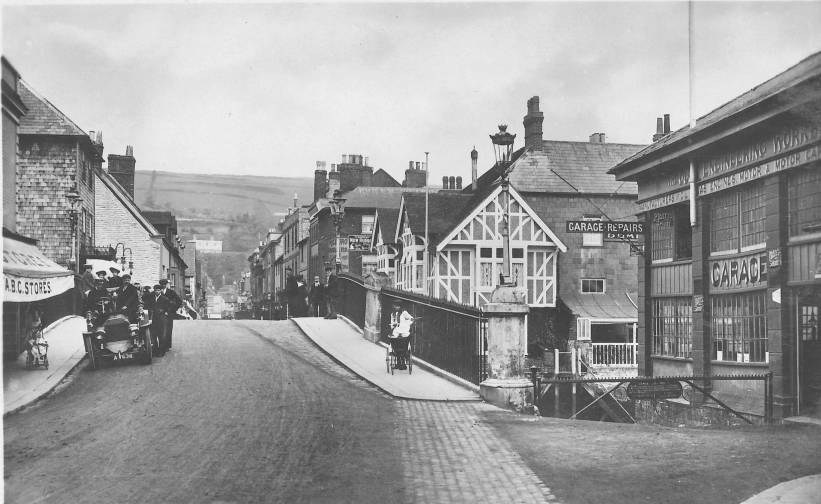
Martin’s Garage, at 1 High Street, is shown in the right foreground of the early 20th century postcard above, while a predecessor can be glimpsed behind the tree in the 1781 drawing by James Lambert in the ESRO collection (below).
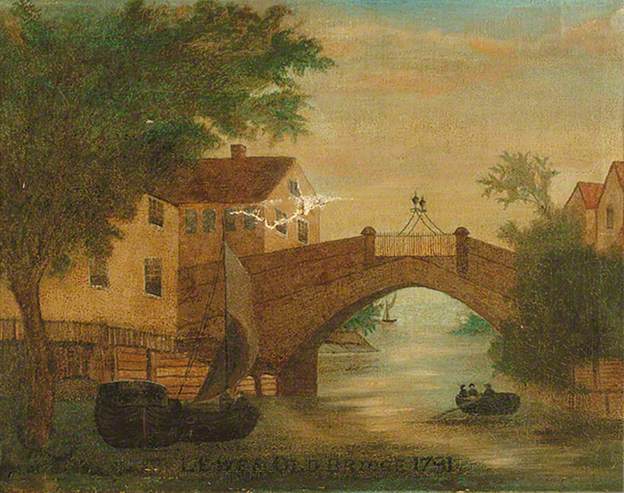
Lewes Old Bridge, painted by James Lambert I, 1781
http://www.bbc.co.uk/arts/yourpaintings/artists/james-i-lambert
David Joyce provides additional information from the 1869 lease. The property comprised a dwelling house, shop, show rooms, foundries, factories, buildings, land and premises. The land and wharf called Friars Wharf were in the parish of All Saints, Lewes, and bounded as follows:
- North to the town wharf;
- East to the river Ouse;
- South partly to a building and premises called the Viper Store and partly to the tramways and railways;
- West partly to the said tramways and railways and partly to the occupation road leading from Leighside to the High Street.
David concludes from a plan with the lease that the dwelling house, 1 High Street, was that now Forfars the bakers, and that the Etna ironworks extended as far down river as the Viper Store. In 1839 Burwood Godlee of Leighside erected a suspension bridge to cross from the Viper Store to his Cliffe warehouse in Bear Yard.
John Kay
Contact details for Friends of the Lewes History Group promoting local historical events
Sussex Archaeological Society
Lewes Priory Trust
Lewes Archaeological Group and go to ‘Lectures’
Friends of Lewes
Viva Lewes
Facebook: https://www.facebook.com/LewesHistoryGroup
Twitter: https://twitter.com/LewesHistory
–




 Lewes History Group