1. Next Meeting on Monday 14 May 2012: ‘Lewes Clockmakers and their Clocks’
2. Research Group meeting, Monday 23 May 2012: Lewes street histories
3. Windover Crescent
4. William Hooker of Lewes, clockmaker
5. Bryan Hart’s story: Evacuated to Lewes. Chapter 2, Castle Banks
6. A Spritsail Barge at the Southerham Cement Works
7. Wallands Park
1. Monday 14 May 2012, 7.30 p.m. at the King’s Church building (main hall)
Marion Smith & Bill Bruce: ‘Lewes Clockmakers and their Clocks’
Marion Smith, one of our members, has been researching the remarkable number of clockmakers based in Lewes, while Bill Bruce is an expert on the clocks and watches they produced. Many people will be familiar with Bill Bruce’s specialist shop selling antique clocks on North Street, just opposite the top of East Street – one of the most fascinating independent shops in the town.
2. Monday 21 May 2012, 7.30 p.m. at the King’s Church building (meeting room)
Research Group meeting on ‘Lewes Streets’
Lewes History Group members have the opportunity to contribute to a ‘Lewes Streets’ section of the BBC-sponsored Lewes History Day, to be held in late June, and this will also be a theme for one of our autumn meetings. If you are one of the people interested in studying a specific part of Lewes, please try to attend this meeting.
3. Windover Crescent
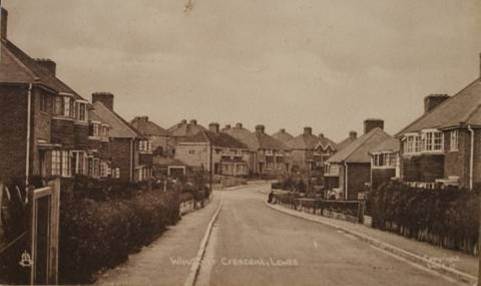
This Raphael Tuck postcard showing Windover Crescent, on the Neville Estate, was offered for sale on ebay in February 2011. The postmark is illegible, but the card carries stamps to the value of 2d from the reign of King George VI. Note the absence of cars.
4. William Hooker of Lewes, clockmaker
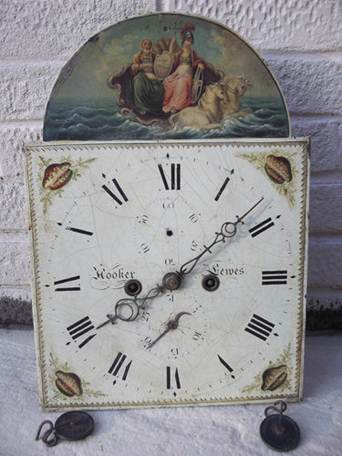
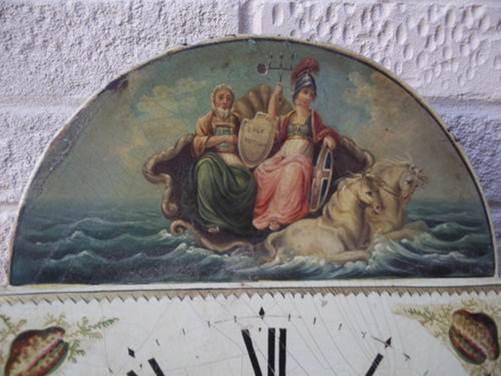
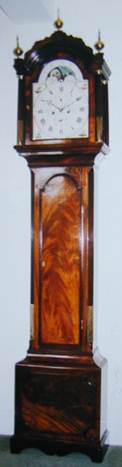
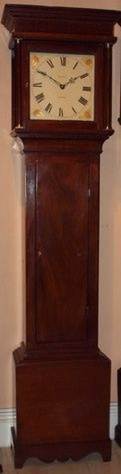
The clock movement below (left) by William Hooker of Lewes (clockmaker 1803-1832) was advertised for sale on ebay in April 2012. It was described as an 8-day long case clock movement, with a dial, featuring Britannia, painted by Walker & Hughes of Birmingham. Another, rather grander-looking, clock by him is shown to the right, and an 1820 clock with a plainer case below. There is a 30 hr longcase clock by him in the British Museum collection. The Museum catalogue gives his address as Cliffe High Street.
5. Bryan Hart’s story: Evacuated to Lewes. Chapter 2, Castle Banks
Miss Hunter lived in an old terrace house at the bottom of Castle Banks. Nearby, on White Hill, was a small grocer’s shop and just around the corner in Mount Pleasant was a stonemason’s yard where headstones for graves were made. The house was built on three levels. Care was needed on entering it, particularly in the dark, because there was a flight of stairs just behind the front door that fell away steeply to the floor below. At the bottom of the stairs, on the right, was a small kitchen. There, in the stillness of the evening by the light of an oil-lamp, we would munch our supper biscuits and sip cocoa before going to bed, two flights up, by the light of a candle. The shadows cast by the lamp and the flickering of the candle flame produced an unfamiliar air of mystery. In our house in Croydon gas mantles had been replaced by electric light bulbs for lighting in 1935. Opposite the kitchen, on the other side of the stairs, a short passage led to an outside lavatory which had to be flushed using a bucket of water.
Miss Hunter was a dumpy, middle-aged lady with spectacles and a pudding-basin haircut. Claiming to have been a nurse in the Great War of 1914-1918, she was good-natured but inclined to be strict. We were made to understand that if any one of us was careless enough to fall over and cut his knee while playing outside, then he would have one sausage less on his dinner plate that day. She was also a trifle eccentric. If she was riding her bicycle and it started to rain she would still unfurl her umbrella as she careered along.
Our early schooling in Lewes was in two establishments, the Pells School and the British School. Miss Hunter’s house was conveniently located for both and for buying toffees in Mr Pelham’s sweet shop at the comer of St John’s Terrace. Our school, shared classrooms at the Pells. We would occupy the rooms for one part of the day, the morning for example, and the Pells pupils would occupy them for the rest of the day. The British School in Lancaster Street was situated next door to the Little Theatre and opposite the Naval Prison. Inside a corrugated fence at the front of the school was a dirt playground and around its edges were patches of soil that we tended with hoes and rakes before planting seeds.
At lunch-time we would stand outside the fence and watch the soldiers stationed in the prison practicing drill on an artillery gun placed outside a gate. Just in front of the Little Theatre was an air-raid shelter. In air-raid practice we were all expected to line up and march to the shelter carrying our gas masks and “tins”. Biscuits, in tins sealed with sticky tape, were meant to stave off the pangs of hunger if we had an extended stay in the shelter, but the temptation was too much for some boys and tins were opened before the intended event. Sometimes, when we were sharing classrooms, our teachers took us on long healthy walks in and around the town. During walks along the footpaths, and through the fields, by the river we were given lessons on “nature studies”. When it came to walks in the woods, some of those trailing at the back would prefer to “get lost”, i.e., hide behind trees and take a short cut home, rather than learn about such things as the shape of a sycamore leaf.
On historical trips we clambered up Cliffe Hill to see the Martyrs’ Memorial and up to the Race Hill to learn about the Battle of Lewes. A teacher told us the date and how to remember it. The gist was as follows. “Its twelve sixty-four. Remember, there are twelve pennies in a shilling. Divide by two and what do you get? That’s right, six. Now divide by three and you get four, so it’s twelve-six-four.” That magic formula never left me. After being told about the battle we were divided into two groups. The King’s Men and Simon De Montfort’s Army and encouraged to re-enact it, but this time without loss of life.
Apart from homesickness, my brothers and I were not unhappy at Miss Hunter’s, but when Mum and Dad came down to visit us they were upset with our accommodation and demanded to see the chief billeting officer. Another foster-home was speedily arranged and, after only a few weeks stay with Miss Hunter, we were off to stay with Mr and Mrs Weller on the Landport Estate. There were no leaving presents this time and, to make matters worse, the heads of my Red Indian Braves had to be secured to their bodies with matchsticks.
Source: WW2 People’s War is an online archive of wartime memories contributed by members of the public and gathered by the BBC. The archive can be found at http://www.bbc.co.uk/history/ww2peopleswar/, Article ID: A7223096
6. A Spritsail Barge at the Southerham Cement Works
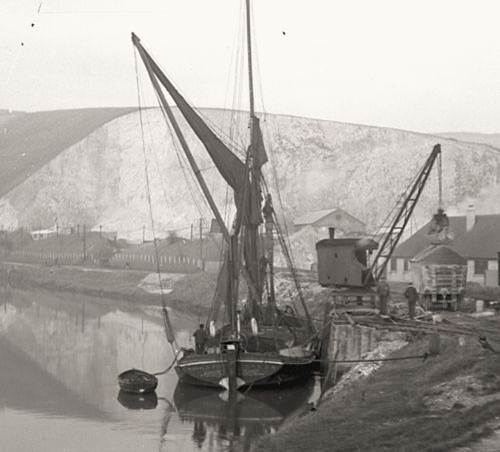
This image from a glass negative shows the spritsail barge ‘Ronald West’, at the cement works on the River Ouse. The ‘Ronald West’ was built in Kent in 1903, and owned by Londoner Samuel West.
Source: this negative was advertised for sale on ebay in February 2012.
7. Wallands Park
“The town [Lewes] was for a long time in a stationary position, and the population did not increase; but of late an impetus has been given to the building trade. Some excellent houses have sprung up, and it is believed that in a few years Lewes will be second to few towns near the South Coast, especially should Mr W.E. Baxter’s project for a new suburb, “Wallands Park”, be carried out. The natural and artificial advantages of the town are very great indeed.”
Source: Mark Antony Lower, ‘History of Sussex’, vol.II, p.26 (1870)
John Kay
–