1. Next Meeting on Monday 9 July 2012: Chris Swarbrooke, ‘The monuments of St John-sub-Castro churchyard’
2. St John-sub-Castro churchyard
3. St John-sub-Castro Church
4. The Schools of Lewes, from the 12th century to the 21st century
5. Hazards of life
6. Bryan Hart’s story: Evacuated to Lewes. Chapter 4, St Peter’s Place
7. St Peter’s Place
8. Landport Bottom in the 20th century
9. Providence Baptist Chapel, Lewes
1. Monday 9 July 2012, 7.30 p.m. at the King’s Church Building, Brooks Road
Chris Swarbrooke: ‘The monuments of St John-sub-Castro churchyard’
St John-sub-Castro churchyard is one of the hidden glories of Lewes. Those who have heard John Bleach or Prof John Blair talking about the early history of Lewes will know that there is much more to this important early site than is yet understood, but Chris Swarbrooke is an expert on the more recent history of the town, and in particular the people remembered in its churchyards. Chris studied St John’s Sub Castro Churchyard between 1999 and 2006, together with a group of trainees from the East Sussex Archaeology & Museums Project. They surveyed, recorded, photographed and transcribed all of the tombstones situated within the church and churchyard. Some areas of the churchyard were very overgrown and much work had to be carried out to initially locate the tombstones and then clear the undergrowth and tree saplings in order to be able to transcribe the epitaphs and then photograph the monuments.
Transcription of the Burial registers of St John-sub-Castro (1602 – 1993) showed over 8,000 burials were recorded, while the final plan of the churchyard shows 766 graves with some kind of monument – of which only 11 refused to give up an inscription. As usual all will be welcome.
2. St John-sub-Castro churchyard
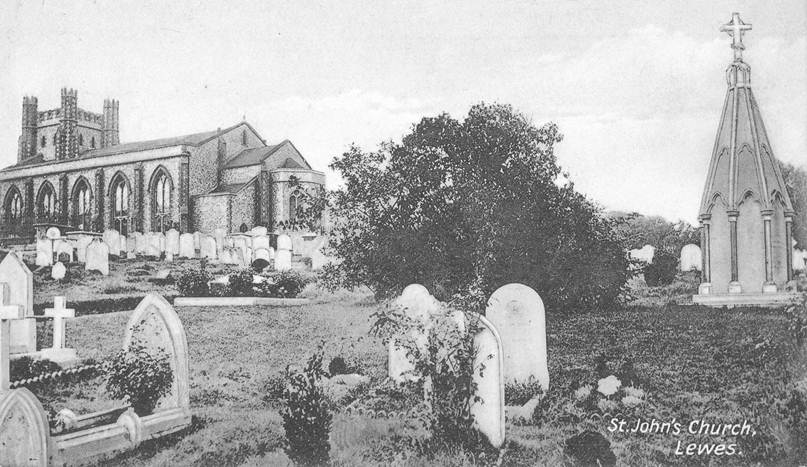
This postcard showing St John-sub-Castro churchyard was in the Chester Vaughan series. The card was never posted, and Chester Vaughan are a national rather than local producer, but their other cards identifiable by Google are all Edwardian. Today the churchyard is less managed than it was a century ago.
3. St John-sub-Castro Church
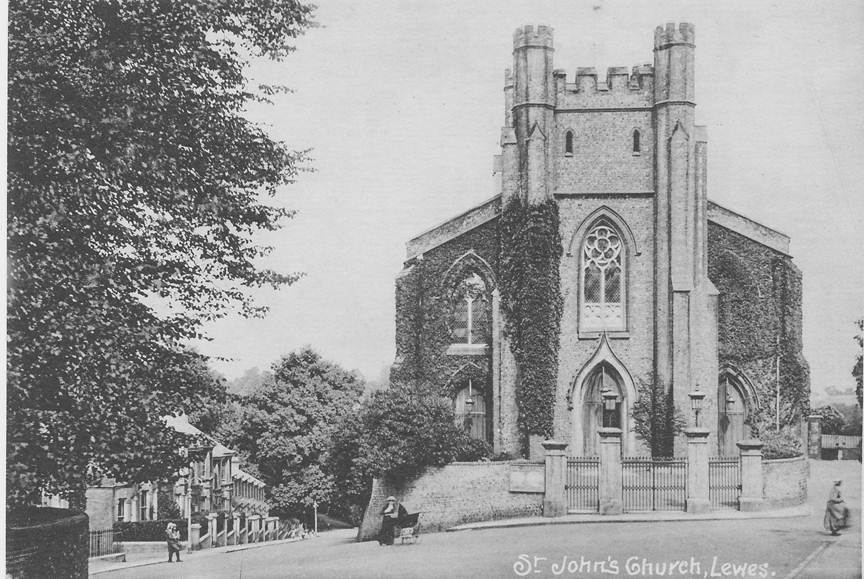
“St John’s Church is a modern brick structure, which we cannot commend, as it is a kind of hybrid between a castle and a barn. It supersedes a very venerable structure, probably of the time of the Confessor, which was pulled down in 1838 to meet the necessities of an increased population.”
Source: Mark Antony Lower, ‘History of Sussex’, vol.II, p.24 (1870)
Chris Swarbrooke adds: The present church, built in 1839, and was constructed on a North – South axis, whilst the old church was in the usual East – West orientation. Its nave dated back to the Saxon era. It was the oldest part of any church still standing in Lewes and may well have been built about the time of King Alfred. On the outside wall of the old nave was a unique plaque in Latin dedicated to Prince Magnus of the Royal House of Denmark who became an anchorite here in Lewes. This medieval Lombardic inscription was later incorporated in the wall of the new Church. The rest of the old church was built on the Saxon foundations in medieval times. The area of the churchyard formed an entrenched angle in the town’s medieval defences and is believed to be part of the Earthworks of a Roman fort built to guard the old river crossing.
4. The Schools of Lewes, from the 12th century to the 21st century
‘The Schools of Lewes’ by Brigid Chapman is a 96 page paperback published by CGB Books at £8.99. From the twelfth century when the Cluniac Priory of St Pancras was founded in Southover by William the Conqueror’s brother-in-law William de Warenne, Lewes has had an interesting mixture of educational establishments. One of the first free grammar schools in the country opened here in 1512 and continues today as an independent school. There have been business and classical academies for young gentlemen and boarding establishments offering a ‘polite education’ for young ladies; charity schools; Dame Schools; Quaker boarding schools; day schools; a British School; a Ragged School; training schools; a Mechanic’s Institute; and any number of Church of England National Schools.
However, until now there has been little in print about them. The Rev Thomas Walker Horsfield has a few words to say about the Free Grammar School in his ‘History and Antiquities of Lewes’, published in 1824 but makes no mention of his own boys’ boarding school in St Anne’s parish. Historian Mark Antony Lower, one of the founders of the Sussex Archaeological Society, was equally reticent about his ‘English and Continental boarding school’ at St Anne’s House from 1855-1868. Only in the trade directories of those days and advertisements in the county’s first newspaper, the Sussex Weekly Advertiser or Lewes Journal was there any information about the thirty or more private and charity schools that there were in Lewes before the introduction of state education.
This new book is the story of those schools, and the ones that followed them up to today. Lewes has its independent Old Grammar School; Lewes New School, which may soon become a ‘Free School’; five primary schools; a comprehensive and a college. The book also notes who went to them – John Evelyn was at the grammar school in 1630; Camilla, Duchess of Cornwall at Southover Manor School in 1958; and Piers Morgan at the Priory Upper School in 1981 – and the subjects taught in them, from the days when all lessons were in Latin to the computerised classrooms of today.
‘The Schools of Lewes’ is available from Barbican House Bookshop 169, High Street, Lewes BN7 1YE, or direct from CGB Books, Flat 4, St Thomas Court, Cliffe High Street, Lewes BN7 2AW.
5. Hazards of life
Detailed records of many coroners’ inquests have disappeared over the years, but the expenses claims of the East Sussex coroners contain enough information to reveal a little of the common hazards of life in Georgian Lewes. The following are a selection of local inquests. The coroner claimed £1 for each inquest held in the immediate Lewes area, but larger sums when he had to travel. Findings of lunacy were significant – a suicide whose mind was disturbed was permitted Christian burial in a churchyard, but otherwise burial would be in unconsecrated ground, often at a crossroads.
| 21 May 1804 | Lewes. Samuel Brown, a gunner in His Majesty’s Royal Regiment of Artillery, being lunatic hanged himself. |
| 15 Sep 1804 | Lewes New Barracks. George Horp, infant, accidentally fell into a tub of water and was drowned. |
| 2 Dec 1804 | South Malling. Ann Hopper accidentally fell into the Ouse and was drowned. |
| 11 Jan 1805 | South Malling. John Berry accidentally fell into a chalk-pit and was killed. |
| 19 Mar 1805 | Lewes. Abraham Morris junior accidentally killed by some deals falling on him from a wagon. |
| 28 Mar 1805 | Lewes Barracks. Mr Robert Marshall died of excessive drinking. |
| 30 May 1805 | Lewes. John Jordan, agreeing to fight with Thomas Dykes, was killed by a blow received in the fight. [The coroner received a further fee at the subsequent assizes] |
| 13 Nov 1805 | St Michael’s, Lewes. Joseph Drawbridge, infant, poisoned by eating some paste prepared for killing mice. |
| 28 Apr 1806 | Westout in Lewes. Anne Potter, infant, accidentally killed by the wheels of a carriage used for breaking stones going over her head. |
| 13 Jun 1807 | Lewes House of Correction. Solomon Lovell, infant, being in the House of Correction with his mother for nurture, died a natural death in convulsion fits. |
| 13 Jul 1808 | Near Lewes. Richard Dix, a corporal in the 10th Regiment of Light Dragoons, accidentally drowned bathing in the Ouse. |
| 8 Aug 1808 | Cliffe. Mary Might, being lunatic, hanged herself. |
| 14 Aug 1809 | Cliffe workhouse. Francis Dunford being lunatic, hanged himself. |
| 11 Oct 1810 | Lewes. John Homar was killed by John Carter, who fired a pistol loaded with small pieces of lead at him. |
| 25 Oct 1810 | Lewes. Samuel Ridge, being lunatic, shot himself. |
| 27 Dec 1810 | Lewes. Ann Parsons, infant, accidentally burnt to death by her clothes taking fire. |
| 29 Jan 1811 | South Malling. William Winter accidentally killed while repairing a well at Mr Marchants by the coulter of a plough falling into the well on his head. |
| 16 Jul 1811 | Cliffe. George Wilbar died by the visitation of God, in a natural way. |
| 28 Sep 1811 | Lewes. John Ventham Grigg feloniously killed by John Kennard. |
| 26 Mar 1812 | Glyndebourne. Richard Wood, servant to the Revd. Mr Tutty, murdered himself by shooting himself with a gun. |
| 17 Aug 1812 | South Malling. Sarah Gower accidentally fell down a precipice and was killed. |
| – Jul 1815 | Lewes. Elizabeth Molineux, being lunatic, threw herself into a well and was drowned. |
Verdicts that suicides were lunatics were important – at this date such unfortunates could be given Christian burial in a churchyard, while those who “murdered themselves” while of sound mind could not be buried in consecrated ground.
Source: R.F. Hunnisett (ed), ‘East Sussex Coroner’s Records, 1688-1838’. Sussex Record Society, vol. 89, 2005.
6. Bryan Hart’s story: Evacuated to Lewes. Chapter 4, St Peter’s Place
Mr and Mrs Collingham and Mr Collingham’s son David lived in a Victorian house at the far end of St Peter’s Place. The lavatory was outside in the garden, close to a railing-topped wall that overlooked Paddock Lane. Each day milk was delivered to the doorstep, but not in bottles. The milkman ladled the milk from a chum into gill and pint size lidded metal containers left outside for that purpose.
At the beginning of our stay, Mrs Collingham busied herself as a housewife and Mr Collingham worked on a mobile shop. This was a van with sides that opened up to reveal groceries, items for domestic cleaning and paraffin for the oil lamps used in house lighting.
Mr Collingham was an amiable man who would let Maurice clean his rifle for him for those evenings that he was on duty with the Home Guard. Mrs Collingham’s attitude towards us seemed to change when her husband was called up for service with the army. We had to be out of the house when Mrs Collingham was at the part-time job that she had started and as often as possible when she was not at work. When we were in the house she was subject to fits of irritability that could be frightening. On one occasion we had done some shopping for her at the Co-op but had left the ration books behind by mistake. This annoyed her and we rushed out of the house to retrieve them. In so doing I slipped on the front step and ended up with a badly chipped front tooth as my face struck the pavement.
On another occasion Mrs Collingham had, unusually, left us at home while she popped out on some errand. When she returned she had reason to visit the food cupboard in the room where we had our meals and spent most of our time while in the house. To her consternation she discovered that one of the tasty rock cakes that she had recently made and stored in a white enamel bin, was missing. Furious and determined to mete out punishment, she decided that the thief must be David, a lad of my age. As she smacked him and he cried out, I came to know the meaning of guilt and cowardice because it was I who had felt hungry, while she was out, but was too afraid of her anger to own up. As growing lads we were always hungry. At tea-time I would make a visual count of the number of slices of bread on the plate in the middle of the table and divide it by the number of people sitting down in order to work out the ration and how fast to eat it.
Each Saturday morning we waited at the comer of the road for the postman to deliver our pocket money from Mum and Dad in the form of 6d postal orders. Some of this was spent on food and some on the ‘pictures’ (cinema). On the way to school, hot rolls from the small baker’s shop near the top of Keere St. (or Keere ‘Hill’ as we preferred to call it, on account of its slope) were always a delight. The man who served us had a foreign accent, so in our childish imaginations he was a German spy. One day we bought a freshly baked loaf from the baker’s shop just around the comer of St Peter’s Place and took it into the cinema with us. There, we three brothers, sitting in a row, proceeded to hollow out the soft doughy interior of the loaf and stuff it into our mouths as we watched the film. That was at the Cinema de Luxe on School Hill. It was managed by Mr B., a stout man with a commanding voice, who was irreverently known to children as ‘Fatty B’.
We loved the adventure films we saw there, such as ‘They Died with Their Boots On’, ‘Sanders of the River’, ‘The Mark of Zorro’ and ‘Gunga Din’. The cinema was a refuge for us but it was not always easy to get in. If an air-raid warning had been sounded we were only allowed in if accompanied by a ‘grown-up’, so this meant hanging about outside till an accommodating adult yielded to the plaintive plea, ‘Would you take us in, please Mister?’
On Saturday afternoons there would be screams of excitement from the children in the 4d seats at the front of the cinema as the lights went down at the start of the programme. Then, some of those sitting in the end seats of a row would pad up the aisles on all fours to the more expensive 7d seats at the back. However, the management became aware of this manoeuvre and usherettes’ torchlight’s would seek out the errant children, like searchlight beams directed at the enemy aircraft, and the children would be escorted back to their seats. We also visited the Odeon cinema, where memorable films included ‘Sun Valley Serenade’, ‘Holiday Inn’ and ‘The Ghost of St. Michael’s.’
When not in school or at the cinema we roamed the town and soon got to know every nook and cranny of it. Our geographical knowledge of the town helped us to avoid ‘trouble’. If, for example, we needed to go through Westgate Street but a gang of boys we knew to be unfriendly was up to some mischief there, then we knew we could slip down Pipe Passage instead.
Curiosity was a driving force in our out-of-school activities. We rushed up to see a German biplane, said to contain mail, when it landed in fog on a patch of grass near the prison. Later on, we hurried to the race course to see a British fighter plane that had crashed upside down. Anything to do with the military was interesting to watch, whether it was army lorries, with their regimental insignia proudly displayed on their front mud guards, struggling to get up School Hill or the Bren-gun carriers that drove up and down the lower part of Keere St.
At that time soldiers of a Canadian regiment. Princess Priscilla’s Canadian Light Infantry, were billeted in the Grange and troops also occupied Lewes House on School Hill. In the space outside the house was a wooden board fixed to a post and in the centre of the board was a small square of coloured material which was supposed to change colour in the event of an enemy gas attack. We glanced at it with curiosity each time we passed.
Sometimes, boyhood daring combined with curiosity in prompting outside pursuits. One day, Ronald and I were climbing a tree near St. Pancras School when he fell on top of me, bounced off without dislodging me, and narrowly missed a set of spiked railings near the bottom of the tree. Fortunately, he fell on soft ground and was only slightly bruised.
When we inspected an air-raid shelter in Baxter’s sports ground, over the wall from Paddock Lane, I decided to investigate the emergency exit at the far end of the shelter. Climbing some wooden steps I lifted up a cast iron cover that sealed the exit and glanced around like a submarine commander scanning the surrounding area. Unfortunately, I broke the iron cover as I lowered it clumsily back into its initial position so we made a speedy exit from the ground. More innocent activities were play in the hayloft of some stables in Nevill Road and on the swings and slide in Winterbourne recreation ground.
On a Sunday there was little to do outdoors and we atoned for our weekly ‘sins’ by going to St Anne’s Sunday School in the morning and to the Wesleyan Sunday School, next door to Rugg’s garage in Station Street, in the afternoon. For our conscientious attendance at both of these places we were each presented with a book. Sometimes we would squeeze in a visit to church as well as Sunday School.
Occasional treats were visits to some of Mrs Collingham’s friends. One of them lived on a farm down a lane at Barcombe Mills and a visit there gave us a first keen impression of life on a farm. Another friend of Mrs Collingham was a maid who worked in ‘The Deanery’. This was a fine country estate situated just across the river. It was accessible via a private white suspension bridge that spanned the river. Normally, the gate on the public-footpath side of the bridge was locked to keep out intruders, though it did not prevent adventurous lads from climbing around the fan-shaped protective railings at the side of it. On our visit we had a key, entrusted to us by Mrs Collingham who had borrowed it from her friend at the house. In the spacious kitchen we were treated by the maids to delicious bowls of strawberries and cream.
Mum and Dad came down to see us one day and stayed overnight. Among the things they brought us were some eggs, which were then rationed. When these were not served up to us for breakfast the next morning there were cross words between our parents and Mrs Collingham. Perhaps this incident had something to do with our leaving Mrs Collingham’s. Our next foster-home was to be with Mr and Mrs Arnold and their sons back at Landport.
Source: WW2 People’s War is an online archive of wartime memories contributed by members of the public and gathered by the BBC. The archive can be found at bbc.co.uk/history/ww2peopleswar/, Article ID: A7224301
7. St Peter’s Place
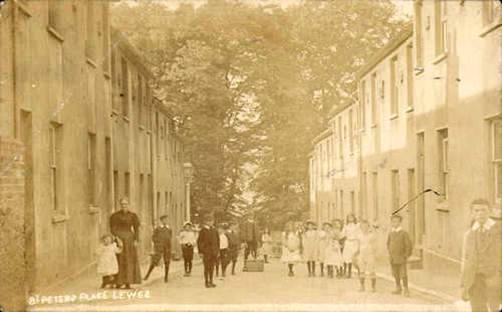
This postcard of St Peter’s Place, Lewes, off St Anne’s Hill, was postmarked in 1909 pm. The postcard was offered for sale on ebay in April 2012, with spirited bidding.
8. Landport Bottom in the 20th century (Brian Beck)
I was born on the Nevill Estate in 1929 and have lived in Highdown Road for fifty-seven years and feel that the following history of Landport Bottom might be interesting to others. This account covers the time from 1900 to the present time. Up to about 1936 I have used old maps, photos and accounts from my parents: for the subsequent years I can speak from experience.
A photograph taken just before 1900 shows the area looking south towards H.M. Prison. Corn had just been harvested and sheep were grazing over the stubble. An Ordnance Survey map dated 1911 suggests that arable farming had by then ceased. The land had reverted to a typical Southdown scene with areas of woodland, scrub and gorse, similar to the landscape that can be seen on the hills towards Mount Caburn, at Blackcap and on the Southdown Way.
Through the 1920s and 1930s Landport Bottom continued as described. Although the new part of the Nevill estate developed by the Ringmer Building Works encroached on our territory, nothing else changed. Up to 1941 there were no fences, as there were no sheep. It was mainly grass with a scattering of gorse, brambles, blackthorn and the occasional tree, including oak. There was a wood about 150 yards long by 60 yards at its widest. This remained after the Nevill Estate was completed until about 1941, and was genuine woodland, with oak and other trees for us to climb and fall from, and where we made our camps. There were worn short grass paths to different parts of the Downs and to Offham, and a route for the punters, who had come to Lewes by train for the race meetings. This latter was up to 20 yards wide and started where the allotments are. There was an old dewpond, unused except by boys as another play area. Bird life was plentiful and varied, including pheasants, partridges and skylarks. Animals included rabbits and reptiles in abundance, foxes and stoats. Wild flowers varied with location, including buttercups, cowslips, violets, daises, cornflowers and many I can’t name. In addition to the races, there were also the annual motor hill climb trials up the road to the Race Hill to watch.
This changed in World War II. In 1941, the Government ordered all available land should be turned over to food production and Landport Bottom became two corn fields. Trees, scrub and gorse were uprooted and the ploughing began. Corn crops were grown throughout the war and this continued, from memory, to the mid sixties. The farmers still allowed paths to the main destinations, and after harvesting they left enough bales of straw for the children to play with. Until the next ploughing the land was ours. We also had changing vistas throughout the year.
After that the land lay fallow and as nature took its course. It started the gradual return to a typical Southdown landscape. Scrub started to grow and the old footpaths returned, with varied animals and bird life. Residents of Lewes and particularly the Nevill enjoyed the freedom to roam, ride, fly kites and enjoy themselves without hindrance.
9. Providence Baptist Chapel, Lewes
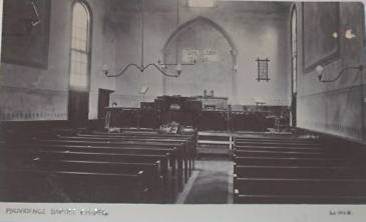
This postcard featuring the interior of Providence Baptist Chapel, Lewes, was offered for sale on ebay in February 2011.
John Kay
–