Lewes History Group: Bulletin 13, (3 August 2011)

1.   No meeting in August
2.   View over Cliffe
3.   
Lewes Water-Works
4.   
Mary Akehurst, a Quaker Wife
5.   
Gideon Mantell’s Journal: Accident in the South Street Quarry
6.   The First Lewes Railway Station
7.   
Can you name this clergyman?
8.   Lewes Bridge


1.  There is a break in the Lewes History Group programme for August

Our next meeting will be on Monday 12 September, when Lewes author Nigel Jones will speak about the Tower of London, the subject of his forthcoming book.


2.  View over Cliffe


This photograph on this postcard, titled “Cliff Bridge and High Street” was taken after the Bear Inn burned down, but before any replacement was built, perhaps in the 1920s? Cliffe High Street is already beginning to look a little inadequate for the traffic. Development on Cuilfail is underway.


3.  Lewes Water-Works

Source: Mark Antony Lower, ‘Hand-book for Lewes’ (1845)

“By an act passed 3 & 4 William IV, a company was empowered to construct reservoirs and lay down pipes to supply the town with water. The water, which is of the purest quality, is derived from a copious spring in the parish of Kingston, and immediately contiguous to Southover, whence it is forced by a low pressure steam-engine to a reservoir about 90 feet high, on the opposite eminence, for the supply of the lower parts of the town; and to another near St Anne’s Church, 150 feet high, for the accommodation of the higher parts. The management is vested in a board of Directors. Superintendent, Mr William Davey.”


4.  Mary Akehurst, a Quaker Wife

Source: David Hitchin, ‘Quakers in Lewes’, 2010, 2nd edn, including direct quotations from the Friends records.

“In this year [1659] Mary Akehurst, wife of Ralph Akehurst of the Cliff, neare Lewes, beeing moved to go to St Michal’s Steeplehouse (soe called), where an Independent priest was speaking, she for asking him a question was by people haled out, and then sent for her aforesaid husband, who after she came home, did so hunch and pincht her, that she could not lift her arms to her head.”

“The same Ralph again on the seventeenth day of the third month of this present yeare, bound the hands and feet of his said wife and pinioned her, and then covered her very hot with bed-cloathes, and soe kept her for the space of four or five hours; this it seems he did because she tooke occasion to reprove a hireling priest for belying her.”

Five months later Ralph Akehurst’s further mistreatment of his wife was reported to two Justices of the Peace (“soe called”):

“Whereas complaint hath beene made unto two of those who are in place to doe justice as, namely, Richard Boughton and Nathaniel Studly, of cruel persecution inflicted upon the body of a woman in the Clift, near Lewis, by the hands of a wicked tyrant, who is called her husband; his name is Ralph Akehurst, he hath chained his wife in a close back chamber in his house, between two high bed-steads, with a great chain much like a timber chain, containing thirty-five links, and a staple and lock, soe that this woman cannot move aboute the roome, or lye in the bed without this chaine, soe that with wait of itt it hath done much wrong to her legg, beside blows and bruises that he hath given her in executing his cruelty in putting on this chaine, soe that thereby her body is much weakened at present, and murther may ensue if the Lord by his providence doth not some way for her deliverance; for this man hath promised that he will never unlock the chaine from off her, soe that in all likelyhood his heart is bent to destroy the body of this woman someway, for he hath attempted her life, as she hath said, by endeavouring to throatle her. We set this forth to declare to the world, that if this woman shall putt off the body or sacrifice her life through his cruelty, that none shall hereafter upon just grounds say that she hath destroyed herself, or done any evil to her owne body, so that if innocent blood be shead, we shall be clear and the guilt shall remain upon the heads which suffer such things to be done.

                        Mary Akehurst, Mary Coulstock, Ambrose Galloway, Mary Dapson”

We do not know the outcome, but the refusal of Quakers to give evidence on oath may not have been helpful to the magistrates, had they been inclined to help. The subscribers’ faith in their justices was such that they also attached one copy of the letter to the door of Cliffe Church and another to the Lewes market-house.

The 1662 hearth tax shows Ralph Akehurst as having a house in Cliffe, with 9 hearths, the second largest in the parish. He died a few years later, and Mary survived to entertain William Penn at her house in Cliffe in 1672. She remained a Quaker and continued in business. Her merchant sons Ralph and Thomas imported cargoes of such items as wine, brandy, grain and pantiles through Newhaven.


5.  Gideon Mantell’s Journal: Accident in the South Street Quarry

2 July 1820: “Yesterday a man was dreadfully bruised by a large fall of chalk under which he was working in South Street quarry; I was immediately sent for, and had him conveyed to Cliffe P. House.”

3 July 1820: “The man who received the accident is much better, and will probably recover.”

Source: John A. Cooper, ‘The Unpublished Journal of Gideon Mantell’, published online only.


6.  The First Lewes Railway Station

This first photograph shows the approach to Lewes Old Station in June 1957, then used for goods, and was taken by J.J. Davis. The backs of the Friars Walk houses are to the left.

The second 1957 photograph, also by J.J. Davis, shows the first railway station in Friars Walk. Only the upper parts of the building are shown.

The final photograph, which from the cars dates from the 1960s, was probably taken shortly before the station was demolished.
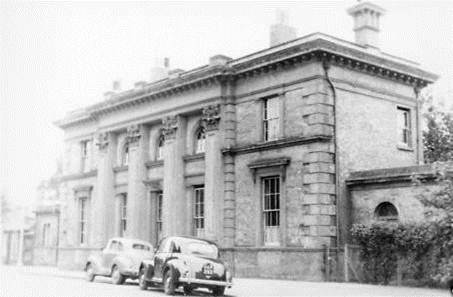
All three photographs were offered on eBay earlier this year, and attracted several bids.


7.   Can you name this clergyman?
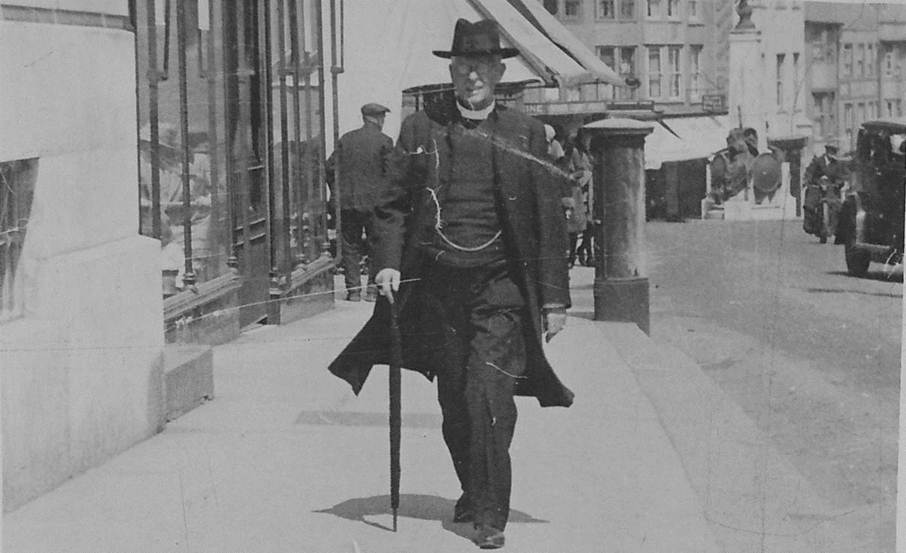
Geoff Isted purchased this photograph at Heathfield for £1.25p. It features a clergyman of distinctive appearance, with a tightly furled umbrella, walking along Lewes High Street towards St Michael’s. Does anyone recognise him? The war memorial and car in the background suggest the photograph dates from between the wars. It bears on the reverse the inscription “Leightons Cine-Snaps, Queens Avenue, Hastings”. The pillar box at the junction of High Street & Fisher Street looks to be placed at a vulnerable location.


8. Lewes Bridge

This 1781 print by William Scott, taken from the Rev Thomas Walker Horsfield’s ‘History & Antiquities of Lewes’ (1824), shows the Lewes Bridge erected in 1726, after its predecessor was swept away by a high tide. This bridge was widened and substantially rebuilt in 1932. In the 18th century the river was a much busier and more important highway than it is today.

John Kay
Posted in History of Religions, Legal History, Lewes, Local History, Transport History, Urban Studies | Comments Off on Lewes History Group: Bulletin 13, (3 August 2011)

Lewes History Group: Bulletin 12, (2 July 2011)

1.   Next meeting on Monday 11 July 2011: Sarah Hitchings & Joy Preston
2.   The Lewes Portland Cement Works
3.   Researching a Lewes Business
4.   
Lewes Gas-Light Company
5.   Lewes Quakers
6.   
Auction at the Star of the White Hart Stables
7.   T
he White Hart & The Unicorn


1.  Next meeting at 7.30 p.m. on Monday 11 July 2011

     Sarah Hitchings & Joy Preston, ‘Memories of Lewes, collected by U3A’

The Lewes U3A Oral History Project created an archive of over two hundred recordings, which is a rich resource for historians who are interested in almost any aspect life in Lewes in the twentieth century. This little known archive is accessible to the general public at East Sussex Record Office and covers a wide range of topics such as:  local shops and businesses, schools, churches, the races, clubs and societies. Joy Preston and Sarah Hitchings will introduce the project and the archive, play some extracts of the voices, and explain how to go about making use of the recordings for research. Full of the details of everyday life, as well as the way Lewes was touched by wider events such as the Second World War, this is history told and brought to life by those who experienced it.

As usual the meeting will be held in the King’s Church Building, Brooks Road, and all are welcome.


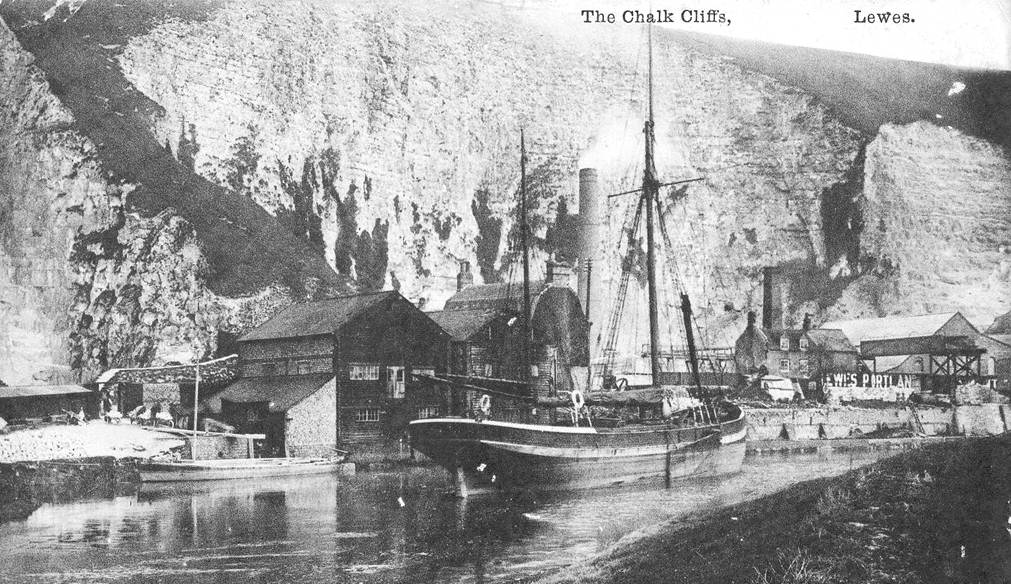
2.  The Lewes Portland Cement Works

Lewes Portland Cement Works

This postcard, showing the business Geoff Isted is researching, was mailed from Seaford to Belgium in 1920. There hardly looks room for South Street to have run along by the river bank when this was operating.


3.  Researching a Lewes Business

Towns have a range of functions, with those of Lewes over the years including fortress, seat of local government, regional social and cultural centre and commuter dormitory. However, amongst the principal roles of every market town is to be a centre of commerce for its hinterland – a market for surplus countryside produce, a source of those products that are not locally produced but must be imported and, for some products, a manufacturing centre.

The prosperity of Lewes has been largely a function of its success, or lack of success, in these commercial roles, yet surprisingly little is known about the details. To underpin a full study of Lewes commerce, we should need to know much more than we do about the various local enterprises and the people who ran them. The town’s civic leadership over the centuries has, of course, been primarily composed of successful local businessmen and professionals.

I hope that the Lewes History Group’s research projects will include such studies of individual businesses, or perhaps a small group of related businesses, such as the town’s printers, or auctioneers, or brewers. A few such projects are already underway, but we could do much more.

How would one approach a study of a business? It does, of course, depend on the business, but there are a few common questions as a first step.

When was it started, and who started it?
Where in the town was it based?
How successful was it?
What records of its operations still survive?
Are there still people with personal or family knowledge of the business?
When did it close, and why?

Is this something that might interest you? And are there local businesses, current or deceased, of which you have personal knowledge? If so, please do contact me.

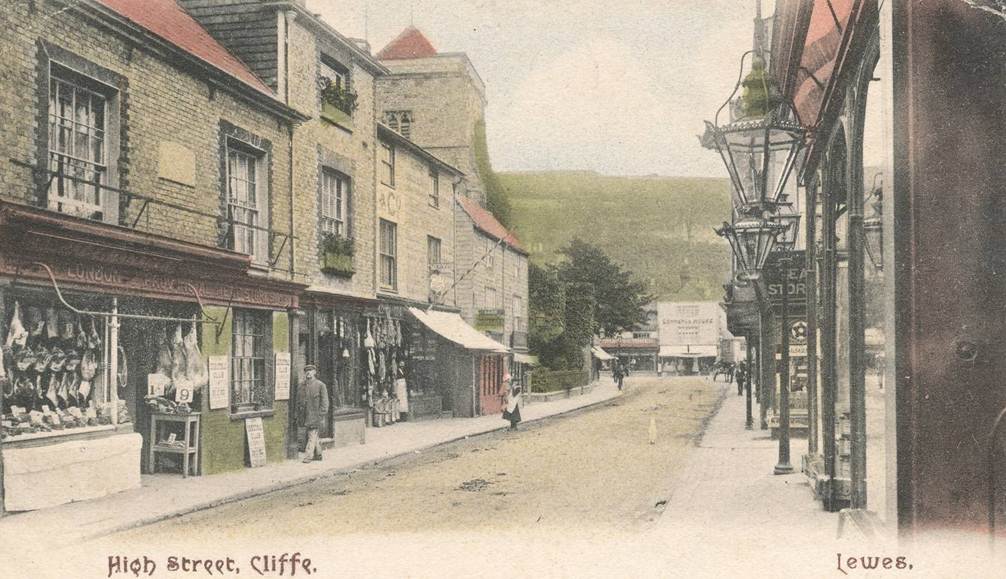
Cliffe High Street

This Edwardian postcard of Cliffe High Street by the Mezzotint Company features an impressive range of retail businesses in Cliffe High Street. The London & Provincial Meat Stores in the foreground advertises its Christmas Club, while Commerce House dominates Cliffe Corner.


4.  Lewes Gas-Light Company

Source: Mark Antony Lower, ‘Hand-book for Lewes’ (1845)

“The streets and shops of the town are lighted with gas, supplied by a company established in 1822, and incorporated in 1845. The works are situated in the Cliffe, on the bank of the river, at a short distance below the bridge. Besides being a great public advantage the undertaking is understood to afford a satisfactory return for the capital invested. Managing Director, B. Godlee, esq.”

Burwood Godlee, a prominent Quaker businessman, lived at Leighside, on what is now the Railway Land.


5.  Lewes Quakers

David Hitchin’s book ‘Quakers in Lewes’ was first published in 1984, but I have only recently become aware of an updated second edition published almost a year ago, in August 2010.

This new edition is updated and, most importantly for local historians, includes an index.

David records that in the third month of 1655 (during Oliver Cromwell’s time) Thomas Robinson the elder came to settle in Lewes and attended a Seeker’s meeting held at John Russell’s house in Southover, a house identified by Colin Brent as ‘The Croft’ in Southover High Street. There he convinced at least three people of the truth of his message. They were the tailor Ambrose Galloway, his wife Elizabeth Galloway and Stephen Eager. Soon afterwards George Fox, regarded as pre-eminent amongst the Quaker pioneers, also visited Southover on a tour through Sussex, and the Lewes Meeting was quickly established.

Even in the relative toleration of Cromwell’s rule, the Friends attracted negative attention, and carefully recorded the various verbal, physical and economic insults they received in their first few years in the town. They rejected ‘hireling priests’, and refused to attend the normal services they held in their ‘steeplehouses’ – the New Testament uses the word ‘church’ only to describe the people who followed Christ’s teaching, never buildings, and Quakers strictly followed this. They refused to pay their tithes. Although holding strict views on honesty and personal integrity, they followed a literal interpretation of Jesus’s teaching, and so refused to swear oaths, even the required oaths of allegiance to the state or in the legal proceedings in which they often became embroiled. Their evidence thus went unheard, and many languished in jail for long periods.

Their defiance of social convention also did little to endear them to their fellow townsmen. They refused to use the names of the days of the week, or the months of the year, on the grounds that many were taken from the names of pagan gods. They used ‘you’ only in its formal plural sense, when referring to two or more people. They refused to doff their hats in respectful greeting, removing them only in prayer. They were strict pacifists, at a time when Englishmen were generally in the habit of settling minor arguments with their fists. Quakers also got into trouble for refusing to enlist in, or pay for, the Sussex militia.

At first they met in private houses, but by 1675 the meeting acquired its own premises in Friars Walk, nearer to the High Street than the present Meeting House established in 1784. They maintained their distinctive manners and plain dress, and enforced strict discipline on members, but as time passed, and especially following the 1689 Act of Toleration, they became more accepted by the other citizens of Lewes. Several Quaker families became prominent in a range of businesses. One undoubted commercial asset was that their punctiliousness extended to their financial dealings – indeed any member unable to meet his financial obligations was expelled.

The Rickmans, and their relative Burwood Godlee, were the most important Lewes Quaker family in the late 18th and 19th centuries. Burwood Godlee (1802-1882) brought gas to Lewes as a young man, and ran the company for 60 years. He was a director of the Lewes Baths Association, commissioner for the town sewers, a trustee of the Lower Ouse Navigation and chairman of the Lewes Savings Bank. He endowed the British School (for non-conformists) on Lancaster Street and the new town hospital and dispensary, and he led the Quaker meeting. In 1855 he became a magistrate, and for many years he was the only non-conformist on the county bench.


6.  Auction at the Star of the White Hart Stables

On 7 August 1838 Lewes auctioneer Plumer Verrall noted in his book that he had sold at the Star Inn the horses, chaises and stable effects of the rival White Hart, by order of Mr George Wood. George Wood was, I believe, the brewer at the Cliffe’s Bear Brewery. The total proceeds amounted to £258 11s 6d. Four vehicles were offered. The White Hart fly made 46 guineas, a post chaise 26 guineas, a barouche 15 guineas, and the pony gig, including its harness, 7½ guineas

Horses were sold in guineas, with bids rising in steps of half a guinea. The White Hart sold six geldings, five mares and a black pony. The geldings were named ‘Butcher’, ‘Alderton’, ‘Rodney’, ‘Croft’, ‘Doctor’ and ‘One-eye’. Counter-intuitively, the highest price was paid for ‘One-eye’, who sold for 14½ guineas, twice the price of the cheapest, ‘Alderton’. The top price was 22 guineas, paid for a 7 year old black mare, but three other mares were in the same price range as the geldings, and one poor bay mare attracted no bids at all. The pony sold for 13 guineas.

Source: the recently catalogued auction book ESRO/AMS/6941/1/1


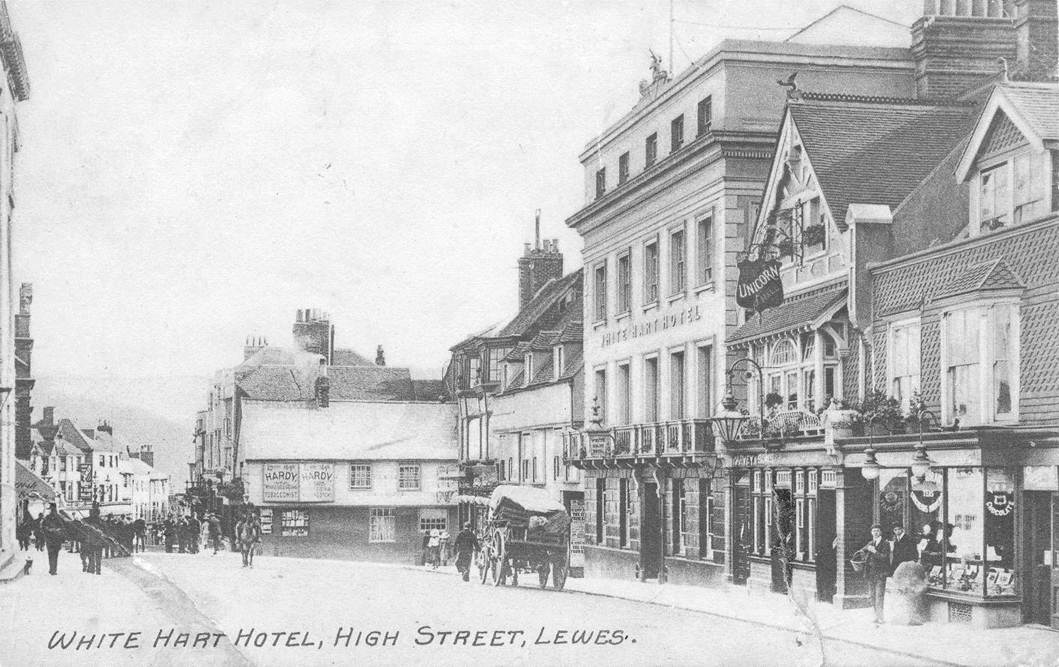
7.  The White Hart & The Unicorn

White Hart Hotel, Lewes

This Edwardian postcard shows The White Hart and its neighbour The Unicorn on a busy shopping day around the turn of the century. Hardy’s tobacconists stands at the top of Station Street.

John Kay

Posted in Economic History, History of Religions, Lewes, Local History, Oral History | Tagged , | Comments Off on Lewes History Group: Bulletin 12, (2 July 2011)

Updated website section: Research Resources

We aim to build a web-based repository of research resources, including our publications, and to provide a gateway to external information sources invaluable to researchers within the Group.

  • Historical maps of Lewes

    A catalogue of locally accessible maps of Lewes, from the 1600s onwards, compiled by a Lewes History Group member.

The link to this new section is in the black bar at the top of each web page, under the photo of the Lewes Castle.

Posted in Lewes, Local History | Tagged , , , , , | Comments Off on Updated website section: Research Resources