Lewes History Group: Bulletin 7, (11 February 2011)

1.   Next meeting on Monday 21 February 2011: Mark Perry-Nash
2.   Malling Brooks from Cliffe Hill
3.   Lewes History Group Organisation
4.   Lewes History Group Accounts, 2010
5.
Lewes Coaching Routes, 1845
6.
Grim Discovery at the Priory
7.   The Friars
8.   Lewes Railway Development

1. Next meeting at 7.30 p.m. on Monday 21 February

This month we shall be meeting on the third Monday of the month, to avoid St Valentine’s Day on the second Monday.  Our Research Group will not be meeting in February.

The speaker at our next meeting will be Mark Perry-Nash, whose title will be “Daily Life in a Medieval Sussex Castle”. Mark is a professional, most entertaining, speaker. As usual the meeting will be held in the King’s Church Building, Brooks Road, and all are welcome.

2. Malling Brooks from Cliffe Hill
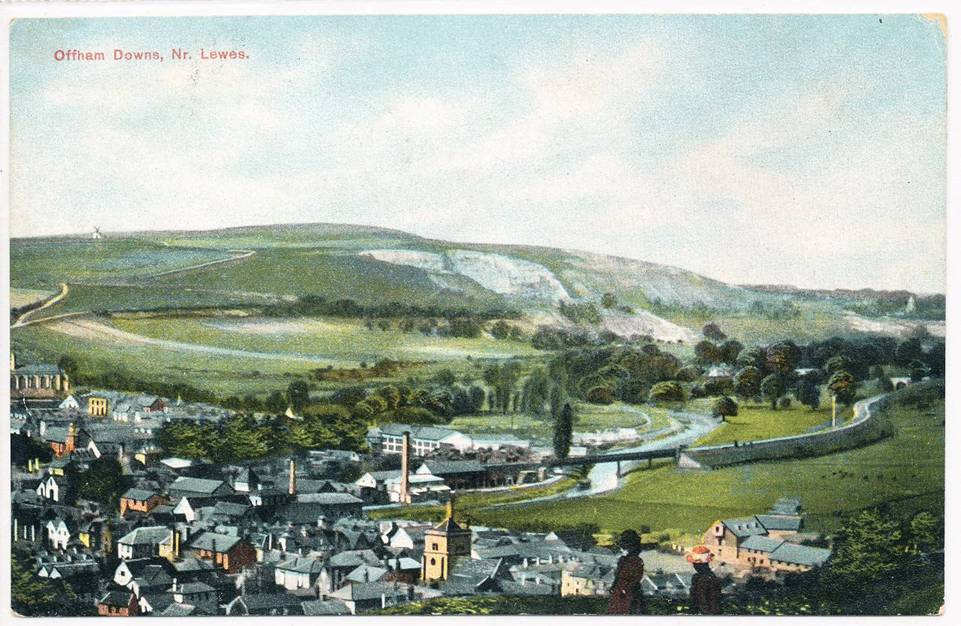


This postcard shows an Edwardian view from Cliffe Hill – with the colour added afterwards in the studio. In the foreground can be seen Cliffe church. Behind the railway from Lewes to Uckfield snakes across Malling Brooks on an embankment, crossing the Ouse near where Tesco is now. Behind the railway is the Phoenix Ironworks. Most of St John-sub-Castro church creeps in on the left edge of the picture. The fields of Landport Farm are below the rural Offham Road. Hill Road branches off from Offham Road, heading for Steere’s windmill on the skyline.


3.  Lewes History Group Organisation

Ian McClelland has kindly agreed to chair our Monday meetings in future. Paul Myles will be deputy chair.

4. Lewes History Group accounts, 2010

Cash brought forward £  297 Payments to speakers £  320
Entry fees £  967 Premises hire & tech help £  580
Coffee, milk, biscuits £    60
Wine & mince pies, Christmas £    34
Website expenses £    16
Microphone batteries £      4
Cash carried forward £  250
Total £1264 Total £1264

5. Lewes Coaching Routes, 1845

Source: Mark Antony Lower, ‘Hand-book for Lewes’ (1845), immediately prior to the railway reached Lewes

“There is a coach to London, leaving Lewes at 10 on Monday, Wednesday and Friday, and arriving at 5 on the alternate days. The Brighton coaches are numerous, thus maintaining an hourly communication between Lewes and the ‘Queen of Watering-places’. Offices, Leney’s, High Street, and Ticehurst’s, High Street. A coach from Brighton to Tunbridge Wells through Lewes, three times a week. A coach daily from Brighton to Hastings, Sundays excepted. A coach from Brighton to East Bourne three times a week. Further particulars would be useless to give, as the arrangements are continually varying.”

6. Grim Discovery at the Priory

Source: Mark Antony Lower, ‘Hand-book for Lewes’ (1845, reissued with additions 1847), describing work on the site of Lewes Priory in creating the new Brighton-Lewes railway line.

“To the eastward of the [Priory] church was the common burial ground of the convent. Upwards of 100 skeletons, deposited in cists slightly made of hewn chalk-stones, were exhumed. The practice of repeated interments in the same ground seems to have been eschewed in this establishment, and hence the cemetery must have been of large extent.


Within a few feet of the eastern end of the church a most singular discovery was made. A circular pit, ten feet in diameter and eighteen feet deep, was found to be filled to above half its depth with human remains. The stench emitted from them was so great that the excavators (certainly none of the most squeamish of beings) ran away from the spot, sick and disgusted. For twenty four hours the hindmost of a train of wagons was constantly occupied with the contents of this horrible subterranean charnel-house. The bones were much crushed and broken. The number of bodies the pit had contained cannot be estimated with much precision; suffice it to say that it must have been many hundreds, and that the bones in the aggregate weighed many tons.


That the unnumbered dead thus summarily buried were the victims of the sword appears likely from the discovery in the pit of an iron spur, part of a bridle iron and a portion of a weapon. That they were among those who fell at the battle of Lewes in 1264 is equally probable.”

7. The Friars

Source: Mark Antony Lower, ‘Hand-book for Lewes’ (1845)

“The Friars is so designated from the site having originally been occupied by a monastery of Grey Friars. The history of this establishment is very obscure; the name of the founder and the extent of its possessions being alike unknown. That it existed prior to the Battle of Lewes is proved by the fact that two of the friars belonging to it were zealously engaged in the good work of composing the differences between the king and the barons. It shared the fate of all similar establishments in the reign of Henry VIII, who granted it to William Heydon and Hugh Stukely. It afterwards passed to the Keynes, and in 1631 belonged to John Shurley. From 1682 to 1803 it was possessed by the family of Pellatt, who alienated it at the latter date to Mr George Verrall. About 20 years since it was purchased by Mr N. Wimble, whose widow lately disposed of it to the Directors of the Brighton, Lewes and Hastings Railway Company. It is feared that ere long it will be pulled down to meet the exigencies of that undertaking.


This was formerly the residence of Sir Ferdinando Poole, Bart [co-founder with Lord Rosebery of the Derby]. The judges have been accommodated here during the assizes for about half a century; and it was here that King William IV and his consort were entertained on the occasion of their visit.”


8. Lewes Railway Development

This information comes from an article by Charles E. Lee published in the January 1950 edition of The Railway Magazine. For a full reference and link to the article see the Lewes bibliography available on leweshistory.org.uk.

There were once six railway lines radiating from Lewes, in date sequence:

Jun 1846         Lewes to Brighton
Jun 1846         Lewes to St Leonards (later extended to Hastings)
Oct 1847         Lewes to Keymer junction
Dec 1847        Lewes to Newhaven (1864 extended to Seaford)
Oct 1858         Lewes to Uckfield (1868 new route out of Lewes)
Aug 1882         Lewes to East Grinstead (Bluebell Railway)
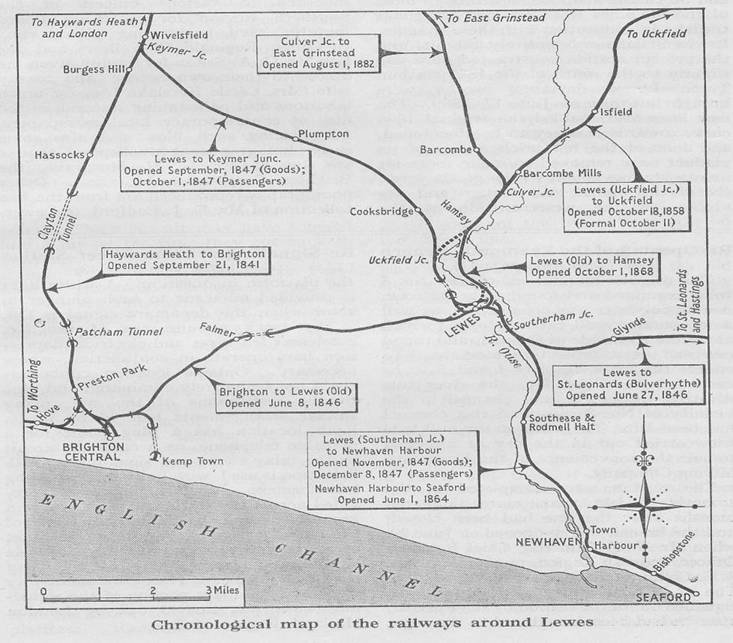
Map of railways around Lewes

The first Railway station was in Friars Walk, with separate platforms for through trains to Hastings nearby at Pinwell. A separate halt was built below Lansdown Place, to serve Southover. This arrangement was never satisfactory, so in 1857 a new station was built at the bottom of St Mary’s Lane (Station Street) and the old stations were converted to goods traffic.

The Friars, Lewes

The Friars, built c.1673, demolished 1846


Old Railway Station, Lewes

The Old Railway Station, Friars Walk, built 1846, demolished 1960s

Drawings by John Houghton, in ‘A Look at Lewes’ (1998)


Station arrangements at Lewes, 1847-1857

Lewes Station arrangements 1847-1857

The new station itself was still inadequate, and in 1889 there was another major reorganisation. The 1857 station was completely rebuilt as the present Lewes station, and the Hastings and Uckfield lines were re-aligned. The main changes since then have been confined to changes in platform length and closures affecting the routes to Uckfield and East Grinstead, allowing the demolition of the bridge across the High Street and removal of the embankment across South Malling brooks. The railway cutting between Old Malling Farm and the Malling Estate remains.

Station arrangements at Lewes, 1857-1950
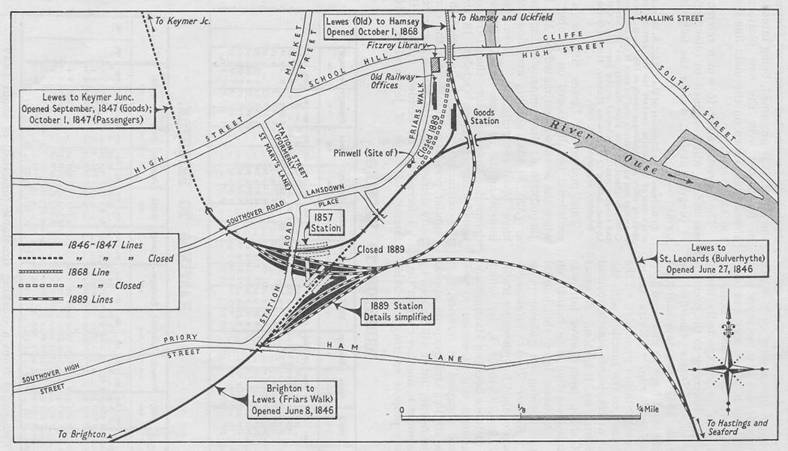
Lewes Station arrangements 1857-1950

John Kay

Posted in Lewes, Local History, Social History, Transport History, Uncategorized | Tagged , , , , , , , , , , | Comments Off on Lewes History Group: Bulletin 7, (11 February 2011)

Meeting – Monday 21 February, 7:30pm [Programme change]

John Kay: Settlement Records in Lewes Parish Chests

Under the Old Poor Law everyone was settled in a particular parish, in the same way that today we are citizens of a particular country. You might be allowed to live outside your “home” parish, but if you fell on hard times it was that parish’s responsibility to look after you. You were liable to be deported back “home” to receive this care – though “home” might be somewhere you had left decades previously, or sometimes never lived at all.

Parishes were proactive in trying to prevent the poor belonging to another parish gaining a settlement, and in exporting their own poor elsewhere. Lawsuits and appeals between parishes were commonplace. Sometimes the results were hilarious; the situations in which other people found themselves make your heart ache, even across the centuries.

Many parish chests, including some Lewes parish chests, still contain records created in the operation of this system. Where they survive, they offer unparalleled insight into the lives of ordinary or unfortunate Lewesians two or more centuries ago, and in their aggregate they offer an important insight into late Stuart & Georgian society.

This talk is a programme change from:

Mark Perry-Nash: Daily Life in a Medieval Sussex Castle

Venue: The new King’s Church building on Brooks Road, Lewes. (Between Tesco car park and Homebase)

See the Meetings page for a list of  forthcoming monthly talks organised by the Lewes History Group.

Posted in Lewes, Local History, Social History | Tagged | Comments Off on Meeting – Monday 21 February, 7:30pm [Programme change]

Lewes History Group: Bulletin 6, (6 January 2011)

1.   Next meeting on Monday 10 January: Debby Matthews, ‘A tour around Gideon Mantell’s Lewes’
2.   Lewes Floods of 1911
3.   Godlee’s Quaker School, 1826
4.   Elizabeth Ollive’s School, 1769
5.   Life in Lewes Jail in 1824
6.   North Street before its reconstruction by the Luftwaffe
7    Cliffe Fair update
8.   Add a friend or unsubscribe
9.   February meeting date


1. Next meeting on Monday 10 January

The speaker at our next meeting will be Debby Matthews, who will give an illustrated talk entitled ‘A tour around Gideon Mantell’s Lewes’, based on Mantell’s original guide-book to Lewes. Mantell’s book was in turn based on a visit back to his home town in 1846. He describes the town as it was during his childhood in the 1790s, and as it developed during the years in which he practised medicine at Castle Place. Mantell grew up in St Mary’s Lane [now Station Street], and Debby now lives in the house in which he was born. Debby has many other roles in Lewes, including Director of the South Downs Council for Voluntary Service, newsletter editor for the South Street Bonfire Society, a town tour leader, member of the Oyster Project team and presenter on Rocket FM.

As usual the meeting will be held in the King’s Church Building, Brooks Road, and all are welcome.


2. Lewes Floods of 1911

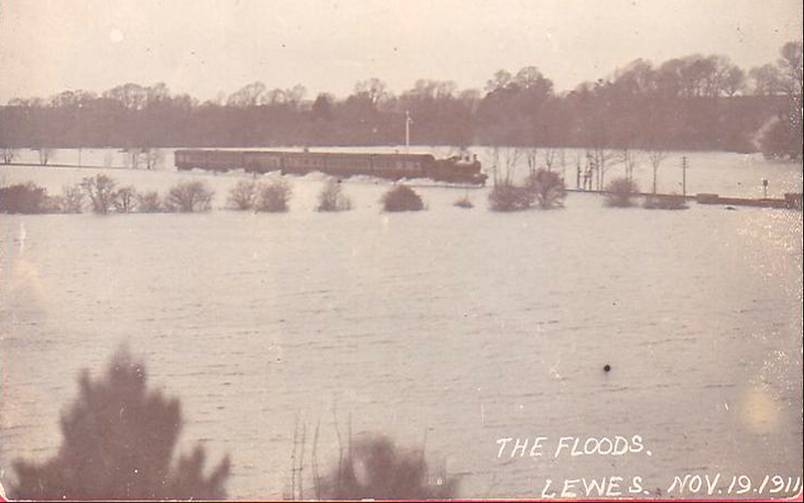
Flooding at Malling Brooks 1911This postcard, offered for sale last year on ebay, shows a steam engine creating a substantial bow wave as it pulls a train across the flooded Malling Brooks. Would today’s electrified railway service prove so resilient? Silly question!


3. Godlee’s Quaker School, 1826

Nearly two centuries ago the elegant Dial House in the pedestrian precinct was a Quaker school for young ladies. The Quaker businessman John Godlee had four daughters, and when in 1826 a friend died, Godlee’s wife suggested that the friend’s two motherless children should be taken in and educated by her daughters. The school grew from this small beginning to have 20 pupils.

Quaker education was thorough, encompassing reading aloud, an emphasis on correct spelling and writing in a good clear hand. The syllabus included geography, grammar and of course scripture, with enough French to be able to read a book and some Latin. Hymns and poems were committed to memory. Excellent needlework was considered important, and the girls made garments for the poor. The Friends did not approve of music, so that was not taught, but painting was an admired accomplishment.

The girls were a visible presence in the town, walking two by two from the school and along Friars Walk for meditation and worship at the Friends Meeting House.

Sources: The July 1934 ‘Sussex County Magazine’ and John Eccles’ column in the 2 Oct 2009 Sussex Express.


4. Elizabeth Ollive’s School, 1769

In his recent article on Tom Paine in Lewes, Colin Brent noted in passing that in January 1769 Elizabeth Ollive had advertised the opening of a new school for young ladies in Lewes High Street. Elizabeth Ollive had been born in 1749, so was herself still a minor at this time, but she did have some experience – she had previously taught in Miss Ridge’s school. The Ridges were at this date the principal family supporting the Westgate Chapel, and the Ollives also attended Westgate, immediately adjoining their shop. The new school was perhaps intended to replace Miss Ridge’s school, which had closed on her retirement.

This new venture was short-lived. Six months later Elizabeth Ollive’s father died, and she took over his shop, in partnership with Thomas Paine. In 1771 the couple were married.

Source: Colin Brent, Sussex Archaeological Collections vol.147, p.154. (See Lewes History Group Bibliography for more details)


5. Life in Lewes Jail in 1824

This account comes from the Rev Thomas Walker Horsfield, minister of Westgate Chapel. The jail he is describing is the one on North Street, built in 1793 and extended to 70 cells in 1817.

“The keeper’s apartments and culinary offices form the central part of the building, over which is a convenient chapel, where service is performed every week by the Rev W. Gwynne, the chaplain to the prison. The male and female prisoners are separated from each other by a lofty partition during the hours of divine service. Above the chapel are two rooms appropriated to the sick prisoners, and in which they are enabled to benefit by the instructions of the chaplain without leaving their apartments. The southern wing of the prison is devoted to the male prisoners; and the northern wing is appropriated to the females.”

“The whole building comprehends 70 cells; twenty six of which are in the newly erected part. Fourteen of the cells are solitary. Each cell is nine feet long and seven feet in width, and about eleven feet high, and has in one corner a branch of water and in the other a close-stool. The mattress of the bed is composed of straw, which is changed as often as is requisite to preserve the health of the prisoners.”

The prisoners are divided into ten classes, five male and five female. For each class is a day-room, in which the inmates assemble to their meals, and a fire is allowed. The classes are: 1st, prisoners committed of felony; 2nd, prisoners convicted of misdemeanours; 3rd, prisoners committed on charge or suspicion of felony; 4th, prisoners committed on charge or suspicion of misdemeanours; 5th, vagrants. The following rules relate to the classification of prisoners in regard to their meals and treatment.”

“The prisoners are divided into three classes. The first class consists of felons convict, or convicts for fraudulent misdemeanours, during the first two months of their confinement, and until reported by the gaoler to the visiting magistrates as having behaved orderly and regularly; refractory servants and apprentices; idle and disorderly persons; refractory paupers in workhouses; fathers of bastards, committed for punishment for disobedience of orders; persons running away and leaving their families to the parish; vagrants; mothers of bastards committed for punishment; prisoners of any description, having attempted to escape or otherwise misbehaved themselves while in custody, during such time as any one or more of the visiting magistrates shall direct.”

“The second class consists of felons convict, or convicts for fraudulent misdemeanours, after two months confinement, and having been reported as aforesaid; all other prisoners committed to hard labour, under the provisions of any statute, whether absolutely for a certain period, or for a certain period, unless some penalty be sooner paid (and not included in the description of class 1). The third class includes all other prisoners not included in either of the above descriptions.”

“Each class of prisoners has a separate airing-yard, in which they are permitted to take exercise at all hours of the day; but no game of any kind is allowed.”

“Every prisoner of the first class is allowed two pounds of bread daily, and no other provisions except Sundays, when the allowance is one pint of soup and one pound and a half of bread.”

“Every prisoner of classes 2 and 3 is allowed one pound and a half of bread, and one pint of soup daily; and all prisoners of classes 1 and 2 are strictly confined to the gaol allowance, and are not suffered to purchase, have or receive any articles of provision whatsoever, except by the direction of the surgeon, or a visiting magistrate. But the prisoners of class 3 are permitted to purchase, or receive from their friends, any article of dressed provision; but no cooking is allowed in their rooms, nor any spirituous liquors, or fermented liquors except small beer, is allowed to be brought into the gaol, on any pretence whatsoever.”

“The visiting magistrates are authorised to direct such extra allowance to prisoners of the first and second class, sentenced to hard labour, during such time as they are actually employed in work requiring extraordinary bodily exertion, as may appear necessary to enable them to perform it without injury to their health. The soup provided for the prisoners is made with three ounces of meat to the pint or mess, with a proper proportion of vegetables.”

“All prisoners of class 1 and 2 are compelled to wear the gaol dress (but the same in cases of vagrants may be dispensed with at discretion, and in other special cases may likewise be dispensed with by order of a visiting magistrate) and not permitted to retain by them any clothes, or any money, or other article of value; but all articles are retained by the gaoler, and re-delivered to the prisoner when discharged, together with a share of his or her earnings, viz, one half thereof, if committed to hard labour, and two thirds thereof if not so committed, and employed in any profitable work or employment; prisoners not within those classes, and employed in any kind of work, do, in like manner, receive two thirds of their net earnings; provided that the share of earnings of any prisoner committed for deserting his wife and family, or so much thereof as may be necessary to indemnify the parish for any expense incurred in their maintenance in consequence of such desertion, is paid to the officers of the parish who shall have maintained such family, and the residue (if any) to the prisoner himself; the gaoler is especially directed to keep an account of all such earnings, to be exhibited to prisoners at the time of their respective discharges, and likewise to the visiting magistrate from time to time, as required.”

“Prisoners more closely confined, or punished for misconduct by the keeper, are reported to a visiting magistrate within 24 hours, who gives such direction thereon as he thinks proper.”

Horsfield notes the numbers of prisoners admitted each year from 1815 (305) to 1823 (675). There seems a steady upward trend, though the highest total was 830 for 1821. He notes that a treadmill had been installed in 1822, which required 18 men to operate it. “The males only are doomed to labour at this machine; the female prisoners being employed in a variety of domestic operations.”

He notes that, compared with former times, and with some contemporary prisons, the discipline of the prison was excellent. He ascribed this to the gaoler, Mr Jones, who united affability and benevolence with firmness of decision and character. Horsfield thought it might be even better if the interactions between prisoners, allowed under existing regulations, were done away with. “Good cannot be expected to result from a communion of vicious characters. They necessarily corrupt each other by association.” Horsfield, who was of course minister of Westgate Chapel, also recorded that three years previously some benevolent ladies had proposed forming a society to visit the female prisoners, instructing them in needlework and other domestic duties and teaching them to read the scriptures. However, this proposal had come to nothing, “because the doctrines of the Church of England were not to be exclusively impressed on the prisoners “.

Source Horsfield (1824) vol.1, pp.218-9. Full reference in the bibliography on leweshistory.org.uk


6. North Street before its reconstruction by the Luftwaffe

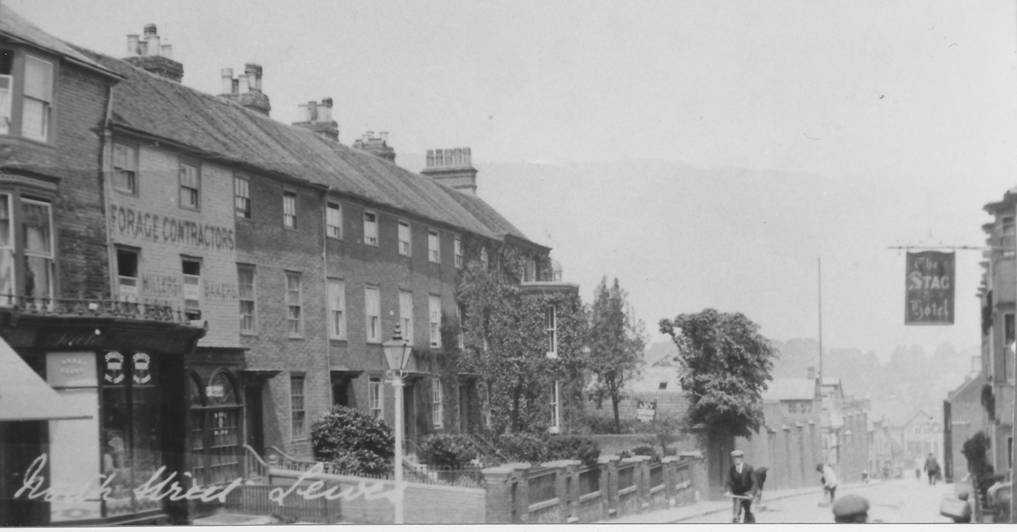
North Street, Lewes, pre-World War IIThis postcard shows the pre-war view down North Street, with the Stag Hotel sign on the right.

The shop on the far left survives, but the terrace beyond had to be demolished after the German bombing raid. The telephone exchange and the new police station now occupy the space. Beyond these houses is part of the 1793 prison, at this date taken over by the Royal Navy. The fire station can just be made out at the end of North Street.


7. Cliffe Fair update (from Ron Newth)

Re Cliffe Fair (Bulletin no.5). I have had the privilege of reading the Charter at the fairs still held every year at Cliffe Church.


8. Add a friend or unsubscribe

To add a friend to this email distribution list, please send their email address back to me. To unsubscribe from this list, please reply to this email, changing the email title to ‘Unsubscribe’.


9. February Meeting

Please remember that next month’s meeting will be on the 3rd Monday, rather than our usual date. This is to avoid a clash with Valentine’s Day. There will be no research group meeting in February.

For our full 2011 programme see Meetings page.

John Kay

Posted in Education History, Legal History, Lewes, Local History, Social History | Tagged , , , , , , , , , | Comments Off on Lewes History Group: Bulletin 6, (6 January 2011)